
Next Generation Centrifuge Market Size and Share
Market Overview
| Study Period | 2020 - 2031 |
|---|---|
| Market Size (2026) | USD 1.54 Billion |
| Market Size (2031) | USD 2.10 Billion |
| Growth Rate (2026 - 2031) | 6.40 % |
| Fastest Growing Market | Asia-Pacific |
| Largest Market | North America |
| Market Concentration | Medium |
Major Players *Disclaimer: Major Players sorted in no particular order Image © Mordor Intelligence. Reuse requires attribution under CC BY 4.0. | |
Next Generation Centrifuge Market Analysis by Mordor Intelligence
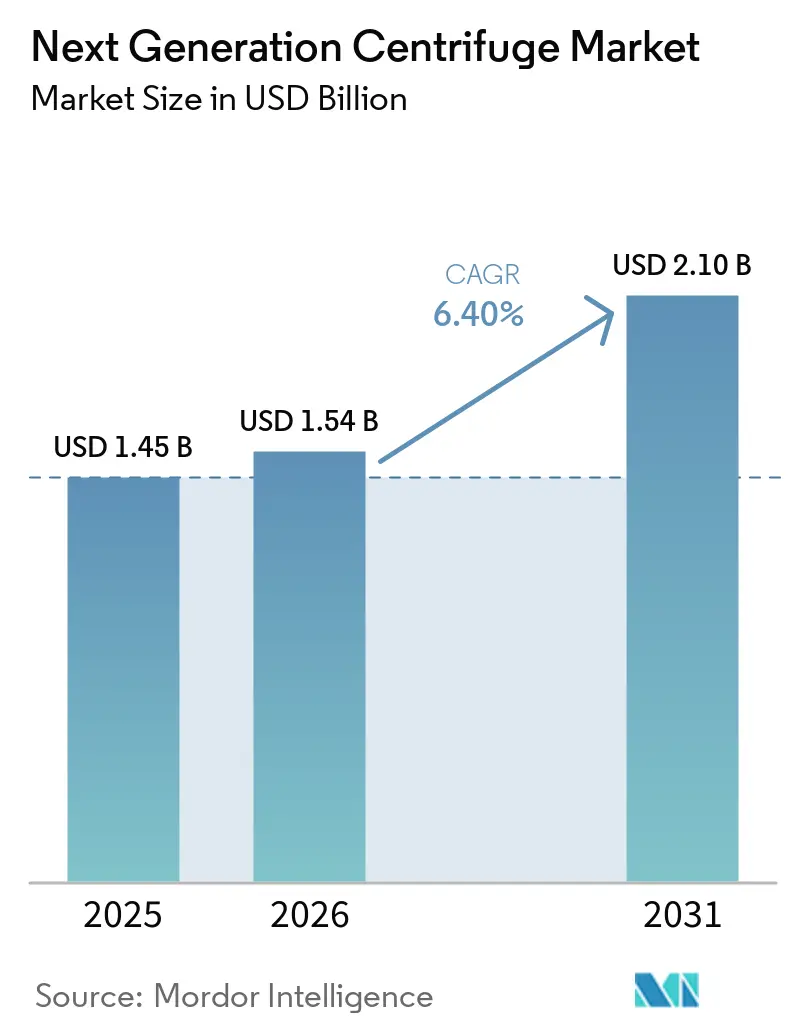
The Next Generation Centrifuge Market size was valued at USD 1.45 billion in 2025 and is estimated to grow from USD 1.54 billion in 2026 to reach USD 2.10 billion by 2031, at a CAGR of 6.40% during the forecast period (2026-2031).
Cell and gene therapy manufacturing is increasing demand for closed, GMP-validated centrifugation at several production stages. Molecular diagnostics, microfluidics, and omics workflows are extending centrifugation beyond traditional standalone laboratory instruments. Refrigerant requirements in Europe and North America are also supporting replacement purchases of compliant systems.
Key Report Takeaways
- By product type, equipment held 76.12% of the Next Generation Centrifuge Market share in 2025, while accessories and consumables are projected to grow at a 9.22% CAGR through 2031.
- By model type, benchtop centrifuges accounted for 61.30% of the Next Generation Centrifuge Market share in 2025, while floor-standing centrifuges are projected to expand at an 8.67% CAGR through 2031.
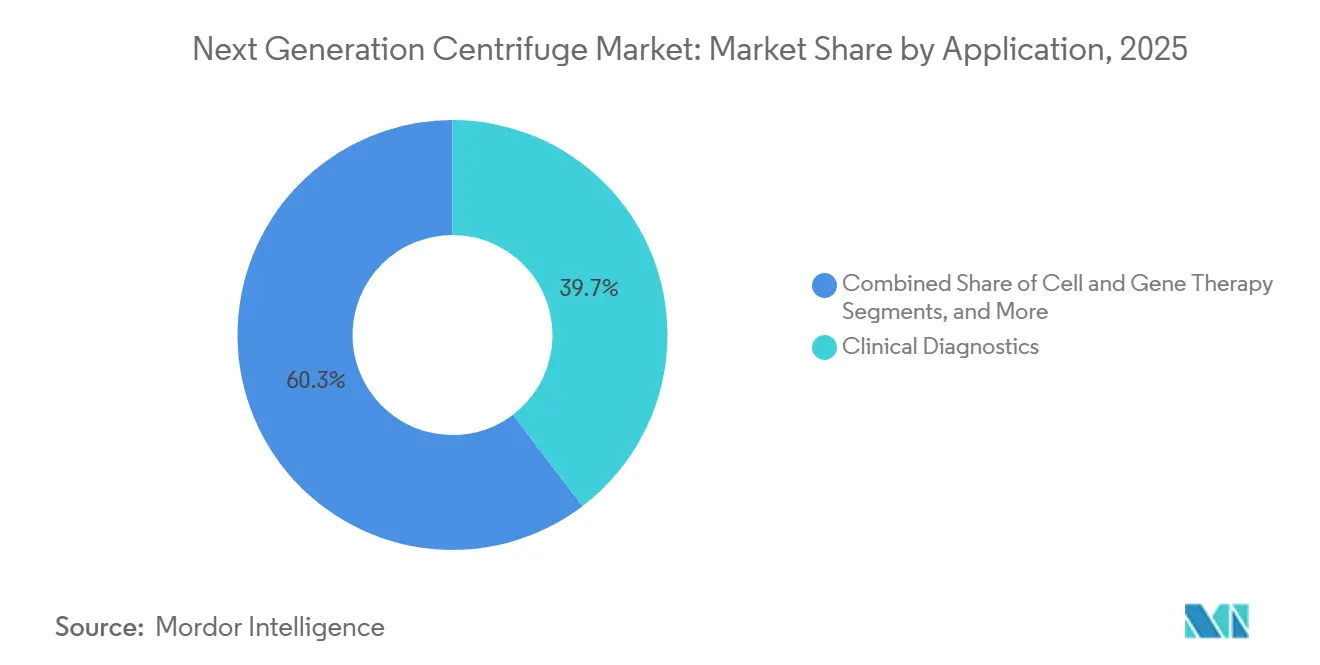
- By application, clinical diagnostics held 39.67% of the Next Generation Centrifuge Market share in 2025, while cell and gene therapy is projected to advance at a 9.78% CAGR through 2031.
- By end user, hospitals and diagnostic laboratories represented 46.75% of the Next Generation Centrifuge Market share in 2025, while biotechnology and pharmaceutical companies are expected to grow at a 10.45% CAGR through 2031.
- By geography, North America held 38.10% of the Next Generation Centrifuge Market share in 2025, while Asia-Pacific is forecast to grow at an 8.95% CAGR through 2031
Note: Market size and forecast figures in this report are generated using Mordor Intelligence’s proprietary estimation framework, updated with the latest available data and insights as of January 2026.
Global Next Generation Centrifuge Market Trends and Insights
Drivers Impact Analysis*
| DRIVER | (~) % IMPACT ON CAGR FORECAST | GEOGRAPHIC RELEVANCE | IMPACT TIMELINE |
|---|---|---|---|
| Expansion of cell and gene therapy manufacturing | +1.5% | Global, concentrated in North America, Europe, and East Asia | Long term (≥ 4 years) |
| Growth of high-throughput molecular diagnostics and omics workflows | +1.2% | Global, led by North America and the Asia-Pacific | Medium term (2-4 years) |
| Adoption of automated, connected, and traceable laboratory workflows | +1.0% | North America and Europe as early adopters, Asia-Pacific during scale-up | Medium term (2-4 years) |
| Increasing use of closed and single-use separation systems in bioprocessing | +0.9% | Global, with the strongest demand from North American and European CDMOs | Medium term (2-4 years) |
| Expansion of biopharmaceutical and contract manufacturing capacity in Asia-Pacific | +0.8% | Asia-Pacific, with spillover to the Middle East and Africa | Long term (≥ 4 years) |
| Demand for energy-efficient refrigeration and advanced rotor platforms | +0.6% | North America and Europe, because of regulation, Asia-Pacific, because of procurement preferences | Short term (≤ 2 years) |
| Source: Mordor Intelligence | |||
Expansion of Cell and Gene Therapy Manufacturing
Cell and gene therapy manufacturing has transformed centrifugation from a routine laboratory activity into a controlled production process. Cell isolation, density-gradient fractionation, spinoculation, post-transduction washing, and final formulation require defined centrifuge settings under GMP controls. A 2025 study reported transduction efficiency of 83.4% using an automated closed-system centrifuge, compared with 72.8% for conventional bag centrifugation and 35.7% for static incubation.[1] These performance differences can affect yield and batch acceptance at commercial scale, supporting demand in the next-generation centrifuge market for systems with validated parameters, electronic records, and closed tubing connections.
Growth of High-Throughput Molecular Diagnostics and Omics Workflows
Centrifugal microfluidics is expanding the application of centrifugation in diagnostic workflows. A single drive unit can perform fluid movement, separation, and mixing across more than 30 sample wells, reducing manual pipetting in complex processes. A 2025 study described a centrifugal microfluidic chip that integrated 30-plex nucleic acid purification and ELISA on a single lab-on-disc platform. This integration supports demand for compatible drive systems and diagnostic cartridges in the next-generation centrifuge market.[2]
Adoption of Automated, Connected, and Traceable Laboratory Workflows
Laboratory automation is changing centrifuge selection criteria in high-volume settings. Buyers increasingly require serial communication, programmable rotor positioning, rapid lid cycles, and LIMS connectivity to integrate centrifuges into automated laboratory cells. Automation-ready systems reduce manual handoffs and strengthen workflow traceability. As a result, the Next Generation Centrifuge Market is shifting toward connected platforms rather than standalone instruments. Regulated laboratories require electronic audit trails and traceable component identification to meet FDA 21 CFR Part 11 and EU Annex 11 requirements. Eppendorf introduced the SpinPro 6R in March 2026, featuring CO2-based ACT 2.0 cooling, RFID rotor recognition, LIMS connectivity, and QuickLock Pro lids. These capabilities support documented workflows across pharmaceutical, biotechnology, and research applications. Validated connectivity can also reduce competition from the refurbished equipment channel, as regulated buyers prioritize compliance over lower acquisition costs.
Increasing Use of Closed and Single-Use Separation Systems in Bioprocessing
Single-use centrifuge systems eliminate cleaning-in-place and sterilization-in-place requirements between production runs. In biopharmaceutical manufacturing, these activities previously required 6 to 12 hours of downtime. Eliminating these steps improves primary clarification productivity and reduces turnaround time. GEA introduced the kytero 10 in 2025 as a single-use disk-stack centrifuge for 1 to 10-liter cell harvesting, supporting continuous perfusion processes in cell and gene therapy and alternative protein production.
A 2025 evaluation assessed a single-use disk-stack centrifuge for monoclonal antibody harvest at scales of up to 5,000 liters. The study found product quality comparable to conventional stainless-steel centrifuges across SE-HPLC, icIEF, HCP, and rDNA profiles, along with improved turbidity and LDH reduction. These findings validate the technology for commercial-scale monoclonal antibody manufacturing.[3] Single-use systems also increase demand for accessories and consumable assemblies, placing pressure on conventional equipment suppliers as buyers adopt disposable-centered operating models.
Restraints Impact Analysis*
| RESTRAINT | (~) % IMPACT ON CAGR FORECAST | GEOGRAPHIC RELEVANCE | IMPACT TIMELINE |
|---|---|---|---|
| High capital cost and total cost of ownership | -0.9% | Global, most pronounced in emerging markets and small laboratories | Medium term (2-4 years) |
| Long replacement cycles and availability of refurbished equipment | -0.6% | North America and Europe, where the installed base is mature and dense | Long term (≥ 4 years) |
| Shortage of qualified service engineers and centrifugation specialists | -0.4% | Global, particularly acute in Asia-Pacific and the Middle East and Africa | Medium term (2-4 years) |
| Validation, biosafety, and rotor-integrity requirements | -0.4% | North America and Europe in GMP-regulated environments | Short term (≤ 2 years) |
| Source: Mordor Intelligence | |||
High Capital Cost and Total Cost of Ownership
Advanced floor-standing centrifuges for GMP bioprocessing require acquisition costs ranging from USD 80,000 to more than USD 300,000. Over a 10-year operating life, rotor replacements, preventive maintenance, recertification, validated consumable kits, and energy consumption can raise total ownership costs to more than three times the list price. These high costs limit equipment upgrades among smaller laboratories and emerging organizations.
Large CDMOs and pharmaceutical manufacturers can absorb these expenses more readily, while academic spinouts and early-stage cell therapy developers may retain existing equipment longer. Qualification and process validation add further costs, as IQ, OQ, and PQ documentation for a GMP-grade installation can require three to six months of engineering work. Cost-sensitive buyers may select certified pre-owned systems, available at 30-50% of new-instrument prices, for standard separation requirements.
Long Replacement Cycles and Availability of Refurbished Equipment
A well-maintained laboratory centrifuge typically has an operational life of 8-12 years, limiting annual demand for new equipment in North America and Western Europe, where installed bases are dense. Authorized repair networks further extend equipment life. Certified pre-owned systems, resold with calibration certificates, updated operating software, and rotor-integrity documentation, compete directly with new instruments in academic, clinical, and early-stage pharmaceutical settings.
Third-party brokers, rather than manufacturer distributors, often operate the refurbished equipment channel, making its impact less visible in manufacturer sales reporting and win-loss reviews. Users may also wait for full asset depreciation before replacing equipment, slowing technology transitions across installed bases. This can delay the adoption of natural-refrigerant platforms, despite their compliance and energy-efficiency benefits.
*Our forecasts treat driver/restraint impacts as directional, not additive. The impact forecasts reflect baseline growth, mix effects, and variable interactions.
Segment Analysis
By Product Type: Consumables Growth Is Reshaping the Revenue Mix
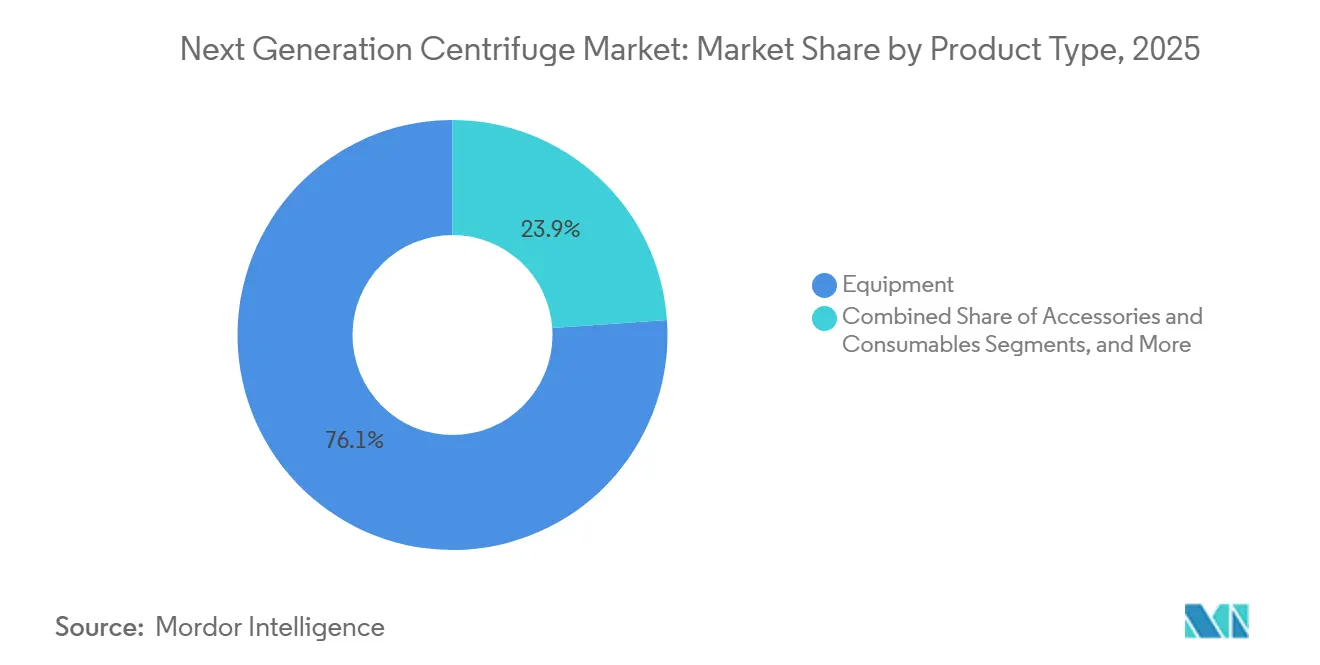
Equipment is projected to account for 76.12% of the Next Generation Centrifuge Market in 2025. Purchases of clinical-grade and GMP-certified systems by hospitals, CDMOs, and pharmaceutical companies support this position. Both floor-standing and benchtop formats contribute to equipment revenue. Service and lifecycle support are also becoming increasingly important as suppliers offer multiyear service contracts. These contracts generate recurring revenue and help suppliers retain key accounts, resembling the reagent-rental models used in in-vitro diagnostics.
Accessories and consumables are forecast to grow at a CAGR of 9.22% through 2031. Single-use separation sets, validated tubeset assemblies, and RFID-chipped rotor adapters often require replacement after each production batch, helping prevent cross-contamination in cell therapy cleanrooms. Instant Systems' CentriLoc cell therapy tubes provide an example of validated tubeset assemblies. In high-utilization GMP operations, consumables revenue can exceed the initial equipment purchase. Suppliers are therefore competing through validated consumables ecosystems in addition to instrument performance.

By Model: Floor-Standing Centrifuge Demand Follows Bioprocessing Scale-Up
Benchtop centrifuges are projected to hold 61.30% of the Next Generation Centrifuge Market in 2025. Their position reflects widespread use across clinical laboratories, research institutes, and biotechnology discovery operations. Footprint, versatility, and lower upfront costs remain key selection criteria. In 2025, Haier Biomedical is expected to launch the LX-155T750R, a 3-liter refrigerated system that reaches speeds of 15,500 rpm and 26,322 × g for molecular biology, clinical research, and biobanking workflows.
Floor-standing centrifuges are forecast to grow at a CAGR of 8.67% through 2031, driven by the shift toward larger-scale, continuous-duty separation in commercial bioprocessing. In April 2025, Thermo Fisher is expected to launch the BIOS A and 16 centrifuges featuring GreenCool Technology. The company reports that the systems will have a global warming potential of 1 and consume 15% less energy than the preceding systems. Ultracentrifuges and microcentrifuges remain specialized categories for virology, nanoparticle characterization, and subcellular fractionation applications requiring speeds above 100,000 × g.
By Application: Diagnostics Supports Volume While Cell Therapy Drives Premium Demand
Clinical diagnostics are projected to account for 39.67% of the Next Generation Centrifuge Market in 2025. Hospital networks and commercial reference laboratories support this volume through serum separation, urinalysis, blood processing, and nucleic acid extraction. These workflows are high frequency and generally non-discretionary. Biotechnology and pharmaceutical research represent the second-largest application segment, encompassing plasmid DNA preparation, exosome isolation, viral vector purification, and protein fractionation. These applications require programmable g-force profiles and controlled temperatures over extended run times.
Cell and gene therapy is forecast to grow at a CAGR of 9.78% through 2031. GMP-certified systems with closed tubing, electronic audit trails, and spinoculation capabilities can command premium prices in this application. Blood component separation and bioprocessing continue to support demand from transfusion centers and bioreactor harvest operations. Although validated equipment configurations can slow replacement cycles, they sustain consumables attachment rates.
By End User: Biotechnology and Pharmaceutical Companies Support the Premium Tier
Hospitals and diagnostic laboratories represented 46.75% of the Next Generation Centrifuge Market share in 2025, supported by routine clinical centrifugation requirements and high sample volumes. Academic and research institutes remain important end users, although grant-funded purchasing and shared-equipment models can slow replacement cycles. Blood banks and transfusion centers require ergonomic, traceable blood-bag centrifuges.
Biotechnology and pharmaceutical companies are forecast to grow at a 10.45% CAGR through 2031. Commercial-stage cell therapy manufacturers are bringing separation workflows in-house to maintain per-batch quality control, supporting demand for automation-compatible and LIMS-connected systems. Samsung Biologics secured a USD 262 million manufacturing contract in 2026 and is expanding its Songdo campus from 180,000 liters to 720,000 liters by 2032, requiring centrifuge fleets for clarification, washing, and formulation.
Geography Analysis
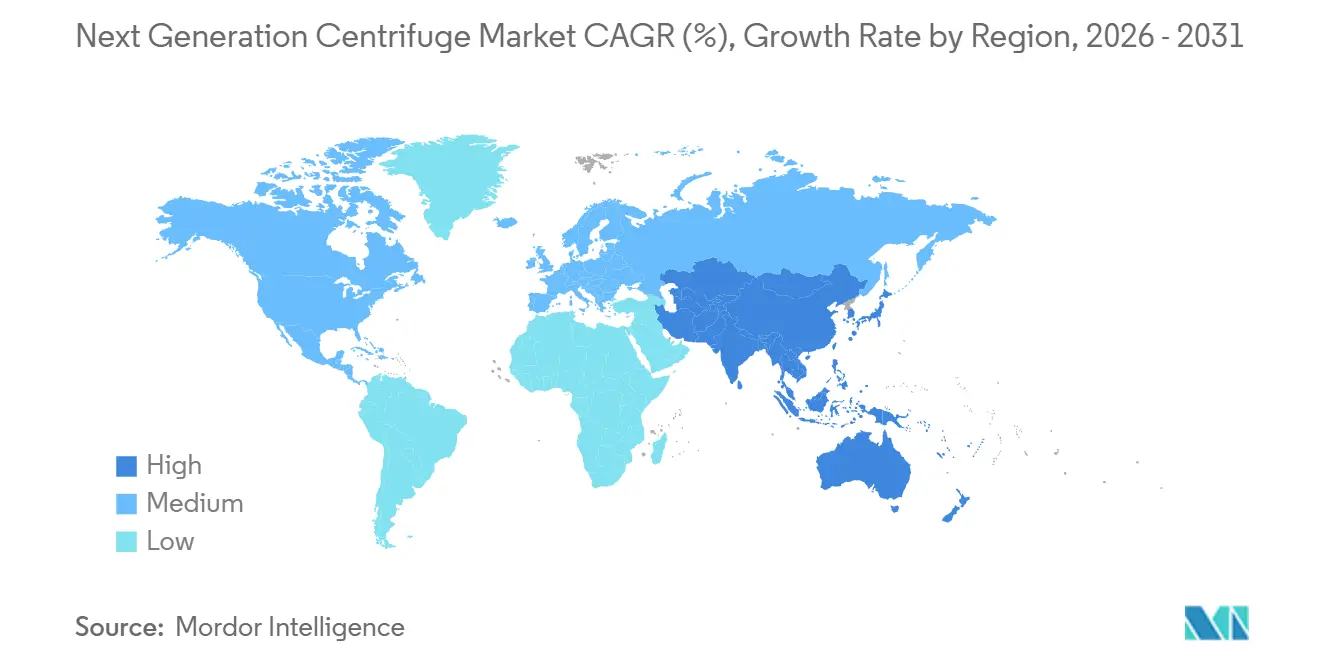
North America is projected to hold a 38.10% share of the Next Generation Centrifuge Market in 2025. The United States has a large regulated base of approved cell and gene therapies, supported by hospitals, reference laboratories, and biopharmaceutical networks. Canada is expanding biomanufacturing capacity, while Mexico is strengthening clinical diagnostics and pharmaceutical manufacturing capabilities.
North American growth through 2031 is forecast to remain steady, supported by compliance-driven replacements and cell therapy investments. In Europe, Regulation (EU) 2024/573 is driving equipment replacement as quota reductions for high-global-warming-potential refrigerants begin in 2025. Thermo Fisher Scientific introduced the Cryofuge, BIOS, and LYNX lines to meet EU F-gas and U.S. EPA SNAP requirements, with Germany, the United Kingdom, and France leading demand.
Asia-Pacific is forecast to record an 8.95% CAGR through 2031, the highest among regional markets. China, South Korea, Japan, and India are expanding biopharmaceutical capacity, while AGC Biologics has a commercial agreement for production at its Yokohama site. TheraNym Biologics announced a USD 150-175 million investment in a mammalian cell culture biologic drug substance facility for Merck. The Middle East and Africa and South America continue to benefit from healthcare investment, regulatory modernization, laboratory consolidation, and biopharmaceutical activity.
Competitive Landscape
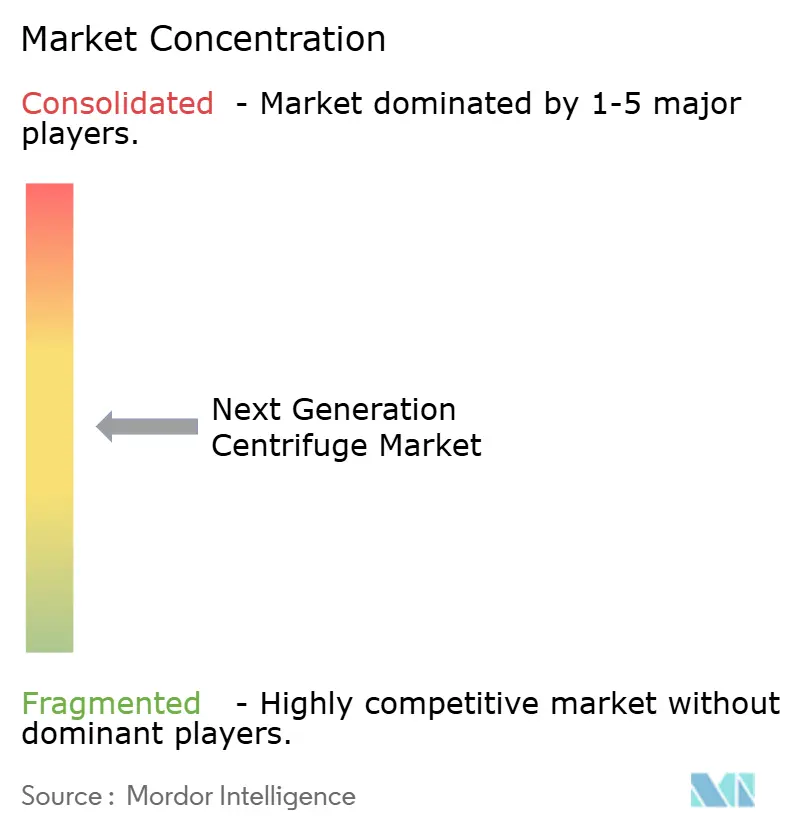
The Next Generation Centrifuge Market has moderate concentration, with Thermo Fisher Scientific and Eppendorf SE holding leading positions through broad portfolios and frequent product development. Between April 2025 and August 2026, Thermo Fisher Scientific introduced the Cryofuge, BIOS, LYNX, X and S Series, M Series, and X2 and S2 Series, completing its portfolio of refrigerated centrifuges with natural-refrigerant cooling systems compliant with EU F-gas and U.S. EPA SNAP requirements. These launches address replacement demand across clinical, bioprocessing, blood banking, and general laboratory applications.
Eppendorf launched the SpinPro 6R in March 2026 with RFID rotor recognition, CO2-based cooling, LIMS documentation, and QuickLock Pro lids. It later launched the Centrifuge 5811 R in September 2026, maintaining compatibility with 16 of 17 existing 5810 R rotors. This strategy supports installed-base relationships, reduces switching costs, and reinforces differentiation through workflow integration, documentation, refrigeration, and specialized rotor capabilities.
Specialist suppliers serve applications that larger suppliers do not fully address. GEA's kytero 10 supports alternative protein and small-volume cell therapy applications at 1-10 liters, while GEA CARR Biosystems acquired Alfa Wassermann in August 2026 to expand virus and fine-particle purification capabilities through single-use centrifuge solutions. The market continues to have gaps in integrated closed-system cell therapy platforms, predictive rotor maintenance, and compact cartridge-drive units for decentralized molecular diagnostics. No company in the supplied research offers a complete solution across all three areas, supporting the market's moderate concentration.
Next Generation Centrifuge Industry Leaders
-
Agilent Technologies, Inc.
-
Eppendorf SE
-
Thermo Fisher Scientific Inc.
-
QIAGEN N.V.
-
NuAire, Inc.
- *Disclaimer: Major Players sorted in no particular order
Recent Industry Developments
- August 2026: Thermo Fisher Scientific introduced the Thermo Scientific X2 and S2 Series general-purpose centrifuges with GreenCool Technology and a global warming potential of 3. The portfolio was the first full range of refrigerated centrifuges using natural-refrigerant cooling compliant with EU and U.S. EPA F-gas requirements.
- April 2025: Thermo Fisher Scientific launched the Cryofuge, BIOS, and LYNX floor-model centrifuge lines with natural-refrigerant cooling. The platforms reduced energy consumption by 14%, 15%, and 13%, respectively.
- March 2025: GEA Group introduced the kytero 10 for 1–10-liter cell harvesting in biopharmaceutical, cell and gene therapy, and alternative protein applications. The single-use disk-stack centrifuge eliminated CIP and SIP requirements and supported low-shear hermetic separation.
Global Next Generation Centrifuge Market Report Scope
As per the scope of the report, a next-generation centrifuge refers to a highly modernized laboratory or industrial instrument that uses advanced microprocessor control, smart digital connectivity, and sustainable engineering to separate mixtures of different densities.
The next-generation centrifuge market is segmented by product type, model, application, end user, and geography. By product type, the market includes equipment, accessories and consumables, and services and lifecycle support. By model, the market is segmented into benchtop centrifuges, floor-standing centrifuges, and others. By application, the market is categorized into clinical diagnostics, biotechnology and pharmaceutical research, cell and gene therapy, genomics and proteomics, blood component separation, bioprocessing, academic and research, and others. By end user, the market is segmented into hospitals and diagnostic laboratories, biotechnology and pharmaceutical companies, contract research organizations, contract development and manufacturing organizations, academic and research institutes, blood banks and transfusion centers, and others. By geography, the market is analyzed across North America, Europe, Asia-Pacific, the Middle East and Africa, and South America. The report also covers the estimated market sizes and trends for 17 countries across major regions globally. The report offers market sizes and forecasts in terms of value (USD) for the above segments.
| Equipment |
| Accessories and Consumables |
| Service and Lifecycle Support |
| Benchtop Centrifuges |
| Floor-Standing Centrifuges |
| Others |
| Clinical Diagnostics |
| Biotechnology & Pharmaceutical Research |
| Cell & Gene Therapy |
| Genomics & Proteomics |
| Blood Component Separation |
| Bioprocessing |
| Academic & Research |
| Other |
| Hospitals and Diagnostic Laboratories |
| Biotechnology and Pharmaceutical Companies |
| Contract Research Organizations |
| Contract Development and Manufacturing Organizations |
| Academic and Research Institutes |
| Blood Banks and Transfusion Centers |
| Others |
| North America | United States |
| Canada | |
| Mexico | |
| Europe | Germany |
| United Kingdom | |
| France | |
| Italy | |
| Spain | |
| Rest of Europe | |
| Asia-Pacific | China |
| India | |
| Japan | |
| Australia | |
| South Korea | |
| Rest of Asia-Pacific | |
| Middle East and Africa | GCC |
| South Africa | |
| Rest of Middle East and Africa | |
| South America | Brazil |
| Argentina | |
| Rest of South America |
| By Product Type | Equipment | |
| Accessories and Consumables | ||
| Service and Lifecycle Support | ||
| By Model | Benchtop Centrifuges | |
| Floor-Standing Centrifuges | ||
| Others | ||
| By Application | Clinical Diagnostics | |
| Biotechnology & Pharmaceutical Research | ||
| Cell & Gene Therapy | ||
| Genomics & Proteomics | ||
| Blood Component Separation | ||
| Bioprocessing | ||
| Academic & Research | ||
| Other | ||
| By End User | Hospitals and Diagnostic Laboratories | |
| Biotechnology and Pharmaceutical Companies | ||
| Contract Research Organizations | ||
| Contract Development and Manufacturing Organizations | ||
| Academic and Research Institutes | ||
| Blood Banks and Transfusion Centers | ||
| Others | ||
| By Geography | North America | United States |
| Canada | ||
| Mexico | ||
| Europe | Germany | |
| United Kingdom | ||
| France | ||
| Italy | ||
| Spain | ||
| Rest of Europe | ||
| Asia-Pacific | China | |
| India | ||
| Japan | ||
| Australia | ||
| South Korea | ||
| Rest of Asia-Pacific | ||
| Middle East and Africa | GCC | |
| South Africa | ||
| Rest of Middle East and Africa | ||
| South America | Brazil | |
| Argentina | ||
| Rest of South America | ||
Key Questions Answered in the Report
What is the projected value of the Next Generation Centrifuge Market by 2031?
The Next Generation Centrifuge Market is projected to reach USD 2.10 billion by 2031 from USD 1.54 billion in 2026, at a 6.40% CAGR.
Which product category led revenue in 2025?
Equipment-led product-type revenue had a 76.12% share in 2025.
Which centrifuge model is growing fastest?
Floor-standing centrifuges are forecast to grow at an 8.67% CAGR through 2031 as commercial bioprocessing capacity expands.
Which application has the highest forecast growth?
Cell and gene therapy is forecast to record a 9.78% CAGR through 2031, supported by closed and GMP-compliant production workflows.
Which end-user group is expected to grow fastest?
Biotechnology and pharmaceutical companies are expected to grow at a 10.45% CAGR through 2031.
Which region is forecast to expand the fastest?
Asia-Pacific is forecast to grow at an 8.95% CAGR through 2031 as biopharmaceutical and contract manufacturing capacity increase.