
Neurosurgery Software Market Size and Share
Market Overview
| Study Period | 2020 - 2031 |
|---|---|
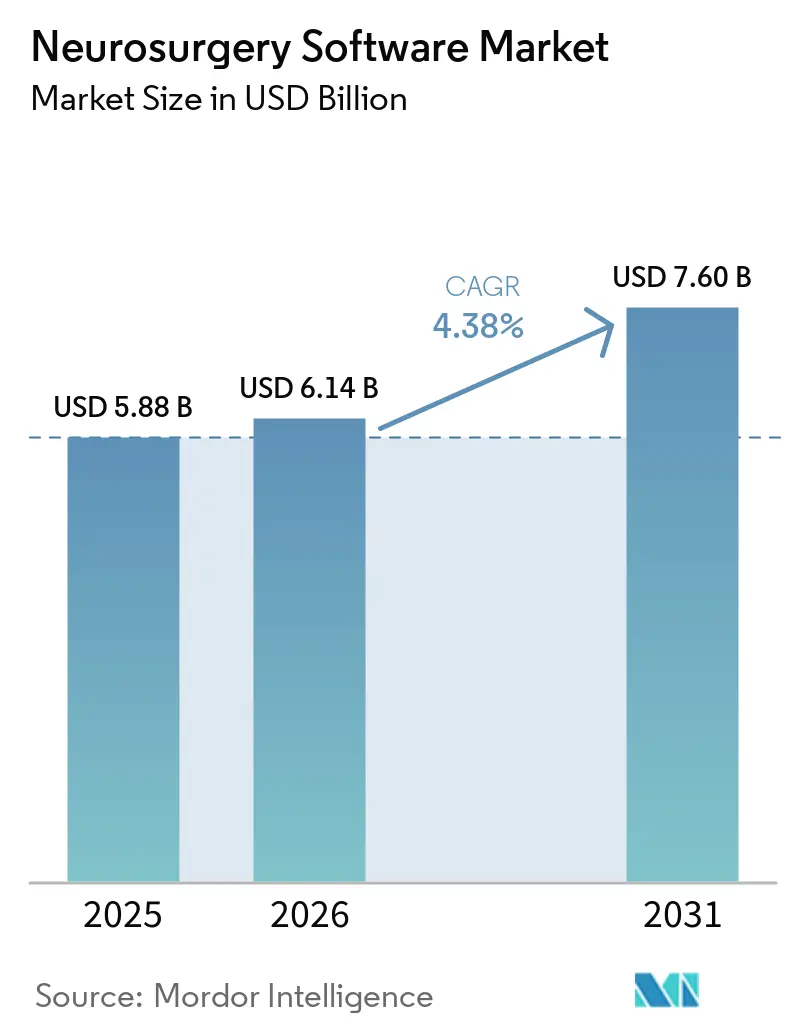
| Market Size (2026) | USD 6.14 Billion |
| Market Size (2031) | USD 7.60 Billion |
| Growth Rate (2026 - 2031) | 4.38 % |
| Fastest Growing Market | Asia-Pacific |
| Largest Market | North America |
| Market Concentration | Medium |
Major Players *Disclaimer: Major Players sorted in no particular order Image © Mordor Intelligence. Reuse requires attribution under CC BY 4.0. | |
Neurosurgery Software Market Analysis by Mordor Intelligence
The Neurosurgery Software Market size was valued at USD 5.88 billion in 2025 and is estimated to grow from USD 6.14 billion in 2026 to reach USD 7.60 billion by 2031, at a CAGR of 4.38% during the forecast period (2026-2031).
The neurosurgery software market is supported by the rising burden of neurological conditions and the need to manage more complex cranial and spinal procedures. Software now supports planning, image registration, tractography, navigation, and intraoperative imaging across the surgical pathway. Vendors are moving from individual products toward connected platforms that link planning, guidance, imaging, and follow-up analysis. The neurosurgery software market also has an emerging opportunity in precision drug delivery, where treatment planning software can support accurate intracranial infusion routes. High ownership costs, difficult system integration, and uncertainty around reimbursement for AI-assisted tools continue to limit adoption.
Key Report Takeaways
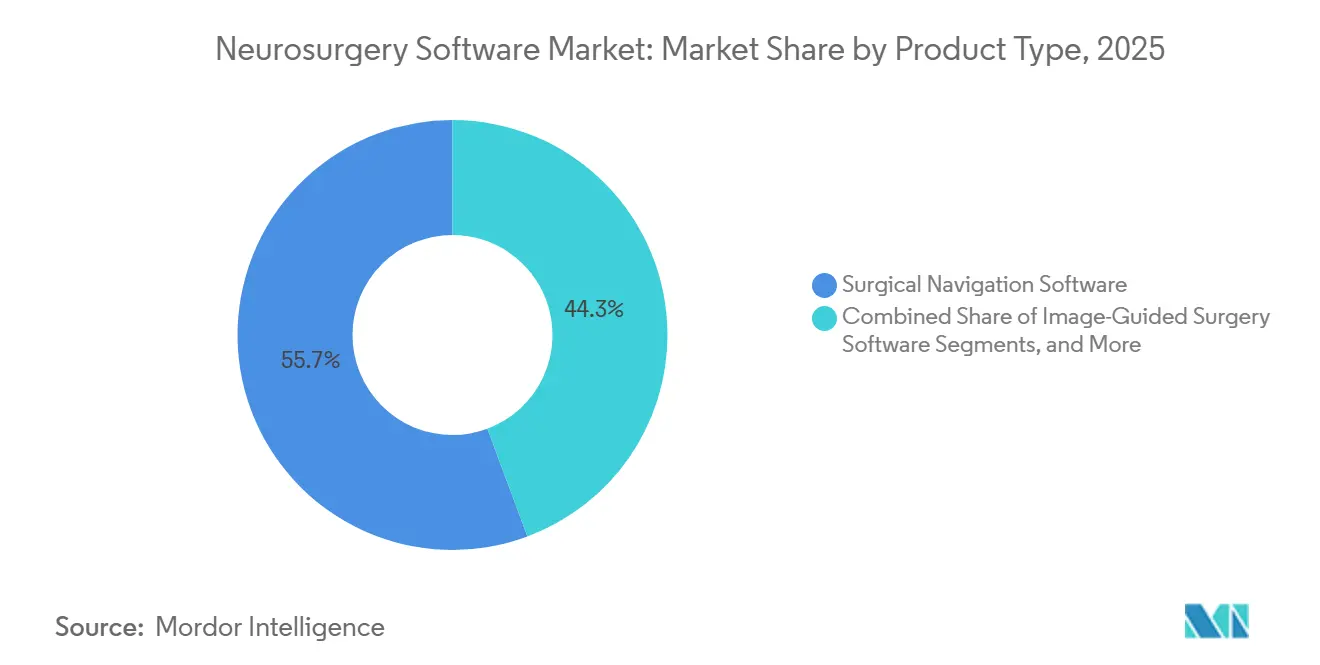
- By product type, surgical navigation software held 55.67% of the neurosurgery software market share in 2025, while surgical planning and visualization software is projected to grow at a 6.89% CAGR through 2031.
- By deployment mode, cloud-based software held 64.60% of the neurosurgery software market share in 2025, while on-premises software is projected to grow at an 8.67% CAGR through 2031.
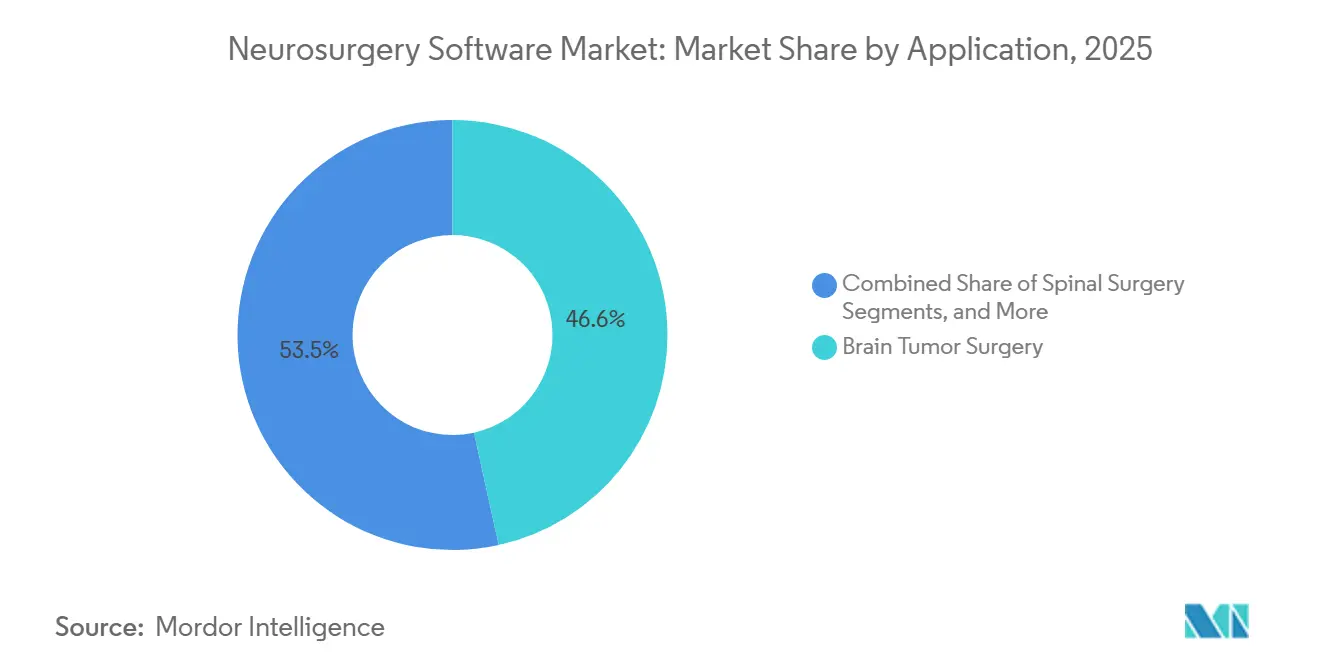
- By application, brain tumor surgery held 46.55% of the neurosurgery software market share in 2025, while functional and stereotactic neurosurgery is projected to grow at a 9.78% CAGR through 2031.
- By technology, optical navigation held 51.45% of the neurosurgery software market share in 2025, while AI and machine learning tools are projected to grow at a 7.55% CAGR through 2031.
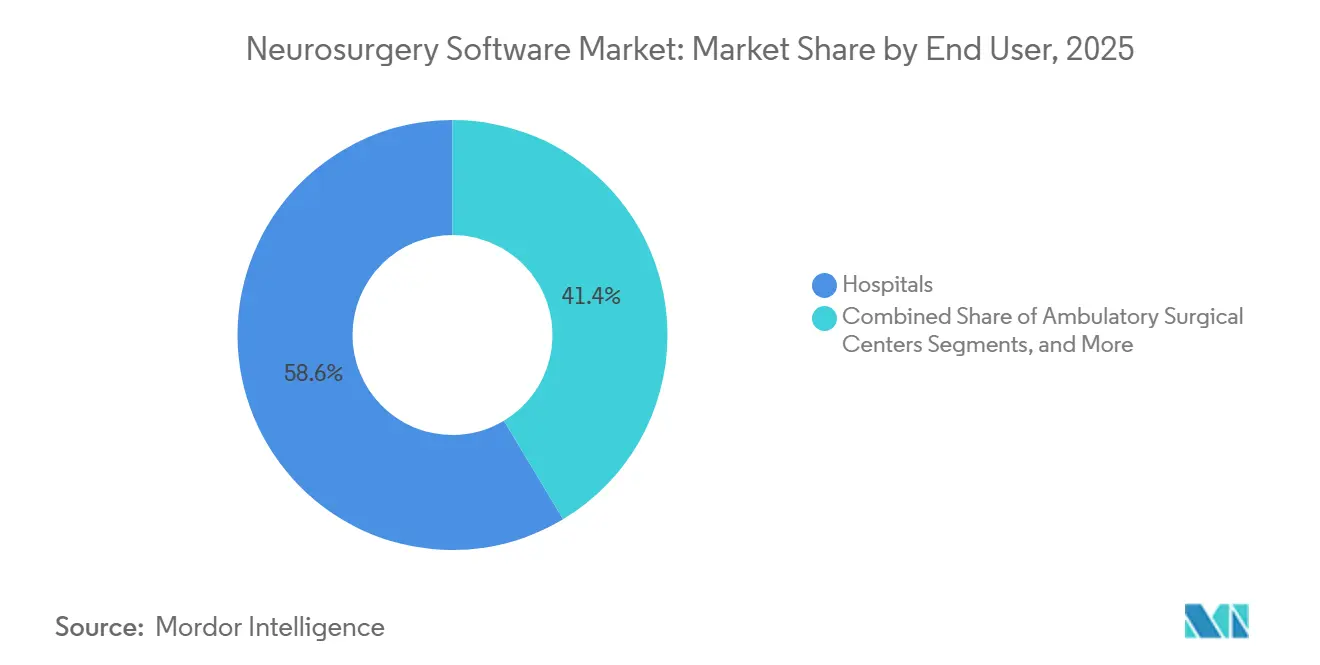
- By end user, hospitals held 58.60% of the neurosurgery software market share in 2025, while ambulatory surgical centers are projected to grow at a 6.56% CAGR through 2031.
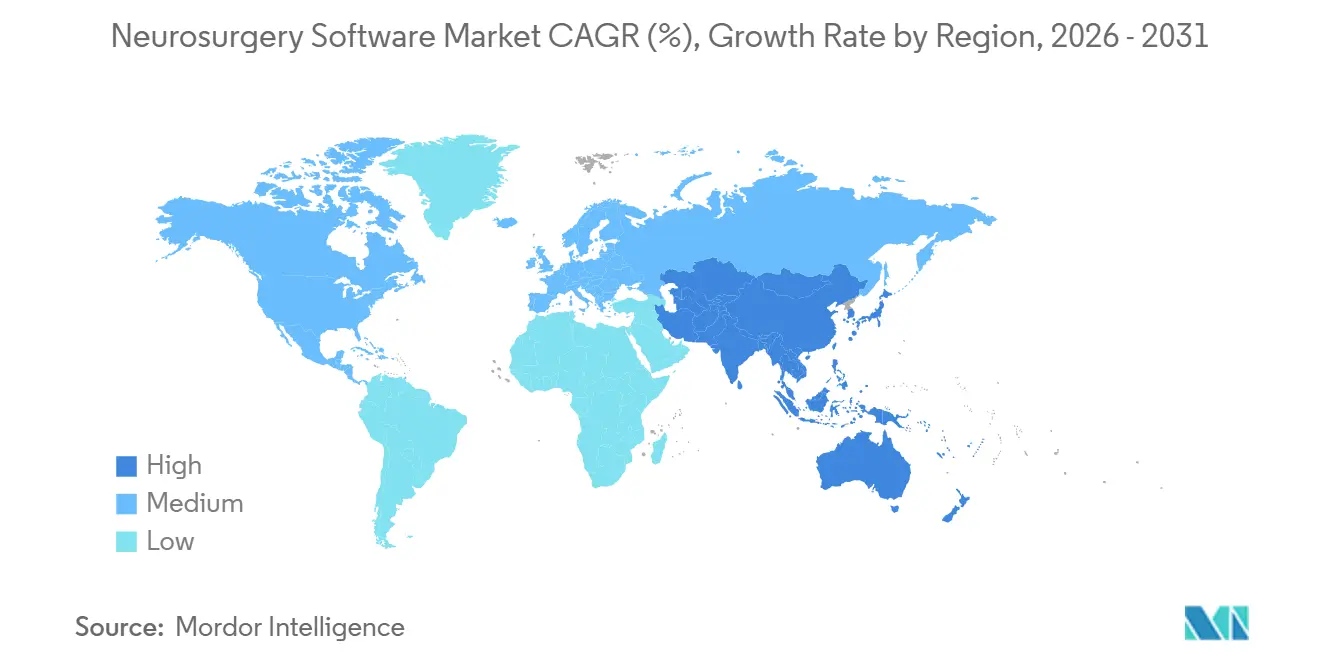
- By geography, North America held 42.80% of the neurosurgery software market share in 2025, while Asia-Pacific is projected to grow at a 7.98% CAGR through 2031.
Note: Market size and forecast figures in this report are generated using Mordor Intelligence’s proprietary estimation framework, updated with the latest available data and insights as of January 2026.
Global Neurosurgery Software Market Trends and Insights
Drivers Impact Analysis*
| DRIVER | (~) % IMPACT ON CAGR FORECAST | GEOGRAPHIC RELEVANCE | IMPACT TIMELINE |
|---|---|---|---|
| Increasing use of image-guided cranial and functional neurosurgery | +1.0% | Global, concentrated in North America and Europe | Medium term (2-4 years) |
| Integration of ai-based segmentation, tractography, and image registration | +1.2% | Global, with early adoption concentrated in North America and Japan | Short term (≤ 2 years) |
| Expansion of mixed-reality and augmented-reality surgical workflows | +0.8% | North America, Europe, and Japan | Medium term (2-4 years) |
| Demand for integrated planning, navigation, and robotic platforms | +0.9% | North America, Europe, and South Korea | Medium term (2-4 years) |
| Growth of neurosurgery capacity in the Asia-Pacific and emerging markets | +0.7% | Asia-Pacific, with spillover to GCC countries and South Africa | Long term (≥ 4 years) |
| Expansion of software subscription and usage-based licensing models | +0.6% | Global, with faster uptake in Asia-Pacific and South America | Short term (≤ 2 years) |
| Source: Mordor Intelligence | |||
Increasing Use of Image-Guided Cranial and Functional Neurosurgery
Image-guided neurosurgery is becoming a standard requirement at high-volume centers, expanding beyond academic hospitals. This shift is reducing reliance on landmark-based methods for complex cranial and functional procedures. A 2026 pilot study reported sub-millimeter target registration error for real-time augmented reality navigation in glioma resection, with a mean registration time of less than 5 minutes.
A 2026 study of 7 Tesla MRI connectivity-guided deep brain stimulation reported a 56% improvement in motor outcomes, compared with 50% for conventional targeting. It also achieved optimal electrode placement in 96% of cases, compared with 86% using conventional targeting.[1] These outcomes support investment in functional planning and targeting tools in the neurosurgery software market.
Integration of AI-Based Segmentation, Tractography, and Image Registration
AI is shifting the neurosurgery software market from image visualization toward clinical decision-support tools that integrate with surgical workflows. A 2026 review reported tumor segmentation Dice coefficients above 0.80 and hemorrhage detection AUC values close to 0.95 for current AI models. It also found that tractography support can improve intraoperative mapping accuracy.
Automated, patient-specific pathway maps can reduce reliance on labor-intensive manual segmentation in functional procedures. In March 2026, Medtronic received FDA clearance for its Stealth AXiS surgical system for cranial and ENT procedures, which includes AI-powered automated tractography. Regulatory requirements favor vendors that can generate clinical evidence and maintain compliance.
Expansion of Mixed-Reality and Augmented-Reality Surgical Workflows
Mixed-reality and augmented-reality tools bring navigation data directly into the surgeon's line of sight, reducing shifts of attention between the operative field and external monitors. These technologies also enable navigation use in settings without extensive fixed operating room infrastructure.
A first-in-human study published in 2026 evaluated real-time computer vision assistance in endoscopic transsphenoidal pituitary surgery across six cases. The study demonstrated the feasibility of integrating AI assistance into the operative field rather than limiting its use to preoperative planning.[2] Portable visualization systems can expand access to image guidance in regional hospitals and outpatient settings.
Demand for Integrated Planning, Navigation, and Robotic Platforms
Hospitals increasingly seek connected clinical systems that integrate planning, navigation, imaging, and robotic guidance. This preference is reshaping competition in the neurosurgery software market, as platform depth is becoming as important as the performance of individual modules. Integrated systems can reduce repeated logins, data conversions, and device handoffs during procedures.
These systems can connect postoperative information with future surgical planning and support consistent workflow management. In April 2026, Medtronic received CE Mark approval for Stealth AXiS, expanding its modular navigation system for cranial and spine procedures into European markets. Established connected-platform workflows can strengthen long-term supplier relationships due to the operational complexity of switching systems.
Restraints Impact Analysis*
| RESTRAINT | (~) % IMPACT ON CAGR FORECAST | GEOGRAPHIC RELEVANCE | IMPACT TIMELINE |
|---|---|---|---|
| High total cost of ownership and complex implementation | -0.5% | Global, most acute in Asia-Pacific, the Middle East and Africa, and South America | Medium term (2-4 years) |
| Interoperability and data-format fragmentation | -0.3% | Global | Medium term (2-4 years) |
| Shortage of trained neurosurgical and operating-room technology personnel | -0.2% | Global, critical in Asia-Pacific, the Middle East and Africa | Long term (≥ 4 years) |
| Limited prospective evidence, reimbursement uncertainty, and ai liability risk | -0.2% | North America and Europe | Medium term (2-4 years) |
| Source: Mordor Intelligence | |||
High Total Cost of Ownership and Complex Implementation
The cost of advanced neurosurgery software extends beyond the initial software license or equipment purchase. Hospitals must also invest in hardware, staff training, service support, software validation, and clinical engineering resources. Integrated navigation and robotic platforms may require operating room workflow changes that can take several weeks to implement, resulting in downtime and additional staffing costs. A 2026 review identifies latency, interface redesign, and interoperability limitations as persistent implementation barriers, even when AI tools meet clinical validation requirements. For community hospitals and ambulatory surgical centers, infrastructure limitations and capital constraints can continue to restrict the reliable use of subscription-based systems.[3]
Interoperability and Data-Format Fragmentation
The neurosurgery software market spans imaging modalities, PACS systems, electronic health records, and navigation hardware that may not seamlessly exchange data. Hospitals may require customized integration work to incorporate cleared AI tools into local clinical workflows. A 2026 review identifies interoperability complexity as a key reason why clinically validated AI neuroimaging tools may remain at the proof-of-concept stage. Although DICOM provides a common baseline, proprietary extensions and vendor-specific file formats can create compatibility gaps, particularly for intraoperative MRI and hyperspectral imaging data. The resulting integration burden favors diversified suppliers with established imaging and navigation installations over software providers that must integrate their solutions separately at each site.
*Our forecasts treat driver/restraint impacts as directional, not additive. The impact forecasts reflect baseline growth, mix effects, and variable interactions.
Segment Analysis
By Product Type: Navigation Software Leads While Planning Tools Expand
Surgical navigation software held 55.67% of the neurosurgery software market share in 2025, driven by real-time spatial guidance during craniotomy, deep brain stimulation, and spinal procedures. It integrates preoperative imaging with operating room workflows, allowing surgeons to visualize planned trajectories during complex procedures. The software also supports tractography and intraoperative imaging within a unified clinical workflow.
Surgical planning and visualization software is the fastest-growing product segment at a 6.89% CAGR through 2031. AI-supported planning tools reduce preparation time and improve imaging review consistency, while vendors integrate segmentation, imaging, robotic guidance, and postoperative analysis into connected platforms. Regulatory, validation, and service requirements continue to favor suppliers offering stable product roadmaps, clinical support, and integration with existing surgical equipment.

By Deployment Mode: Cloud Leads While On-Premises Software Grows Faster
Cloud-based software held 64.60% of the neurosurgery software market share in 2025. Subscription delivery enables vendors to deploy compliant updates without device downtime and supports connected planning, navigation, and outcome-analysis services across multiple hospital sites. Hybrid deployment allows hospitals to retain sensitive imaging data locally while using cloud computing for selected analytics and planning tasks.
On-premises software is projected to grow at an 8.67% CAGR through 2031, making it the fastest-growing deployment model. This growth reflects institutional requirements for control over patient brain-imaging data, including European privacy regulations, hospital IT policies in Japan, South Korea, and China, and data sovereignty requirements across GCC health systems. Vendors must support both cloud-based and local deployment options to address varying governance, connectivity, and IT infrastructure requirements.
By Application: Brain Tumor Surgery Leads While Functional Procedures Grow Fastest
Brain tumor surgery held 46.55% of the neurosurgery software market share in 2025. Neuro-oncology procedures require software for preoperative segmentation, tractography, navigation, and intraoperative imaging, resulting in high software utilization per complex case. A 2026 study described the growing use of structural, functional, and molecular information, with AI supporting segmentation, brain-shift compensation, and residual tumor detection.
Functional and stereotactic neurosurgery is forecast to grow at a 9.78% CAGR through 2031, supported by deep brain stimulation for Parkinson's disease, essential tremor, and epilepsy, alongside emerging focused ultrasound applications. The 7 Tesla MRI study showed a higher optimal electrode placement rate with connectivity-guided targeting than with conventional targeting. Integrated planning and navigation platforms are gaining importance as providers seek to support both preoperative preparation and intraoperative decision-making.
By Technology: Optical Navigation Holds the Largest Position While AI Tools Advance
Optical navigation held 51.45% of the neurosurgery software market share in 2025. It remains widely used in cranial navigation because infrared optical tracking delivers sub-millimeter accuracy and supports a large installed base of navigation hardware. Electromagnetic navigation remains relevant for transnasal and endoscopic procedures where optical tracking is obstructed.
AI and machine learning tools are projected to grow at a 7.55% CAGR through 2031, supported by their use in segmentation, detection, mapping, and decision support. Medtronic's cleared system includes automatic tractography as part of its clinical offering. AI capabilities are increasingly embedded in established navigation platforms, shifting competition toward integrated imaging, planning, navigation, and reporting workflows.
By End User: Hospitals Lead While Ambulatory Surgical Centers Gain Momentum
Hospitals held 58.60% of the neurosurgery software market share in 2025. Tertiary care and academic hospitals perform a significant share of complex cranial and functional procedures and have the staffing, imaging infrastructure, and case volumes required for premium navigation and AI planning systems. Academic institutions, specialty neurosurgical centers, and dedicated focused ultrasound and radiosurgery centers remain important customers for advanced planning platforms.
Ambulatory surgical centers are forecast to grow at a 6.56% CAGR through 2031, supported by the shift of selected spine and minimally invasive cranial procedures to outpatient settings. These providers value accurate guidance, efficient workflows, and lower infrastructure requirements. Vendors that offer compatible, easy-to-implement platforms can address the needs of facilities with limited space, fewer specialized staff, and time-sensitive case schedules.
Geography Analysis
North America held 42.80% of the neurosurgery software market share in 2025, supported by a dense network of neurosurgical centers, favorable reimbursement, and an active FDA clearance environment for AI-enabled navigation systems. Medtronic received FDA clearance for Stealth AXiS in March 2026, adding AI-powered tractography to its cranial and ENT surgical system. Hospital networks are shifting from point-product purchases to broader connected platform contracts.
Europe remains a key region for the neurosurgery software market, driven by academic medical centers and investments in digital surgical infrastructure. Germany, the United Kingdom, and France account for a significant share of regional demand, while the EU Medical Device Regulation requires clinical evidence for AI-based medical software. Medtronic received the CE Mark for Stealth AXiS in April 2026, and the STRATUM project is developing a real-time, three-dimensional decision-support system for brain tumor surgery. Privacy requirements for medical imaging also support demand for hybrid and on-premises deployment models.
Asia-Pacific is projected to grow at a CAGR of 7.98% through 2031, supported by expanding neurosurgical capacity and hospital infrastructure investments across China, India, South Korea, and Japan. Rising neurological care needs are driving demand for planning, navigation, and imaging software, while South Korea highlights the potential for usage-based models in cost-sensitive institutional settings. The market also offers opportunities in the Middle East and Africa, particularly in GCC countries, and in South America, where Brazil’s public hospital network supports expanding procedural capacity.
Competitive Landscape
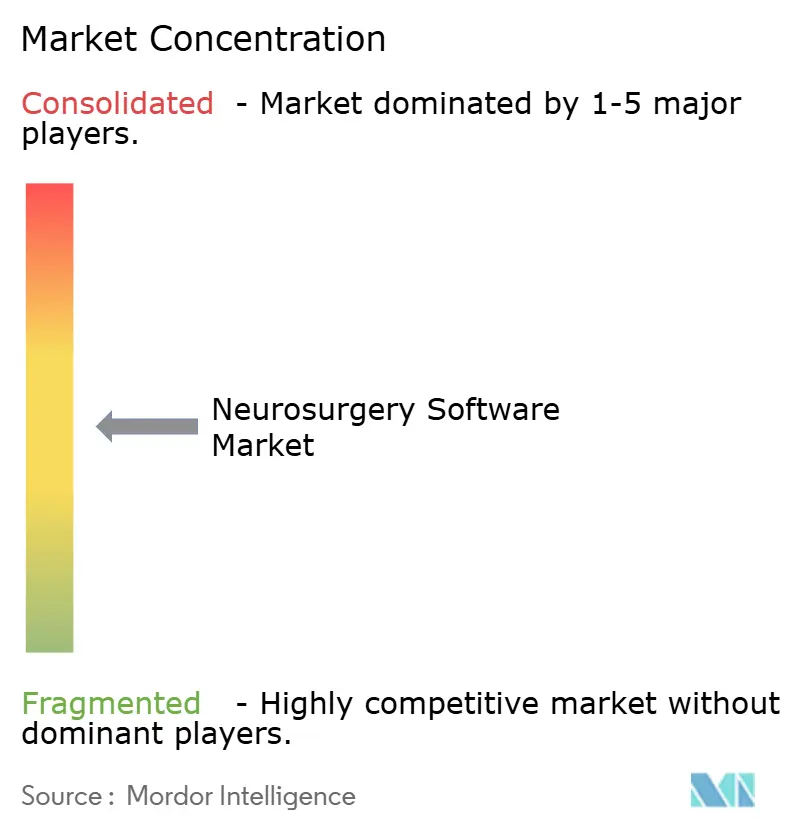
The neurosurgery software market has a moderately consolidated top tier. Medtronic, Brainlab, Siemens Healthineers, and GE HealthCare leverage established imaging and capital equipment portfolios to drive software adoption among existing hospital customers. Their integrated planning, navigation, imaging, and surgical workflow capabilities strengthen their installed-base advantage. Medtronic's FDA clearance for Stealth AXiS in March 2026 supports its strategy to integrate AI-supported functionality into its broader navigation platform. Its CE Mark in April 2026 extended the modular system to European cranial and spine applications. These approvals demonstrate how leading suppliers expand connected platform access across regions.
Hospitals increasingly evaluate software based on its ability to support the complete surgical workflow rather than a single image-processing task. Medical software lifecycle and quality management requirements raise entry barriers and favor companies with established regulatory, clinical, and support capabilities. Effective implementation remains critical for integration with imaging systems, patient records, and operating-room workflows.
Specialist companies can compete in drug delivery planning, patient-specific anatomical modeling, and focused procedural workflows where broader platforms have limited specialized coverage. AI-native companies also target workflow niches that legacy hardware models may not address effectively. Their expansion depends on clinical evidence, regulatory clearance, practical integration, and post-installation customer support. The neurosurgery software market is shaped by connected-platform suppliers and focused software providers. Large companies can build end-to-end ecosystems, while smaller providers can compete by delivering clear benefits for specific planning, visualization, or treatment-delivery requirements. This balance supports specialist innovation while preserving the competitive value of established platforms.
Neurosurgery Software Industry Leaders
-
Medtronic plc
-
Brainlab AG
-
Stryker Corporation
-
Synaptive Medical Inc.
-
Siemens Healthineers AG
- *Disclaimer: Major Players sorted in no particular order
Recent Industry Developments
- June 2026: Cercare Medical received FDA 510(k) clearance (K260316) for Oncology Virtual Expert, an AI-powered brain tumor segmentation module for semi-automated tumor contouring in PACS workflows. The tool achieved a Dice coefficient of 0.82 across 100 patients and operated fully on-premises to support stringent data governance requirements.
- June 2026: Medtronic launched GAiTEWAY, a cloud-based platform integrating AI-driven preoperative planning, Stealth AXiS intraoperative navigation, and postoperative analytics across the AiBLE ecosystem. The platform used surgical outcomes to inform subsequent planning for spine and cranial procedures.
- June 2026: Brainlab signed an MoU with KIMS Hospitals, Bengaluru, to establish South Asia's first Functional Neurosurgery Reference Center, Training Hub, and Center of Excellence. The initiative integrated mixed-reality visualization, robotic-assisted intraoperative imaging, and advanced surgical navigation into functional neurosurgery workflows across India and South Asia.
- April 2026: GE HealthCare announced the commercial availability of a digital integration between its bkActiv intraoperative ultrasound system and Medtronic's Stealth AXiS navigation platform. The integration enabled real-time ultrasound visualization alongside preoperative MRI and CT data during cranial procedures and was showcased at the AANS Annual Scientific Meeting in San Antonio, Texas.
Global Neurosurgery Software Market Report Scope
As per the scope of the report, neurosurgery software refers to a class of highly specialized medical applications used by neurosurgeons to plan, simulate, and execute complex surgical procedures on the brain, spine, and peripheral nervous system.
The neurosurgery software market is segmented by product type, deployment mode, application, technology, end user, and geography. By product type, the market includes surgical planning and visualization software, surgical navigation software, image-guided surgery software, robotic-assisted surgery software, intraoperative imaging and analysis software, postoperative analysis and monitoring software, and other neurosurgical software. By deployment mode, the market is segmented into on-premises software, cloud-based software, and hybrid software. By application, the market is categorized into brain tumor surgery, spinal surgery, epilepsy surgery, functional and stereotactic neurosurgery, neurovascular surgery, trauma surgery, and other applications. By technology, the market is segmented into artificial intelligence and machine learning, 3D visualization and modeling, electromagnetic navigation, optical navigation, and cloud computing. By end user, the market is segmented into hospitals, ambulatory surgical centers, specialty neurosurgical centers, academic and research institutes, and others. By geography, the market is analyzed across North America, Europe, Asia-Pacific, the Middle East and Africa, and South America. The report also covers the estimated market sizes and trends for 17 countries across major regions globally. The report offers market sizes and forecasts in terms of value (USD) for the above segments.
| Surgical Planning & Visualization Software |
| Surgical Navigation Software |
| Image-Guided Surgery Software |
| Robotic-Assisted Surgery Software |
| Intraoperative Imaging & Analysis Software |
| Postoperative Analysis & Monitoring Software |
| Other Neurosurgical Software |
| On-Premises Software |
| Cloud-Based Software |
| Hybrid Software |
| Brain Tumor Surgery |
| Spinal Surgery |
| Epilepsy Surgery |
| Functional & Stereotactic Neurosurgery |
| Neurovascular Surgery |
| Trauma Surgery |
| Other Applications |
| Artificial Intelligence/Machine Learning |
| 3D Visualization & Modeling |
| Electromagnetic Navigation |
| Optical Navigation |
| Cloud Computing |
| Hospitals |
| Ambulatory Surgical Centers |
| Specialty Neurosurgical Centers |
| Academic & Research Institutes |
| Others |
| North America | United States |
| Canada | |
| Mexico | |
| Europe | Germany |
| United Kingdom | |
| France | |
| Italy | |
| Spain | |
| Rest of Europe | |
| Asia-Pacific | China |
| India | |
| Japan | |
| Australia | |
| South Korea | |
| Rest of Asia-Pacific | |
| Middle East and Africa | GCC |
| South Africa | |
| Rest of Middle East and Africa | |
| South America | Brazil |
| Argentina | |
| Rest of South America |
| By Product Type | Surgical Planning & Visualization Software | |
| Surgical Navigation Software | ||
| Image-Guided Surgery Software | ||
| Robotic-Assisted Surgery Software | ||
| Intraoperative Imaging & Analysis Software | ||
| Postoperative Analysis & Monitoring Software | ||
| Other Neurosurgical Software | ||
| By Deployment Mode | On-Premises Software | |
| Cloud-Based Software | ||
| Hybrid Software | ||
| By Application | Brain Tumor Surgery | |
| Spinal Surgery | ||
| Epilepsy Surgery | ||
| Functional & Stereotactic Neurosurgery | ||
| Neurovascular Surgery | ||
| Trauma Surgery | ||
| Other Applications | ||
| By Technology | Artificial Intelligence/Machine Learning | |
| 3D Visualization & Modeling | ||
| Electromagnetic Navigation | ||
| Optical Navigation | ||
| Cloud Computing | ||
| By End User | Hospitals | |
| Ambulatory Surgical Centers | ||
| Specialty Neurosurgical Centers | ||
| Academic & Research Institutes | ||
| Others | ||
| By Geography | North America | United States |
| Canada | ||
| Mexico | ||
| Europe | Germany | |
| United Kingdom | ||
| France | ||
| Italy | ||
| Spain | ||
| Rest of Europe | ||
| Asia-Pacific | China | |
| India | ||
| Japan | ||
| Australia | ||
| South Korea | ||
| Rest of Asia-Pacific | ||
| Middle East and Africa | GCC | |
| South Africa | ||
| Rest of Middle East and Africa | ||
| South America | Brazil | |
| Argentina | ||
| Rest of South America | ||
Key Questions Answered in the Report
What is the projected value of the neurosurgery software market by 2031?
The neurosurgery software market is projected to reach USD 7.60 billion by 2031, from USD 6.14 billion in 2026, at a 4.38% CAGR.
Which product category held the largest share in 2025?
Surgical navigation software led with 55.67% share in 2025 because it supports real-time guidance in cranial, functional, and spinal procedures.
Which application is expected to grow the fastest through 2031?
Functional and stereotactic neurosurgery is forecast to grow at a 9.78% CAGR through 2031, supported by deep brain stimulation and precision targeting workflows.
Why is on-premises deployment growing faster than cloud delivery?
On-premises software is forecast to grow at an 8.67% CAGR because hospital data governance and sovereignty requirements can limit external cloud transfer of brain imaging data.
Which region has the largest share and which has the fastest growth?
North America held 42.80% share in 2025, while Asia-Pacific is forecast to grow at a 7.98% CAGR through 2031.
How are AI tools affecting neurosurgical workflows?
AI tools support tumor segmentation, tractography, image registration, and decision support, helping expand the role of software across planning and intraoperative care. Their relevance depends on clinical evidence, integration with current imaging and navigation systems, and the ability to fit within established operating-room processes.