
Netherlands HVAC Market Size and Share
| Study Period | 2019 - 2030 |
| Forecast Data Period | 2025 - 2030 |
| Historical Data Period | 2019 - 2023 |
| Market Size (2025) | USD 2.43 Billion |
| Market Size (2030) | USD 3.05 Billion |
| CAGR (2025 - 2030) | 4.60% |
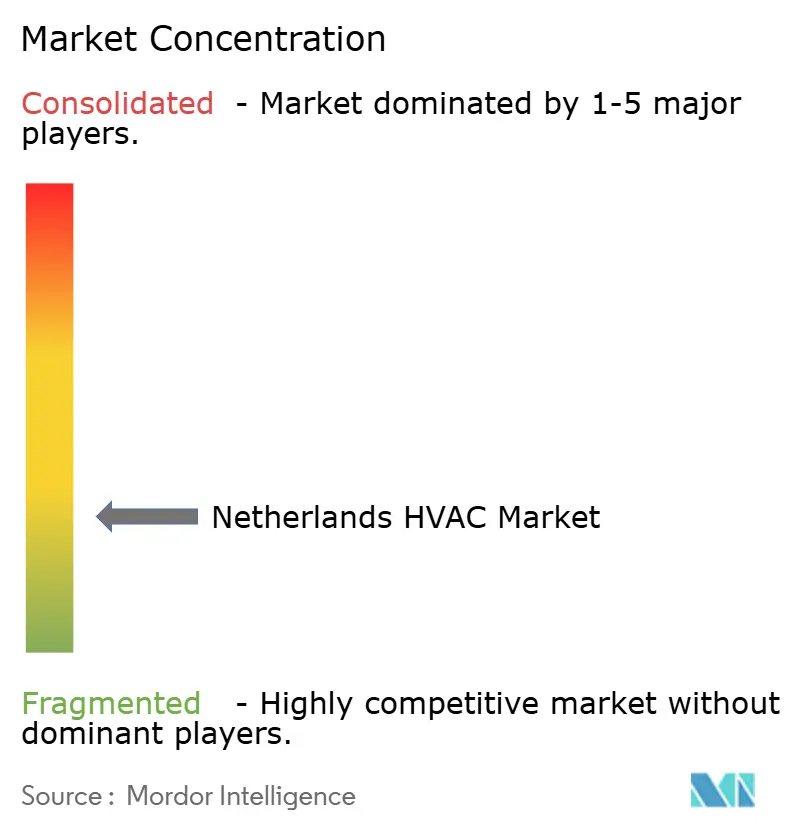
| Market Concentration | Low |
Major Players *Disclaimer: Major Players sorted in no particular order |
Netherlands HVAC Market Analysis by Mordor Intelligence
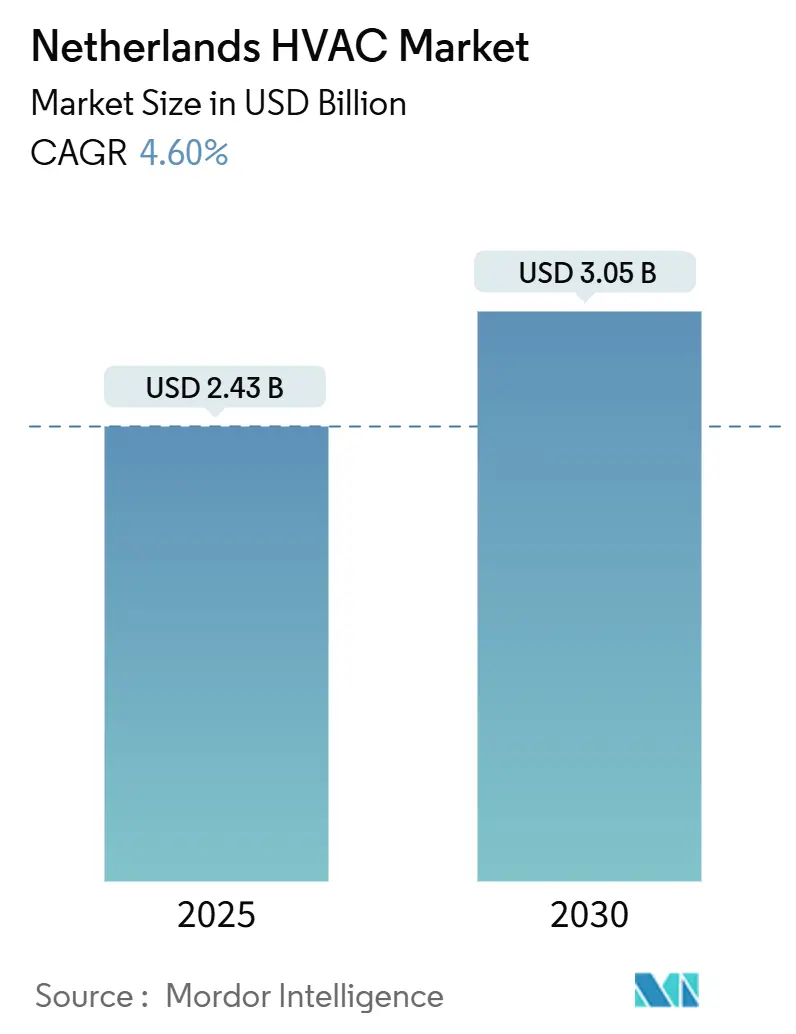
The Netherlands HVAC Market size is estimated at USD 2.43 billion in 2025, and is expected to reach USD 3.05 billion by 2030, at a CAGR of 4.60% during the forecast period (2025-2030).
- The Dutch government is actively addressing climate change through clearly defined goals and measures outlined in the Climate Act and the National Climate Agreement. These initiatives aim to significantly reduce greenhouse gas emissions within the Netherlands, targeting a 49% reduction by 2030 and an ambitious 95% reduction by 2050. Supportive regulations from the Dutch government are driving HVAC demand in the Netherlands. The country’s goal to reduce greenhouse gas emissions is speeding up the move from fossil fuel-based heating systems to energy-efficient options, such as heat pumps and smart climate control systems.
- The Dutch government plans to increase funding for energy-efficient business investments to EUR 431 million (USD 488 million) in 2025, which is EUR 172 million (USD 195 million) more than the allocation in 2024. This initiative, part of the Energy Investment Allowance (EIA) program, is designed to support sustainable economic growth and reduce CO2 emissions.
- The Dutch government promotes energy-efficient retrofits through subsidies, grants, and low-interest loans, aiming to encourage sustainable housing solutions. These retrofits include installing solar boilers and heat pumps, which enhance energy efficiency and environmental sustainability in homes. Additionally, policies like the regressive carbon tax and the proposed green tax highlight the government's efforts to drive sustainable practices and behaviors through effective policy measures.
- European HVAC installers are struggling with a labor shortage, particularly in Germany and the Netherlands, where nearly 80% report severe shortages. The industry expects a significant loss of experienced installers and an increase in unqualified personnel, making training a critical need. Manufacturers and wholesalers in the HVAC sector must focus on providing effective training programs to support installers and build customer loyalty.
- In the Netherlands, real GDP growth is projected to reach 1.3% in 2025, supported by strong domestic demand despite the impact of US tariffs on trade. A booming economy propels commercial, residential, and industrial construction, increasing demand for HVAC installations in new buildings and renovations. Additionally, higher wage growth is increasing real disposable income, which is expected to drive a significant rise in private consumption and, ultimately, spending on HVAC upgrades.
Netherlands HVAC Market Trends and Insights
Growth in Construction Sector to Fuel the Market Growth
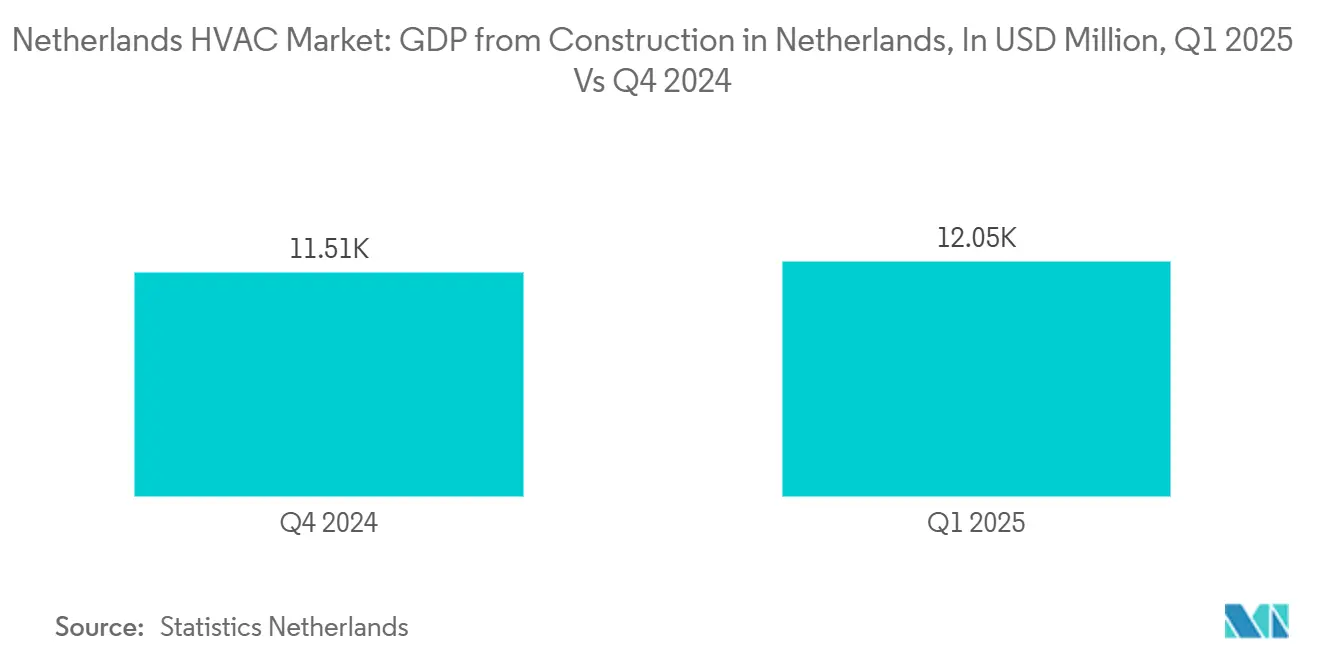
- The Dutch construction sector is showing signs of recovery after experiencing a decline in recent years. According to Statistics Netherlands, GDP from construction in the Netherlands increased to EUR 11,129 million (USD 12,049 million) in Q1 2025 from EUR 11,051 million (USD 11,510 million) in Q4 2024. This recovery is also reflected in rising house prices, increased sales of new houses, and strong order books.
- Moreover, in 2023, non-residential construction recorded a 2% growth, supported by favorable trends in both non-residential construction and renovations. The growth in renovation activities is largely driven by increased investments in insulating non-residential buildings and the adoption of sustainable heating systems.
- A significant portion of the housing stock in the Netherlands consists of older buildings, which increases the need for restoration services. These services aim to modernize homes by improving energy efficiency and enhancing comfort levels. The Dutch government provides incentives and subsidies to support energy-efficient renovations and sustainable building practices. These include low-interest loans for measures, such as insulation upgrades, heating system replacements, and renewable energy installations.
- In 2023, the Dutch government set up a EUR 35 billion fund (USD 35.7 billion) to help achieve its 2030 emission targets by supporting the energy transition. In 2024, this fund increased to EUR 40 billion (USD 41 billion ). The fund is being used to improve energy efficiency and invest in renewable energy. For example, it supports energy efficiency measures, including installing heat pumps and insulation systems in second-hand homes.


Air Conditioning Equipment is Expected to Witness a Significant Growth
- The Netherlands is experiencing a rapid increase in tropical days, according to the Dutch Meteorological Institute (KNMI). Heat waves are becoming more frequent, lasting longer, and reaching higher temperatures. The report highlights that the country is warming at a rate of 0.4% per decade, which is twice the global average. Rising sea levels are identified as the most significant long-term threat. To cope with the increasing heat, many consumers are installing air conditioners to cool spaces such as attics, bedrooms, and living rooms.
- The Netherlands is a highly urbanized country, with most people living in cities. The urban population of the Netherlands is projected to be about 16.3 million by the end of 2025, which is approximately 88.9% of the total population. This urbanization, supported by high living standards and advanced infrastructure, is expected to increase the demand for air conditioning in densely populated areas.
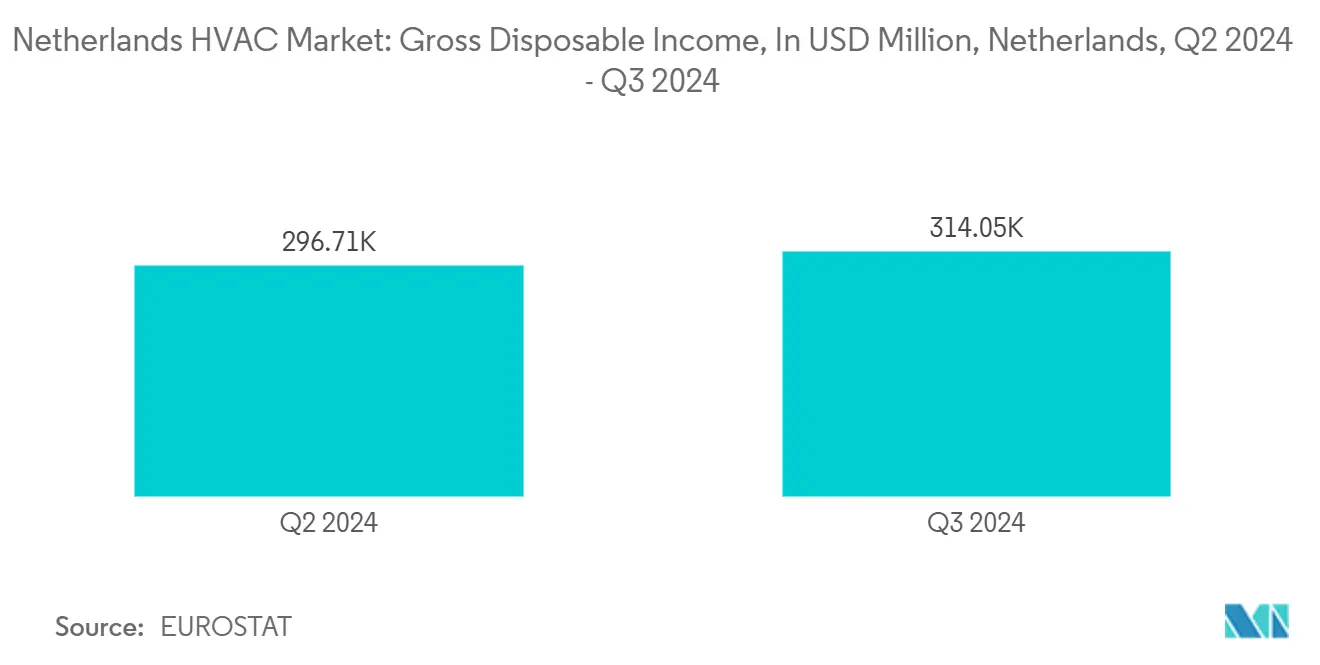
- Wage growth in the Netherlands rose above 6% in 2024 and is projected to remain strong in 2025. This growth is expected to increase households' disposable income, which will drive higher private consumption. According to EUROSTAT, the gross disposable income in the Netherlands was EUR 281,329 million (USD 314,045 million) as of September 2024.
- Increasing disposable incomes are boosting the demand for air conditioning. As people have more money to spend, they are purchasing air conditioners to enhance comfort, particularly in hotter regions. Urbanization and changing climate conditions are also significant factors contributing to this growing demand.

Competitive Landscape
In the Netherlands, a diverse HVAC market thrives, characterized by a mix of regional conglomerates and specialized players. While a handful of multinational giants command dominance in high-value segments, a multitude of regional and niche entities intensify the competition. This rich tapestry of players is a testament to the versatile applications of HVAC systems, fostering an environment where both large and small enterprises can flourish.
Key players shaping the Netherlands HVAC landscape include BDR Thermea Group, Robert Bosch BV, LG Electronics, Daikin Industries, Ltd., and Carrier Corporation. With robust global operations and strong brand recognition, these companies wield considerable market influence. Their prowess is anchored in innovation, a diverse portfolio of solutions, and expansive distribution networks. To bolster their market presence and edge, these industry leaders frequently pursue strategic acquisitions and partnerships.
In the Netherlands' HVAC market, companies are finding that prioritizing innovation is key to success. With industries pushing for more advanced solutions, energy-efficient systems are emerging as a major differentiator. Beyond just products, broadening service offerings and bolstering customer support are vital for nurturing long-term relationships and ensuring repeat business. Furthermore, firms that channel investments into emerging markets and tailor their products to meet regional demands stand to carve out a competitive edge in this fragmented landscape.
Netherlands HVAC Industry Leaders
BDR Thermea Group
Robert Bosch BV
LG Electronics
Daikin Industries, Ltd.
Carrier Corporation
- *Disclaimer: Major Players sorted in no particular order

Recent Industry Developments
- April 2025: Koelplan, a Dutch air conditioning contractor, has acquired a majority stake in All Climate BV, a company specializing in climate solutions.
- September 2024: Eneco Groep N.V. and the water authority HDSR (Hoogheemraadschap De Stichtse Rijnlanden) opened the largest heat pump in Utrecht, Netherlands. Eneco uses heat from HDSR's treated wastewater and converts it into energy for the heating grid. This project now supplies sustainable heating to approximately 20,000 households in the municipalities of Utrecht and Nieuwegein.


Netherlands HVAC Market Report Scope
HVAC is a comprehensive system designed to create and maintain comfortable indoor environmental conditions in residential, commercial, and industrial spaces. Heating is the first component, which involves warming interior spaces during cold weather through various methods such as furnaces, heat pumps, and radiant heating systems. These technologies convert energy into heat, distributing warmth evenly throughout a building to ensure occupant comfort and prevent temperature-related issues.
Ventilation represents the critical process of exchanging indoor and outdoor air, ensuring proper air circulation, removing pollutants, controlling humidity, and maintaining air quality. This aspect of HVAC involves mechanical and natural ventilation techniques that introduce fresh air, filter contaminants, and regulate oxygen levels. Proper ventilation is essential for preventing the buildup of harmful gases, reducing moisture-related problems, and creating a healthy indoor environment.
Air Conditioning focuses on cooling and dehumidifying interior spaces during warm weather. Modern air conditioning systems use refrigeration cycles to remove heat and moisture from the air, creating a comfortable and controlled climate. These systems range from central air conditioning units to ductless mini-splits, providing precise temperature management and improving overall indoor comfort. The integration of these three components- heating, ventilation, and air conditioning- creates a sophisticated environmental control system that adapts to changing weather conditions and occupant needs.
The study tracks the revenue accrued through the sale of HVAC product types by various players in the Netherlands. The study also tracks the key market parameters, underlying growth influencers, and major vendors operating in the industry, which supports the market estimations and growth rates over the forecast period. The study further analyses the overall impact of macroeconomic factors on the market. The report's scope encompasses market sizing and forecasts for the various market segments.
The Netherlands HVAC market is Segmented by product type (heating equipment [heat pumps (air source, ground source), furnaces (gas, electric, oil), boilers (condensing, non-condensing), unit heaters, and others (radiators & baseboard heaters, solar water heating systems)], ventilation equipment [air handling units (AHUs), energy recovery ventilators (ERVs)/heat recovery, ventilators (HRVs), exhaust and supply fans, dehumidifiers/humidifiers], air conditioning equipment [unitary air conditioners, variable refrigerant flow (VRF) systems, chillers (air-cooled, water-cooled), fan coil units (FCUs), and others (window and portable air conditioners)]) and end-user industry (residential, commercial, and industrial). The market sizes and forecasts are provided in terms of value (USD) for all the above segments.
| Heating Equipment | Heat Pumps (Air Source, Ground Source) | |
| Furnaces (Gas, Electric, Oil) | ||
| Boilers (Condensing, Non-condensing) | ||
| Unit Heaters | ||
| Others (Radiators & Baseboard Heaters, Solar Water Heating Systems) | ||
| Ventilation Equipment | Air Handling Units (AHUs) | |
| Energy Recovery Ventilators (ERVs) / Heat Recovery Ventilators (HRVs) | ||
| Exhaust and Supply Fans | ||
| Dehumidifiers / Humidifiers | ||
| Air Conditioning Equipment | Unitary Air Conditioners | Split Air Conditioners |
| Packaged Terminal ACs (PTACs) | ||
| Rooftop Packaged Units (RTUs) | ||
| Variable Refrigerant Flow (VRF) Systems | ||
| Chillers (Air-Cooled, Water-Cooled) | ||
| Fan Coil Units (FCUs) | ||
| Others (Window and Portable Air Conditioners) | ||
| Residential |
| Commercial |
| Industrial |
| By Product Type | Heating Equipment | Heat Pumps (Air Source, Ground Source) | |
| Furnaces (Gas, Electric, Oil) | |||
| Boilers (Condensing, Non-condensing) | |||
| Unit Heaters | |||
| Others (Radiators & Baseboard Heaters, Solar Water Heating Systems) | |||
| Ventilation Equipment | Air Handling Units (AHUs) | ||
| Energy Recovery Ventilators (ERVs) / Heat Recovery Ventilators (HRVs) | |||
| Exhaust and Supply Fans | |||
| Dehumidifiers / Humidifiers | |||
| Air Conditioning Equipment | Unitary Air Conditioners | Split Air Conditioners | |
| Packaged Terminal ACs (PTACs) | |||
| Rooftop Packaged Units (RTUs) | |||
| Variable Refrigerant Flow (VRF) Systems | |||
| Chillers (Air-Cooled, Water-Cooled) | |||
| Fan Coil Units (FCUs) | |||
| Others (Window and Portable Air Conditioners) | |||
| By End-user Industry | Residential | ||
| Commercial | |||
| Industrial | |||


Key Questions Answered in the Report
How big is the Netherlands HVAC Market?
The Netherlands HVAC Market size is expected to reach USD 2.43 billion in 2025 and grow at a CAGR of 4.60% to reach USD 3.05 billion by 2030.
What is the current Netherlands HVAC Market size?
In 2025, the Netherlands HVAC Market size is expected to reach USD 2.43 billion.
Who are the key players in Netherlands HVAC Market?
BDR Thermea Group, Robert Bosch BV, LG Electronics, Daikin Industries, Ltd. and Carrier Corporation are the major companies operating in the Netherlands HVAC Market.
What years does this Netherlands HVAC Market cover, and what was the market size in 2024?
In 2024, the Netherlands HVAC Market size was estimated at USD 2.32 billion. The report covers the Netherlands HVAC Market historical market size for years: 2019, 2020, 2021, 2022, 2023 and 2024. The report also forecasts the Netherlands HVAC Market size for years: 2025, 2026, 2027, 2028, 2029 and 2030.
Page last updated on:
Netherlands HVAC Market Report
Statistics for the 2025 Netherlands HVAC market share, size and revenue growth rate, created by Mordor Intelligence™ Industry Reports. Netherlands HVAC analysis includes a market forecast outlook for 2025 to 2030 and historical overview. Get a sample of this industry analysis as a free report PDF download.





