
Natural Gas Storage Market Size and Share
Market Overview
| Study Period | 2021 - 2031 |
|---|---|
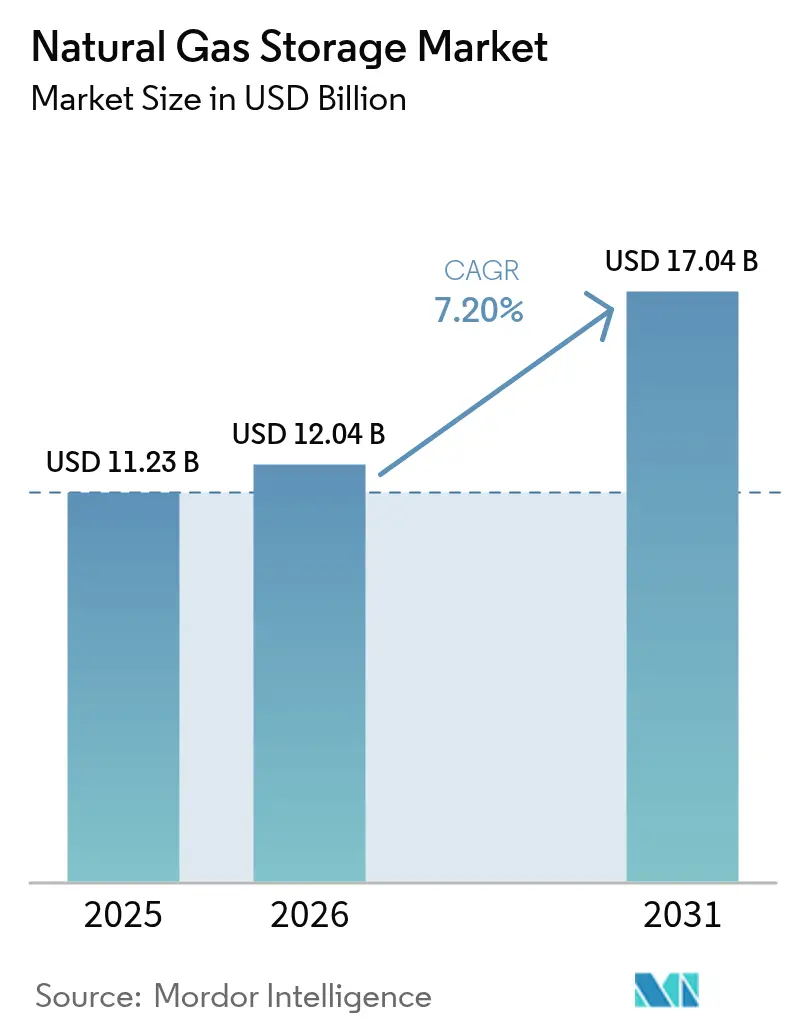
| Market Size (2026) | USD 12.04 Billion |
| Market Size (2031) | USD 17.04 Billion |
| Growth Rate (2026 - 2031) | 7.20 % |
| Fastest Growing Market | Asia Pacific |
| Largest Market | North America |
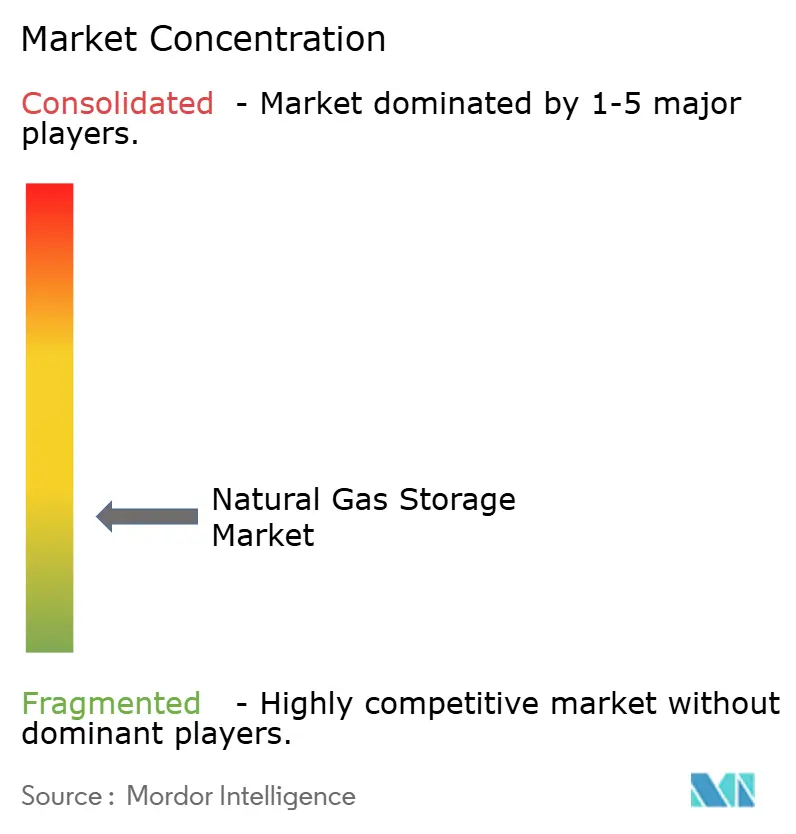
| Market Concentration | Low |
Major Players *Disclaimer: Major Players sorted in no particular order Image © Mordor Intelligence. Reuse requires attribution under CC BY 4.0. | |
Natural Gas Storage Market Analysis by Mordor Intelligence
Natural Gas Storage market size in 2026 is estimated at USD 12.04 billion, growing from 2025 value of USD 11.23 billion with 2031 projections showing USD 17.04 billion, growing at 7.20% CAGR over 2026-2031.
Seasonal heating swings, rising LNG trade volumes, and the emergence of hydrogen blend regulations collectively underpin persistent demand growth across every major consuming region. Underground depleted reservoirs continue to drive capacity additions due to their cost advantage, while salt caverns gain traction in premium peak-shaving services thanks to their rapid cycling performance. The Asia-Pacific region displays the fastest capacity build-out as China accelerates its strategic reserve mandates and India scales up gas-fired power generation, whereas North America leverages its mature infrastructure near prolific shale basins to maintain the largest regional share of the natural gas storage market. Storage operators are increasingly bundling seasonal balancing with short-cycle services to maximise utilisation, a strategy that mitigates revenue pressure from battery storage technologies. Capital spending priorities are shifting toward emission-mitigating retrofits and hydrogen-ready upgrades to comply with evolving environmental regulations and capitalize on future low-carbon opportunities.
Key Report Takeaways
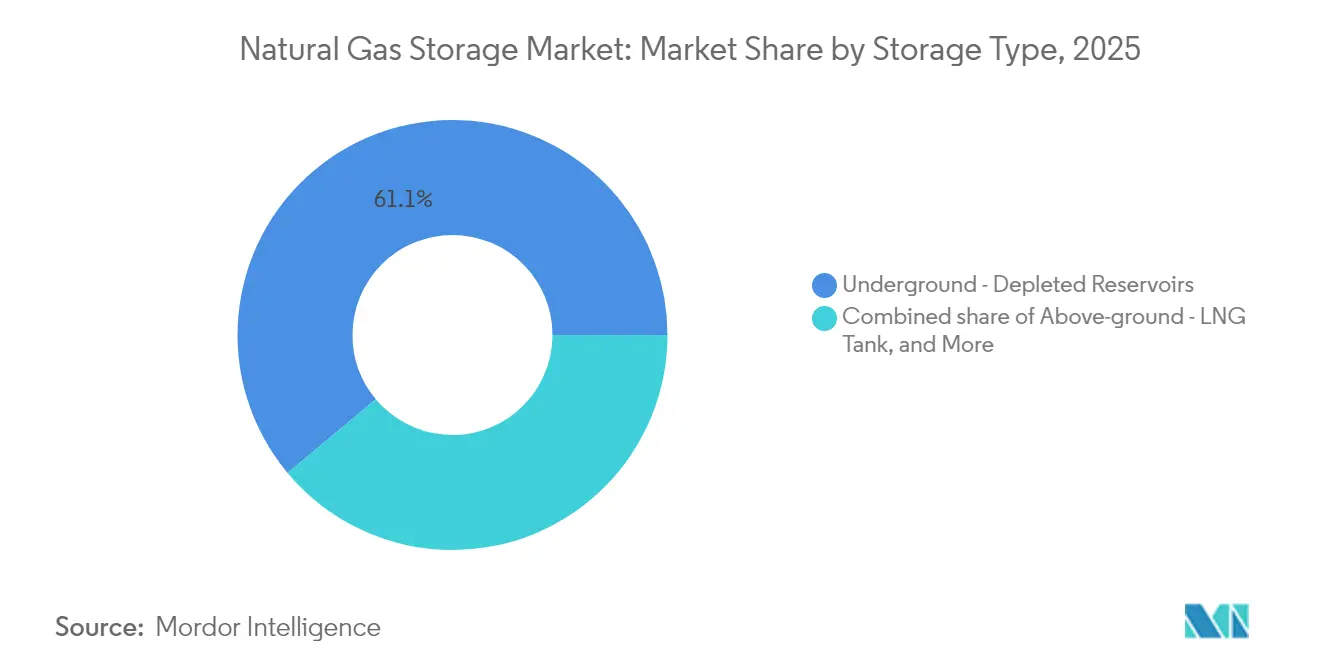
- By storage type, depleted reservoirs held 61.08% of the natural gas storage market share in 2025, while LNG tanks are projected to record a 9.22% CAGR to 2031.
- By mode of service, seasonal balancing accounted for 58.35% of the natural gas storage market size in 2025, and peak shaving is expected to advance at an 8.62% CAGR through 2031.
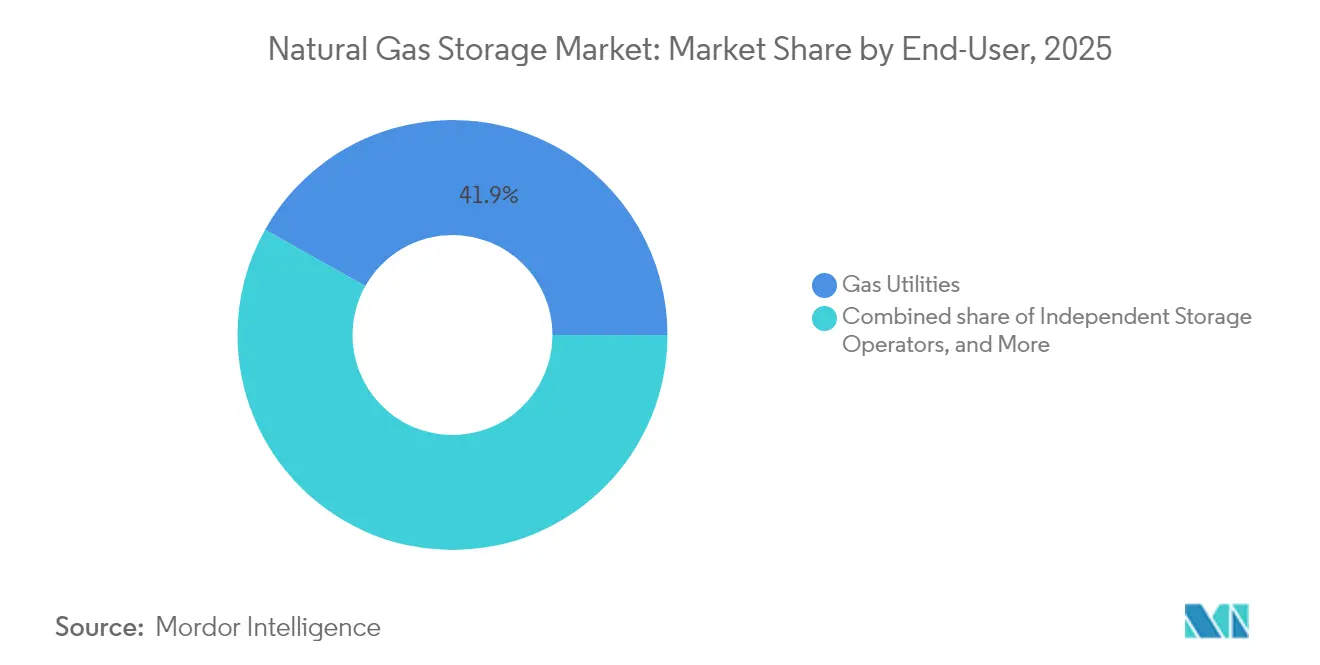
- By end-user, gas utilities commanded a 41.85% share of the natural gas storage market size in 2025, while independent operators posted the highest 8.95% CAGR toward 2031.
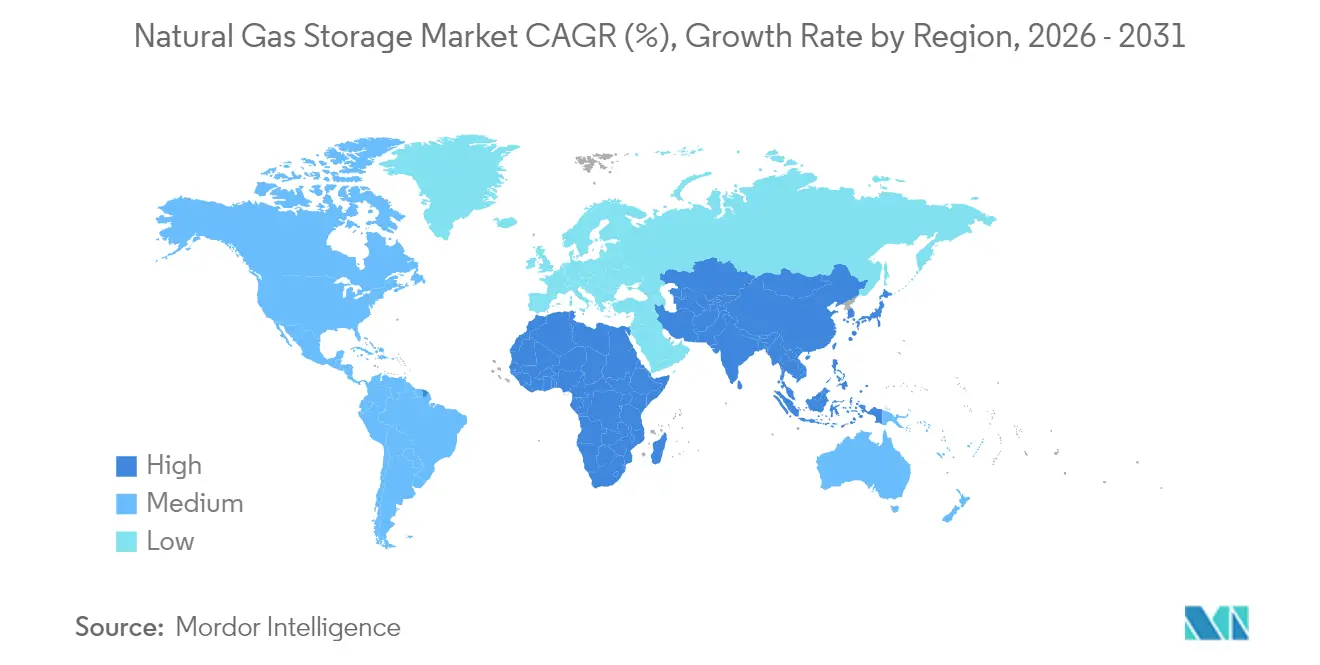
- By geography, North America led the natural gas storage market in 2025, accounting for a 35.10% revenue share, while the Asia-Pacific region is forecasted to post a 11.07% CAGR from 2025 to 2031.
Note: Market size and forecast figures in this report are generated using Mordor Intelligence’s proprietary estimation framework, updated with the latest available data and insights as of 2026.
Market Trends and Insights
Drivers Impact Analysis of Natural Gas Storage Market*
| Driver | (~) % Impact on CAGR Forecast | Geographic Relevance | Impact Timeline |
|---|---|---|---|
| Growing gas-fired power generation demand | 1.50% | Global, with concentration in Asia-Pacific and North America | Medium term (2-4 years) |
| Expansion of global LNG trade & balancing need | 2.10% | Global, particularly Asia-Pacific and Europe | Long term (≥ 4 years) |
| Seasonal residential-heating demand swings | 1.80% | North America & Europe, with emerging impact in Asia | Short term (≤ 2 years) |
| Strategic-reserve mandates for energy security | 1.20% | Asia-Pacific core, spill-over to Europe and Middle East | Long term (≥ 4 years) |
| Hydrogen-blend regulations requiring flexible storage | 0.80% | Europe & North America, early adoption in select APAC markets | Long term (≥ 4 years) |
| Short-cycle shale-gas volatility near production basins | 0.60% | North America, particularly Permian and Haynesville regions | Medium term (2-4 years) |
| Source: Mordor Intelligence | |||
Growing Gas-Fired Power Generation Demand
Data-center expansion and grid peaking needs keep gas turbines in the spotlight, prompting utilities and independent producers to line up multi-year storage contracts that hedge against fuel supply volatility.[1]Robert Bryce, “Data Centers Fuel Natural Gas Reliance,” realclearenergy.com In the Asia-Pacific region, more than 25 GW of new combined-cycle capacity entering service between 2025 and 2028 is already supporting long-term storage bookings. North American operators observe heavier withdrawal profiles during summer heatwaves when air conditioning and renewable energy shortfalls coincide, reinforcing the natural gas storage market’s role in year-round reliability. Equipment lead times for new plants now exceed 30 months, which raises the option value of existing storage caverns located near major power hubs. Market participants, therefore, view firm storage rights as essential insurance in regions with capacity constraints.
Expansion of Global LNG Trade & Balancing Need
Qatar’s North Field program adds 16 MTPA of liquefaction by 2030, boosting global LNG supply by 85% and requiring additional storage to manage voyage timing gaps. US Gulf Coast export terminals also push cargoes toward Asia, intensifying congestion risks at key trans-shipment hubs. Storage hubs enable parcel aggregation that maximises vessel utilisation and captures price spreads when spot markets diverge, a practice especially pronounced in Europe, where TTF volatility has exceeded 60% since 2024. Emerging consumers, such as those in the Philippines, face a five-fold increase in LNG volumes through 2029, which accelerates above-ground tank construction schedules. Floating storage regasification units bridge the infrastructure gap while underscoring the structural shortfall of permanent capacity, cementing the natural gas storage market as a linchpin of LNG system flexibility.
Seasonal Residential-Heating Demand Swings
Heating demand continues to drive winter withdrawal cycles in temperate OECD regions, where buildings account for nearly 40% of total gas consumption. Polar vortex events compress withdrawal windows and expose vulnerabilities in pipeline deliverability, leading regulators to compel local distribution companies to allocate more line pack and contracted storage. European inventory minimums introduced after 2024, following Russian supply disruptions, now require all member states to achieve 90% fullness by 1 November, effectively ring-fencing storage volumes from commercial optimization. These rules increase base-load revenue stability for operators but intensify summer injection competition, elevating hub spreads that reward flexible cavern facilities. Asia-Pacific utilities are adopting similar winter preparation targets, expanding the natural gas storage market footprint in regions that have historically relied on oil-based peaking fuels.
Strategic-Reserve Mandates for Energy Security
China’s national oil and gas reserve framework targets storage capacity that exceeds commercial turnover rates by 30%, creating a floor under utilisation regardless of price cycles.[2]Center on Global Energy Policy, “Asia-Pacific Gas Security,” columbia.edu Inventory requirements translate into long-dated take-or-pay contracts, which improve bankability for large caverns and insulated above-ground tanks. Europe instituted comparable reserve obligations after 2024, stipulating minimum capacity bookings that are remunerated through regulated tariffs. Resource-rich states in the Middle East are also considering dedicated domestic storage to balance export commitments with local demand peaks. This policy wave secures revenue for the natural gas storage market while reducing exposure to spot demand variability.
Restraints Impact Analysis of Natural Gas Storage Market*
| Restraint | (~) % Impact on CAGR Forecast | Geographic Relevance | Impact Timeline |
|---|---|---|---|
| High cap-ex for salt-cavern development | -0.9% | Global, particularly acute in regions without existing salt formations | Long term (≥ 4 years) |
| Stringent methane-leakage rules increasing O&M cost | -1.3% | North America & Europe, with emerging impact in Asia-Pacific | Medium term (2-4 years) |
| Battery storage cannibalising peak-shaving revenues | -0.7% | Global, with highest impact in renewable-heavy grids | Medium term (2-4 years) |
| Environmental permitting complexity | -0.5% | North America & Europe, with varying impact in emerging markets | Long term (≥ 4 years) |
| Source: Mordor Intelligence | |||
High Cap-ex for Salt-Cavern Development
Greenfield salt storage requires an investment of USD 100–150 million for each billion cubic feet, which is almost double the cost of converting a depleted reservoir. Limited availability of suitable domes outside North America and Eastern Europe further inflates construction lead times. Financing costs rise because lenders require firm service agreements before approving debt, a hurdle that smaller developers struggle to clear. Environmental permitting often takes 18-24 months longer than for depleted fields, locking up capital during non-revenue-generating phases and diluting project returns. Although salt caverns deliver superior cycling rates, vital for peak shaving, budget overruns can shift customers toward alternative storage types, constraining the natural gas storage market penetration of cavern technology.
Stringent Methane-Leakage Rules Increasing O&M Cost
The US EPA Waste Emissions Charge, which ranges from USD 900 to USD 1,500 per metric ton of methane, incurs annual compliance expenses that approach 7% of revenue for older facilities. European continuous monitoring standards add USD 2-5 million each year for large sites through mandatory sensor networks and advanced leak detection. Smaller independents without integrated operations lose economies of scale, spurring consolidation as larger players buy distressed assets. While newer caverns equipped with low-bleed valves and automated vent capture incur lower penalties, retrofits at legacy reservoirs divert capital away from expansion. These costs weigh on the growth rate of the natural gas storage market, even as they drive technological upgrades.
*Our forecasts treat driver/restraint impacts as directional, not additive. The impact forecasts reflect baseline growth, mix effects, and variable interactions.
Natural Gas Storage Market Segment Analysis
By Storage Type:
Underground Dominance Faces LNG ChallengeDepleted reservoirs accounted for 61.08% of the natural gas storage market in 2025, primarily due to their low conversion costs and widespread geological availability. Salt caverns, despite higher construction costs, secure premium pricing for high-deliverability, peak-shaving services, and are also well-suited for future hydrogen storage. Aquifer projects remain modest because cushion-gas requirements lift working-gas economics. Above-ground LNG tanks show a 9.22% CAGR through 2031 as import terminals proliferate in Asia-Pacific and Africa to accommodate rising LNG cargo arrivals. Pressurized vessels serve niche industrial clusters where subsurface geology is unsuitable; however, their higher boil-off rates restrict their adoption. Regional policy on hydrogen blending and methane emissions increasingly shapes the technology mix, with operators favouring retrofitted caverns over new reservoirs in jurisdictions prioritising low-carbon readiness.
Underground facilities dominate base-load and seasonal balancing contracts that underpin cash flow stability in the natural gas storage market. LNG tank projects benefit from co-location with regasification or liquefaction plants, which allows integrated optimisation of marine scheduling and terminal send-out. Utilities and merchants alike increasingly structure hybrid offerings that combine subsurface capacity with above-ground tanks to diversify risk. Advancements in insulation and boil-off gas recovery further improve LNG tank economics, narrowing the cost gap with caverns for short-cycle service. Over the forecast period, technology selection will be driven by local geology, permitting timelines, and hydrogen preparedness, rather than a one-size-fits-all approach.



By Mode of Service:
Peak-Shaving Gains on Seasonal BalancingSeasonal balancing accounted for 58.35% of the natural gas storage market size in 2025, reflecting utilities’ need to match winter demand with summer surplus injection. Peak-shaving services are projected to record an 8.62% CAGR through 2031, as renewable variability and extreme weather events exacerbate short-duration demand spikes. Base-load storage retains relevance for strategic reserves and industrial supply security but faces slower growth as efficiency measures temper baseline consumption. Caverns with high cycling rates capture the lion’s share of peak-shaving revenue, whereas depleted fields and aquifers remain dominant in seasonal balancing, given their large working gas volumes.
Customers increasingly sign multi-service contracts that guarantee flexible withdrawal profiles, blurring the historical distinction between mode categories. For instance, a power utility may allocate 70% of its contracted volume to seasonal draws and reserve 30% for emergency peak demand. This shift supports higher asset utilisation, bolstering returns for facility owners. Operators that can dynamically reconfigure service allocations based on market signals will gain a competitive advantage, reinforcing strategic investments in control-system upgrades and analytics across the natural gas storage market.
By End-user:
Independent Operators Challenge Utility DominanceGas utilities retained 41.85% of the natural gas storage market share in 2025, primarily due to their regulated cost recovery and embedded customer relationships. Independent storage operators are projected to grow at a 8.95% CAGR through 2031, as merchant models capitalize on arbitrage opportunities and tailor services to meet the needs of power generators, industrials, and LNG merchants. Power-sector demand continues to rise, driven by additional gas-fired capacity and resiliency needs in data-center-centric economies. Industrial customers are increasingly bypassing utilities, contracting directly with independent operators for bespoke capacity that aligns with their plant outage schedules and commodity procurement needs.
Utility dominance varies by region. In North America, rate-based incentives continue to encourage utilities to invest in new storage, while independents leverage FERC-approved market-based rates to expand in unregulated commercial hubs. Europe is seeing a shift toward merchant ownership, where unbundling rules separate network operations from asset investment. The Asia-Pacific region remains a mix of state-owned utilities and private consortia, with some piloting greenfield subsurface caverns. Competitive dynamics, therefore, hinge on regulatory frameworks, financing access, and the ability to deploy hydrogen-ready assets across the natural gas storage market.
Geography Analysis
North America Natural Gas Storage Market
North America held a 35.10% revenue lead in the natural gas storage market in 2025 and continues to invest in brownfield expansions that minimise permitting delays. The region’s shale-driven production volatility keeps working gas turnover high, which sustains merchant spreads during seasonal and intra-day price swings. Canada’s Cavern Alliance programme encourages joint utility-merchant ventures that pool credit strength for large-scale expansions.
APAC Natural Gas Storage Market
The Asia-Pacific’s natural gas storage market size is growing at the fastest rate, supported by an 11.07% CAGR that reflects China’s reserve mandates and India’s expanding gas-to-power footprint. ASEAN importers are accelerating LNG tank and floating storage installations to buffer procurement lead times and hedge against spot market exposure. South Korea and Japan are exploring salt cavern sites to complement their existing above-ground tanks, aiming to diversify their storage technology portfolios.
EMEA Natural Gas Storage Market
Europe maintains balanced growth anchored by strategic inventory obligations introduced after 2024. Underground depleted reservoirs in Germany and the Netherlands dominate capacity, yet new salt cavern clusters in Eastern Europe enhance peak-shaving optionality. Southern European LNG importers are investing in tank additions to manage seasonal demand surges driven by tourism. Emerging markets in the Middle East and Africa, led by Saudi Arabia and South Africa, are piloting depleted reservoir conversions to underpin domestic gas-to-power programs, establishing a nascent regional natural gas storage market that is expected to accelerate beyond 2027.

Regulatory Landscape
Regulation continues to tighten around security-of-supply obligations and third-party access to storage and LNG infrastructure, affecting utilization and investment decisions across regions. In Europe, Regulation (EU) 2025/1733 (adopted 18 July 2025) reinforces mandatory storage filling targets as part of the EU security-of-supply framework, while Regulation (EU) 2024/1789 (13 June 2024) strengthens transparency and access rules for natural gas storage and LNG facilities, shaping capacity booking and inventory management practices.
In North America, oversight through the Federal Energy Regulatory Commission (FERC) and related Federal Register processes keeps project permitting and tariff practices central to commercial viability, particularly for expansions and optimization projects at existing sites. Recent notices for projects such as Monroe Gas Storage Company, LLCs request for blanket authorization in 2026 reflect continued reliance on federal procedures to advance incremental capacity and operational flexibility upgrades, alongside environmental review requirements that affect timelines and stakeholder participation.
Competitive Landscape
The natural gas storage market remains moderately fragmented, although regional concentration varies according to geology and regulation. Integrated midstream groups combine storage with pipeline and LNG terminals to capture optimisation synergies that independent operators cannot fully replicate. Williams’ USD 1.95 billion purchase of Hartree Partners’ storage assets in August 2024 reinforced the premium valuations for location-advantaged caverns.[4]Securities and Exchange Commission, “Williams Form 8-K on Hartree Acquisition,” sec.gov Sempra Infrastructure invests heavily in hydrogen-ready upgrades at Port Arthur LNG Phase 2, signalling strategic alignment with low-carbon policy trajectories.
Independent merchants expand through greenfield salt cavern projects where they can secure long-term service agreements with power producers seeking high-deliverability rates. Regional utilities continue to dominate in regulated jurisdictions, yet they increasingly form joint ventures with merchants to finance costly emission control retrofits. Technology adoption patterns reveal that early investment in fibre-optic leak detection, automated valve controls, and materials compatible with hydrogen blends confers operating cost advantages. Market participants that balance regulatory reliability with commercial agility will strengthen their position in the evolving natural gas storage market.
Natural Gas Storage Industry Leaders
Gazprom PJSC
China National Petroleum Corp.
Engie SA
TC Energy Corp.
Kinder Morgan Inc.
- *Disclaimer: Major Players sorted in no particular order
Natural Gas Storage Market Companies Covered in this Report
- China National Petroleum Corporation (CNPC)
- Gazprom PJSC
- Engie SA
- Enbridge Inc.
- TC Energy Corp.
- Kinder Morgan Inc.
- Sempra Infrastructure
- National Grid plc
- Equinor ASA
- Chiyoda Corporation
- Costain Group PLC
- John Wood Group PLC
- Koninklijke Vopak N.V.
- NAFTA a.s.
- Uniper SE
- Dominion Energy
- Southern California Gas Company
- Korea Gas Corporation
- Tokyo Gas Co.
- PetroChina Co.

Market Opportunities and Future Outlook
High-cycle deliverability services and LNG-linked balancing needs create clear whitespace for salt cavern expansions near export and coastal demand hubs. In the United States Gulf Coast corridor, Caliche Development Partners approved the first phase of the Spindletop Expansion Project in Beaumont, Texas (June 2026), adding new salt-dome caverns and pipeline interconnections as part of a buildout designed to reach 60 Bcf of working gas capacity, tying storage development to LNG logistics and intra-day volatility management.
Policy-backed energy security measures and standardized market rules are also widening the addressable opportunity set for storage owners and developers. A US Presidential Determination under Section 303 of the Defense Production Act (April 2026) identified natural gas storage as an industrial resource essential to national defense, enabling support mechanisms for capacity expansion. Separately, FERCs final rule updating interstate pipeline business practice standards (effective July 27, 2026) supports more consistent nomination and scheduling processes that can improve the monetization of flexible storage. New commercial capacity offerings, including Sempra Infrastructures non-binding open season for its Louisiana Storage expansion (March 2026) and Origem Energias announced gas storage expansion at the Pilar field in Alagoas, Brazil (July 2026, US$100 million), also point to active contracting and capital deployment. These projects favor sites that can support fast cycling, emissions-mitigating retrofits, and hydrogen-ready upgrade pathways.
Recent Industry Developments in Natural Gas Storage Market
- July 2026: Gazprom PJSC instructed subsidiaries to create a record 73.296 billion cubic meter operational gas reserve in Russian underground storage facilities by the start of the 2026/2027 selection season. The directive elevates the role of storage in managing peak demand and system reliability. It also reinforces the value of operational flexibility and available working gas volumes for balancing domestic supply obligations.
- August 2025: PetroChina (CNPC) proposed acquiring three state-owned gas storage companies, including Xinjiang Gas Storage, Xiangguosi Gas Storage, and Liaohe Gas Storage, for 40 billion yuan. The move supports consolidation of storage infrastructure under centralized control. It also strengthens portfolio scale for coordinated capacity dispatch and security-of-supply planning across key consuming regions.
- November 2024: Engie SA (Depomures) launched construction of a compressor station at the Targu-Mures gas storage facility in Romania to increase capacity by 33% to 400 million cubic meters. The project highlights compression upgrades as a practical lever for capacity and deliverability improvements at existing sites. It also supports seasonal balancing and peak-shaving performance in a market shaped by post-2024 European inventory obligations.


Natural Gas Storage Market Report Scope and Research Methodology
Market Definition and Coverage
For this study, the natural gas storage market is defined as revenues linked to building, expanding, and operating storage assets and related services that let gas be injected, held, and withdrawn to balance seasonal and short-term demand.
Scope exclusions: We exclude upstream gas production, long-distance transmission pipeline tolling, and retail gas supply margins unless they are directly bundled into storage service contracts.
Segments Covered in This Report
- By Storage Type
- Underground - Depleted Reservoirs
- Underground - Salt Caverns
- Underground - Aquifers
- Above-ground - LNG Tanks
- Above-ground - Pressurised Vessels
- By Mode of Service
- Base-Load Storage
- Peak-Shaving Storage
- Seasonal Balancing Storage
- By End-user
- Gas Utilities
- Independent Storage Operators
- Power Generators
- Industrial and Commercial Consumers
- By Geography
- North America
- United States
- Canada
- Mexico
- Europe
- Germany
- United Kingdom
- France
- Italy
- NORDIC Countries
- Russia
- Rest of Europe
- Asia-Pacific
- China
- India
- Japan
- South Korea
- ASEAN Countries
- Australia and New Zealand
- Rest of Asia-Pacific
- South America
- Brazil
- Argentina
- Colombia
- Rest of South America
- Middle East and Africa
- Saudi Arabia
- United Arab Emirates
- Qatar
- South Africa
- Egypt
- Rest of Middle East and Africa
- North America
Data Sources, Market Sizing, and Validation
Desk Research
Desk research starts with public data that anchors the physical side of the market, and then it is translated into revenue signals. We rely on sources such as EIA storage levels and capacity reporting, FERC filings for regulated assets, Eurostat and national energy ministry publications for consumption and import dependence, and IEA gas market updates for demand and policy direction.
To sanity-check build activity and timelines, we also review operator press releases, annual reports, and investor presentations, then we cross-check against energy press coverage and tender notices for new facilities. Where available, we use paid subscriptions for company financials and news to track project status, ownership changes, and capital spending patterns that are not consistently captured in public datasets. These sources are not exhaustive, and many other public references were used for data collection, validation, and clarification during the study.
Primary Interviews and Surveys
Primary work was used to pressure-test the desk model, mainly around fee structures, utilization patterns, and how contracts are priced across different storage types. We spoke with a mix of asset operators, midstream service providers, engineering and project teams, and large end users. We also covered views across APAC, EMEA, and the Americas so assumptions were not shaped by one region's market design alone.
Distribution of primary research fieldwork respondents
| Company type | Respondent position | Region |
|---|---|---|
| Top tier: 38% | CXOs: 15% | APAC: 46% |
| Mid tier: 45% | Functional/Unit leaders: 40% | EMEA: 36% |
| Smaller Players: 17% | Managers: 45% | Americas: 18% |
Market-Sizing & Forecasting
Sizing is built using a top-down and bottom-up logic. We first use regional gas demand, seasonal swings, and import exposure to reconstruct the storage need and service intensity. Then we derive revenue using typical tariff and contract patterns. The output is corroborated with selective bottom-up approximations, including roll-ups of disclosed storage operators, sampled capacity additions and retirements, and capacity-based pricing checks, and totals are adjusted when gaps appear.
Key inputs used in the model include working gas capacity additions (Bcm or Bcf), injection and withdrawal cycle behavior, regulated versus market-based tariff structures, utilization expectations by season, and the pace of new LNG import infrastructure that changes balancing requirements. When a facility-level revenue is not disclosed, we create a proxy using capacity class and regional tariff ranges, followed by a conservative utilization assumption that is validated in interviews.
For forecasting, scenario analysis is used so the base case can reflect different winter severity, policy-driven storage mandates, and the speed of gas-to-power changes. Each scenario is reviewed with primary experts for realism. The final forecast is produced after aligning assumptions on tariff escalation, project commissioning dates, and regional gas demand outlooks.
Data Validation & Update Cycle
Validation is done in steps so unusual outputs get caught early and corrected with evidence. Model totals are compared against independent signals such as regional storage capacity growth, known project pipelines, and shifts in seasonal spreads that influence storage economics, and then variance checks are run at the region and storage-type levels.
Before sign-off, another analyst reviews key assumptions, conversions, and year-on-year movements, and we re-contact experts if a major mismatch shows up in capacity, pricing, or commissioning timelines. Reports are refreshed annually, and interim updates are made when material events occur, such as large project delays, policy changes, or sudden demand shocks. Right before delivery, the latest public updates are re-checked so clients receive an up-to-date view.
Mordor Intelligence's Natural Gas Storage Market Size Compared With Other Published Estimates
Different published market sizes for natural gas storage can look far apart even when the topic sounds the same, because the boundaries of what is counted are not always aligned. The biggest swings usually come from whether studies mix capacity-volume measures with revenue, whether construction and EPC spending is blended into the operating market, and how quickly tariffs and utilization assumptions are refreshed.
By tracking tariff and contract pricing changes and re-checking commissioning timelines through operator disclosures, Mordor Intelligence keeps the revenue model tied to storage services rather than capacity-only reporting. This reduces year-to-year jumps that can be caused by one-off project announcements.
Benchmark comparison
| Source | Market Size | Gaps in Research Methodology |
|---|---|---|
| Mordor Intelligence | USD 12.04 B (2026) | |
| Global Consultancy A | USD 10.83 B (2025) | Uses an earlier base year and a different forecast window, and the scope appears to lean more on broad application splits without clearly separating storage service revenues from adjacent midstream value pools in all regions. |
| Industry Publisher B | USD 10.80 B (2024) | Anchors estimates on a 2024 base with wider segmentation that can blend capacity-driven indicators into revenue, and long-dated forecasts can be sensitive to assumed tariff escalation and currency timing. |
The table shows that timing and what is being monetized (capacity signals versus storage-service revenue) explain most of the spread. Using a repeatable set of demand indicators, capacity additions, and pricing checks helps keep the estimate balanced, and it also makes updates easier when tariffs, utilization, or project schedules change.


Key Questions Answered in the Report
What is the current size of the natural gas storage market?
The natural gas storage market size stood at USD 12.04 billion in 2026 and is projected to reach USD 17.04 billion by 2031.
Which region leads the natural gas storage market?
North America led with 35.10% revenue share in 2025, supported by extensive depleted reservoirs and salt caverns near shale production hubs.
What is driving the fastest growth in Asia-Pacific?
Strategic-reserve mandates in China and expanding gas-fired power generation in India are propelling an 11.07% CAGR for Asia-Pacific storage capacity.
Why are salt caverns important for hydrogen blending?
Salt caverns offer superior material compatibility and rapid cycling rates, making them well-suited for networks targeting up to 20% hydrogen blends.
How do methane-leak regulations affect storage operators?
New EPA and EU rules impose higher monitoring and repair costs, which raise operating expenses for legacy facilities and accelerate consolidation.
What service mode is growing fastest?
Peak-shaving storage is advancing at an 8.62% CAGR through 2031 as renewable intermittency boosts demand for rapid-response gas deliveries.
Page last updated on:


 Your data is secure and never sold or shared.


