
Multi-Cloud Security Orchestration Market Size and Share
Market Overview
| Study Period | 2020 - 2031 |
|---|---|
| Market Size (2026) | USD 2.62 Billion |
| Market Size (2031) | USD 7.12 Billion |
| Growth Rate (2026 - 2031) | 22.13 % |
| Fastest Growing Market | Asia-Pacific |
| Largest Market | North America |
| Market Concentration | Medium |
Major Players *Disclaimer: Major Players sorted in no particular order Image © Mordor Intelligence. Reuse requires attribution under CC BY 4.0. | |
Multi-Cloud Security Orchestration Market Analysis by Mordor Intelligence
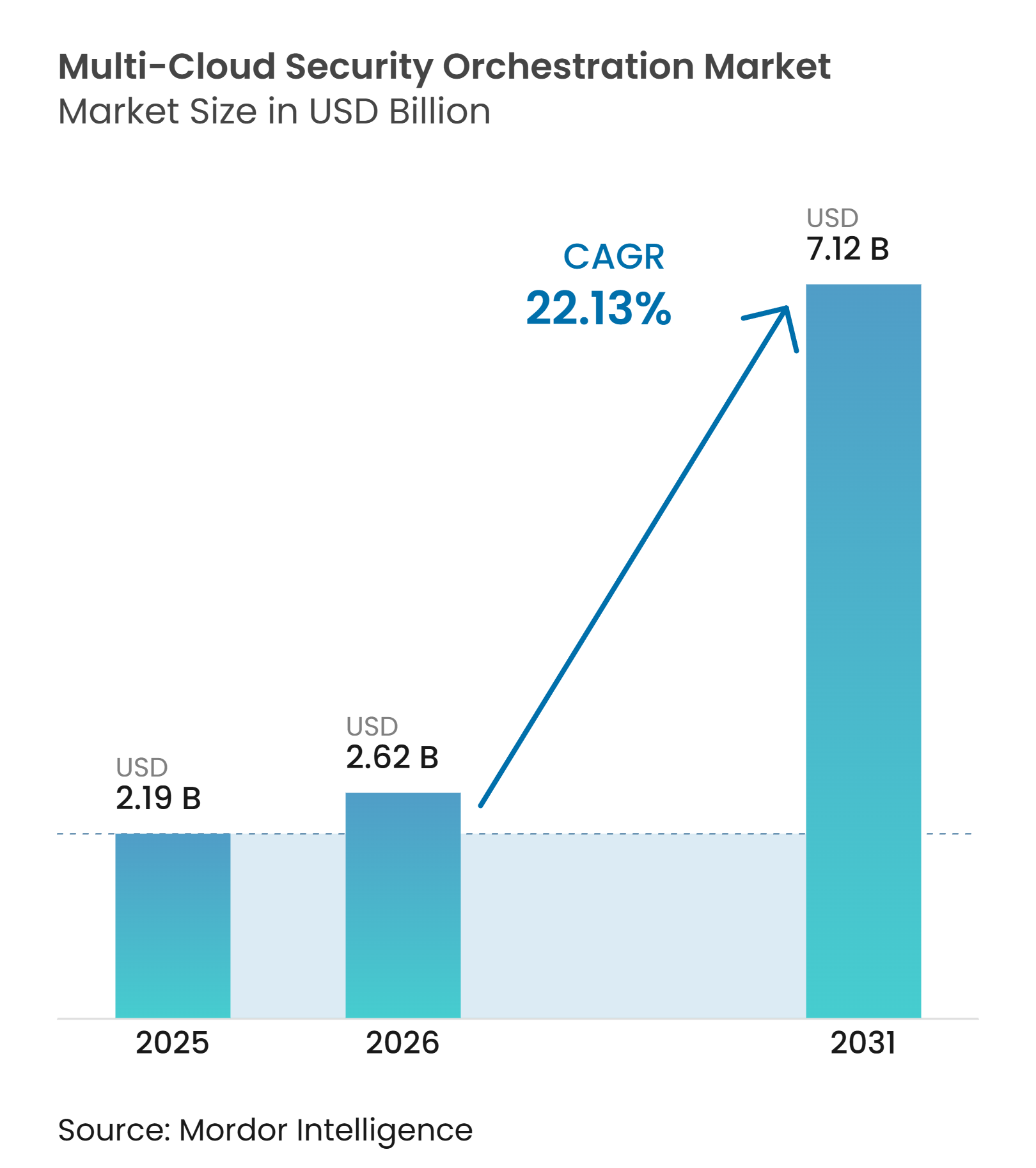
The multi-cloud security orchestration market size is projected to be USD 2.19 billion in 2025, USD 2.62 billion in 2026, and reach USD 7.12 billion by 2031, growing at a CAGR of 22.13% from 2026 to 2031. Enterprises are treating multi-cloud security as a spending priority because workloads across multiple cloud providers create exposure that isolated tools cannot consistently monitor. Each new cloud service adds an exposure point and another stream of security data, which increases the value of systems that can organize information and trigger responses quickly. AI agents are changing the role of orchestration by supporting triage, investigation, and remediation within approved workflows. Competition is moving toward broader data coverage, AI capability, and integration depth, while implementation challenges continue to favor established providers and managed service channels.
Key Report Takeaways
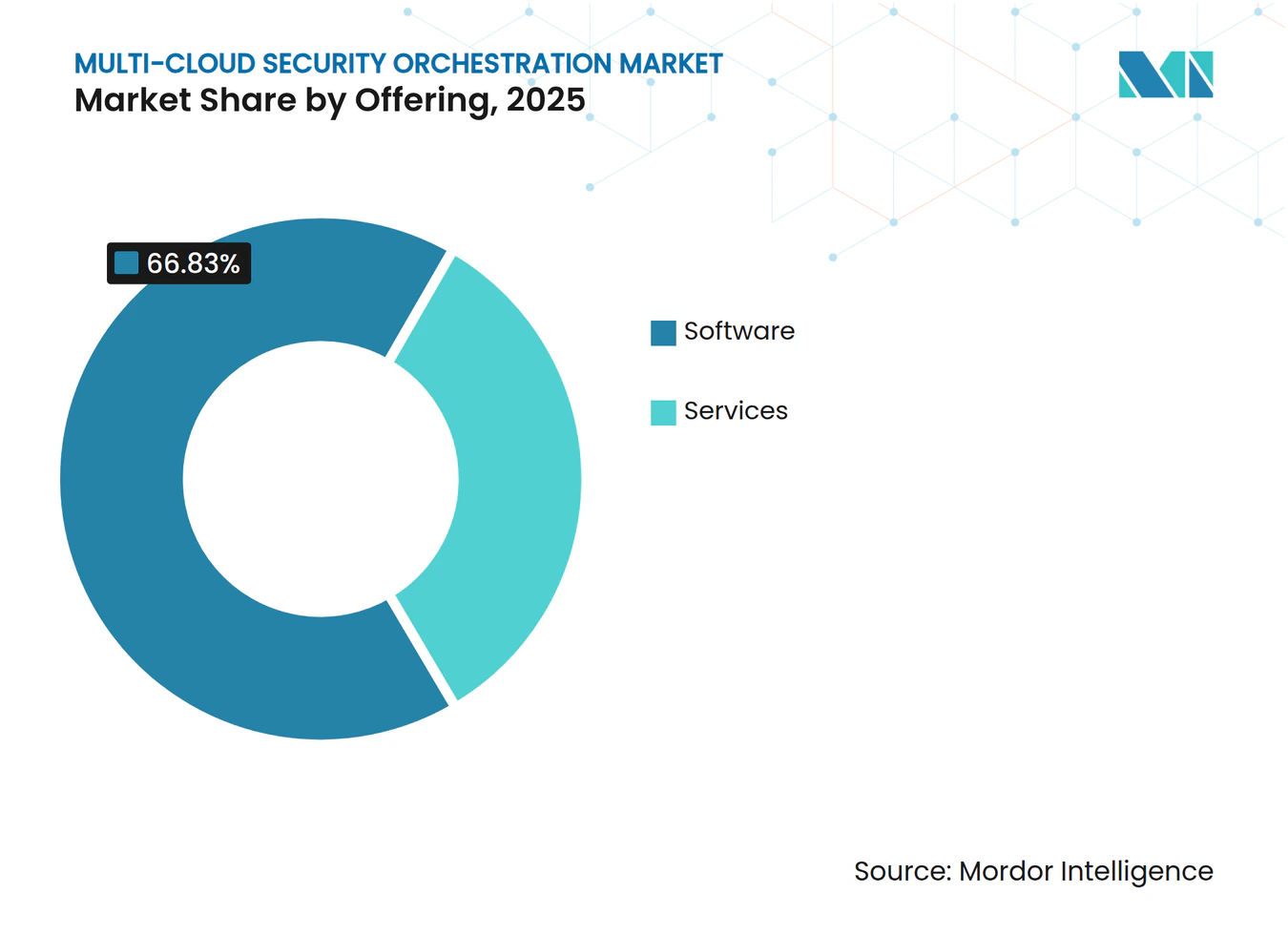
- By offering, software held 66.83% of the multi-cloud security orchestration market in 2025, while services are projected to expand at a 24.91% CAGR through 2031.
- By orchestration function, security posture and compliance orchestration accounted for 26.19% in 2025, while security operations orchestration is projected to grow at a 24.11% CAGR through 2031.
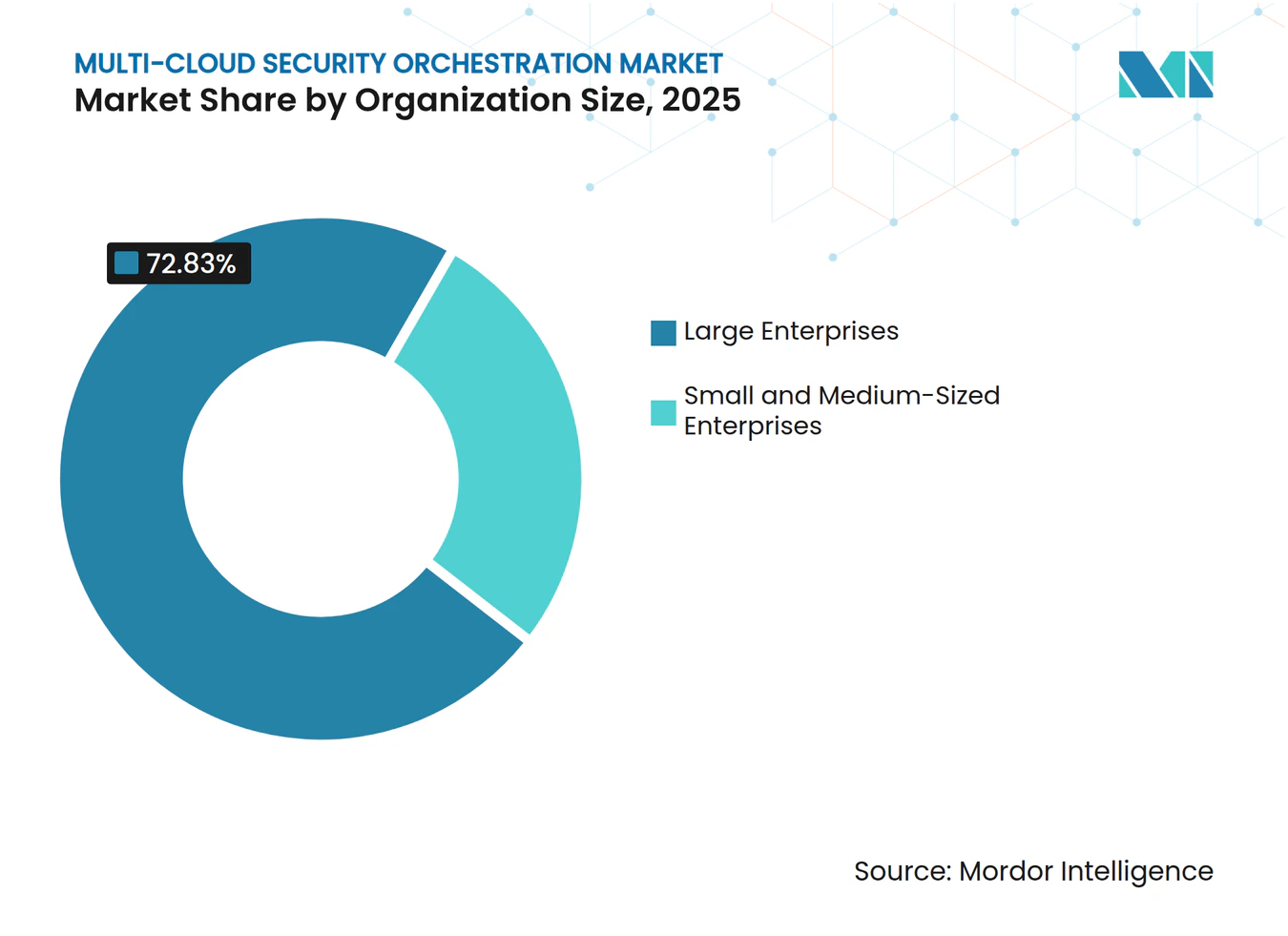
- By organization size, large enterprises held 72.83% in 2025, while small and medium-sized enterprises are projected to advance at a 26.49% CAGR through 2031.
- By end-user industry, BFSI accounted for 24.76% in the multi-cloud security orchestration market in 2025, while the healthcare and life sciences industry is projected to expand at a 23.94% CAGR through 2031.
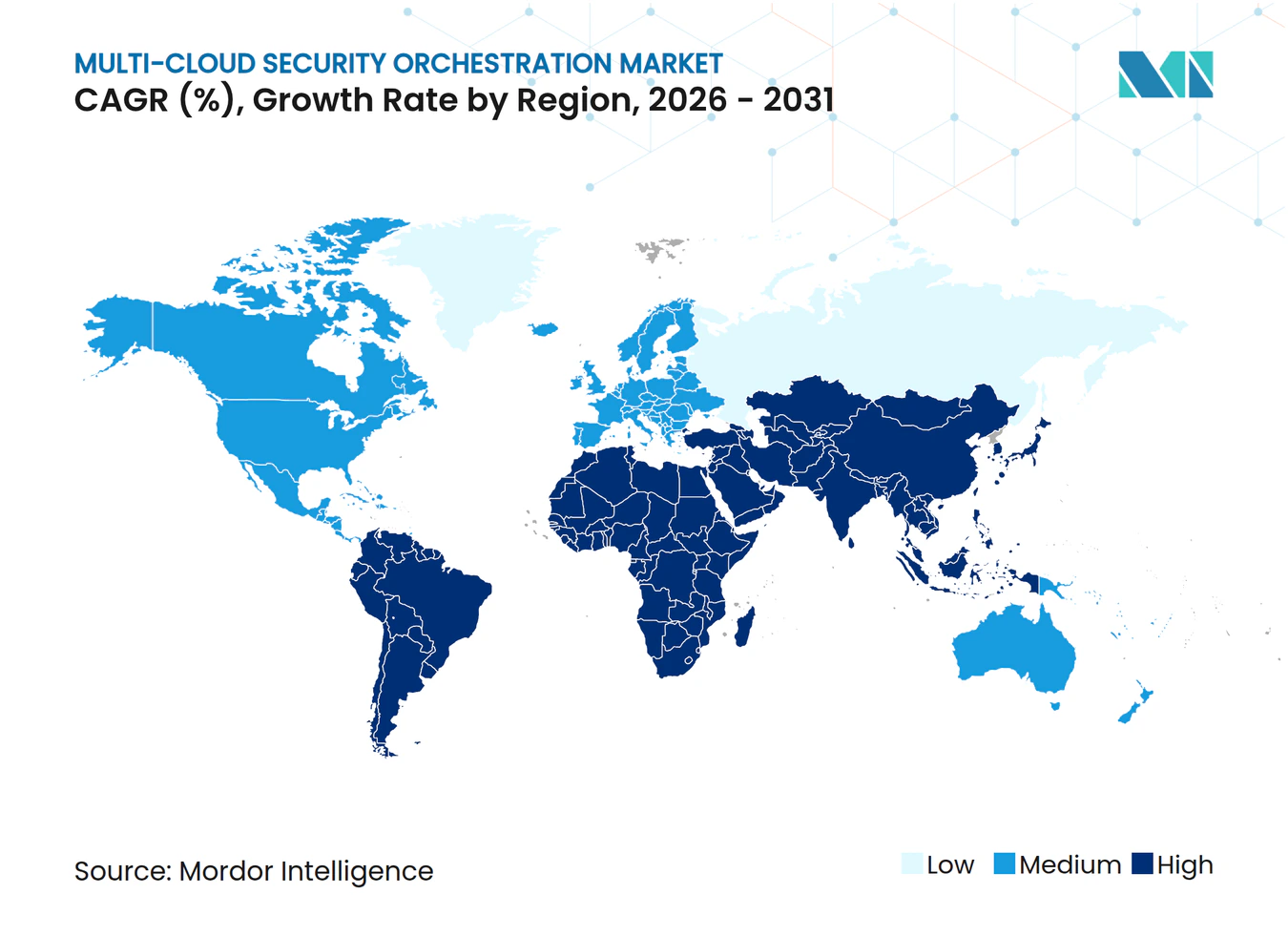
- By geography, North America held 36.28% in the multi-cloud security orchestration market in 2025, while Asia-Pacific is projected to grow at 28.67% CAGR through 2031.
Note: Market size and forecast figures in this report are generated using Mordor Intelligence’s proprietary estimation framework, updated with the latest available data and insights as of 2026.
Market Trends and Insights
Drivers Impact Analysis of Multi-Cloud Security Orchestration Market*
| Driver | (~) % Impact on CAGR Forecast | Geographic Relevance | Impact Timeline |
|---|---|---|---|
| Rising Multi-Cloud Complexity and Security Tool Sprawl | +4.8% | Global, with peak intensity in North America and Europe | Short term (≤ 2 years) |
| Increasing Cloud-Native Threat Volume and Attack-Path Exposure | +4.2% | Global, amplified in Asia-Pacific and North America | Short term (≤ 2 years) |
| Regulatory Demand for Continuous, Auditable Response | +3.6% | Europe, North America, and Asia-Pacific | Medium term (2-4 years) |
| Cybersecurity Talent Shortages and Alert-Fatigue Reduction | +3.1% | Global | Short term (≤ 2 years) |
| Growing Need for Unified Cross-Cloud Visibility and Risk Correlation | +2.4% | Global, especially North America and Asia-Pacific enterprises | Medium term (2-4 years) |
| Policy Drift Between Infrastructure as Code and Runtime Environments | +1.8% | Global, with early gains in North America, the United Kingdom, and Singapore | Long term (≥ 4 years) |
| Source: Mordor Intelligence | |||
Rising Multi-Cloud Complexity and Security Tool Sprawl
Organizations using several cloud providers must manage different application interfaces, logging formats, and identity systems. This makes it difficult for security teams to compare events across Amazon Web Services, Microsoft Azure, and Google Cloud. The multi-cloud security orchestration market benefits when buyers need one process for collecting, organizing, and responding to this data. Tool sprawl also makes platform consolidation more attractive because separate products often maintain distinct alert formats and operational processes. Providers with extensive prebuilt integrations can shorten deployment work and protect their position in enterprise accounts. The 2025 SANS SOC Survey found that 42% of security operations centers ingested data into SIEM systems without a plan to retrieve or manage it, showing that data management problems often begin before the response stage.[1]
Increasing Cloud-Native Threat Volume and Attack-Path Exposure
Cloud environments introduce security challenges that differ from those of traditional endpoint and network incidents. Misconfigured storage, excessive permissions, and container escape can combine across systems, making isolated alerts difficult to interpret. This supports demand in the multi-cloud security orchestration market for systems that link infrastructure settings, identity permissions, application behavior, and runtime activity. Wiz introduced its AI Application Protection Platform in March 2026 to connect code, cloud resources, models, agents, data, and runtime protection in its Security Graph.[2] The product reflects buyer interest in identifying connected attack paths rather than reviewing each misconfiguration individually. As automated attacks move faster, organizations have greater reason to use workflows that help analysts investigate and prioritize risk across their cloud estate.
Regulatory Demand for Continuous, Auditable Response
Regulatory requirements are increasing the need for security records that are complete, timely, and easy to review. The Digital Operational Resilience Act took effect on January 17, 2025, and requires covered financial entities to maintain documented information and communication technology risk management arrangements. It also establishes reporting obligations for major information and communication technology incidents, making manual evidence collection less practical for large cloud environments. NIST released Cybersecurity Framework 2.0 in February 2024, adding the Govern function to help organizations incorporate cybersecurity into wider organizational risk management. These frameworks support spending on platforms that maintain evidence and response records across several cloud environments. Financial services, healthcare, and other regulated buyers may therefore prioritize continuous monitoring over periodic assessments when selecting a multi-cloud security orchestration market solution.
Cybersecurity Talent Shortages and Alert-Fatigue Reduction
Security teams must manage a growing number of alerts while finding and retaining experienced analysts. Repetitive triage work can reduce the time available for higher-risk investigations and environment-specific decisions. This creates demand for orchestration tools that classify common alerts and send only validated issues to human teams. The multi-cloud security orchestration market also benefits, as managed security providers can operate complex platforms for customers with limited internal capabilities. Automated workflows can preserve consistent handling of known cases when staff members change roles or leave the organization. Buyers are likely to value practical reductions in repetitive workload alongside conventional measures such as response time and cost per incident.
Restraints Impact Analysis of Multi-Cloud Security Orchestration Market*
| Restraint | (~) % Impact on CAGR Forecast | Geographic Relevance | Impact Timeline |
|---|---|---|---|
| Limited Standardization Across Cloud Security Controls | -3.2% | Global, most acute in Asia-Pacific and South America | Medium term (2-4 years) |
| Data Privacy and Sovereignty Constraints on Centralized Security Telemetry | -2.7% | Europe, China, India, and the Middle East | Long term (≥ 4 years) |
| Complexity of Legacy Security Tool Integration | -2.1% | Global, highest among large enterprises and government organizations | Short term (≤ 2 years) |
| Fragmented Cloud APIs and Rapidly Changing Cloud Services | -1.6% | Global | Medium term (2-4 years) |
| Source: Mordor Intelligence | |||
Limited Standardization Across Cloud Security Controls
Major cloud providers use their own security controls, event formats, policy languages, and application interfaces. A control mapped for one provider may need separate configuration and testing for another. This adds work for vendors and customers that want to apply common controls across a multi-cloud environment. The lack of a universal framework for cloud security controls can extend deployments and increase ongoing maintenance requirements. It can also lead buyers to depend on proprietary connectors, even when they want portability between providers. These limitations can slow the multi-cloud security orchestration market where organizations have complex environments and limited implementation resources.
Data Privacy and Sovereignty Constraints on Centralized Security Telemetry
Centralized orchestration often relies on collecting logs, event streams, and identity data in a shared data environment. Data residency requirements can restrict where that information is processed and stored. The General Data Protection Regulation applies to personal data in security logs, while China applies local requirements to data generated within its territory. India’s Digital Personal Data Protection Act and sovereign cloud requirements in Gulf Cooperation Council countries create related planning considerations. These rules can require hybrid designs that retain raw information locally and send only permitted or aggregated signals to a broader control plane. The added design, governance, and deployment work can slow adoption in the multi-cloud security orchestration market, even when buyers recognize its security benefits.
*Our forecasts treat driver/restraint impacts as directional, not additive. The impact forecasts reflect baseline growth, mix effects, and variable interactions.
Multi-Cloud Security Orchestration Market Segment Analysis
By Offering:
Platforms Lead Adoption, Services Support DeploymentSoftware held 66.83% of the multi-cloud security orchestration market share in 2025. Enterprises often favor consolidated licensing because cross-domain correlation works best when policy enforcement, posture management, and response automation use a shared data model. A common control plane can help security teams connect information that would otherwise remain in separate software products. CrowdStrike announced in August 2026 that Falcon was available on Google Cloud, allowing customers to retain unified platform management while addressing data localization needs. This type of platform coverage supports software demand as organizations reduce the number of security vendors. Software providers must still demonstrate that their integrations work across the tools customers already use.
Services are projected to grow at a 24.91% CAGR from 2026 to 2031. The multi-cloud security orchestration services market is expanding because many customers need support with configuring connectors, creating workflows, and operating new response processes. This need is especially relevant for mid-market organizations, public sector buyers, and regulated users in developing cloud environments. Managed security service providers can package orchestration technology with monitoring and response support, reducing the technical burden on the end customer. Professional services also remain important for implementation, security program design, and customization of orchestration workflows. These channels can extend adoption to organizations that cannot maintain specialized internal teams.


By Orchestration Function:
Compliance Spending Leads, Security Operations Grow FasterSecurity posture and compliance orchestration held 26.19% of the multi-cloud security orchestration market share in 2025. Continuous evidence collection has become more important as regulated organizations need to show that their cloud settings and controls remain effective. DORA requires covered financial entities to maintain a documented and tested information and communication technology risk management framework. This makes automated scanning and evidence collection important for financial services technology environments. Security posture tools also help teams identify configuration changes before they become audit or operational problems. The function remains important because compliance work is recurring rather than limited to a one-time review.
Security operations orchestration is projected to grow at a 24.11% CAGR from 2026 to 2031. AI-supported investigation workflows are increasing interest in systems that can triage alerts, gather context, and route actions through approved processes. Identity and access security orchestration is also gaining importance because zero-trust programs require more frequent checks of human and machine identities. Workload and application security orchestration are affected by containerized applications and Kubernetes clusters that create short-lived workloads. Security policy and control orchestration are increasingly converging with threat detection and response functions as vendors embed detection logic into response workflows. These changes encourage buyers to assess functions as interconnected parts of a single operating model rather than as separate security purchases.
By Organization Size:
Large Enterprises Lead, SMEs Expand Through Managed ServicesLarge enterprises held 72.83% of the multi-cloud security orchestration market in 2025. Their scale reflects multi-vendor security stacks, dedicated security operations centers, and compliance requirements across clouds, on-premises, and identity environments. These organizations typically have sufficient telemetry and internal process maturity to make broader orchestration programs practical. CrowdStrike introduced Charlotte AI AgentWorks in September 2025 as a no-code capability for building, testing, and orchestrating trusted security agents.[3] The release illustrates the product development pace aimed at large enterprises with established security data layers. Large buyers also remain attractive because they can consolidate several security functions under a smaller group of providers.
Small and medium-sized enterprises are projected to grow at 26.49% CAGR from 2026 to 2031. Many smaller organizations now rely on cloud applications for core business processes but lack dedicated controls beyond those included with software subscriptions. This gap gives managed security providers a route to supply orchestration without requiring each customer to build a full internal security operations capability. Subscription pricing and application interface-based onboarding can make adoption more manageable for smaller information technology teams. The cloud security orchestration industry is therefore expanding its reach through service models as well as through direct software sales. Providers that simplify setup and ongoing operation will be better positioned to serve this customer group.

By End-User Industry:
BFSI Leads Demand, Healthcare Grows QuicklyBFSI held 24.76% of the multi-cloud security orchestration market in 2025. Financial institutions face a dense set of compliance obligations, including DORA, PCI DSS, and the SWIFT Customer Security Program. These requirements make continuous monitoring and documented response particularly important at the transaction volumes handled by financial institutions. DORA also requires covered entities to identify, classify, and report major information and communication technology incidents under defined conditions. A coordinated control environment can help these organizations manage security evidence across multiple cloud services. This gives BFSI a stable role in the cloud security orchestration market.
The healthcare and life sciences industry is projected to grow at a 23.94% CAGR from 2026 to 2031. The U.S. Department of Health and Human Services published a proposed update to the HIPAA Security Rule on January 6, 2025.[4] The proposal would make encryption, multifactor authentication, and network segmentation mandatory technical safeguards rather than addressable measures. Government and public administration, information technology and telecommunications, and energy and utilities are also significant users because national cybersecurity programs increasingly call for continuous compliance automation. Manufacturing, retail, and e-commerce are gaining relevance as operational technology and cloud-managed supply chains become more connected. Transportation and logistics, media and entertainment, and education and research remain smaller user groups, in which adoption may follow a breach or an audit requirement.
Geography Analysis
North America Multi-Cloud Security Orchestration Market
North America held 36.28% of the multi-cloud security orchestration market in 2025. The United States accounted for much of this demand because it has a large base of cloud-native enterprises and many major platform providers. Federal security expectations, the Securities and Exchange Commission's cyber disclosure requirements, and the NIST Cybersecurity Framework 2.0 support the demand for auditable response processes. Canada and Mexico support regional growth through cloud adoption in financial services and energy. In September 2026, Palo Alto Networks announced its acquisition of Console to add agentic capabilities to Cortex, illustrating the pace of regional product activity.
Europe and South America Multi-Cloud Security Orchestration Market
Europe was the second-largest geographic area in 2025. DORA and NIS2 have increased demand for platforms that can map controls across related but distinct regulatory obligations. NIS2 expanded cybersecurity requirements for essential entities across the European Union.[5] The first mandatory threat-led penetration testing cycles under DORA began in 2026, increasing the need for complete records of response activities. Requirements for cloud sovereignty in France and Germany support hybrid designs, while Brazil’s financial technology sector and data protection needs support South American demand.
APAC and MEA Multi-Cloud Security Orchestration Market
Asia-Pacific is projected to grow at a 28.67% CAGR from 2026 to 2031. Japan is increasing the use of AI and machine learning in security workflows, while India’s data protection framework and expanding financial technology activity support cloud security procurement. China’s data localization requirements create a distinct domestic environment that is served mainly by local suppliers. The Middle East and Africa are developing through demand in the public sector, financial services, government, and managed services.
Competitive Landscape
Market Concentration
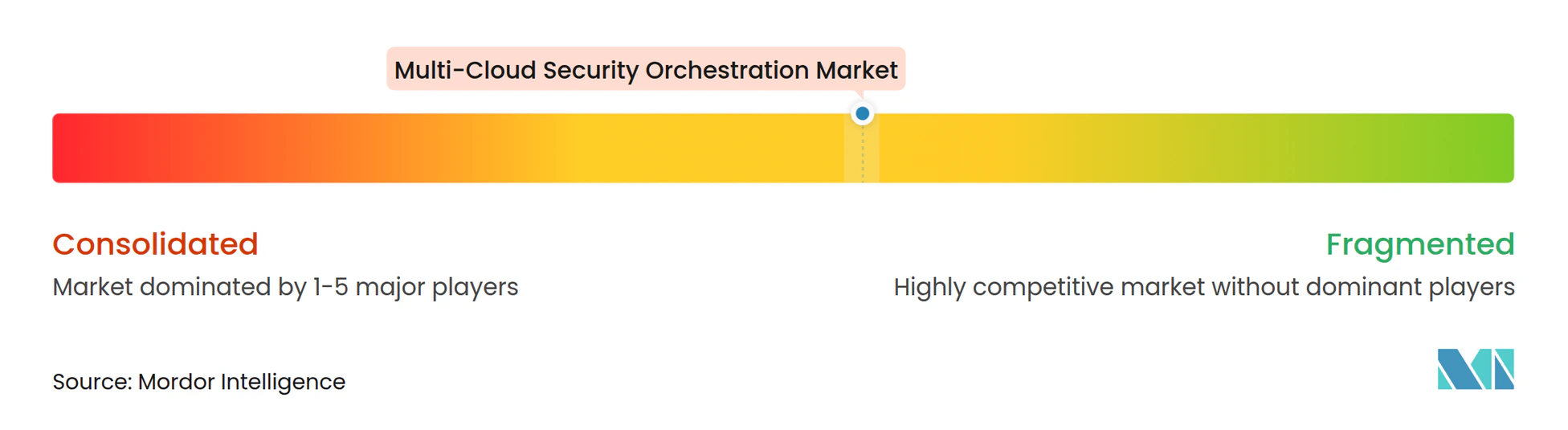
The multi-cloud security orchestration market is moderately concentrated among large platform providers, while the middle tier remains fragmented. Palo Alto Networks, Microsoft, CrowdStrike, Cisco Systems, Fortinet, and IBM compete for enterprise consolidation programs. Their principal advantage is broad telemetry across endpoints, identities, cloud workloads, and network layers. That coverage can help customers connect events from several stages of an attack. Alphabet completed its USD 32 billion acquisition of Wiz in March 2026, while Palo Alto Networks announced its acquisition of Console in September 2026.[6]
Competitive strategies increasingly center on agentic security operations. CrowdStrike launched Falcon IQ in August 2026, featuring more than 50 AI agents powered by NVIDIA Nemotron models for assessment, prioritization, and remediation. Wiz launched Wiz Workflows in public preview in March 2026, combining Security Graph context, AI agents, and more than 250 integrations to enable multi-step workflows. CrowdStrike also expanded Falcon Cloud Security coverage to Azure and Google Cloud in June 2026, extending multi-cloud risk correlation beyond Amazon Web Services. These moves show that providers are competing on the depth of automation, data context, and cloud coverage.
Mid-tier providers such as Swimlane, Tines, and Torq continue to focus on no-code automation and vendor-neutral integration. Their position depends on serving customers who do not want to rely on a single broad platform. A gap remains in portable policy execution across the major cloud providers, giving buyers a reason to keep integration flexibility in their evaluation criteria. The multi-cloud security orchestration market remains open to specialized providers, but they face increasing pressure from firms with broader data and distribution resources.
Multi-Cloud Security Orchestration Industry Leaders
-
Palo Alto Networks, Inc.
-
Microsoft Corporation
-
Cisco Systems, Inc.
-
Fortinet, Inc.
-
Alphabet Inc.
- *Disclaimer: Major Players sorted in no particular order
Multi-Cloud Security Orchestration Market Companies Covered in this Report
- Palo Alto Networks, Inc.
- Microsoft Corporation
- Cisco Systems, Inc.
- Fortinet, Inc.
- Alphabet Inc.
- IBM Corporation
- Broadcom Inc.
- Check Point Software Technologies Ltd.
- Trend Micro Incorporated
- CrowdStrike Holdings, Inc.
- Wiz, Inc.
- Orca Security Ltd.
- Aqua Security Software Ltd.
- Rapid7, Inc.
- Qualys, Inc.
- Zscaler, Inc.
- Cloudflare, Inc.
- Okta, Inc.
- ServiceNow, Inc.
- Swimlane, Inc.
- Tines Security Ltd.
- Torq Technologies, Inc.
- Sumo Logic, Inc.
- Tufin Software Technologies Ltd.
- Saviynt, Inc.
- HashiCorp, Inc.
Recent Industry Developments in Multi-Cloud Security Orchestration Market
- September 2026: Wipro Limited and CrowdStrike launched the CISO Command Center, integrating endpoint security, cloud security, exposure management, and AI security through CrowdStrike's Falcon platform and Wipro's CyberTransform and CyberShield solutions. Wipro simultaneously joined Project QuiltWorks, reinforcing the shift from tool-driven to risk-led enterprise security operating models at consulting-led scale.
- September 2026: Palo Alto Networks announced the acquisition of Console, an AI-native platform enabling agentic security capabilities. Console will deepen agentic functionality in Cortex, enabling natural-language-driven alert investigation, prioritization, and remediation at machine speed, the company's formal transition toward software-as-an-agent security architecture.
- August 2026: CrowdStrike launched Falcon IQ at Fal.Con 2026, productizing Project QuiltWorks into a commercially deployable agentic security platform. Falcon IQ uses more than 50 AI agents powered by NVIDIA Nemotron models to automate assessment, vulnerability prioritization, and remediation across the CrowdStrike partner ecosystem. The launch simultaneously expanded Project QuiltWorks with telemetry from 12 additional data sources including Zscaler and Rubrik.
- June 2026: CrowdStrike expanded Falcon Cloud Security to cover Cloud Risks, a feature correlating multiple cloud exposures into potential breach paths, across Azure and Google Cloud. Cloud Infrastructure Entitlement Management capabilities were simultaneously extended to Azure.
- March 2026: Wiz launched the AI Application Protection Platform, combining visibility, cross-layer risk analysis, and runtime protection for AI-native applications across code, cloud, models, agents, and data. The platform introduced 3 specialized orchestration agents, Red, Green, and Blue, operating within a shared Security Graph for attacker simulation, remediation, ownership determination, and threat investigation.
Global Multi-Cloud Security Orchestration Market Report Scope
The multi-cloud security orchestration market comprises platforms that provide unified security policy management, governance, and operational visibility across multiple cloud providers (AWS, Azure, GCP, and others) from a centralized control plane. This market addresses the complexity of maintaining a consistent security posture, compliance, and threat response across heterogeneous cloud environments by federating identity management, aggregating logs and telemetry, enforcing uniform security policies, and automating coordinated incident response across clouds. Solutions enable organizations to implement centralized monitoring, consistent RBAC and access controls, unified encryption and key management, and cross-cloud security automation, while maintaining cloud-native integrations with provider-specific services such as AWS Security Groups, Azure NSGs, and Google Cloud Firewall Rules.
The Multi-Cloud Security Orchestration Market Report is Segmented by Offering (Software, and Services [Professional Services, and Managed Security Services]), Orchestration Function (Security Policy and Control Orchestration, Security Operations Orchestration, Security Posture and Compliance Orchestration, Identity and Access Security Orchestration, Workload and Application Security Orchestration, Threat Detection and Response Orchestration, and Other Orchestration Functions), Organization Size (Large Enterprises, and Small and Medium-Sized Enterprises), End Use Industry (Government and Public Administration, Industrial Manufacturing, Retail and E-Commerce, Transportation and Logistics, Energy and Utilities, IT and Telecommunication, Media and Entertainment, Education and Research Institutions, Healthcare and Life Sciences, Banking, Financial Services, and Insurance (BFSI), and Other End Use Industries), and Geography (North America, South America, Europe, Asia-Pacific, Middle East, and Africa). The Market Forecasts are Provided in Terms of Value (USD).
Segmentation Overview
| Software | |
| Services | Professional Services |
| Managed Security Services |
| Security Policy and Control Orchestration |
| Security Operations Orchestration |
| Security Posture and Compliance Orchestration |
| Identity and Access Security Orchestration |
| Workload and Application Security Orchestration |
| Threat Detection and Response Orchestration |
| Other Orchestration Functions |
| Large Enterprises |
| Small and Medium-Sized Enterprises |
| Government and Public Administration |
| Industrial Manufacturing |
| Retail and E-Commerce |
| Transportation and Logistics |
| Energy and Utilities |
| IT and Telecommunication |
| Media and Entertainment |
| Education and Research Institutions |
| Healthcare and Life Sciences |
| Banking, Financial Services, and Insurance (BFSI) |
| Other End Use Industries |
| North America | United States |
| Canada | |
| South America | Brazil |
| Argentina | |
| Rest of South America | |
| Europe | United Kingdom |
| Germany | |
| France | |
| Italy | |
| Spain | |
| Rest of Europe | |
| Asia-Pacific | China |
| Japan | |
| India | |
| South Korea | |
| Australia | |
| Singapore | |
| Rest of Asia-Pacific | |
| Middle East | United Arab Emirates |
| Saudi Arabia | |
| Turkey | |
| Israel | |
| Rest of Middle East | |
| Africa | South Africa |
| Nigeria | |
| Egypt | |
| Rest of Africa |
| By Offering | Software | |
| Services | Professional Services | |
| Managed Security Services | ||
| By Orchestration Function | Security Policy and Control Orchestration | |
| Security Operations Orchestration | ||
| Security Posture and Compliance Orchestration | ||
| Identity and Access Security Orchestration | ||
| Workload and Application Security Orchestration | ||
| Threat Detection and Response Orchestration | ||
| Other Orchestration Functions | ||
| By Organization Size | Large Enterprises | |
| Small and Medium-Sized Enterprises | ||
| By End Use Industry | Government and Public Administration | |
| Industrial Manufacturing | ||
| Retail and E-Commerce | ||
| Transportation and Logistics | ||
| Energy and Utilities | ||
| IT and Telecommunication | ||
| Media and Entertainment | ||
| Education and Research Institutions | ||
| Healthcare and Life Sciences | ||
| Banking, Financial Services, and Insurance (BFSI) | ||
| Other End Use Industries | ||
| By Geography | North America | United States |
| Canada | ||
| South America | Brazil | |
| Argentina | ||
| Rest of South America | ||
| Europe | United Kingdom | |
| Germany | ||
| France | ||
| Italy | ||
| Spain | ||
| Rest of Europe | ||
| Asia-Pacific | China | |
| Japan | ||
| India | ||
| South Korea | ||
| Australia | ||
| Singapore | ||
| Rest of Asia-Pacific | ||
| Middle East | United Arab Emirates | |
| Saudi Arabia | ||
| Turkey | ||
| Israel | ||
| Rest of Middle East | ||
| Africa | South Africa | |
| Nigeria | ||
| Egypt | ||
| Rest of Africa | ||
Key Questions Answered in the Report
What is the multi-cloud security orchestration market size?
The multi-cloud security orchestration market size is projected to be USD 2.19 billion in 2025, USD 2.62 billion in 2026, and reach USD 7.12 billion by 2031, growing at a CAGR of 22.13% from 2026 to 2031.
What is driving demand for multi-cloud security orchestration?
Multi-cloud complexity, cloud-native threats, continuous compliance needs, and limited security staffing are supporting adoption.
Which offering leads cloud security orchestration spending?
Software led with 66.83% in 2025, while services are projected to grow at a 24.91% CAGR through 2031.
Which end-user group has the largest demand?
BFSI led with 24.76% in 2025 because financial institutions face extensive monitoring and response obligations.
Which region is growing fastest?
Asia-Pacific is projected to grow at a 28.67% CAGR from 2026 to 2031.
How are AI agents affecting security orchestration?
Providers are using AI agents to support alert assessment, investigation, prioritization, and remediation in approved workflows.