
Managed Cloud Security Operations Services Market Size and Share
Market Overview
| Study Period | 2021 - 2032 |
|---|---|
| Market Size (2027) | USD 18.99 Billion |
| Market Size (2032) | USD 34.11 Billion |
| Growth Rate (2027 - 2032) | 12.43 % |
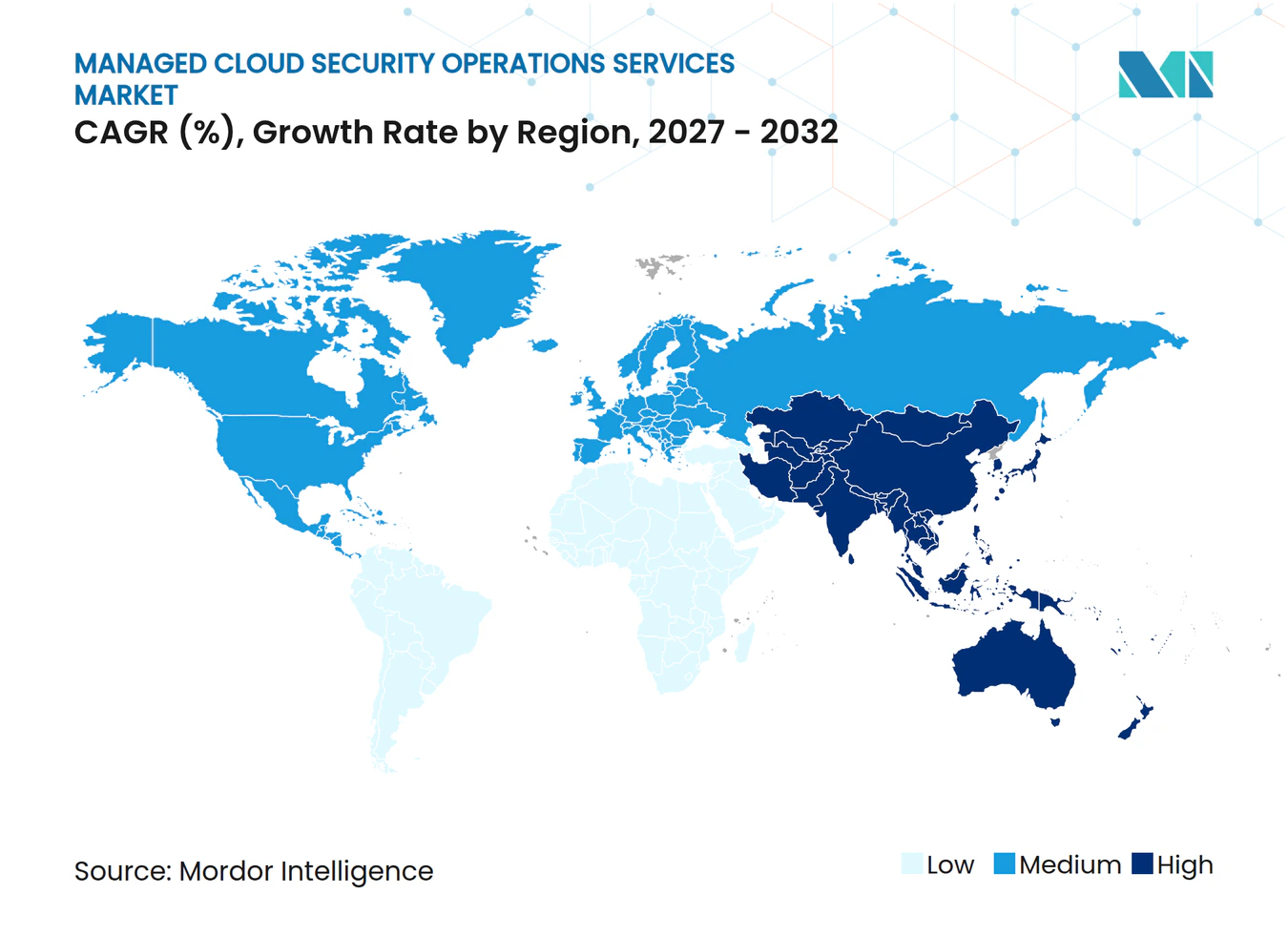
| Fastest Growing Market | Asia-Pacific |
| Largest Market | North America |
| Market Concentration | Medium |
Major Players *Disclaimer: Major Players sorted in no particular order Image © Mordor Intelligence. Reuse requires attribution under CC BY 4.0. | |
Managed Cloud Security Operations Services Market Analysis by Mordor Intelligence
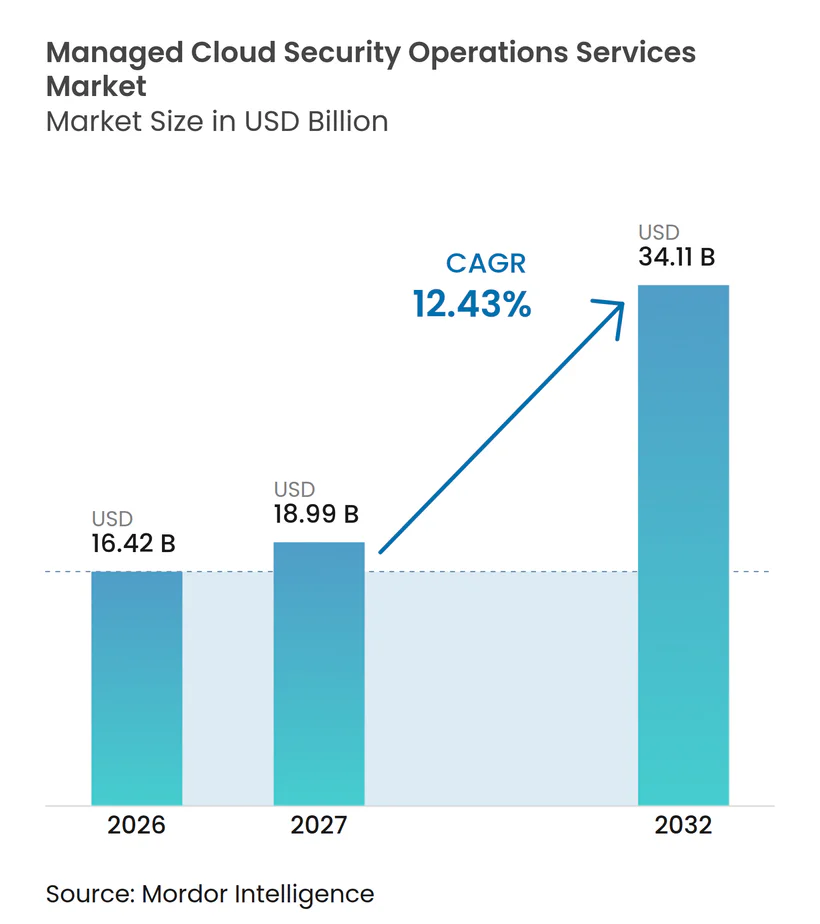
The Managed Cloud Security Operations Services market size is valued at USD 16.42 billion in 2026 and is projected to reach USD 34.11 billion by 2032, expanding at a CAGR of 12.43% from 2027 to 2032. The Managed Cloud Security Operations Services market is being shaped by enterprises moving security operations from internal teams toward subscription-based services with defined response outcomes. Misconfigurations, identity permissions, and containerized workloads have widened the cloud attack surface across hybrid environments. Providers that can monitor AWS, Microsoft Azure, and Google Cloud through a common operating model can reduce the operational burden on customer teams. Sovereign delivery requirements are also creating local service opportunities where data processing and encryption control must stay within a jurisdiction. Competition is shifting toward cloud telemetry depth, automation, and compliance reporting, while economic uncertainty can still delay purchases among midmarket buyers.
Key Report Takeaways
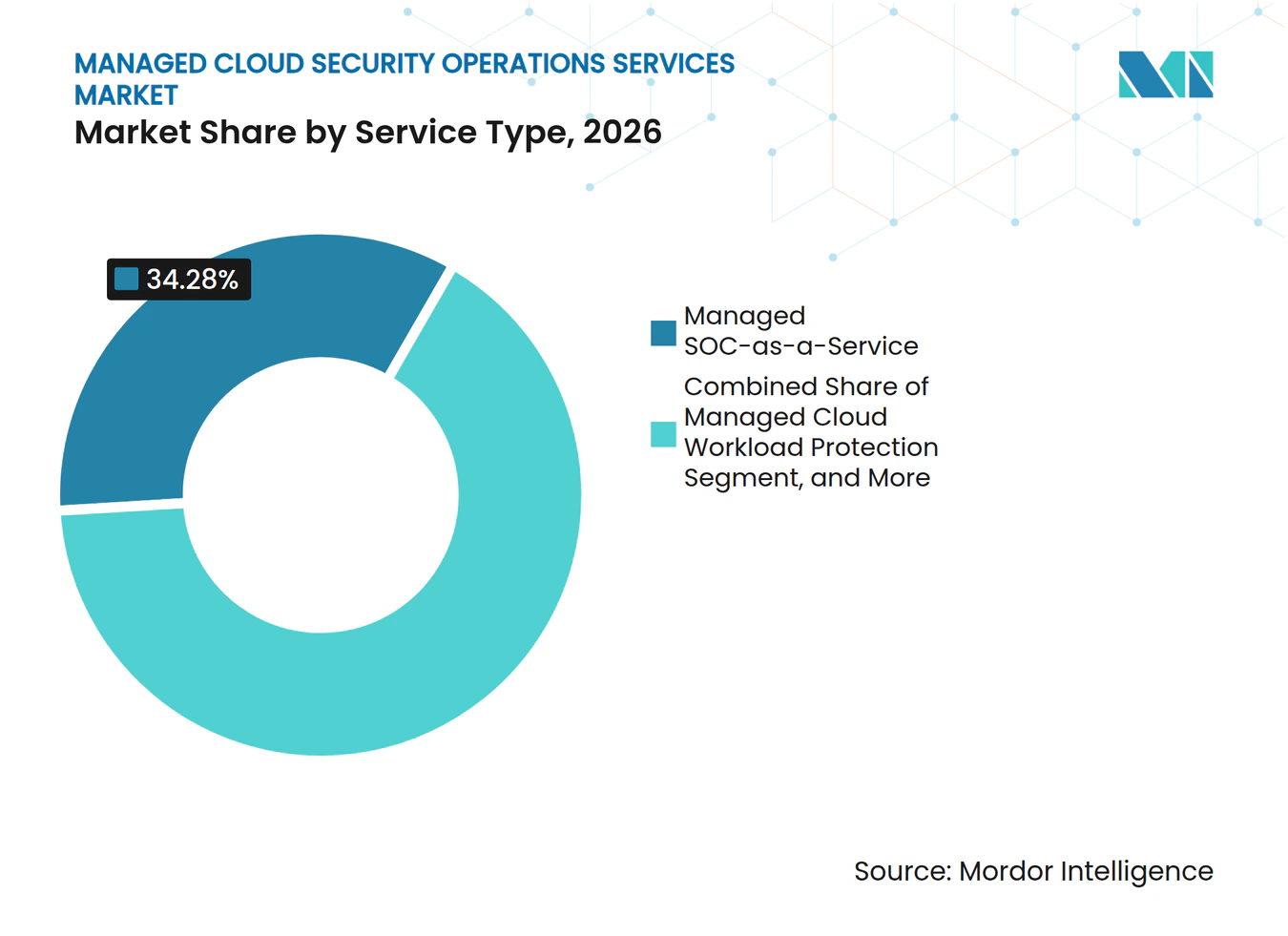
- By service type, Managed SOC-as-a-Service held 34.28% of the Managed Cloud Security Operations Services market share in 2026, while Container and Kubernetes Security Management is projected to expand at a 12.88% CAGR through 2032.
- By delivery model, Fully Managed Services held 56.11% of the Managed Cloud Security Operations Services market share in 2026, while Sovereign or In-Country Managed Services is projected to expand at a 12.67% CAGR through 2032.
- By deployment model, Public Cloud accounted for 58.16% of the Managed Cloud Security Operations Services market size in 2026, while Hybrid Cloud is projected to expand at a 12.92% CAGR through 2032.
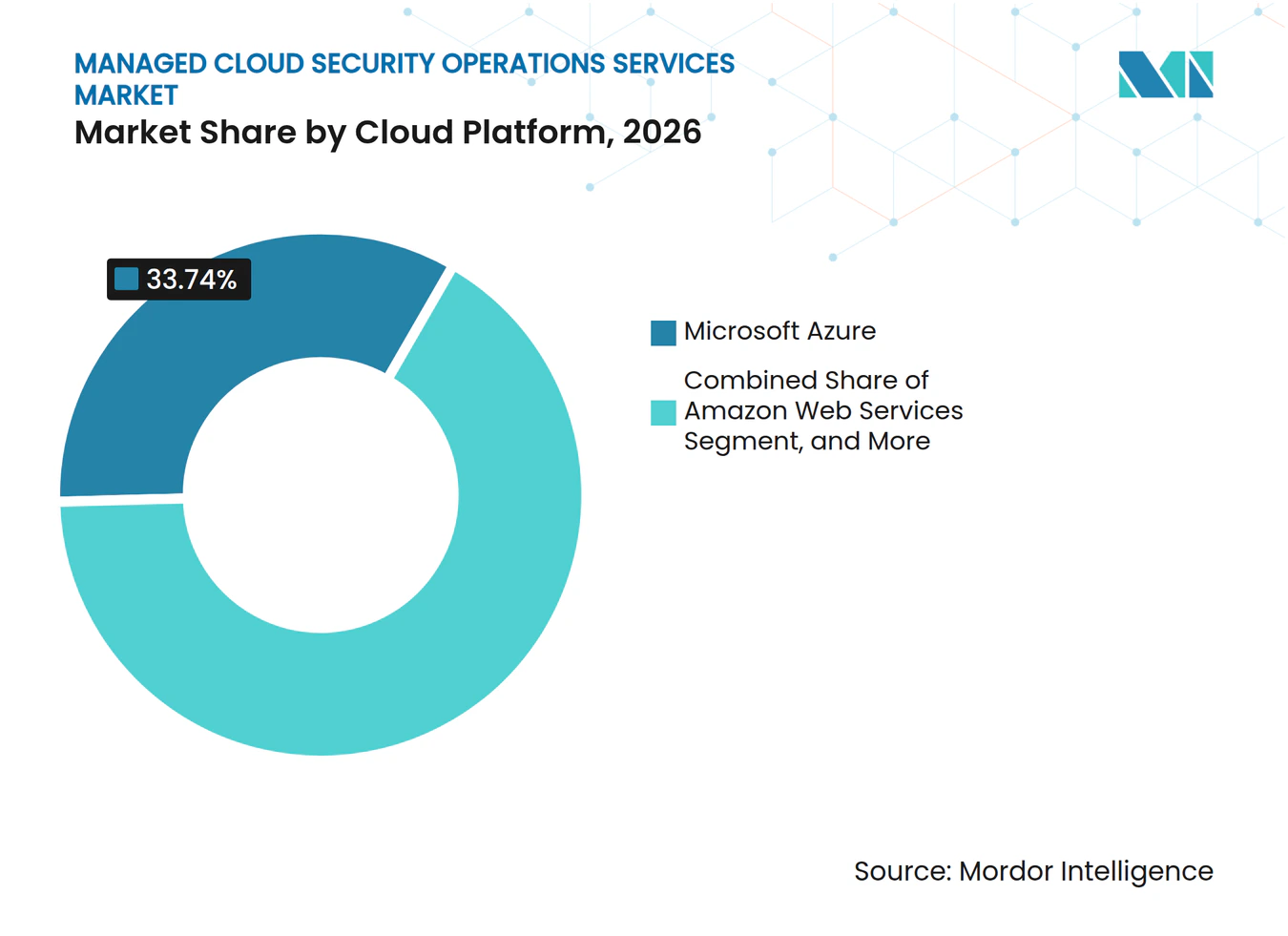
- By cloud platform, Microsoft Azure held 33.74% in 2026, while Google Cloud is projected to expand at a 13.14% CAGR through 2032.
- By end-user industry, Banking, Financial Services, and Insurance accounted for 24.18% in 2026, while Government and Defense is projected to expand at a 13.27% CAGR through 2032.
- By geography, North America accounted for 43.91% in 2026, while Asia-Pacific is projected to expand at a 13.24% CAGR through 2032.
Note: Market numbers in this report are based on Mordor Intelligence's proprietary estimation framework, which combines nine months of actuals with Q4 projections for base year 2026.
Market Trends and Insights
Drivers Impact Analysis of Managed Cloud Security Operations Services Market*
| Driver | (~) % Impact on CAGR Forecast | Geographic Relevance | Impact Timeline |
|---|---|---|---|
| Escalating Multi-Vector Cloud Cyberattacks | +2.8% | Global, concentrated in North America and Europe | Short term (≤ 2 years) |
| Expanding Hybrid and Multi-Cloud Attack Surfaces | +2.2% | Global, led by North America and Asia-Pacific cloud-adoption leaders | Medium term (2-4 years) |
| Regulatory and Cyber-Insurance Demand for Continuous Monitoring | +1.9% | North America, Europe, and Asia-Pacific | Short term (≤ 2 years) |
| Cloud Security Talent Shortages and Managed SOC Economics | +2.1% | Global, most acute in North America, Western Europe, and Asia-Pacific technology hubs | Medium term (2-4 years) |
| Machine-Readable Cloud Telemetry and AI-Augmented Triage | +1.4% | Global, with early adoption in North America and Western Europe | Long term (≥ 4 years) |
| Sovereign-Cloud and Data-Residency Requirements Creating Localized SOC Demand | +1.5% | Europe, Southeast Asia, and Middle East and Africa | Medium term (2-4 years) |
| Source: Mordor Intelligence | |||
Escalating Multi-Vector Cloud Cyberattacks
Cloud infrastructure has become a major target for financially motivated and state-linked threat actors. Check Point reported that 65% of organizations experienced a cloud-related security incident during the preceding year, compared with 61% in the prior period.[1] Only 9% detected the incident within the first hour, which points to a persistent monitoring gap. Attackers can combine configuration weaknesses, broad identity permissions, and supply-chain access in one campaign. The Managed Cloud Security Operations Services market benefits when buyers need continuous correlation across accounts and regions. Behavioral analytics and real-time cloud telemetry are becoming more important than signature-only tools in provider selection.
Expanding Hybrid and Multi-Cloud Attack Surfaces
Multi-cloud and hybrid estates require security teams to interpret different logging formats and identity models. Presidio found that 78% of organizations use 2 or more cloud providers, while 54% operate hybrid environments.[2] Each additional environment can introduce separate alerts and policy structures that increase operational complexity. Research in Computers and Security identified cross-cloud threats, side-channel attacks, and API exposure gaps as specific risks in these environments. Providers with ready connectors for the major hyperscalers can reduce the effort needed to normalize this information. The Managed Cloud Security Operations Services market, therefore, increasingly serves the whole estate rather than an isolated platform. This broader scope can raise contract value where customers need one response process across cloud and on-premises systems.
Regulatory and Cyber-Insurance Demand for Continuous Monitoring
Regulatory requirements are making continuous monitoring a more direct procurement requirement in regulated sectors. The Digital Operational Resilience Act has applied to European Union financial entities since January 2025. It requires financial entities to manage information and communication technology risks and maintain related oversight processes. The Cyber Resilience Act requires manufacturers to report actively exploited vulnerabilities and severe incidents, with requirements implemented on the schedule set by the regulation.[3] Insurers also assess monitoring, response planning, and threat-hunting evidence in their risk reviews. Providers can differentiate their services through evidence packages and reporting mapped to DORA, NIS2, ISO 27001, and related requirements. This favors service offers that unite detection with governance support rather than detection alone.
Cloud Security Talent Shortages and Managed SOC Economics
Security teams face a shortage of specialized cloud and automation skills. Industry sources identify cloud security as a critical skills requirement, while cloud security and AI-related capabilities remain difficult areas for organizations to staff. Maintaining internal around-the-clock coverage requires personnel, workflows, and security tools that many midmarket firms cannot support efficiently. Managed providers can spread these costs across multiple customers and offer broader coverage. The Managed Cloud Security Operations Services market benefits from this cost and capability gap as automation reduces manual alert-handling needs.
Restraints Impact Analysis of Managed Cloud Security Operations Services Market*
| Restraint | (~) % Impact on CAGR Forecast | Geographic Relevance | Impact Timeline |
|---|---|---|---|
| Data Sovereignty and Cross-Border Log-Transfer Constraints | -1.3% | Europe, Southeast Asia, and Middle East | Short term (≤ 2 years) |
| Legacy Tool Integration and Detection-Engineering Friction | -1.0% | Global, most acute in large enterprises with complex on-premises SIEM deployments | Medium term (2-4 years) |
| Outsourcing Trust, Control, and Liability Concerns | -0.8% | Global, with heightened sensitivity in regulated industries | Long term (≥ 4 years) |
| Cloud Egress Costs and Alert-Volume Economics | -0.5% | Global, most visible in multi-cloud, high-volume log environments | Medium term (2-4 years) |
| Source: Mordor Intelligence | |||
Data Sovereignty and Cross-Border Log-Transfer Constraints
Data residency rules can limit a provider’s ability to centralize cloud logs across countries. The European Union’s General Data Protection Regulation places conditions on international transfers of personal data. A global provider may need separate regional infrastructure, local staff, and local encryption management to meet customer requirements. Those choices raise delivery costs and can reduce the scale advantages associated with centralized security operations. Limits on exporting raw telemetry can also restrict the use of a single global data pool for detection improvement. Federated intelligence models can share detection patterns without transferring all underlying data. However, these models require additional engineering and governance that many providers have not yet standardized.
Legacy Tool Integration and Detection-Engineering Friction
Large enterprises often retain older SIEM systems, custom correlation rules, and proprietary log formats. A managed provider must normalize those sources before it can create consistent cloud detections and response workflows. This work can extend onboarding and delay a visible improvement in service outcomes. Presidio found that 64% of organizations lacked confidence in real-time threat detection. That concern reflects the fragmented tools and coverage gaps common in hybrid environments. Automated normalization and detection validation can reduce part of this effort. The diversity of enterprise environments means that integration work will remain a practical constraint on the Managed Cloud Security Operations Services market.
*Our forecasts treat driver/restraint impacts as directional, not additive. The impact forecasts reflect baseline growth, mix effects, and variable interactions.
Managed Cloud Security Operations Services Market Segment Analysis
By Service Type:
Managed SOC Delivery Anchors Service DemandManaged SOC-as-a-Service held 34.28% of the Managed Cloud Security Operations Services market in 2026. It combines detection, investigation, response, and compliance reporting in a single managed operating model. The breadth of this service makes it harder for customers to replace with separate point products. Managed Cloud Security Posture Management addresses configuration drift and policy failures across cloud estates. Managed Cloud Workload Protection focuses on runtime weaknesses and workload exposure. Managed Cloud Access Security Broker services remain relevant when organizations need identity controls for unmanaged SaaS use. SaaS Security Posture Management extends coverage beyond infrastructure into application settings and access paths. Managed Incident Response and Threat Hunting supports customers who need deeper investigation during high-priority events.
Container and Kubernetes Security Management is projected to expand at a 12.88% CAGR through 2032. Microservices architecture creates short-lived workloads that can escape traditional endpoint and network visibility. Kubernetes features related to workload isolation and privilege scoping can increase the need for policy validation in production environments. CNCF Providers are adding container telemetry to detection workflows rather than treating it as a separate posture-scanning task. Mitiga stated that its Helios AIDR platform reduced triage time by 90% in its production deployments. A peer-reviewed study found that automated cloud response architectures can materially reduce triage and containment times under its tested conditions. Such evidence changes the buying discussion from monitoring volume toward response speed and operational context. The Managed Cloud Security Operations Services industry is responding by joining cloud, identity, SaaS, and container signals in one response workflow.



By Delivery Model:
Sovereign Requirements Reshape Delivery ChoicesFully Managed Services held 56.11% in 2026 because customers can transfer responsibility for tools, staffing, and detection engineering to a specialist provider. These contracts commonly include agreed service levels for detection and response. They suit organizations with limited internal security operations capacity. Providers can operate shared tooling and teams across customers under this model. This structure is attractive when a customer needs continuous monitoring without constructing its own 24/7 function. It also gives buyers one accountable party for routine operational activity. The model remains central to the Managed Cloud Security Operations Services market because it can cover the full security operations lifecycle. It must still accommodate customers who want stronger control over sensitive data and escalation decisions.
Sovereign or In-Country Managed Services is projected to expand at a 12.67% CAGR through 2032. The segment addresses cases where logs, processing, personnel, or encryption keys must remain within defined jurisdictions. Deutsche Telekom and Palo Alto Networks launched Sovereign Cortex with T Security in June 2026 for European requirements. The service uses a Sovereign Google Cloud Platform environment and leaves encryption-key control with Deutsche Telekom. Co-Managed Services provide an intermediate option for enterprises that retain a security team but lack round-the-clock cloud coverage. This is particularly relevant in financial services, where internal teams may retain escalation authority and audit rights. Modular co-managed offerings can give providers an entry point before a buyer considers complete outsourcing.
By Deployment Model:
Hybrid Environments Sustain Broader Coverage NeedsPublic Cloud accounted for 58.16% in 2026, supported by elastic capacity and lower infrastructure overhead. Hyperscaler environments also offer security tools that providers can integrate into managed services. Public-cloud deployments can simplify scale where workloads already run on these platforms. They do not remove the need for experienced analysts and response processes. Customers still require continuous monitoring of identities, configurations, workloads, and application activity. The dominance of public cloud supports infrastructure-light delivery for providers. It also increases the importance of platform-specific skills in the Managed Cloud Security Operations Services market. Public-cloud buyers will continue to seek service providers that can improve visibility without adding unnecessary tools.
Hybrid Cloud is projected to expand at a 12.92% CAGR through 2032. Presidio reported that 54% of organizations operate hybrid environments that combine public cloud and on-premises infrastructure. Hybrid environments require providers to interpret legacy logs alongside cloud workload telemetry. Research has identified cross-cloud movement, side-channel threats, and API exposure gaps as material risks in these architectures. Private cloud remains relevant for workloads constrained by regulation, classification, or operational requirements. Tenable documented that organizations face cloud security challenges across complex environments, including multiple cloud services. A mixed environment can raise the scope of a managed contract because the service must cover more than one operating model. Providers that integrate on-premises and cloud signals can therefore address a broader customer need.
By Cloud Platform:
Platform Alignment Influences Provider PositioningMicrosoft Azure held 33.74% in 2026. Its enterprise position is supported by links with Microsoft 365, Sentinel, Defender for Cloud, and Purview. These integrations can reduce the configuration work needed when a provider supports Azure-focused customers. Azure-aligned services can use existing identity and security data from the customer environment. This can shorten onboarding when the organization already uses Microsoft tools. AWS retains a large installed base in government and regulated deployments. Its certified service catalog supports customers with formal compliance needs. Providers still need independent detection engineering to deliver a consistent service across varied workloads. The Managed Cloud Security Operations Services market includes platform specialists as well as providers designed to operate across several cloud platforms.
Google Cloud is projected to expand at a 13.14% CAGR through 2032. Google Security Operations has helped extend the platform’s position in managed security delivery. The Multi-Cloud and Hybrid Cloud platform category supports buyers who avoid reliance on a single provider. Tenable reported that organizations in its research sample manage an average of 2.7 cloud environments. These buyers need providers that can correlate telemetry from AWS, Azure, and Google Cloud under a shared alert model. Palo Alto Networks’ Cortex Cloud 2.0 introduced autonomous AI agents for cloud security investigation and remediation. The direction of platform development increases the value of providers that can combine native tools with cross-platform workflows. It also creates competitive pressure on service firms that depend only on manual alert handling.

By End-User Industry:
Regulated Buyers Set Service RequirementsBanking, Financial Services, and Insurance accounted for 24.18% in 2026. The sector handles high transaction volumes and remains exposed to targeted attacks. DORA and PCI DSS create formal expectations around security controls and operational resilience. Financial institutions also need evidence that third parties can protect sensitive customer and transaction information. Fully managed and co-managed services are both relevant to these buyers. Co-managed models allow internal teams to maintain oversight over major actions and evidence. Continuous monitoring is a core operating requirement rather than an occasional project. This demand keeps financial services central to the Managed Cloud Security Operations Services market.
Government and Defense is projected to expand at a 13.27% CAGR through 2032. Cloud adoption in defense settings requires operations that can support sensitive workloads and strict access conditions. The United States Air Force requested information in 2026 for 24/7 security platform operations across Kubernetes, containers, and multiple cloud enclaves. Healthcare and Life Sciences need cloud workload protection and incident response where records and patient safety are at stake. Manufacturing and Industrial users need protection as operational technology becomes more connected to enterprise systems. IT and Telecommunications buyers use managed CASB and SaaS posture management to govern widely distributed workforces. Retail and E-Commerce demand is concentrated in payment monitoring and incident-response readiness. These varied requirements encourage providers to tailor service coverage and compliance evidence by end-user setting.
Geography Analysis
North America Managed Cloud Security Operations Services Market
North America held 43.91% in 2026, supported by a large base of cloud-native enterprises and managed service providers. Financial services, healthcare, and defense organizations in the United States create a steady demand for continuous cloud monitoring. Cyber-insurance requirements also encourage buyers to document monitoring and response capabilities. Canada supports demand for co-managed arrangements that preserve internal oversight. Mexico is increasing cloud security investment as companies expand digital operations and nearshore technology activity. The region remains highly competitive because telecommunications firms, IT service providers, and cloud-native specialists compete for the same accounts. Standard managed detection and response contracts face pricing pressure in this environment. Premium sovereign and AI-enabled offers can retain more differentiated positioning.
Europe Managed Cloud Security Operations Services Market
Europe is the second-largest geography, with Germany and the United Kingdom as key revenue contributors. The regional opportunity is supported by regulations that strengthen security and resilience obligations. DORA has applied to European Union financial entities since January 2025. Germany’s demand includes buyers responding to expanded cybersecurity obligations and data residency requirements. The United Kingdom’s financial sector is pursuing co-managed models where internal control remains important. France, Italy, and Spain contribute through telecom-backed security service delivery. AWS reported that its European Sovereign Cloud achieved SOC 2, C5, and 7 ISO certifications covering 69 services. These compliance capabilities provide a foundation for public-sector and regulated managed security deployments.
APAC, MEA and South America Managed Cloud Security Operations Services Market
Asia-Pacific is projected to expand at a 13.24% CAGR through 2032. Digital transformation, hybrid cloud adoption, and new government requirements are driving demand across China, India, Japan, South Korea, and Southeast Asia. Cloud security capabilities such as zero trust, CNAPP, automated detection, and regulatory support are becoming key differentiators for providers. Local data rules favor sovereign SOC models that keep processing and operations in-country. Indosat and Cisco opened Indonesia’s Sovereign Security Operations Center in Jakarta in August 2025. The facility includes a local Splunk Cloud Platform deployment and targets security-as-a-service delivery for more than 10,000 small and medium-sized enterprises. Demand in the Middle East and Africa is rising from a smaller base, led by Saudi Arabia and the United Arab Emirates. South America is developing, with Brazil at the center of regional cloud security investment and demand for LGPD-related compliance.
Competitive Landscape
Market Concentration
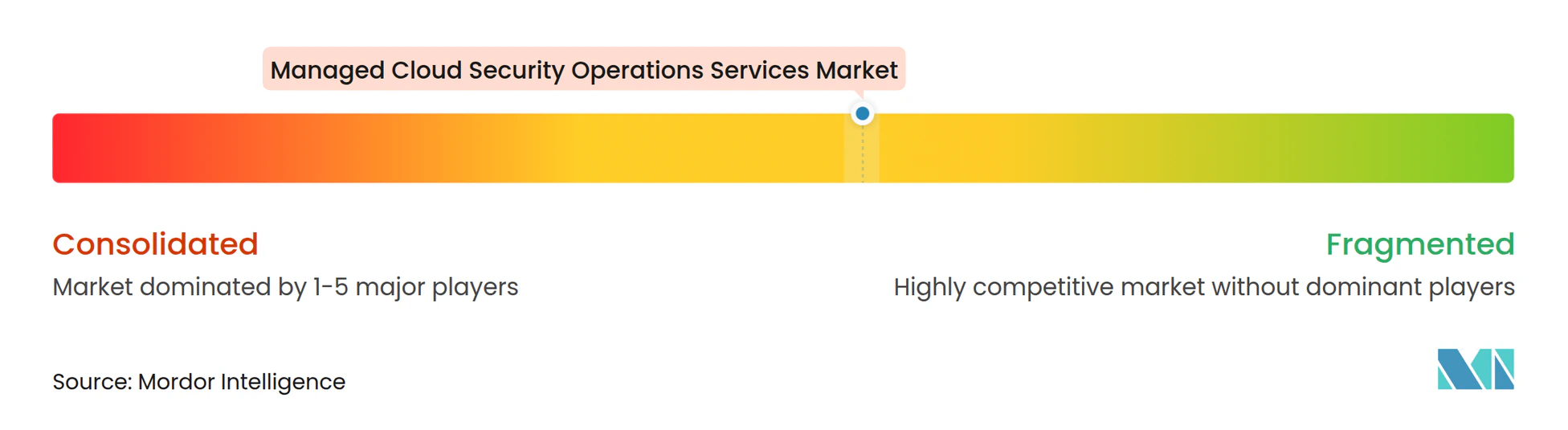
The Managed Cloud Security Operations Services market is moderately fragmented, with competition increasing across traditional and cloud-native providers. Large managed security firms, IT services companies, and telecommunications carriers compete with managed detection and response specialists. Cloud-native providers often compete through visibility, response metrics, and cloud-specific automation. Buyers are examining how well a provider can support AWS, Azure, Google Cloud, and mixed environments. Hyperscaler certifications and service partnerships are important routes to customer access. Platform-specific delivery can reduce implementation complexity for customers already committed to one ecosystem. At the same time, multi-cloud buyers prefer providers that can avoid a single-platform blind spot. This leaves room for both specialist firms and broad, vendor-neutral service models.
Automation is a central competitive area in the Managed Cloud Security Operations Services market. Palo Alto Networks made Cortex Cloud 2.0 generally available in October 2025, adding autonomous AI agents for cloud security investigation and remediation. Fortinet previewed FortiSOC in March 2026 as a cloud-delivered platform that combines several SOC products within a single console. These moves show how product vendors seek to reduce alert-handling effort and join the investigation with the response. Providers that own cloud protection platforms can combine code, runtime, and network telemetry. This can shorten detection and triage cycles compared with services that rely on disconnected data sources. Compliance with ISO 27001, SOC 2, FedRAMP, and BSI C5 remains important for qualification in public-sector and financial-services evaluations. Smaller cloud-native specialists can compete where customers need a tailored service rather than a broad enterprise bundle.
Sovereign delivery creates another basis for differentiation within the Managed Cloud Security Operations Services market. Deutsche Telekom and Palo Alto Networks introduced Sovereign Cortex with T Security in June 2026 for European public-sector and critical-infrastructure needs. The offering maintains encryption key control with Deutsche Telekom and targets NIS2, DORA, and KRITIS requirements. Midmarket sovereign-cloud SOC delivery remains an opportunity where existing offerings can be costly or insufficiently localized. Co-managed container and Kubernetes security also remains underserved beyond basic posture scanning. Cross-cloud incident response automation is another area of opportunity, particularly for organizations that operate across all 3 major hyperscalers. Providers that can demonstrate measurable response outcomes and locally compliant operations are better positioned for these requirements.
Managed Cloud Security Operations Services Industry Leaders
-
IBM Corporation
-
AT&T Inc.
-
Accenture plc
-
NTT DATA Corporation
-
Broadcom Inc.
- *Disclaimer: Major Players sorted in no particular order
Managed Cloud Security Operations Services Market Companies Covered in this Report
- Accenture plc
- AT&T Inc.
- Atos SE
- BAE Systems plc
- Broadcom Inc.
- Capgemini SE
- Cisco Systems, Inc.
- CrowdStrike Holdings, Inc.
- Deloitte Touche Tohmatsu Limited
- DXC Technology Company
- Fortinet, Inc.
- Fujitsu Limited
- International Business Machines Corporation
- Kyndryl Holdings, Inc.
- Lumen Technologies, Inc.
- NTT DATA Corporation
- Orange S.A.
- Palo Alto Networks, Inc.
- Secureworks Corp.
- Tata Consultancy Services Limited
- Verizon Communications Inc.
- Wipro Limited
Recent Industry Developments in Managed Cloud Security Operations Services Market
- October 2026: Atos expanded its partnership with Fortinet from a country-led to a global engagement model, combining Atos’s worldwide network of security operations centers with Fortinet’s advanced cybersecurity technologies to deliver unified managed security services across hybrid and multi-cloud environments for enterprise clients globally, addressing escalating cyber threats and stricter regulatory requirements.
- June 2026: Deutsche Telekom and Palo Alto Networks launched “Sovereign Cortex with T Security,” combining Palo Alto Networks’ agentic SOC platform with Deutsche Telekom’s pan-European SOC network on a Sovereign Google Cloud Platform instance. Deutsche Telekom retains sole control of encryption keys, and the service is designed to meet NIS2, DORA, and KRITIS data-residency and compliance requirements for European public-sector organizations and critical infrastructure operators.
- March 2026: Fortinet previewed FortiSOC at Accelerate 2026, a cloud-delivered integrated SOC platform combining FortiAnalyzer, FortiSIEM, FortiSOAR, and FortiTIP in a single console with a unified data model, and simultaneously expanded FortiAI with agentic execution capabilities for automated alert triage, investigation, and threat hunting across hybrid environments, advancing from interactive copilots toward autonomous, connected SOC workflows.
- February 2026: Kyndryl launched its first Cyber Defense Operations Center in Bengaluru, India, integrating network operations and security operations into a unified command hub with an agentic AI framework, real-time role-based dashboards, and automated runbooks. The center is designed to serve global customers across more than 60 countries and is planned for geographic expansion to meet growing international demand.
Global Managed Cloud Security Operations Services Market Report Scope
The Managed Cloud Security Operations Services Market comprises outsourced, 24/7 security services that monitor, detect, investigate, and respond to threats across cloud environments (public, private, hybrid, and multi-cloud), covering cloud workloads, identities, containers, serverless functions, APIs, and SaaS applications.
The Managed Cloud Security Operations Services Market Report is Segmented by Service Type (Managed Cloud Security Posture Management, Managed Cloud Workload Protection, Managed Cloud Access Security Broker Services, SaaS Security Posture Management, Container and Kubernetes Security Management, Managed Security Operations Center as a Service, and Managed Incident Response and Threat Hunting), Delivery Model (Fully Managed Services, Co-Managed Services, and Sovereign or In-Country Managed Services), Deployment Model (Public Cloud, Private Cloud, and Hybrid Cloud), Cloud Platform (Amazon Web Services, Microsoft Azure, Google Cloud, and Multi-Cloud and Hybrid Cloud), End-User Industry (Banking, Financial Services, and Insurance, Government and Defense, Healthcare and Life Sciences, Manufacturing and Industrial, IT and Telecommunications, Retail and E-Commerce, and Other End-user Industries), and Geography (North America, South America, Europe, Asia-Pacific, and Middle East and Africa). The Market Forecasts Are Provided in Terms of Value (USD).
Segmentation Overview
| Managed Cloud Security Posture Management |
| Managed Cloud Workload Protection |
| Managed Cloud Access Security Broker Services |
| SaaS Security Posture Management |
| Container and Kubernetes Security Management |
| Managed Security Operations Center as a Service |
| Managed Incident Response and Threat Hunting |
| Fully Managed Services |
| Co-Managed Services |
| Sovereign or In-Country Managed Services |
| Public Cloud |
| Private Cloud |
| Hybrid Cloud |
| Amazon Web Services |
| Microsoft Azure |
| Google Cloud |
| Multi-Cloud and Hybrid Cloud |
| Banking, Financial Services, and Insurance |
| Government and Defense |
| Healthcare and Life Sciences |
| Manufacturing and Industrial |
| IT and Telecommunications |
| Retail and E-Commerce |
| Other End-user Industries |
| North America | United States |
| Canada | |
| Mexico | |
| South America | Brazil |
| Argentina | |
| Rest of South America | |
| Europe | Germany |
| United Kingdom | |
| France | |
| Italy | |
| Rest of Europe | |
| Asia-Pacific | China |
| Japan | |
| India | |
| South Korea | |
| Rest of Asia-Pacific | |
| Middle East and Africa | Saudi Arabia |
| United Arab Emirates | |
| South Africa | |
| Egypt | |
| Rest of Middle East and Africa |
| By Service Type | Managed Cloud Security Posture Management | |
| Managed Cloud Workload Protection | ||
| Managed Cloud Access Security Broker Services | ||
| SaaS Security Posture Management | ||
| Container and Kubernetes Security Management | ||
| Managed Security Operations Center as a Service | ||
| Managed Incident Response and Threat Hunting | ||
| By Delivery Model | Fully Managed Services | |
| Co-Managed Services | ||
| Sovereign or In-Country Managed Services | ||
| By Deployment Model | Public Cloud | |
| Private Cloud | ||
| Hybrid Cloud | ||
| By Cloud Platform | Amazon Web Services | |
| Microsoft Azure | ||
| Google Cloud | ||
| Multi-Cloud and Hybrid Cloud | ||
| By End-User Industry | Banking, Financial Services, and Insurance | |
| Government and Defense | ||
| Healthcare and Life Sciences | ||
| Manufacturing and Industrial | ||
| IT and Telecommunications | ||
| Retail and E-Commerce | ||
| Other End-user Industries | ||
| By Geography | North America | United States |
| Canada | ||
| Mexico | ||
| South America | Brazil | |
| Argentina | ||
| Rest of South America | ||
| Europe | Germany | |
| United Kingdom | ||
| France | ||
| Italy | ||
| Rest of Europe | ||
| Asia-Pacific | China | |
| Japan | ||
| India | ||
| South Korea | ||
| Rest of Asia-Pacific | ||
| Middle East and Africa | Saudi Arabia | |
| United Arab Emirates | ||
| South Africa | ||
| Egypt | ||
| Rest of Middle East and Africa | ||
Key Questions Answered in the Report
What is the managed cloud security operations services market size?
The Managed Cloud Security Operations Services market is valued at USD 16.42 billion in 2026 and is projected to reach USD 34.11 billion by 2032, at a CAGR of 12.43% from 2027 to 2032.
Which service type leads managed cloud security operations services?
In the Managed Cloud Security Operations Services market, Managed SOC-as-a-Service leads with 34.28% in 2026 because it combines detection, investigation, response, and compliance reporting.
Why are enterprises outsourcing cloud security operations?
The Managed Cloud Security Operations Services market responds to organizations needing 24/7 monitoring and cloud skills that are difficult to build internally.
Which deployment model is expanding fastest?
In the Managed Cloud Security Operations Services market, Hybrid Cloud is projected to expand at a 12.92% CAGR through 2032 as enterprises need unified coverage across public-cloud and on-premises systems.
Which region has the largest share?
The Managed Cloud Security Operations Services market is led by North America with 43.91% in 2026, supported by regulated sectors and a mature provider ecosystem.
What is driving sovereign SOC demand?
In the Managed Cloud Security Operations Services market, data residency, encryption control, and sector-specific compliance requirements encourage customers to use in-country security operations.