
Data Security Policy Orchestration Market Size and Share
Market Overview
| Study Period | 2020 - 2031 |
|---|---|
| Market Size (2026) | USD 0.92 Billion |
| Market Size (2031) | USD 2.63 Billion |
| Growth Rate (2026 - 2031) | 23.38 % |
| Fastest Growing Market | Asia-Pacific |
| Largest Market | North America |
| Market Concentration | Medium |
Major Players *Disclaimer: Major Players sorted in no particular order Image © Mordor Intelligence. Reuse requires attribution under CC BY 4.0. | |
Data Security Policy Orchestration Market Analysis by Mordor Intelligence
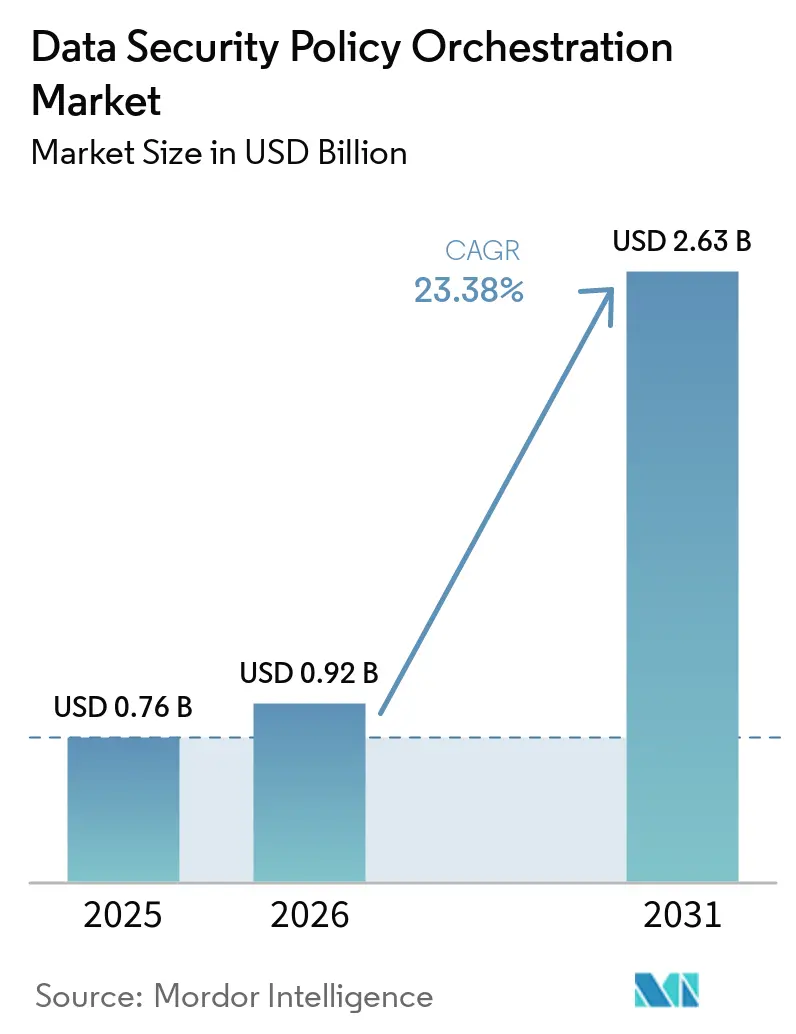
The data security policy orchestration market size is projected to expand from USD 0.76 billion in 2025 to USD 0.92 billion in 2026, and to USD 2.63 billion by 2031, registering a CAGR of 23.38% between 2026 and 2031. Sensitive data is moving across cloud services, private infrastructure, software-as-a-service applications, and AI workflows, which is making a current view of data exposure more important. Organizations are also facing overlapping obligations for privacy, cyber resilience, AI governance, and incident documentation. Multi-environment breaches cost USD 5.05 million per incident in 2025, which strengthened the financial case for continuous data discovery and control validation. The data security policy orchestration market is therefore moving beyond periodic compliance checks toward persistent identification of sensitive data, access paths, and risk conditions. Vendors are broadening their product portfolios through platform development, partner services, and acquisitions, while buyers are placing greater value on coverage across cloud, SaaS, hybrid, and legacy environments.
Key Report Takeaways
- By component, software accounted for 67.48% of revenue in the data security policy orchestration market in 2025, while services are projected to expand at a 27.39% CAGR through 2031.
- By deployment mode, cloud-based deployment accounted for 62.79% of revenue in 2025 and is projected to grow at a 26.98% CAGR through 2031.
- By organization size, large enterprises held 73.14% revenue share in the data security policy orchestration market in 2025, while small and medium-sized enterprises are projected to expand at a 26.46% CAGR through 2031.
- By data type, unstructured data accounted for 41.96% of revenue in 2025, while semi-structured data is projected to grow at a 27.41% CAGR through 2031.
- By industry vertical, BFSI held 24.78% revenue share in 2025, while the healthcare and life sciences industry is projected to expand at a 28.32% CAGR through 2031.
- By geography, North America held 38.29% revenue share in the data security policy orchestration market in 2025, while Asia-Pacific is projected to grow at a 28.66% CAGR through 2031.
Note: Market size and forecast figures in this report are generated using Mordor Intelligence’s proprietary estimation framework, updated with the latest available data and insights as of January 2026.
Global Data Security Policy Orchestration Market Trends and Insights
Drivers Impact Analysis*
| DRIVER | (~) % IMPACT ON CAGR FORECAST | GEOGRAPHIC RELEVANCE | IMPACT TIMELINE |
|---|---|---|---|
| Sensitive Data Sprawl Across Hybrid and Multicloud Environments | +6.5% | Global, most acute in North America and APAC | Short term (≤ 2 years) |
| Continuous Compliance Evidence Requirements | +5.2% | North America and Europe, with spillover to APAC and the Middle East and Africa | Medium term (2-4 years) |
| Generative AI and AI Agent Access to Enterprise Data | +4.8% | Global, with early impact in North America and Western Europe | Short term (≤ 2 years) |
| Identity-Centric Zero-Trust and Least-Privilege Controls | +3.1% | North America and Europe | Medium term (2-4 years) |
| Policy as Code for Changing Data Pipelines | +2.2% | APAC and North America | Long term (≥ 4 years) |
| Runtime Data Lineage for Fast Risk Decisions | +1.8% | Global, with early adoption in financial services hubs | Long term (≥ 4 years) |
| Source: Mordor Intelligence | |||
Escalating Sensitive Data Sprawl Across Hybrid and Multicloud Estates
Enterprise data volumes are growing faster than security teams can classify and govern them through manual processes. Data created through AI training, snapshot replication, and SaaS exports can remain outside planned storage inventories. This shadow data can create blind spots that conventional data loss prevention tools may not identify. The exposure becomes more serious when copies are distributed across cloud services and on-premises repositories. IBM reported that breaches involving multiple environments cost USD 5.05 million per incident in 2025, the highest cost among the environments studied. The data security policy orchestration market is benefiting from automated, continuous discovery, which offers a practical way to identify data across these distributed environments.
Regulatory Convergence and Continuous Compliance Evidence Requirements
Regulators are requiring stronger evidence that organizations can identify, govern, and protect important data. These expectations are moving beyond periodic attestations toward records that can demonstrate ongoing control activity. The Digital Operational Resilience Act became fully applicable on January 17, 2025, and it requires covered financial entities to manage information and communication technology risk and document their resilience arrangements.[1] The EU AI Act also introduces obligations for high-risk AI systems, including controls related to data governance and technical documentation. Data discovery, classification, lineage, and access records can support the evidence required by these obligations. The data security policy orchestration market is gaining traction among compliance programs because these functions require defensible records rather than isolated audit results.
Generative AI and AI-Agent Access to Enterprise Data
Generative AI tools and autonomous AI agents can interact with enterprise files, databases, APIs, and shared storage. Unlike conventional user activity, an agent can perform multiple actions within a single workflow without individual human approval for each step. A poorly configured workflow can therefore expose regulated data across connected systems before a security team identifies the activity. Varonis launched its Atlas AI Security Platform in May 2026 with AI inventory, AI security posture management, testing, runtime guardrails, and AI detection and response capabilities.[2] Microsoft also made Microsoft Purview Data Security Posture Management for AI generally available in May 2026, including recurring assessments of SharePoint sites that support Microsoft 365 Copilot and agent workflows. These releases show why the data security policy orchestration market is expanding to include AI governance teams, legal functions, and security leaders.
Identity-Centric Zero-Trust and Least-Privilege Enforcement
Zero-trust programs depend on understanding both granted access and the data that access can expose. Traditional identity tools show permissions, but they may not reveal where sensitive data resides or whether a permission path results in material exposure. Long-standing permissions, service accounts, nonhuman identities, and compromised credentials can leave unnecessary access routes active. The 2025 ISC2 Cybersecurity Workforce Study identified ongoing skills gaps in areas such as cloud and AI security. Automated correlation of sensitive data, access patterns, and behavioral signals can help teams focus remediation on the most consequential permissions. This need supports the data security policy orchestration market because platforms can help organizations close the difference between written access policy and day-to-day operating conditions.
Restraints Impact Analysis*
| RESTRAINT | (~) % IMPACT ON CAGR FORECAST | GEOGRAPHIC RELEVANCE | IMPACT TIMELINE |
|---|---|---|---|
| Legacy Repository Integration and Inconsistent APIs | -2.8% | Global, most acute in Europe and South America | Medium term (2-4 years) |
| Data Security Engineering and Policy Governance Talent Shortage | -1.9% | Global | Long term (≥ 4 years) |
| Semantic Ambiguity in Business Data Classification | -1.2% | Global | Medium term (2-4 years) |
| Privacy, Residency, and Model Processing Limits on Sensitive Telemetry | -0.8% | Europe, APAC including India and China, and the Middle East and Africa | Long term (≥ 4 years) |
| Source: Mordor Intelligence | |||
Complex Integration With Legacy Repositories and Inconsistent APIs
Mainframe databases, on-premises warehouses, and proprietary enterprise resource planning systems can be difficult to connect to a posture management platform. Many legacy systems do not provide standardized APIs that allow consistent discovery or policy checks. Vendors may need to maintain custom connectors and revalidate them after each underlying system change. This increases operating costs and can delay full deployment. A partial rollout can scan cloud data while leaving older repositories outside the coverage model, which can create an inaccurate sense of security. The data security policy orchestration market will favor suppliers that provide broad, agentless, read-only connector support without requiring customers to move sensitive data.
Shortage of Data Security Engineering and Policy Governance Talent
DSPM deployment requires a combination of cloud data knowledge, security operations skills, and familiarity with privacy and compliance obligations. Many organizations do not have teams with all of these capabilities in one operating group. The 2025 ISC2 study reported that skill gaps had contributed to at least 1 significant security incident at 88% of surveyed organizations.[3] This gap can slow connector deployment, classification tuning, alert review, and remediation planning. It also helps explain the projected 27.39% CAGR for services because organizations are turning to vendor-led and managed delivery models. The data security policy orchestration market has an opportunity in service models that handle maintenance, policy tuning, and alert triage for internal teams.
*Our forecasts treat driver/restraint impacts as directional, not additive. The impact forecasts reflect baseline growth, mix effects, and variable interactions.
Segment Analysis
By Component: Services Growth Reflects the Need for Operational Support
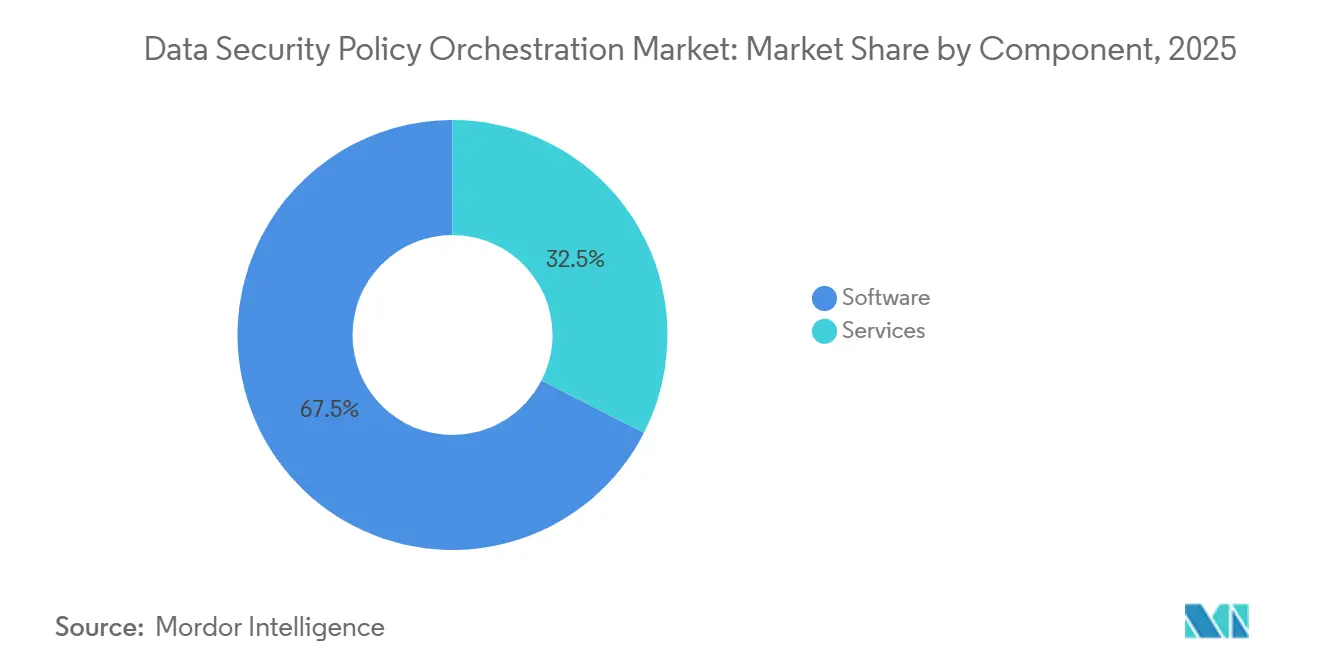
Software held 67.48% of the data security policy orchestration market share in 2025. The segment led because buyers need automated discovery, classification, and risk scoring across cloud and hybrid data estates. Broad connector coverage is important because a platform has limited value when material repositories remain outside discovery processes. Software also provides the common control layer for data inventories, policies, risk prioritization, and remediation workflows. BigID launched BigID Next in February 2025 as a unified cloud-native platform that brought separate security, privacy, and governance modules under a common policy engine.[4] This type of product design can reduce the complexity caused by separate tools and disconnected data maps. It can also make ownership clearer for teams that share responsibility for security, privacy, and governance. The data security policy orchestration market size for software remains supported by the need for a scalable platform layer.
Services are projected to grow at a 27.39% CAGR from 2026 to 2031, faster than the overall data security policy orchestration market. Enterprises often need help configuring connectors, adapting classification policies, and turning risk findings into remediation actions. These tasks are ongoing because data sources, cloud services, policies, and application workflows change regularly. Managed programs can provide specialist resources where internal teams are unable to maintain the required operating model. Professional services can also help buyers connect technical controls with compliance documentation and operational accountability. Vendor-led support is particularly relevant for complex hybrid environments with many repositories. The service opportunity is therefore tied to the practical work needed after a software purchase, not only to initial implementation. Suppliers that combine product capability with clear operating support can respond to this persistent delivery need.
By Deployment Mode: Cloud Demand Coexists with Hybrid Requirements
Cloud-based deployment held 62.79% of revenue in 2025. Sensitive data is increasingly stored in hyperscale cloud infrastructure, SaaS applications, and cloud-native data platforms. These settings are well-suited to services that can discover data continuously and evaluate risk at scale. Cloud delivery can also simplify updates and help customers add connectors as their environments change. Cloud-based deployment is projected to grow at a 26.98% CAGR from 2026 to 2031. Growth is being supported by the migration of regulated workloads and the expansion of cloud-native AI pipelines. Cloud-based delivery is also supported by buyers who want faster access to current product capabilities. Cloud platforms remain central to the category because many data estates now have a substantial cloud component.
On-premises and hybrid models still address a distinct group of buyers. Defense, critical infrastructure, and financial services organizations may face residency restrictions or internal requirements that prevent them from exporting a complete data inventory to a supplier-operated environment. Hybrid deployments must support consistent classification and policy enforcement across SaaS services, cloud storage, private data centers, and older repositories. This requirement can make deployment coverage a core competitive factor. Varonis set December 31, 2026, as the retirement date for support of its legacy self-hosted product while it continued its SaaS transition. This development may lead some customers with durable on-premises requirements to assess vendors that continue to offer full support for those environments. The data security policy orchestration market will continue to require architectures that account for both cloud growth and constrained local environments.
By Organization Size: SME Growth Follows Wider Regulatory Reach
Large enterprises commanded 73.14% of revenue in 2025. These organizations manage extensive regulated data estates and face higher exposure to multi-environment breach costs. They also have the resources to fund broad deployments across business units, data stores, and jurisdictions. Complex procurement and compliance requirements have made large enterprises the main source of absolute spending. Their data environments often include cloud platforms, acquisitions, legacy systems, and specialized applications that require broad coverage. Large enterprise demand provides vendors with a stable base for platform expansion and service revenue. The segment is also important because its requirements have shaped expectations for the depth of data classification and connector support. Large organizations will remain a key buyer group even as adoption extends to smaller firms.
Small and medium-sized enterprises are projected to expand at a 26.46% CAGR from 2026 to 2031. GDPR, DORA, NIS2, and national requirements are driving more mid-sized organizations to adopt formal data protection and resilience programs. The NIS2 Directive covers entities in 18 critical sectors and establishes cybersecurity risk management measures for those within its scope.[5] Smaller organizations can be constrained by limited security staffing and a lower tolerance for long implementation projects. Agentless and consumption-based products can reduce those barriers by limiting infrastructure changes and spreading costs through usage models. Managed services can further reduce the need to build specialist teams internally. The data security policy orchestration market is therefore opening to a more margin-sensitive buyer group that needs simpler onboarding and continuous support. Vendors that make data discovery and remediation practical for lean teams can address this expanding demand.
By Data Type: Semi-Structured Data Requires Broader Protection
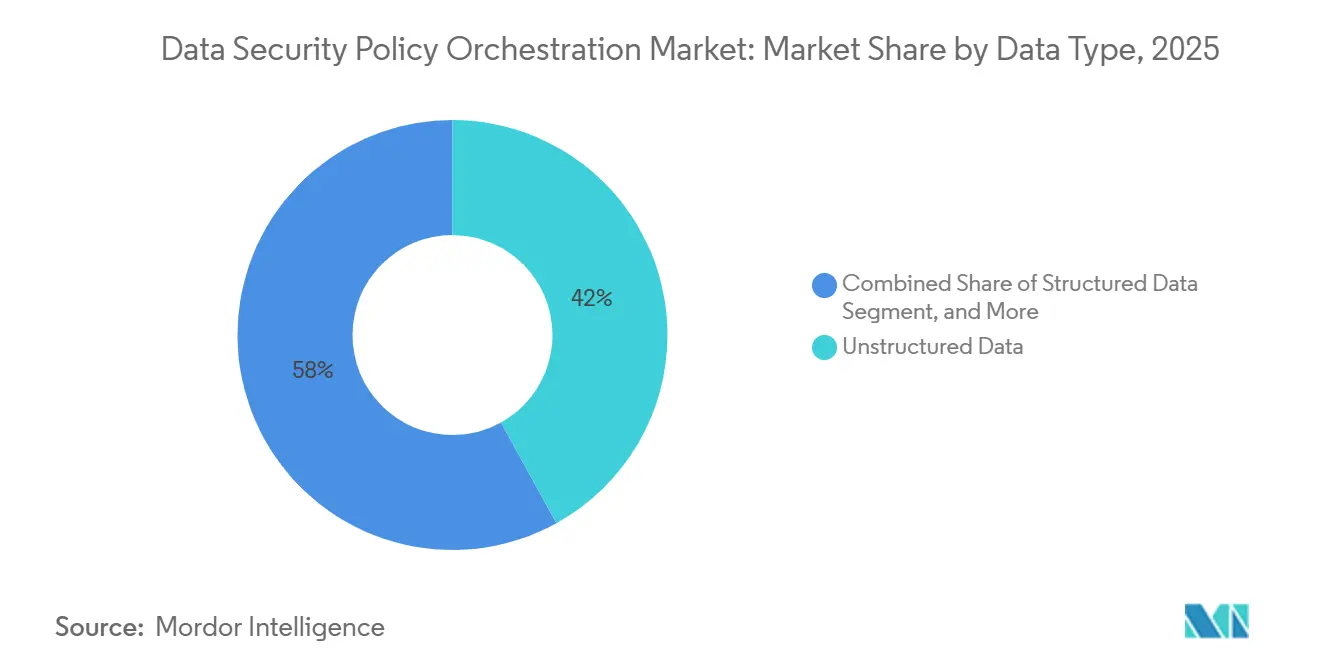
Unstructured data held 41.96% of revenue in 2025. Documents, emails, presentations, and file-sharing content have long posed a significant classification challenge for organizations. Their volume and varied formats make it difficult to identify sensitive information through manual review. Buyers and suppliers have therefore invested heavily in tools that can inspect and classify unstructured content. This leadership reflects the continued importance of collaboration systems and enterprise file stores. It also reflects the fact that sensitive records are often copied, shared, and retained in documents outside core transactional systems. Unstructured data will remain a central part of DSPM deployments as users create and share content across more cloud applications. Coverage of these repositories remains fundamental to a complete data inventory.
Semi-structured data is projected to grow at a 27.41% CAGR from 2026 to 2031. JSON files, event logs, API telemetry, XML records, and database export artifacts commonly support AI training pipelines and automated workflows. These files may contain derived information from personal, financial, or regulated records. Legacy data loss prevention tools can struggle when the content does not fit fixed database fields or full-text document patterns. As AI deployments expand, organizations are generating more pipeline artifacts that need classification and access governance. Structured data remains important because cloud-managed databases and query-level logging are increasingly required by standards such as PCI DSS 4.0. The data security policy orchestration market needs to provide consistent discovery across structured, semi-structured, and unstructured forms. Suppliers that can interpret context across these forms can reduce the blind spots created by fragmented data controls.

By Industry Vertical: Healthcare Growth is Linked to AI and Protected Data
BFSI held 24.78% of revenue in 2025. Financial institutions manage transaction records, credit histories, account information, and customer identity data on a considerable scale. The sector also faces dense obligations under DORA, PCI DSS, GLBA, and Basel IV data governance expectations. DORA requires covered financial entities to manage digital operational resilience and associated technology risk. Any failure to classify important data or to understand access paths can create compliance and operational risks. Financial institutions also have the resources and governance structures needed to run complex posture management programs. These conditions explain why BFSI retained the largest vertical revenue position. The data security policy orchestration market size in BFSI is supported by the sector's need for continuous, auditable data control.
The healthcare and life sciences industry is projected to grow at a 28.32% CAGR from 2026 to 2031. Healthcare providers and life sciences organizations are using AI in clinical decision support, medical imaging analysis, research workflows, and patient engagement. These systems can interact with protected health information and other sensitive records. IBM reported that the average cost of a healthcare data breach reached USD 10.9 million in 2025, the highest cost among the sectors studied. This strengthens the case for preventive discovery, classification, and access governance. Government and public administration, IT and telecommunication, and energy and utilities also have strong demand because their systems handle sensitive citizen, network, and grid information. Retail, e-commerce, transportation, and logistics are adding DSPM coverage as order, loyalty, and logistics platforms create more customer data. The data security posture management industry is expanding across these verticals as cloud services and AI systems increase the number of data pathways that require control.
Geography Analysis
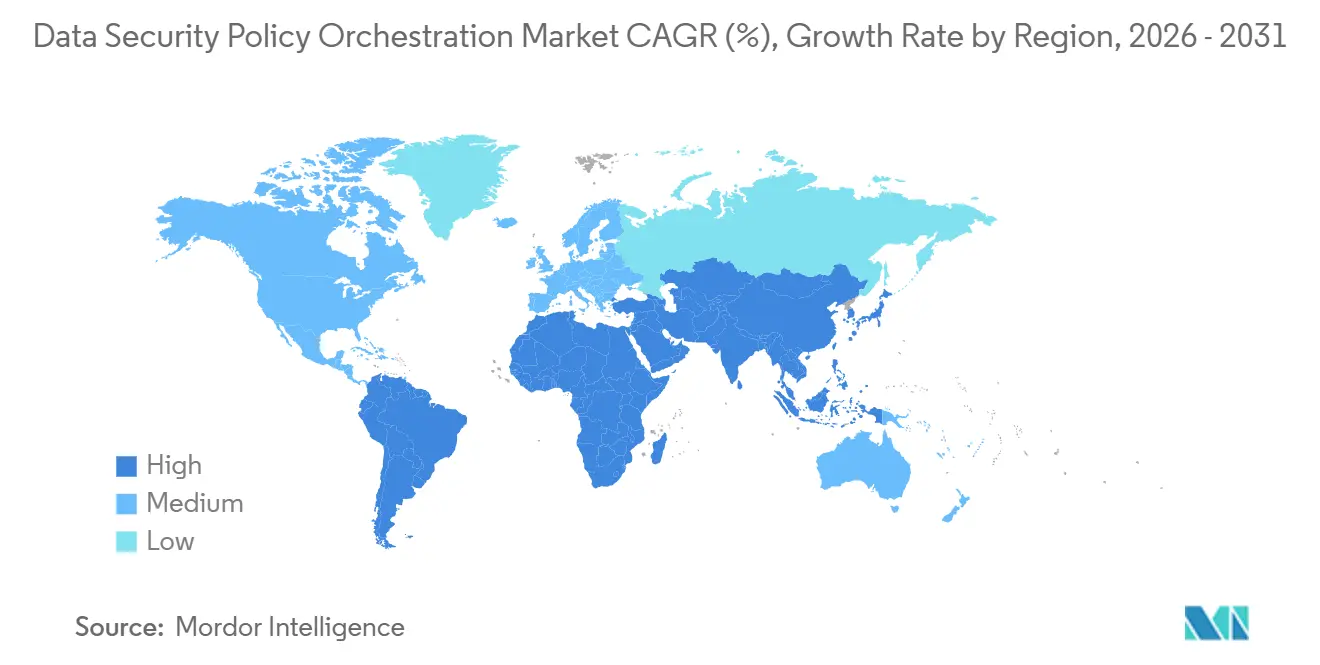
North America held 38.29% of revenue in 2025. The United States has a high concentration of financial services, healthcare, defense contracting, and other regulated activities that hold substantial amounts of sensitive data. HIPAA, the California Consumer Privacy Act, and expanding state privacy requirements sustain demand for data discovery and governance programs. Canada adds demand through financial services and public-sector organizations, while Mexico is developing as its financial sector strengthens cloud-security expectations. BigID obtained FedRAMP authorization in March 2026, which enabled its data intelligence platform to be deployed across U.S. federal agencies. Federal adoption expands the addressable government-buyer base for suppliers that meet authorization requirements. AI project budgets are also increasingly involved in data security purchases, which can broaden the internal funding base beyond security leadership.
Asia-Pacific is projected to grow at a 28.66% CAGR from 2026 to 2031. India, Japan, South Korea, China, and Australia are advancing data protection and privacy requirements, translating awareness into compliance. India's Digital Personal Data Protection Act, Japan's amended Act on the Protection of Personal Information, and South Korea's amendments to the Personal Information Protection Act place greater emphasis on personal data governance. China presents a distinct setting because localization requirements place greater weight on locally suitable data architectures. Multinational organizations must account for these requirements while maintaining consistent controls across their regional data estates. Australia's Privacy Act reform process adds another layer of consideration for organizations managing Pacific data flows. Asia-Pacific demand is supported by these overlapping requirements and expanding cloud adoption.
Europe remains the second-largest regional position in the data security policy orchestration market. DORA has been applied since January 17, 2025, and it requires covered financial entities to establish digital operational resilience arrangements. Germany's NIS2 Implementation Act entered into force on December 6, 2025, establishing registration and risk-management measures for organizations covered by the national framework.[6] The UK's Cyber Security and Resilience Bill was introduced to Parliament on November 12, 2025, extending attention to managed service providers and data center operators. South America is developing around Brazil, where privacy requirements and financial-sector expectations are supporting interest in continuous monitoring. The Middle East and Africa are also gaining momentum through Saudi Arabia's digital transformation agenda, UAE cloud-first government programs, and South Africa's Protection of Personal Information Act. These regions require suppliers to adapt to differing data residency, public-sector, and sovereign cloud requirements.
Competitive Landscape
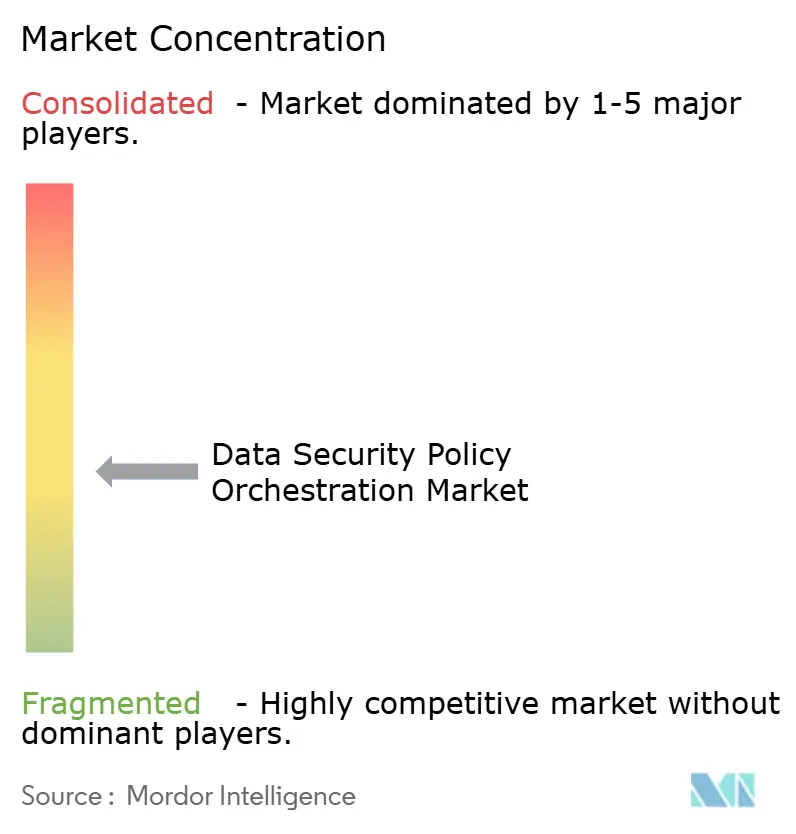
The data security policy orchestration market is moderately fragmented. Varonis Systems, BigID, and Cyera compete as well-capitalized, focused vendors, while Proofpoint and Forcepoint bring broader security portfolios to the category. Buyers are increasingly looking for platforms that combine data discovery with data loss prevention, identity governance, privacy controls, and AI trust functions. This is increasing pressure on narrow products that do not fit into a broader security operating model. Cyera closed a USD 600 million funding round at a USD 12 billion valuation in June 2026, supporting the expansion of its unified data security, data loss prevention, identity, and agentic security trust platform.[7] Veeam completed its USD 1.725 billion acquisition of Securiti AI in December 2025, combining data resilience with DSPM, privacy governance, and AI trust capabilities. These developments show why platform breadth and capital resources are becoming more important in vendor positioning.
Proofpoint completed its acquisition of Normalyze in November 2024, adding agentless, in-place scanning and risk analysis capabilities to its security platform. The transaction showed how established vendors can add DSPM functionality through acquisition rather than build it over a longer period. Varonis introduced Atlas in May 2026 to provide AI inventory, AI security posture management, testing, runtime guardrails, and AI detection and response. BigID launched BigID Next in February 2025 to unify its security, privacy, and governance capabilities under a common policy engine. These moves reflect a common focus on consolidating data intelligence functions and reducing fragmented control models. Vendors also compete through classification accuracy, data-to-identity context, knowledge graph capabilities, and the range of supported connectors. Connector breadth can determine whether a customer can reach complete coverage across SaaS, cloud, private infrastructure, and legacy repositories.
Unaddressed needs remain around runtime governance for autonomous AI workflows, coverage of semi-structured and synthetic AI data, and managed services designed for smaller organizations. Sentra emphasizes support for data sovereignty, while Concentric AI focuses on semantic risk classification without predefined rules. Nightfall AI addresses developer-oriented, API-native use cases for SaaS and cloud storage. These vendors can gain early-adopter accounts, whereas larger platforms require more effort than a specific use case warrants. The data security posture management industry is likely to retain room for specialist suppliers where requirements differ by sovereignty, data type, or operating model. At the same time, product consolidation makes it more difficult for focused providers to compete only on basic discovery. Market leadership will depend on the ability to link data classification with meaningful access context, policy enforcement, and usable remediation processes.
Data Security Policy Orchestration Industry Leaders
-
Varonis Systems, Inc.
-
BigID, Inc.
-
Cyera, Inc.
-
Securiti, Inc.
-
Proofpoint, Inc.
- *Disclaimer: Major Players sorted in no particular order
Recent Industry Developments
- June 2026: Cyera closed a USD 600 million funding round at a USD 12 billion valuation, led by Evolution Equity Partners with participation from Cyberstarts, Temasek, and existing investors including Accel, Blackstone, and Coatue. The round brought Cyera's total funding past USD 2.3 billion, fueling accelerated expansion of its unified DSPM, DLP, identity, and agentic-security trust layer platform targeting Fortune 1000 enterprises.
- May 2026: Varonis launched Atlas, an end-to-end AI Security Platform offering continuous AI inventory, AI-SPM, AI penetration testing, runtime guardrails, and AI Detection and Response (AIDR). Atlas maps enterprise AI systems to EU AI Act and NIST AI RMF compliance obligations and generates audit-ready evidence in real time, positioning Varonis in the emerging AI governance segment alongside its core DSPM offering.
- March 2026: BigID obtained FedRAMP authorization for its data intelligence platform, enabling deployment across U.S. federal agencies. The certification represents a strategic entry into the government vertical, a high-growth segment for DSPM driven by federal data protection mandates and Executive Order 14028 on cybersecurity.
- December 2025: Veeam completed its USD 1.725 billion acquisition of Securiti AI, combining DSPM, privacy governance, AI trust, and data resilience capabilities into a unified command-center platform. The combined entity serves more than 550,000 customers globally, including a significant share of Fortune 500 organizations, and brought Securiti AI founder Rehan Jalil into Veeam as President of Security and AI.
Global Data Security Policy Orchestration Market Report Scope
The data security policy orchestration market includes platforms that provide unified, centralized management and automated enforcement of data security policies across multi-cloud, hybrid, and on-premises data environments. This market enables organizations to define data security policies once (covering encryption, access control, masking, tokenization, retention, and DLP) and automatically orchestrate their enforcement across disparate data platforms like AWS S3, Azure SQL Database, Google BigQuery, Snowflake, Databricks, and on-premises databases. Solutions translate high-level security and compliance requirements into technical controls, provide consistent policy visibility and audit trails across environments, automate policy updates in response to regulatory changes, and integrate with data classification, entitlement management, and monitoring systems to create a cohesive data security posture management framework.
The Data Security Policy Orchestration Market Report is Segmented by Component (Software, and Services), Deployment Mode (Cloud-Based, On-Premises, and Hybrid), Organization Size (Large Enterprises, and Small and Medium-Sized Enterprises), Data Type (Structured Data, Semi-Structured Data, and Unstructured Data), Industry Vertical (Government and Public Administration, Industrial Manufacturing, Retail and E-Commerce, Transportation and Logistics, Energy and Utilities, Oil and Gas, IT and Telecommunication, Media and Entertainment, Education and Research Institutions, Healthcare and Life Sciences, Banking, Financial Services, and Insurance (BFSI), and Other Industry Verticals), and Geography (North America, South America, Europe, Asia-Pacific, and Middle East and Africa). The Market Forecasts are Provided in Terms of Value (USD).
| Software |
| Services |
| Cloud-Based |
| On-Premises |
| Hybrid |
| Large Enterprises |
| Small and Medium-Sized Enterprises |
| Structured Data |
| Semi-Structured Data |
| Unstructured Data |
| Government and Public Administration |
| Industrial Manufacturing |
| Retail and E-Commerce |
| Transportation and Logistics |
| Energy and Utilities |
| Oil and Gas |
| IT and Telecommunication |
| Media and Entertainment |
| Education and Research Institutions |
| Healthcare and Life Sciences |
| Banking, Financial Services, and Insurance (BFSI) |
| Other Industry Verticals |
| North America | United States | |
| Canada | ||
| South America | Brazil | |
| Argentina | ||
| Mexico | ||
| Rest of South America | ||
| Europe | Germany | |
| United Kingdom | ||
| France | ||
| Italy | ||
| BENELUX | ||
| Rest of Europe | ||
| Asia-Pacific | China | |
| Japan | ||
| India | ||
| South Korea | ||
| Australia | ||
| Rest of Asia-Pacific | ||
| Middle East and Africa | Middle East | United Arab Emirates |
| Saudi Arabia | ||
| Rest of Middle East | ||
| Africa | South Africa | |
| Nigeria | ||
| Egypt | ||
| Rest of Africa | ||
| By Component | Software | ||
| Services | |||
| By Deployment Mode | Cloud-Based | ||
| On-Premises | |||
| Hybrid | |||
| By Organization Size | Large Enterprises | ||
| Small and Medium-Sized Enterprises | |||
| By Data Type | Structured Data | ||
| Semi-Structured Data | |||
| Unstructured Data | |||
| By Industry Vertical | Government and Public Administration | ||
| Industrial Manufacturing | |||
| Retail and E-Commerce | |||
| Transportation and Logistics | |||
| Energy and Utilities | |||
| Oil and Gas | |||
| IT and Telecommunication | |||
| Media and Entertainment | |||
| Education and Research Institutions | |||
| Healthcare and Life Sciences | |||
| Banking, Financial Services, and Insurance (BFSI) | |||
| Other Industry Verticals | |||
| By Geography | North America | United States | |
| Canada | |||
| South America | Brazil | ||
| Argentina | |||
| Mexico | |||
| Rest of South America | |||
| Europe | Germany | ||
| United Kingdom | |||
| France | |||
| Italy | |||
| BENELUX | |||
| Rest of Europe | |||
| Asia-Pacific | China | ||
| Japan | |||
| India | |||
| South Korea | |||
| Australia | |||
| Rest of Asia-Pacific | |||
| Middle East and Africa | Middle East | United Arab Emirates | |
| Saudi Arabia | |||
| Rest of Middle East | |||
| Africa | South Africa | ||
| Nigeria | |||
| Egypt | |||
| Rest of Africa | |||
Key Questions Answered in the Report
What is the size of the data security policy orchestration market?
The data security policy orchestration market size is projected to expand from USD 0.76 billion in 2025 to USD 0.92 billion in 2026, and to USD 2.63 billion by 2031, registering a CAGR of 23.38% between 2026 and 2031.
What is driving adoption of data security policy orchestration management?
Hybrid and multicloud data sprawl, continuous compliance evidence requirements, AI-agent access, and zero-trust programs are increasing demand for continuous data discovery and access governance.
Which deployment mode leads data security posture management adoption?
Cloud-based deployment led with 62.79% revenue share in 2025 and is projected to grow at a 26.98% CAGR through 2031.
Which data type is growing fastest for DSPM providers?
Semi-structured data is projected to grow at a 27.41% CAGR through 2031 because AI pipelines and automated workflows generate JSON files, event logs, API telemetry, and related artifacts.
Which organizations are adopting DSPM most quickly?
Small and medium-sized enterprises are projected to expand at a 26.46% CAGR through 2031 as regulations widen in scope and agentless, managed delivery models reduce implementation barriers.
Which vertical has the highest projected growth?
Healthcare and life sciences is projected to grow at a 28.32% CAGR through 2031, supported by AI use cases and the need to protect sensitive health information.