
Cloud Security Remediation Automation Market Size and Share
Market Overview
| Study Period | 2020 - 2031 |
|---|---|
| Market Size (2026) | USD 2.56 Billion |
| Market Size (2031) | USD 6.42 Billion |
| Growth Rate (2026 - 2031) | 20.19 % |
| Fastest Growing Market | Asia-Pacific |
| Largest Market | North America |
| Market Concentration | Medium |
Major Players *Disclaimer: Major Players sorted in no particular order Image © Mordor Intelligence. Reuse requires attribution under CC BY 4.0. | |
Cloud Security Remediation Automation Market Analysis by Mordor Intelligence
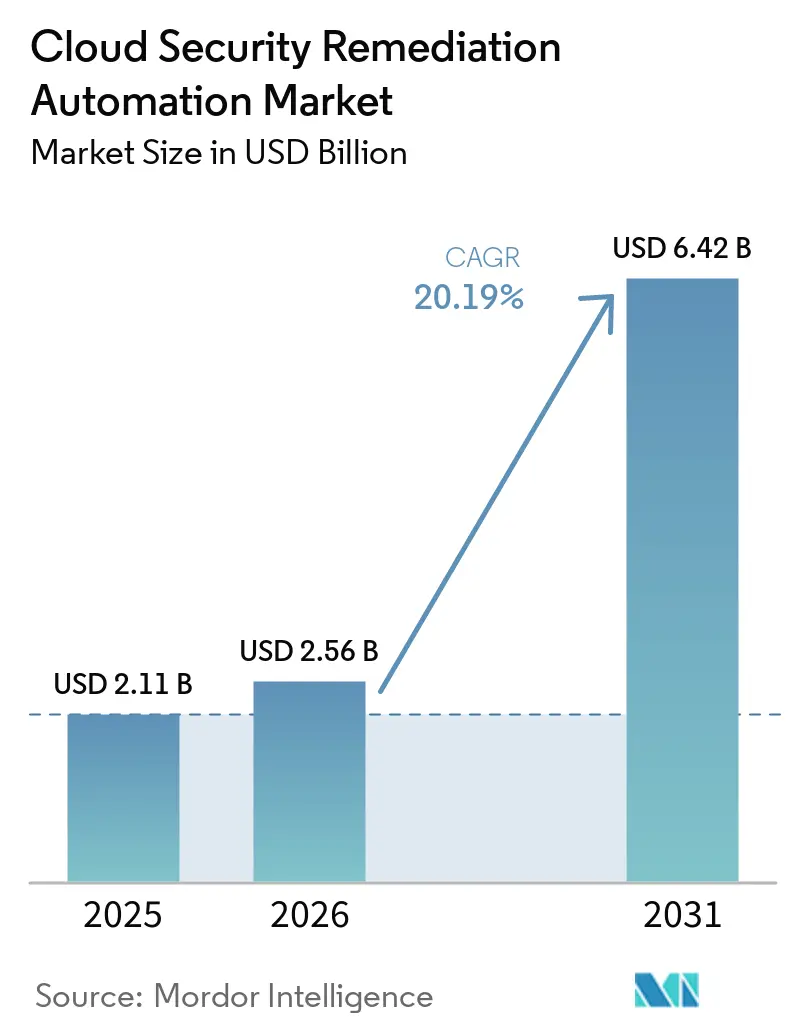
The cloud security remediation automation market size is projected to expand from USD 2.11 billion in 2025 and USD 2.56 billion in 2026 to USD 6.42 billion by 2031, registering a CAGR of 20.19% between 2026 to 2031. Enterprise cloud environments are becoming harder to secure because workloads, identities, SaaS applications, and provider configurations are growing across connected platforms. The cloud security remediation automation market is supported by buyers who need to move from identifying issues to correcting them without long remediation queues. Compliance requirements are also raising demand for systems that produce continuous evidence of control status and completed remediation actions. Vendors are combining risk prioritization, workflow automation, and infrastructure-as-code capabilities to reduce the operational work associated with cloud findings. The cloud security remediation automation market also creates opportunities for providers that can apply safe controls across multicloud environments while preserving clear ownership and change approval processes.
Key Report Takeaways
- By component, software held 66.43% of the cloud security remediation automation market share in 2025, while services are projected to expand at a CAGR of 23.11% through 2031.
- By cloud environment, public cloud accounted for 47.52% of the cloud security remediation automation market share in 2025, while hybrid cloud is projected to grow at a CAGR of 22.38% through 2031.
- By organization size, large enterprises commanded 72.41% of the cloud security remediation automation market share in 2025, while SMEs are projected to expand at a CAGR of 24.73% through 2031.
- By industry vertical, BFSI held 26.17% of revenue in 2025, while the healthcare and life sciences industry is projected to grow at a CAGR of 24.89% through 2031.
- By geography, North America held 37.58% of revenue in 2025, while Asia-Pacific is projected to expand at a CAGR of 25.76% through 2031.
Note: Market size and forecast figures in this report are generated using Mordor Intelligence’s proprietary estimation framework, updated with the latest available data and insights as of January 2026.
Global Cloud Security Remediation Automation Market Trends and Insights
Drivers Impact Analysis*
| DRIVER | (~) % IMPACT ON CAGR FORECAST | GEOGRAPHIC RELEVANCE | IMPACT TIMELINE |
|---|---|---|---|
| Cloud-Native Workload Expansion and Multicloud Complexity | +4.8% | Global, with highest intensity in North America, APAC, and EU | Medium term (2-4 years) |
| AI-Assisted Risk Prioritization and Remediation | +4.3% | Global, with advanced deployments in North America and Western Europe | Medium term (2-4 years) |
| Continuous Compliance and Audit-Evidence Requirements | +3.6% | EU, North America, and global | Short term (≤ 2 years) |
| CNAPP Convergence Across Code, Cloud, and Runtime | +2.9% | Global, with strongest relevance in North America and EMEA | Medium term (2-4 years) |
| Cyber-Insurance Security Scorecards | +1.5% | North America and Western Europe | Short term (≤ 2 years) |
| Mid-Market Adoption of No-Code Remediation | +1.1% | North America, Western Europe, and APAC | Long term (≥ 4 years) |
| Source: Mordor Intelligence | |||
Cloud-Native Workload Expansion and Multicloud Complexity
Containerized workloads and multicloud architectures are expanding the number of configurations that teams must monitor and correct. Thales found that the average enterprise managed 2.1 public cloud providers while retaining on-premises infrastructure in 2025. The study also found that 55% of respondents considered cloud environments harder to secure than on-premises infrastructure. Enterprises used an average of 85 SaaS applications, which increased access-control and visibility gaps across their environments. Cloud security remediation automation market demand rises when connected provider environments require consistent policy enforcement rather than separate manual reviews. Clear ownership remains important because an unattended finding can still require governance escalation before an automated fix is executed.[1]
AI-Assisted Risk Prioritization and Remediation
AI-assisted workflows are helping security teams prioritize cloud findings and prepare remediation actions for developers. Sysdig reported that customers using its AI-powered guided remediation feature reduced remediation time by more than 90%. Its approach combined runtime context and severity scoring to produce instructions for developer action. AWS expanded Automated Security Response on AWS in August 2026 to include an AI Toolkit for custom remediation. The release covered findings from Amazon Inspector, Amazon GuardDuty, and Amazon Macie, and included safeguards for generated remediation actions. The cloud security remediation automation market benefits when a fixed security team can address more of its backlog without a matching rise in headcount.
Continuous Compliance and Audit-Evidence Requirements
The need for continuous compliance is making automated evidence collection more important for cloud security teams. DORA became binding for EU financial entities on January 17, 2025. PCI DSS 4.0.1 requirements became fully enforceable on March 31, 2025, including requirements related to phishing-resistant multifactor authentication and encryption logging. NIST Cybersecurity Framework 2.0 identifies automated policy verification as part of the Respond function.[2] The HIPAA Security Rule also requires covered entities and business associates to implement technical safeguards for electronic protected health information. The cloud security remediation automation market is gaining relevance, where organizations need evidence of control status and timely correction rather than periodic compliance checks.
CNAPP Convergence Across Code, Cloud, and Runtime
Cloud-native application protection platforms are consolidating posture assessment, workload protection, and remediation functions. Google completed its acquisition of Wiz for USD 32 billion on March 11, 2026. Google stated that Wiz would remain available across AWS, Azure, and Oracle Cloud after joining Google Cloud. Palo Alto Networks completed its acquisition of Chronosphere in January 2026, combining cloud-native observability with Cortex AgentiX. CrowdStrike introduced an adversary-informed Cloud Risk Engine at the RSA Conference 2026 to link cloud exposures with active adversary tradecraft. The cloud security remediation automation market is becoming more competitive as large platforms offer integrated capabilities across code, cloud, runtime, identity, and observability.
Restraints Impact Analysis*
| RESTRAINT | (~) % IMPACT ON CAGR FORECAST | GEOGRAPHIC RELEVANCE | IMPACT TIMELINE |
|---|---|---|---|
| Alert Fatigue and Cloud-Security Skills Shortage | -2.8% | Global | Medium term (2-4 years) |
| Remediation Safety, Change-Control, and Rollback Risk | -2.1% | Global, with highest impact in regulated sectors | Medium term (2-4 years) |
| SaaS and PaaS API-Depth Limitations | -1.4% | Global | Short term (≤ 2 years) |
| Sovereign-Cloud and Data-Residency Constraints | -0.9% | EU, Middle East, and APAC | Long term (≥ 4 years) |
| Source: Mordor Intelligence | |||
Alert Fatigue and Cloud-Security Skills Shortage
Alert volume and limited cloud security expertise continue to slow the use of automated remediation. Check Point found that 71% of organizations used more than 10 cloud security tools in 2025. More than half of respondents faced nearly 500 alerts each day, and 62% took more than 24 hours to remediate breaches after detection. ARMO reported that surveyed security operations teams processed an average of 4,080 cloud security alerts each month while identifying an average of 7 true incidents annually. The cloud security remediation automation market must therefore show that it can suppress low-value findings and prioritize issues that need a response. Teams without dedicated cloud security leadership may take longer to establish reliable processes for using these platforms.
Remediation Safety, Change-Control, and Rollback Risk
Automated remediation can create production risk when it changes a configuration that supports an active application dependency. Tamnoon analyzed 4.76 million CNAPP alerts and found that some misconfiguration categories remained open for nearly 3 years because of production and governance concerns. Research presented at USENIX Security 2026 found that autonomous Kubernetes remediation needed controls such as blast-radius caps, approval gates, and progressive rollout constraints. A remediation plan can create an outage or an audit gap if it changes an access setting that was required under a separate approved process. The cloud security remediation automation market favors vendors that allow teams to define risk boundaries and validate a proposed fix before execution. This requirement is likely to keep governed automation relevant while enterprises develop stronger rollback processes.[3]
*Our forecasts treat driver/restraint impacts as directional, not additive. The impact forecasts reflect baseline growth, mix effects, and variable interactions.
Segment Analysis
By Component: Software Leads Revenue While Services Grow Faster
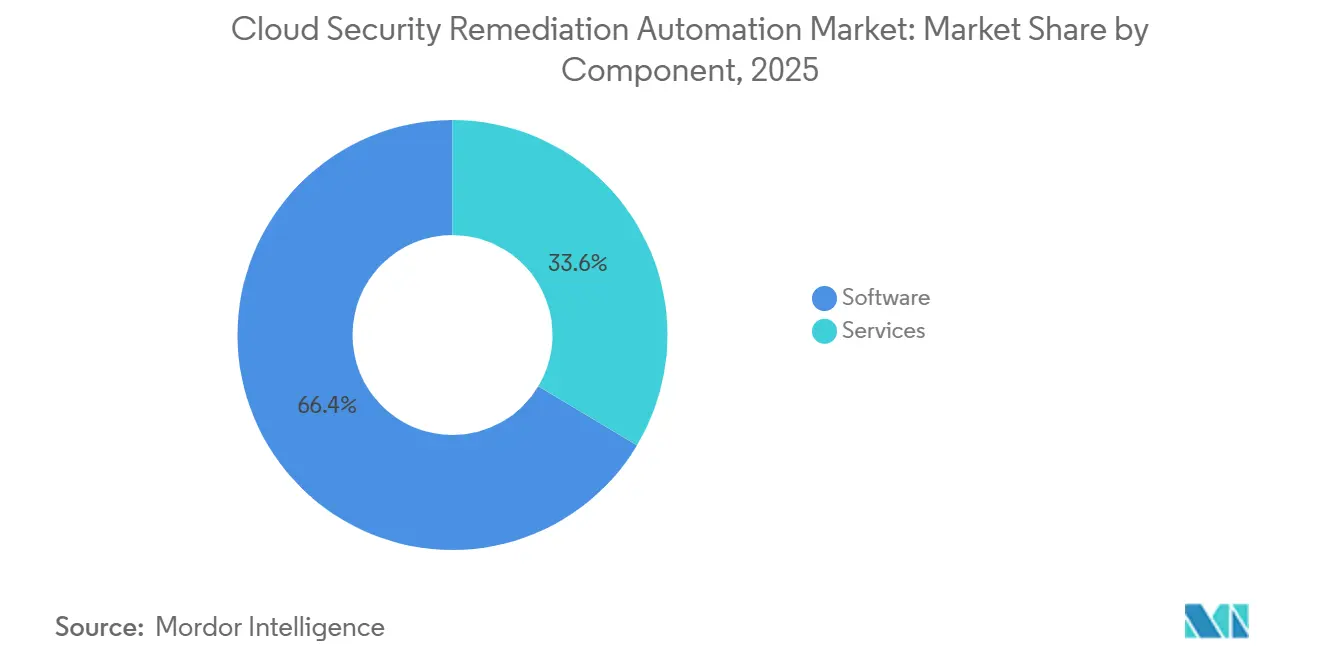
Software held 66.43% of cloud security remediation automation market share in 2025. This position reflected enterprise spending on platforms that generate configuration-specific remediation guidance. Policy-as-code engines can propose JSON or YAML changes instead of providing generic recommendations. Wiz introduced Green Agent in public preview in March 2026 to use its Security Graph, code-to-cloud tracing, identity ownership, and remediation history for environment-specific plans.[4] NIST Cybersecurity Framework 2.0 recognizes automated policy verification within the Respond function. Software providers are therefore competing on the accuracy and relevance of remediation logic.
Services are projected to grow at a 23.11% CAGR from 2026 to 2031. Organizations with limited internal capability are outsourcing triage, investigation, and fix execution to managed service providers. Managed CNAPP remediation commonly links service levels to mean time to remediate rather than only time to identify an issue. That approach ties provider accountability to the completion of a security action. Sysdig launched Secure AI in August 2026 with agents that investigate, prioritize, and generate fixes for cloud risks. The cloud security remediation automation industry is supported by services that combine automated workflows with human oversight.
By Cloud Environment: Public Cloud Holds the Largest Position While Hybrid Expands
Public cloud accounted for 47.52% of cloud security remediation automation market share in 2025. Cloud-native workloads are concentrated on hyperscaler platforms where security tools can connect with provider control planes. AWS added AI Toolkit capabilities to Automated Security Response on AWS in August 2026. The update extended automated remediation to findings from Amazon Inspector, Amazon GuardDuty, and Amazon Macie. Organizations using more than 1 cloud provider also need tools that can normalize policy definitions across different APIs. This requirement supports vendor-neutral capabilities in the public cloud environment.
Hybrid cloud is projected to grow at a 22.38% CAGR from 2026 to 2031. Financial services and healthcare organizations use hybrid designs when sensitive data must remain on-premises while connected cloud services support analytics and communications. Germany's BSI published C5:2026 criteria in 2026, updating cloud compliance requirements in line with NIS2 and the European Cybersecurity Certification Scheme for Cloud Services. These requirements support continuous evidence generation for workloads operating across hyperscaler and sovereign cloud environments. Private cloud adoption remains more common in government and defense environments with network-isolation requirements. The cloud security remediation automation market size for hybrid architectures is supported by the need to verify controls across connected but differently governed infrastructure.
By Organization Size: Large Enterprises Account for Most Spending While SMEs Accelerate
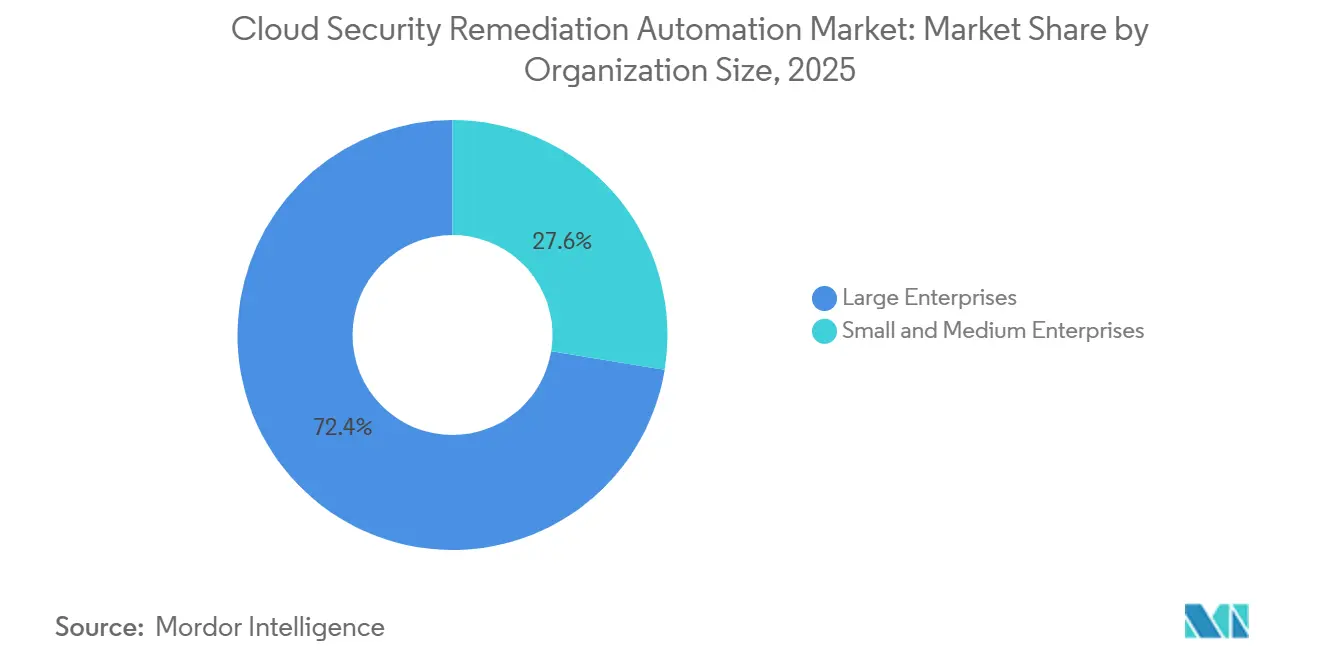
Large enterprises commanded 72.41% of the cloud security remediation automation market share in 2025. Their cloud estates create alert volumes that manual processes cannot consistently address. Many enterprise buyers are consolidating separate posture management, workload protection, and entitlement management products into unified CNAPP suites. These suites offer a connected workflow from detection through remediation. Proof-of-concept buyers increasingly assess whether a platform can reduce an established remediation backlog. This focus rewards providers that demonstrate operational outcomes instead of feature breadth.
SMEs are projected to grow at a 24.73% CAGR from 2026 to 2031. No-code and guided remediation interfaces can present cloud findings as structured actions without requiring extensive platform expertise. Thales reported that the average enterprise used 85 SaaS applications in 2025, creating a broad configuration surface for smaller organizations as well. Subscription-based offerings from managed service providers provide a practical route to adoption for businesses without dedicated cloud security staff. Cyber-insurance requirements for documented remediation workflows add another commercial reason to adopt these tools. The cloud security remediation automation industry can expand among SMEs when implementation and day-to-day operation remain manageable.
By Industry Vertical: BFSI Holds the Largest Share While Healthcare and Life Sciences Grow Fastest
BFSI held 26.17% of global revenue in 2025. The sector has substantial cloud use for transaction processing, fraud analytics, and digital banking. DORA became binding for EU financial entities on January 17, 2025 and increased the need for audit-ready cloud posture evidence. PCI DSS 4.0.1 requirements also became fully enforceable on March 31, 2025. Third-party information and communication technology risk management adds further demand for tools that record the status of controls across cloud providers. The cloud security remediation automation market size in BFSI is reinforced by these overlapping compliance responsibilities.
The healthcare and life sciences industry is projected to grow at a 24.89% CAGR from 2026 to 2031. AI diagnostics, telemedicine infrastructure, and population-health analytics are moving more clinical workloads into cloud environments. The HIPAA Security Rule sets a baseline for technical safeguards within cloud-hosted clinical systems. Government and public administration, IT and telecommunications, and energy and utilities are also increasing investment as cloud-first programs intersect with critical-infrastructure security requirements. Retail and e-commerce, transportation and logistics, oil and gas, media and entertainment, education, and research institutions contribute through cloud migration and PCI DSS obligations. Industrial manufacturing is also becoming more relevant as operational technology connects with cloud-managed platforms.
Geography Analysis
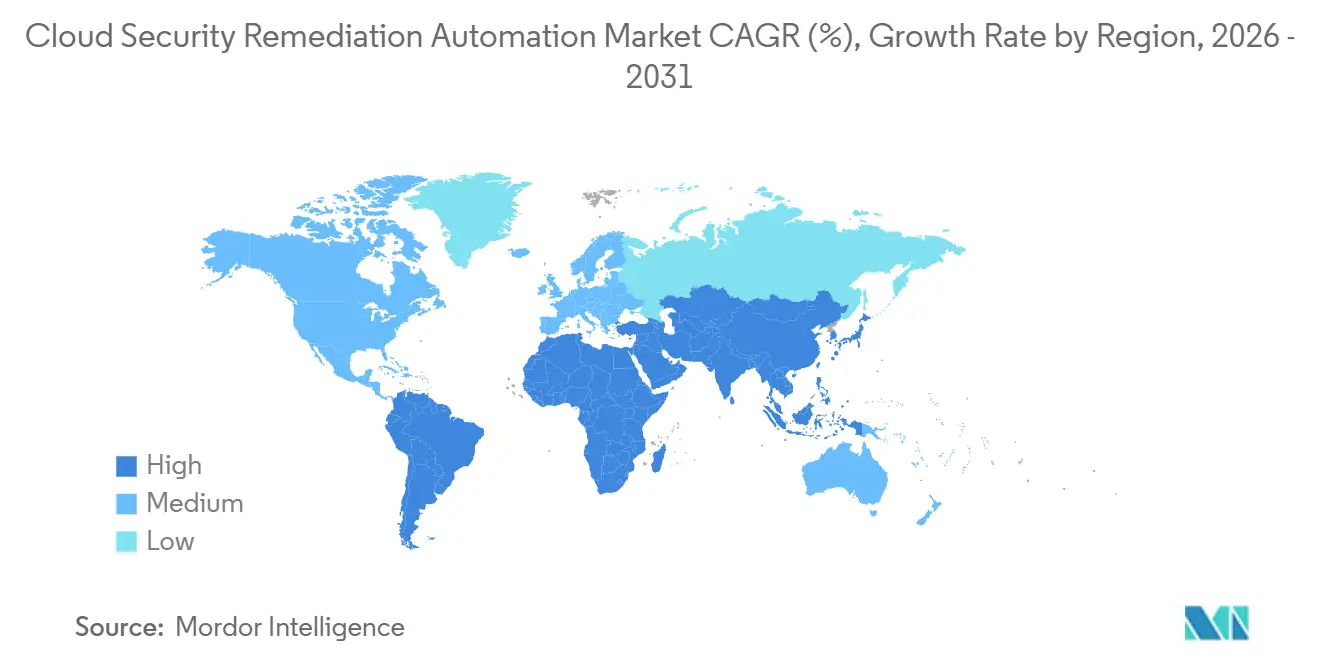
North America held 37.58% of the cloud security remediation automation market share in 2025. The region has a high concentration of cloud-native enterprises and financial-sector cloud activity. NIST Cybersecurity Framework 2.0, HIPAA, and SEC cybersecurity disclosure requirements shape buyer expectations for security controls and reporting. North American enterprises also adopted agentic remediation capabilities early. Their operating requirements continue to influence global evaluations of remediation speed and control. The cloud security remediation automation market remains well-established in the region because buyers can align remediation needs with active regulatory and operational requirements.
Europe has a distinct demand profile due to the multiple compliance frameworks that apply to cloud operations. Germany's IT security sector reached EUR 11.1 billion (USD 12.91 billion) in 2025. Security software and cloud platforms reached EUR 4.8 billion (USD 5.58 billion) during the year. NIS2 audit requirements, DORA supervision, and BSI C5:2026 criteria are increasing the demand for continuous evidence and remediation records. Sovereign cloud requirements also shape procurement because tools may need to operate within national data boundaries. The cloud security remediation automation market size in Europe is tied to vendors' ability to support these governance requirements.
Asia-Pacific is projected to grow at a 25.76% CAGR from 2026 to 2031. India, South Korea, Australia, and Japan are expanding cloud adoption while managing different national compliance requirements. This setting supports tools that can apply policies across several frameworks and local operating environments. Sysdig reported that more than 70% of security teams globally used behavioral analytics for cloud workloads in 2026. Saudi Arabia and the United Arab Emirates are also increasing cloud security investment through national digital transformation programs. South America and Africa remain smaller regions, but Brazil and South Africa are building demand through financial-sector oversight and data-protection requirements.
Competitive Landscape
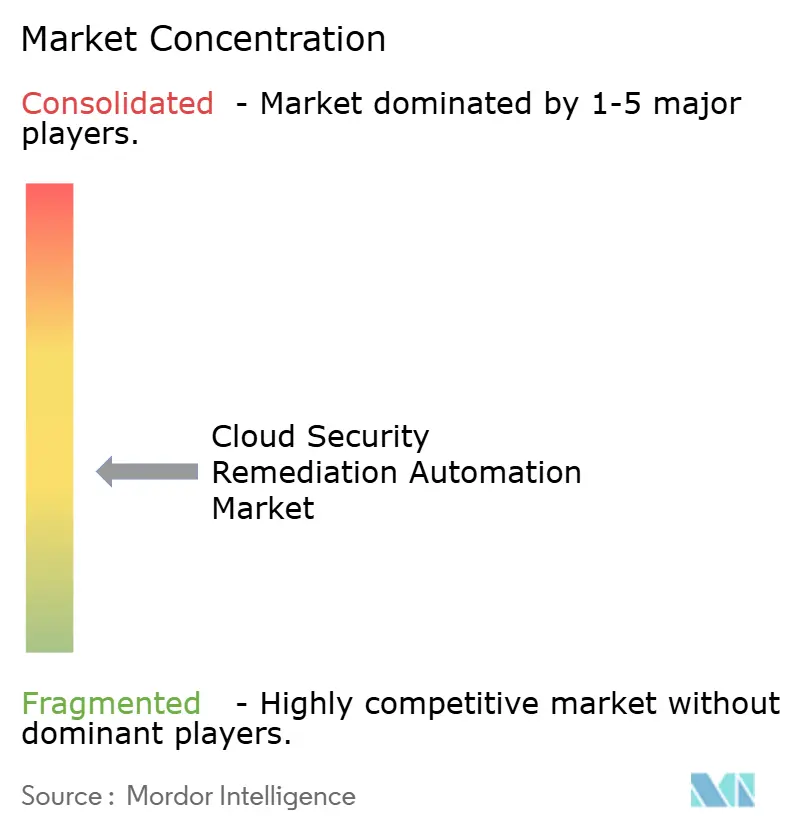
The cloud security remediation automation market is moderately fragmented among leading platform providers, with a larger group of specialist vendors serving narrower use cases. Palo Alto Networks through Prisma Cloud, CrowdStrike through Falcon Cloud Security, and Google through Wiz offer broad CNAPP and remediation portfolios. Orca Security, Sysdig, Aqua Security, Tenable, and Qualys compete through remediation logic, runtime context, and managed service delivery. Google completed the USD 32 billion acquisition of Wiz in March 2026. Wiz retained its brand and continued availability across AWS, Azure, and Oracle Cloud. The transaction gave Wiz access to Google's enterprise sales reach while preserving its multicloud positioning.
Palo Alto Networks completed its acquisitions of Chronosphere in January 2026 and CyberArk in February 2026. These moves added observability and identity security capabilities to its broader platform strategy.[5] CrowdStrike introduced an adversary-informed Cloud Risk Engine at the RSA Conference 2026. The capability maps cloud exposures to active adversary tradecraft and supports more operational risk prioritization. Aqua Security launched Aqua Compass in April 2026 to support agentic investigation, containment, and remediation of runtime incidents. These examples show how suppliers are combining remediation with observability, identity, runtime context, and developer workflows.
Governed autonomous remediation remains an area of competition. Buyers want AI agents that can operate within defined risk limits, change-control gates, and configurable blast-radius caps. AccuKnox, Upwind Security, and Mondoo are building developer-workflow integrations that bring remediation into CI/CD processes. Tenable is using Model Context Protocol capabilities to orchestrate vulnerability remediation workflows across patching tools. ISO/IEC 27001 and SOC 2 requirements continue to influence procurement because buyers seek evidence that security controls have been demonstrated. The cloud security remediation automation market will continue to favor suppliers that balance automation depth with interoperability and governance.
Cloud Security Remediation Automation Industry Leaders
-
Palo Alto Networks, Inc.
-
Wiz, Inc.
-
Microsoft Corporation
-
CrowdStrike Holdings, Inc.
-
Check Point Software Technologies Ltd.
- *Disclaimer: Major Players sorted in no particular order
Recent Industry Developments
- August 2026: AWS announced 4 new capabilities for Automated Security Response on AWS. These included an AI Toolkit that reduced custom remediation development time from weeks to hours through guided prompts with built-in safety guardrails. AWS extended automatic remediation to findings from Amazon Inspector, Amazon GuardDuty, and Amazon Macie. It also added multi-channel notifications through email, Slack, Jira, and ServiceNow with severity-based filtering. The release expanded native remediation coverage to credential compromise, unpatched vulnerabilities, and sensitive-data exposure.
- August 2026: Sysdig launched Sysdig Secure AI at Black Hat USA 2026. The AI-native offering was built on Secure CNAPP and included Vuln Agent, SOC Agent, Posture Agent, Risk Agent, and Response Agent. These agents were designed to investigate, prioritize, and remediate cloud risks. Sysdig positioned the offering as a way for security operators to set goals while AI carried out personalized security outcomes.
- August 2026: Qualys launched Real-Time CSPM in the Qualys Cloud Platform. The capability delivered instant detection and remediation guidance across multicloud environments. Qualys also introduced InstaScan for scanless detection and TruRisk Eliminate for AI-guided autonomous patch deployment. The company reported that its systems deployed 150 million patches during the previous year, including 40 million fully autonomous patches with a rollback rate below 0.1%.
- July 2026: Orca Security unveiled AI AppGen Security and AI Code Security Auditor at Black Hat USA 2026. The capabilities extended its platform to discover and secure AI applications created outside traditional development pipelines. They addressed security gaps in no-code and low-code AI builder environments, including Claude, Supabase, and Lovable.
Global Cloud Security Remediation Automation Market Report Scope
The cloud security remediation automation market includes platforms and tools that automatically identify, prioritize, and resolve cloud security misconfigurations, compliance violations, and vulnerabilities across multi-cloud environments. These solutions automate policy enforcement, compliance monitoring, infrastructure-as-code security scanning, and remediation workflows across AWS, Azure, Google Cloud, and Kubernetes. They help organizations reduce manual security operations, minimize misconfiguration-related risks, maintain compliance with frameworks such as SOC 2, ISO 27001, HIPAA, and PCI DSS, and support DevSecOps by embedding security remediation into cloud deployment and operational workflows.
The Cloud Security Remediation Automation Market Report is Segmented by Component (Software, and Services), Cloud Environment (Public Cloud, Private Cloud, Hybrid Cloud, and Multi-Cloud), Organization Size (Large Enterprises, and Small and Medium-Sized Enterprises), Industry Vertical (Government and Public Administration, Industrial Manufacturing, Retail and E-Commerce, Transportation and Logistics, Energy and Utilities, Oil and Gas, IT and Telecommunication, Media and Entertainment, Education and Research Institutions, Healthcare and Life Sciences, Banking, Financial Services, and Insurance (BFSI), and Other Industry Verticals), and Geography (North America, South America, Europe, Asia-Pacific, Middle East, and Africa). The Market Forecasts are Provided in Terms of Value (USD).
| Software |
| Services |
| Public Cloud |
| Private Cloud |
| Hybrid Cloud |
| Multi-Cloud |
| Large Enterprises |
| Small and Medium Enterprises |
| Government and Public Administration |
| Industrial Manufacturing |
| Retail and E-Commerce |
| Transportation and Logistics |
| Energy and Utilities |
| Oil and Gas |
| IT and Telecommunication |
| Media and Entertainment |
| Education and Research Institutions |
| Healthcare and Life Sciences |
| Banking, Financial Services, and Insurance (BFSI) |
| Other Industry Verticals |
| North America | United States |
| Canada | |
| Mexico | |
| South America | Brazil |
| Argentina | |
| Rest of South America | |
| Europe | Germany |
| United Kingdom | |
| France | |
| Italy | |
| Spain | |
| Rest of Europe | |
| Asia-Pacific | China |
| Japan | |
| India | |
| South Korea | |
| Australia | |
| Rest of Asia-Pacific | |
| Middle East | Saudi Arabia |
| United Arab Emirates | |
| Rest of Middle East | |
| Africa | South Africa |
| Nigeria | |
| Rest of Africa |
| By Componnent | Software | |
| Services | ||
| By Cloud Environment | Public Cloud | |
| Private Cloud | ||
| Hybrid Cloud | ||
| Multi-Cloud | ||
| By Organization Size | Large Enterprises | |
| Small and Medium Enterprises | ||
| By Industry Vertical | Government and Public Administration | |
| Industrial Manufacturing | ||
| Retail and E-Commerce | ||
| Transportation and Logistics | ||
| Energy and Utilities | ||
| Oil and Gas | ||
| IT and Telecommunication | ||
| Media and Entertainment | ||
| Education and Research Institutions | ||
| Healthcare and Life Sciences | ||
| Banking, Financial Services, and Insurance (BFSI) | ||
| Other Industry Verticals | ||
| By Geography | North America | United States |
| Canada | ||
| Mexico | ||
| South America | Brazil | |
| Argentina | ||
| Rest of South America | ||
| Europe | Germany | |
| United Kingdom | ||
| France | ||
| Italy | ||
| Spain | ||
| Rest of Europe | ||
| Asia-Pacific | China | |
| Japan | ||
| India | ||
| South Korea | ||
| Australia | ||
| Rest of Asia-Pacific | ||
| Middle East | Saudi Arabia | |
| United Arab Emirates | ||
| Rest of Middle East | ||
| Africa | South Africa | |
| Nigeria | ||
| Rest of Africa | ||
Key Questions Answered in the Report
What is the cloud security remediation automation market size?
The cloud security remediation automation market size is projected to expand from USD 2.11 billion in 2025 and USD 2.56 billion in 2026 to USD 6.42 billion by 2031, registering a CAGR of 20.19% between 2026 to 2031.
What is driving demand for cloud security remediation automation?
Multicloud complexity, automated compliance evidence, and AI-assisted prioritization are increasing demand for tools that move findings into completed remediation actions.
Which component leads cloud security remediation automation spending?
Software held 66.43% of revenue in 2025, supported by policy-as-code capabilities and configuration-specific remediation workflows.
Which cloud environment is growing fastest for remediation automation?
Hybrid cloud is projected to grow at a 22.38% CAGR through 2031 because regulated organizations need consistent controls across on-premises and cloud environments.
Which organizations are adopting these platforms fastest?
SMEs are projected to grow at a 24.73% CAGR through 2031 as no-code interfaces and managed services lower deployment and operating barriers.
Which region is expected to grow fastest?
Asia-Pacific is projected to grow at a 25.76% CAGR through 2031 as cloud adoption and varied national compliance needs increase demand for automated workflows.