
Motorcycle Advanced Rider Assistance System Market Size and Share
Market Overview
| Study Period | 2019 - 2031 |
|---|---|
| Market Size (2026) | USD 325.82 Million |
| Market Size (2031) | USD 585.83 Million |
| Growth Rate (2026 - 2031) | 12.45 % |
| Fastest Growing Market | Asia Pacific |
| Largest Market | Europe |
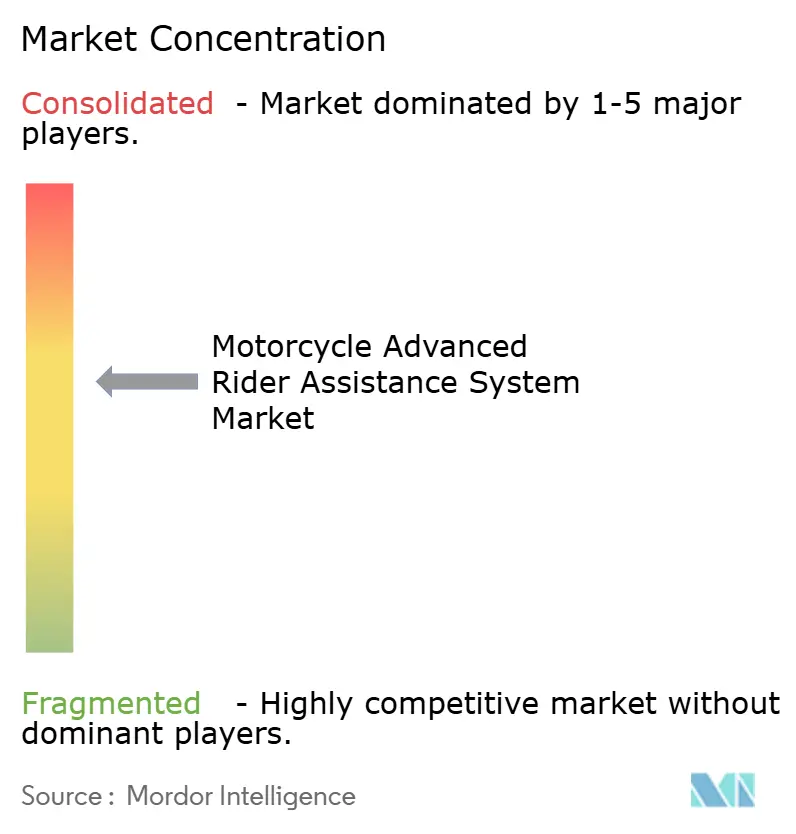
| Market Concentration | Medium |
Major Players *Disclaimer: Major Players sorted in no particular order Image © Mordor Intelligence. Reuse requires attribution under CC BY 4.0. | |
Motorcycle Advanced Rider Assistance System Market Analysis by Mordor Intelligence
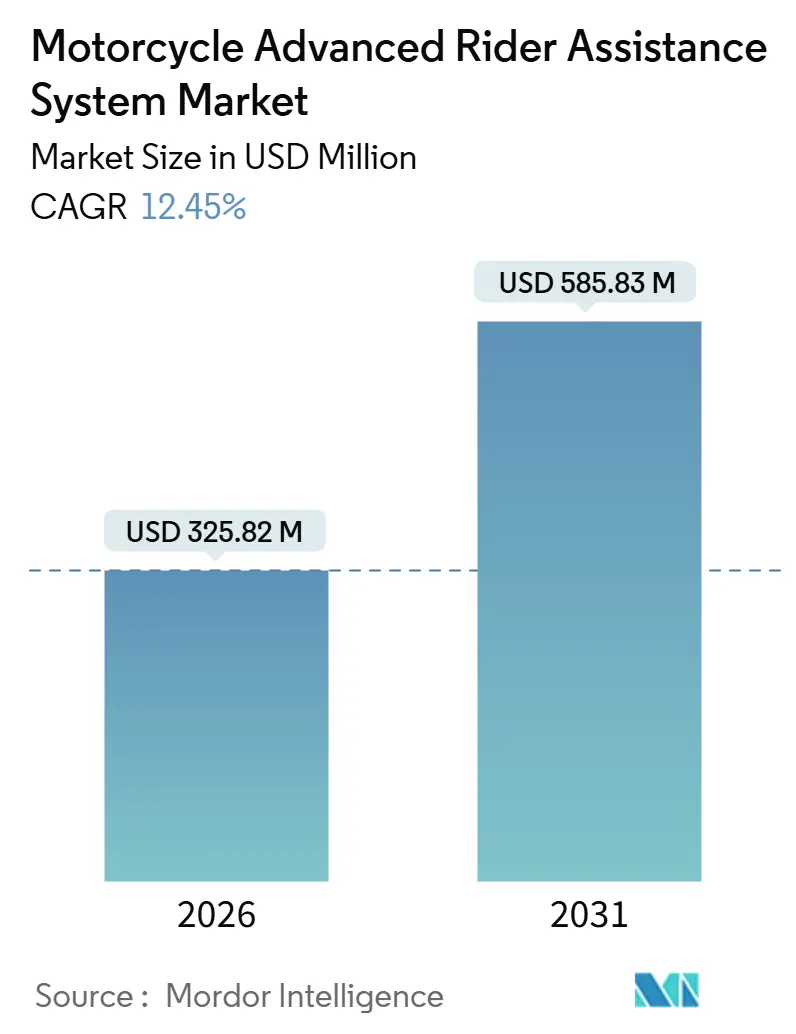
The motorcycle advanced rider assistance system market size stands at USD 325.82 million in 2026 and is projected to reach USD 585.83 million by 2031, advancing at an impressive 12.45% CAGR during the forecast period. Growth is powered by three converging forces: regulatory mandates that mandate collision-mitigation features on mid-displacement platforms, rapid declines in sensor costs that approach automotive parity, and original-equipment-manufacturer (OEM) platform-sharing programs that amortize radar and LiDAR integration across multiple model lines. Tier-1 suppliers now deliver 210-meter front-radar modules at price points viable for motorcycles above 500 cc, enabling mainstream touring and adventure models to debut adaptive cruise control, forward-collision warnings, and emergency-braking assist. India’s draft G.S.R. 415(E) requires anti-lock braking systems (ABS) on L2 motorcycles, laying a sensor and electronic-control foundation that accelerates advanced rider-assist rollouts[1]. Meanwhile, Europe’s Euro 7 framework mandates on-board monitoring and anti-tampering measures, which indirectly spur demand for electronic control units (ECUs) capable of executing multiple rider-assist algorithms.
Key Report Takeaways
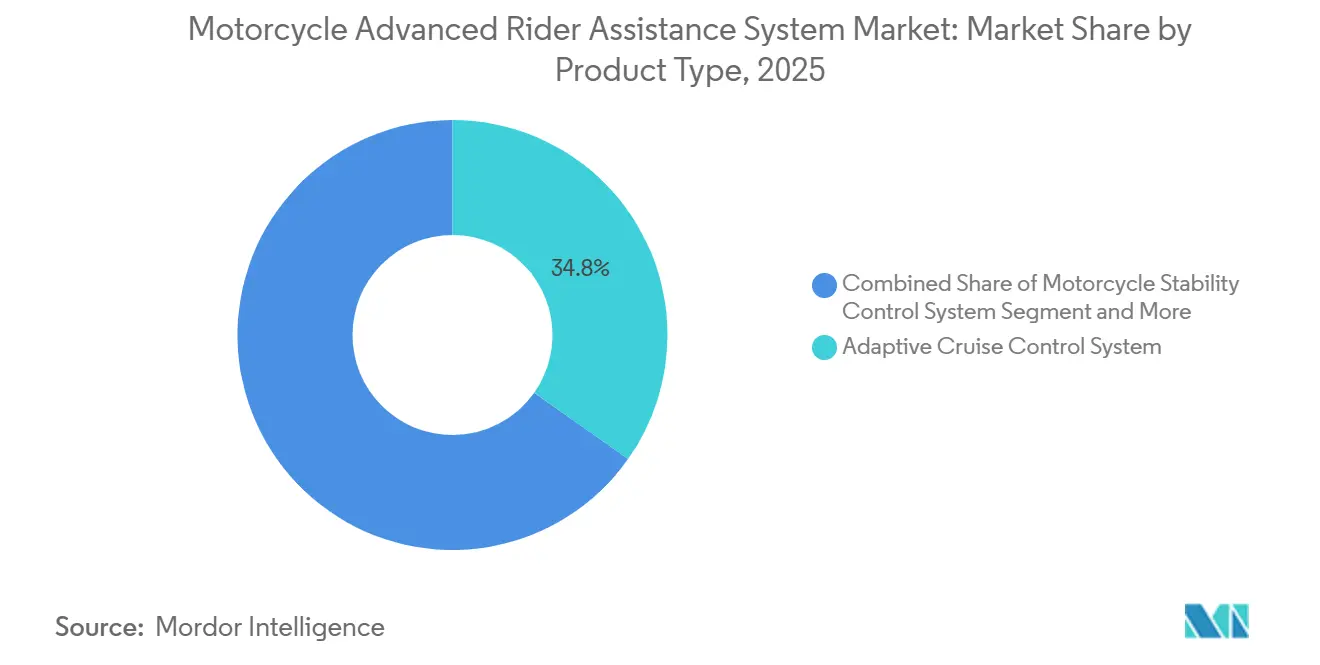
- By product type, adaptive cruise control systems accounted for 34.79% of the motorcycle advanced rider assistance system market share in 2025, while forward-collision warning systems are forecast to expand at a 15.04% CAGR through 2031.
- By sensor, radar captured 32.74% of the motorcycle advanced rider assistance system market share in 2025; LiDAR is projected to grow at a 18.42% CAGR between 2026 and 2031.
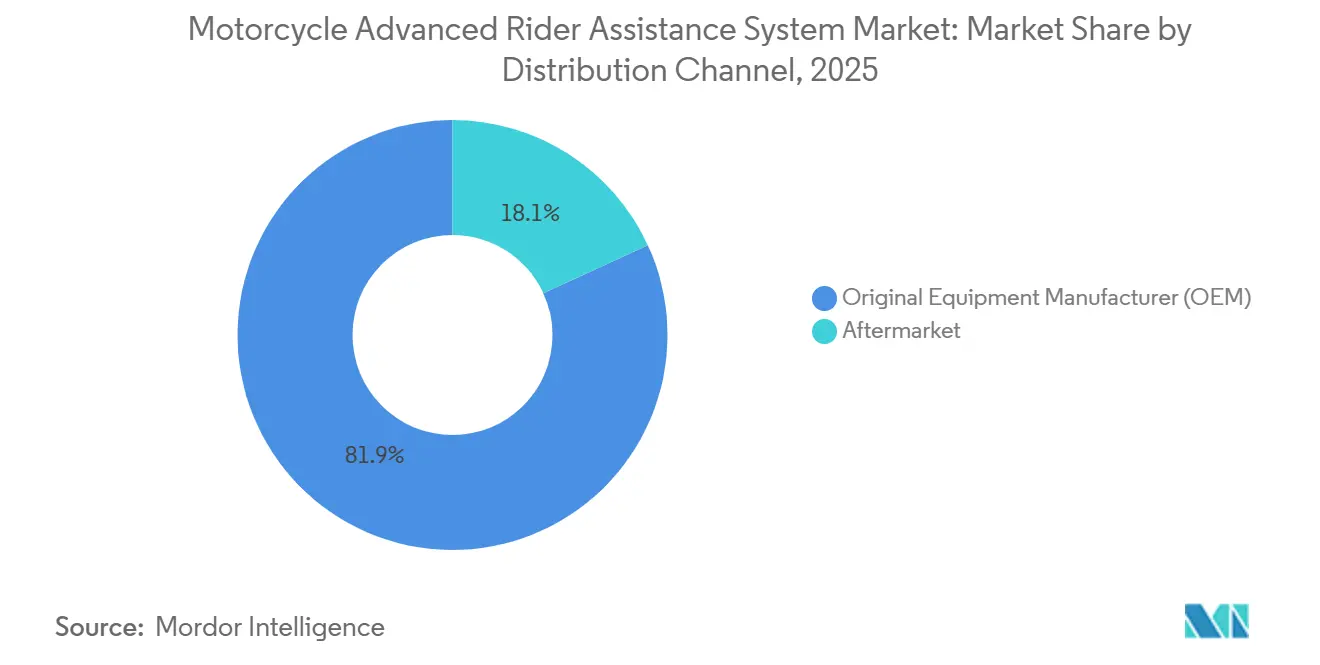
- By distribution channel, OEM sales commanded 81.86% of the motorcycle advanced rider assistance system market share in 2025, yet aftermarket retrofits are set to grow at a 13.52% CAGR through 2031.
- By component, electronic control units accounted for 38.88% of the motorcycle advanced rider assistance system market share in 2025, whereas gear assistors will grow at a 14.07% CAGR through 2031.
- By geography, Europe led with 31.72% of the motorcycle advanced rider assistance system market share in 2025, and Asia-Pacific is forecasted to record the fastest 13.15% CAGR to 2031.
Note: Market size and forecast figures in this report are generated using Mordor Intelligence’s proprietary estimation framework, updated with the latest available data and insights as of January 2026.
Market Trends and Insights
Drivers Impact Analysis of Motorcycle Advanced Rider Assistance System Market*
| Driver | (~)% Impact on CAGR Forecast | Geographic Relevance | Impact Timeline |
|---|---|---|---|
| Declining LiDAR Sensor Pricing | +2.8% | Global, with early adoption in Europe and Asia-Pacific premium segments | Medium term (2-4 years) |
| ARAS Suites | +2.5% | Europe, Asia-Pacific (India, China, ASEAN), North America | Medium term (2-4 years) |
| Premium Touring and Adventure Bikes | +2.2% | ASEAN (Thailand, Vietnam, Indonesia, Philippines), spill-over to India | Long term (≥ 4 years) |
| Motorcycle-Safety Mandates | +2.0% | Europe (Euro 7), India (BS6/draft BS7 ABS mandates), ASEAN (harmonization) | Short term (≤ 2 years) |
| V2X-Enabled OTA Updates | +1.5% | Global, with pilot deployments in Europe, North America, and China | Long term (≥ 4 years) |
| Telematics Discounts | +1.2% | Europe (Greece, Italy), North America, emerging in Asia-Pacific | Medium term (2-4 years) |
| Source: Mordor Intelligence | |||
Rapid Decline in Motorcycle LiDAR Sensor Pricing
Automotive-grade LiDAR modules cost significantly less than they did in 2015, allowing suppliers to offer solid-state units tailored for two-wheelers at prices that rival those of 77 GHz radar. The latest generation of Bosch front-radar achieves a 210-meter detection range, extending coverage by 50 meters relative to the prior unit and improving reaction time in touring scenarios. Chinese harmonization standard T/CECC 028-2024 defines six ARAS capability levels, pushing local OEMs to source modular sensors that drop seamlessly into cross-platform architectures. As premium touring and adventure motorcycles above 500 cc adopt these sensors, economies of scale further compress costs, accelerating adoption in lower price bands. The trajectory confirms a structural cost-advantage pathway that sustains double-digit growth for the motorcycle advanced rider assistance system market.
OEM Platform-Sharing to Embed ARAS Suites at Scale
Major motorcycle makers deploy standard frames, engines, and electronic systems across multiple models, enabling rider-assist hardware to spread across entire line-ups. A flagship case integrates adaptive cruise, group-ride assist, riding-distance assist, and emergency-brake assist within the same ECU and harness, cutting unit costs, engineering time, and certification fees. Yamaha Motor’s Advanced Motorcycle Stabilisation Assist System (AMSAS) illustrates in-house verticalization: a 6-axis inertial measurement unit (IMU) and dual actuators deliver low-speed balance control and seamlessly plug into existing YZF-R25 frames without chassis changes. Supplier–OEM collaborations built on automotive ISO 26262 toolchains shorten functional-safety validation, allowing rapid scale-ups across mid-displacement categories that dominate sales volumes in Asia-Pacific. Platform-sharing thereby locks in sustained demand for ARAS modules throughout the forecast period.
Rising Demand for Premium Touring and Adventure Bikes in ASEAN
Electrification targets in Thailand, Vietnam, and the Philippines are stimulating premium motorcycle purchases among consumers who value safety and connectivity over price. Electric powertrains typically operate on 48-V architectures, leaving ample headroom for continuous radar scanning, vision processing, and V2X communication. Regional sales of large touring and adventure models climbed sharply in early 2025 as riders sought lane-change assistance, blind-spot alerts, and adaptive cruise control to navigate crowded urban corridors and extended highway journeys. Local authorities encourage tech adoption through preferential registration fees and fleet electrification subsidies, thereby expanding the addressable market for the motorcycle advanced rider assistance system. With ASEAN riders traveling thousands of kilometers per year for leisure and commerce, demand for fatigue-reduction and collision-avoidance technologies is rising rapidly.
Stricter Euro 7 and Bharat Stage 7 Motorcycle-Safety Mandates
Europe’s Euro 7 regulation, phased from 2025, obliges on-board monitoring, driver warnings, and anti-tampering functions, nudging OEMs to integrate ECUs capable of multiple rider-assist tasks. India’s draft G.S.R. 415(E) proposes mandatory ABS on all L2 motorcycles, a pivotal prerequisite for forward-collision warning and emergency-braking assist. Convergence toward UN Regulation 171 on Direct Control Advanced Safety (DCAS) systems ensures standard global test protocols, shortening homologation times and lowering compliance costs. Functional-safety certification under ISO 26262 has become the baseline, further institutionalizing electronic rider-assistance across value chains. Collectively, these mandates embed ARAS features as standard equipment, immediately lifting penetration rates in the motorcycle advanced rider assistance system market.
Restraints Impact Analysis of Motorcycle Advanced Rider Assistance System Market*
| Restraint | (~)% Impact on CAGR Forecast | Geographic Relevance | Impact Timeline |
|---|---|---|---|
| Sensor-Fusion Latency | -1.8% | Global, particularly affecting high-performance and sport-touring segments | Medium term (2-4 years) |
| Limited 12-V Electrical Headroom | -1.5% | Asia-Pacific (India, China, ASEAN), South America, Africa | Long term (≥ 4 years) |
| Consumer Privacy Concerns | -0.8% | Europe (GDPR), North America, emerging in Asia-Pacific | Short term (≤ 2 years) |
| Retro-Fit Kit Regulatory Ambiguity | -0.6% | Europe, North America, with spill-over to Asia-Pacific | Medium term (2-4 years) |
| Source: Mordor Intelligence | |||
Persistent Sensor-Fusion Latency at Lean Angles
During steep cornering, motorcycles can exceed 45-degree lean angles, shifting the radar and camera fields of view away from the road ahead. Peer-reviewed work shows false-positive spikes and longer object-classification latency when roll, pitch, and yaw change rapidly, forcing conservative warning thresholds that diminish rider confidence. ISO 26262 demands sub-200-millisecond end-to-end latency, yet many multi-sensor stacks struggle to meet this standard under aggressive sport-riding. Bosch’s emergency-brake assist improves rear-end collision avoidance but raises rider-stability concerns when automatic braking triggers during active lean. Solving these physics-driven challenges requires adaptive algorithms that blend IMU data with predictive trajectory modeling, an R&D priority expected to take several product cycles.
Limited 12-V Electrical Headroom on Commuter Motorcycles
Most 100-cc to 150-cc commuter motorcycles rely on 12-V systems with power budgets under 300 W, leaving little margin for continuous radar (20–40 W), camera (30–50 W), and V2X (10–20 W) loads. Upgrading to 48-V architectures adds USD 150–200 in batteries and converters, exceeding the bill-of-materials targets for price-sensitive segments. New e-clutch ECUs add another 15–20 W, intensifying the power deficit. OEMs must either redesign electronics or wait for ultra-low-power sensors, slowing deployment in the highest-volume market bands and restraining overall expansion of the motorcycle advanced rider assistance system market.
*Our forecasts treat driver/restraint impacts as directional, not additive. The impact forecasts reflect baseline growth, mix effects, and variable interactions.
Motorcycle Advanced Rider Assistance System Market Segment Analysis
By Product Type:
Collision Mitigation Drives Near-Term AdoptionAdaptive cruise control systems, which held 34.79% of the motorcycle advanced rider assistance system market share in 2025, remain dominant thanks to touring riders who value automatic gap-keeping in mixed traffic. Forward-collision warning systems are projected to grow at 15.04% annually from 2026 to 2031, the quickest pace within product categories. Their ascent aligns with Euro 7 monitoring mandates and draft Indian ABS rules, pushing OEMs to embed front-radar modules coupled with predictive braking algorithms. Motorcycle stability control systems, integrating tilt-aware braking and traction management, expand as sensor costs fall and sport-touring customers demand corner-safe braking. Blind-spot detection, previously a passenger-car exclusive, is now available on high-trim adventure bikes that use rear radar to flag overtaking vehicles.
Niche features such as group-ride assist and riding-distance assist cater to organized touring communities and, though small today, illustrate the ecosystem’s shift from pure safety to convenience and social riding features. The product portfolio paints a two-track evolution. Collision-mitigation capabilities become baseline for regulatory compliance and insurance incentives, ensuring broad penetration across mid- and high-displacement motorcycles. Comfort-oriented features differentiate premium models, allowing OEMs to tier trim levels and sell subscription-based feature unlocks via OTA updates. Competitive positioning, therefore, hinges on a balanced offering that satisfies regulators, riders, and recurring-revenue ambitions inside the motorcycle advanced rider assistance system market.

By Sensor:
LiDAR Gains as Automotive Volumes Drive Cost CurvesRadar modules held 32.74% of the motorcycle advanced rider assistance system market share in 2025 due to proven all-weather performance and a relatively low cost. Yet LiDAR revenue is forecast to rise at an 18.42% CAGR as solid-state designs fall below USD 200, providing motorcycles with 3-D point clouds that improve lane-merging and rear-collision estimation accuracy. Image sensors remain hampered by limited mounting options and exposure to glare, rain, and vibration, although machine-learning-enhanced de-noising now salvages more frames for algorithmic use. Ultrasonic sensors, useful at distances of less than 5 meters, remain confined to parking-assist add-ons. Infrared night-vision remains a luxury option for a small subset of long-distance touring bikes.
Technological convergence steers the sector toward radar-centric arrays complemented by LiDAR for high-resolution mapping and cameras for visual classification. Standard-setting bodies encourage harmonized sensor suites, reducing bespoke engineering and securing multi-vendor supply resilience. Continued automotive volume drives down costs, ensuring sensor diversification without jeopardizing profit margins inside the motorcycle advanced rider assistance system market.
By Distribution Channel:
Aftermarket Gains as Retrofit Clarity ImprovesOEMs commanded 81.86% of the motorcycle advanced rider assistance system market share in 2025 because clean-sheet integration better meets type-approval hurdles, functional-safety validation, and CAN bus messaging demands. Yet aftermarket solutions are projected to climb at 13.52% CAGR through 2031, propelled by startups offering adhesive radar pods and camera kits that link to smartphone dashboards. Regulatory bodies now draft inspection manuals that outline wiring, mounting, and diagnostic-trouble-code requirements, lowering barriers for third-party installers.
Riders of older or low-trim motorcycles, especially in emerging Asian megacities, value bolt-on blind-spot, forward-collision, and lane-change warning functions that raise daily commute safety without new-bike expenditures. Over time, an ecosystem of certified installers, telematics insurers, and ride-share operators will broaden aftermarket reach. However, OEM dominance will remain in premium touring and adventure segments where ARAS features arrive factory-fitted, software-activated, and bundled with extended warranties. The interplay between factory-installed systems and aftermarket kits underpins the continued expansion of the motorcycle advanced rider assistance system market.
By Component:
Gear Assistors Surge as E-Clutch ECUs Enable AutomationElectronic control units accounted for 38.88% of the motorcycle advanced rider assistance system market share in 2025, serving as the fusion hub for sensor inputs and actuator commands. Their share gradually tapers as ECUs shift from high-margin stand-alone boxes to commoditized network nodes that leverage over-the-air updates for feature unlocks. Gear assistors, driven by the advent of electronic clutches, will increase at a 14.07% CAGR; automated clutch actuation integrates seamlessly with stop-and-go adaptive cruise and hill-start assist, reducing rider fatigue in congested traffic. Sensor modules drop in absolute price but maintain healthy value contribution, driven by rising volume and multi-sensor arrays on high-end models.
Ancillary components, actuators, harnesses, and power-management units must evolve toward ultra-low-watt designs to fit 12-V commuter motorcycles, reinforcing R&D investments in miniaturization. As automation deepens, the component hierarchy rearranges: software-defined ECUs become the subscription gateway. At the same time, gear assistors translate algorithms into tactile rider benefits such as smoother shifts and clutch-free low-speed maneuvers. This evolution cements a robust revenue mix, sustaining the broader motorcycle advanced rider assistance system market.
Geography Analysis
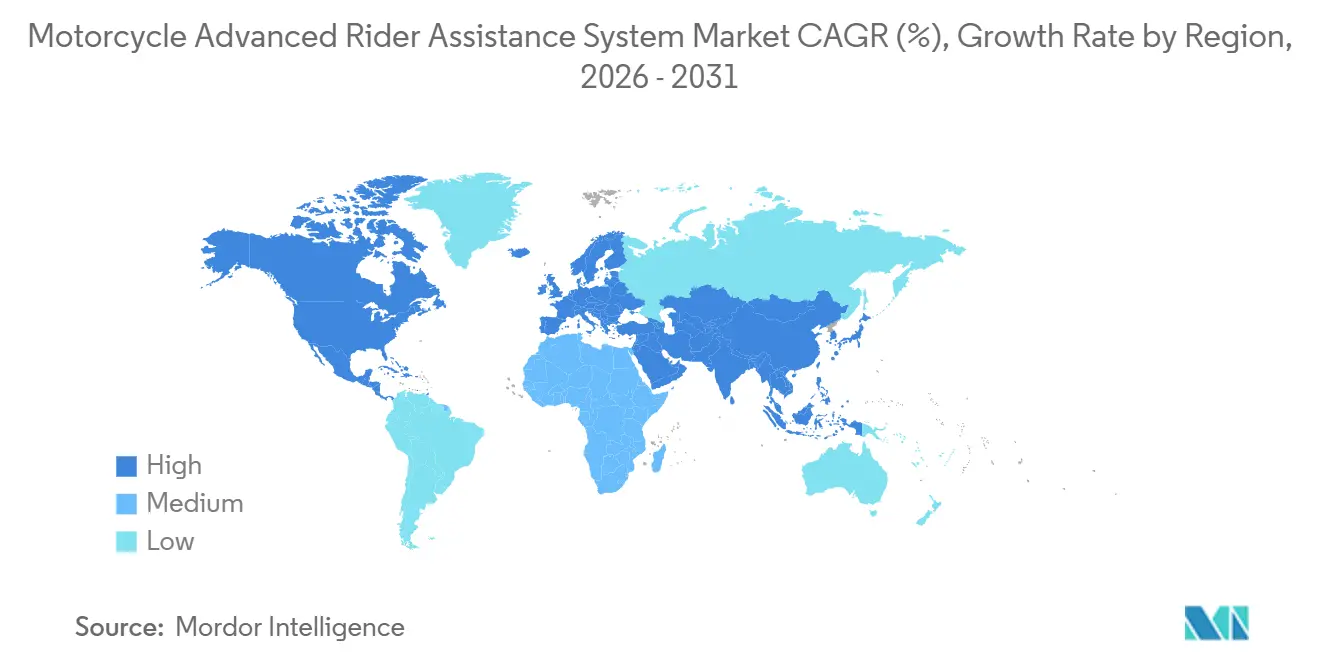
Europe Motorcycle Advanced Rider Assistance System Market
Europe controlled 31.72% of the motorcycle advanced rider assistance system market share in 2025 and is projected to expand at 9.78% through 2031. The continent’s strict Euro 7 mandates obligate on-board monitoring and data logging, pushing OEMs to embed multi-sensor ECUs and advanced diagnostics[2]. Premium brands headquartered in Germany, Italy, and Austria equip touring and adventure models with adaptive cruise, blind-spot detection, and emergency-brake assist as standard, ensuring regulatory compliance while meeting consumer expectations. Data-privacy directives under Europe’s GDPR prompt software features such as local video storage, consent screens, and automatic anonymization, adding cost but also boosting user trust. Insurance carriers accelerate uptake by offering double-digit policy discounts for ARAS-equipped bikes, reinforcing a virtuous cycle of safety and commercial incentives.
APAC Motorcycle Advanced Rider Assistance System Market
Asia-Pacific is forecast to grow at a 13.15% CAGR through 2031, the fastest worldwide. India’s impending ABS requirement for L2 motorcycles, China’s six-tier intelligence classification, and expanding electrification targets across Southeast Asia jointly create the ideal conditions for rider-assist proliferation. Local producers scale sensor packages into commuter and sport models, leveraging regionally low labor and manufacturing costs to hit sub-USD 150 sensor unit thresholds. Japanese OEMs now integrate traction control and tilt-aware braking across mid-displacement offerings, while Chinese automotive brands migrating into high-end motorcycles port over car-grade digital cockpits and ADAS stacks. As charging infrastructure for electric bikes improves, 48-V architectures unlock ample electrical headroom, enabling the integration of radar and LiDAR on mainstream platforms.
The Americas, MEA and Russia Motorcycle Advanced Rider Assistance System Market
North America advances at 8.88% owing to an entrenched motorcycle touring culture and insurance telematics incentives that slash premiums by as much as half for ARAS-equipped riders. Stateside regulators adopt UN DCAS protocols to harmonize testing, simplifying OEM homologation for cross-Atlantic models. Western Asia posts an 11.61% rise amid affluent consumers in the Gulf who favor premium touring machines with lane-change and blind-spot alerts for long stretches of highway. South America, Africa, and Russia lag, with premium-segment penetration remaining limited and homologation pathways for retrofit kits still in development. Even so, improving disposable income and early pilots of safety features hint at latent demand that could accelerate should financing and regulatory clarity emerge.
Regulatory Landscape
Motorcycle ARAS deployment is shaped by L-category type-approval and UNECE harmonization, with Regulation (EU) No 168/2013 anchoring EU requirements for motorcycles and related market-surveillance controls. In the report context, Euro 7 is phased from 2025 and raises expectations around on-board monitoring and anti-tampering, pushing OEMs toward ECUs and diagnostics that can also support rider-assist algorithms.
Globally, UNECE WP.29 working groups have advanced provisions relevant to electronically controlled braking and advanced control functions for two-wheelers, including GRVA work to evaluate updates to UN Regulation No. 78 (braking of Category L vehicles) for Complex Electronic Control Systems and automatically commanded braking concepts. In parallel, UNECE cybersecurity management requirements under UN Regulation No. 155 have been extended to L-category vehicles, adding compliance obligations around secure software and update governance for connected ARAS platforms.
Value Chain Analysis
The value chain begins with sensing and compute inputs (77/79 GHz radar, cameras, IMUs, ECUs, and embedded software) supplied by Tier-1s such as Robert Bosch GmbH, Continental, and NOVELIC, while OEMs (including KTM, BMW Motorrad, Ducati, and Hero MotoCorp) handle vehicle-level integration, calibration, and homologation. Functional safety and process compliance influence upstream design choices, with ISO 26262-12:2018 and ISO/TR 5340:2023 supporting motorcycle-specific safety integrity work, and China aligning through GB/T 34590.12-2022, which helps suppliers productize reusable hardware-software blocks across regions.
Midstream, integration bottlenecks focus on motorcycle packaging, wiring complexity, and tight power budgets, increasing the importance of platform-sharing architectures and consolidated ECUs as the fusion hub. For fully integrated ARAS, OEM distribution remains dominant due to type-approval, diagnostics, and CAN integration needs, while aftermarket activity is building around camera-based and radar add-on kits supported by installer networks and clearer inspection practices. Strategic supplier-OEM collaboration is visible in programs such as Valeo and Hero MotoCorp's MoU to co-develop two-wheeler ARAS, reflecting a shift toward localized engineering and scalable sourcing for high-volume markets.
Competitive Landscape
The motorcycle advanced rider assistance system market shows moderate concentration: Bosch and Continental lead, yet newcomer dynamics indicate future dilution. Bosch deploys ISO 26262-compliant ARAS suites developed initially for automobiles, using standard radar hardware across passenger-car and motorcycle lines to maximize scale economies. Continental, meanwhile, targets fast-growing Asian markets, leveraging local production to achieve competitive price points suitable for mid-displacement bikes.
Vision-centric startup Roadio offers camera-based retrofit kits that deliver forward-collision and lane-deviation warnings through smartphone dashboards, bypassing proprietary CAN bus interfaces and appealing to tech-savvy riders upgrading older motorcycles. Yamaha Motor’s integrated innovation strategy under its “Jin-Ki Kanno x Jin-Ki Anzen” vision leverages robotics, artificial intelligence, and sensor expertise to develop proprietary rider-assist features. The firm’s AMSAS prototype stabilizes motorcycles at walking pace with coordinated drive and steering actuators, a differentiator unmatched by traditional Tier-1s[3].
Automotive mega-suppliers ZF, Denso, and Autoliv signal entry, repurposing vast ADAS portfolios for two-wheeler dynamics and raising the bar for feature completeness. Standards harmonization via UN Regulation 171 favors firms with global certification capabilities, while limited 12-V power budgets spur a race for low-current radar chips and ultra-efficient ECUs. Competitive intensity is therefore projected to tighten, gradually redistributing share toward agile players that blend hardware scale, software over-the-air agility, and regional production footprints.
Motorcycle Advanced Rider Assistance System Industry Leaders
-
Continental AG
-
ZF Friendrichafen AG
-
Robert Bosch GmbH
-
BMW Motorrad
-
Denso Corporation
- *Disclaimer: Major Players sorted in no particular order
Motorcycle Advanced Rider Assistance System Market Companies Covered in this Report
- Robert Bosch GmbH
- Continental AG
- ZF Friedrichshafen AG
- Denso Corporation
- Mitsubishi Electric Corporation
- BMW Motorrad
- Ducati Motor Holding
- Honda Motor Co.
- Yamaha Motor Co.
- Kawasaki Heavy Industries
- KTM AG
- Triumph Motorcycles
- Harley-Davidson
- Piaggio Group (Aprilia)
- Autoliv Inc.
Read Analysis of Motorcycle Advanced Rider Assistance System Companies
Market Opportunities and Future Outlook
The clearest whitespace is at the intersection of regulation-driven braking infrastructure and the need for repeatable validation of motorcycle-specific automatic interventions. UN Regulation No. 171 (DCAS) provides a pathway for technologically neutral approval of driver control assistance concepts across categories that include motorcycles, encouraging OEMs and suppliers to adapt existing car-grade ADAS modules into two-wheeler-ready systems with appropriate HMI and fault-handling. For braking-centric ARAS, UNECE workstreams on electronically controlled braking and complex electronic control systems, combined with ABS buildout in markets such as India (via draft G.S.R. 415(E) in the report context), support wider deployment of forward-collision warning and emergency-braking assist that rely on electronically actuated braking and stable IMU inputs.
Software-defined ARAS is another opportunity as cybersecurity and update governance become part of compliance for connected functions, following the extension of UN Regulation No. 155 to L-category vehicles. This shifts differentiation toward secure OTA-capable ECUs, sensor-fusion stacks, and validation tooling that can be reused across model lines, consistent with the report context on OEM platform-sharing. Industry activity also points to localization and cost-down opportunities in Asia-Pacific, where partnerships such as Valeo with Hero MotoCorp and India-focused rollouts by local component firms collaborating with ARAS specialists show ongoing investment in domestically engineered and manufactured rider-assist solutions for both ICE and electric motorcycles.
Recent Industry Developments in Motorcycle Advanced Rider Assistance System Market
- June 2026: Dhoot Transmission partnered with RideVision to introduce AI-driven rider assistance technologies tailored for Indian road conditions. The collaboration targets localized perception and alerting performance, supporting retrofit and OEM-fitment pathways for camera-based ARAS in high-volume operating environments.
- April 2026: Sterling Tools Limited entered into a technology collaboration and supply agreement with Nanjing Haohang Technology to localize ARAS engineering, manufacturing, and sales for the Indian market. Local production capability strengthens supply resilience and positions Indian component makers to serve OEM programs seeking cost-optimized sensor and ECU integration.
- November 2024: Bosch debuted new front-radar-based ARAS functions, including Adaptive Cruise Control Stop and Go, Group Ride Assist, Riding Distance Assist, and Emergency Brake Assist, with production deployment targeted for 2025 and first fitment referenced on KTM’s 1390 Super Adventure S Evo. The move expanded the feature set available for motorcycle-grade radar stacks and increased competitive pressure on Tier-1 and OEM roadmaps for mid- and high-displacement platforms.
Motorcycle Advanced Rider Assistance System Market Report Scope and Research Methodology
Market Definition and Coverage
This market covers the revenue generated from advanced rider assistance systems installed on motorcycles, where sensing, control, and alerting functions are used to reduce crash risk and improve rider stability in real traffic conditions.
Scope exclusions: We exclude basic, non-electronic safety parts and general motorcycle maintenance items that do not deliver an assistance function.
Segments Covered in This Report
- By Product Type
- Adaptive Cruise Control System
- Motorcycle Stability Control System
- Forward Collision Warning System
- Blind Spot Detection System
- Other Product Types
- By Sensor
- LiDAR
- Image
- Ultrasonic
- Radar
- Infrared
- By Distribution Channel
- Original Equipment Manufacturer (OEM)
- Aftermarket
- By Component
- Electronic Control Unit (ECU)
- Sensors
- Gear Assistors
- Others
- By Geography
- North America
- United States
- Canada
- Rest of North America
- South America
- Brazil
- Argentina
- Rest of South America
- Europe
- United Kingdom
- Germany
- Spain
- Italy
- France
- Russia
- Rest of Europe
- Asia-Pacific
- India
- China
- Japan
- South Korea
- Rest of Asia-Pacific
- Middle East and Africa
- United Arab Emirates
- Saudi Arabia
- Turkey
- Egypt
- South Africa
- Rest of Middle-East and Africa
- North America
Data Sources, Market Sizing, and Validation
Desk Research
Desk work starts by mapping the demand backdrop for powered two-wheelers and the safety push that typically drives ARAS fitment. We use public sources such as national road safety statistics and crash databases, transport ministry vehicle registration releases, and UNECE type-approval and safety regulation publications to understand which ARAS features are being encouraged or mandated.
To convert that background into sizing inputs, we also review motorcycle OEM annual reports, investor decks, and press releases that describe feature launches and platform upgrades. For technical context, we check patent databases and peer-reviewed papers on motorcycle sensing and control, and we sanity-check shipment and trade direction using an import and export shipment-level database when a country signal looks unusually high or low. These desk research sources are illustrative only, and we also relied on other public documents and datasets to collect, cross-check, and clarify inputs.
Primary Interviews and Surveys
Primary calls and structured questionnaires were used to confirm feature fitment rates, typical ARAS system pricing logic, and how quickly older platforms are being refreshed, areas where desk sources tend to be thinner. We spoke with a mix of motorcycle OEM ecosystem contacts, component supply-side experts, and channel-linked stakeholders across APAC, EMEA, and the Americas, so our assumptions reflect different bike mixes and safety adoption curves.
Distribution of primary research fieldwork respondents
| Company type | Respondent position | Region |
|---|---|---|
| Top tier: 34% | CXOs: 15% | APAC: 45% |
| Mid tier: 49% | Functional/Unit leaders: 34% | EMEA: 36% |
| Smaller Players: 17% | Managers: 51% | Americas: 19% |
Market-Sizing & Forecasting
Sizing is built using a top-down model where motorcycle production, registrations, and the addressable premium and mid-premium mix are reconstructed by region, then converted into an ARAS-equipped unit pool using feature-level penetration rates. The totals are checked with selective bottom-up approximations, such as sampled system ASPs multiplied by estimated equipped volumes, followed by supplier-side volume direction checks to see if implied shipments are realistic.
Key inputs include annual motorcycle production and sales by region, the share of models launched with safety electronics, take-up rates for functions like ABS-linked control, traction and stability features, and radar or camera-based assistance, plus average selling price ranges by package and sensor content. For forecasting, we run scenario analysis around two main levers that came up repeatedly in interviews: regulatory momentum and platform refresh timing. The model is smoothed with adoption S-curves so the feature ramp does not jump unrealistically. Where country data is missing, we fill gaps using comparable bike mix proxies and then re-check outcomes against regional ARAS fitment narratives shared by respondents.
Data Validation & Update Cycle
Outputs are validated by comparing them with independent signals, including motorcycle sales direction, safety feature launch frequency, and the implied ARAS content per equipped motorcycle, and then investigating any mismatches before final sign-off. When a country estimate looks out of line, we re-check the underlying penetration, pricing, and currency timing assumptions, and we re-contact experts if variance cannot be explained through observable public indicators.
We run a multi-step internal review so calculations, units, and conversions are consistent across regions and years. The study is refreshed annually, and interim updates are triggered when material events occur, such as new safety mandates, major platform launches, or sudden demand swings. Before delivery, a final analyst pass is completed so clients receive the most current view available at that time.
Mordor Intelligence's Motorcycle Advanced Rider Assistance System Market Size Measured Against Other Published Estimates
Published numbers for motorcycle ARAS can look far apart because each publisher sets its own definition of what counts as ARAS, chooses different base years, and applies different pricing and adoption ramps. Differences also show up when one estimate mixes OEM-installed systems with retrofit kits, or when the value includes adjacent electronics that are not directly tied to assistance functions.
The biggest gap drivers in this market usually come from feature scope and how penetration is applied across the global motorcycle parc. High-volume commuter models and premium touring models do not adopt safety electronics at the same pace. Some estimates also treat the sensor stack as a full package on every equipped bike, while others price only incremental content newly added in a specific year, and currency conversion timing can widen the spread. If the model is refreshed less often, step-changes from new platform launches can be missed and the forecast line can drift.
Benchmark comparison
| Source | Market Size | Gaps in Research Methodology |
|---|---|---|
| Mordor Intelligence | USD 325.82 M (2026) | |
| Industry Publisher A | USD 77.10 M (2024) | Uses an earlier base year and a narrower counted value pool, which can happen when only selected high-end model launches are captured and broader regional fitment is not fully scaled. |
| Global Publisher B | USD 248.00 M (2025) | Applies a different study window and pricing basis, and the total can shift when aftermarket and multi-technology bundles are included without a clear separation from OEM-fitted assistance functions. |
The table shows that the spread is mostly explained by what is counted as an assistance feature, how quickly penetration is applied across the motorcycle mix, and whether pricing reflects full packages or incremental content. By keeping the value tied to OEM-fit ARAS functions and validating penetration and ASP steps against platform refresh patterns and regional sales signals, the final total stays more traceable to repeatable inputs, a modeling choice applied by Mordor Intelligence.
Key Questions Answered in the Report
What is the projected value of the motorcycle advanced rider assistance system market in 2031?
The market is forecast to reach USD 585.83 million by 2031.
Which product category will expand the fastest by 2031?
Forward-collision warning systems are expected to grow at a 15.04% CAGR, the highest among product types.
Why is Asia-Pacific the fastest-growing region?
New safety mandates, rapid electrification, and cost-optimized platform-sharing spur a 13.15% CAGR across the region.
How do regulatory frameworks influence adoption?
Euro 7 and India’s draft ABS rules require electronic monitoring and braking infrastructure that make ARAS functions integral to compliance.
What technological hurdle most limits mass-market uptake?
Limited 12-V electrical capacity on commuter motorcycles constrains power-hungry radar and vision modules until ultra-low-power designs mature.