
Market Overview
| Study Period | 2020 - 2031 |
|---|---|
| Market Size (2026) | USD 15.66 Billion |
| Market Size (2031) | USD 25.66 Billion |
| Growth Rate (2026 - 2031) | 10.38 % |
| Fastest Growing Market | Middle East |
| Largest Market | Asia Pacific |
| Market Concentration | Medium |
Major Players *Disclaimer: Major Players sorted in no particular order Image © Mordor Intelligence. Reuse requires attribution under CC BY 4.0. | |
Motherboard Market Analysis by Mordor Intelligence
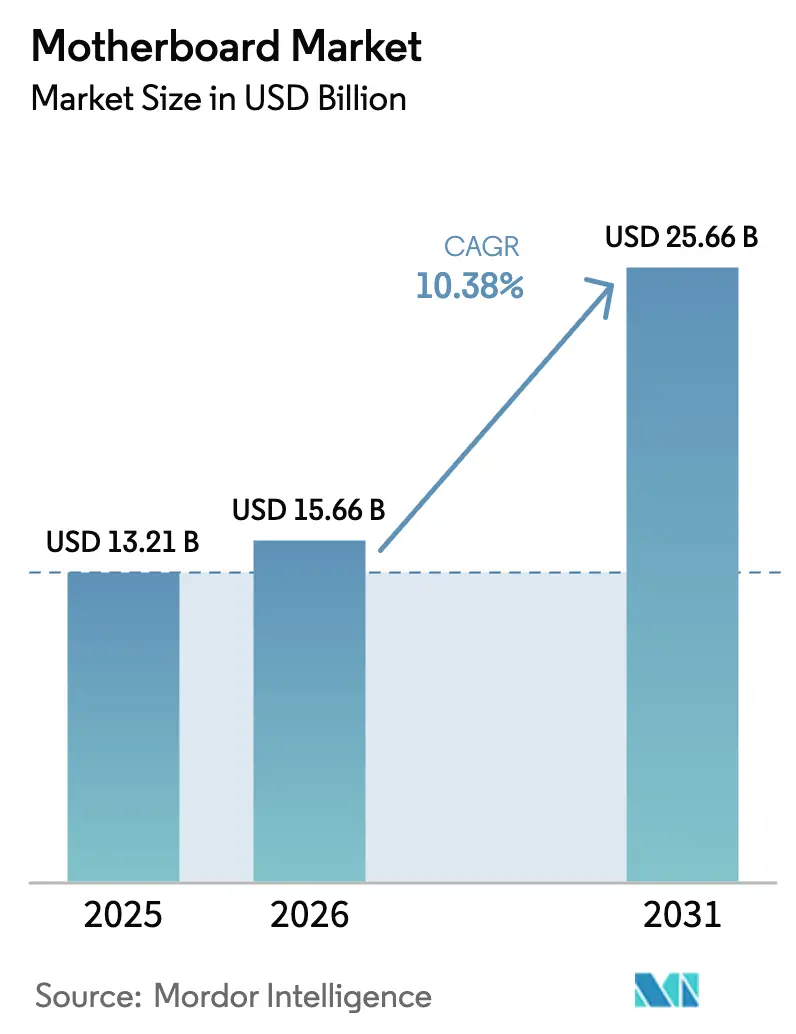
The motherboard market size is projected to expand from USD 13.21 billion in 2025 and USD 15.66 billion in 2026 to USD 25.66 billion by 2031, registering a CAGR of 10.38% between 2026 to 2031. Growing AI-centric server rollouts are lifting average selling prices for high-layer server boards even as the consumer segment grapples with DDR5 cost swings. Socket transitions to AMD AM5 and Intel LGA-1851 are compressing upgrade windows, while industrial buyers shift toward ruggedized designs that tolerate harsh environments. Asia-Pacific continues to anchor volume through Taiwan’s ODM cluster and China’s contract-manufacturing base, yet the Middle East is emerging as the fastest-growing region as digital-infrastructure investments accelerate. Component tariffs, multi-layer PCB skill shortages, and second-hand board availability temper near-term demand but do not derail the long-run trajectory of the motherboard market.
Key Report Takeaways
- By form factor, ATX led with 45.28% of the motherboard market share in 2025, while Mini-ITX is projected to advance at a 10.41% CAGR through 2031.
- By end-user industry, consumer and DIY builders held 38.72% of 2025 revenue, whereas industrial and embedded applications are poised to expand at a 10.44% CAGR up to 2031.
- By CPU platform, Intel boards commanded 51.57% of shipments in 2025; RISC-V solutions are forecast to grow at a 10.49% CAGR during 2026-2031.
- By application, desktop PCs accounted for 42.64% of demand in 2025, yet edge-AI and IoT gateways are set to rise at a 10.58% CAGR over the same horizon.
- By geography, Asia-Pacific captured 36.71% of 2025 value, while Middle East is on track for a 10.52% CAGR through 2031.
Note: Market size and forecast figures in this report are generated using Mordor Intelligence’s proprietary estimation framework, updated with the latest available data and insights as of January 2026.
Market Trends and Insights
Drivers Impact Analysis of Motherboard Market*
| Driver | (~) % Impact on CAGR Forecast | Geographic Relevance | Impact Timeline |
|---|---|---|---|
| Server motherboard demand from AI data-centres | +2.3% | Global, led by North America and Asia-Pacific | Medium term (2-4 years) |
| Rapid AM5 and LGA-1851 platform refresh cycles | +2.1% | Global, early uptake in North America and Europe | Short term (≤ 2 years) |
| AI-accelerated BIOS utilities driving DIY upgrades | +1.8% | North America, Europe, Asia-Pacific | Short term (≤ 2 years) |
| Growth of industrial IoT requiring rugged boards | +1.6% | Global, spill-over to Middle East and Africa | Long term (≥ 4 years) |
| Falling DDR5 prices lowering total build costs | +1.2% | Global | Medium term (2-4 years) |
| Eco-design regulations favoring repairable boards | +0.9% | Europe core, expanding to North America and Asia-Pacific | Long term (≥ 4 years) |
| Source: Mordor Intelligence | |||
Server Motherboard Demand From AI Data-Centres
Hyperscale operators expanded AI infrastructure by 61% year-over-year in 2024, and Supermicro’s X14 boards supporting up to 12 GPUs per node illustrate how dense topologies are lifting board complexity and margins.[1] Multi-layer stack-ups, redundant VRMs, and out-of-band management add bill-of-materials value that consumer SKUs cannot match. Taiwan ODMs supplied more than 60% of global server-board volume in 2024, leveraging proximity to substrate vendors.[2] Adoption of PCIe 5.0 slots per PCI-SIG CEM 5.0 spec compounds signal-integrity challenges but secures higher ASPs. With major cloud providers budgeting multi-billion-dollar GPU clusters through 2027, server boards remain a pivotal growth engine.
Rapid AM5 and LGA-1851 Platform Refresh Cycles
Intel’s Z890 and B860 chipsets, introduced alongside Arrow Lake CPUs in late 2024, dropped DDR4 support and folded Wi-Fi 7 and Thunderbolt 4 into baseline features, forcing faster channel inventory transitions. AMD’s AM5 socket, conversely, pledges chipset compatibility through 2027, allowing board brands to span entry-level B650 to halo X870E with minimal socket redesign. ASRock’s B850 series debuted in January 2025 at mid-market price points, providing PCIe 5.0 M.2 without overclocking extras. The compressed cadence benefits agile ODMs that can re-tool quickly, but smaller firms face margin squeeze as payback windows narrow. Consumers confront shorter perceived longevity, nudging upgrade behavior toward subscription-like frequency.
AI-Accelerated BIOS Utilities Driving DIY Upgrades
ASUS integrated AI Overclocking into UEFI in 2024, using machine-learning models to map stable voltage-frequency curves and cut tuning from hours to minutes. Intel’s Extreme Tuning Utility added AI profiling in 2025, tailoring settings for content-creation workflows. Gigabyte’s Computex 2025 showcase extended the concept to predictive fan curves, pre-emptively modulating RPM for thermal headroom. These utilities lower the knowledge barrier, expanding the reachable population of DIY builders. Each incremental upgrader reinforces board vendors’ premium segments, sustaining the motherboard market as a lifestyle category rather than a commoditized component.
Growth of Industrial IoT Requiring Rugged Boards
Factory-floor and transportation deployments now demand boards certified to IEC 61131-2, with conformal coating and operating envelopes of −40 °C to 85 °C. Advantech embeds Time-Sensitive Networking and 5G modem slots to guarantee sub-millisecond determinism in automation cells. Moxa’s AIG-502 gateway pairs Intel Core i7 silicon with EN 50155 railway certification, bridging edge computing with rolling-stock use cases. Fanless heat-pipe assemblies have become common as IP65 ingress ratings rise. Losant validated several NPUs inside gateways in 2025, enabling on-device inferencing that slashes cloud bandwidth. Certification complexity favors incumbents with deep compliance budgets, nudging the motherboard market toward higher-margin industrial sub-segments.
Restraints Impact Analysis of Motherboard Market*
| Restraint | (~) % Impact on CAGR Forecast | Geographic Relevance | Impact Timeline |
|---|---|---|---|
| End-user hesitation due to generational price jumps | -1.4% | Global, acute in Asia-Pacific and South America | Short term (≤ 2 years) |
| Skill shortage in multi-layer PCB manufacturing | -1.1% | Global, centered in Asia-Pacific hubs | Medium term (2-4 years) |
| Geopolitical tariffs on key PCB raw materials | -0.8% | North America and Europe | Medium term (2-4 years) |
| Second-hand LGA 1151 boards cannibalizing sales | -0.6% | Global, cost-sensitive consumer channels | Short term (≤ 2 years) |
| Source: Mordor Intelligence | |||
End-User Hesitation Due to Generational Price Jumps
A mid-tier LGA-1851 system in early 2025 required USD 200 for the motherboard, USD 150 for 32 GB DDR5-6000, and USD 120 for a PCIe 5.0 SSD, totaling USD 470 before CPU and GPU, versus USD 320 for a comparable 2024 build.[3] Asia-Pacific sees 39% of PC shipments refurbished, highlighting price sensitivity. South American buyers confront additional import duties, with Brazil’s IPI adding 10-15% to component costs. The wider delta delays purchase intent, lengthening replacement cycles and trimming short-run shipments. Vendors respond with cut-down chipset SKUs, bundled memory promotions, and financing options, but elasticity remains limited in low-income regions.
Skill Shortage In Multi-Layer PCB Manufacturing
High-speed signal integrity now demands 10-layer to 12-layer boards, yet Deloitte identified a 25% deficit in qualified layout engineers across Asia-Pacific in 2024. HVLP4 copper foil supply lags demand, projected to be 25% short in 2026 and 42% in 2027. Lead times for glass fabric ranged from 8 to 14 weeks, while micro-via drill-bit shortages created a 2.2-billion-unit gap for 2026. IPC’s raw-material price index climbed to 131 by late 2024, escalating board costs. The talent and material deficit curbs peak throughput just as AI servers spike demand, placing a natural ceiling on motherboard market volume.
*Our forecasts treat driver/restraint impacts as directional, not additive. The impact forecasts reflect baseline growth, mix effects, and variable interactions.
Motherboard Market Segment Analysis
By Form Factor:
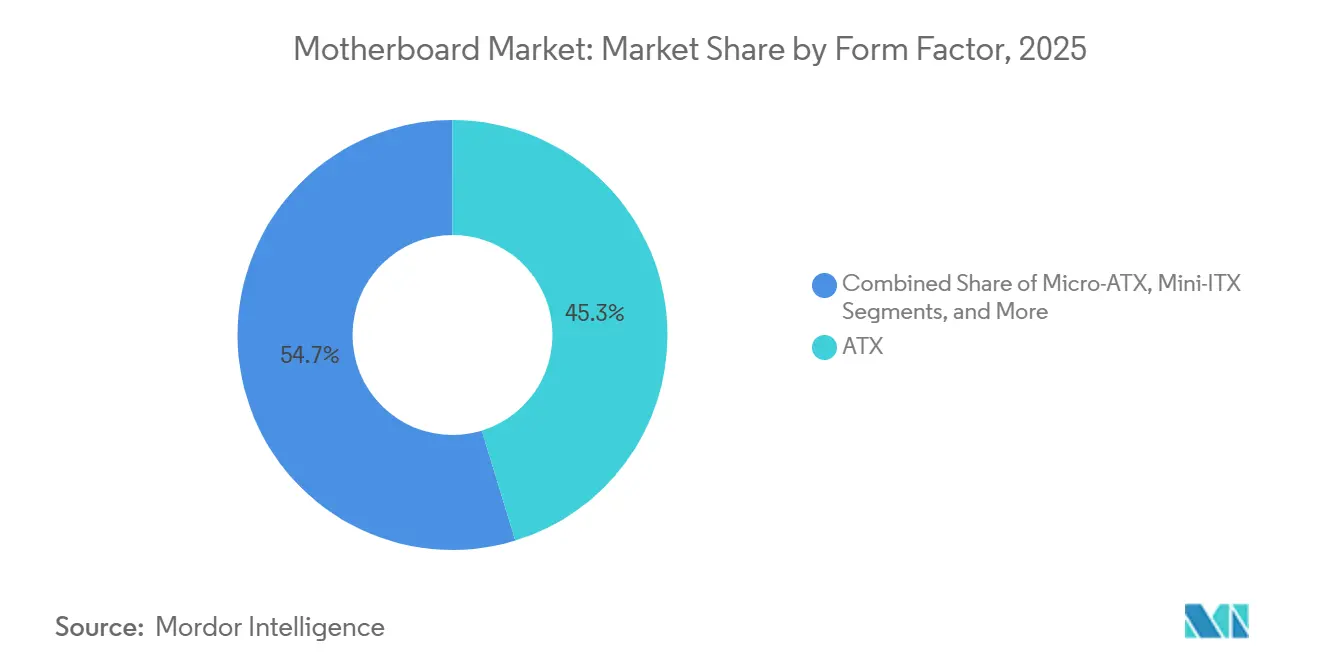
Compact Builds Challenge ATX DominanceATX accounted for 45.28% of 2025 revenue, securing the largest motherboard market share for its robust expansion-slot layout and ample VRM headroom. Mini-ITX, however, is forecast to accelerate at a 10.41% CAGR through 2031 as enthusiasts pursue space-efficient gaming rigs and integrators deploy edge-AI appliances in constrained enclosures. Outside holiday peaks, ATX maintains a steady enterprise refresh cadence, while Mini-ITX spikes align with trade-show launches that unveil high-density PCIe 5.0 storage capabilities.
PCIe 5.0 lanes and 16-phase VRMs have migrated into Mini-ITX, eroding the historical performance gap. ASRock’s Taichi OCF Mini-ITX and Gigabyte’s X870E Aorus Master showcase 105 A power stages inside 170 mm × 170 mm footprints, signaling that footprint no longer dictates capability. Micro-ATX remains the volume workhorse for budget OEM towers, balancing four expansion slots against simpler six-layer PCB stack-ups. Extended-ATX persists mainly in dual-socket servers and showcase overclocking boards, niches where the motherboard market size supports premium pricing on extra-wide PCBs.

By End-User Industry:
Industrial Segment Outpaces Consumer GrowthConsumer and DIY builders generated 38.72% of 2025 sales, fueled by eSports cafés and home creators who value RGB lighting, high-refresh outputs, and reinforced PCIe slots. Gaming venues in China and India sustain high ASPs despite moderating unit growth. The industrial and embedded segment, by contrast, is on a 10.44% CAGR path that elevates the motherboard market size across automation and smart-city rollouts needing 5-year component roadmaps and IEC-compliant ruggedness.
Enterprise and data-center buyers demand out-of-band management, ECC memory, and multi-GPU topologies for AI training. Supermicro’s server boards with NVIDIA NVLink bifurcation exemplify design features absent from the consumer realm. Longer 36-48 month production runs reduce design churn, improving gross margins relative to 12-18 month consumer cadences. Although gaming boards sell at 30-50% ASP premiums, industrial motherboards increasingly match that uplift by layering certifications, remote-monitoring hardware, and extended warranty packages.
By CPU Platform:
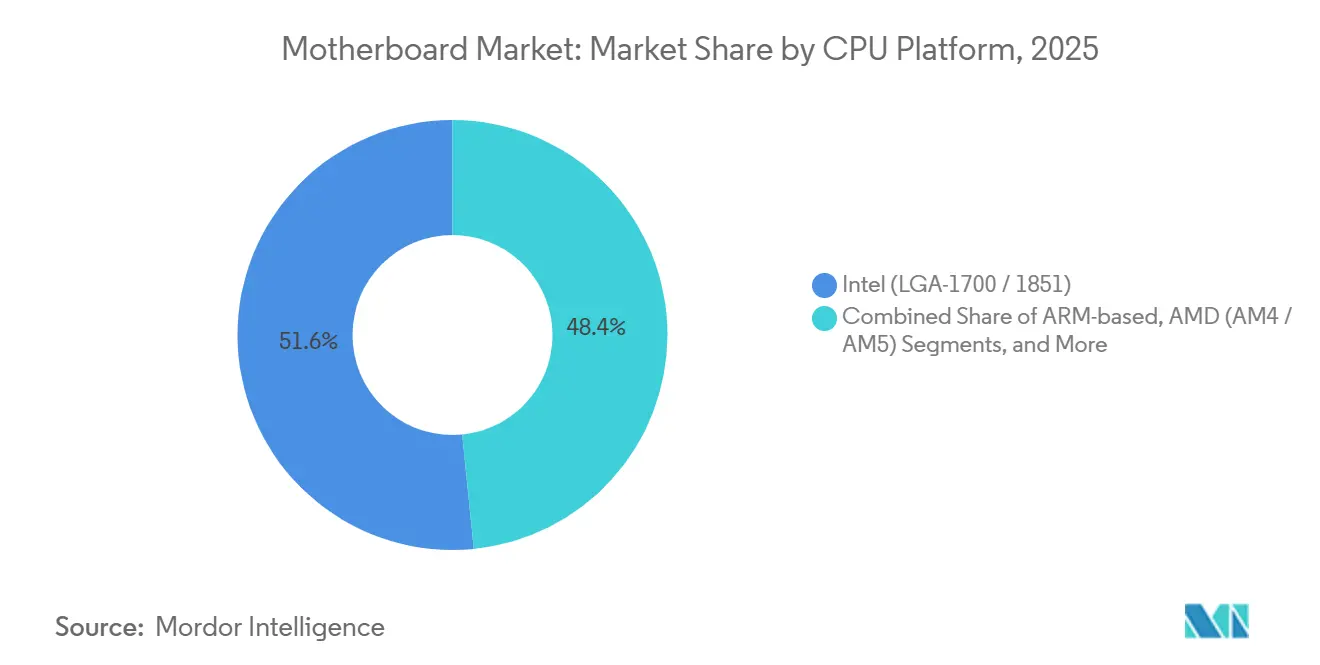
RISC-V Emerges As Disruptive AlternativeIntel retained 51.57% of 2025 shipments under LGA-1700 and LGA-1851 sockets, anchoring software ecosystem gravity. Yet open-source momentum positions RISC-V boards for a 10.49% CAGR, a trajectory that could ultimately reshape motherboard market dynamics. Milk-V’s USD 329 Titan Mini-ITX and DeepComputing’s USD 199–349 DC-ROMA laptop boards validate commercial viability for 64-core and notebook-class RISC-V designs, respectively.
AMD’s AM5 portfolio remains the second-largest platform, spanning B650 value to X870E halo tiers and matching Intel’s PCIe 5.0 lane counts at lower entry prices. ARM-based boards stay niche within NAS and low-power servers but gain mindshare through Ampere’s Altra cloud deployments. Framework’s modular approach demonstrates that alternative architectures can fit consumer workflows without ecosystem fragmentation, an early hint that the motherboard market share hierarchy can change as license-free ISAs mature.
By Application:
Edge-AI Gateways Redefine Deployment PatternsDesktop PCs still controlled 42.64% of 2025 shipments, reflecting steady hybrid-work demand, but edge-AI and IoT gateways are projected to scale at a 10.58% CAGR. Intel’s AI Edge verification certifies boards that meet deterministic latency envelopes, signaling OEM commitment to on-device inference. Advantech and Losant showcase boards with embedded NPUs delivering 8-16 TOPS, shrinking cloud round-trips for object detection.
Workstations remain premium, driven by AMD Threadripper Pro and Intel Xeon W platforms that require ECC memory and PCIe bifurcation for GPU render farms. Server motherboards reach the highest ASPs, often topping USD 1,200 for dual-socket variants. Desktop volumes face commoditization as integrated graphics and SaaS productivity grow, whereas regulatory pushes such as the EU AI Act mandate on-premises processing, fortifying demand for edge-AI-class boards and elevating the motherboard market size within compliance-bound verticals.
Geography Analysis
APAC Motherboard Market
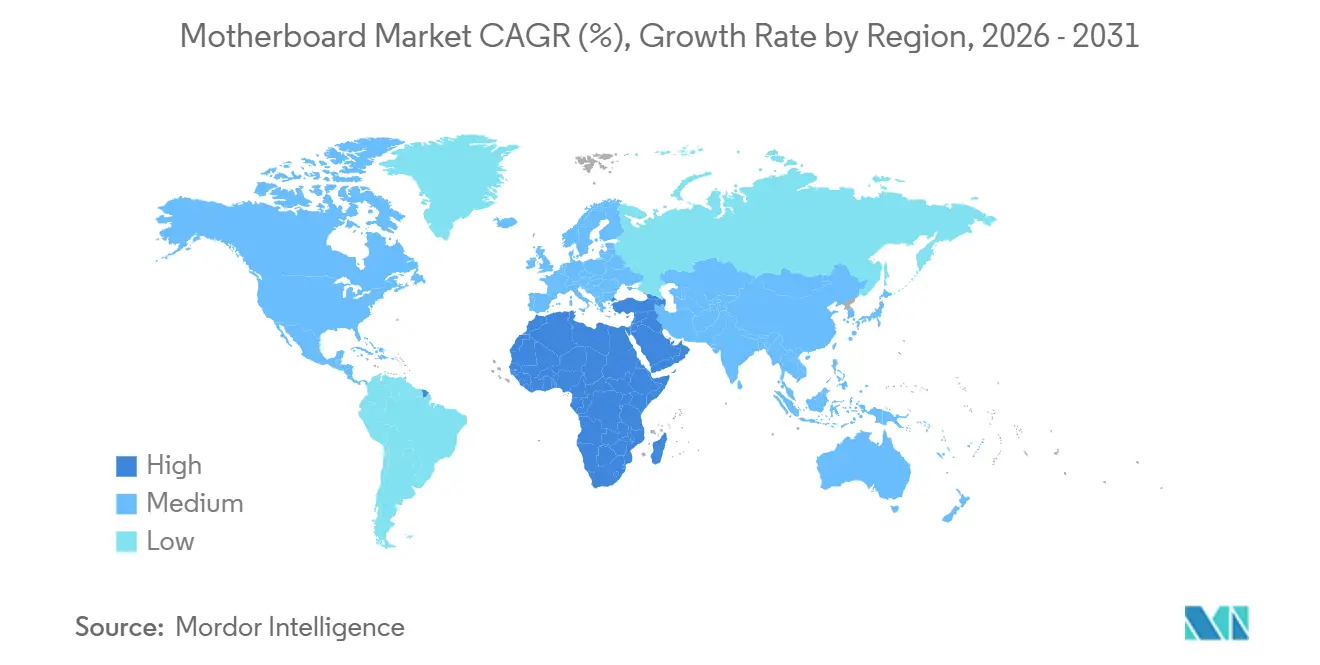
Asia-Pacific generated 36.71% of the 2025 value, sustained by Taiwan’s ODM ecosystem that compresses prototype-to-production lead times and China’s 120 million-unit assembly base. Japanese vendors pivot toward factory-automation motherboards with IEC certifications, while South Korea’s memory dominance supplies DDR5 modules that streamline board design. Australia and New Zealand contribute modest volumes, mainly in enterprise desktops and educational deployments, yet predictable refresh budgets create a resilient revenue floor.
Middle East Motherboard Market
The Middle East is the fastest-growing territory at a 10.52% CAGR through 2031. Saudi Arabia's USD 100 billion 2025 digital economy and the region's fintech boom are catalyzing low-cost desktop builds for call-center and government workloads. The United Arab Emirates's USD 20 billion electronics sector now locally assembles motherboards for data-center rollouts, reducing import friction. Intermittent power and broadband constraints drive demand for boards with wide-input PSUs and passive cooling, aligning with industrial-grade specifications and boosting regional motherboard market share for rugged SKUs.
North America, Europe and APAC Motherboard Market
North America and Europe represent mature but strategically important regions where tariff policies and eco-design mandates shape sourcing. The United States’ 25%-35% Section 301 duties sparked diversification to Vietnam and Mexico, while USD 2 billion in CHIPS Act grants targets domestic substrate production. Europe’s Directive 2024/1799 on repairability obliges vendors to supply spares for seven years, nudging designs toward modular daughtercards. Germany and the United Kingdom spearhead AI server deployments, whereas France promotes sovereign compute and Russia accelerates local assembly, all reinforcing sustained, if moderate, motherboard market growth.
Competitive Landscape
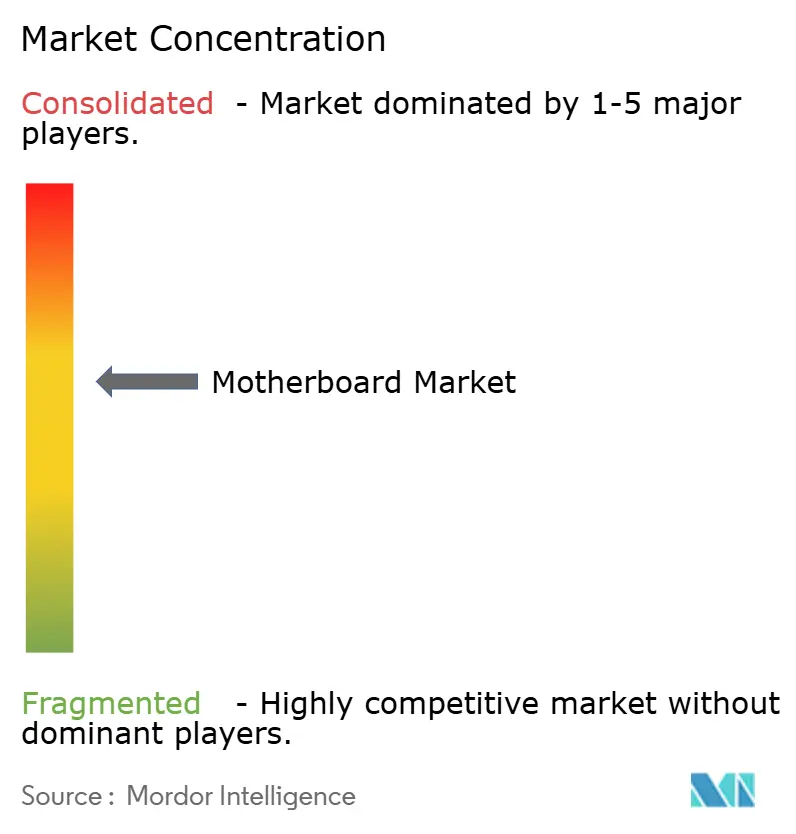
ASUSTeK, Gigabyte, and MSI collectively account for a considerable share of consumer and gaming shipments, anchoring a moderately concentrated field. ASUS invests in AI-enabled BIOS features and RGB ecosystems that cultivate brand lock-in, while Gigabyte pursues cost-optimized mid-range SKUs to capture system-integrator volume. MSI targets premium gaming with reinforced slots and bundled lighting hubs, and ASRock undercuts first-tier competitors by 10%-15% with feature-rich value boards.
Server and industrial niches introduce different leaders, Supermicro scales up to 12-GPU nodes on its X14 platform, commanding premium pricing through high-availability features. Advantech dominates rugged industrial boards by marrying TSN, 5G, and IEC certifications, widening gross margins by 20%-30% relative to consumer SKUs. Dell Technologies competes in OEM server motherboards, leveraging vertical integration for enterprise accounts.
White-space entrants such as Milk-V, DeepComputing, and ESWIN exploit royalty-free RISC-V instruction sets to address developer and embedded markets at USD 199-698 price points. Edge-AI gateways serve as another springboard for differentiation, with Moxa and Advantech integrating NPUs and fanless designs that fulfil railway and factory needs. Tariff-induced supply-chain reshoring, eco-design mandates, and PCB talent scarcity all influence strategic alliances, patent filings, and production localization, intensifying rivalry even within a compressed refresh cadence.
Motherboard Industry Leaders
-
ASUSTeK Computer Inc.
-
Gigabyte Technology Co.
-
ASRock Inc
-
Super Micro Computer Inc
-
Advantech Co. Ltd
- *Disclaimer: Major Players sorted in no particular order
Motherboard Market Companies Covered in this Report
- ASUSTeK Computer Inc.
- GIGABYTE Technology Co., Ltd.
- Micro-Star International Co., Ltd. (MSI)
- ASRock Incorporation
- Super Micro Computer, Inc.
- Advantech Co., Ltd.
- MiTAC Computing Technology Corporation
- Biostar Microtech International Corp.
- EVGA Corporation
- Acer Inc.
- Shenzhen Seavo Technology Co., Ltd.
- Sapphire Technology Ltd.
- AAEON Technology Inc.
- Kontron AG
- Advantech Europe B.V.
- DFI Inc.
- IEI Integration Corp.
- Dell Technologies Inc.
- Intel Corporation
- Lenovo Group Ltd.
Recent Industry Developments in Motherboard Market
- January 2026: ASRock unveiled its B850 motherboard lineup at CES 2026, targeting mid-range AMD AM5 builders with PCIe 5.0 M.2 support and DDR5-6400 compatibility, priced from USD 150 to USD 220.
- December 2025: A critical UEFI firmware vulnerability affecting multiple vendors was disclosed, prompting emergency patches from ASUS, Gigabyte, MSI, and ASRock.
- October 2025: Intel launched Arrow Lake processors on LGA-1851, mandating DDR5-only support and PCIe 5.0, forcing early retirement of LGA-1700 inventory.
- June 2025: Gigabyte showcased X870E and X870 motherboards at Computex 2025, adding AI-driven fan curves and USB4.
Global Motherboard Market Report Scope
The motherboard market encompasses the production, distribution, and utilization of motherboards, which serve as the primary circuit boards in computing devices. These boards facilitate communication between the central processing unit (CPU), memory, storage, and other hardware components, enabling the functionality of devices such as desktop PCs, workstations, servers, and IoT gateways.
The Motherboard Market Report is Segmented by Form Factor (ATX, Micro-ATX, Mini-ITX, and Extended-ATX), End-user Industry (Consumer/DIY, Gaming and eSports Centres, Industrial/Embedded, Enterprise and Data-centre), CPU Platform (Intel LGA-1700/1851, AMD AM4/AM5, ARM-based, RISC-V and Others), Application (Desktop PCs, Workstations, Servers, Edge-AI and IoT Gateways), and Geography (North America, South America, Europe, Asia-Pacific, Middle East, and Africa). The Market Forecasts are Provided in Terms of Value (USD).
Segmentation Overview
By Form Factor
| ATX |
| Micro-ATX |
| Mini-ITX |
| Extended-ATX (E-ATX) |
By End-user Industry
| Consumer / DIY |
| Gaming and eSports Centres |
| Industrial / Embedded |
| Enterprise and Data-centre |
By CPU Platform
| Intel (LGA-1700 / 1851) |
| AMD (AM4 / AM5) |
| ARM-based |
| RISC-V and Others |
By Application
| Desktop PCs |
| Workstations |
| Servers |
| Edge-AI and IoT Gateways |
By Geography
| North America | United States |
| Canada | |
| Mexico | |
| South America | Brazil |
| Argentina | |
| Rest of South America | |
| Europe | United Kingdom |
| Germany | |
| France | |
| Spain | |
| Rest of Europe | |
| Asia-Pacific | China |
| India | |
| Japan | |
| South Korea | |
| Australia and New Zealand | |
| Rest of Asia-Pacific | |
| Middle East | Saudi Arabia |
| Turkey | |
| Rest of Middle East | |
| Africa | South Africa |
| Nigeria | |
| Rest of Africa |
| By Form Factor | ATX | |
| Micro-ATX | ||
| Mini-ITX | ||
| Extended-ATX (E-ATX) | ||
| By End-user Industry | Consumer / DIY | |
| Gaming and eSports Centres | ||
| Industrial / Embedded | ||
| Enterprise and Data-centre | ||
| By CPU Platform | Intel (LGA-1700 / 1851) | |
| AMD (AM4 / AM5) | ||
| ARM-based | ||
| RISC-V and Others | ||
| By Application | Desktop PCs | |
| Workstations | ||
| Servers | ||
| Edge-AI and IoT Gateways | ||
| By Geography | North America | United States |
| Canada | ||
| Mexico | ||
| South America | Brazil | |
| Argentina | ||
| Rest of South America | ||
| Europe | United Kingdom | |
| Germany | ||
| France | ||
| Spain | ||
| Rest of Europe | ||
| Asia-Pacific | China | |
| India | ||
| Japan | ||
| South Korea | ||
| Australia and New Zealand | ||
| Rest of Asia-Pacific | ||
| Middle East | Saudi Arabia | |
| Turkey | ||
| Rest of Middle East | ||
| Africa | South Africa | |
| Nigeria | ||
| Rest of Africa | ||
Key Questions Answered in the Report
What is the projected value of the motherboard market by 2031?
The motherboard market is forecast to reach USD 25.66 billion by 2031.
How fast is the motherboard market expected to grow between 2026 and 2031?
It is projected to register a 10.38% CAGR over the 2026-2031 period.
Which motherboard form factor is growing the fastest?
Mini-ITX boards are expected to expand at a 10.41% CAGR through 2031.
Why are server motherboards seeing higher average selling prices?
AI data-centre builds require multi-layer PCBs, redundant power, and PCIe 5.0, all of which lift material costs and ASPs.
Which region is the quickest-growing market for motherboards?
Middle East is set to grow at a 10.52% CAGR as digital infrastructure accelerates.
How are tariff policies affecting motherboard sourcing?
U.S. Section 301 duties on Chinese electronics are prompting vendors to shift assembly to Vietnam and Mexico and re-source components from South Korea and Taiwan.