
Modular Wall Panels Market Size and Share
Market Overview
| Study Period | 2021 - 2031 |
|---|---|
| Market Size (2026) | USD 1.86 Billion |
| Market Size (2031) | USD 2.63 Billion |
| Growth Rate (2026 - 2031) | 7.23 % |
| Fastest Growing Market | North America |
| Largest Market | Asia-Pacific |
| Market Concentration | Medium |
Major Players *Disclaimer: Major Players sorted in no particular order Image © Mordor Intelligence. Reuse requires attribution under CC BY 4.0. | |
Modular Wall Panels Market Analysis by Mordor Intelligence
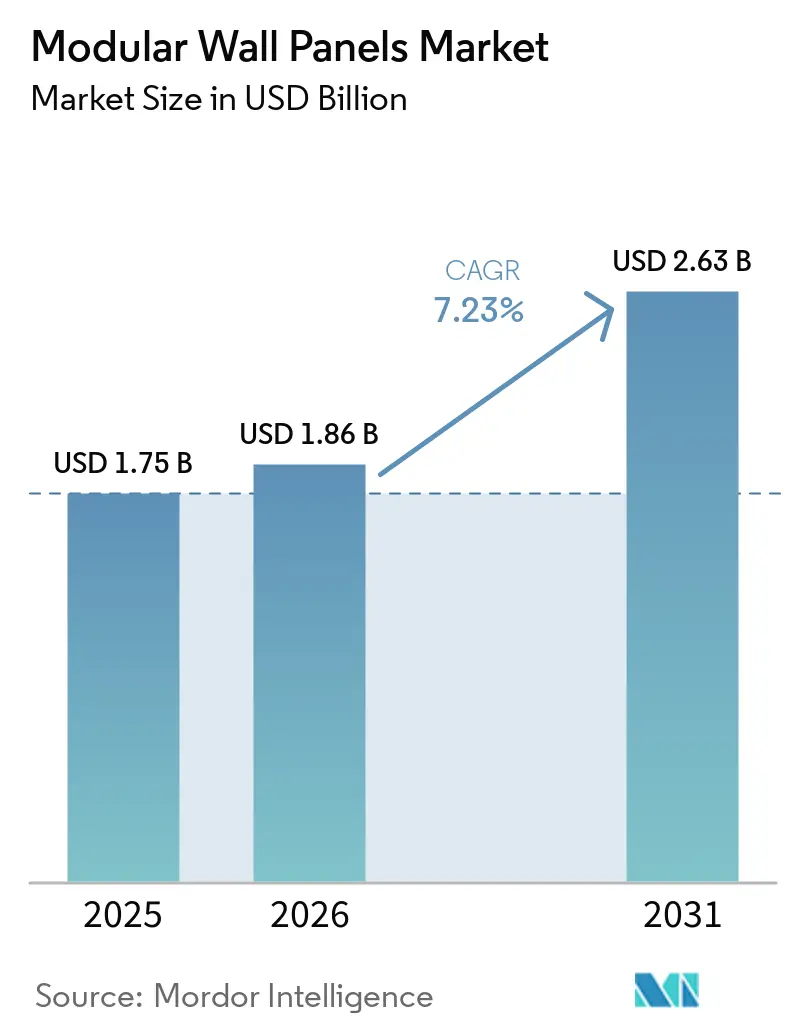
The modular wall panels market size is expected to increase from USD 1.75 billion in 2025 to USD 1.86 billion in 2026 and reach USD 2.63 billion by 2031, growing at a CAGR of 7.23% over 2026-2031. Labor availability is making off-site production more relevant because factory assembly reduces dependence on specialized site crews. Compliance requirements for fire performance, energy efficiency, and embodied carbon are also changing how wall systems are specified in Europe and North America. Commercial customers increasingly require predictable schedules, repeatable quality, and documentation that can support building approvals. Digital product libraries and BIM-compatible design workflows are moving manufacturer engagement earlier in the project process. Input costs, financing barriers, and liability at system interfaces remain important limits on adoption, especially for smaller manufacturers and institutional projects.
Key Report Takeaways
- By installation configuration, fixed modular panels led with 40.54% of the modular wall panels market share in 2025, while clip-on and snap-fit systems are projected to register a 9.56% CAGR through 2031.
- By surface material, metals led with 28.48% of the modular wall panels market share in 2025, while glass panels are projected to register an 8.33% CAGR through 2031.
- By construction method, factory-prefabricated panels led the modular wall panels market with 46.71% market share in 2025, while kit-of-parts and modular assembly are projected to register an 8.62% CAGR through 2031.
- By end user, commercial applications led with 73.62% of the modular wall panels market share in 2025, while commercial healthcare applications are projected to register a 9.02% CAGR through 2031.
- By distribution channel, indirect sales led with 62.00% of the modular wall panels market share in 2025, while direct online B2B sales are projected to register an 8.85% CAGR through 2031.
- By geography, North America led with 31.68% of the modular wall panels market share in 2025, while Asia-Pacific is projected to register an 8.57% CAGR through 2031.
Note: Market size and forecast figures in this report are generated using Mordor Intelligence’s proprietary estimation framework, updated with the latest available data and insights as of January 2026.
Global Modular Wall Panels Market Trends and Insights
Drivers Impact Analysis*
| Driver | (~) % Impact on CAGR Forecast | Geographic Relevance | Impact Timeline |
|---|---|---|---|
| Construction Labor Shortages and Off-Site Productivity | +2.1% | Global, highest in North America, Western Europe, and Australia | Short term (≤ 2 years) |
| Energy Efficiency and Embodied Carbon Compliance | +1.6% | EU-27, United Kingdom, Canada, with growing adoption in the United States and East Asia | Medium term (2-4 years) |
| Affordable Housing and Rapid Urban Development | +1.3% | North America, South and Southeast Asia, and Sub-Saharan Africa | Medium term (2-4 years) |
| Cold-Chain, Data-Center, and Controlled-Environment Expansion | +0.8% | Global, concentrated in North America, Northern Europe, and East Asia | Short term (≤ 2 years) |
| Renovation and Occupied-Building Retrofit Demand | +0.7% | Europe, North America, and Japan | Medium term (2-4 years) |
| BIM-Enabled Standardization and Factory Automation | +0.6% | Global, concentrated in markets with digital procurement mandates | Long term (≥ 4 years) |
| Source: Mordor Intelligence | |||
Construction Labor Shortages and Off-Site Productivity
Labor scarcity is supporting wider use of modular wall panels because it reduces the work performed at the project site. The Associated Builders and Contractors estimated that the United States construction sector needs 349,000 net new workers in 2026[1]. Factory production can shift work from scarce field trades to production roles that can be trained in a more controlled setting. The Association of the Wall and Ceiling Industry states that committed off-site programs can reduce total project duration by 15-25%[2]. The same industry association reports that panelized construction can cut on-site framing crew needs by 60% or more compared with conventional methods. This advantage is most relevant in remote and climate-constrained locations, where less site time improves delivery certainty.
Energy Efficiency and Embodied Carbon Compliance
Energy and carbon requirements are increasing the need for tested wall systems with documented performance. The European Commission issued Delegated Regulation (EU) 2026/331 in February 2026 to update reaction-to-fire classifications for construction products under the revised Construction Products Regulation. A European cladding standard took effect on January 31, 2026, establishing more uniform fire safety levels and certification routes across member states. Kingspan stated that its LEC Built-On Wall Panel reduced global warming potential by 55% across modules A1-A3 compared with its standard panel equivalent[3]. A 2025 ACS Energy Letters article reported that embodied carbon from buildings represented 11% of national greenhouse gas emissions in the United States. Manufacturers with certified A1 or A2 product ranges are better placed to participate in institutional projects where compliance documentation is required early in the design process.
Affordable Housing and Rapid Urban Development
Affordable housing programs are creating a larger role for industrialized construction methods. The Modular Building Institute reported that modular and panelized approaches represented 7% of newly completed United States multifamily buildings in 2025, the highest recorded share. The same report placed the United States modular multifamily activity at USD 7.1 billion in 2025 and projected it to exceed USD 11.3 billion by 2029. The Modular Building Institute also reported a United States housing shortfall of 4.7 million units in 2025[4]. Public order commitments can improve factory utilization because developers and lenders need visible project pipelines before supporting new capacity. This relationship supports modular wall panels where housing projects need faster completion and greater control over labor availability.
Cold-Chain, Data-Center, and Controlled-Environment Expansion
Data centers, cleanrooms, and cold-chain facilities require wall systems with controlled joints and documented thermal, air, and hygiene performance. These uses favor factory-prefabricated panels because quality checks occur before delivery to the site. Kingspan opened a data-solutions insulated panel plant in Arkansas in 2025 and is commissioning a larger Kentucky facility in the second half of 2026. The company stated that the Kentucky facility could support annual revenue in the hundreds of millions of USD. Controlled-environment applications also need materials that meet cleanroom, fire, thermal, and vapor-control requirements. A broader portfolio across commercial and precision environments can help manufacturers balance demand when residential activity changes.
Restraints Impact Analysis*
| Restraint | (~) % Impact on CAGR Forecast | Geographic Relevance | Impact Timeline |
|---|---|---|---|
| High Upfront Cost and Financing Friction | -1.8% | Global, sharpest in emerging markets with limited project finance depth | Short term (≤ 2 years) |
| Fire, Moisture, and Interface-Quality Risk | -0.9% | United Kingdom, Europe, and Australia | Medium term (2-4 years) |
| Transport, Handling, and Site-Tolerance Constraints | -0.6% | South America and Sub-Saharan Africa | Medium term (2-4 years) |
| Volatility in Steel, Insulation, Timber, and Adhesive Inputs | -1.1% | Global, concentrated in markets exposed to the United States Section 232 tariffs | Short term (≤ 2 years) |
| Source: Mordor Intelligence | |||
High Upfront Cost and Financing Friction
New factories require significant capital and dependable order pipelines before lenders support capacity expansion. The cited research estimates that a modular manufacturing facility requires USD 40 million to USD 50 million in capital. Buyers can also face a higher initial invoice for panel systems than for conventional materials. Project-level labor savings and shorter schedules can offset this difference, but those benefits are harder to finance where valuation methods do not recognize delivery speed. Specifiers may also prefer familiar site-built systems when they must accept responsibility for thermal bridging, air leakage, or joint performance. Standards from organizations such as ASTM International and ISO can reduce this concern, but specification templates often change more slowly than technical standards.
Volatility in Steel, Insulation, Timber, and Adhesive Inputs
Cost volatility across steel, insulation, timber, and adhesives is an immediate challenge for modular wall panel market participants. The supplied material states that the United States steel and aluminum imports carry 50% tariffs in 2026, while softwood lumber faces a 10% tariff, and derivatives face 25%. Price changes affect metal-faced panels directly and can make fixed-price commercial bids more difficult to manage. Insulation core costs can also move independently with petrochemical and energy conditions. Manufacturers with in-house steel processing or insulation-core production have more control over these changes than assemblers that buy all inputs externally. This cost difference can affect tender pricing, margins, and the ability to offer cost-locked project delivery.
*Our forecasts treat driver/restraint impacts as directional, not additive. The impact forecasts reflect baseline growth, mix effects, and variable interactions.
Segment Analysis
By Installation Configuration: Fixed Panels Lead While Snap-Fit Formats Grow
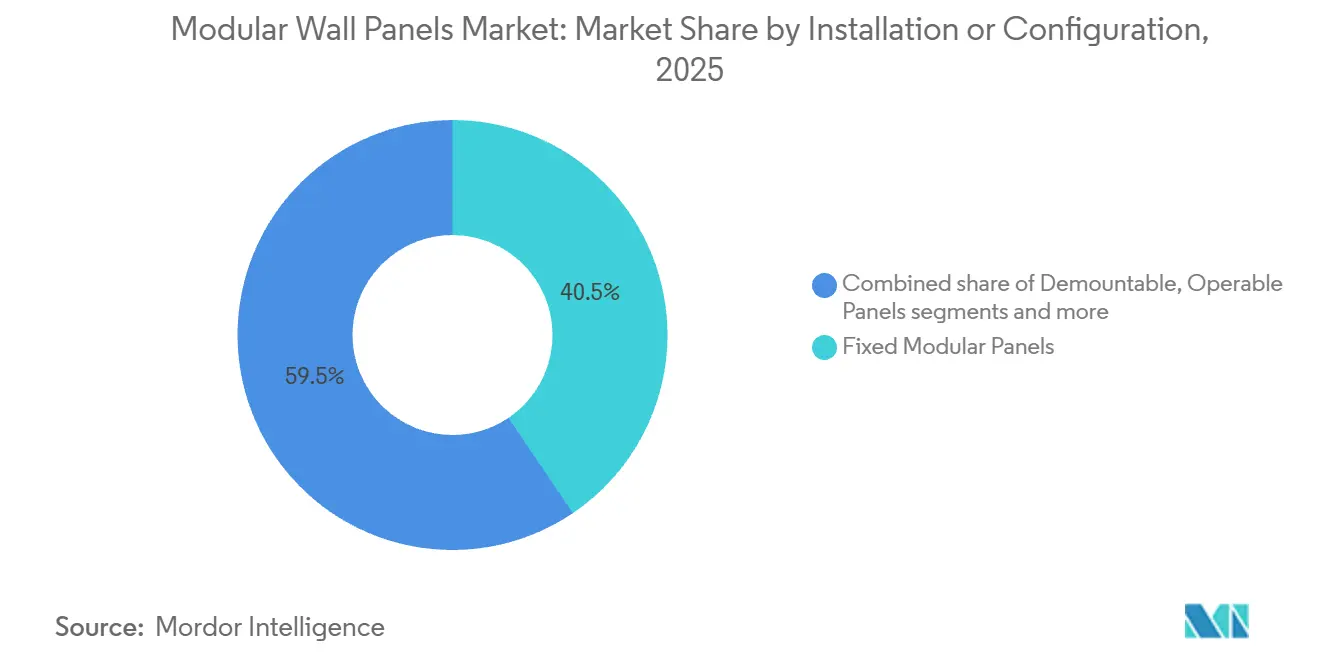
Fixed modular panels held 40.54% of the modular wall panels market share in 2025. They remain relevant for data-center envelopes, industrial facilities, and office retrofits that need permanent installations. Their position reflects demand for structural permanence and established installation practices. Clip-on and snap-fit systems are the fastest-growing configuration, with a forecast CAGR of 9.56% through 2031. Tool-free or simplified installation supports contractors facing smaller available crews. The modular wall panels market is, therefore, rewarding systems that reduce specialist labor without compromising predictable installation quality.
Demountable panels continue to serve corporate workspace customers who need layouts to change over time. Movable and operable panels address acoustic partition uses where space flexibility is more important than thermal performance. The other configuration category includes hybrid fixed and demountable formats used by healthcare customers who need changes during active operations. These projects place a high value on reducing disruption and avoiding extensive on-site work. Precision manufacturing remains important because panel joints must preserve acoustic and thermal performance. The Association of the Wall and Ceiling Industry identifies off-site methods as a practical response to site labor constraints and scheduling requirements.

By Surface Material: Metals Lead While Glass Gains Ground
Metals held 28.48% of the global share by facing material in 2025. Metal panels are used widely because they combine structural performance, thermal efficiency, and proven suitability for cold-storage applications. The segment has an established record across commercial and industrial buildings. The United States tariff exposure is increasing the installed-cost pressure on metal-faced systems. This gives glass and composite alternatives more opportunities in projects where design requirements or material selection priorities differ. Glass panels are forecast to grow at a CAGR of 8.33% through 2031, supported by façade applications and insulated glazing requirements.
Wood-facing systems are gaining visibility as low-carbon material requirements develop. Daiwa House Industry, Fujita, and Hagauma Manufacturing developed Kantai Panel, a curtain-wall-format exterior wood panel using thinning timber that received Japan's first 60-minute fire certification for this configuration in March 2025. Concrete panels remain important for public infrastructure and seismically active locations. Composite and fiber-cement facings continue to serve rain-screen cladding requirements in European and Asia-Pacific projects. The facing-material mix in the modular wall panels industry reflects different needs for fire performance, thermal control, appearance, and structural use.
By Construction Method: Factory Prefabrication Sets the Standard
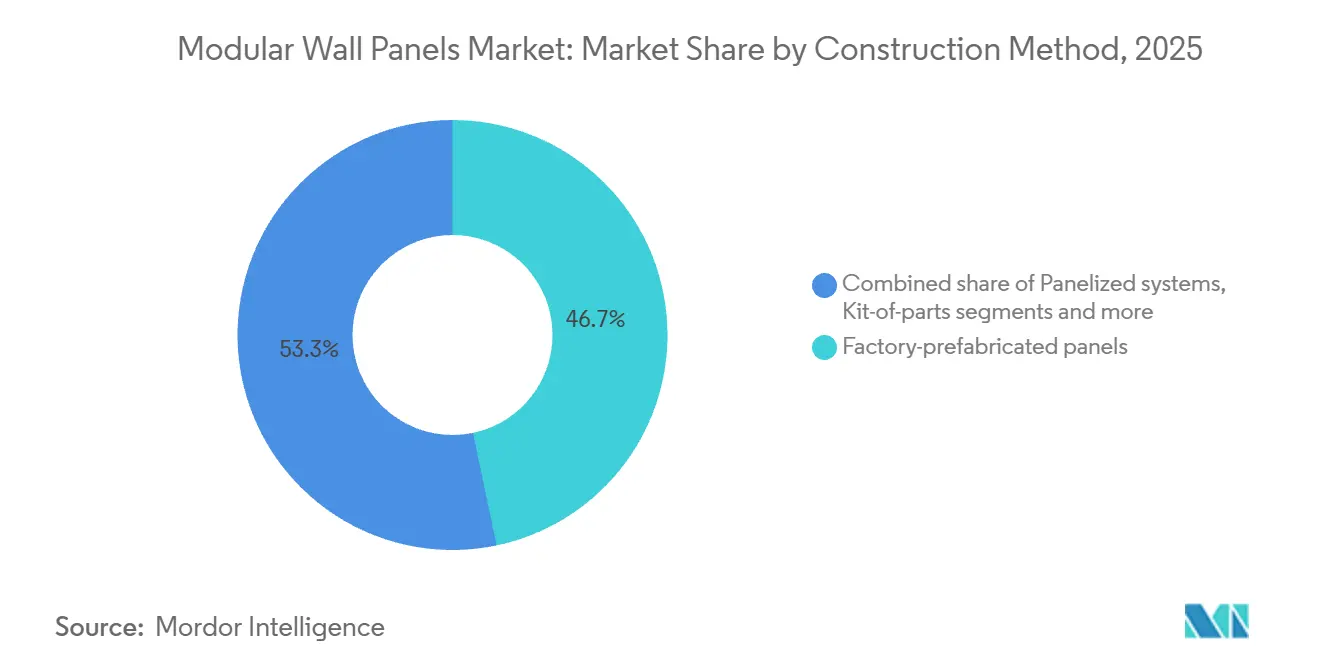
Factory-prefabricated panels held 46.71% of the global share by construction method in 2025. Their lead reflects the ability to produce repeatable dimensions and carry out quality checks in a controlled factory environment. Commercial buyers value this consistency because it can reduce field cutting, interface adjustments, and coordination rework. Factory investments in CNC fabrication, robotic welding, and quality-control systems reinforce this advantage. The modular wall panels market size for factory-prefabricated formats benefits from uses that require documented performance before installation. These systems also support faster project sequencing when site conditions are uncertain.
Kit-of-parts and modular assembly are forecast to grow at a CAGR of 8.62% through 2031. This format supports project-specific assembly without the capital commitment required for bespoke volumetric construction. An IEEE study published in 2025 found that AI-infused BIM and modular generative design achieved 96.1% modularity conformance and generated 128 feasible designs per run. Panelized systems remain suited to cost-sensitive residential and light-commercial work where material and schedule predictability are important. Volumetric components are used in healthcare and education projects where controlled infection and acoustic performance can support higher unit costs. Kit-of-parts systems can also help occupied-building retrofits by allowing room-by-room delivery with less on-site storage.
By End User: Commercial Applications Remain the Primary Demand Base
Commercial applications held 73.62% of global demand in 2025. Commercial construction supports premium specifications, formal procurement methods, and multi-site project requirements. Healthcare is the fastest-growing commercial use, with a projected CAGR of 9.02% through 2031. Hospitals and medical facilities require infection-control performance and often need construction to proceed with limited disruption to occupied areas. These requirements support modular wall panel systems with controlled interfaces and repeatable documentation. The commercial base also includes corporate fit-outs, logistics facilities, and other projects with strict schedules and quality requirements.
Residential demand accounted for the balance of 2025 demand and is changing as housing programs seek faster delivery methods. The National Apartment Association, citing the Modular Building Institute, reported that modular and panelized methods represented 7% of completed United States multifamily buildings in 2025. Sangetsu launched INNO PANEL in February 2026 for residential and commercial interior applications using its Smart JG installation method. The product illustrates residential-focused innovation beyond North America. Residential penetration remains below 30% in many developed markets, leaving room for growth when public housing programs and local supply chains support wider adoption. The modular wall panels industry can therefore serve both high-specification commercial buildings and more standardized residential requirements.
By Distribution Channel: Indirect Sales Hold Scale While Direct B2B Grows
Indirect sales held 62.00% of global revenue in 2025. Distributors continue to provide technical support, contractor credit, project logistics, and showroom access in fragmented construction markets. These services remain important where manufacturers do not have a direct local presence. Direct online B2B sales are forecast to grow at a CAGR of 8.85% through 2031. Large commercial customers are using direct channels to standardize specifications across multiple locations. The modular wall panels market size for online direct sales is supported by demand for clearer pricing and better control over configurations.
Direct procurement can give specifiers access to product libraries, thermal calculations, custom configurations, and binding quotations without an intermediary step. DIRTT reported USD 40.3 million in revenue for Q2 2026 and a gross margin of 34.7%, compared with 27.8% in the prior-year period. Its Construction Services model combines design software with direct project delivery. Traditional distributors are responding by emphasizing design services and system integration. The transition is uneven because regional distributors have different levels of digital infrastructure. Manufacturers that link digital tools with nearby production capacity can better support direct specification and delivery needs.
Geography Analysis
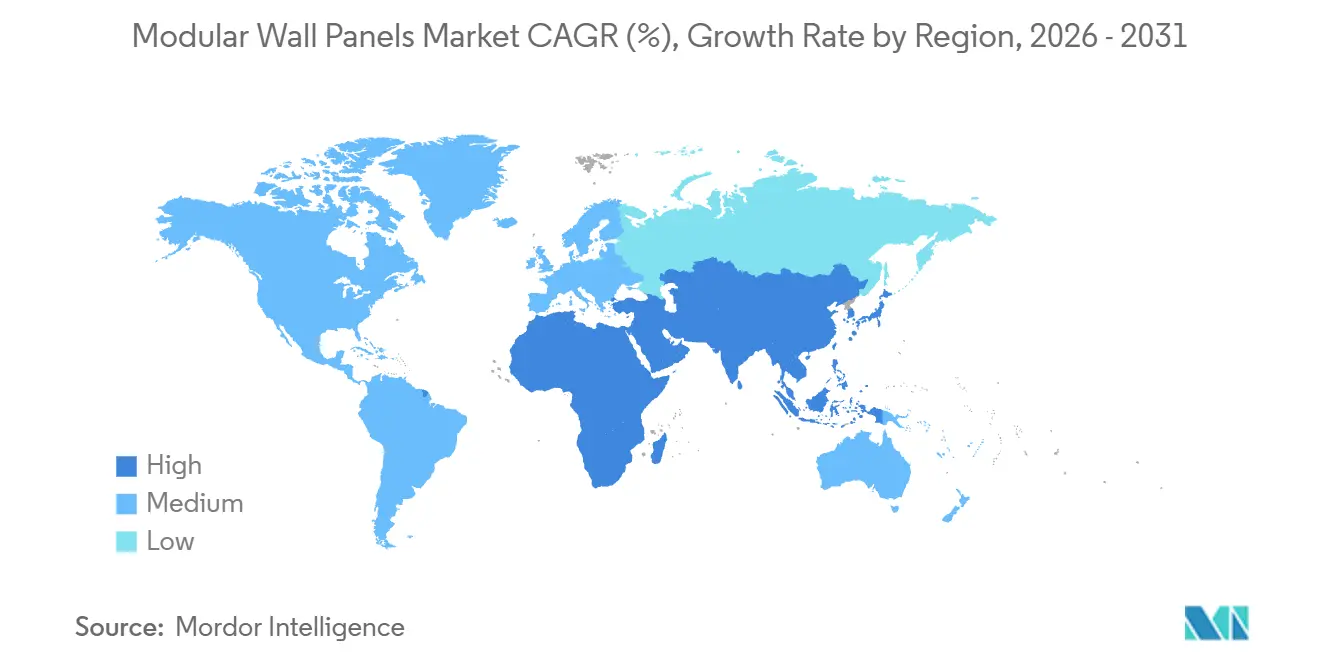
North America held 31.68% of the modular wall panels market share in 2025. The United States supports regional demand through multifamily housing, commercial projects, data centers, and controlled-environment facilities. Modular and panelized methods represented 7% of newly completed United States multifamily buildings in 2025. Sun Belt cities in Texas, Florida, and the Southeast have demand for faster project delivery, where labor availability and financing periods are important. Section 232 tariffs also change sourcing economics and favor domestic integrated manufacturers over import-dependent suppliers.
Fire safety requirements, sustainability compliance, and retrofit demand shape Europe. The European Commission’s 2026 regulation updates product fire classifications under the Construction Products Regulation. The United Kingdom’s Approved Document B requires relevant external wall materials to meet minimum A2-s1,d0 or A1 classifications. Germany supports serial prefabricated renovation through energy-efficient building retrofit programs. France, the Nordics, and Benelux favor bio-based and low-carbon panels, while Spain and Italy retain demand for concrete systems in seismic areas.
Asia-Pacific is forecast to grow at a CAGR of 8.57% through 2031. China is supporting capacity investment through a policy that increases prefabricated building use in new construction. Singapore’s Design-for-Manufacturing-and-Assembly program has a 70% gross floor area target and achieved 68%, setting a regional reference point for modular adoption. Japan contributes premium product development through fire-certified wood panels and interior systems. Daiwa House Industry, Fujita, and Hagauma Manufacturing received Japan’s first 60-minute fire certification for the Kantai Panel configuration in March 2025. Sangetsu introduced INNO PANEL in February 2026, showing continued product development for interior wall systems. South America, the Middle East, and Africa remain earlier-stage regions where logistics, local production capacity, and road infrastructure affect the addressable opportunity.
Competitive Landscape
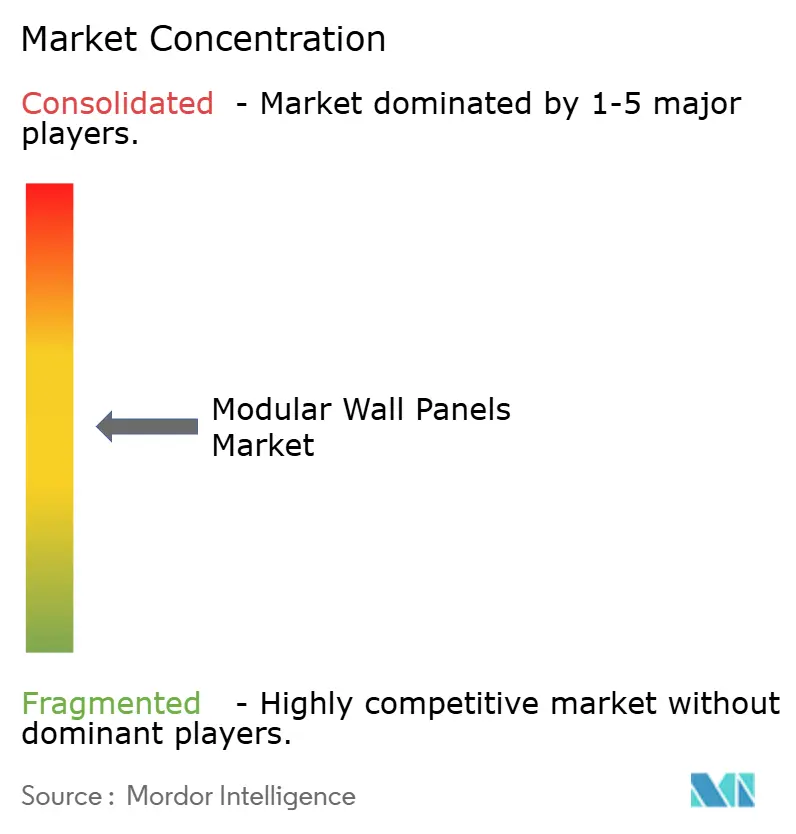
The modular wall panels market is moderately consolidated among large envelope-system manufacturers, while regional and specialist suppliers remain numerous. Kingspan Group, METECNO, Trimo, Assan Panel, and Lindab form the upper tier through broad manufacturing networks and established project references. These companies benefit from insulation-core production, certification resources, and the ability to serve multiple geographies. Kingspan invested more than EUR 500 million (USD 588.1 million) in its Insulated Building Envelopes business during 2025. Its global capital program totals EUR 1.2 billion (USD 1.4 billion) and targets EUR 2 billion (USD 2.3 billion) in additional revenue capacity.
Compliance testing and digital specification tools are becoming more important in competition. The 2026 European fire-classification framework favors manufacturers with existing testing infrastructure and certified product ranges. Kingspan’s data-solutions expansion in Arkansas and Kentucky demonstrates a focus on controlled-environment demand. Sangetsu launched INNO PANEL in 2026, expanding its modular interior wall offering in Japan.
Opportunities remain in low-carbon retrofit systems, cleanroom-grade interiors, and accessible residential assemblies. Regional companies can compete through customization and local technical support. However, they may have fewer resources for fire certification, digital libraries, and large capital programs. DIRTT competes through project certainty and digital-model adaptability rather than volume pricing. The company reported a Q2 2026 forward-looking pipeline of USD 338 million.
Modular Wall Panels Industry Leaders
-
Kingspan Group
-
ArcelorMittal
-
Owens Corning
-
Tata Steel
-
METECNO GROUP
- *Disclaimer: Major Players sorted in no particular order
Recent Industry Developments
- August 2026: Saint-Gobain, through its subsidiary CertainTeed Canada Inc., will acquire MCM Acoustical. MCM Acoustical manufactures wood ceiling and wall panels in Mississauga, Ontario. The acquisition will add a 70,000 ft² manufacturing facility and 90 employees to CertainTeed Architectural. The transaction will expand architectural wall panel manufacturing capacity in Canada and support Saint-Gobain's light construction operations in North America.
- July 2026: Saint-Gobain will enter into a definitive agreement to acquire a glass fiber plant in Lexington, North Carolina. The plant will support internal glass mat production for high-performance plasterboard and insulated panel systems.
- May 2026: Kingspan Group opened a manufacturing facility in Saudi Arabia. The facility expanded insulated panel and data solutions operations in the Middle East and supports panel supply for Vision 2030 infrastructure and data center programs across the region.
- May 2026: Kingspan Insulated Panels Czech Republic opened an EUR 30 million (USD 35.2 million) production facility in Hradec Králové. The facility increased regional capacity from 100 000 m² to 135 000 m² and has a planned annual output of up to 2 000 km² of insulated panels. The facility serves German-speaking European markets and created more than 30 direct jobs.
Global Modular Wall Panels Market Report Scope
Modular wall panels are engineered to offer flexible and efficient space management solutions for diverse interior environments. The modular wall panels market is segmented by installation/configuration, facing/surface material, construction method, end user, distribution channel, and geography. By installation/configuration, the market is segmented into fixed modular panels, demountable panels, movable/operable panels, clip-on / snap-fit systems, and others. By facing/surface material, the market is segmented into metal panels, concrete panels, wood panels, glass panels, and other materials. By construction method, the market is segmented into factory-prefabricated panels, panelized systems, kit-of-parts / modular assembly, volumetric modular wall components, and others. By end user, the market is segmented into residential and commercial. By distribution channel, the market is segmented into direct sales and indirect sales. By geography, the market is segmented into North America, South America, Europe, Asia-Pacific, and the Middle East & Africa. The report offers the market size in value terms in USD for all the above-mentioned segments.
| Fixed Modular Panels |
| Demountable Panels |
| Movable / Operable Panels |
| Clip-on / Snap-fit Systems |
| Others |
| Metal Panels |
| Concrete Panels |
| Wood Panels |
| Glass Panels |
| Other Materials |
| Factory-prefabricated panels |
| Panelized systems |
| Kit-of-parts / Modular assembly |
| Volumetric modular wall components |
| Others |
| Residential |
| Commercial |
| Direct Sales |
| Indirect Sales |
| North America | Canada |
| United States | |
| Mexico | |
| South America | Brazil |
| Peru | |
| Chile | |
| Argentina | |
| Rest of South America | |
| Europe | United Kingdom |
| Germany | |
| France | |
| Spain | |
| Italy | |
| BENELUX (Belgium, Netherlands, Luxembourg) | |
| NORDICS (Denmark, Finland, Iceland, Norway, Sweden) | |
| Rest of Europe | |
| Asia-Pacific | India |
| China | |
| Japan | |
| Australia | |
| South Korea | |
| South-East Asia | |
| Rest of Asia-Pacific | |
| Middle East & Africa | United Arab Emirates |
| Saudi Arabia | |
| South Africa | |
| Nigeria | |
| Rest of Middle East & Africa |
| By Installation/Configuration | Fixed Modular Panels | |
| Demountable Panels | ||
| Movable / Operable Panels | ||
| Clip-on / Snap-fit Systems | ||
| Others | ||
| By Facing/Surface Material | Metal Panels | |
| Concrete Panels | ||
| Wood Panels | ||
| Glass Panels | ||
| Other Materials | ||
| By Construction Method | Factory-prefabricated panels | |
| Panelized systems | ||
| Kit-of-parts / Modular assembly | ||
| Volumetric modular wall components | ||
| Others | ||
| By End User | Residential | |
| Commercial | ||
| By Distribution Channel | Direct Sales | |
| Indirect Sales | ||
| By Geography | North America | Canada |
| United States | ||
| Mexico | ||
| South America | Brazil | |
| Peru | ||
| Chile | ||
| Argentina | ||
| Rest of South America | ||
| Europe | United Kingdom | |
| Germany | ||
| France | ||
| Spain | ||
| Italy | ||
| BENELUX (Belgium, Netherlands, Luxembourg) | ||
| NORDICS (Denmark, Finland, Iceland, Norway, Sweden) | ||
| Rest of Europe | ||
| Asia-Pacific | India | |
| China | ||
| Japan | ||
| Australia | ||
| South Korea | ||
| South-East Asia | ||
| Rest of Asia-Pacific | ||
| Middle East & Africa | United Arab Emirates | |
| Saudi Arabia | ||
| South Africa | ||
| Nigeria | ||
| Rest of Middle East & Africa | ||
Key Questions Answered in the Report
What is the forecast for modular wall panels through 2031?
The modular wall panels market size is forecast to reach USD 2.63 billion by 2031 from USD 1.86 billion in 2026, at a 7.23% CAGR.
Which installation format is growing the fastest?
Clip-on and snap-fit systems are forecast to grow at a 9.56% CAGR through 2031 because they reduce specialist installation requirements.
Which end-user accounts for the greatest demand?
Commercial applications held 73.62% of demand in 2025, supported by healthcare, corporate fit-outs, logistics, and controlled environments.
Why are factory-prefabricated panels widely used?
Factory-prefabricated panels held 46.71% in 2025 because controlled production supports dimensional accuracy, repeatable quality, and compliance documentation.
Which region is expanding fastest?
Asia-Pacific is forecast to grow at a 8.57% CAGR through 2031, supported by urbanization, prefabrication policy, and regional product development.
What are the main barriers to wider adoption?
High initial investment, financing constraints, interface liability, and volatility in steel, insulation, timber, and adhesive costs remain key constraints.