
Education Wall Coverings Market Size and Share
Market Overview
| Study Period | 2020 - 2031 |
|---|---|
| Market Size (2026) | USD 4.31 Billion |
| Market Size (2031) | USD 5.42 Billion |
| Growth Rate (2026 - 2031) | 4.71 % |
| Fastest Growing Market | Asia-Pacific |
| Largest Market | North America |
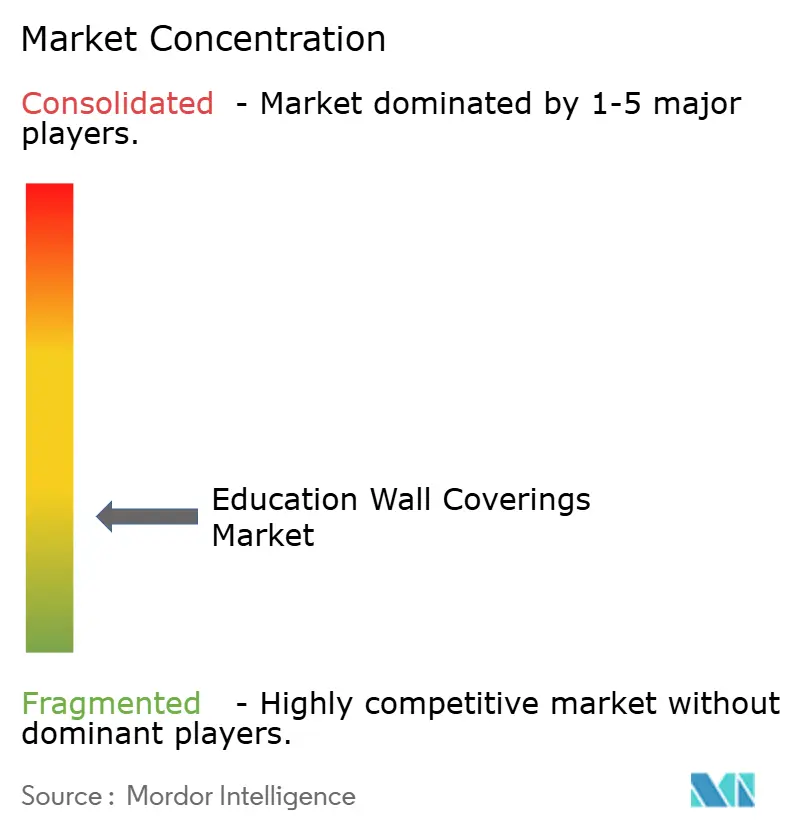
| Market Concentration | Low |
Major Players *Disclaimer: Major Players sorted in no particular order Image © Mordor Intelligence. Reuse requires attribution under CC BY 4.0. | |
Education Wall Coverings Market Analysis by Mordor Intelligence
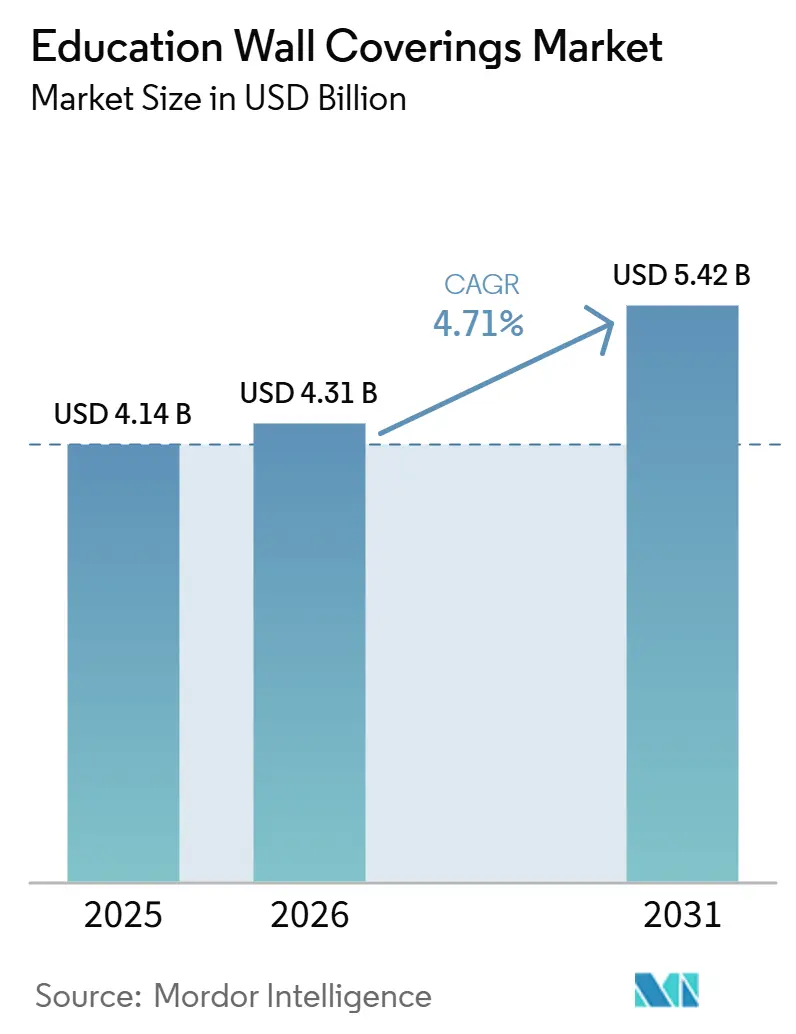
The education wall coverings market size was valued at USD 4.14 billion in 2025 and estimated to grow from USD 4.31 billion in 2026 to reach USD 5.42 billion by 2031, at a CAGR of 4.7% during the forecast period from 2026 to 2031. School modernization programs, renovation spending, and a wider focus on classroom acoustics, cleanability, and durable interior finishes support the education wall coverings market. Public education construction spending in the United States ran at a seasonally adjusted annual rate of USD 113.4 billion in May 2026, which continued to support demand for interior building products [1]. Product selection in the education wall coverings market increasingly depends on acoustic ratings, indoor air quality documentation, fire performance, and lifecycle cost evidence. Suppliers with tender-ready documents and early relationships with architects, facility managers, and procurement teams are better placed to participate as school projects move from planning into construction. Competitive conditions remain fragmented because global acoustic specialists, regional wall-protection suppliers, digital mural providers, and contractors serve different specification needs.
Key Report Takeaways
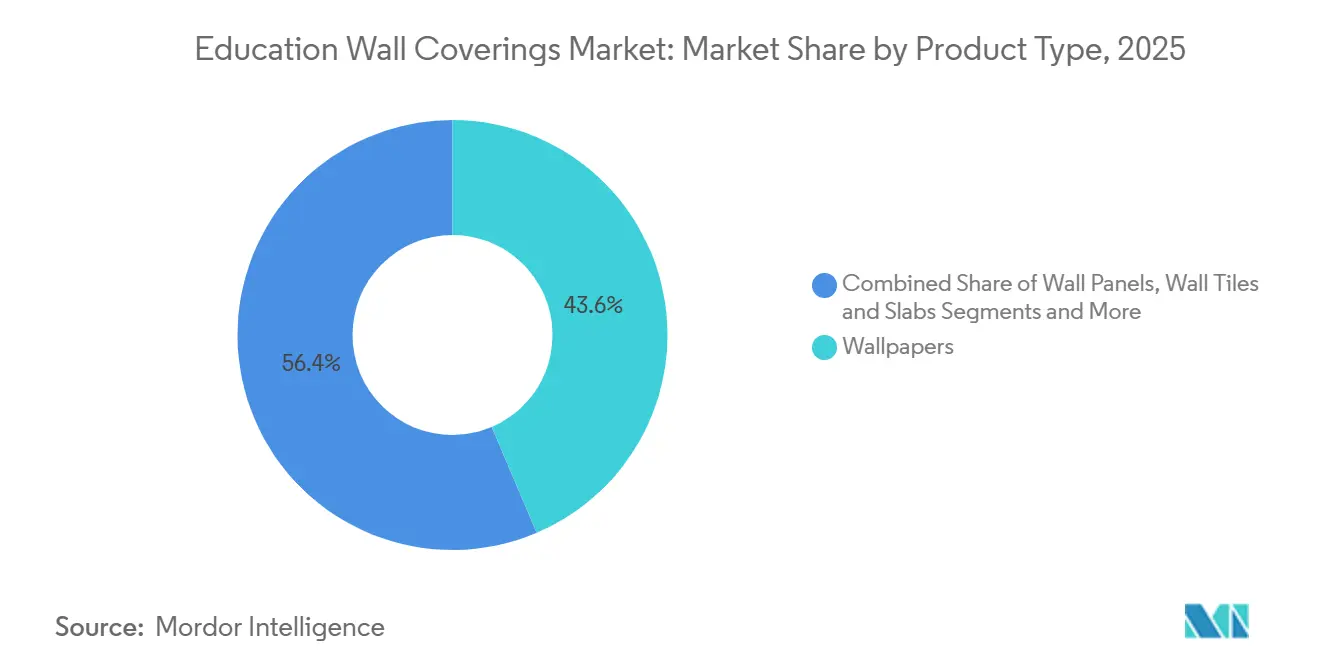
- By product type, wallpapers held 43.6% of the education wall coverings market share in 2025, while wall panels are forecast to grow at a 5.3% CAGR through 2031.
- By application, renovation and remodeling accounted for 58.8% of the education wall-coverings market share in 2025, while new construction is forecast to grow at a 4.7% CAGR through 2031.
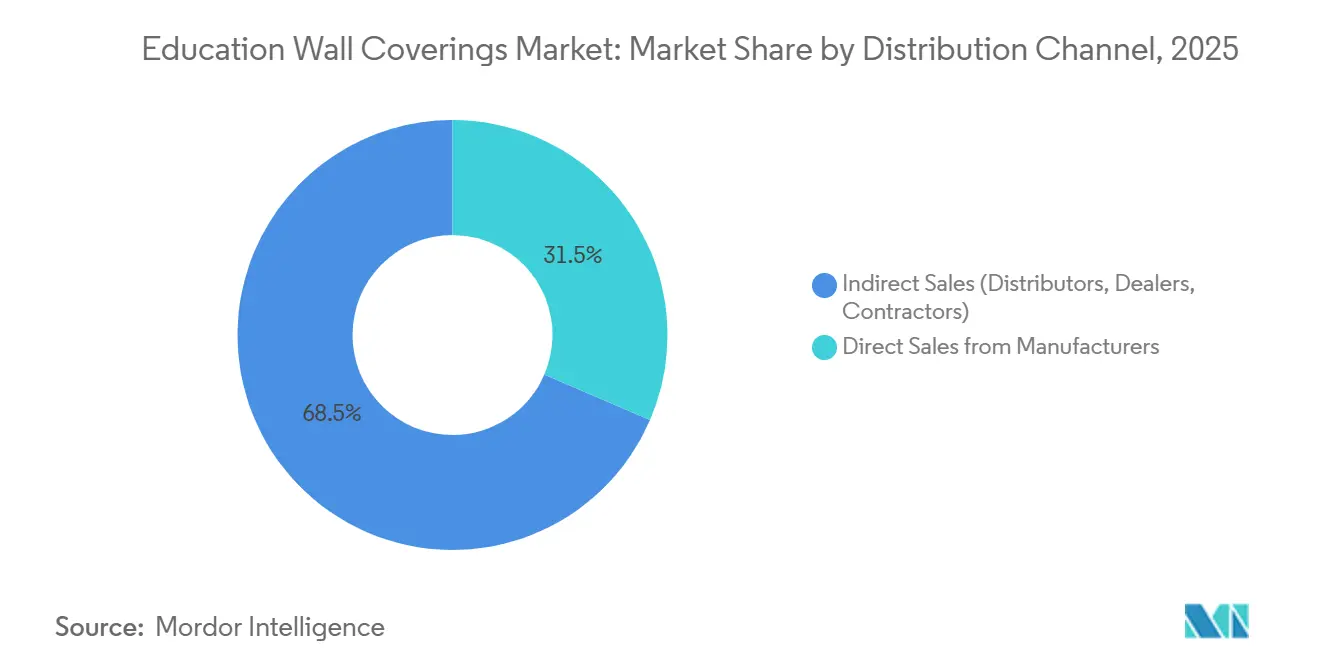
- By distribution channel, indirect sales represented 68.5% of revenue in 2025, while direct sales are forecast to grow at a 4.8% CAGR through 2031.
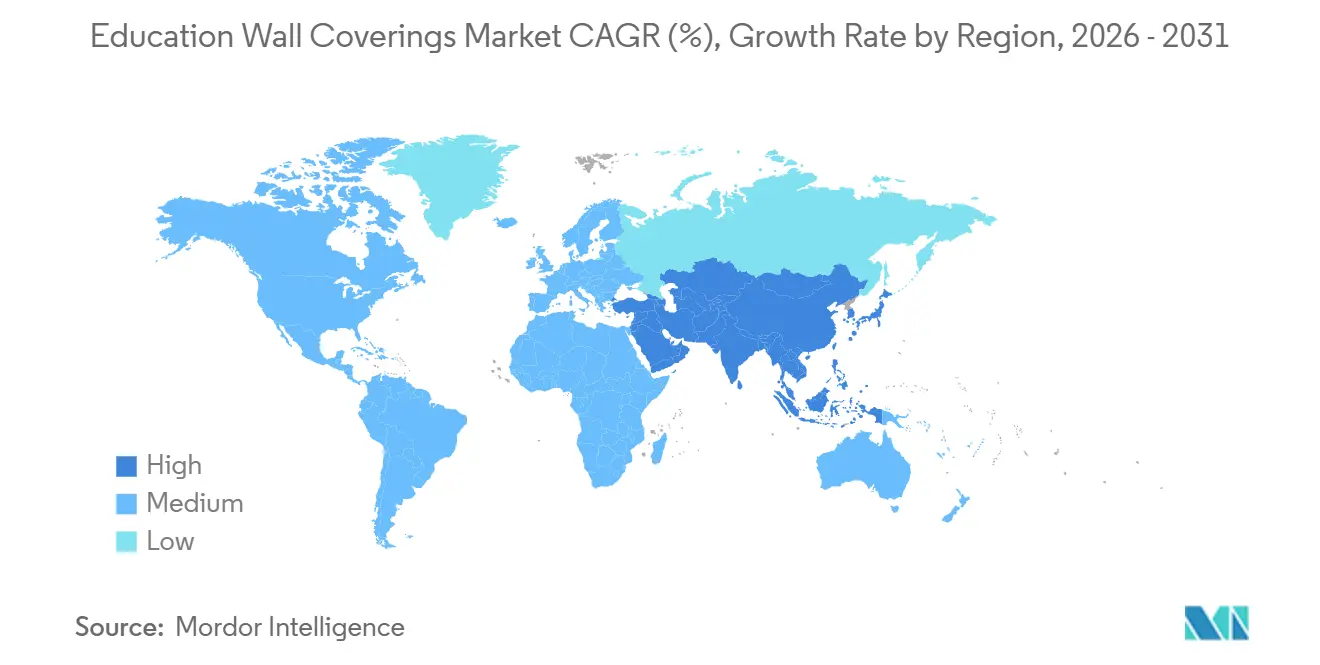
- By geography, North America held 33.3% of revenue in 2025, while Asia-Pacific is forecast to expand at a 5.4% CAGR through 2031.
Note: Market size and forecast figures in this report are generated using Mordor Intelligence’s proprietary estimation framework, updated with the latest available data and insights as of January 2026.
Market Trends and Insights
Drivers Impact Analysis of Education Wall Coverings Market*
| Driver | (~) % Impact on CAGR Forecast | Geographic Relevance | Impact Timeline |
|---|---|---|---|
| Government-Led School Modernization and Capital Improvement Programs | +1.4% | Global, concentrated in North America, EU member states, India, and Gulf states. | Medium term (2-4 years) |
| Rising Requirements for Classroom Speech Clarity and Noise Control | +1.0% | Global, most acute in North America and Europe | Short term (≤ 2 years) |
| Demand for Durable, Cleanable, and Impact-Resistant Surfaces | +0.8% | Global, strongest in secondary schools and vocational and higher-education campuses | Medium term (2-4 years) |
| Expansion of Digitally Printed Educational Graphics and Institutional Branding | +0.6% | North America and Europe, with growing adoption in urban Asia-Pacific private schools | Medium term (2-4 years) |
| Multi-Functional Wall Systems Combining Acoustics, Tackability, and Wall Protection | +0.7% | North America and Europe, with emerging use in Australia and Gulf premium projects | Long term (≥ 4 years) |
| Curriculum-Linked Visual Learning and Place-Based School Identity Programs | +0.4% | North America, the United Kingdom, and Australia, with early adoption in South Korea and Singapore | Long term (≥ 4 years) |
| Source: Mordor Intelligence | |||
Government-Led School Modernization and Capital Improvement Programs
Government capital programs are creating multi-year demand for finishes used in new schools and retrofit work. United States public education construction spending totaled USD 41.2 billion during the first 4 months of 2026, up 1.9% from the same period in 2025. Private educational construction spending increased 6.1% over the same period. The European Union Recovery and Resilience Facility allocated EUR 277 million to Bulgaria for the construction and renovation of kindergarten, school, and university campuses [2]. These programs support the education wall coverings market by enabling new specifications for acoustic treatments, protective surfaces, and finishes to remain in place through subsequent refurbishment cycles. School buildings designed for 30-50 years can therefore create demand beyond the current forecast period.
Rising Requirements for Classroom Speech Clarity and Noise Control
Acoustic wall panels are increasingly specified to meet classroom performance requirements rather than as optional design features. ANSI/ASA S12.60-2010, reaffirmed in 2020, specifies a maximum background noise level of 35 dB(A) and reverberation time of 0.6 seconds or less for core learning spaces. Florida adopted those thresholds in Section 1211 of its building code in 2023. Building Bulletin 93 sets acoustic performance requirements for new and significantly refurbished schools in England and Wales. A 2025 academic review found that WELL and LEED targets broadly align with national reverberation standards. The education wall coverings market benefits most in special educational needs projects, where acoustic performance can influence learning and therapy environments.
Demand for Durable, Cleanable, and Impact-Resistant Surfaces in High-Traffic Education Facilities
School corridors, cafeterias, gymnasiums, and shared areas expose walls to impacts, abrasion, cleaning agents, and moisture. Fiberglass-reinforced plastic panels, high-density fiber wainscoting, and thermoplastic sheet systems address those conditions with fire ratings, moisture resistance, and mold control properties. These characteristics support lifecycle-cost decisions because facility teams need surfaces that reduce repainting and maintenance work. Armstrong World Industries reported net sales of USD 1,621 million in 2025, with education accounting for 30% of its business. The company positioned its Templok ceiling and wall system for schools and cited potential HVAC energy savings of up to 15%. GREENGUARD Gold certification has also become a procurement consideration in many United States school districts, raising the importance of certified products in the education wall coverings market.
Expansion of Digitally Printed Educational Graphics and Institutional Branding
Digital printing enables schools to use wall surfaces for science diagrams, historical timelines, maps, and institutional graphics. UV-cured, eco-solvent, and dye-sublimation processes can be applied to vinyl, nonwoven, and fabric wallcoverings. This use combines visual communication with the physical requirements of institutional interiors. Digital graphics can also be paired with acoustic backing, allowing a wall system to support speech clarity while carrying school identity material. District-wide rollouts commonly require volume pricing and documented fire and low-emission credentials. These requirements favor suppliers that can provide ASTM E84 Class A, low-VOC, and NFPA 701 documentation as part of a structured offer to the education wall coverings market.
Restraints Impact Analysis of Education Wall Coverings Market*
| Restraint | (~) % Impact on CAGR Forecast | Geographic Relevance | Impact Timeline |
|---|---|---|---|
| Budget Competition from Paint, Plasterboard, Ceramic Tile, and Standard Acoustic Treatments | -0.8% | Global, most acute in price-sensitive public schools in South America, Africa, and parts of South and Southeast Asia | Short term (≤ 2 years) |
| Fire, Smoke, VOC, and Indoor Air Quality Compliance Costs | -0.5% | North America, Europe, and Australia, with tightening requirements in China and the Gulf | Medium term (2-4 years) |
| Installation Coordination and Substrate-Preparation Complexity in Retrofit Projects | -0.4% | Global, strongest in older building stock in Europe and North America | Medium term (2-4 years) |
| Procurement Fragmentation and Long Public-Sector Approval Cycles | -0.3% | Global, embedded in EU procurement and large United States school district systems | Long term (≥ 4 years) |
| Source: Mordor Intelligence | |||
Budget Competition from Paint, Plasterboard, Ceramic Tile, and Standard Acoustic Treatments
Painted gypsum board remains the principal low-cost substitute for specified wall panels and vinyl wallcovering systems. Public school budgets often lead facility managers to select the lowest initial-cost option. Standard acoustic ceiling tiles also compete with acoustic wall panels when ceiling treatments can meet reverberation targets on their own. The risk is higher where acoustic standards are voluntary or where certification is not consistently enforced. These conditions are present in parts of Sub-Saharan Africa, rural South Asia, and several Latin American countries. Suppliers in the education wall coverings market need to document longer service life, fewer repainting cycles, and lower maintenance needs to defend their position against lower-cost alternatives.
Fire, Smoke, VOC, and Indoor Air Quality Compliance Costs
Educational wall finishes must meet overlapping fire, smoke, and indoor air quality requirements. The International Building Code regulates flame spread and smoke development for interior finishes, while the 2024 International Fire Code includes requirements for decorative materials in Group E educational occupancies [3]. Products seeking LEED v4.1 or WELL v2 credits need VOC compliance supported by third-party testing. China’s GB 8624-2025 standard requires at least B1 fire performance for educational interior materials and A-grade performance in higher-risk spaces. These tests add cost and lead time to product development. The burden can slow the use of new bio-based and mycelium materials in the education wall coverings market.
*Our forecasts treat driver/restraint impacts as directional, not additive. The impact forecasts reflect baseline growth, mix effects, and variable interactions.
Education Wall Coverings Market Segment Analysis
By Product Type:
Wallpaper Leads Current Revenue While Wall Panels Drive GrowthWallpapers accounted for 43.6% of revenue in 2025, making them the largest product category in the education wall coverings market. Vinyl and PVC wallpapers remain widely used in renovation projects because they offer moisture resistance, cleanability, and dimensional stability. Nonwoven formats can reduce disruption in occupied schools through paste-free or low-adhesive installation. Paper-based products serve cost-sensitive applications, while fabric and textile wallpapers support projects that need acoustic absorption and tactile quality.
Wall panels are forecast to grow at a 5.3% CAGR through 2031 and are the fastest-growing product type. Acoustic panels are used in classrooms and libraries, while decorative 3D panels are used in reception areas and social spaces. Textile and felt products enhance absorption and tackiness, while wood-fiber panels can meet sustainability-led specifications. The Hämeenlinna co-educational school in Finland opened in January 2025 with 3,840 m² of Ecophon acoustic products, including 2,600 m² from the CarbonLow range [4]. Wall tiles, slabs, metal coverings, and impact-resistant systems continue to serve gyms, food-service spaces, and locker-room corridors.

By Application:
Renovation Supplies Volume While New Construction Adds GrowthRenovation and remodeling accounted for 58.8% of application revenue in 2025, the largest share among applications in the education wall coverings market. Much of the global school estate was built decades ago and requires repeat capital improvement rather than full replacement. Maryland set aside USD 450 million annually for public school capital improvements in its fiscal year 2026 budget analysis. Bulgaria’s recovery plan included renovation work across 116 kindergartens and schools. Low-odor adhesives, rapid-installation formats, and peel-and-stick systems matter where buildings remain partly occupied.
New construction is forecast to grow at a 4.7% CAGR through 2031, ahead of the renovation segment. Asia-Pacific, the Gulf Cooperation Council states, and Sub-Saharan Africa provide the principal greenfield pipeline identified. New projects allow teams to integrate acoustic panels, tackable zones, and lower-wall protection during design. This avoids substrate problems that arise in existing buildings. The education wall coverings industry can benefit as government-funded construction moves toward stronger acoustic and indoor-environment requirements.
By Distribution Channel:
Indirect Sales Maintain Reach While Direct Sales Shape SpecificationsIndirect sales through distributors, retailers, dealers, and contractors generated 68.5% of revenue in 2025. This channel supports the education wall-coverings market because public school procurement often relies on regional suppliers and approved vendor lists. Distributors combine demand from many schools and help contractors access products for routine purchases. The model is most effective for familiar, lower-specification materials. Complex products require acoustic, fire, and VOC data that can exceed the technical support available through a standard distribution relationship.
Direct manufacturer sales are forecast to increase at a 4.8% CAGR through 2031. Manufacturers are expanding specification teams, BIM-compatible product libraries, and relationships with architects and facilities directors. Early inclusion in drawings and approved product lists can determine which products later move through the distributor network. Armstrong World Industries reported 11% net sales growth in its Architectural Specialties segment in the first quarter of 2026. The education wall-coverings industry benefits when technical support is as important as product availability.
Geography Analysis
North America Education Wall Coverings Market
North America accounted for 33.3% of revenue in 2025 and was the largest geographic region in the education wall coverings market. The region has mature school capital-improvement systems and a high concentration of acoustic and indoor-air-quality requirements. United States public educational construction spending stood at a seasonally adjusted annual rate of USD 113.4 billion in May 2026. Private educational construction contributed an additional USD 26 billion on the same basis. Canada emphasizes acoustic and low-VOC renovation products, while Mexican urban school construction is expanding from a cost-sensitive base.
Europe and APAC Education Wall Coverings Market
Europe remains a mature market where acoustic performance, fire safety, and sustainability documentation guide purchasing decisions. The European Commission directed EUR 277 million to the Bulgarian educational infrastructure. Building Bulletin 93 and other national frameworks create demand for acoustic and low-emission wall systems. Asia-Pacific is forecast to grow at a 5.4% CAGR through 2031. China formalized sound-absorption requirements for new, extended, and renovated school spaces in June 2025.
MEA Education Wall Coverings Market
The Middle East and Africa had the smallest combined revenue, but both areas offer stronger long-term potential. Saudi Arabia and the United Arab Emirates are investing in premium institutional projects with acoustic and sustainability specifications. African markets face public budget constraints, foreign-exchange limitations, and limited distribution for certified products. The education wall coverings market can expand as durable surfaces become more cost-competitive with paint over their lifecycle.
Competitive Landscape
The education wall coverings market has a fragmented supplier base that includes global acoustic manufacturers, regional protective-panel suppliers, mural specialists, and distributors. Saint-Gobain Ecophon, Rockfon, and Knauf compete through technical data, environmental documentation, and established specification relationships. Armstrong World Industries reported USD 1,621 million in revenue in 2025, with education accounting for 30% of net sales. It acquired Eventscape in February 2026 to add custom design and fabrication capabilities for ceilings, feature walls, and facades. Marlite and NUDO Products focus on durable FRP and high-pressure laminate systems for high-traffic zones.
Few suppliers combine acoustic performance with in-house digital-print customization. OrangePiel is a notable North American provider of printed acoustic murals. Re-skinable and modular panels can reduce disruption and substrate damage during occupied-school upgrades. Sustainability documentation is another differentiator in the education wall coverings market. Autex Acoustics received the construction sector’s first NaturePositive+ Declaration in 2025 for a carbon-negative acoustic product with a -8.6 CO₂e footprint per functional unit.
Armstrong acquired Geometrik Manufacturing and FGM-Parallel in 2025 to expand its capabilities in wood, metal, and fabrication. Rockfon’s 2025 Canva Wall Panel update added recycled content, 8 frame finishes, and custom modular formats up to 13 × 3 meters. The education wall coverings market remains open to suppliers that connect technical compliance, adaptable design, and procurement support.
Education Wall Coverings Industry Leaders
-
Saint-Gobain Ecophon AB
-
ROCKWOOL International A/S
-
Knauf Gips KG
-
Armstrong World Industries, Inc.
-
BAUX AB
- *Disclaimer: Major Players sorted in no particular order
Education Wall Coverings Market Companies Covered in this Report
- Saint-Gobain Ecophon AB
- ROCKWOOL International A/S
- Knauf Gips KG
- Armstrong World Industries, Inc.
- BAUX AB
- Momentum Textiles and Wallcoverings
- Autex Acoustics Limited
- Acoufelt Pty Ltd
- BuzziSpace NV
- CertainTeed Corporation
- Marlite
- NUDO Products, Inc.
- Unilin Panels
- Fabricmate Systems, Inc.
- Sontext Pty Ltd
- Vicoustic
- OrangePiel, Inc.
- Magic Murals
- Murals Your Way
- Wallsauce
Recent Industry Developments in Education Wall Coverings Market
- June 2026: Autex Acoustics exhibited its Mirage Textured Panels at the NeoCon 2026 showroom in Chicago under the theme “Shaped By Many,” highlighting a new texture for acoustic wall applications in education and commercial interiors.
- February 2026: Armstrong World Industries acquired Eventscape Inc., a New York- and Toronto-based design and fabrication company specializing in complex, design-driven ceilings, feature walls, and facades. The acquisition adds custom architectural capability to Armstrong's specification platform. It marks the company's 15th Architectural Specialties deal since 2017, with the education vertical remaining its largest end market, accounting for 30% of net sales.
- October 2025: Rockfon, part of ROCKWOOL Group, launched the updated Rockfon Canva Wall Panel with recycled material content, a slimmer panel profile, 8 new frame finishes, and expanded modular options, including custom configurations up to 13 × 3 meters.
Global Education Wall Coverings Market Report Scope
The global education wall coverings market is covered from 2026 to 2031. It assesses demand for wallpapers, acoustic panels, protective wall systems, and other interior wall finishes used in schools and higher-education facilities. The analysis includes renovation and remodeling projects, new school construction, and sales through distributors, contractors, and direct manufacturer channels. It covers North America, Europe, Asia-Pacific, South America, and the Middle East and Africa. It also examines modernization spending, acoustic standards, hygiene and durability needs, fire and VOC compliance, procurement processes, competing materials, supplier strategies, recent developments, and the fragmented competitive structure.
Segmentation Overview
| Wallpapers | Vinyl and PVC-Based Wallpapers |
| Non-Woven Wallpapers | |
| Paper-Based Wallpapers | |
| Fabric and Textile Wallpapers | |
| Other Materials | |
| Wall Panels | Acoustic Wall Panels |
| Decorative 3D Wall Panels | |
| Textile and Felt Wall Panels | |
| Wood and Plant-Fiber Wall Panels | |
| Wall Tiles and Slabs | |
| Metal Wall Coverings | |
| Protective and Impact-Resistant Wall Systems | |
| Other Product Types |
| New Construction |
| Renovation and Remodeling |
| Direct Sales from Manufacturers |
| Indirect Sales (Distributors, Retailers, Dealers, Contractors) |
| North America | Canada |
| United States | |
| Mexico | |
| South America | Brazil |
| Peru | |
| Chile | |
| Argentina | |
| Rest of South America | |
| Europe | United Kingdom |
| Germany | |
| France | |
| Spain | |
| Italy | |
| BENELUX (Belgium, Netherlands, Luxembourg) | |
| NORDICS (Denmark, Finland, Iceland, Norway, Sweden) | |
| Rest of Europe | |
| Asia-Pacific | India |
| China | |
| Japan | |
| Australia | |
| South Korea | |
| South-East Asia | |
| Rest of Asia-Pacific | |
| Middle East & Africa | United Arab Emirates |
| Saudi Arabia | |
| South Africa | |
| Nigeria | |
| Rest of Middle East & Africa |
| By Product Type | Wallpapers | Vinyl and PVC-Based Wallpapers |
| Non-Woven Wallpapers | ||
| Paper-Based Wallpapers | ||
| Fabric and Textile Wallpapers | ||
| Other Materials | ||
| Wall Panels | Acoustic Wall Panels | |
| Decorative 3D Wall Panels | ||
| Textile and Felt Wall Panels | ||
| Wood and Plant-Fiber Wall Panels | ||
| Wall Tiles and Slabs | ||
| Metal Wall Coverings | ||
| Protective and Impact-Resistant Wall Systems | ||
| Other Product Types | ||
| By Application | New Construction | |
| Renovation and Remodeling | ||
| By Distribution Channel | Direct Sales from Manufacturers | |
| Indirect Sales (Distributors, Retailers, Dealers, Contractors) | ||
| By Geography | North America | Canada |
| United States | ||
| Mexico | ||
| South America | Brazil | |
| Peru | ||
| Chile | ||
| Argentina | ||
| Rest of South America | ||
| Europe | United Kingdom | |
| Germany | ||
| France | ||
| Spain | ||
| Italy | ||
| BENELUX (Belgium, Netherlands, Luxembourg) | ||
| NORDICS (Denmark, Finland, Iceland, Norway, Sweden) | ||
| Rest of Europe | ||
| Asia-Pacific | India | |
| China | ||
| Japan | ||
| Australia | ||
| South Korea | ||
| South-East Asia | ||
| Rest of Asia-Pacific | ||
| Middle East & Africa | United Arab Emirates | |
| Saudi Arabia | ||
| South Africa | ||
| Nigeria | ||
| Rest of Middle East & Africa | ||
Key Questions Answered in the Report
What is the forecast for education wall coverings through 2031?
The education wall coverings market is forecast to grow from USD 4.31 billion in 2026 to USD 5.42 billion by 2031 at a 4.7% CAGR.
Which product type leads the education wall coverings revenue?
Wallpapers led revenue with a 43.6% share in 2025, while wall panels are projected to grow fastest at a 5.3% CAGR through 2031.
Why are acoustic wall panels becoming more important in schools?
Classroom acoustic standards and requirements for speech clarity are increasing the use of wall systems that control reverberation.
Does renovation or new construction generate more demand for school wall finishes?
Renovation and remodeling led application revenue in 2025 at 58.8%, while new construction is projected to grow faster at a 4.7% CAGR.
Which region offers the strongest growth opportunity for school wall finishes?
Asia-Pacific is projected to expand at a 5.4% CAGR through 2031, supporting expansion in the education wall coverings market through school construction and stronger acoustic requirements.
How fragmented is the supplier landscape for education wall coverings?
The market concentration is fragmentation because acoustic specialists, protective-panel suppliers, mural providers, and contractors compete in specialized niches.