
Hospitality Wall Coverings Market Size and Share
Market Overview
| Study Period | 2020 - 2031 |
|---|---|
| Market Size (2026) | USD 11.97 Billion |
| Market Size (2031) | USD 14.72 Billion |
| Growth Rate (2026 - 2031) | 4.23 % |
| Fastest Growing Market | Asia-Pacific |
| Largest Market | North America |
| Market Concentration | Low |
Major Players *Disclaimer: Major Players sorted in no particular order Image © Mordor Intelligence. Reuse requires attribution under CC BY 4.0. | |
Hospitality Wall Coverings Market Analysis by Mordor Intelligence
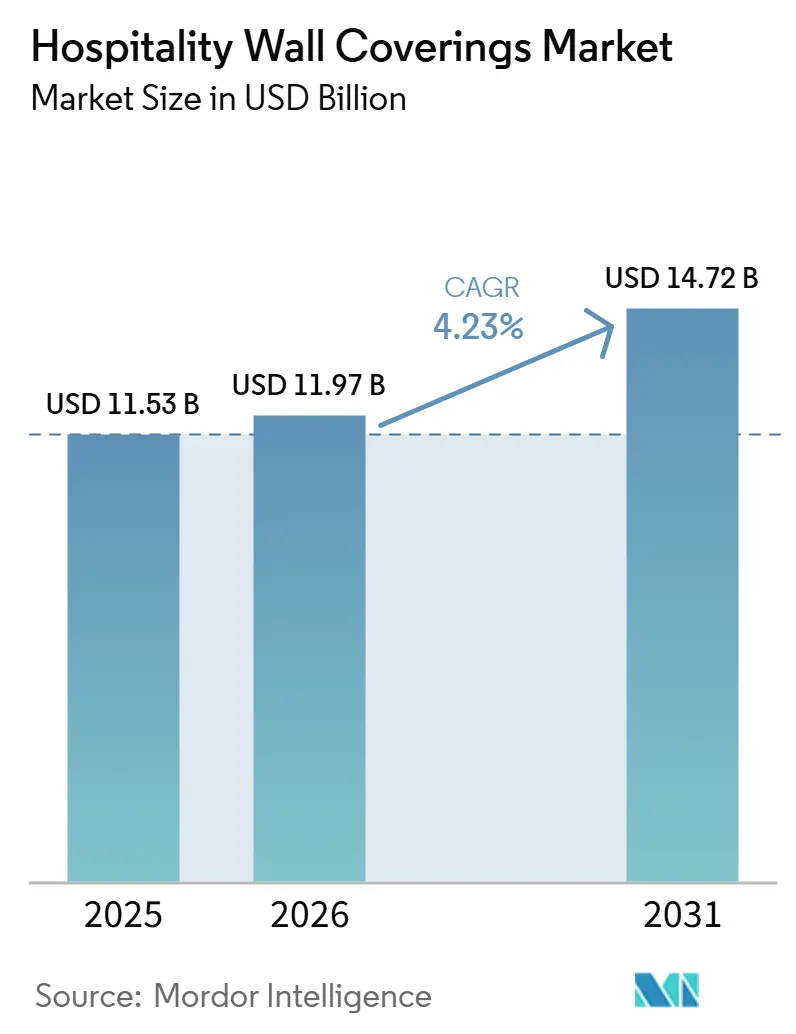
The hospitality wall coverings market size is projected to expand from USD 11.53 billion in 2025 to USD 11.97 billion in 2026, and to USD 14.72 billion by 2031, registering a CAGR of 4.2% between 2026 and 2031. Hotel operators now treat wall surfaces as functional procurement choices that affect fire compliance, acoustic control, durability, maintenance, and sustainability records. This change raises the performance threshold for suppliers and can increase the value of each installation. New hotel supply supports first-fit demand in developing regions, while renovation cycles provide recurring demand in established hotel markets. Suppliers are therefore balancing standardized contract products with customized services for premium projects. The hospitality wall coverings market also faces pressure from lower-cost surface alternatives and variable petrochemical inputs, particularly where renovation schedules are compressed.
Key Report Takeaways
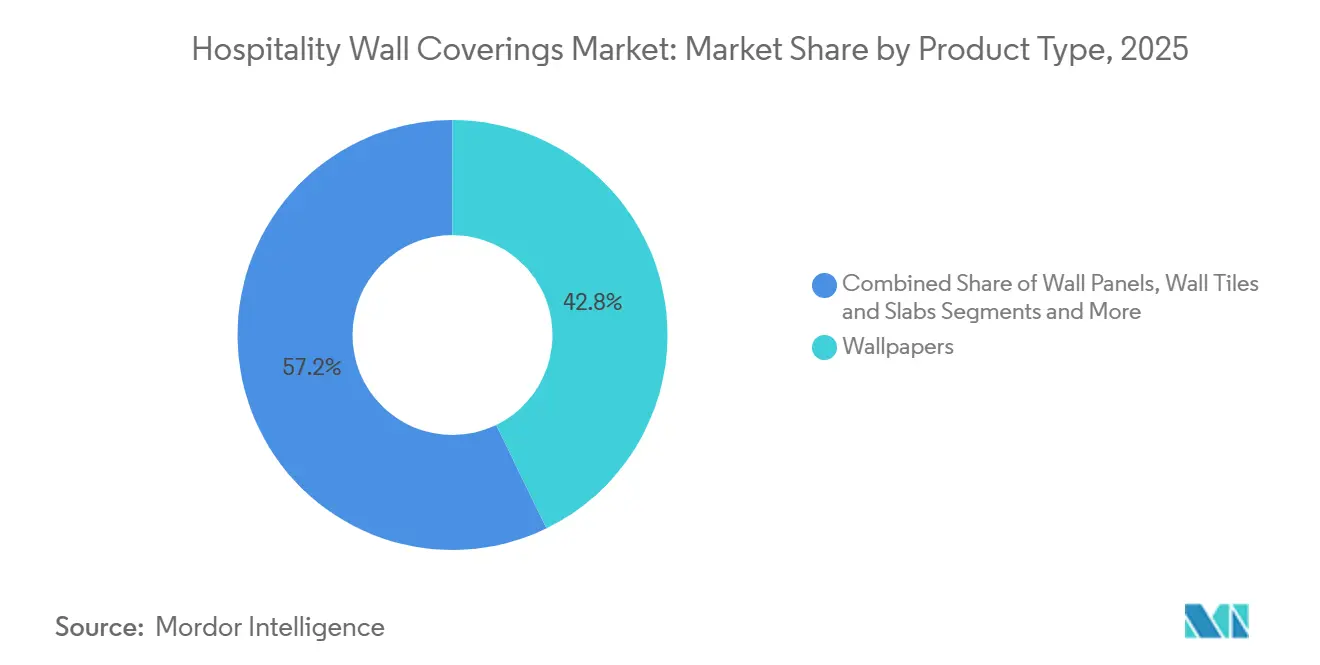
- By product type, wallpapers accounted for 42.8% of the hospitality wall coverings market's size in 2025, while wall panels are projected to grow at a 4.8% CAGR through 2031.
- By construction type, renovation and remodeling accounted for 61.4% of activity in the hospitality wall coverings market in 2025, while new construction is forecast to grow at a 4.4% CAGR through 2031.
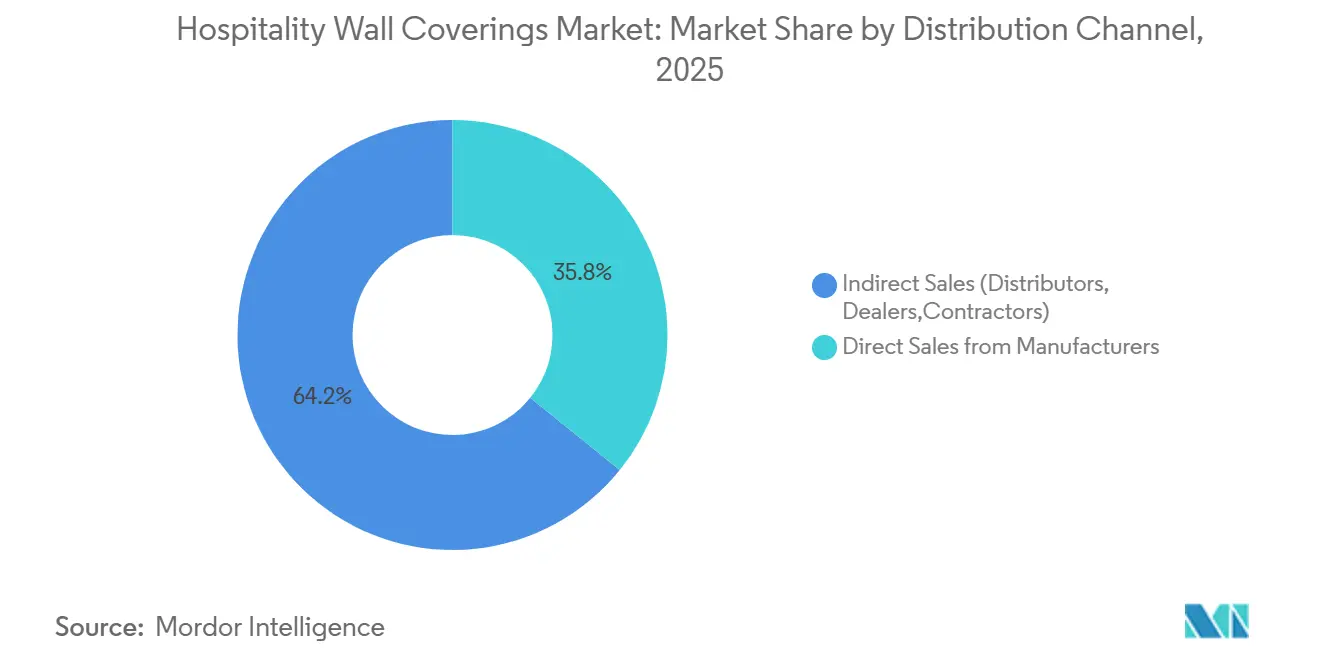
- By distribution channel, indirect sales accounted for 64.2% of the hospitality wall coverings market's 2025 revenue, while direct sales are projected to grow at a 4.7% CAGR through 2031.
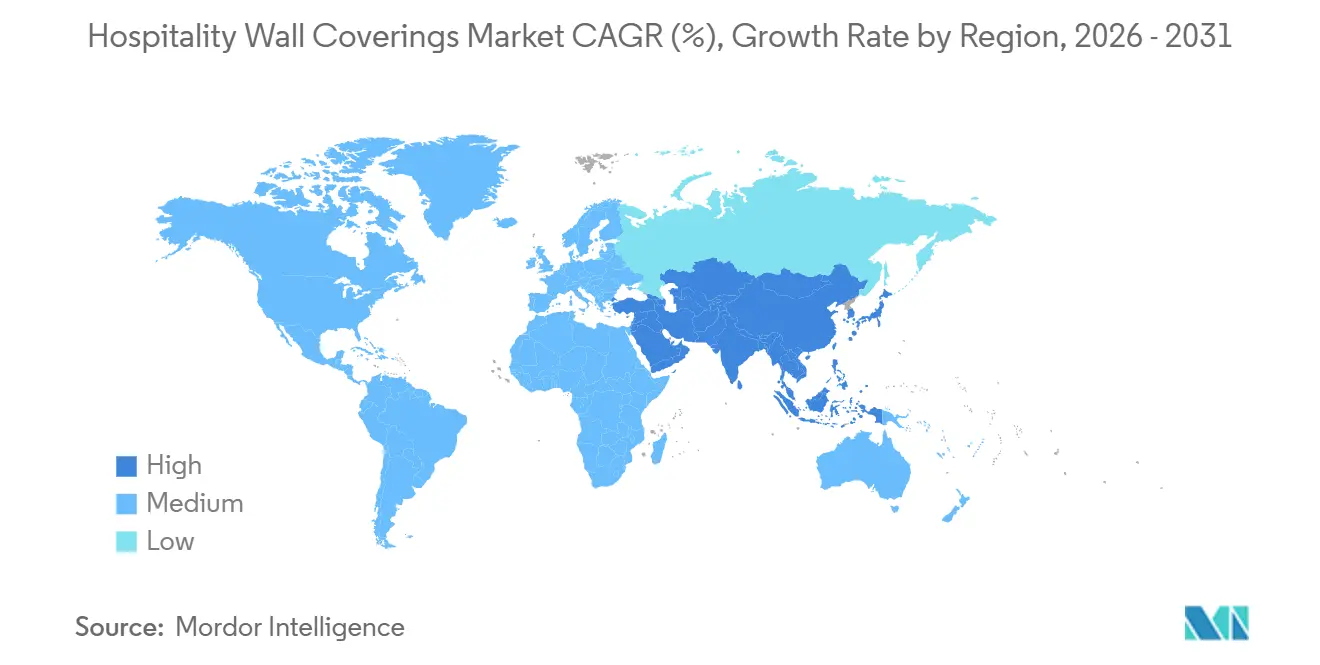
- By geography, North America held 35.8% of the 2025 revenue of the hospitality wall coverings market, while Asia-Pacific is forecast to grow at a 5.3% CAGR through 2031.
Note: Market size and forecast figures in this report are generated using Mordor Intelligence’s proprietary estimation framework, updated with the latest available data and insights as of January 2026.
Market Trends and Insights
Drivers Impact Analysis of Hospitality Wall Coverings Market*
| Driver | (~) % Impact on CAGR Forecast | Geographic Relevance | Impact Timeline |
|---|---|---|---|
| Hospitality Property Improvement and Renovation Cycles | +0.7% | Global, with the highest concentration in North America and Europe | Medium term (2-4 years) |
| Fire-Rated, Scrubbable, and Impact-Resistant Specifications | +0.5% | Global, with the strongest regulatory influence in North America, Europe, and the GCC | Short term (≤ 2 years) |
| Digital Customization and Short-Run Production for Branded Interiors | +0.6% | North America, Europe, and premium Asia-Pacific markets | Medium term (2-4 years) |
| Sustainability-Certified, PVC-Free, and Bio-Based Procurement | +0.6% | North America and Western Europe, with compliance extending to the Asia-Pacific | Long term (≥ 4 years) |
| Local Identity, Biophilic Design, and Wellness-Led Guest Experiences | +0.5% | Global, concentrated in luxury and upper-upscale hotels | Short term (≤ 2 years) |
| Stock Continuity and Rapid Replacement Across Hotel Portfolios | +0.3% | North America and Europe, particularly multi-property rollouts | Medium term (2-4 years) |
| Source: Mordor Intelligence | |||
Hospitality Property Improvement and Renovation Cycles Sustain Baseline Demand
Branded hotels in mature regions commonly follow property improvement programs that refresh wall surfaces every 7 to 10 years. These programs create recurring demand for contract wallcoverings across established portfolios. Brand standards often define required material weight, scrubbability, and color continuity for renovated rooms and public areas. Such requirements keep approved suppliers involved through multiple phases of a renovation program. Sangetsu reported continued hotel demand in Japan’s nonresidential sector even as office and industrial demand declined. This pattern makes the hospitality wall coverings market less dependent on new hotel openings alone.
Fire-Rated, Scrubbable, and Impact-Resistant Performance Specifications Drive Premium Product Adoption
Performance requirements influence which products make it onto hotel specification lists and which suppliers can serve them. Branded full-service hotels in the United States commonly require ASTM E84 Class A fire ratings and CDPH 01350 compliance for indoor air quality. European projects apply EN 13501 fire-reaction requirements and EN 12149 limits for heavy-metal toxicity. Wolf-Gordon states that its high-performance textile range meets ASTM E84 Class A, CDPH 01350, and EU REACH exclusion standards [1]. Meeting multiple standards in a single product increases development and documentation requirements for suppliers. This favors manufacturers that can provide verified performance records alongside design options.
Digital Customization and Short-Run Production Unlock New Revenue Streams for Manufacturers
Digital printing allows hotels to translate location-specific graphics and brand narratives into installed wall surfaces. Designers can order murals and custom patterns without the high minimum volumes associated with conventional collection production. This gives smaller projects access to designs that were previously practical only for large portfolios. Muraspec introduced its Murals service using Greenguard Gold-certified UV ink systems produced in accordance with ISO 20690:2018. Short production runs also support occupied renovations where property teams need replacement materials within limited time windows. The hospitality wall coverings market benefits when suppliers combine design assistance, substrate selection, compliance records, and production responsiveness.
Sustainability-Certified, PVC-Free, and Bio-Based Materials Restructure Specification Choices
Hospitality procurement teams increasingly request environmental product declarations, health product declarations, and material contribution statements during selection. These documents can carry the same weight as fire-rating records in furniture, fixtures, and equipment requests. Materials with PVC-free or bio-based claims are gaining relevance where projects target LEED or WELL requirements. Vescom expanded its Purefin range with three designs made from thermoplastic polyolefin and a non-woven backing. The range gives projects a non-vinyl option while retaining contract-grade durability. Suppliers without current environmental documentation may face fewer opportunities in projects that use formal material libraries.
Restraints Impact Analysis of Hospitality Wall Coverings Market*
| Restraint | (~) % Impact on CAGR Forecast | Geographic Relevance | Impact Timeline |
|---|---|---|---|
| Substitution From Paint, Decorative Panels, Tile, and Engineered Surfaces | -0.6% | Global, with the greatest pressure in budget and midscale renovations | Short term (≤ 2 years) |
| PVC, Petrochemical, and Specialty Fiber Price Volatility | -0.5% | Global, with a stronger effect on Asia-based manufacturers | Medium term (2-4 years) |
| Fragmented Certification, Installation, and End-of-Life Requirements | -0.4% | Asia-Pacific, Middle East, and Africa multi-jurisdiction projects | Long term (≥ 4 years) |
| Maintenance Disruption, Skilled Installation Constraints, and Replacement Matching Complexity | -0.4% | North America and Europe, where skilled labor is limited | Medium term (2-4 years) |
| Source: Mordor Intelligence | |||
Competing Surface Systems Limit Volume Recovery in Economy and Midscale Segments
Premium paint finishes, large-format porcelain, and engineered wall panels compete with wallcoverings in economy and midscale hotels. These alternatives can reduce installed cost and shorten the time required for a renovation. Plaster and limewash finishes can provide tactile appearances with less concern over matching future replacement batches. Corridor applications are particularly exposed because scrubbable silicate coatings compete with Type I vinyl on life-cycle cost. The substitution effect is less pronounced in premium projects that need acoustic performance, detailed branding, or material-led design. It nevertheless restricts volume growth in price-sensitive segments of the hospitality wall-coverings market.
Input Cost Volatility Creates Margin Asymmetry Across the Supplier Landscape
PVC resin, plasticizers, and specialty synthetic fibers remain exposed to energy prices and disruptions in petrochemical supply chains. The resulting cost changes can be difficult to pass through when hotel specifications have already been approved. A.S. Création reported FY2025 revenue of EUR 105.1 million (USD 113.5 million), down 5.6% [2]. The company returned to adjusted operating profitability of EUR 1.1 million through cost-reduction measures. Sangetsu also identified raw material inflation and Middle East supply-chain disruption as material uncertainties in its FY2026/3 guidance. Suppliers with several substrate platforms have more flexibility than firms dependent on a single material type.
*Our forecasts treat driver/restraint impacts as directional, not additive. The impact forecasts reflect baseline growth, mix effects, and variable interactions.
Hospitality Wall Coverings Market Segment Analysis
By Product Type:
Acoustic Wall Panels Reshape the Premium Specification BaselineWallpapers held 42.8% of 2025 revenue and remained the leading product format in the hospitality wall coverings market. Vinyl and PVC-based constructions led this position because they combine familiar fire-rated credentials with broad texture choices. Non-woven and fabric-backed products are also gaining attention because they support installation and removal during phased renovation work. Their format can help hotel operators limit disruption when rooms remain in service. Wall panels are forecast to grow at a 4.8% CAGR through 2031. The hospitality wall coverings market size for wall panels is supported by demand for acoustic products in open lobbies and multifunction spaces. Duchateau launched its Moderne collection in March 2025, featuring fluted white oak and walnut panels with integrated acoustic felt backing. The flexible backing allows the panels to follow curved surfaces. Shaw Contract identifies acoustic performance as a foundational tool in hospitality design for 2026.
Wall tiles, slabs, metal coverings, and protective impact-resistant systems serve smaller but important areas within a hotel. Service corridors, food-and-beverage back-of-house areas, and elevator lobbies often require a higher durability threshold. These uses can exceed the performance level of conventional wallpaper substrates. Decorative 3D panels, textile and felt panels, and wood-fiber panels are also used in luxury lobbies. They provide dimensional and tactile effects that painted surfaces cannot duplicate. The hospitality wall coverings industry can pursue more projects when manufacturers offer products tailored to each operating environment. This reduces the need for a hotel to use unrelated suppliers across its surface program. Product breadth also gives suppliers a path to extend relationships beyond guest-room wallpaper. Acoustic materials can further raise the relevance of wall systems where comfort and sound control are considered together.

By Construction Type:
New Construction Pipeline Narrows the Gap With Renovation’s Dominant ShareRenovation and remodeling accounted for 61.4% of activity in 2025 and represented the largest construction type. This hospitality wall coverings market share reflects the scale of the existing global hotel base and its regular refresh requirements. Brand-led property improvement plans create concentrated specification opportunities across multiple hotels simultaneously. Marriott, IHG, and Accor use rolling renovation programs that require product consistency across different properties. Suppliers that can maintain stock continuity and color matching can be better positioned for this work. Wall surfaces are replaced according to schedules set by brand standards and hotel operating plans. The hospitality wall coverings market, therefore, receives repeat demand from refurbishment even when new construction is slower. This pattern can create clearer production windows for contract suppliers. It also makes service, availability, and batch control important factors in supplier selection. Renovation projects remain focused on operational efficiency and compliance with established brand requirements.
New construction is projected to grow at a 4.4% CAGR through 2031, faster than renovation activity. Middle East projects and urban hotel pipelines in the Association of Southeast Asian Nations support first-fit demand. Lodging Econometrics projected 93 new hotels with 18,511 rooms to open in the Middle East during 2026. Each opening requires wall-surface materials in guest rooms, corridors, food-and-beverage spaces, and public areas. Luxury developments in Saudi Arabia and the United Arab Emirates use bespoke panels with custom printing and culturally referenced designs. These projects can command higher values than standard contract vinyl installations. Their needs differ from refurbishment work, where cost and brand-standard compliance are more central. Manufacturers serving both types can combine standardized renovation lines with bespoke design support. Suppliers with a single capability must decide which demand profile to prioritize.
By Distribution Channel:
Manufacturer Direct Investment Responds to Specifier Relationship ValueIndirect sales through distributors, dealers, and contractors accounted for 64.2% of 2025 revenue. This leadership reflects the role of intermediaries in hospitality procurement and project execution. Interior designers, furniture, fixtures, and equipment firms, and contractors can determine which brands make it onto project shortlists. Distributor relationships have historically provided manufacturers with local access to these specification gatekeepers. Indirect partners also manage logistics, installation coordination, and replacement needs. These services remain important on multi-site projects and in locations where manufacturers lack a local operating presence. The hospitality wall coverings market relies on this channel because wall covering selection is tied to site schedules and installed performance. The channel is especially useful for standardized catalog products that can move through established stock systems. It also reduces the number of direct accounts a manufacturer must manage. Distributor capability can therefore matter as much as product breadth in routine renovation work.
Direct sales are projected to grow at a 4.7% CAGR through 2031. Manufacturers are increasing contact with design studios and using digital tools to influence specifications before channel selection begins. Wolf-Gordon’s hospitality design program, Vescom’s Milan Design Week activity, and Koroseal’s Fortis collaboration with Arte illustrate this direct creative engagement [3]. Project-specific custom orders placed with manufacturers can carry a higher per-unit value than standardized catalog orders. Digital printing and short-run production strengthen the rationale for direct specification relationships. Distributors are responding by focusing on installation assistance, logistics, and post-installation replacement matching. The hospitality wall coverings industry is therefore not eliminating intermediaries. Instead, it is separating upstream design influence from downstream project delivery. This approach lets manufacturers build closer connections with specifiers while retaining local execution support.
Geography Analysis
North America and Europe Hospitality Wall Coverings Market
North America held 35.8% of 2025 revenue. The region is largely supported by renovation cycles rather than rapid additions to hotel supply. Branded hotel operators use rolling property improvement plans that create recurring replacement requirements. These programs favor established contract suppliers with a record of product continuity. Koroseal serves as Sangetsu’s North American manufacturing platform within its global organization. Europe is forecast to expand significantly through 2031, supported by sustainability-led replacement activity. Russia’s weaker development environment limits the wider regional average.
APAC Hospitality Wall Coverings Market
Asia-Pacific is forecast to grow at a 5.3% CAGR through 2031, making it the fastest-growing region. The region’s hotel construction pipeline supports demand for first-fit wallcovering installation. The Asia-Pacific pipeline excluding China reached 2,387 projects and 442,973 rooms in Q1 2026. This represented 11% year-on-year growth in project count. India accounted for 906 projects and 118,334 rooms, or 39% of the regional pipeline. Vietnam, Japan, and Thailand provide additional sources of demand, with Japan’s pipeline rising 23% year-on-year. Sangetsu’s Southeast Asia interior business turned profitable in Q2 FY2025, while its current plan names North America and Southeast Asia as overseas growth corridors.
MEA and South America Hospitality Wall Coverings Market
Saudi Arabia had 394 hotel projects and 106,521 rooms in its pipeline during Q4 2025 [4]. The number of Saudi projects was 25% higher than a year earlier. Average daily rates at Gulf Cooperation Council luxury properties rose 14% year-on-year in Q1 2026. Egypt’s pipeline reached 140 projects and 31,104 rooms during Q4 2025, up 17% year-on-year. South America is forecast to grow significantly, with Brazil and Argentina supported by resort and mixed-use hospitality development. The hospitality wall coverings market size in these regions depends on the conversion of planned rooms into completed, specified projects.
Competitive Landscape
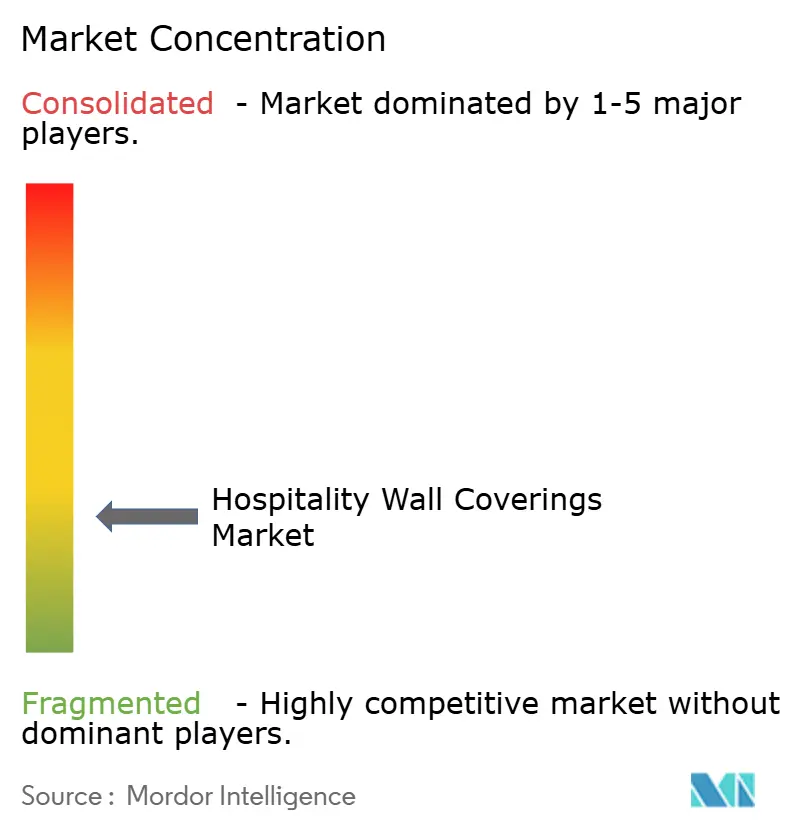
The hospitality wall coverings market is fragmented, and the top 5 players are estimated to hold a combined share of 20% to 30%. Regional specification relationships, compliance credentials, and design services shape competition more than scale alone. Suppliers are broadening substrate portfolios to serve both PVC and non-PVC requirements. This strategy helps them respond to different project standards without abandoning established contract products. Wolf-Gordon introduced Achimwi in April 2026 as a PVC-free collection developed with Lenape artists. The launch combined cultural storytelling with a material approach relevant to sustainability-focused specifications. Vescom uses in-house weaving operations as part of its production approach. This can support product quality and lead-time control for its contract customers.
Koroseal launched the Fortis Collection in February 2026 with 109 colorways in 20 oz woven Type II construction. The range was co-developed with Arte and carried a Class A fire rating. It combined design references such as linen, silk, raffia, banana leaf, and handwoven textures. The product also complied with California indoor air quality standards and was free of harsh chemicals and heavy metals. These attributes show how suppliers bundle certification, material performance, and design collaboration into a product introduction. Vescom expanded its material program at Milan Design Week 2026 with a couture-inspired textile collection and its Purefin non-vinyl range. Such moves position the hospitality wall coverings market around documented performance and differentiated design, rather than decoration alone.
Opportunities remain where acoustic performance and rapid installation are needed in phased renovation work. Peel-and-stick acoustic panels with certified fire performance could reduce downtime for occupied properties, although such systems were identified as an unmet need rather than a current product claim. Premium manufacturers are also using augmented reality tools to help designers view patterns at room scale before approval. This can shorten sample review cycles and support faster purchasing decisions. Antimicrobial surface treatments, bio-based adhesives, and augmented reality-enabled specification platforms may become areas of product differentiation over the next 5 years. These developments matter because customer needs extend beyond the visual appearance of a wall surface. The competitive picture remains open to regional specialists and private-label suppliers that understand local specification ecosystems. Large manufacturers must therefore combine global compliance capabilities with local project service to improve their position.
Hospitality Wall Coverings Industry Leaders
-
York Wallcoverings, Inc.
-
Muraspec
-
Newmor Wallcoverings
-
Vescom B.V.
-
Goodrich Global
- *Disclaimer: Major Players sorted in no particular order
Hospitality Wall Coverings Market Companies Covered in this Report
- York Wallcoverings, Inc.
- Muraspec
- Newmor Wallcoverings
- Astek Wallcovering
- Goodrich Global
- Vescom B.V.
- Momentum Textiles and Wallcoverings
- Koroseal Interior Products LLC
- Wolf-Gordon, Inc.
- MDC Interior Solutions
- Phillip Jeffries Ltd.
- F. Schumacher and Co.
- Sangetsu Corporation
- A.S. Création Tapeten AG
- Grandeco Wallfashion Group Belgium NV
- Innovations in Wallcoverings
- Casamance Group
- Arte International BV
- Rubelli S.p.A.
- Omexco NV
Recent Industry Developments in Hospitality Wall Coverings Market
- July 2026: Vescom launched Harrison, a vinyl wallcovering with a herringbone textile aesthetic and 30% recycled content, positioned explicitly for luxury hospitality and high-traffic contract interiors. The design was engineered at Vescom's owned production facility, meeting the highest flame-retardancy standard, B s1 d0, required for contract environments.
- May 2026: Wolf-Gordon relaunched Knitte 1 in PVC-free construction as part of its yearlong 25th-anniversary retrospective, translating Petra Blaisse's original knit experiments into a large-scale, dimensionally graphic wallcovering. The relaunch signals a commitment to converting legacy high-demand designs to non-PVC substrates.
- April 2026: Wolf-Gordon introduced Achimwi, a PVC-free wallcovering collection developed in collaboration with Lenape artists, translating cultural heritage narratives into pattern-rich surfaces for commercial and hospitality interiors. The launch connects sustainability material credentials with authentic cultural storytelling, addressing both specification compliance and design differentiation simultaneously.
Global Hospitality Wall Coverings Market Report Scope
Segmentation Overview
| Wallpapers | Vinyl and PVC-Based Wallpapers |
| Non-Woven Wallpapers | |
| Paper-Based Wallpapers | |
| Fabric and Textile Wallpapers | |
| Other Materials | |
| Wall Panels | Acoustic Wall Panels |
| Decorative 3D Wall Panels | |
| Textile and Felt Wall Panels | |
| Wood and Plant-Fiber Wall Panels | |
| Wall Tiles and Slabs | |
| Metal Wall Coverings | |
| Protective and Impact-Resistant Wall Systems | |
| Other Product Types |
| New Construction |
| Renovation and Remodeling |
| Direct Sales from Manufacturers |
| Indirect Sales (Distributors, Retailers, Dealers, Contractors) |
| North America | Canada |
| United States | |
| Mexico | |
| South America | Brazil |
| Peru | |
| Chile | |
| Argentina | |
| Rest of South America | |
| Europe | United Kingdom |
| Germany | |
| France | |
| Spain | |
| Italy | |
| BENELUX (Belgium, Netherlands, Luxembourg) | |
| NORDICS (Denmark, Finland, Iceland, Norway, Sweden) | |
| Rest of Europe | |
| Asia-Pacific | India |
| China | |
| Japan | |
| Australia | |
| South Korea | |
| South-East Asia | |
| Rest of Asia-Pacific | |
| Middle East & Africa | United Arab Emirates |
| Saudi Arabia | |
| South Africa | |
| Nigeria | |
| Rest of Middle East & Africa |
| By Product Type | Wallpapers | Vinyl and PVC-Based Wallpapers |
| Non-Woven Wallpapers | ||
| Paper-Based Wallpapers | ||
| Fabric and Textile Wallpapers | ||
| Other Materials | ||
| Wall Panels | Acoustic Wall Panels | |
| Decorative 3D Wall Panels | ||
| Textile and Felt Wall Panels | ||
| Wood and Plant-Fiber Wall Panels | ||
| Wall Tiles and Slabs | ||
| Metal Wall Coverings | ||
| Protective and Impact-Resistant Wall Systems | ||
| Other Product Types | ||
| By Construction Type | New Construction | |
| Renovation and Remodeling | ||
| By Distribution Channel | Direct Sales from Manufacturers | |
| Indirect Sales (Distributors, Retailers, Dealers, Contractors) | ||
| By Geography | North America | Canada |
| United States | ||
| Mexico | ||
| South America | Brazil | |
| Peru | ||
| Chile | ||
| Argentina | ||
| Rest of South America | ||
| Europe | United Kingdom | |
| Germany | ||
| France | ||
| Spain | ||
| Italy | ||
| BENELUX (Belgium, Netherlands, Luxembourg) | ||
| NORDICS (Denmark, Finland, Iceland, Norway, Sweden) | ||
| Rest of Europe | ||
| Asia-Pacific | India | |
| China | ||
| Japan | ||
| Australia | ||
| South Korea | ||
| South-East Asia | ||
| Rest of Asia-Pacific | ||
| Middle East & Africa | United Arab Emirates | |
| Saudi Arabia | ||
| South Africa | ||
| Nigeria | ||
| Rest of Middle East & Africa | ||
Key Questions Answered in the Report
What is the projected value of the hospitality wall coverings market by 2031?
The hospitality wall coverings market is forecast to reach USD 14.7 billion by 2031, growing at a 4.2% CAGR from 2026. Recurring renovations and new hotel projects support this outlook.
Which product format is growing fastest in the hospitality wall coverings market?
In the hospitality wall coverings market, wall panels are forecast to grow at a 4.8% CAGR through 2031. Acoustic needs in public spaces support demand for this format at large hotel properties.
Why does the hospitality wall coverings market draw most demand from renovation projects?
The hospitality wall coverings market recorded 61.4% of 2025 activity from renovation and remodeling. Hotel brands use regular property improvement programs to update rooms and public spaces.
Which region has the strongest forecast growth in the hospitality wall coverings market under current hotel development plans?
Asia-Pacific is the fastest-growing part of the hospitality wall coverings market, with a 5.3% CAGR through 2031. Hotel construction in India and Southeast Asia supports first-fit demand.
What factors influence supplier selection for hotel wall surfaces?
In the hospitality wall-coverings market, fire ratings, indoor air quality records, durability, color consistency, sustainability documentation, and design support influence specifications. These requirements shape approved supplier lists.
How concentrated is competition among hospitality wallcovering suppliers?
The hospitality wall coverings market remains fragmented, as the top 5 players hold an estimated 20%-30% combined share. Regional specialists, therefore, retain a meaningful role in local projects.