
Wood Wall Panels Market Size and Share
Market Overview
| Study Period | 2020 - 2031 |
|---|---|
| Market Size (2026) | USD 10.33 Billion |
| Market Size (2031) | USD 12.97 Billion |
| Growth Rate (2026 - 2031) | 4.66 % |
| Fastest Growing Market | Asia-Pacific |
| Largest Market | Europe |
| Market Concentration | Low |
Major Players *Disclaimer: Major Players sorted in no particular order Image © Mordor Intelligence. Reuse requires attribution under CC BY 4.0. | |
Wood Wall Panels Market Analysis by Mordor Intelligence
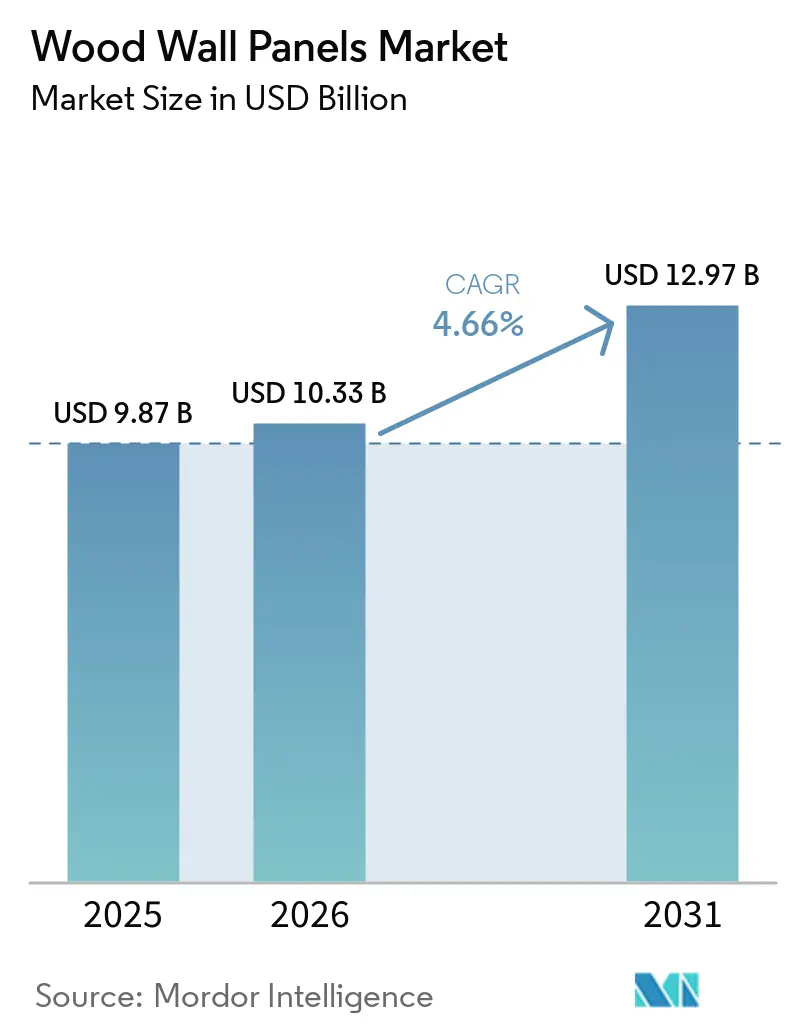
The wood wall panels market size was valued at USD 9.87 billion in 2025 and estimated to grow from USD 10.33 billion in 2026 to reach USD 12.97 billion by 2031, at a CAGR of 4.66% during the forecast period (2026-2031). Renovation demand in North America and Europe supports the wood wall panels market because owners are upgrading older homes rather than moving. New housing, urban development, and hospitality projects support demand across Asia-Pacific. Producers are responding with prefinished systems that reduce installation work and with certified low-emission materials. Compliance with traceability and formaldehyde rules is also changing purchasing decisions and production investment. These conditions favor suppliers that can combine reliable wood supply, technical certification, and broad distribution.
Key Report Takeaways
- By panel type, 3D and decorative panels held 24.52% of the wood wall panels market share in 2025, while acoustic panels are projected to grow at the fastest CAGR of 6.24% during 2026-2031.
- By wood type, engineered wood held 45.14% of the wood wall panels market share in 2025, while reclaimed and recycled wood is forecast to expand at a 6.01% CAGR from 2026 to 2031.
- By installation type, direct-to-wall systems held 48.17% of revenue in 2025, while interlocking systems are forecast to expand at a 5.54% CAGR from 2026 to 2031.
- By end user, residential applications held 52.23% of revenue in 2025, while commercial applications are forecast to expand at a 5.83% from 2026 to 2031.
- By distribution channel, B2C held 65.42% of revenue in 2025, while B2B channels are forecast to expand at a 5.48% CAGR from 2026 to 2031.
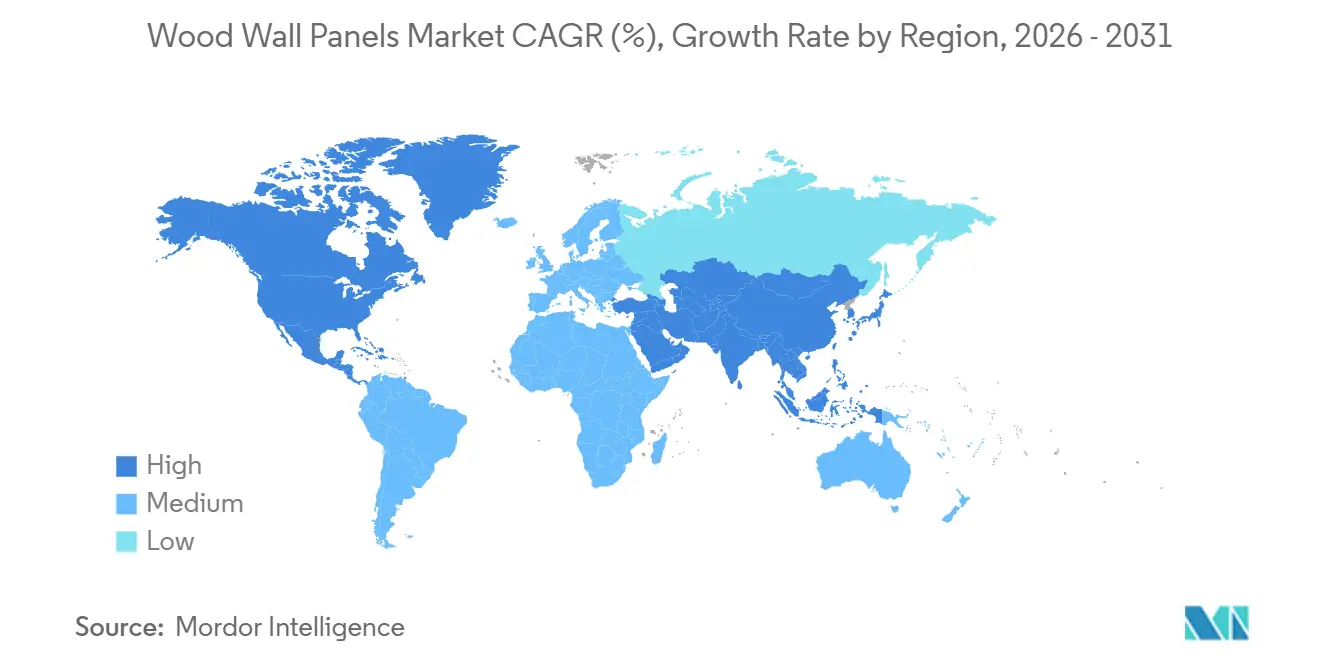
- By geography, Europe accounted for 32.21% of 2025 revenue, while Asia-Pacific is projected to grow at a 6.13% CAGR through 2031.
Note: Market size and forecast figures in this report are generated using Mordor Intelligence’s proprietary estimation framework, updated with the latest available data and insights as of January 2026.
Global Wood Wall Panels Market Trends and Insights
Drivers Impact Analysis*
| Driver | (~) % Impact on CAGR Forecast | Geographic Relevance | Impact Timeline |
|---|---|---|---|
| Renovation And Remodeling of Existing Housing Stock | +1.4% | Global, concentrated in North America and Europe, where the housing stock averages more than 40 years old | Medium term (2-4 years) |
| Hospitality And Commercial Real Estate Renovation Surge | +0.7% | Global, strongest in Asia-Pacific, the Middle East and Africa, and North America | Short term (≤ 2 years) |
| Modular And Prefabricated Interior Construction | +0.9% | North America and Europe, with early adoption spreading into the Asia-Pacific | Medium term (2-4 years) |
| Demand For Acoustic and Biophilic Commercial Interiors | +1.1% | Global, particularly North America, Europe, and urban Asia-Pacific | Short term (≤ 2 years) |
| Recycled-Fiber and Traceable-Wood Procurement Requirements | +0.7% | EU-led, with implications for suppliers in Asia-Pacific and South America | Medium term (2-4 years) |
| Digital Mass Customization and Low-Waste CNC Fabrication | +0.5% | North America and Europe, with expansion into Southeast Asia and India | Long term (≥ 4 years) |
| Source: Mordor Intelligence | |||
Renovation and Remodeling of Existing Housing Stock
An aging housing base is increasing the need for periodic interior upgrades. The National Association of Home Builders expects the United States residential remodeling activity to grow 3% in inflation-adjusted terms during 2026 and a further 2% during 2027. High mortgage rates continue to discourage many owners from moving, which directs spending toward existing homes. Bathroom, kitchen, and whole-house projects frequently include wall surface upgrades because they are visible elements of a finished room. The National Association of Home Builders recorded 128,000 United States remodeling firms at the start of 2025, compared with 69,000 in 2000[1]https://www.nahb.org/news-and-economics/press-releases/2026/02/nahb-expects-remodeling-growth-2026. Wood wall panels can benefit when remodeling firms move from basic painting toward more durable finishes. Harvard’s Joint Center for Housing Studies expects annual United States homeowner improvement spending to reach USD 518 billion by the end of 2026[2]https://www.jchs.harvard.edu/blog/remodeling-growth-set-downshift-late-2026. That spending base supports demand even when new construction softens. The wood wall panels market, therefore, has exposure to renovation budgets that are less dependent on housing starts.
Modular and Prefabricated Interior Construction
Off-site assembly and factory-prepared interior components are becoming more widely used. Prefinished panels arrive dimensioned for direct installation and can reduce the carpentry work required on a project. This approach is useful where experienced woodworking labor is limited. A peer-reviewed study found that targeted CNC automation in 2 of 8 production activities could lift a factory’s output above 300 homes annually[3]https://www.mdpi.com/2075-5309/16/5/908. The result illustrates how limited automation can increase output when panel production is standardized. Prefabrication shifts panel purchasing from individual job sites to factory procurement teams, creating larger orders and greater emphasis on consistent dimensions and delivery performance. Producers with established engineering support may be better positioned for these specifications. Smaller site crews can use prefinished systems with less cutting and finishing work. The wood wall panels market gains from this shift because it increases the value of panels prepared for immediate installation.
Demand for Acoustic and Biophilic Commercial Interiors
Commercial projects increasingly require a visual finish alongside acoustic performance. Open-plan offices have increased attention to reverberation and speech control. Healthcare, education, and hospitality projects also specify materials that support comfortable interior environments. Wood slat systems can combine a natural veneer surface with sound-absorptive backing. Such products can support low-emitting material requirements in building certification programs. Architects increasingly evaluate acoustic performance alongside fire ratings and indoor air quality credentials, narrowing the field for suppliers without tested product documentation. Armstrong's July 2026 WoodWorks Shapes ceiling panels show the same wood-acoustic specification trend. The products include 10 standard FSC-certified wood species and ASTM E84 Class A fire performance. The wood wall panels market benefits when decorative products also meet functional design requirements.
Recycled-Fiber and Traceable-Wood Procurement Requirements
Procurement rules increasingly require documented wood sourcing and greater recycled content. EU Regulation 2023/1115 will require operators, from 30 December 2026, to demonstrate geolocation traceability and deforestation-free sourcing. The regulation was amended in December 2025, while its core traceability requirement remained in place[4]https://eur-lex.europa.eu/legal-content/EN/TXT/?uri=CELEX%3A02023R1115-20251226. The Forest Stewardship Council provides a due diligence framework that businesses can align with these requirements. These rules make chain-of-custody documentation more important in supplier selection and increase scrutiny of mixed recycled fiber inputs used in particleboard and MDF. Recycled material can reduce virgin fiber use, but grading, denailing, and species verification add operational costs. EGGER reported that recycled material and sawmill by-products account for 66% of wood used in its wood-based materials, and 76% of wood used for particleboard. These practices explain why recycling capacity has become strategically relevant. The wood wall panels market will continue to favor suppliers that can document material origin and quality.
Restraints Impact Analysis*
| Restraint | (~) % Impact on CAGR Forecast | Geographic Relevance | Impact Timeline |
|---|---|---|---|
| Timber, Fiber And Resin Cost Volatility | -0.8% | Global, especially North America and Europe where resin costs are sensitive to energy markets | Short term (≤ 2 years) |
| Trade Tariffs And Import Duties On Timber And Derivative Wood Products | -0.7% | North America, with implications for European and Asia-Pacific suppliers selling into the United States | Short term (≤ 2 years) |
| Fire, VOC And Deforestation-Traceability Compliance Costs | -0.7% | The European Union, with effects on exporters in Asia-Pacific and South America | Medium term (2-4 years) |
| Skilled Installation Requirements In Retrofit Projects | -0.5% | North America, Europe, and urban Asia-Pacific markets | Medium term (2-4 years) |
| Source: Mordor Intelligence | |||
Timber, Fiber and Resin Cost Volatility
Input costs can limit margins across the wood wall panels market, particularly for products with MDF, particleboard, or other resin-intensive cores. Resin and wax represent 10% to 35% of variable production costs for OSB, plywood, particleboard, and MDF. West Fraser reported a USD 13 million sequential increase in resin and wax costs for its North American and European engineered wood operations during the second quarter of 2026. The company also identified oil price changes as a meaningful cost variable. Producers face difficulty when fiber and petrochemical costs move in different directions, which makes long-term pricing and supply commitments harder to manage. Freight disruption can add pressure for suppliers serving several regional markets. Higher resin-content decorative panels are more exposed than solid-wood products to the petrochemical input cycle. Cost recovery can therefore differ across portfolios, while vertically integrated producers can partly offset exposure through wood-fiber supply and self-generated energy. The wood wall panels market remains sensitive to these movements because panel systems compete with lower-cost surface alternatives.
Trade Tariffs and Import Duties on Timber and Derivative Wood Products
Trade measures have increased the cost of timber and derivative products moving into the United States. A September 2025 presidential proclamation established a 10% tariff on softwood timber and lumber imports from October 14, 2025. It also established a 25% duty on kitchen cabinets, vanities, and upholstered wooden products. A scheduled increase to 50% for cabinets and vanities was postponed from January 2026 to January 1, 2027. These measures affect material costs for building and renovation projects and create planning uncertainty for suppliers that depend on cross-border wood flows. The National Association of Home Builders reported that tariff-related costs added USD 10,900 per home in survey responses. Higher project costs can reduce the budget available for premium interior finishes, especially in renovation-led residential demand. Buyers may select lower-cost materials, while producers respond through local sourcing, product redesign, and more efficient installation methods. The wood wall panels market faces a constraint where tariffs affect both raw material costs and end-user affordability.
*Our forecasts treat driver/restraint impacts as directional, not additive. The impact forecasts reflect baseline growth, mix effects, and variable interactions.
Segment Analysis
By Panel Type and Configuration: Acoustic Demand Reshapes the Decorative Category
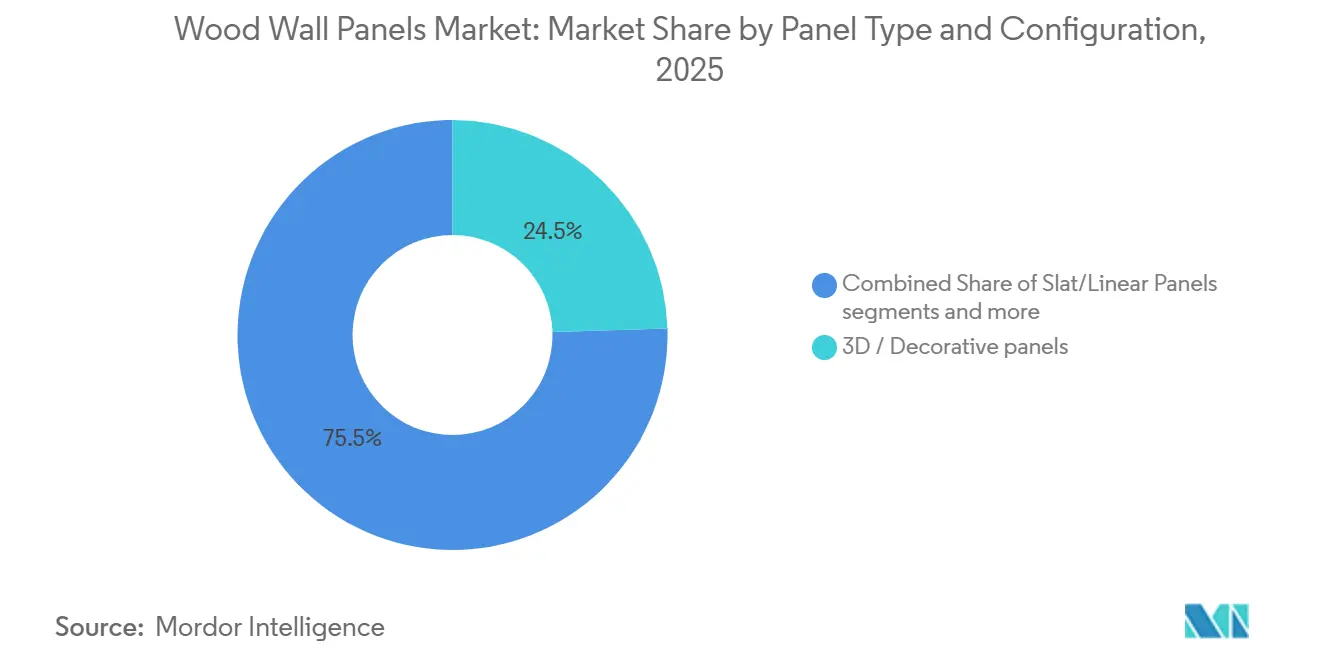
3D and decorative panels held 24.52% of the wood wall panels market share in 2025. Their position reflects use in residential accent walls, commercial reception areas, and hospitality feature installations. Fluted walls and cabinets increased in popularity for 2 consecutive years, according to the Composite Panel Association’s 2026 trend reporting. This has increased use beyond isolated feature walls toward wider room coverage. More coverage can increase panel area per installation. It can also raise order values for suppliers and installers.
Slat and linear panels are gaining use in commercial spaces because their modular dimensions can reduce on-site cutting. They also retain the visual character of wood while accommodating acoustic backings. Flat and flush panels remain relevant in healthcare, corporate, and institutional interiors. These settings often require continuous surfaces and clear compliance documentation. Acoustic panels are forecast to expand at a 6.24% CAGR through 2031. Their growth reflects demand for measurable sound control rather than a short-lived styling preference. Perforated and grooved systems continue to address studios and auditoriums, but their volume remains constrained by narrow applications.



By Wood Type and Material: Engineered Formats Anchor Volume, Reclaimed Accelerates on ESG
Engineered wood held 45.14% of the wood wall panels market share in 2025. MDF-core veneered panels, laminated decorative boards, and related formats offer consistent dimensions and surfaces. These features support factory production and commercial project specifications. Engineered formats also allow manufacturers to provide documented emissions performance. Plywood remains a meaningful secondary option where wood appearance is needed at a lower cost. Solid hardwood and softwood panels retain positions in premium and artisan projects.
Reclaimed and recycled wood is forecast to expand at a 6.01% CAGR through 2031. The wood wall panels market size is supported by sustainability reporting requirements and demand for authenticated material provenance. Producers must manage grading variation, denailing, and species verification before recycled inputs can be used consistently. Those activities can increase the cost relative to virgin timber. The PEFC chain-of-custody standard includes requirements supporting EUDR due diligence systems. Bamboo composites and agricultural-fiber-core panels remain smaller alternatives. They are receiving attention in India and Southeast Asia, where local plantation resources can support non-timber materials.
By Installation Type: Prefab-Compatible Methods Gain as Labor Scarcity Bites
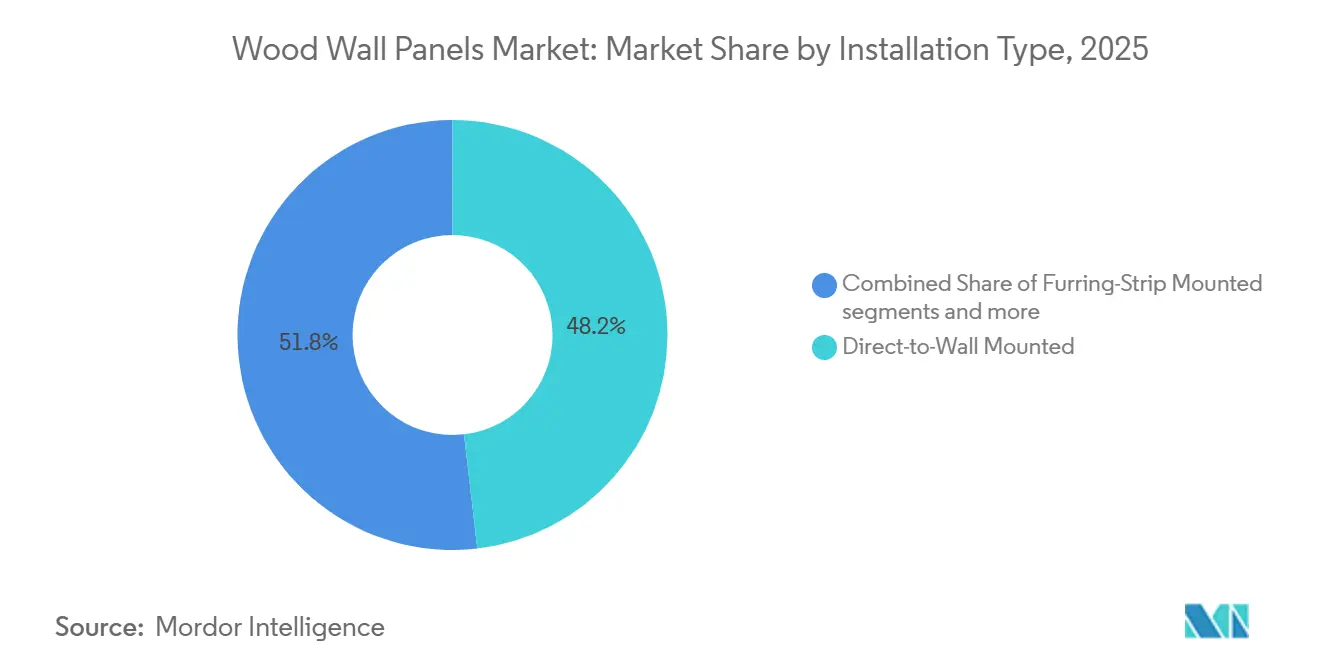
Direct-to-wall systems commanded 48.17% of global installations in 2025. Their position reflects compatibility with professional installers and experienced do-it-yourself users. Panels can adhere or fasten directly to drywall and other prepared substrates. This reduces the number of materials required at the job site. It also limits installation time where wall conditions are suitable. Furring-strip systems remain important where existing walls are uneven or a service void is required.
Interlocking systems are forecast to expand at a 5.54% CAGR through 2031. Edge profiles allow panels to join with minimal visible fasteners and less adhesive. This can reduce the labor premium that previously separated wood panels from vinyl or PVC alternatives. Clip-in and rail systems also appeal to commercial users who need replaceable panels. These systems offer maintenance access and can support future interior changes. The wood wall panels market benefits from installation systems designed for quicker retrofit projects. Manufacturing precision is increasingly important because panel profiles require consistent tolerances.
By End User: Residential Volume, Commercial Value Premium Drive Parallel Growth
Residential applications held 52.23% of revenue in 2025. Renovation in North America and Europe supports this position, alongside new residential construction in the Asia-Pacific. Accent wall use has become a more routine specification in apartments and home renovation projects. Developers can use upgraded interior finishes to differentiate units where affordability is constrained. Aging-in-place renovations also create opportunities for wider surface refreshes. The National Association of Home Builders reported that 56% of U.S. remodelers completed aging-in-place work.
Commercial applications are forecast to expand at a 5.83% CAGR through 2031. Their wood wall panels market size is supported by requirements for acoustic performance, indoor air quality, and chain-of-custody documentation. Hospitality projects place particular value on distinctive interior finishes. Healthcare and education also generate specification demand in North America. Commercial buyers typically require more technical data before approving products. These requirements can favor established suppliers with tested systems. They can also make commercial demand more resilient for certified panel producers.
By Distribution Channel: Specification Channels Outpace Retail in Value Creation
B2C channels accounted for 65.42% of revenue in 2025. Retailers, specialty stores, and online platforms have made decorative panels more accessible to homeowners. Online channels are helping buyers compare finishes and configurations without visiting a showroom. Product configurators can support self-directed selection for smaller residential projects. This model is well-suited to accent walls and other limited-scope installations. Physical retail remains relevant where customers want to inspect materials before buying.
B2B channels are forecast to expand at a 5.48% CAGR through 2031. Contractors, architects, designers, and institutional procurement teams typically purchase larger systems for commercial projects. The wood wall panels market share of B2B channels is shaped by higher average project value and demand for certified acoustic or recycled-content products. Architects can select panels during the building information modeling and specification stages. Approved distributors then serve contractors with the required systems. Wolf-Gordon acquired Andor Willow in June 2026, adding a ready-to-install wood panel producer with e-commerce capability. This move connected digital sales capabilities with architectural specification channels.
Geography Analysis
Europe held 32.21% of the global wood wall panels market share in 2025. The region benefits from established timber interior traditions, renovation activity, and certified forestry resources. The European Panel Federation reported that apparent consumption of wood-based panels in member countries rose 3% to 60,900,000 m³ in 2025. This occurred despite weak new-build construction, high interest rates, and cautious consumer spending. Renovation and commercial fit-out activity helped support demand during that period.
Germany, Poland, the United Kingdom, and the Nordic countries remain active commercial specification markets. The European Union’s deforestation and formaldehyde requirements favor producers with well-developed compliance systems. Regulation 2023/1464 took effect on August 6, 2026, setting a 0.062 mg/m³ formaldehyde limit for covered wood-based articles. South America provides a secondary production base through Chile and Brazil. Domestic consumption remains constrained by affordability and distribution gaps across parts of the region.
Asia-Pacific is forecast to expand at a 6.13% CAGR through 2031. India and Southeast Asia are supported by housing development, urbanization, and hospitality construction. Japan and South Korea remain mature markets for customized veneer systems and premium acoustic products. China is the region’s largest wood-based panel producer, although weaker construction activity has moderated domestic demand since 2024. North America remains a major wood wall panels market area because renovation and commercial fit-outs provide complementary demand. The Middle East and Africa is developing as an import market, supported by Saudi Arabian projects and hospitality expansion in the United Arab Emirates.

Competitive Landscape
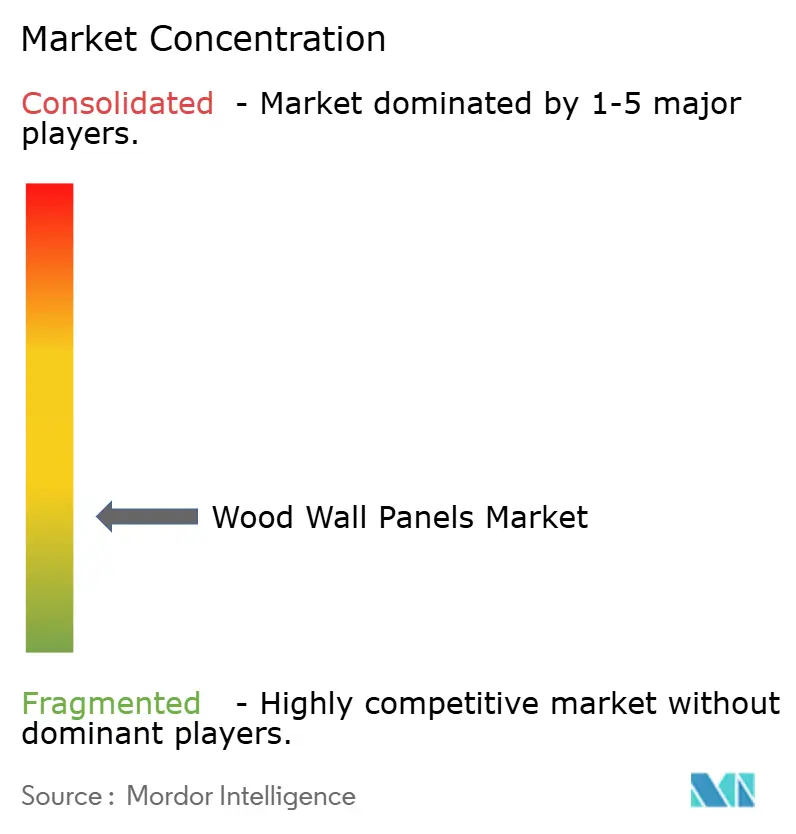
The wood wall panels market is fragmented. Large integrated producers include Arauco, EGGER Group, Kronospan, Swiss Krono Group, and Sonae Arauco. Their scale is based on wood sourcing, continuous-press production, and certification systems. These capabilities matter as emissions, traceability, and recycled-fiber requirements expand. EGGER reported fiscal 2025/26 revenue of EUR 4.13 billion and investment of EUR 542.2 million. The company’s investment program shows the capital requirements of maintaining production and compliance capabilities.
Regional suppliers such as Pfleiderer, Finsa, Kastamonu Entegre, and Investwood compete through product range and delivery performance. They face recurring spending requirements for formaldehyde reformulation and wood traceability. Stora Enso and Koskisen expanded their Zero product family in January 2026. The range uses NeoLigno, a lignin-derived binder that eliminates added formaldehyde. This initiative addresses demand for products with lower emissions and bio-based inputs. Kronospan completed its acquisition of the ZG Timber Sebeș sawmill in November 2025, adding raw-material control to its Romanian operations.
Acoustic and architectural panel specialists compete through tested performance data and established design relationships. Armstrong World Industries, Hunter Douglas Architectural, and BAUX Sweden hold premium positions in this area. Their products are difficult to replace on price alone when projects require published acoustic or fire performance. Smaller brands, including Andor Willow and Naturepanel, use online configuration and made-to-order production. This can reduce inventory risk while meeting individualized design requirements. The wood wall panels market has an opening for products that combine recycled content, acoustic testing, and traceable sourcing.
Wood Wall Panels Industry Leaders
EGGER Group
Kronospan
Arauco
Swiss Krono Group
West Fraser Timber Co. Ltd.
- *Disclaimer: Major Players sorted in no particular order

Recent Industry Developments
- June 2026: Wolf-Gordon acquired Andor Willow, a digitally native producer of architectural wood wall panels, acoustical slat wall systems, and room dividers. The acquisition expanded Wolf-Gordon's portfolio into natural wood surfaces and added an established e-commerce platform and direct-to-consumer sales channel, positioning the combined entity across both B2C and commercial specification segments.
- November 2025: Kronospan completed the acquisition of ZG Timber's Sebeș sawmill in Romania, formerly part of the Ziegler Group, preserving more than 500 jobs and integrating sawn timber production into Kronospan's existing Sebeș MDF, particleboard, and melamine board operations. The move expands Kronospan's Romanian product range and raw-material control, reinforcing its vertical integration in a cost-sensitive supply environment.


Global Wood Wall Panels Market Report Scope
| 3D / Decorative Panels |
| Slat/Linear Panels |
| Acoustic Wood Panels |
| Flat / Flush Wood Panels |
| Other Specialty Panels |
| Hardwood |
| Softwood |
| Engineered Wood |
| Plywood |
| Reclaimed / Recycled Wood |
| Others |
| Direct-to-Wall Mounted |
| Furring-Strip Mounted |
| Clip-In and Rail-Based |
| Interlocking |
| Others |
| Residential |
| Commercial |
| B2C Channels | Hypermarkets and Supermarkets |
| Specialty Stores | |
| Home Improvement Stores/DIY Chains | |
| Online | |
| Local Hardware Shops | |
| Other Distribution Channels | |
| B2B Channels (Contractors and Installers, Interior Designers and Architects, Project Procurement and Institutional Sales) |
| North America | Canada |
| United States | |
| Mexico | |
| South America | Brazil |
| Peru | |
| Chile | |
| Argentina | |
| Rest of South America | |
| Europe | United Kingdom |
| Germany | |
| France | |
| Spain | |
| Italy | |
| BENELUX (Belgium, Netherlands, Luxembourg) | |
| NORDICS (Denmark, Finland, Iceland, Norway, Sweden) | |
| Rest of Europe | |
| Asia-Pacific | India |
| China | |
| Japan | |
| Australia | |
| South Korea | |
| South-East Asia | |
| Rest of Asia-Pacific | |
| Middle East and Africa | United Arab Emirates |
| Saudi Arabia | |
| South Africa | |
| Nigeria | |
| Rest of Middle East and Africa |
| By Panel Type and Configuration | 3D / Decorative Panels | |
| Slat/Linear Panels | ||
| Acoustic Wood Panels | ||
| Flat / Flush Wood Panels | ||
| Other Specialty Panels | ||
| By Wood Type and Material | Hardwood | |
| Softwood | ||
| Engineered Wood | ||
| Plywood | ||
| Reclaimed / Recycled Wood | ||
| Others | ||
| By Installation Type | Direct-to-Wall Mounted | |
| Furring-Strip Mounted | ||
| Clip-In and Rail-Based | ||
| Interlocking | ||
| Others | ||
| By End User | Residential | |
| Commercial | ||
| By Distribution Channel | B2C Channels | Hypermarkets and Supermarkets |
| Specialty Stores | ||
| Home Improvement Stores/DIY Chains | ||
| Online | ||
| Local Hardware Shops | ||
| Other Distribution Channels | ||
| B2B Channels (Contractors and Installers, Interior Designers and Architects, Project Procurement and Institutional Sales) | ||
| By Geography | North America | Canada |
| United States | ||
| Mexico | ||
| South America | Brazil | |
| Peru | ||
| Chile | ||
| Argentina | ||
| Rest of South America | ||
| Europe | United Kingdom | |
| Germany | ||
| France | ||
| Spain | ||
| Italy | ||
| BENELUX (Belgium, Netherlands, Luxembourg) | ||
| NORDICS (Denmark, Finland, Iceland, Norway, Sweden) | ||
| Rest of Europe | ||
| Asia-Pacific | India | |
| China | ||
| Japan | ||
| Australia | ||
| South Korea | ||
| South-East Asia | ||
| Rest of Asia-Pacific | ||
| Middle East and Africa | United Arab Emirates | |
| Saudi Arabia | ||
| South Africa | ||
| Nigeria | ||
| Rest of Middle East and Africa | ||


Key Questions Answered in the Report
What is driving demand for wood wall panels through 2031?
Renovation of older homes, commercial fit-outs, and demand for acoustic and certified products are supporting expansion at a 4.66% CAGR through 2031.
Which panel format is growing fastest?
Acoustic wood panels are forecast to expand at a 6.24% CAGR through 2031, supported by commercial acoustic and interior performance requirements.
Why is engineered wood widely used for interior wall panels?
Engineered wood held 45.14% of revenue in 2025 because it offers consistent dimensions, surface quality, and compatibility with prefabricated systems.
Which end-user group is growing fastest?
Commercial applications are forecast to expand at a 5.83% CAGR through 2031, supported by acoustic, fire, air-quality, and sourcing documentation requirements.
How are sourcing regulations affecting panel suppliers?
EUDR traceability requirements and the European Union’s formaldehyde limits increase the importance of documented sourcing and low-emission product systems.
Page last updated on:


 Your data is secure and never sold or shared.


