
Milling Machines Market Size and Share
Market Overview
| Study Period | 2020 - 2031 |
|---|---|
| Market Size (2026) | USD 15.59 Billion |
| Market Size (2031) | USD 19.39 Billion |
| Growth Rate (2026 - 2031) | 4.50 % |
| Fastest Growing Market | Asia-Pacific |
| Largest Market | Asia-Pacific |
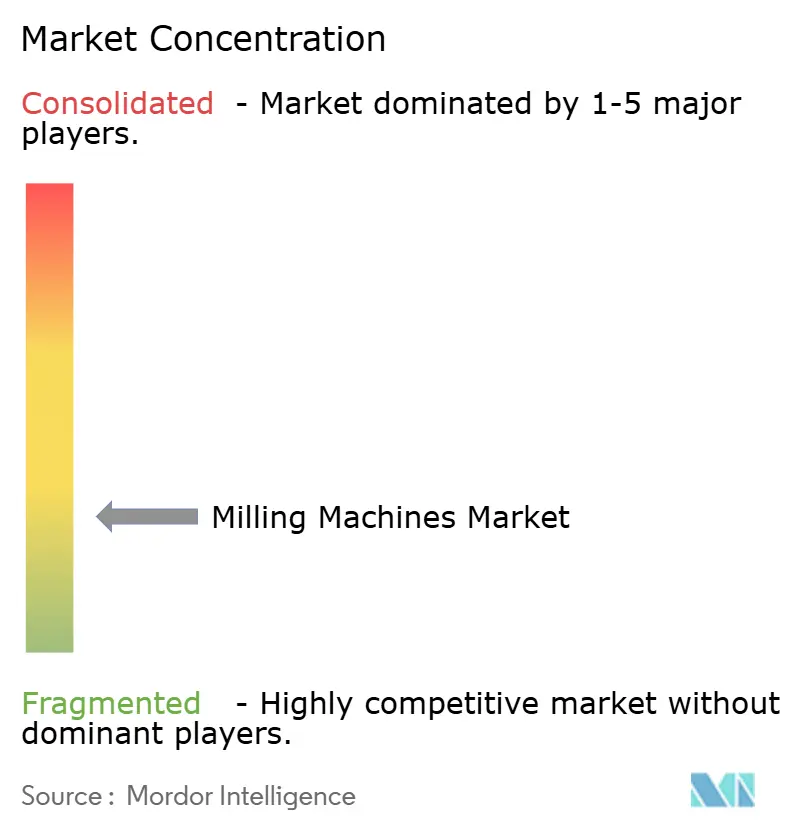
| Market Concentration | Low |
Major Players *Disclaimer: Major Players sorted in no particular order Image © Mordor Intelligence. Reuse requires attribution under CC BY 4.0. | |
Milling Machines Market Analysis by Mordor Intelligence
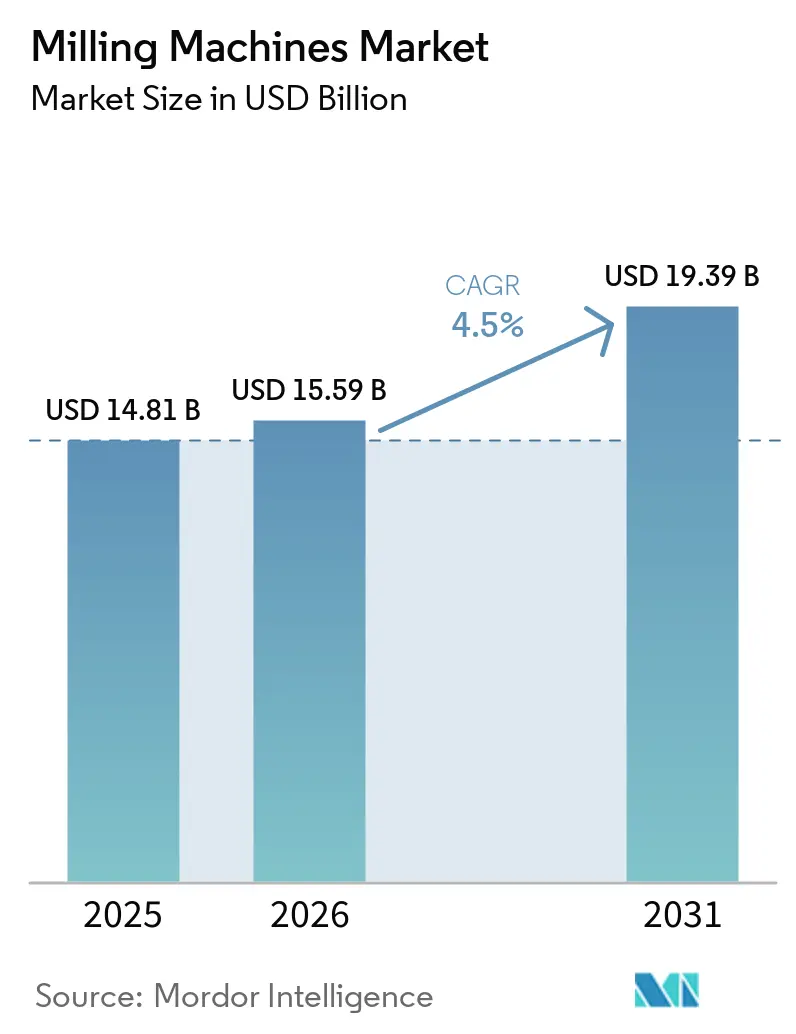
The Milling Machines Market size was valued at USD 14.81 billion in 2025 and is estimated to grow from USD 15.59 billion in 2026 to reach USD 19.39 billion by 2031, at a CAGR of 4.5% during the forecast period (2026-2031).
Demand for milling machines is being driven by investment in precision manufacturing capacity, replacement of aging manual and conventional equipment, and the adoption of CNC and automated machining systems. Manufacturers are upgrading equipment to improve accuracy, productivity, repeatability, and their ability to produce increasingly complex components. New factories across North America, Europe, and Asia-Pacific are also being designed with greater automation, favoring CNC machines that can operate within integrated production cells and support automated material handling. Demand from aerospace, defense, automotive, medical, semiconductor, and electrification applications is further supported by the need for tighter tolerances and more complex geometries. At the same time, high equipment costs, tariffs, material prices, financing conditions, and shortages of skilled machining personnel can delay capital expenditure. As a result, the milling machines market is expected to grow steadily, with modernization, replacement, and automation remaining key sources of demand.
Key Report Takeaways
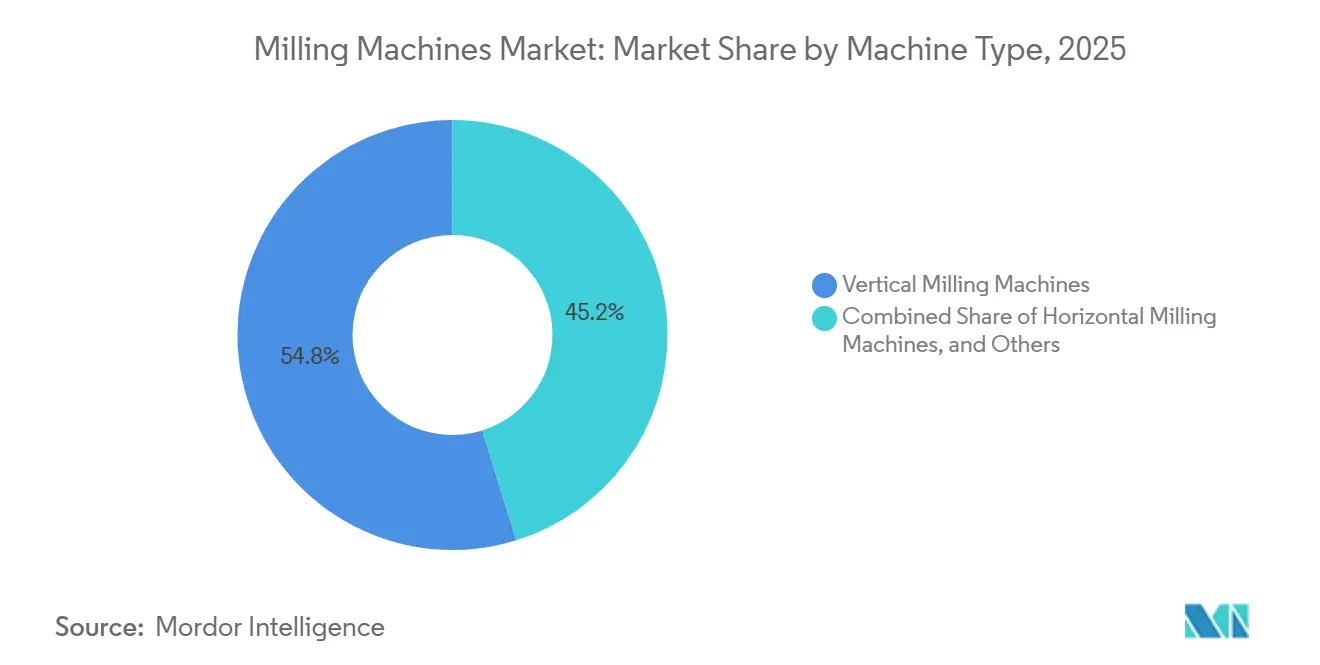
- By machine type, vertical machines accounted for 54.8% of the milling machines market share in 2025, while horizontal machines recorded the fastest growth outlook of 5.61% CAGR through 2031.
- By axis type, 3-axis machines accounted for 48.2% of the milling machines market share in 2025, while 5-axis and more machines recorded the fastest growth outlook of 6.41% CAGR through 2031.
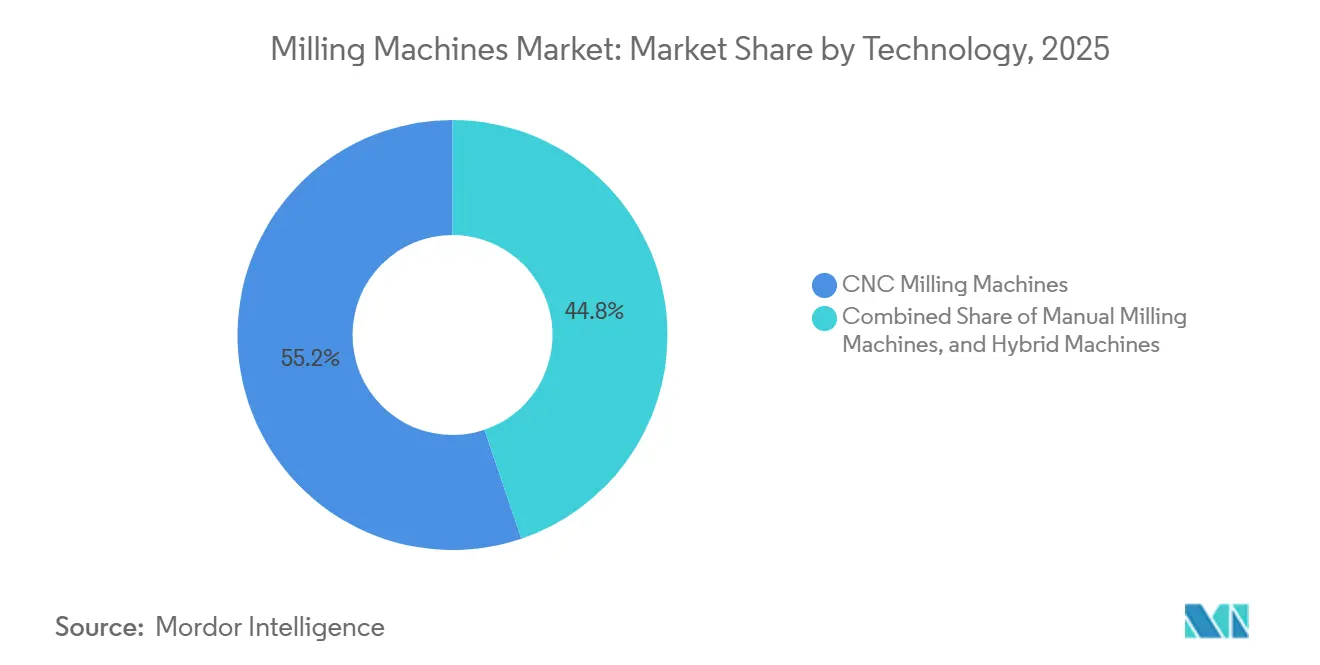
- By technology, CNC machines accounted for 55.2% of the milling machines market size in 2025 and also recorded the fastest growth outlook of 6.12% through 2031.
- By end-user industry, automotive and transportation represented 34.8% of the milling machines market size in 2025, while aerospace and defense recorded the fastest growth outlook of 6.3% through 2031.
- By geography, Asia-Pacific accounted for 38.10% of the milling machines market size in 2025 and also recorded the fastest growth outlook of 6.8% through 2031.
Note: Market size and forecast figures in this report are generated using Mordor Intelligence’s proprietary estimation framework, updated with the latest available data and insights as of January 2026.
Global Milling Machines Market Trends and Insights
Drivers Impact Analysis*
| Driver | (~) % Impact on CAGR Forecast | Geographic Relevance | Impact Timeline |
|---|---|---|---|
| Investment in High-Precision Manufacturing | +1.3% | Global, with early gains in North America, Germany, Japan, and South Korea | Short term (≤ 2 years) |
| CNC Conversion of Conventional Fleets | +0.9% | Global, with large conversion pools in India, Southeast Asia, Eastern Europe, and Latin America | Medium term (2-4 years) |
| Manufacturing Reshoring and Localization | +0.7% | North America, Europe, India, and Mexico | Medium term (2-4 years) |
| Demand for Complex Multi-Surface Components | +0.5% | Global, with concentration in North American and European aerospace and medical applications in Europe and Asia-Pacific | Long term (≥ 4 years) |
| EV Powertrain and Electrification Components | +0.4% | China, South Korea, Japan, North America, and Europe | Medium term (2-4 years) |
| Automation of Machine Shops | +0.3% | North America, Europe, Japan, South Korea, India, and ASEAN | Long term (≥ 4 years) |
| Source: Mordor Intelligence | |||
Investment in High-Precision Manufacturing
Investment in precision manufacturing equipment is supporting equipment purchases across the milling machine market. The United States manufacturing technology orders totaled USD 1.6 billion in the first quarter of 2026, up 27.8% from the first quarter of 2025, according to the Association for Manufacturing Technology. Capacity utilization among metalworking machinery manufacturers rose for four consecutive months through December 2025, which supported continuing procurement activity. Makino completed its Fujiyoshida Plant in Japan in May 2026 to support demand from aerospace, die and mold, and data-center equipment manufacturing. Shops that install advanced 5-axis or multitasking equipment can compete for work with stricter quality requirements, which can support subsequent equipment purchases. This favors manufacturers able to continuously upgrade machine capability, potentially widening the productivity gap versus facilities operating legacy equipment. The resulting demand supports the milling machine market because it combines replacement purchases with new production capacity.
CNC Conversion of Conventional Fleets
Conversion from conventional milling machines to CNC equipment remains a major source of demand in the milling machines market. Older manually operated machines are still widely used in India, Southeast Asia, Eastern Europe, and Latin America, where buyers historically placed greater weight on purchase cost. Tighter tolerance requirements, more complex part designs, and wider availability of entry-level CNC controls are changing that decision. The United States Producer Price Index for metal-cutting machine tools reached 236.947 in July 2026, using June 1983 as the base of 100. Entry-level machining centers priced from USD 80,000 to USD 200,000 can now provide CNC capability that was previously associated with higher-priced platforms.[1]U.S. Bureau of Labor Statistics and Federal Reserve Bank of St. Louis, “Producer Price Index by Industry, Machine Tool Manufacturing, Metal Cutting Machine Tools,” FRED, fred.stlouisfed.org Some shops can consolidate multiple conventional machines into a higher-capability CNC machining center, depending on part mix and utilization. Growing use of automated shop equipment and demand for electrification components further support this shift toward more capable machines.
Manufacturing Reshoring and Localization
Reshoring and local production programs are expanding the customer base for the milling machines market. The CHIPS and Science Act provided USD 52.7 billion for semiconductor research, manufacturing, and workforce development, alongside a 25% investment tax credit for eligible semiconductor capital spending. The Semiconductor Industry Association reported that CHIPS Act funding was creating manufacturing jobs and supporting new domestic facilities. New plants are usually designed with automation and CNC capacity from the beginning, rather than being upgraded in stages like many older sites. This supports demand for milling centers used in semiconductor equipment, electric vehicles, clean energy systems, and advanced materials production. Mexico benefits from proximity to United States customers under the United States-Mexico-Canada Agreement, while India’s production-linked programs support local manufacturing investment. Capacity localization, therefore, creates equipment demand across more than one country and gives machine builders opportunities to serve new production sites.
Demand for Complex Multi-Surface Components
Demand for complex components is raising the need for higher-axis milling equipment in the milling machine market. Aerospace production requires turbine blades, bladed rotors, airframe structures, and landing-gear parts with curved surfaces that cannot be machined efficiently on 3-axis equipment. Medical device production also requires precise work on patient-specific implants and minimally invasive surgical instruments. FANUC introduced its 5-Axis Integrated Technology Initiative in August 2026 to improve coordination among CNC controllers, CAD/CAM post-processors, and simulation environments. Electric vehicle manufacturing is changing the type of machining required, as large battery enclosures and thin-walled motor housings require accurate aluminum machining. A 2025 scientific study described fixture design requirements for milling thin-walled housing used in new energy vehicle motors. These applications support demand for complex machines even as some conventional internal-combustion-engine work declines.
Restraints Impact Analysis*
| Restraint | (~) % Impact on CAGR Forecast | Geographic Relevance | Impact Timeline |
|---|---|---|---|
| High Initial Capital Investment | -0.9% | Global, especially India, Southeast Asia, and Latin America | Medium term (2-4 years) |
| Shortage of Skilled CNC Operators and Programmers | -0.7% | North America, Europe, Japan, India, South Korea | Long term (≥ 4 years) |
| Long Machine Payback Periods | -0.5% | Global, especially in North America and Europe | Medium term (2-4 years) |
| Cyclical Capital Equipment Demand | -0.3% | Global, especially Germany, Japan, and China | Short term (≤ 2 years) |
| Source: Mordor Intelligence | |||
High Initial Capital Investment
High purchase costs continue to limit adoption in the milling machines market, especially among small and medium-sized manufacturers. Entry-level vertical machinery requires at least USD 80,000 of upfront capital, while configured 5-axis and multitasking platforms can exceed USD 1 million before installation, tooling, and training. The Internal Revenue Service states that the Advanced Manufacturing Investment Credit can provide 25% credit for qualified investments under Section 48D. Buyers must also fund commissioning, work holding, and operator qualification, which raises the total cost of ownership. The metal-cutting machine tool price index remained elevated in July 2026, adding pressure to equipment budgets. Tax support is less useful for firms with limited taxable income, which is common in smaller businesses and developing manufacturing locations. The capital barrier will continue to favor buyers who can finance equipment, obtain incentives, or combine a purchase with automation gains.
Shortage of Skilled CNC Operators and Programmers
A shortage of qualified operators and programmers restricts the productive use of new milling capacity. The Bureau of Labor Statistics recorded 29,440 computer-controlled machine tool operators in machinery manufacturing in 2025, while United States manufacturing had 409,000 open positions in August 2025. The Manufacturing Skills Institute reported 449,000 unfilled United States manufacturing jobs in March 2025, citing a mismatch between available skills and the needs of modern production systems. The National Association of Manufacturers found that more than 44% of respondents to its first-quarter 2026 survey identified attracting and retaining talent as their primary challenge. This shortage can delay production ramp-ups after a machine is installed and makes buyers more selective about equipment choices. It also supports interest in user-friendly controls, integrated automation, and software that reduces programming effort. The restraint can therefore shift spending toward premium machines while limiting the number of smaller buyers that can operate advanced equipment effectively.
*Our forecasts treat driver/restraint impacts as directional, not additive. The impact forecasts reflect baseline growth, mix effects, and variable interactions.
Segment Analysis
By Machine Type: Vertical Machines Lead Broad-Based Demand
Vertical machines held 54.8% of the milling machines market share in 2025. Their position reflects broad use in general machining, die and mold work, and automotive component production. A smaller footprint, familiar operating approach, and established tooling base make vertical equipment a common choice for job shops, contract manufacturers, and entry-level production. Buyers can apply these machines across a wide range of parts without committing to a highly specialized layout. This flexibility helps vertical platforms remain relevant even as factories invest in more automation. The milling machines market continues to depend on this installed base because many customers need dependable general-purpose cutting capacity.
Horizontal machines recorded the fastest growth outlook of 5.61% CAGR through 2031. Aerospace producers, heavy-component machinists, and high-volume manufacturers use horizontal platforms for chip control, pallet changing, and multi-face machining without repeated repositioning. These features support longer unattended operating periods and easier integration with automated pallet storage. Gantry, bridge, and other specialized mills also benefit where aerospace and energy customers need large machining envelopes. GROB launched the GP1350 5-axis portal milling center in March 2026 with X, Y, and Z working ranges of 1,400 mm, 1,950 mm, and 1,100 mm. The product shows the demand for large-format, accurate machines where standard vertical and horizontal designs do not provide sufficient capacity.



By Axis Type: Three-Axis Machines Remain the Volume Base
3-axis machines held 48.2% of the milling machines market share in 2025. They remain widely used in general metal removal, standard consumer-goods molds, and production work with less demanding geometry. Their versatility supports use across job shops and mainstream production lines. The systems are familiar to operators and can provide an accessible route into CNC production. 4-axis machines serve a middle group of users producing indexed or cylindrical components such as impellers, engine blocks, and rotary parts. This broad role maintains 3-axis equipment as the principal volume platform in the milling machines market.
5-axis and above machines recorded the fastest growth outlook through 2031, registering a 6.41% CAGR. Aerospace, medical, and energy customers use these machines for bladed rotors, implants, impellers, and other parts that require several surfaces to be machined in one setup. Removing 3 or 4 separate setups can reduce accumulated errors, shorten cycle times, and lower work-in-process inventory. These operating benefits can justify a higher purchase price where quality requirements are strict. FANUC’s August 2026 initiative addressed alignment between controls, CAD/CAM post-processors, and simulation tools, which can make 5-axis implementation easier for users. Aerospace suppliers also face demanding certification and traceability expectations, which support the movement toward higher-axis capability.[2]FANUC Corporation, “FANUC Launches 5-Axis Integrated Technology Initiative,” Newswire Canada, newswire.ca
By Technology: CNC Machines Combine Scale and Growth
CNC milling machines accounted for 55.2% of the milling machines market size in 2025. CNC platforms also recorded the fastest growth outlook of 6.12% CAGR through 2031. Their position is supported by replacement demand, new factory construction, and conversion of conventional fleets. CNC equipment offers repeatability and digital traceability that support quality systems used in regulated and high-precision supply chains. This makes it the preferred technology for aerospace, medical, semiconductor, and increasingly automotive applications. CNC is therefore both the largest technology category and the main route through which many buyers improve process control.
Conventional and manual machines remain in use where labor costs are lower, and part complexity does not justify a CNC purchase. They are also used for training and educational purposes, but their role is narrowing as suppliers introduce more accessible CNC options. Hybrid machines combine additive and subtractive functions and are used in aerospace repair, tooling, and near-net-shape production where reduced material waste is valuable. DMG MORI expanded its hybrid and mill-turn offering through the NTX 3rd Generation series in September 2025 for aerospace, medical, energy, electric vehicle, and semiconductor applications. ISO 10791 provides a common reference for testing machining-center accuracy, reinforcing the importance of consistent performance in CNC procurement. The technology mix is moving toward machines that can combine precision, traceability, and multiple operations within fewer setups.
By End-User Industry: Automotive and Transportation Hold the Largest Share
Automotive and transportation represented 34.8% of the milling machines market size in 2025. The sector uses milling machines for powertrain parts, body-in-white tooling, transmissions, and chassis components. Electrification is changing rather than eliminating much of this machining requirement. Demand for cylinder heads, crankshafts, and valve bodies is declining with internal-combustion production, while motor housings, battery tray frames, gearbox internals, and cooling manifolds require new machining processes. Thin-walled motor housings and aluminum battery enclosures can require accurate large-format machining. Automotive remains the largest end-user group because it combines high production volumes with continuing equipment needs across traditional and electric vehicle components.
Aerospace and defense recorded the fastest growth outlook of 6.3% CAGR through 2031. Airbus and Boeing had combined commercial aircraft backlogs above 14,000 aircraft, and defense procurement remains elevated among NATO and Indo-Pacific partners. Complex aerospace parts require tight tolerances and can favor 5-axis machines, horizontal platforms, and automated cells. Industrial machinery, energy and power, electronics and semiconductors, and medical devices also provide continuing demand. Medical devices are a smaller but valuable application because patient-specific implants and surgical instruments can justify premium equipment for short production runs. Construction and mining equipment manufacturing supports demand for hydraulic and structural parts, particularly where infrastructure spending is increasing in South and Southeast Asia.
Geography Analysis
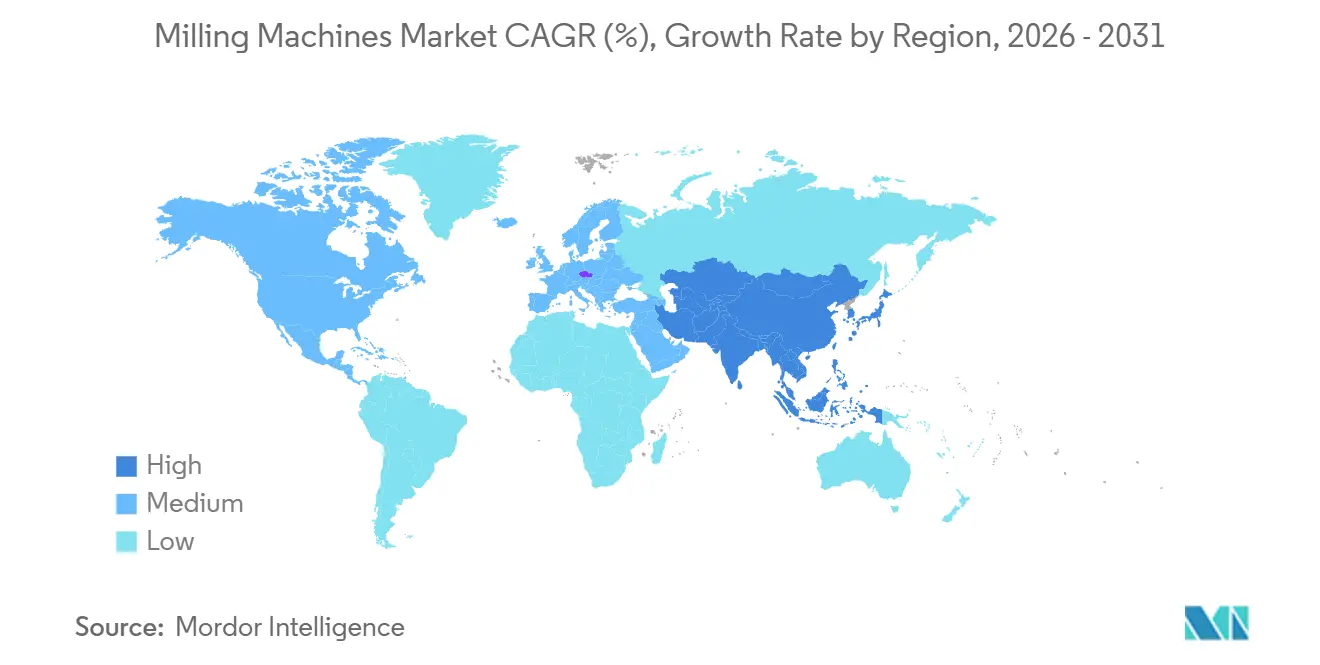
Asia-Pacific held 38.1% of the milling machines market share in 2025 and recorded the fastest regional growth outlook of 6.8% CAGR through 2031. China is the largest national market for both machine tool production and consumption, with domestic builders active in mid-tier applications and Japanese, German, and Korean suppliers competing in premium aerospace, semiconductor, and automotive work. India is developing from a major importer into a larger manufacturing location as policy programs support domestic production capacity. DN Solutions inaugurated its first overseas manufacturing facility since 2003 in Bengaluru in August 2026, with an investment of USD 72 million.[3]DN Solutions Co., Ltd., “South Korean Machine Tool Player DN Solutions Opens Its First India Plant in Bengaluru at an Investment of 600 Crore,” The Hindu, thehindu.com Southeast Asia is also upgrading equipment as electronics and precision-parts producers diversify supply chains, and Makino opened its Hung Yen Factory and Technology Center in Vietnam in December 2025.
North America is a major source of new milling machine demand because manufacturers are adding domestic capacity. CHIPS Act programs, clean-energy investment, and infrastructure-related spending support the construction of facilities that require precision equipment. The Semiconductor Industry Association reported that CHIPS Act funding was supporting new United States manufacturing facilities and related jobs. Manufacturing technology orders in the United States reached USD 1.6 billion in the first quarter of 2026, increasing 27.8% year over year. Reshored factories are more likely to install automation and CNC capacity when they open, supporting demand for advanced milling platforms. Mexico and Canada also receive investment as supply chains move closer to North American customers, with Mexico’s automotive corridors supporting demand for mid-tier machinery.
Europe has mixed conditions across the milling machines market. Automotive restructuring and energy costs have reduced investment confidence for some manufacturers, while aerospace, defense, and power-generation customers continue to order high-precision equipment. StarragTornos reported a 33.6% increase in order intake in the first half of 2026 compared with the first half of 2025, supported by aerospace and energy demand. The Middle East and Africa are receiving capacity-localization investment for defense and energy applications, especially in Saudi Arabia and the United Arab Emirates. South American demand is centered on Brazil’s automotive sector but is constrained by currency volatility, import tariffs, and less developed CNC tooling networks. These regional differences encourage suppliers to balance established European customer relationships with growth opportunities in Asia-Pacific and North America.

Competitive Landscape
The milling machines market is fragmented, as competition is strongest at the premium end, where Japanese, German, Korean, and North American equipment suppliers compete through machine performance, application expertise, control systems, and after-sales service. Yamazaki Mazak, Makino, Okuma, DMG MORI, GROB-WERKE, CHIRON, GF Machining Solutions, Hermle, and StarragTornos are among the established suppliers serving demanding applications. DN Solutions and Hyundai WIA compete in the mid-premium category with CNC capability suited to mid-volume manufacturers. Chinese suppliers are increasingly competing in price-sensitive mid-tier applications, particularly where machining specifications are relatively standardized. This differentiation may place greater price pressure on mid-range suppliers, while premium suppliers can differentiate through application engineering, machine performance, and service. Competition, therefore, centers on both equipment cost and the ability to help customers deliver reliable output.
Automation is a central competitive strategy because small and medium-sized buyers need to improve output without adding comparable numbers of skilled operators. GROB introduced the GRC-M60 modular robot cell in March 2026 for automated series production. CHIRON expanded its SmartLine portfolio in August 2026 with a module for production-order management and automation solutions for smaller batches. Okuma launched the MULTUS U1000 and U2000 5-axis multitasking machines in April 2026, followed by the GENOS M4000H-e horizontal machining center in May 2026. These moves show how established suppliers are serving customers who need automation-ready production without relying only on large, fully customized cells.
Digital tools are becoming more important to product positioning in the milling machines market. Makino’s a630iT 5-axis horizontal machining center illustrates the use of proprietary control software to make advanced machining more manageable for users. FANUC’s 5-axis initiative also addresses the integration of controls, programming, and simulation, which can reduce implementation difficulty. Suppliers are pairing physical equipment with digital simulation, adaptive machining functions, and software-enabled services. These capabilities can help customers manage limited operator availability and improve repeatability.
Milling Machines Industry Leaders
Yamazaki Mazak Corporation
DMG MORI
Okuma Corporation
Makino Milling Machine
Haas Automation, Inc.
- *Disclaimer: Major Players sorted in no particular order

Recent Industry Developments
- August 2026: DN Solutions inaugurated its first overseas manufacturing facility since 2003 in Bengaluru, India, with an investment of USD 72 million. The 25-acre facility in the ITIR Industrial Area combines manufacturing, R&D, a technical center, and after-sales services, initially producing the SVM vertical machining center series, with five-axis machine production planned for later phases. The investment marks a significant strategic pivot toward local manufacturing for the Indian market. It lowers the total cost of ownership for Indian buyers through domestic supply-chain development, targeting 80% localization by parts count.
- August 2026: FANUC Corporation launched its 5-Axis Integrated Technology Initiative, a program targeting alignment between CNC machine controllers, CAD/CAM post-processors, and simulation environments to improve part quality, production speed, and repeatability in complex-component machining. The initiative provides guidelines for machine setup optimization. It is structured as an industry-wide standard rather than a proprietary tool, positioning FANUC's CNC platform as a reference architecture for 5-axis ecosystem integration.
- May 2026: Makino Milling Machine completed its new Fujiyoshida Plant, the company’s third production base in Japan, designed to reduce lead times for large horizontal machining centers and 5-axis machining centers. The plant uses a modular production flow and includes automated warehousing for logistics efficiency.
- April 2026: Okuma introduced the MULTUS U1000 and U2000 5-axis simultaneous multitasking machines with standard 80-tool magazines and an 8.2 m² footprint for constrained production environments.


Global Milling Machines Market Report Scope
The Milling Machines Market Report is Segmented by Machine Type (Vertical, Horizontal, and Others), by Axis Type (3-Axis, 4-Axis, and 5-Axis and More), by Technology (CNC Milling Machines, Hybrid Machines, and More), by End-User (Automotive & Transportation, Industrial Machinery, and More), and by Geography (Asia-Pacific, Europe, and More). The Report Offers Market Size and Forecasts in Value (USD) for all the Above Segments.
| Vertical Milling Machines |
| Horizontal Milling Machines |
| Others (Gantry mills, etc.) |
| 3-Axis Machine |
| 4-Axis Machine |
| 5-Axis and More |
| Conventional / Manual Milling Machines |
| CNC Milling Machines |
| Hybrid Machines |
| Automotive & Transportation |
| Aerospace & Defense |
| Industrial Machinery |
| Energy & Power |
| Medical Devices |
| Electronics & Semiconductor |
| Construction & Mining Equipment |
| General Manufacturing |
| Others |
| North America | United States |
| Canada | |
| Mexico | |
| South America | Brazil |
| Rest of South America | |
| Europe | Germany |
| Italy | |
| United Kingdom | |
| France | |
| Spain | |
| Switzerland | |
| BENELUX (Belgium, Netherlands, and Luxembourg) | |
| NORDICS (Denmark, Finland, Iceland, Norway, and Sweden) | |
| Rest of Europe | |
| Asia-Pacific | China |
| India | |
| Japan | |
| South Korea | |
| Taiwan | |
| ASEAN (Indonesia, Thailand, Philippines, Malaysia, Vietnam) | |
| Rest of Asia-Pacific | |
| Middle East and Africa | Saudi Arabia |
| United Arab Emirates | |
| South Africa | |
| Rest of Middle East and Africa |
| By Machine Type | Vertical Milling Machines | |
| Horizontal Milling Machines | ||
| Others (Gantry mills, etc.) | ||
| By Axis Type | 3-Axis Machine | |
| 4-Axis Machine | ||
| 5-Axis and More | ||
| By Technology | Conventional / Manual Milling Machines | |
| CNC Milling Machines | ||
| Hybrid Machines | ||
| By End-User Industry | Automotive & Transportation | |
| Aerospace & Defense | ||
| Industrial Machinery | ||
| Energy & Power | ||
| Medical Devices | ||
| Electronics & Semiconductor | ||
| Construction & Mining Equipment | ||
| General Manufacturing | ||
| Others | ||
| By Geography | North America | United States |
| Canada | ||
| Mexico | ||
| South America | Brazil | |
| Rest of South America | ||
| Europe | Germany | |
| Italy | ||
| United Kingdom | ||
| France | ||
| Spain | ||
| Switzerland | ||
| BENELUX (Belgium, Netherlands, and Luxembourg) | ||
| NORDICS (Denmark, Finland, Iceland, Norway, and Sweden) | ||
| Rest of Europe | ||
| Asia-Pacific | China | |
| India | ||
| Japan | ||
| South Korea | ||
| Taiwan | ||
| ASEAN (Indonesia, Thailand, Philippines, Malaysia, Vietnam) | ||
| Rest of Asia-Pacific | ||
| Middle East and Africa | Saudi Arabia | |
| United Arab Emirates | ||
| South Africa | ||
| Rest of Middle East and Africa | ||


Key Questions Answered in the Report
What is the projected size of the milling machines market by 2031?
The milling machines market is forecast to reach USD 19.39 billion by 2031, growing at a 4.5% CAGR from 2026-2031.
Which machine type held the largest share in 2025?
Vertical machines led with 54.8% share in 2025, supported by their use in general machining, molds, and automotive production.
Which technology is growing fastest?
CNC machines recorded the fastest growth outlook through 2031 and held 55.2% share in 2025.
Why are 5-axis milling machines gaining use?
Aerospace, medical, energy, and electric vehicle applications need complex components that can be machined in fewer setups on 5-axis platforms.
Which region is expected to grow fastest through 2031?
Asia-Pacific recorded the fastest regional growth outlook, registering a 6.8% CAGR from 2026-2031.
What limits the adoption of advanced milling equipment?
High upfront costs, long payback periods, cyclical capital spending, and a shortage of skilled CNC operators can delay purchases.
Page last updated on:


 Your data is secure and never sold or shared.


