
Military Simulation and Training Market Size and Share
Market Overview
| Study Period | 2020 - 2031 |
|---|---|
| Market Size (2026) | USD 14.29 Billion |
| Market Size (2031) | USD 18.17 Billion |
| Growth Rate (2026 - 2031) | 4.93 % |
| Fastest Growing Market | North America |
| Largest Market | North America |
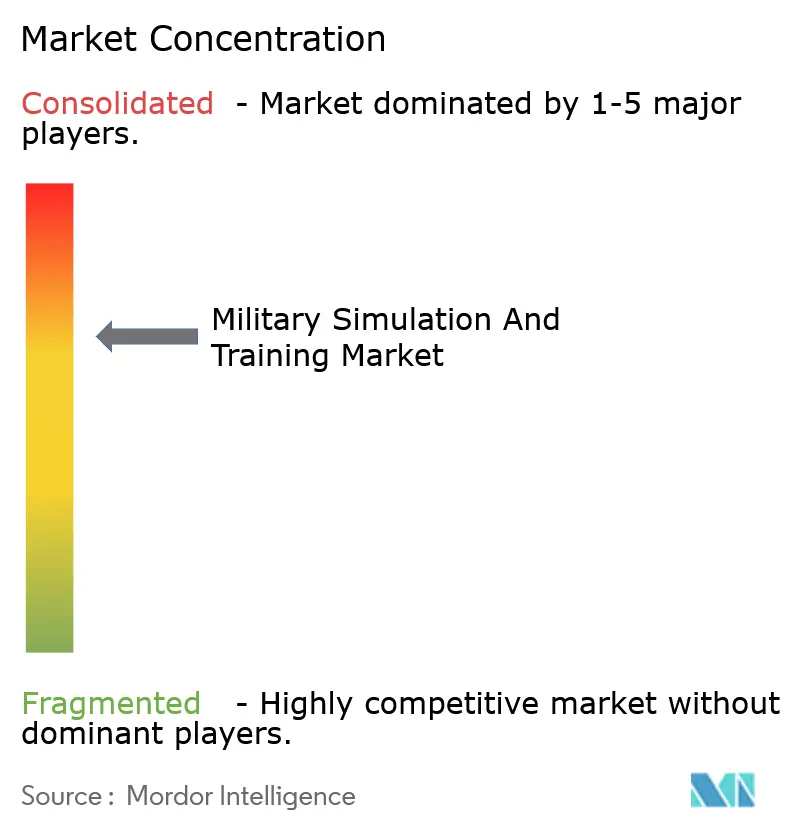
| Market Concentration | Medium |
Major Players *Disclaimer: Major Players sorted in no particular order Image © Mordor Intelligence. Reuse requires attribution under CC BY 4.0. | |
Military Simulation and Training Market Analysis by Mordor Intelligence
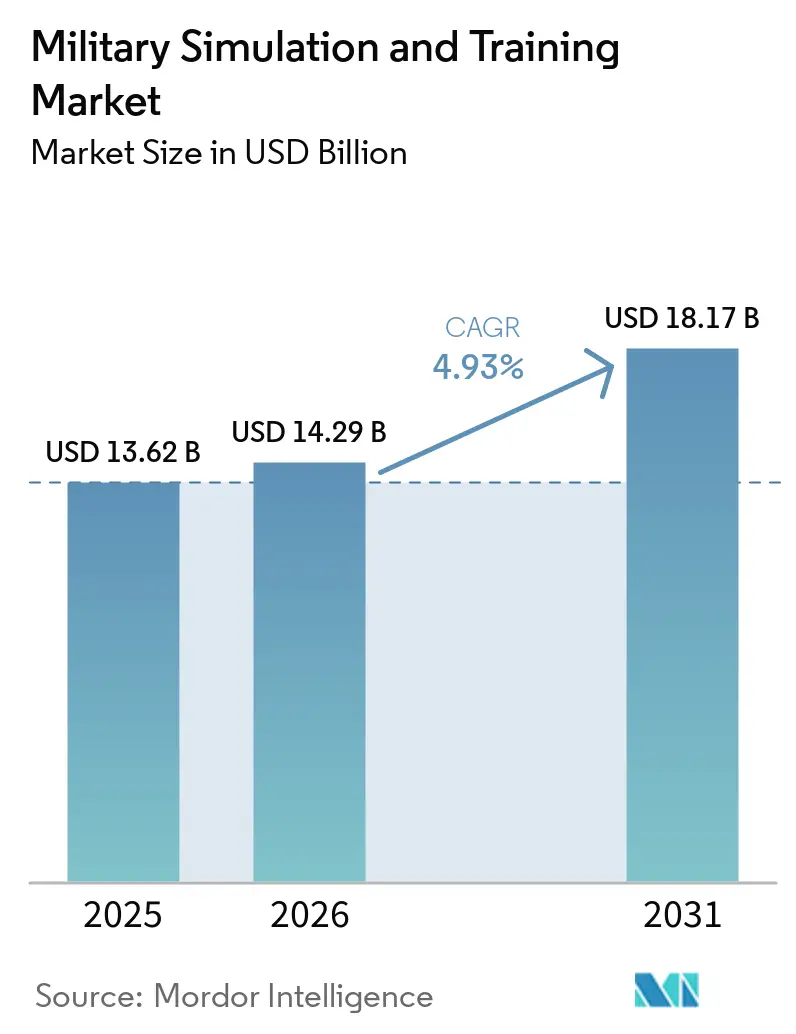
The Military Simulation And Training Market size was valued at USD 13.62 billion in 2025 and estimated to grow from USD 14.29 billion in 2026 to reach USD 18.17 billion by 2031, at a CAGR of 4.93% during the forecast period (2026-2031).
The continued growth in global defense spending combined with the increased need for skilled forces to successfully navigate and operate various new combat vehicles is expected to propel the growth of the military simulators and training market during the forecast period.
The growth in demand for military vehicles across the land, sea, and aerial platforms is the primary driver of the market growth. Several countries are modernizing their military fleet by inducting newer generation vehicle platforms, generating a simultaneous demand for simulation-based training for the military personnel on these platforms, thereby propelling the market prospects of the affiliate military simulators.
The training of pilots and military personnel in real aircraft, land vehicles, and ships involves multiple risks and sometimes may lead to hazardous situations and fatalities. Simulators provide a realistic experience and safety training for beginners. This need for safe and efficient training is also driving the simulator market.
Product development in the simulators market is lengthy, as it takes a significant amount of time to develop a replica of any aircraft tested. They also need to comply with safety and regulatory management issues, making it a challenge to deliver the required simulators on time.
Note: Market size and forecast figures in this report are generated using Mordor Intelligence’s proprietary estimation framework, updated with the latest available data and insights as of 2026.
Global Military Simulation and Training Market Trends and Insights
Aerial Segment is Expected to Experience the Highest Growth During the Forecast Period
The increasing adoption of newer aircraft that incorporate complex technologies in the military may require pilots to familiarize themselves with the latest equipment and systems. The growing adoption of advanced aircraft is also driving demand for military aerospace simulation and training solutions, enabling pilots and aircrews to develop operational skills in realistic and controlled environments. In such situations, providing hands-on experience may be difficult due to high-cost involvement. In such cases, the simulators act as the preferred option.
For instance, the operating cost of the USAF's F-35A is estimated to be about USD 44,000 per flight hour. In this regard, the F-35 pilots are first trained on simulators instead of the actual aircraft, which helps in cost-cutting. Pilots are typically trained for about 30 hours on the F-35 full-mission simulators before getting airborne on their first sortie in the F-35.
Lockheed Martin Corporation is also planning to connect full-mission simulators in the US and the UK through a software upgrade, allowing the Air Force pilots in these countries to virtually train with one another across international borders. Furthermore, the US Air Force (USAF) aims to deploy and connect more full-mission simulators in the years to come. Such initiatives also help the militaries increase interoperability without conducting joint military exercises on actual aircraft.
With the interest of the defense departments of major countries in utilizing flight simulator training, the demand for simulators that cater to the needs of aircraft and military pilot training is skyrocketing. As a result, new purchases and product innovations to supply the most advanced military aircraft training activities have been taking place in the market.
Similarly, in August 2022, Northrop Grumman Corporation & Terma A/S signed an MoU to collaborate on electronic warfare simulation & training opportunities in Northern Europe. Fourth & 5th generation aircraft will likely receive realistic air combat training due to the company’s simulation & training capabilities.


North America Held the Largest Market Share
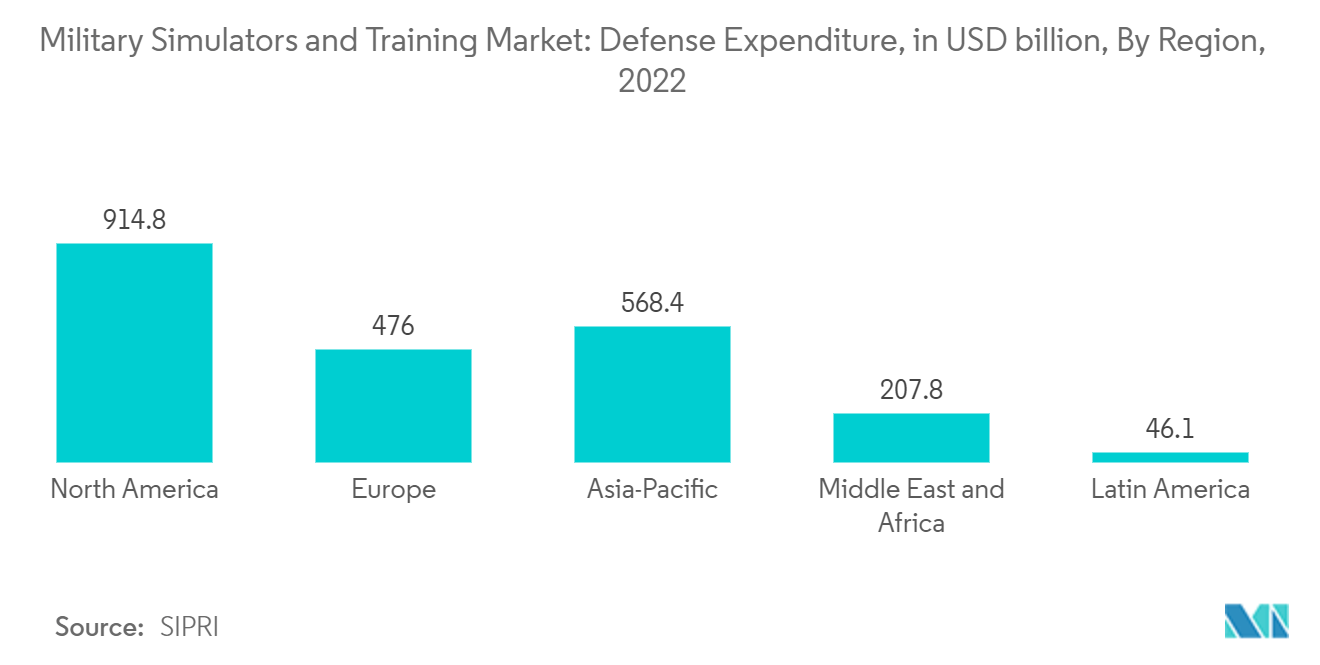
In 2022, the US defense expenditure accounted for USD 877 billion, wherein a major share was invested towards the procurement of several newer generation military vehicles across all platforms amidst the ongoing race for technological superiority. Simultaneously, the country is investing in the development and procurement of related simulator solutions, which is expected to drive market growth in the region. Although the US Air Force has been procuring simulators on a large scale for several years, the US Navy is investing heavily in simulation to improve its navigation training, and it budgeted for new integrated bridge simulators to fill the capacity gaps.
The efforts to increase ship simulator capacity are further supported by constructing new buildings in San Diego and Norfolk to house multiple simulation facilities. The Royal Canadian Air Force plans to combine two training programs under a single, multibillion-dollar project, the Future Aircrew Training Program (FAcT), where the number of pilots trained annually will likely increase.
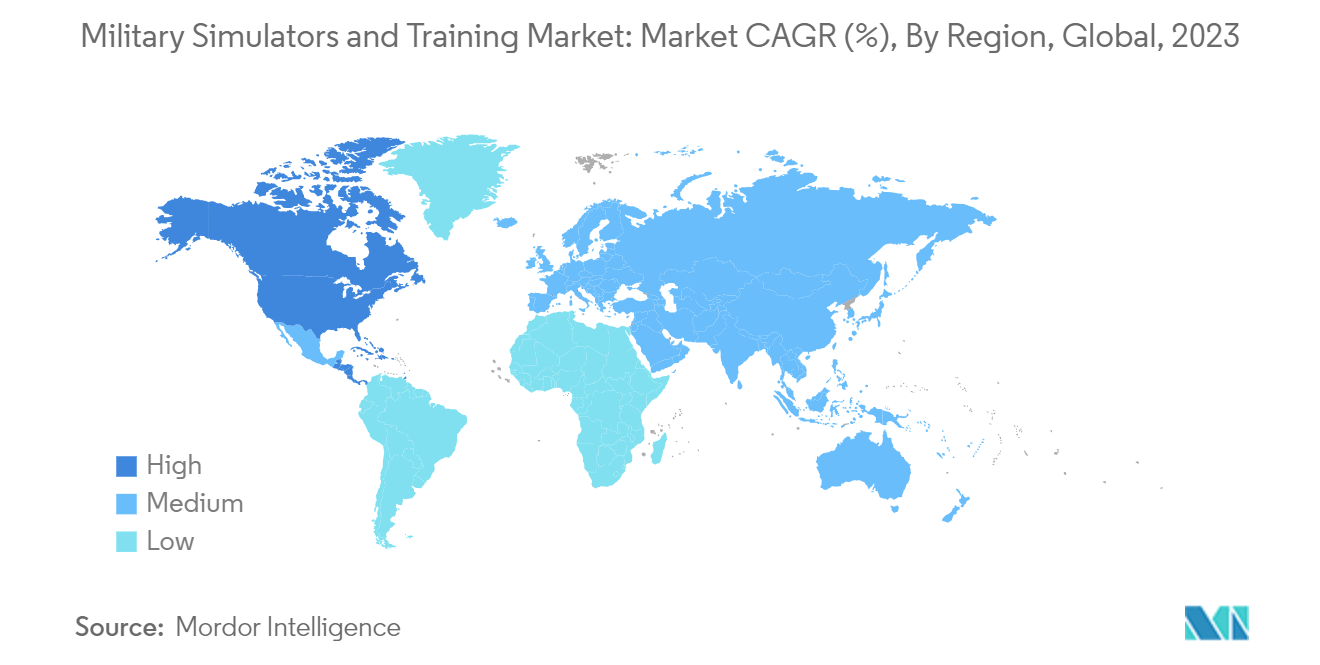
Furthermore, the government of Canada, with plans to implement fire training simulators for military uses, offered to stand VirTra, Inc. in December 2021. As per the offer, the company was expected to supply advanced military training simulators to the country's land, marine, and air force divisions of the military. Such developments are expected to drive the growth of the market in the North American region during the forecast period.

Competitive Landscape
The military simulation and training market is semi-consolidated and dominated by players such as Collins Aerospace (RTX Corporation), CAE Inc., Rheinmetall AG, FlightSafety International Inc., and THALES. Simulator manufacturers are required to build a brand and reach out to geographical extremes to get customers. Manufacturers may have the first-mover advantage if they can attract customers for the simulators for new vehicle platforms, as simulators tend to be reconfigured or upgraded to support newer variants, providing the players with continuous revenue inflow.
Mergers and acquisitions are expected to help the players by increasing their addressable market. For instance, in March 2021, CAE Inc. announced the acquisition of L3Harris Technologies' Military Training business for USD 1.05 billion. Such acquisitions are expected to help the companies expand their market presence and their revenue share in the market during the forecast period. In the coming future, growing demand from end-users is expected to create some intense competitive rivalry where the companies offering the best products for a limited budget, along with other affiliate services, will reap the most benefits.
Military Simulation and Training Industry Leaders
Rheinmetall AG
CAE Inc.
THALES
FlightSafety International Inc.
Collins Aerospace (RTX Corporation)
- *Disclaimer: Major Players sorted in no particular order

Market Opportunities and Future Outlook
Long-duration, service-led collective training programs are taking clearer shape, with requirements that extend beyond one-off device delivery. These programs integrate live, virtual, and constructive environments and rely on persistent digital tooling, ongoing content updates, and analytics rather than a single equipment rollout. In the United Kingdom, the Army Collective Training Service (ACTS) has been structured as a 15-year arrangement under the Omnia Training consortium, which favors suppliers that can deliver end-to-end collective training digitalization and sustainment at scale.
In the United States, demand signals are also pointing toward modular, interoperable training software and data-driven architectures, supported by initiatives such as the US Army CPE ST3 Army Training Verse Innovation Prize Challenge (Digital Enterprise Engineering Environment, DE3) and a stated movement toward a marketplace approach that supports multi-vendor capability increments. Platform-specific modernization adds another channel for demand, as advanced aircraft and armored fleets generate new simulator content, image generation, and networked training requirements for allied forces. For example, CAE secured a US Air Force contract to deliver F-16 Block 70 training simulators for Taiwan, while Rheinmetall received a Bundeswehr award to supply Puma infantry fighting vehicle training simulators, reinforcing demand for high-fidelity, platform-representative training systems with through-life support. Within Europe, aviation training and simulation investment continues to be shaped by evolving standards and rulemaking, including EASA regulatory activity in 2025-2026, which supports qualification work, device upgrades, and compliance-ready training environments for military-adjacent aircrew training pipelines.
Recent Industry Developments
- July 2026: Rheinmetall AG joins the Raytheon UK led Omnia Training consortium, securing the British Army training services contract. Rheinmetall's share is valued at just under 1 billion euros over 15 years, signaling a large scale, long cycle service based model that supports EU/UK interoperability for high end simulators.
- February 2026: CAE Inc. secured a 69.9 million USD contract to provide F-16 Block 70 training simulators for the Republic of China Air Force. The project is on track for completion by August 2028, expanding networked training capabilities in Asia-Pacific and reinforcing allied training architectures.
- January 2026: Rheinmetall AG was awarded a 118.5 million euro contract to supply nine Puma infantry fighting vehicle training simulators to the German Bundeswehr. The procurement anchors next generation vehicle training for a key platform and reinforces German domestic defense training capability.


Research Methodology Framework and Report Scope
Market Definition and Coverage
This market covers spending on military simulation and training solutions used by defense forces to prepare personnel for missions. It includes simulator hardware, training software, and related support that supports structured training outcomes across services.
Scope exclusions: it excludes purely live-only field exercises without simulation content. It also excludes general classroom education that is not tied to simulation tools or training systems.
Segmentation Overview
- By Platform
- Terrestrial
- Armored Tanks
- Howitzers
- Other Platforms
- Naval
- Naval Vessels
- Submarines
- Other Naval Vessels
- Aerial
- Fixed-wing Aircraft
- Rotary-wing Aircraft
- Terrestrial
- Geography
- North America
- United States
- Canada
- Europe
- Germany
- United Kingdom
- France
- Russia
- Spain
- Rest of Europe
- Asia-Pacific
- India
- China
- Japan
- South Korea
- Rest of Asia-Pacific
- Latin America
- Brazil
- Argentina
- Middle East & Africa
- United Arab Emirates
- Saudi Arabia
- South Africa
- Rest of Middle East & Africa
- North America
Data Sources, Market Sizing, and Validation
Desk Research
Desk research began by mapping what defense buyers procure under training and simulation lines, and how that aligns with public budget terminology. We relied on public defense budget documents and procurement releases, supported by sources such as NATO publications and SIPRI defense expenditure tables. For country-level context and budget detail, we used U.S. government materials including DoD budget justification books and USASpending records.
To keep inputs grounded, we also used trade statistics when imported training equipment categories were relevant, patent databases to understand where R&D activity is occurring, and open technical references such as NIST cybersecurity guidance when security requirements influenced adoption timing. Company filings, investor presentations, and credible defense press were used to verify contract visibility and delivery timing, and paid subscriptions were used selectively for company financials, news tracking, patents, and defense contracts and tenders. The sources listed here are illustrative only, and additional public and internal references were used to collect, cross-check, and clarify data points.
Primary Interviews and Surveys
Primary interviews and surveys focused on confirming what is actually procured, when deliveries occur, and how recurring support is priced across the program life. We also stress-tested assumptions that public documents did not fully clarify. We spoke with a mix of supply-side and demand-side experts, including program managers, training operators, engineering leads, and procurement and budgeting stakeholders across APAC, EMEA, and the Americas.
Distribution of primary research fieldwork respondents
| Company type | Respondent position | Region |
|---|---|---|
| Top tier: 30% | CXOs: 14% | APAC: 43% |
| Mid tier: 55% | Functional/Unit leaders: 29% | EMEA: 34% |
| Smaller Players: 15% | Managers: 57% | Americas: 23% |
Market-Sizing & Forecasting
Sizing starts with a top-down build that reconstructs addressable spend by linking defense training and readiness allocations to simulation-related procurement and sustainment signals by service and platform. Once that backbone is in place, we check results with selective bottom-up approximations, including rolling up visible program values, sampling unit prices for key devices, and applying expected delivery schedules to convert awards into revenue timing.
The model uses a small set of practical inputs that we can explain and re-check, including annual defense budget trends, training hours and sortie-generation pressure, modernization cycles for simulators and courseware, contract duration and sustainment shares, and the mix shift toward networked and LVC style training where it is being adopted. When contract values are announced without a clear split between equipment and services, we apply standardized allocation rules that were validated in expert calls, and we fill remaining gaps using comparable program structures in similar countries or services.
Forecasts are developed using scenario analysis. The baseline is anchored to expected defense spending direction and training modernization priorities, and the upside and downside reflect procurement timing, program delays, and funding re-phasing. Assumptions are refined through interview feedback on delivery lead times, upgrade cadence, and how pricing shifts with software content and support intensity.
Data Validation & Update Cycle
Outputs are tested against independent signals, including major training program awards, defense budget line movements, and platform-specific modernization activity. We also review for unusual jumps that cannot be supported by procurement timing.
Variance checks are run across regions and platforms, and a second analyst review is completed before final sign-off to keep key assumptions and conversions consistent.
The report is refreshed annually, and interim updates are triggered when material events occur, such as major readiness shifts tied to conflict, large contract announcements, or notable budget revisions. Before delivery, we run a final verification pass so clients receive the most current view available at that point in time.
Mordor Intelligence's Military Simulation and Training Market Size Versus Other Published Estimates
Published market numbers for military simulation and training can differ because the underlying scope and timing are not always aligned. Variations often come from what is counted as training services versus equipment, how multi-year programs are represented across the delivery schedule, and whether values reflect awarded contract terms or realized yearly spending.
Full mission rehearsal systems that bundle weapons effects, range instrumentation, and broader readiness services are where spreads often begin, and those are outside Mordor Intelligence's scope when spend is not tied directly to simulation and training systems revenue. Additional differences show up when an estimate includes adjacent maintenance for platforms, uses aggressive upgrade rates for legacy simulators, or applies a single ASP curve without checking platform mix changes, and currency conversion timing can widen gaps in high-volatility years.
Benchmark comparison
| Source | Market Size | Gaps in Research Methodology |
|---|---|---|
| Mordor Intelligence | USD 13.62 B (2025) | |
| Global Consultancy A | USD 12.91 B (2024) | Uses a narrower included-revenue view that leans toward device sales and near-term delivery recognition, and it can undercount recurring training support and software upgrades that scale over time. |
| Industry Association B | USD 15.10 B (2025) | Tends to fold in adjacent readiness and exercise enablement spending, and it often applies broad budget-to-market ratios that are not consistently filtered for simulator and training-system revenue. |
The table indicates that most variation can be explained once scope and revenue timing are made explicit, especially around bundled services and how multi-year programs are annualized. By keeping inputs traceable to budget signals, visible program cadence, and interview-checked pricing logic, we produce a number that is easier to reproduce and update without relying on hidden assumptions.


Key Questions Answered in the Report
How big is the Military Simulation And Training Market?
The Military Simulation And Training Market size is expected to reach USD 14.29 billion in 2026 and grow at a CAGR of 4.93% to reach USD 18.17 billion by 2031.
What is the current Military Simulation And Training Market size?
In 2026, the Military Simulation And Training Market size is expected to reach USD 14.29 billion.
Who are the key players in Military Simulation And Training Market?
Rheinmetall AG, CAE Inc., THALES, FlightSafety International Inc. and Collins Aerospace (RTX Corporation) are the major companies operating in the Military Simulation And Training Market.
Which is the fastest growing region in Military Simulation And Training Market?
North America is estimated to grow at the highest CAGR over the forecast period (2026-2031).
Which region has the biggest share in Military Simulation And Training Market?
In 2025, the North America accounts for the largest market share in Military Simulation And Training Market.
What years does this Military Simulation And Training Market cover, and what was the market size in 2024?
In 2024, the Military Simulation And Training Market size was estimated at USD 12.91 billion. The report covers the Military Simulation And Training Market historical market size for years: 2019, 2020, 2021, 2022, 2023 and 2024. The report also forecasts the Military Simulation And Training Market size for years: 2026, 2027, 2028, 2029, 2030 and 2031.
Page last updated on:





