
Market Overview
| Study Period | 2020 - 2031 |
|---|---|
| Forecast Data Period | 2026 - 2031 |
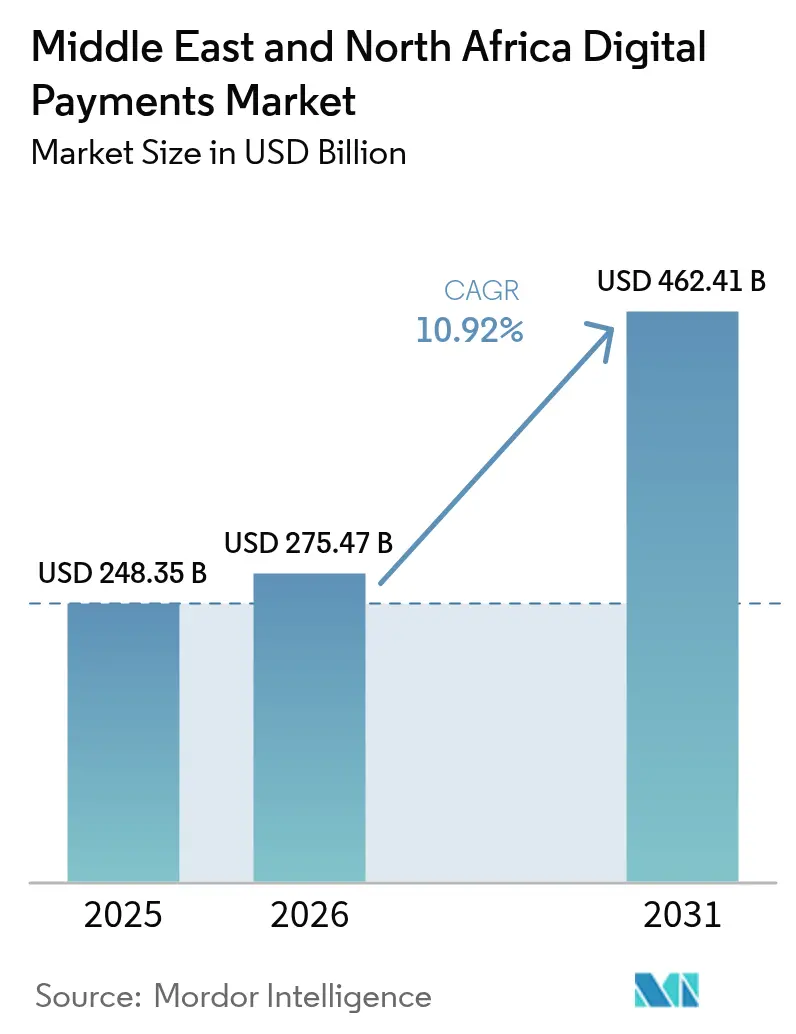
| Base Year Market Size (2025) | USD 248.35 Billion |
| Market Size (2026) | USD 275.47 Billion |
| Market Size (2031) | USD 462.41 Billion |
| Growth Rate (2026 - 2031) | 10.92 % |
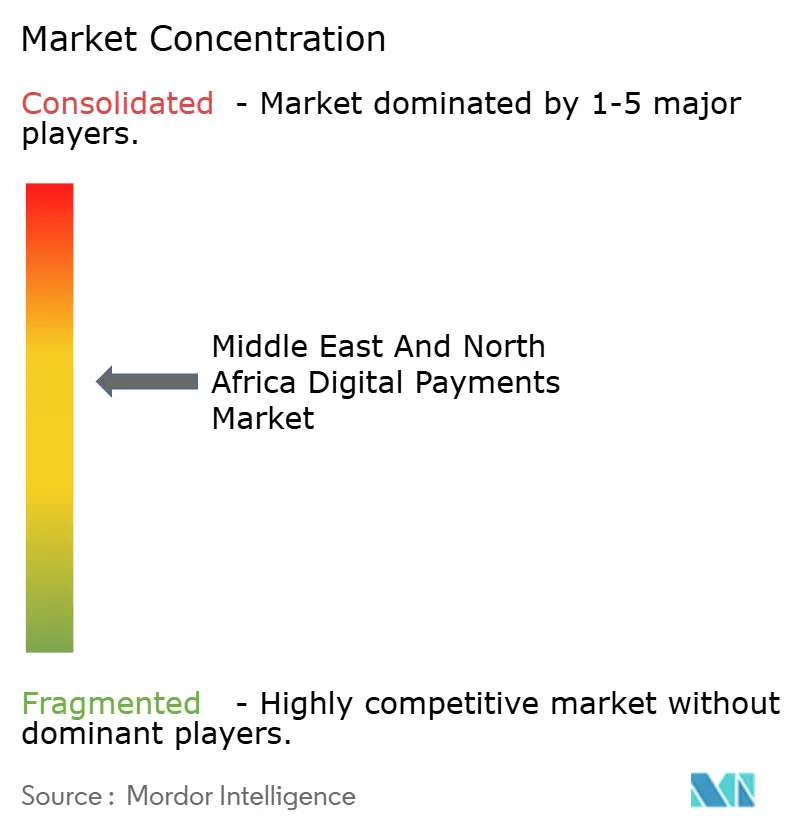
| Market Concentration | Medium |
Major Players *Disclaimer: Major Players sorted in no particular order Image © Mordor Intelligence. Reuse requires attribution under CC BY 4.0. | |
Middle East And North Africa Digital Payments Market Analysis by Mordor Intelligence
The Middle East and North Africa digital payments market size was valued at USD 248.35 billion in 2025 and estimated to grow from USD 275.47 billion in 2026 to reach USD 462.41 billion by 2031, at a CAGR of 10.92% during the forecast period (2026-2031). Rapid real-time rails, policy-led cashless mandates, and cross-border e-commerce flows are cementing digital channels as the default settlement method across consumer and B2B contexts. Fintech sandboxes in Bahrain, Abu Dhabi, and Saudi Arabia are accelerating wallet and API innovation, while super-app ecosystems in the Gulf are embedding payments inside everyday consumer journeys. Regional processors are pursuing scale through mergers, and global networks are deepening local partnerships to capture rising card-not-present volumes. Heightened fraud risks in Egypt and Morocco are prompting substantial investments in AI-driven risk engines, tightening the link between security posture and customer adoption.
Key Report Takeaways
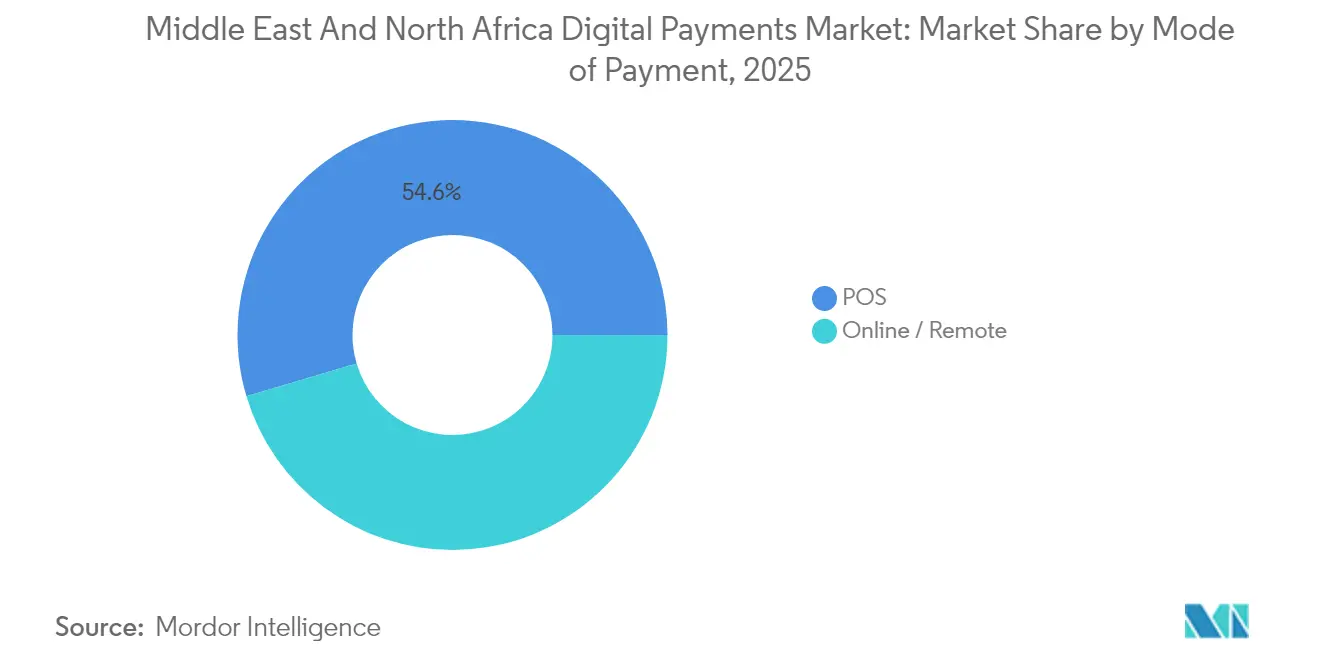
- By mode of payment, the Point-of-Sale segment led with a 54.60% share of the Middle East and North Africa digital payments market in 2025; Online/Remote payments are expected to advance at a 14.45% CAGR through 2031.
- By component, Solutions commanded a 60.85% share of the Middle East and North Africa digital payments market size in 2025, while Services are forecast to expand at an 18.05% CAGR between 2026 and 2031.
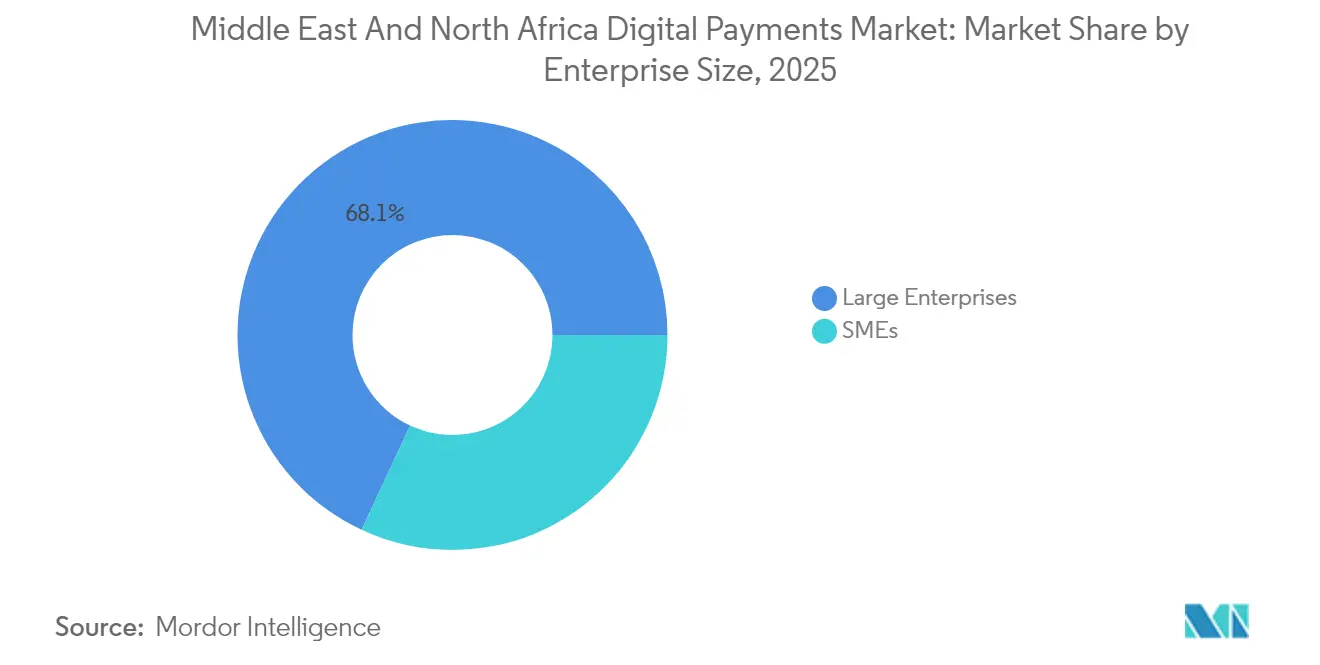
- By enterprise size, large enterprises accounted for 68.05% of the 2025 revenue of the Middle East and North Africa digital payments market, whereas the SME segment is projected to grow at a 21.85% CAGR through 2031.
- By end-user industry, the Retail and E-commerce sector captured 37.95% of the Middle East and North Africa digital payments market revenue in 2025; Other End-user Industries are projected to grow at the fastest rate of 19.15% CAGR.
- By geography, the United Arab Emirates held a 24.05% share of the Middle East and North Africa digital payments market in 2025, and Turkey is set to post a 20.75% CAGR through 2031.
Note: Market size and forecast figures in this report are generated using Mordor Intelligence’s proprietary estimation framework, updated with the latest available data and insights as of 2026.
Market Trends and Insights
Drivers Impact Analysis of Middle East And North Africa Digital Payments Market*
| Driver | (~) % Impact on CAGR Forecast | Geographic Relevance | Impact Timeline |
|---|---|---|---|
| Rapid Real-time Payment Rails Roll-out across GCC and Egypt | +3.2% | GCC countries and Egypt, with spillover effects to North Africa | Medium term (2-4 years) |
| Government–backed Cashless Society Mandates in Saudi Arabia and UAE | +2.8% | Saudi Arabia and UAE primarily, with influence across GCC | Medium term (2-4 years) |
| Surge in Cross-border E-commerce Imports via Turkey and UAE Free-Zones | +1.9% | UAE, Turkey, with regional impact across MENA | Short term (≤ 2 years) |
| FinTech Sandboxes liberalising Digital Wallet Licensing in Bahrain, Abu Dhabi, and Saudi | +1.4% | Bahrain, UAE (Abu Dhabi), Saudi Arabia | Medium term (2-4 years) |
| High Expat Remittance Volumes converging on Mobile P2P Platforms | +1.2% | UAE, Saudi Arabia, Qatar, Kuwait | Short term (≤ 2 years) |
| Retailer-led Super-App Race accelerating Embedded Payments | +0.9% | UAE, Saudi Arabia, Egypt, Turkey | Medium term (2-4 years) |
| Source: Mordor Intelligence | |||
Rapid Real-time Payment Rails: Transforming Transaction Velocity
Saudi Arabia’s SARIE processed 463 million transfers worth SAR 3.2 trillion in 2024, up 42% year-on-year. The UAE Instant Payment Platform captured 28% of domestic transfers within six months. Instant settlement has shortened working-capital cycles for SMEs, catalysed overlay services such as request-to-pay, and fostered wallet uptake among cash-centric segments. Processors are integrating ISO 20022 messaging to enable richer remittance data, a prerequisite for B2B embedded finance. Banks are recalibrating fee models as intraday liquidity risks decline, while merchants report lower cart abandonment thanks to irrevocable push-payments. The network effects are expected to peak between 2026-2028 as remaining GCC banks finalise full API connectivity.
Government-backed Cashless Mandates: Policy-driven Transformation
Saudi Arabia reached 79% non-cash retail transactions by Q1 2025, surpassing Vision 2030’s interim 70% goal. Dubai recorded 88% cashless usage under its Cashless Strategy. Fiscal authorities are linking VAT rebates and procurement contracts to digital acceptance, turning compliance into a commercial incentive. Central banks are synchronising open-finance and token-service rules to streamline wallet provisioning and ensure data portability. Public-sector payroll disbursements now default to wallets, driving inclusion among migrant workers. With statutory e-invoice mandates due in most GCC markets by 2026, card-present and account-to-account rails will converge around national ID tokenisation, tightening KYC assurance.
Cross-border E-commerce: Reshaping Regional Trade Flows
E-commerce GMV in MENA expanded 30% in 2024, with average order values climbing to USD 35.6. UAE free-zones and Turkish fulfilment hubs channel the bulk of cross-border parcels, placing multi-currency processing and local-method acceptance on the strategic roadmap of PSPs. BNPL penetration is rising fastest in cross-border baskets, lifting approval conversion. Processors are introducing smart routing to mitigate foreign-exchange liquidity constraints, especially in markets with capital-control regimes. Compliance teams are prioritising simplified customs documentation and instant duty calculation inside checkout flows, which further lowers friction for first-time buyers. The accelerated ramp-up is front-loaded into 2025-2026 as global brands localise in Arabic and Turkish.
Fintech Sandboxes: Cultivating Innovation Ecosystems
UAE’s FIT Programme counted 329 active fintechs in 2024, 128.5% more than 2021. Bahrain’s sandbox is piloting blockchain-based remittances that promise sub-USD 1 settlement cost into Africa corridors. Saudi sandbox cohorts have accelerated wallet user growth to 14 million. Sandbox waivers lower capital requirements and streamline proof-of-concepts, encouraging cloud-native micro-service architectures that can be exported across MENA. Early-stage PSPs leverage these programmes to demonstrate regulatory compliance before scaling, compressing go-to-market cycles from 24 months to less than 10. As regulators tighten graduation criteria, market entrants will pivot to specialised use cases such as microlending and supply-chain finance.
Restraints Impact Analysis of Middle East And North Africa Digital Payments Market*
| Restraint | (~) % Impact on CAGR Forecast | Geographic Relevance | Impact Timeline |
|---|---|---|---|
| Fragmented Interchange / MDR Caps across MENA Jurisdictions | -1.1% | Pan-MENA, particularly affecting cross-border merchants | Medium term (2-4 years) |
| Cyber-fraud escalation in Egypt and Morocco is dampening consumer trust | -0.8% | Egypt, Morocco, with spillover effects to other North African markets | Short term (≤ 2 years) |
| Legacy POS infrastructure outside Tier-1 cities | -0.7% | North Africa, Turkey, Egypt, Jordan | Long term (≥ 4 years) |
| Foreign-currency liquidity pressure on cross-border settlements | -0.5% | Egypt, Turkey, Morocco, Tunisia | Medium term (2-4 years) |
| Source: Mordor Intelligence | |||
Fragmented Interchange and MDR Caps: Economics Under Pressure
Disparate merchant-discount-rate ceilings complicate cross-border acquiring economics. PSPs operating in both UAE (flexible MDR) and Egypt (tighter caps) struggle to harmonise blended pricing models, leading to margin compression. SMEs delay terminal deployment when economics appear unfavourable, prolonging cash reliance. Regional associations are lobbying for convergence around cost-based interchange, but legislative cycles point to a multi-year resolution. In the interim, acquirers bundle value-added services such as analytics and instant settlement to defend fee revenue. Tokenised account-to-account propositions also emerge as MDR-free alternatives, reshaping gateway strategy.
Cyber-fraud Escalation: Barriers in Emerging Markets
Visa’s 2025 study reveals that 97% of GCC consumers employ at least one security measure online, yet fraud incidents have risen sharply in Egypt and Morocco.[3]Visa, “Consumers Embrace Security Measures as Digital Payments Continue to Grow,” visa.com Phishing and SIM-swap schemes target first-time wallet users, eroding confidence. Banks are embedding AI-based deep authorisation to cut false positives by 20% while catching synthetic identities in near real-time. Mandatory 3-D Secure adoption is expanding to low-value transactions, but poor network latency can increase abandonment. Education campaigns run in Arabic and French aim to rebuild trust, and the PCI Council’s regional office is rolling out compliance clinics for small acquirers. A measurable impact on uptake is expected once fraud-loss ratios fall below the 10-basis-point mark, which is targeted for mid-2026.
*Our forecasts treat driver/restraint impacts as directional, not additive. The impact forecasts reflect baseline growth, mix effects, and variable interactions.
Middle East And North Africa Digital Payments Market Segment Analysis
By Mode of Payment:
Online/Remote Segment Disrupting Traditional POS DominanceThe Middle East and North Africa digital payments market recorded 54.60% of its 2025 transaction value at the point of sale; however, online and remote channels grew at a 14.45% CAGR, chipping away at historical dominance. Mobile wallets already account for 18% of in-store spending in the Gulf and are expected to exceed one-third by 2027 as Near-Field Communication (NFC) acceptance becomes ubiquitous. QR-code rails launched by central banks are further collapsing the distinction between “card-present” and “card-not-present,” delivering checkout consistency in both physical stores and social-commerce feeds.
Heightened e-commerce adoption after the 2024 pandemic phase-out created durable behavioral change: 85% of regional consumers tested at least one emerging method, such as tokenized click-to-pay or BNPL checkout. Processors now optimise for gateway orchestration that can auto-failover between local schemes, international networks, and account-to-account options in under 200 milliseconds. As instant rails converge with open-banking APIs, PSPs expect authorisation cost reductions of up to 40 basis points, sustaining the margin economics of remote commerce as volume scales.



By Component:
Services Growth Outpacing Solutions as Complexity RisesSolutions gateways, processors, wallets, and fraud engines held 60.85% of the Middle East and North Africa digital payments market size in 2025, reflecting the foundational nature of core infrastructure. Yet Services are projected to climb 18.05% CAGR to 2031, overtaking software revenue in fast-growing sub-markets such as Saudi Arabia. Consultancies are booked nine months in advance for open-API readiness audits, and cloud migration mandates from regulators intensify demand for integration specialists.
Managed fraud monitoring is shifting from licence fees to usage-based models that flex with transaction peaks during Ramadan and Singles’ Day. Banks outsource white-label wallets to platform providers, preferring SLA-backed uptime guarantees over in-house builds. Regulatory support functions, including reporting, dispute management, and consumer-protection dashboards, round out service bundles, pushing the average contract value 1.7 times higher than its 2023 equivalents. Consequently, hybrid vendors that pair modular SaaS with advisory retainment enjoy double-digit expansion in bookings through 2028.
By Enterprise Size:
SMEs Driving Unprecedented Growth through Digital AdoptionLarge enterprises still generated 68.05% of transaction flows in 2025, leveraging omnichannel orchestration and direct scheme memberships to squeeze processing costs. Nevertheless, the SME cohort is on a 21.85% CAGR run rate, the fastest across the Middle East and North Africa digital payments market. Wallet-based soft-POS products such as Geidea’s smartphone app eliminate hardware outlays, unlocking acceptance for micro-retailers. In the Gulf, government procurement portals now mandate digital invoicing, nudging SME suppliers into formal payment rails.
Mastercard’s SME Confidence Index shows that 72% of surveyed firms expect equal or higher revenue in 2025, prompting investment in global storefronts and the localization of checkout flows. Cross-border enablement is top priority: 79% of SMEs plan to sell internationally, relying on multi-currency settlement, real-time FX quotes, and built-in duty calculation. PSPs court this segment with revenue-based financing and embedded working-capital lines, deepening wallet share beyond payments alone.
By End-user Industry:
Diversification beyond Retail and E-commerceRetail and E-commerce retained 37.95% of the 2025 value pool, but other industries, government, education, utilities, and gaming are collectively expanding at a 19.15% CAGR, tilting the demand mix. Government agencies in the UAE now issue 100% of resident visa fees through wallets or cards, driving steady baseline volume. Utility providers adopt autopay mandates that cut delinquency by 15 percentage points. The MENA gaming sector, valued at USD 7.45 billion in 2023 and growing at a 9.4% CAGR, integrates frictionless top-ups through carrier billing and tokenised cards, extending the lifetime value of players.
Education institutions pivoted to recurring digital tuition plans during pandemic lockdowns and have retained them for convenience, creating seasonally predictable payment spikes each semester. Healthcare providers' interest in the instant disbursement of insurance reimbursements is another greenfield, positioning PSPs with payout capabilities for outsized growth. Combined, these verticals diversify revenue sources and reduce cyclicality tied to retail sales cycles.
Geography Analysis
United Arab Emirates and North Africa Digital Payments Market
The UAE accounted for 24.05% of the Middle East and North Africa digital payments market in 2025, driven by 329 active fintech companies and a supportive Financial Infrastructure Transformation roadmap. Real-time rails, open-finance regulations, and an 88% cashless adoption rate underpin an addressable fintech revenue pool projected to reach USD 3.56 billion by 2025 and USD 6.43 billion by 2030. Cross-border corridors leveraging Dubai ports contribute a disproportionate share of high-value, multi-currency flows, prompting PSPs to embed automated sanctions screening and real-time duty calculation as value-added services.
Turkey and North Africa Digital Payments Market
Turkey is the fastest-growing market, forecast at a 20.75% CAGR through 2031, driven by a youthful, mobile-first consumer base and nascent cryptocurrency regulation, which is expected to exit the FATF grey list. Domestic processors are racing to integrate instant card withdrawal into gaming and influencer-commerce apps, while manufacturers leverage B2B BNPL for export receivables.
Saudi Arabia and North Africa Digital Payments Market
Saudi Arabia’s e-payments reached 79% of retail transactions in early 2025, with Vision 2030 milestones driving aggressive wallet issuance and open banking rollouts. Venture funding flows confirm momentum: the Kingdom captured 58% of MENA VC dollars in Q1 2025, with fintechs taking 57% of that haul. Banks pivot to product factories that unbundle issuing, acquiring, and lending via micro-services, aligning with SAMA’s graduated licensing regime.
Egypt and North Africa Digital Payments Market
Egypt offers scale with latent potential; policy frameworks such as the National Payment Council’s financial-inclusion strategy are nudging consumers toward wallets. Fawry’s network processes millions of daily micro-transactions, and new partnerships like dubizzle-Paymob extend acceptance to classifieds marketplaces. Yet cyber-fraud episodes keep trust fragile, triggering coordinated public-private security programmes.
Morocco and North Africa Digital Payments Market
Morocco, the third-largest Arab fintech hub, is building payment corridors into Francophone Africa. Venture-backed PayTic plans to roll out issuer processing across the continent, and regulators are drafting open-API standards. Consumer adoption concentrates in urban Casablanca and Rabat, leaving rural digitisation as the next frontier contingent on mobile-coverage upgrades.
Regulatory Landscape
Across MENA, digital payments regulation is moving from fragmented directives toward law-backed licensing and oversight that covers payment system operators, PSPs, e-money, and emerging payment tokens. In Saudi Arabia, the Law of Payments and Payment Services (Royal Decree M/26) and SAMA implementing regulations are being operationalized through tighter supervisory controls, including SAMA's updated Oversight Framework on Payment Systems and their Operators issued on 8 March 2026.
Regulators are also hard-wiring compliance into national digital infrastructure. SAMA Circular 472047799 (9 March 2026) requires payment system operators to integrate with the Wathq service for Ultimate Beneficial Owner verification, raising KYC and risk-control standards for scalable wallet and acquiring models. In the UAE, the Central Bank of the UAE continues to expand its licensed perimeter under the Retail Payment Services and Card Schemes framework and Payment Token Services Regulation, including licensing actions in January 2026 for a payment services provider (MBME PAY) and a Dirham Payment Token Issuance entity (AEDC Stable Coin-L.L.C), while Lebanon's Banque du Liban issued Basic Decision No. 13790 (9 January 2026) to define licensing categories for electronic payment services providers across e-money and transfer activities.
Value Chain Analysis
The MENA digital payments value chain starts with regulators and national infrastructure operators, including instant payment platforms and domestic schemes, then moves through banks and non-bank PSPs for onboarding, KYC, and account provisioning. Execution runs through issuers, acquirers, processors, gateways, and fraud and identity layers. Merchant acceptance is supported through POS aggregators, e-commerce platforms, super-apps, and sector-specific aggregators, with settlement and reconciliation handled by bank treasury functions and, increasingly, newer cross-border connectivity rails.
Competitive differentiation is concentrating in processing scale, tokenization, and cross-border capability. For instance, Emirates NBD enabled real-time, blockchain-based cross-border USD payments on the Partior network (March 2026), which signals a push upstream into faster clearing for higher-value flows. In acquiring and merchant enablement, Network International expanded ecosystem reach through partnerships such as FABMISR in Egypt to deploy the N-Genius processing platform (May 2026) and American Express Middle East in the UAE to add merchant acceptance at scale (June 2026). National infrastructure also shapes downstream routing and scheme economics, including Al Etihad Payments commencing nationwide issuance of the UAE's Jaywan national payment card scheme (July 2026), with Network International enabling Jaywan transactions on its online payment gateway.
Competitive Landscape
The Middle East and North Africa digital payments market is dominated by prominent players such as Visa, Mastercard, and PayPal, alongside regional players including Network International, Fawry, and STC Pay. Consolidation is evident, as PayU’s 43.5% stake in Mindgate anchors a real-time processing capability that complements its regional acquiring footprint.[1]Prosus, “PayU Joins Mindgate as a Strategic Investor to Accelerate Global Innovation,” prosus.com Global networks invest heavily in tokenisation and AI-based fraud tools to preserve interchange relevance as account-to-account rails mature.
Strategic alliances dominate the expansion strategy. Mastercard paired with Corpay to scale business-to-business cross-border payouts, blending network tokenisation with Corpay’s FX platform.[2]Mastercard, “Mastercard and Corpay Launch Strategic Partnership in Cross-Border Payments,” mastercard.com Visa’s Deep Authorization engine reduces false fraud declines in card-not-present flows, giving issuers a competitive lift in e-commerce traffic.
Super-app ambitions among retailers and telcos reshape channel control. Areeba’s partnership with Foo delivers turnkey card programmes and wallets to banks pursuing embedded finance, shortening time-to-market and diversifying revenue beyond interchange. Geidea’s SoftPOS expansion into Egypt converts smartphones into terminals, attacking the last-mile acceptance gap and bolstering its regional merchant base.
Middle East And North Africa Digital Payments Industry Leaders
Paypal Holdings Inc.
ACI Worldwide Inc.
Visa Inc.
Mastercard Incorporated
Samsung Electronics Co., Ltd. (Samsung Pay)
- *Disclaimer: Major Players sorted in no particular order
Middle East And North Africa Digital Payments Market Companies Covered in this Report
- PayPal Holdings, Inc.
- Apple Inc.
- Google LLC (Google Pay)
- Samsung Electronics Co., Ltd. (Samsung Pay)
- Mastercard Incorporated
- Visa Inc.
- ACI Worldwide Inc.
- Fawry for Banking and Payment Technology Services S.A.E.
- Network International Holdings plc
- STC Pay – Saudi Digital Payments Co.
- Mada Pay – Saudi Payments
- First Data Corporation (Fiserv, Inc.)
- Denarii Cash Ltd.
- BayanPay – Bayantech Payment Services
- HalalaH Payments Co.
- Beam Wallet LLC
- Commercial International Bank (CIB) Egypt
- Qatar National Bank Al-Ahli (QNB Al-Ahli)
- Emirates Digital Wallet LLC
- BKM Express – Bankalararası Kart Merkezi A.Ş.

Market Opportunities and Future Outlook
Cross-border settlement modernization is creating whitespace for providers that combine instant-payment interoperability, compliant identity controls, and multi-currency orchestration across key Gulf and North Africa corridors. Al Etihad Payments selecting Montran in February 2026 to implement an International Remittance Platform (IRP) Gateway to connect with other national instant payment systems provides a concrete integration pathway for PSPs and banks to productize faster remittances and SME trade payouts. Emirates NBD going live on Partior for real-time, blockchain-based cross-border USD payments also supports demand for solutions that can bridge treasury workflows, compliance screening, and real-time posting for high-value B2B and institutional flows.
Sovereign payment infrastructure and regulated digital money rails are expanding the addressable surface for local acquiring, token services, and scheme processing, while also raising compliance requirements that favor vendors with proven regulatory alignment. The UAE's Jaywan national card scheme entering nationwide issuance in July 2026 creates opportunities in domestic routing, acceptance expansion, and issuer enablement, particularly for e-commerce and omnichannel merchants that need consistent success rates across local and international methods. In Saudi Arabia, SAMA expanding the Digital Saudi Riyal domestic pilot from 6 to 20 banks in June 2026 and commencing cross-border testing with the UAE Central Bank creates a specific enterprise payments and treasury use case set around programmable settlement, though it increases the need for governance, integration, and risk tooling. Conversely, tighter supervisory actions in Egypt, including the FRA Decree No. 43 effective 25 February 2026 suspending new consumer finance company licensing under the FinTech Law for one year, point to near-term concentration in payments infrastructure, fraud controls, and compliant acceptance rather than pure-play consumer credit expansion.
Recent Industry Developments in Middle East And North Africa Digital Payments Market
- July 2026: Al Etihad Payments commenced nationwide issuance of the UAE's Jaywan national payment card scheme, with Network International enabling Jaywan transactions for online payments via its gateway. This accelerates domestic scheme adoption and expands routing options for merchants and issuers operating across UAE omnichannel commerce.
- May 2026: Mastercard renewed its digital payments partnership with Commercial International Bank (CIB) in Egypt to support core digital payments and card issuance programs. The move reinforces issuer-led digitization in a large-volume market where authorization performance and risk controls directly influence e-commerce conversion.
- November 2024: Mastercard joined Buna, the Arab Regional Payment System, strengthening connectivity for regional cross-border payments and settlement. Participation supports broader interoperability efforts across Arab markets and complements banks and PSPs building multi-country payout and collections capabilities.


Middle East And North Africa Digital Payments Market Report Scope and Research Methodology
Market Definition and Coverage
For this report, the digital payments market covers the value of electronic payment transactions made through digital channels across Middle East and North Africa, spanning in-store and remote use cases and the related payment solutions and services that enable these transactions.
Scope exclusions: We exclude cash transactions, informal transfers outside regulated or trackable digital rails, and pure hardware-only sales where no payments software or service value is captured.
Segments Covered in This Report
- By Mode of Payment
- Point of Sale (POS)
- Online / Remote Payment
- By Component
- Solutions (Gateway, Processing, Wallet, Fraud, Other)
- Services (Consulting, Integration, Support)
- By Enterprise Size
- Large Enterprises
- Small and Medium Enterprises (SMEs)
- By End-user Industry
- Retail and E-commerce
- Media and Entertainment
- Healthcare
- Hospitality and Travel
- Other End-user Industries (Education, Utilities, Govt.)
- By Country
- Saudi Arabia
- United Arab Emirates
- Egypt
- Turkey
- Morocco
- Rest of Middle East and North Africa
Data Sources, Market Sizing, and Validation
Desk Research
Desk work starts by mapping the payment ecosystem across the region and the main rails used for digital transactions. We rely on public and official sources such as central bank payment statistics, national financial inclusion dashboards, telecom regulators for mobile penetration, and IMF and World Bank macro series for inflation, exchange rates, and consumption indicators.
To keep assumptions grounded, we also review sources such as BIS payments notes, ISO 20022 and scheme documentation for rail readiness, and government digital economy programs where timelines are published. This is then supported by company filings, investor presentations, audited annual reports, and reputable press coverage on major policy changes and merchant adoption trends. Where needed, we use paid databases for company financials, news and financials, patent databases, and shipment-level import and export signals to validate the direction of enabling infrastructure. The sources listed here are illustrative only, and we used other public references as well to collect, cross-check, and clarify data points.
Primary Interviews and Surveys
Primary work focuses on confirming what the desk data cannot fully show, especially pricing logic, take-rate ranges, and the pace of migration from cash to digital in different use cases. We spoke with payment ecosystem participants such as banks, payment service providers, merchants, and enabling solution providers across key MENA markets, and we used their input to stress-test adoption assumptions and the value build before finalizing totals.
Distribution of primary research fieldwork respondents
| Company type | Respondent position |
|---|---|
| Top tier: 28% | CXOs: 22% |
| Mid tier: 50% | Functional/Unit leaders: 18% |
| Smaller Players: 22% | Managers: 60% |
Market-Sizing & Forecasting
Sizing starts with a top-down build where payment value is reconstructed from country-level digital transaction signals, which are then aligned to the MENA roll-up using consistent currency timing. Once the demand pool is formed, it is split across the common acceptance routes (POS and online or remote) so the model reflects purchase behavior rather than relying only on provider revenue reporting.
A selective bottom-up layer is then used to corroborate totals, including sampled checks of payment volumes and value from public disclosures, channel checks on merchant penetration, and sanity checks using implied average transaction size by use case. In practice, the model is most sensitive to indicators such as smartphone and internet penetration, merchant terminal and acceptance growth, share of e-commerce in retail, remittance and cross-border purchase intensity, and inflation and FX movements that change reported USD value. Where gaps appear for smaller markets or private participants, we apply conservative proxy ranges based on similar markets in the region and then re-check the implied outcomes with interview feedback.
For forecasting, scenario analysis is used so adoption can be flexed under different policy and consumer behavior paths, and the final view is selected after experts confirm the most likely trajectory for cash displacement and online spend growth. Key assumptions are updated for price and value progression, including average transaction size by channel and the pace of shift from card to account-to-account and wallet-led flows, where this affects reported value trends.
Data Validation & Update Cycle
Validation is done through several cross-checks so the final numbers do not depend on one source or one assumption. Analysts compare outputs against independent signals such as macro consumption, payment infrastructure growth, and published central bank digital transaction series, and then large variances are investigated and corrected.
Before sign-off, the model goes through internal review steps where inputs, calculations, and implied growth patterns are rechecked, followed by re-contact triggers if any datapoint conflicts across multiple sources. Reports are refreshed annually, and interim updates are made when material events occur, such as major regulatory changes, currency shocks, or rapid shifts in consumer payment behavior. Right before delivery, a fresh pass is performed so clients receive the most current view available at that time.
Mordor Intelligence's Middle East and North Africa Digital Payments Market Estimate Compared With Other Published Estimates
Published market sizes for MENA digital payments often vary because the underlying timing and math can be handled differently, even when the titles look similar. Common differences include which year is treated as the base, how USD conversion is applied during FX swings, and whether average transaction size changes are modeled consistently across POS and online usage.
When refresh cadence is tighter, FX timing is standardized, and average transaction size is recalibrated using recent channel-mix shifts, the total tends to move in a way that is easier to explain and recheck, which is how the latest update was handled by Mordor Intelligence.
Benchmark comparison
| Source | Market Size | Gaps in Research Methodology |
|---|---|---|
| Mordor Intelligence | USD 248.35 B (2025) | |
| Regional Consultancy A | USD 229.85 B (2024) | Uses an earlier base year and a longer forecast horizon, and the USD value can shift with different FX conversion points during volatile periods. |
| Trade Journal B | USD 4.02 B (2021) | Appears to measure a narrower scope closer to digital payment solutions and services revenue, rather than total digital transaction value across the region. |
The spread across published numbers is mainly explained by year choice, whether the figure represents transaction value or enabling solution revenue, and how FX and average ticket size are treated. By keeping those choices explicit, and checking them against observable payment and macro signals, the model stays traceable and repeatable for planning use.


Key Questions Answered in the Report
What is the current size of the MENA digital payments market?
The MENA digital payments market size is USD 275.47 billion in 2026 and is forecast to reach USD 462.41 billion by 2031.
Which payment mode is expanding fastest?
Online/Remote payments are growing at a 14.45% CAGR, outpacing the Point-of-Sale segment that currently leads in share.
Why are services revenues accelerating quicker than solutions?
Implementation complexity around open banking, instant rails, and fraud management is driving 18.05% CAGR in services as firms seek specialised expertise.
Which country offers the highest growth potential?
Turkey is projected to record a 20.75% CAGR through 2031 owing to its young population, smartphone uptake, and supportive fintech regulation.
How are SMEs influencing market dynamics?
SMEs, growing at 21.85% CAGR, are adopting soft-POS and multi-currency gateways to expand cross-border sales, boosting transaction volumes beyond large-enterprise channels.
What is the principal challenge restraining wider adoption?
Fragmented interchange caps and escalating cyber-fraud, particularly in Egypt and Morocco, are dampening merchant economics and consumer trust, respectively.
Page last updated on:




