
Middle East And Africa Unitary Heater Market Size and Share
| Study Period | 2019 - 2030 |
| Forecast Data Period | 2025 - 2030 |
| Historical Data Period | 2019 - 2023 |
| Market Size (2025) | USD 197.11 Million |
| Market Size (2030) | USD 233.42 Million |
| CAGR (2025 - 2030) | 3.44% |
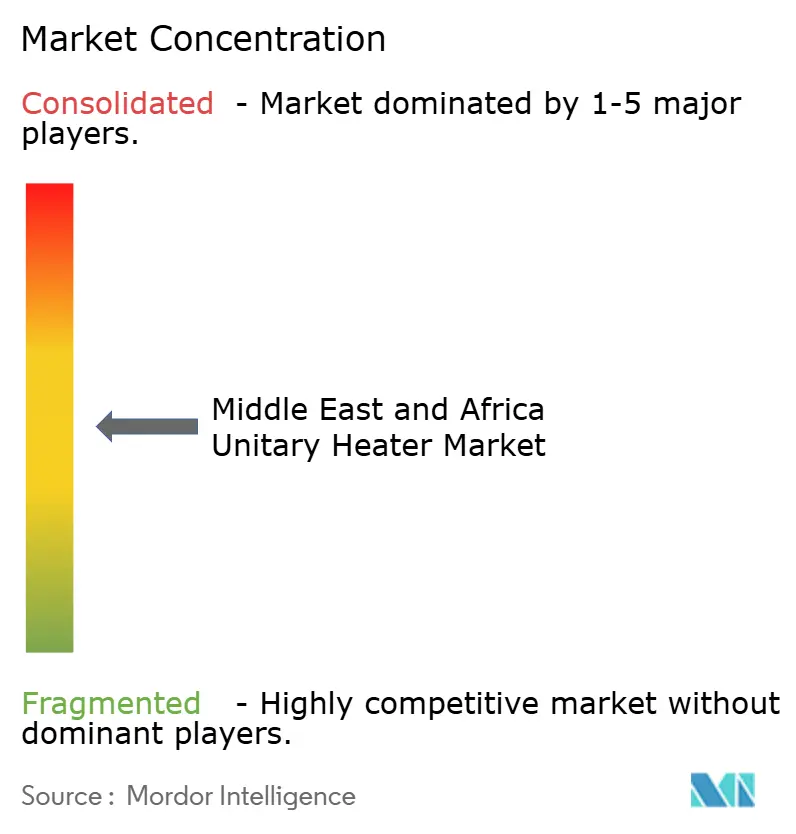
| Market Concentration | Medium |
Major Players *Disclaimer: Major Players sorted in no particular order |
Middle East And Africa Unitary Heater Market Analysis by Mordor Intelligence
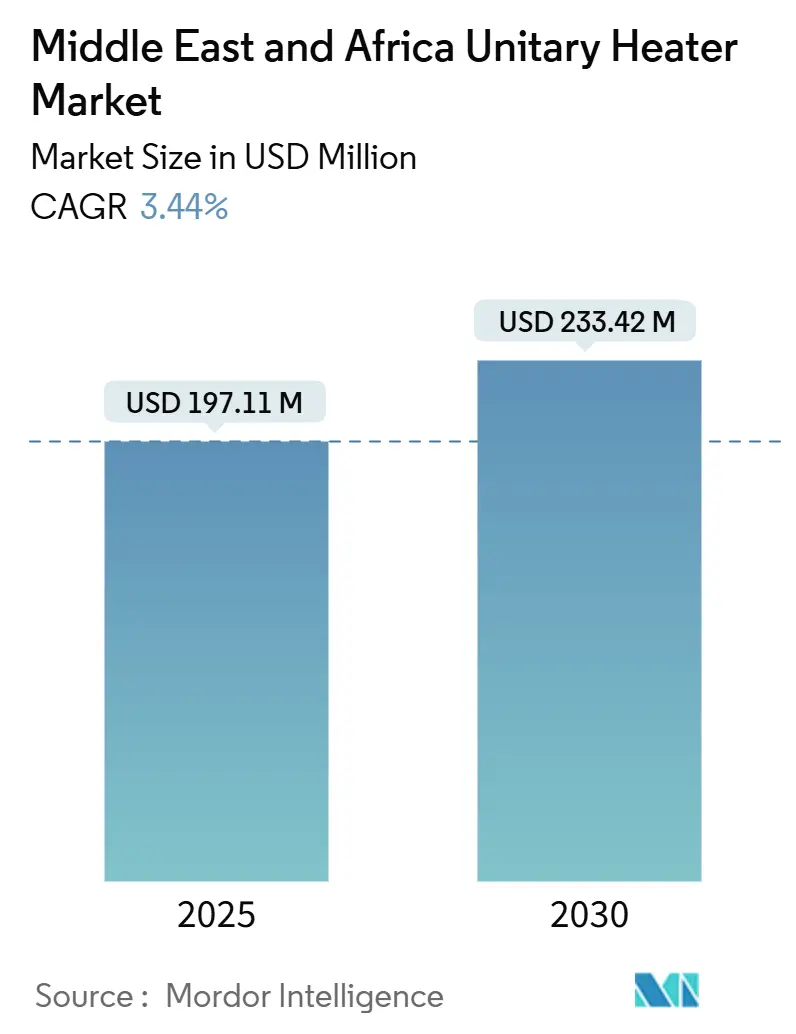
The Middle East And Africa Unitary Heater Market size is estimated at USD 197.11 million in 2025, and is expected to reach USD 233.42 million by 2030, at a CAGR of 3.44% during the forecast period (2025-2030).
- Unit heaters, stand-alone non-ducted space heaters, operate independently from a facility's main HVAC system. These heaters emit warmth directly into their surrounding environment. Capable of heating expansive areas like warehouses or mechanical shops, unit heaters boast outputs ranging from 25,000 to a robust 400,000 BTUs/hr. Available in varied efficiencies, standard units operate at a fixed capacity, while high-efficiency models feature variable capacities and employ condensing techniques to reclaim heat from exhaust gases, optimizing energy consumption.
- Unitary heater demand is on the rise in the Middle East and Africa, with the United Arab Emirates, Saudi Arabia, and South Africa witnessing significant growth. This growth is largely attributed to heightened demand for energy-efficient heating solutions and ongoing technological strides in the HVAC sector. Furthermore, government-backed initiatives championing eco-friendly heating systems are amplifying this market momentum.
- In the Middle East and Africa, cities like South Africa, Abu Dhabi and Dubai are witnessing a wave of industrialization and urbanization, spurring a heightened demand for unitary heaters. The pressing need for efficient and cost-effective heating across residential, commercial, and industrial domains fuels this surge. Furthermore, an increasing emphasis on sustainability and environmental stewardship is accelerating the shift towards energy-efficient unitary heaters.
- High installation costs are key challenges in the unitary heaters market. These elevated initial costs can dissuade potential consumers from investing. Furthermore, manufacturers grapple with stringent regulatory mandates, especially those emphasizing energy efficiency standards.
- Inflation, a pivotal macroeconomic factor, is pushing up the costs of essential raw materials like electronic controls and motors, crucial for unitary heaters. Faced with these escalating costs, manufacturers might pass the burden onto consumers, which could, in turn, suppress demand. Moreover, trade wars, tariffs, and sanctions are hindering the smooth flow of goods, curbing the push for equipment upgrades. On another front, regional instability looms as a threat, with the power to postpone or entirely stall industrial projects dependent on unitary heaters.
Proportional positioning is established by comparing regional contributions against the global total, including that of Middle east and africa. The unitary heater market share in our global report expresses these relative weights.
Middle East And Africa Unitary Heater Market Trends and Insights
Gas-Fired Heaters are Expected to Hold a Significant Share
- A gas-fired unit heater is a self-contained appliance that burns gas and distributes warm air without ducts. It operates automatically and is vented, with a maximum input rate of 2,931 kW (or 10,000,000 Btu/h). Typically found in spaces with high ceilings, gas unit heaters are directly exposed to the areas they warm. These heaters boast a low installation cost and efficiently heat large volumes without the need for extensive ductwork.
- Gas-fired unitary heaters excel in energy efficiency, converting fuel directly into heat with minimal losses. In contrast, the process of generating and transmitting electricity, followed by its conversion to heat, often leads to efficiency reductions. Moreover, in many countries across the Middle East and Africa, natural gas is usually cheaper than electricity, making gas-fired heating a more cost-effective choice over time. These heaters provide quick and steady heat output, reducing the time and energy needed to reach desired temperatures, especially in larger spaces.
- In the United Arab Emirates, natural gas dominates energy production, especially for space heating. This heavy reliance on natural gas is propelling the growth of the gas-fired unit heater industry. Meanwhile, government initiatives championing cleaner energy, alongside technological strides in heating, are reshaping the market landscape. Noteworthy innovations, such as advanced burner designs, superior heat exchangers, and automated controls, have enhanced the efficiency and sustainability of these heating units. Furthermore, in April 2024, South Africa was pushing forward with several natural gas projects, seeking to address ongoing energy shortages and reduce its dependence on coal.
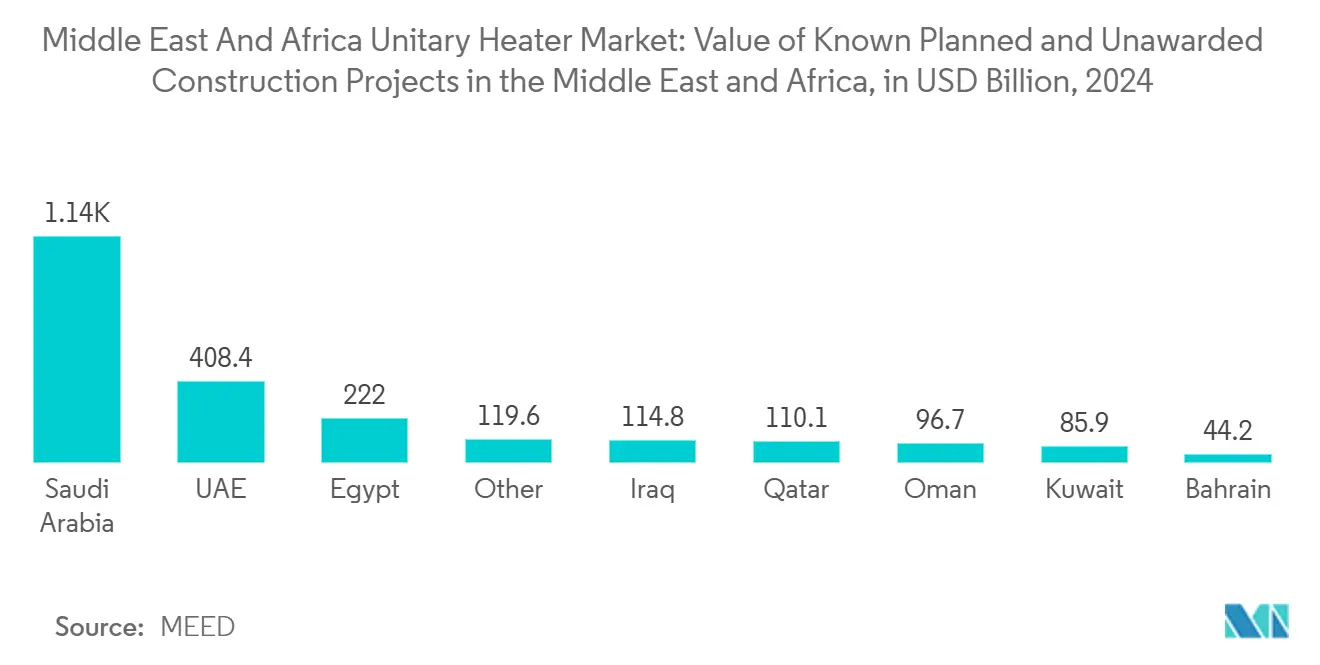
- Gas-fired unit heaters prove to be more cost-effective than electric heaters, particularly when heating expansive areas like warehouses, commercial buildings, and multi-story constructions. The gas-fired unit heaters demand is poised to benefit from the anticipated growth in the construction sector. As reported by MEED, in 2024, Saudi Arabia led the Middle East and Africa with a staggering USD 1.136 trillion in planned and unawarded construction projects. Notably, Saudi Arabia's construction market is projected to outpace the United Arab Emirates by approximately 64%.


United Arab Emirates is Expected to Witness a Significant Growth
- The increase in demand for energy-efficient heating solutions is propelling the expansion of the unitary heater market in the United Arab Emirates (UAE). As consumers and businesses prioritize cost savings, environmental sustainability, and regulatory compliance, manufacturers are ramping up innovations to meet these evolving demands. Unitary heaters that prioritize energy efficiency are becoming increasingly popular in the market, largely because of their operational efficiency and cost-saving advantages. As the industry evolves, manufacturers focusing on efficiency-driven innovations are likely to lead the way, skillfully addressing the changing needs of consumers.
- In the UAE (United Arab Emirates), the transition to energy-efficient unitary heaters is driven by the allure of long-term cost savings and improved operational efficiency. Businesses and homeowners alike recognize that choosing high-efficiency heating solutions not only reduces energy and maintenance expenses but also lessens their environmental impact.
- In the UAE (United Arab Emirates), as cities expand and commercial centers such as malls, offices, and schools multiply, the demand for reliable heating solutions escalates. This increase in demand is especially evident in regions experiencing both population growth and increased commercial activity, leading to a heightened need for unitary heaters.
- Unitary heaters are gaining traction in the residential sector, driven by an increase in demand for energy-efficient solutions and government incentives promoting sustainability. Homeowners are leaning towards heating systems that prioritize both cost-effectiveness and environmental friendliness. With their compact designs, easy installation, and efficient performance, unitary heaters are emerging as the top choice.
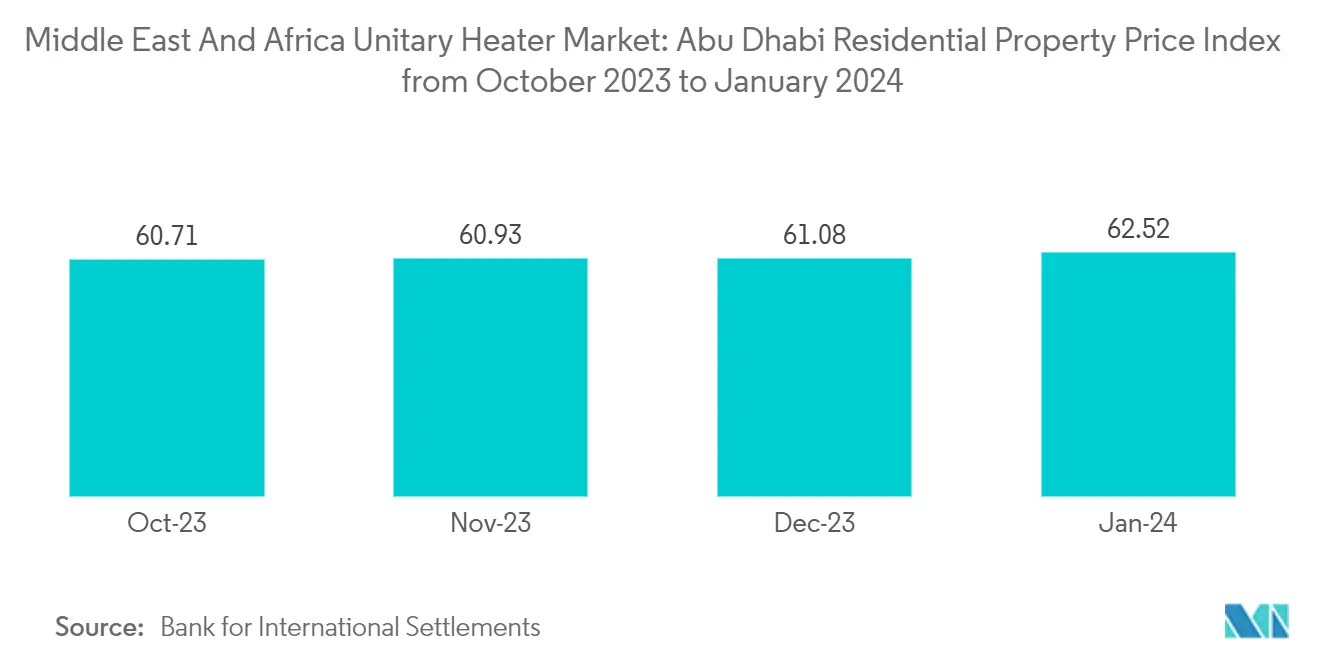
- In January 2024, the Bank for International Settlements reported that residential property prices in Abu Dhabi, United Arab Emirates (UAE), hit a peak index value of 62.52 points. This uptick in residential construction is set to propel market growth.

Mordor Intelligence examines the unitary heater market across diverse other regional markets as well, including North America, Asia, and Europe.
Competitive Landscape
The Middle East and Africa unitary heater market is characterized by a semi-consolidated structure, with specialized players and regional conglomerates operating across various segments. While multiple large multinational companies dominate certain high-value segments, numerous regional and niche players contribute to the overall competition, making the market highly diverse. This competition is driven by the wide range of applications for unitary heaters, allowing both small and large companies to coexist and thrive in the market.
Several leading companies in the Middle East and Africa unitary heaters market include Trane Inc. (Trane Technologies PLC), Modine Manufacturing Company, The Marley Company LLC (SPX Technologies, Inc.), Daikin Applied (Daikin Industries, Ltd.), Thermon Group Holdings, Inc., and many others. With strong brand recognition and extensive regional operations, these companies command a significant market share. Their strengths include innovation, a broad solutions portfolio, and robust distribution networks. To maintain their competitive edge and broaden their market reach, these leaders frequently pursue strategic acquisitions and partnerships.
To succeed in the regional unitary heater market, companies must prioritize innovation, especially in product types like gas-fired heaters, electric heaters, and hydronic heaters. With industries clamoring for advanced solutions, unitary heaters are poised to emerge as a key differentiator. Furthermore, broadening service offerings and bolstering customer support will be vital for nurturing long-term relationships and ensuring repeat business. Companies that channel investments into emerging markets and design their products to meet regional demands stand to carve out a competitive edge in this moderately competitive landscape.
Middle East And Africa Unitary Heater Industry Leaders
Trane Inc. (Trane Technologies PLC)
Modine Manufacturing Company
The Marley Company LLC (SPX Technologies, Inc.)
Daikin Applied (Daikin Industries, ltd.)
Thermon Group holdings, Inc.
- *Disclaimer: Major Players sorted in no particular order

Recent Industry Developments
- January 2025: Indeeco has expanded its Ultra-Safe Explosion-Proof Unit Heater (233 Series) line, introducing a model with an expanded rating of up to 35kW. This move underscores Indeeco's commitment to maintaining its position as a prominent player through continuous product enhancement. By broadening this product line, the company not only bolsters its competitive edge but also highlights its dedication to providing market-aligned solutions.
- January 2024: Powrmatic Limited has introduced its newest product, the EUX Unit Heater. This electric unit heater, designed for warehouses, factories, garages, workshops, and manufacturing facilities, provides businesses with an energy-efficient warming solution. Beyond delivering outstanding warmth and comfort, the EUX Unit Heater is equipped with notable eco-friendly features, pushing the industry closer to a sustainable future.


Middle East And Africa Unitary Heater Market Report Scope
Unit heaters, non-ducted, deliver localized warmth without relying on a central HVAC system. These versatile devices can be set up independently to warm specific areas, including garages, workshops, and expansive spaces. Whether ensuring comfortable conditions in industrial settings, supplementing central heating in commercial spaces, or warming private garages and workshops, unit heaters stand out as a reliable and cost-effective solution for targeted heating needs. The study tracks the revenue accrued through the sale of unitary heaters by various players in the Middle East and Africa region. The study also tracks the key market parameters, underlying growth influencers, and major vendors operating in the industry, which supports the market estimations and growth rates over the forecast period.
The Middle East and Africa unitary heater market is segmented by product type (gas-fired heaters, electric heaters, hydronic heaters, and others), end-user industry (residential, commercial, and industrial), and country (United Arab Emirates, Saudi Arabia, South Africa, and Rest of Middle East and Africa). The market sizes and forecasts are provided in terms of value (USD) for all the above segments.
| Gas-Fired Heaters |
| Electric Heaters |
| Hydronic Heaters |
| Others |
| Residential |
| Commercial |
| Industrial |
| United Arab Emirates |
| Saudi Arabia |
| South Africa |
| By Product Type | Gas-Fired Heaters |
| Electric Heaters | |
| Hydronic Heaters | |
| Others | |
| By End-user Industry | Residential |
| Commercial | |
| Industrial | |
| By Country*** | United Arab Emirates |
| Saudi Arabia | |
| South Africa |


Key Questions Answered in the Report
How big is the Middle East And Africa Unitary Heater Market?
The Middle East And Africa Unitary Heater Market size is expected to reach USD 197.11 million in 2025 and grow at a CAGR of 3.44% to reach USD 233.42 million by 2030.
What is the current Middle East And Africa Unitary Heater Market size?
In 2025, the Middle East And Africa Unitary Heater Market size is expected to reach USD 197.11 million.
Who are the key players in Middle East And Africa Unitary Heater Market?
Trane Inc. (Trane Technologies PLC), Modine Manufacturing Company, The Marley Company LLC (SPX Technologies, Inc.), Daikin Applied (Daikin Industries, ltd.) and Thermon Group holdings, Inc. are the major companies operating in the Middle East And Africa Unitary Heater Market.
What years does this Middle East And Africa Unitary Heater Market cover, and what was the market size in 2024?
In 2024, the Middle East And Africa Unitary Heater Market size was estimated at USD 190.33 million. The report covers the Middle East And Africa Unitary Heater Market historical market size for years: 2019, 2020, 2021, 2022, 2023 and 2024. The report also forecasts the Middle East And Africa Unitary Heater Market size for years: 2025, 2026, 2027, 2028, 2029 and 2030.
Page last updated on:
Middle East And Africa Unitary Heater Market Report
Statistics for the 2025 Middle East And Africa Unitary Heater market share, size and revenue growth rate, created by Mordor Intelligence™ Industry Reports. Middle East And Africa Unitary Heater analysis includes a market forecast outlook for 2025 to 2030 and historical overview. Get a sample of this industry analysis as a free report PDF download.


 Your data is secure and never sold or shared.


