
Middle East and Africa Electric Vehicle Battery Materials Market Size and Share
| Study Period | 2019 - 2030 |
| Forecast Data Period | 2025 - 2030 |
| Historical Data Period | 2019 - 2023 |
| Market Size (2025) | USD 0.09 Billion |
| Market Size (2030) | USD 0.12 Billion |
| CAGR (2025 - 2030) | 7.68% |
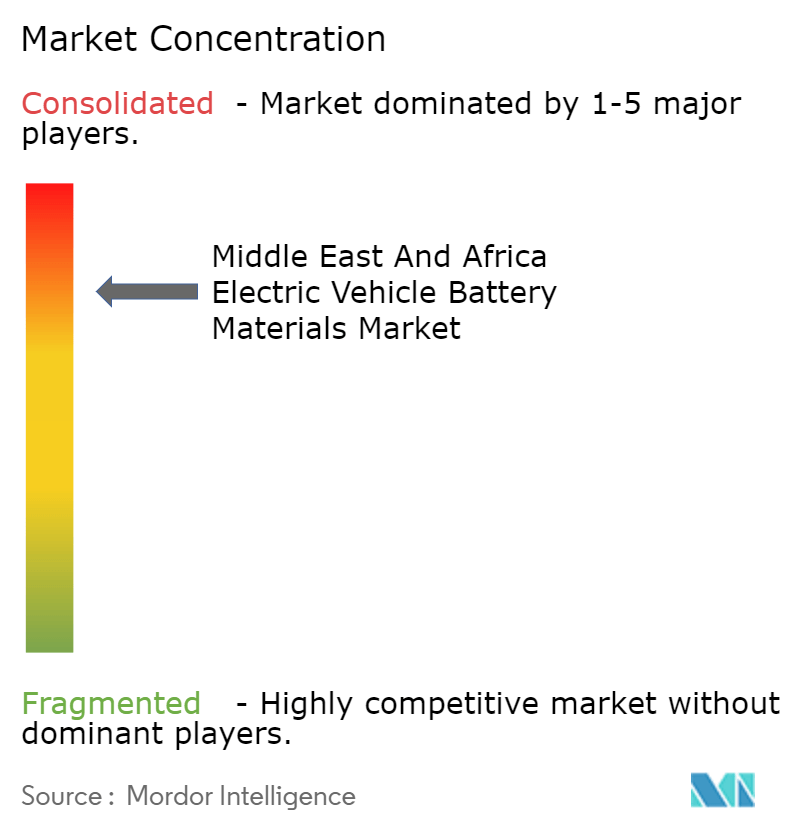
| Market Concentration | High |
Major Players *Disclaimer: Major Players sorted in no particular order |
Middle East and Africa Electric Vehicle Battery Materials Market Analysis by Mordor Intelligence
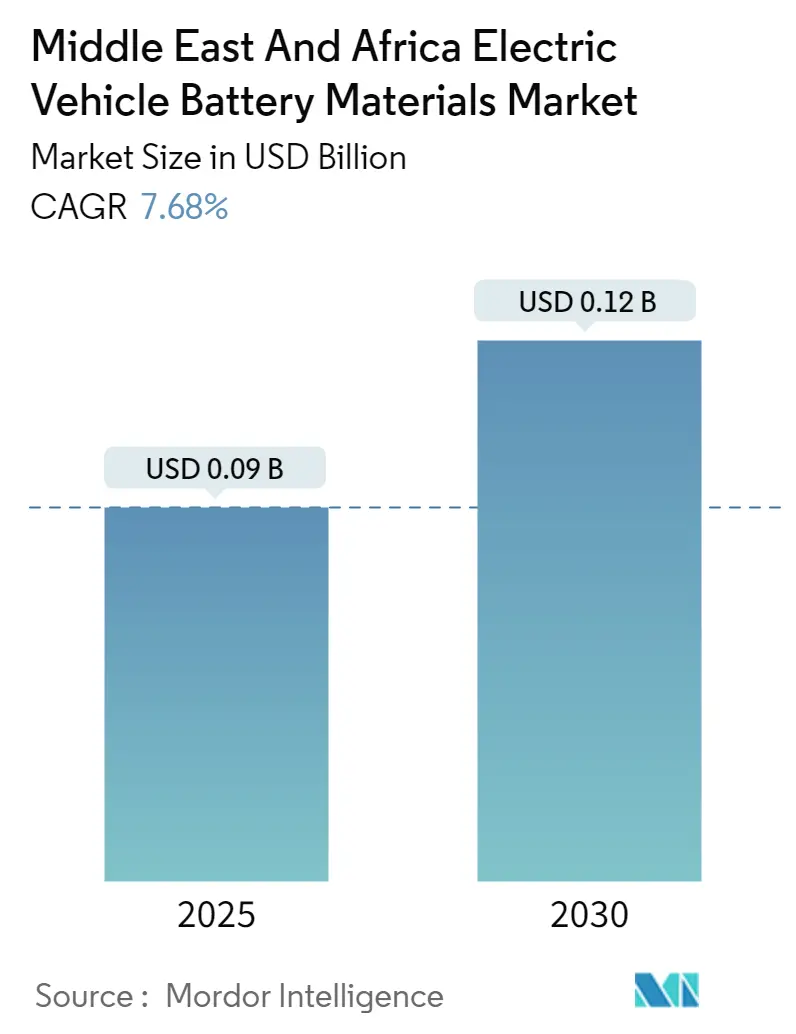
The Middle East And Africa Electric Vehicle Battery Materials Market size is estimated at USD 0.09 billion in 2025, and is expected to reach USD 0.12 billion by 2030, at a CAGR of 7.68% during the forecast period (2025-2030).
- Over the medium term, factors such as rising growth in electric vehicle sales and supportive government policies and regulations are expected to be among the most significant drivers for the Middle East and Africa Electric Vehicle Battery Materials Market during the forecast period.
- Conversely, the Middle East and Africa Electric Vehicle Battery Materials Market faces challenges during the forecast period due to insufficient raw material production and critical battery reserves.
- However, ongoing advancements in battery technology are anticipated to open up numerous opportunities for the market down the line.
- Saudi Arabia is poised for notable growth, projected to achieve the highest growth during the forecast period, driven by intensified efforts to set up battery manufacturing facilities in the region.
Middle east and africa holds a defined position within a broader international distribution. The electric vehicle battery materials market share data by Mordor Intelligence maps that allocation across all contributing regions, globally.
Middle East and Africa Electric Vehicle Battery Materials Market Trends and Insights
Lithium-ion Batteries to Dominate the Market
- Driven by government initiatives and investments promoting sustainable energy, the lithium-ion battery segment in the Middle East and Africa's electric vehicle (EV) battery materials market is set for substantial growth. As electric vehicle adoption rises in the region, lithium-ion batteries emerge as the favored option, due to their high energy density, extended cycle life, and decreasing costs.
- Leading the charge in the shift to electric mobility, countries like the United Arab Emirates and Saudi Arabia are rolling out policies and subsidies to promote electric vehicle usage, consequently driving up the demand for lithium-ion batteries. This transition gains momentum as global automotive giants establish regional facilities, eyeing the burgeoning market and amplifying the demand for cutting-edge battery technologies.
- Over the past decade, breakthroughs in MEA electric vehicle battery manufacturing technology and manufacturing have propelled the uptake of lithium-ion batteries in the electric vehicle sector. These innovations have not only slashed costs but also bolstered performance and reliability, making lithium-ion batteries a top choice for both manufacturers and consumers.
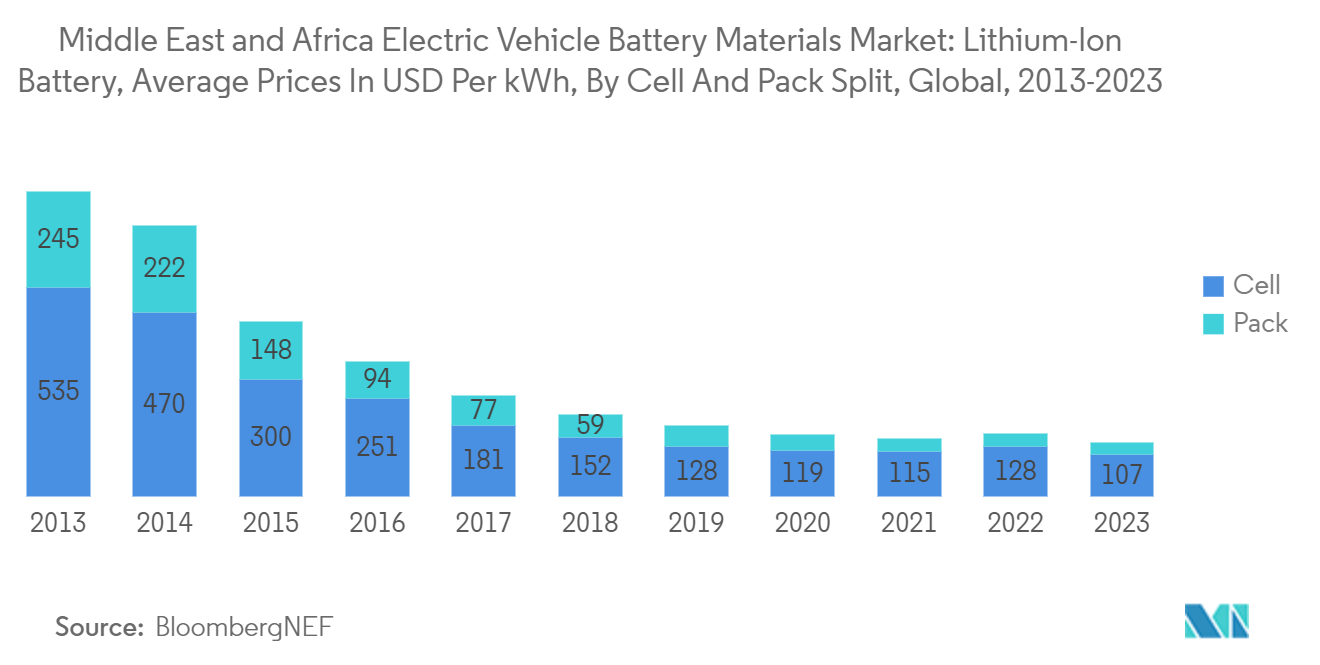
- Recently, declining prices of lithium-ion batteries and cell packs have made them more attractive to end-user industries. After a brief uptick in 2022, battery prices continued their downward trend in 2023. Remarkably, lithium-ion battery pack costs dropped by 14%, reaching a historic low of USD 139/kWh.
- Furthermore, the Middle East and Africa are witnessing strategic collaborations and initiatives to fortify the lithium-ion battery supply chain. These endeavors encompass joint ventures between local and global entities, establishing gigafactories and research centers dedicated to battery innovation and production efficiency.
- For example, in December 2023, an agreement was inked under the watchful eyes of the Federal Ministry of Power and the China Ministry of Ecology and Environment. This pact facilitates a Chinese company's establishment of a USD 150 million lithium-ion battery manufacturing facility in Nigeria. The agreement was signed in Dubai during the United Nations Climate Conference, commonly known as COP28, as highlighted by the Rural Electrification Agency.
- Beyond governmental and industrial moves, heightened consumer awareness regarding the environmental advantages of electric vehicles is propelling the lithium-ion battery segment's growth.
- Given these developments, the lithium-ion battery segment is poised to lead the market in the coming years.
Saudi Arabia to Witness Significant Growth
- Saudi Arabia is in the midst of a transformative journey, marked by significant investments, strategic initiatives, and ambitious objectives, all in line with the nation's Vision 2030 framework. As part of its broader strategy to diversify the economy, lessen its oil dependency, and bolster environmental sustainability, the Saudi government is championing the adoption of electric vehicles.
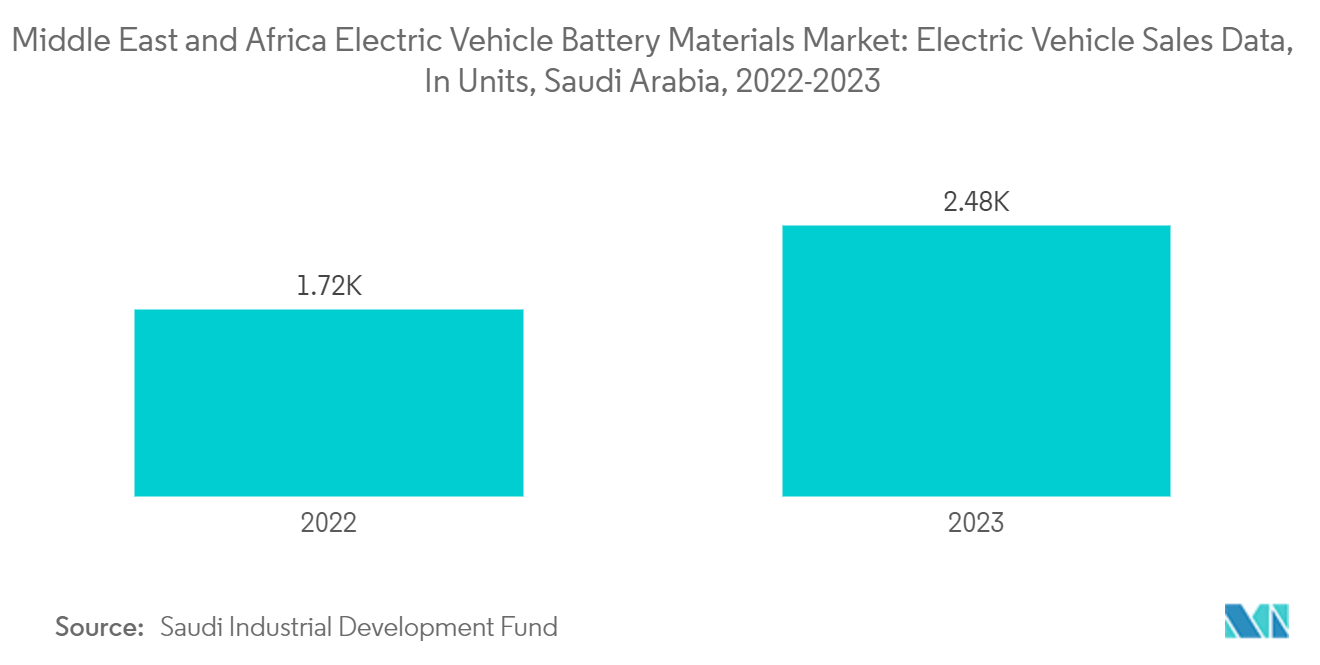
- According to the Saudi Industrial Development Fund, electric vehicle sales in the country surged by over 44.2% from 2022 to 2023, highlighting the growing traction of electric vehicles among the populace. This rising adoption not only signals a shift in consumer preferences but also sets the stage for a burgeoning market for electric vehicle battery materials. In line with these developments, Saudi Arabia is actively working to set up battery manufacturing plants, aiming to meet both its domestic needs and global electric vehicle sales forecasts.
- The increasing demand for electric vehicle battery materials is pivotal for fortifying the nation's electric mobility infrastructure. Saudi Arabia is not just stopping at battery materials; the country is laying down the groundwork for a comprehensive electric vehicle ecosystem, which encompasses manufacturing facilities, research centers, and an expansive charging infrastructure.
- For instance, in January 2023, EV Metals Group (EVM), a global leader in battery materials and technology, announced that its Saudi subsidiary, EV Metals Arabia Company for Industry (EVM Arabia), has been allocated 127 hectares of land by the Royal Commission for Jubail and Yanbu (RCJY).
- This land allocation is a significant milestone for EV Metals Group, marking the site of their ambitious integrated Battery Chemicals Complex in Yanbu Industrial City, backed by an estimated investment of USD 899 million. This complex is not just another facility; it's a strategic move to position the Kingdom as a central midstream hub, especially in meeting the rising demand for high-purity chemicals essential for electric vehicle and battery cell manufacturing.
- Moreover, Saudi Arabia's prime location, coupled with its advanced logistics infrastructure, positions it as a key player in exporting battery materials and finished products. This strategic advantage extends its reach to markets across the Middle East, Africa, and further afield, cementing its stature in the global supply chain.
- Given these developments and the momentum building in the electric vehicle sector, Saudi Arabia is poised for significant growth in the coming years.
Mordor Intelligence delivers a comprehensive view of the electric vehicle battery materials market across all major regions such as South America, Europe, and Asia, alongside country-level analysis for India, China, Germany, France, United Kingdom, and Italy, each offering a view of the local market realities.
Competitive Landscape
The Middle East and Africa Electric Vehicle Battery Materials Market is semi-consolidated. Some of the key players in this market (in no particular order) are Targray Technology International Inc., BASF SE, Mitsubishi Chemical Group Corporation, Middle East Battery Company, and SGL Carbon.
Middle East and Africa Electric Vehicle Battery Materials Industry Leaders
-
Targray Technology International Inc.
-
BASF SE
-
Mitsubishi Chemical Group Corporation
-
Middle East Battery Company
-
SGL Carbon
- *Disclaimer: Major Players sorted in no particular order
Recent Industry Developments
- June 2024: The Moroccan government announced that China's Gotion High will spearhead the construction of Morocco's inaugural EV battery gigafactory, with a price tag of USD 1.3 billion. Gotion High Tech's move underscores a broader trend, as Morocco, eyeing the surge in electric vehicle demand, is attracting a slew of investments in EV battery production. The investment pact inked between the Moroccan government and Gotion High Tech outlines the gigafactory's initial capacity at 20 gigawatt-hours (GWh).
- January 2024: South Africa's Aqora has rebranded itself as Afrivolt. Afrivolt's strategic pivot involves establishing a lithium-ion cell gigafactory in South Africa. The facility aims to craft anodes, cathodes, and lithium-ion batteries, initially targeting stationary storage applications and, later, electric vehicles (EVs).
Middle East and Africa Electric Vehicle Battery Materials Market Report Scope
Electric vehicle battery materials refer to the raw materials and components used in the manufacturing of batteries for electric vehicles (EVs). The cathode, anode, electrolyte, and separator are key components of these batteries, each requiring specific materials to function effectively. The availability, cost, and sustainability of these materials are crucial factors influencing the production and advancement of electric vehicle batteries.
The Middle East and Africa Electric Vehicle Battery Materials Market is segmented by battery type, material, and Geography. By battery type, the market is divided into Lithium-ion Batteries, Lead-Acid Batteries, and Others. By material, it is divided into Cathode, Anode, Electrolyte, Separator, and Others. By Geography, the market is segmented into Saudi Arabia, the United Arab Emirates, Nigeria, Qatar, Egypt, South Africa, and the Rest of the Middle East and Africa. The report also covers the size and forecasts for the Electric Vehicle Battery Materials Markets across major regions. The market sizing and forecasts have been done for each segment based on revenue (USD).
| Lithium-ion Battery |
| Lead-Acid Battery |
| Others |
| Cathode |
| Anode |
| Electrolyte |
| Separator |
| Others |
| Saudi Arabia |
| United Arab Emirates |
| Nigeria |
| Qatar |
| Egypt |
| South Africa |
| Rest of Middle East and Africa |
| Battery Type | Lithium-ion Battery |
| Lead-Acid Battery | |
| Others | |
| Material | Cathode |
| Anode | |
| Electrolyte | |
| Separator | |
| Others | |
| Geography | Saudi Arabia |
| United Arab Emirates | |
| Nigeria | |
| Qatar | |
| Egypt | |
| South Africa | |
| Rest of Middle East and Africa |
Key Questions Answered in the Report
How big is the Middle East And Africa Electric Vehicle Battery Materials Market?
The Middle East And Africa Electric Vehicle Battery Materials Market size is expected to reach USD 0.09 billion in 2025 and grow at a CAGR of 7.68% to reach USD 0.12 billion by 2030.
What is the current Middle East And Africa Electric Vehicle Battery Materials Market size?
In 2025, the Middle East And Africa Electric Vehicle Battery Materials Market size is expected to reach USD 0.09 billion.
Who are the key players in Middle East And Africa Electric Vehicle Battery Materials Market?
Targray Technology International Inc., BASF SE, Mitsubishi Chemical Group Corporation, Middle East Battery Company and SGL Carbon are the major companies operating in the Middle East And Africa Electric Vehicle Battery Materials Market.
What years does this Middle East And Africa Electric Vehicle Battery Materials Market cover, and what was the market size in 2024?
In 2024, the Middle East And Africa Electric Vehicle Battery Materials Market size was estimated at USD 0.08 billion. The report covers the Middle East And Africa Electric Vehicle Battery Materials Market historical market size for years: 2019, 2020, 2021, 2022, 2023 and 2024. The report also forecasts the Middle East And Africa Electric Vehicle Battery Materials Market size for years: 2025, 2026, 2027, 2028, 2029 and 2030.
Middle East and Africa Electric Vehicle Battery Materials Market Report
Statistics for the 2025 Middle East and Africa Electric Vehicle Battery Materials market share, size and revenue growth rate, created by Mordor Intelligence™ Industry Reports. Middle East and Africa Electric Vehicle Battery Materials analysis includes a market forecast outlook for 2025 to 2030 and historical overview. Get a sample of this industry analysis as a free report PDF download.