
Micro-Ultrasound Systems Market Size and Share
Market Overview
| Study Period | 2020 - 2031 |
|---|---|
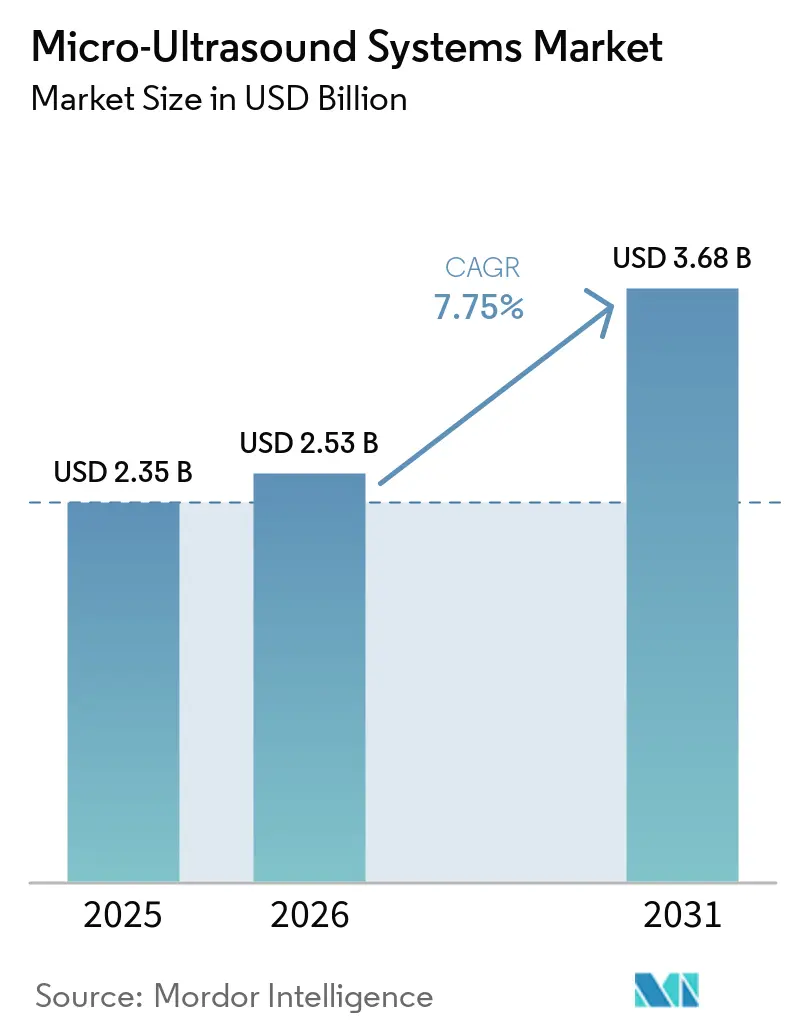
| Market Size (2026) | USD 2.53 Billion |
| Market Size (2031) | USD 3.68 Billion |
| Growth Rate (2026 - 2031) | 7.75 % |
| Fastest Growing Market | Asia-Pacific |
| Largest Market | North America |
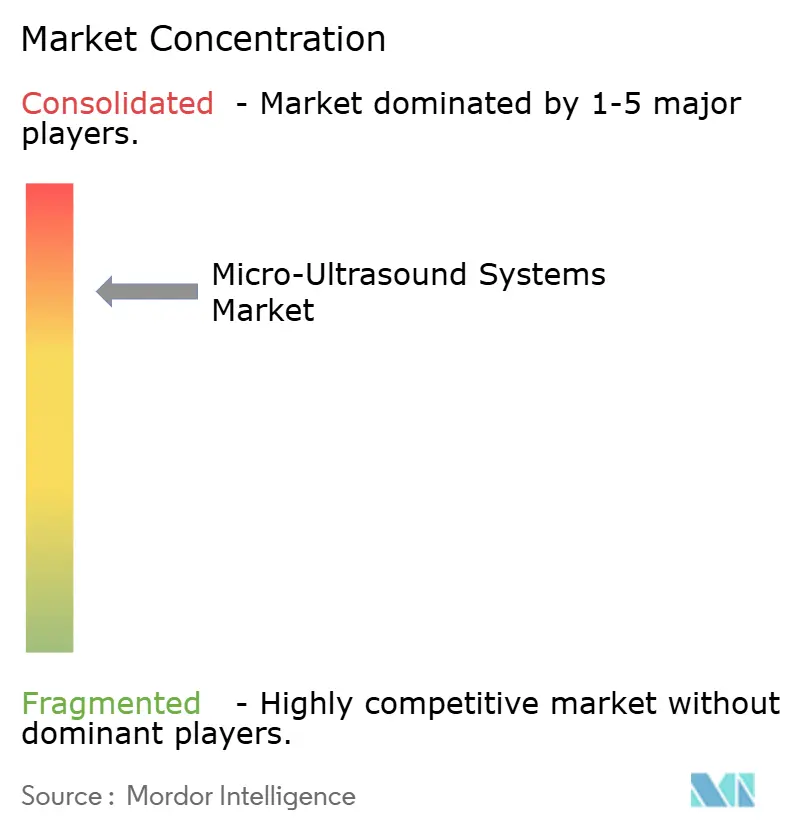
| Market Concentration | High |
Major Players *Disclaimer: Major Players sorted in no particular order Image © Mordor Intelligence. Reuse requires attribution under CC BY 4.0. | |
Micro-Ultrasound Systems Market Analysis by Mordor Intelligence
The Micro-Ultrasound Systems Market size is expected to grow from USD 2.35 billion in 2025 to USD 2.53 billion in 2026 and is forecast to reach USD 3.68 billion by 2031 at 7.75% CAGR over 2026-2031.
Demand is rising for procedure-specific imaging that provides real-time views and supports targeted interventions. In prostate care, 29 MHz micro-ultrasound offers an alternative to MRI-based pathways by enabling targeting, image review, and biopsy planning within the urology setting. When MRI capacity is limited, office-based micro-ultrasound can reduce delays, streamline referrals, and help patients receive decisions sooner. Suppliers are focusing on image interpretation software, workflow integration, probes, and service arrangements. Buyers consider training, software updates, reporting compatibility, local support, probe replacement, and use across multiple locations. Growth is strongest where clinical evidence, reimbursement, training, and technical support align. However, deep-tissue limitations and uncertain payment pathways restrict use beyond established applications.
Key Report Takeaways
- By product type, high-frequency probes and transducers held 39.31% share in 2025, while software platforms are forecast to grow at a 12.65% CAGR through 2031.
- By form factor, cart-based systems held 35.24% share in 2025, while handheld systems are forecast to grow at 13.42% CAGR through 2031.
- By technology, high-frequency ultrasound held 42.14% share in 2025, while elastography is forecast to grow at 12.12% CAGR through 2031.
- By application, urology and prostate imaging held 44.54% share in 2025, while cardiovascular and intravascular imaging is forecast to grow at a 12.82% CAGR through 2031.
- By end user, hospitals and health systems held 32.64% share in 2025, while specialized clinics and ambulatory surgery centers are forecast to grow at a 13.25% CAGR through 2031.
- By geography, North America held 36.21% share in 2025, while Asia-Pacific is forecast to grow at a 12.15% CAGR through 2031.
Note: Market size and forecast figures in this report are generated using Mordor Intelligence’s proprietary estimation framework, updated with the latest available data and insights as of January 2026.
Global Micro-Ultrasound Systems Market Trends and Insights
Drivers Impact Analysis*
| Driver | (~) % Impact on CAGR Forecast | Geographic Relevance | Impact Timeline |
|---|---|---|---|
| Adoption Of High-Resolution Real-Time Imaging | +2.0% | Global, with peak concentration in North America and Western Europe | Medium term (2-4 years) |
| Expansion Of Targeted Prostate Biopsy Workflows | +1.7% | North America, Europe, Japan, Australia, with spillover to Brazil and South Korea | Short term (≤ 2 years) |
| Growth Of Preclinical And Translational Imaging Research | +1.0% | North America and Europe, with expansion to Asia-Pacific academic hubs | Medium term (2-4 years) |
| CMUT And PMUT Miniaturization For High-Frequency Imaging | +0.9% | Global, with technology development concentrated in the United States, China, and Germany | Long term (≥ 4 years) |
| Procedure-Level Economics Of MRI-Alternative Screening Pathways | +1.1% | Global, with highest fiscal sensitivity in Europe and Asia-Pacific public health systems | Short term (≤ 2 years) |
| Source: Mordor Intelligence | |||
Increasing Adoption Of High-Resolution, Real-Time Imaging
The Micro-ultrasound systems market is supported by systems that combine 29 MHz to 70 MHz operating frequencies with real-time processing at the point of examination. This range helps clinicians visualize fine superficial anatomy during an assessment rather than waiting for a later imaging review. These systems can show microanatomical detail that previously required MRI or histopathology in selected workflows. Still, they remain designed for defined clinical indications rather than broad replacement of every imaging method. A 2026 review reported that AI-enabled models for prostate cancer detection achieved an area under the curve of up to 0.871, with 92.5% sensitivity and 68.1% specificity.
AI tools can make interpretation more consistent, reduce dependence on a small group of highly specialized users, and give hospitals a clearer basis for training clinicians across several sites. This matters in musculoskeletal and ophthalmology care, where high-resolution imaging may improve diagnostic assessment without the capital cost, scheduling requirements, or separate physical space associated with MRI. As multisite AI models move into commercial use, more referring physicians may direct suitable patients to office-based micro-ultrasound, which can reduce diagnostic delays, simplify patient movement between departments, and raise procedure volumes.
Expansion Of Targeted Prostate Biopsy Workflows
Targeted prostate biopsy is a central demand driver for the Micro-ultrasound systems market because it fits the clinical workflow that urologists already use for transrectal procedures. The OPTIMUM randomized trial included 802 biopsy-naive men across 20 centers and found that micro-ultrasound-guided biopsy was non-inferior to MRI fusion-guided biopsy for the detection of Gleason Grade Group 2 or higher prostate cancer.
A 29 MHz system allows the physician to perform targeted imaging and biopsy without a separate MRI scheduling cycle, which can remove a practical delay between a clinical concern and a diagnostic procedure. This can improve throughput where radiology departments face long queues, and it can make scheduling easier for patients who would otherwise need several appointments. Exact Imaging expanded its North American commercial team in 2026 as it built momentum with major health systems. The PRI-MUS scoring protocol, which is included in clinical guidelines, can support more consistent diagnostic performance across institutions and can give providers a common method for discussing imaging findings.
Growth Of Preclinical And Translational Imaging Research
Preclinical research provides a separate source of demand for the Micro-ultrasound systems market, one that is less dependent on the reimbursement decisions that shape hospital purchasing. Micro-ultrasound supports longitudinal monitoring of tumor blood vessels and tumor volume in small-animal models without ionizing radiation, allowing repeated observation within a research program. A 2026 study demonstrated the feasibility of contrast-free super-resolution ultrasound for assessing microvasculature in murine subcutaneous tumor models. VisualSonics states that its Vevo F2xc system operates across a 71 MHz to 1 MHz range and supports neurovascular imaging and whole-brain microvascular reconstruction in mice within 5 seconds[1]“Vevo F2xc Imaging System,” FUJIFILM VisualSonics, visualsonics.com..
Research use broadens the base of investigators who can later support clinical evidence generation in oncology, cardiovascular research, neuroscience, and other applications that need detailed imaging of small structures. Pharmaceutical and biotechnology buyers can offer more stable demand because their imaging purchases are tied to continuing study programs, established laboratory workflows, and repeat research activity rather than reimbursement decisions alone. This research base can also help suppliers demonstrate new use cases before they seek wider clinical adoption.
CMUT And PMUT Miniaturization For High-Frequency Imaging
CMUT and PMUT development is expanding the technical options available to the Micro-ultrasound systems market, particularly for manufacturers seeking smaller probes and closer integration with electronic components. These micromachined transducers can offer broad bandwidth, compatibility with CMOS integration, and more uniform wafer-level manufacturing than conventional lead-zirconate-titanate ceramics, which can support repeatable production at scale. A 2026 study described a 64-element aluminum nitride PMUT array with a 7:1 aspect ratio, fractional bandwidth above 60% at a 7 MHz center frequency, and lateral resolution of 0.26 mm.
Kolo Medical has commercialized CMUT-based linear probes for dermatology, ophthalmology, rheumatology, and musculoskeletal imaging. The company’s SiliconWave approach provides a semiconductor fabrication path that could lower probe costs as production scales and could support application-specific designs. Lower output pressure, dielectric charging, and bias-voltage requirements still limit use in deep-tissue cardiology and intravascular settings, so technical progress alone does not remove the need for clinical validation.
Restraints Impact Analysis*
| Restraint | (~) % Impact on CAGR Forecast | Geographic Relevance | Impact Timeline |
|---|---|---|---|
| Limited Penetration Depth At Ultra-High Frequencies | -1.2% | Global, limiting uptake in deep-tissue clinical workflows | Long term (≥ 4 years) |
| Clinical Evidence And Reimbursement Uncertainty Outside Urology | -1.0% | Europe, Asia-Pacific, and the Middle East, with partial mitigation through United States payer coverage | Medium term (2-4 years) |
| Shortage Of Specialized Acoustic Engineering And Clinical Applications Talent | -0.7% | Global, with the greatest pressure in emerging Asia-Pacific and Middle East markets | Short term (≤ 2 years) |
| Source: Mordor Intelligence | |||
Limited Penetration Depth At Ultra-High Frequencies
Limited penetration depth restricts the Micro-ultrasound systems market in deep-tissue care settings and remains a physical constraint rather than a short-term commercial issue. Above 40 MHz, usable penetration depth falls below 10 mm to 15 mm, which limits use in deep abdominal, pelvic floor, and cardiac wall imaging, where clinicians need a view beyond superficial structures. High-frequency devices, therefore, do not directly replace MRI, CT, or conventional ultrasound in these procedures, even where the image detail at shallower depths is valuable.
Intravascular delivery can address the depth issue for lesion assessment, but it adds procedure cost, device requirements, and clinical complexity that limit use to selected high-risk cases. The European Federation of Societies for Ultrasound in Medicine and Biology noted that vascular ultrasound elastography was not recommended for routine clinical decision-making. Signal-processing methods such as compounding and coherent plane-wave imaging can partly improve the trade-off at 15 MHz to 30 MHz. Still, they do not remove the structural limit on deep-tissue imaging or open every conventional ultrasound application to micro-ultrasound.
Clinical Evidence And Reimbursement Uncertainty Outside Urology
Clinical evidence and reimbursement uncertainty remain significant limits on the Micro-ultrasound systems market outside urology. Micro-ultrasound-guided prostate biopsy using the PRI-MUS protocol has the strongest comparative clinical evidence and guideline support among current applications, giving providers a clearer starting point for adoption. In musculoskeletal, ophthalmology, and cardiovascular care, the evidence base remains at preclinical or early clinical stages, so payers have less comparative data on which to base a reimbursement decision.
Aetna’s clinical policy addresses micro-ultrasound-guided prostate biopsy as investigational outside specified clinical criteria[2]“Prostate Biopsy, Medical Clinical Policy Bulletins,” Aetna, aetna.com.. European health technology assessment systems and Japan’s reimbursement review process can create multi-year delays between clinical evidence and a billing pathway, which makes market entry more resource-intensive for suppliers. Manufacturers must therefore fund investigator-led trials and health economics studies before they can expect broad adoption in new indications. A shortage of acoustic engineering and clinical applications specialists adds a near-term training constraint, especially in emerging Asia-Pacific and Middle East markets, where providers may have less access to specialized education and local technical support.
*Our forecasts treat driver/restraint impacts as directional, not additive. The impact forecasts reflect baseline growth, mix effects, and variable interactions.
Segment Analysis
By Product Type: Software Integration Reshaping Hardware Revenue Dynamics
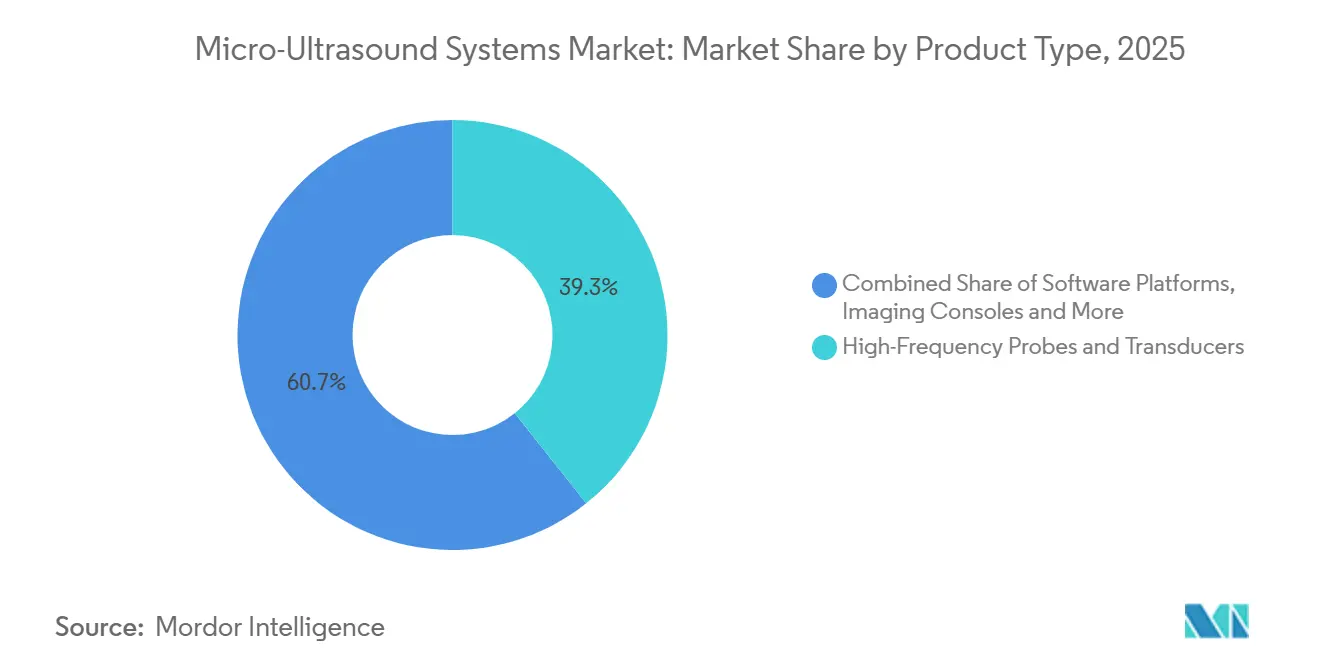
High-frequency probes and transducers held 39.31% of the micro-ultrasound systems market share in 2025. Their leading position reflects recurring procurement because transducers require replacement, and multiprobe workflows add spending beyond the original console purchase. In practice, a department can need different probes for different anatomy, patient positioning, and procedural requirements, which makes the probe portfolio important after the first system sale. Probe specialization is becoming an important competitive consideration in clinical imaging because buyers assess resolution, ease of handling, compatibility, and service support together. Kolo Medical’s commercially available CMUT-based probes operate at frequencies up to 38+ MHz for high-resolution dermatology, ophthalmology, and musculoskeletal imaging. This product mix favors suppliers that can tailor probe design to individual clinical uses and help users select the right tool for a defined examination. Accessories and consumables also benefit as more preclinical imaging centers add systems and require routine supplies, positioning aids, and replacement components during long research programs.
Software platforms are forecast to grow at a 12.65% CAGR through 2031, the highest rate among product types. The Micro-ultrasound systems market size for software platforms is supported by demand for automated lesion scoring, PRI-MUS risk assessment, and MRI-fusion overlays. These functions increasingly influence system selection in competitive tenders because buyers want an imaging system that can be used consistently by different clinicians and linked to existing documentation practices. Software can help users manage operator variation and integrate images into existing clinical workflows, including review, reporting, and follow-up discussions. The Micro-ultrasound systems industry is moving toward a model where software licensing can supplement hardware revenue and support a continuing commercial relationship after installation. Higher software attachment can improve recurring revenue even when equipment unit growth is uneven, especially where providers add modules after gaining experience with a system. Suppliers that combine validated image analysis with dependable workflow support are better placed to benefit from this shift.



By Form Factor: Handheld Systems Expanding Point-Of-Care Access
Cart-based systems held 35.24% of the Micro-ultrasound systems market in 2025. Their established position is tied to the computing stability and fixed-aperture arrays needed for prostate imaging and intravascular procedures. Cart-based installations are common in tertiary hospitals and academic centers that manage complex procedures, maintain dedicated imaging rooms, and can support regular use by a specialist team. They can support consistent imaging in settings where a dedicated clinical room, trained staff, and established technical support are available. These systems also suit facilities that need to connect imaging data with a wider group of clinicians and electronic records. Tabletop research systems serve a different but steady role in pharmaceutical and academic studies. FUJIFILM VisualSonics positions the Vevo F2xc as a wide-frequency research platform for cardiovascular and oncology work.
Handheld systems are forecast to grow at a 13.42% CAGR through 2031, making them the fastest-growing form factor. Portability can bring high-resolution assessment closer to the point of care and reduce the capital commitment needed for office-based adoption, particularly where a practice has limited space or a smaller equipment budget. CMUT-on-ASIC integration creates a possible path for smaller, purpose-built devices that retain useful image quality while reducing the size of the hardware platform. The opportunity that was mentioned above is particularly relevant to independent urology practices that may not be a cart-based purchase but can use a portable system within a focused diagnostic pathway. Current handheld options have not yet combined a sub-USD 10,000 price point, 29 MHz imaging capability, and a validated AI scoring protocol in one device. The Micro-ultrasound systems market may therefore see competition focus on the balance between compact design, image quality, clinical validation, and the practical demands of cleaning, storage, and data management. A portable device must still meet the reliability and workflow needs of specialist users before it can replace more established equipment in a routine setting.
By Technology: Elastography Adding Tissue Characterization Capability
High-frequency ultrasound held 42.14% of market revenue in 2025 and remained the core technology across urology, dermatology, and preclinical research. It provides the imaging foundation for systems designed to show superficial structures in real time, which is why it remains central to the clinical uses with the clearest evidence base. Two-dimensional micro-ultrasound remains the main clinical format because it supports routine imaging and guided procedures without requiring a major change in the physician’s workflow. Doppler micro-ultrasound also supports vascular access and superficial-vein procedures where blood flow information can complement structural imaging. Three-dimensional and 4D systems are emerging in obstetrics, oncology surgery, and other settings that benefit from live volumetric views and closer assessment of tissue boundaries. These technology options allow platform vendors to serve different clinical needs from related high-frequency imaging architectures, rather than relying on a single configuration for every use.
Elastography is forecast to grow at a 12.12% CAGR through 2031, the fastest rate within the technology segmentation. It measures tissue stiffness and can support cancer differentiation and assessment of plaque vulnerability, adding a functional element to imaging that otherwise focuses on anatomy. A 2025 study of intravascular ultrasound elastography reported a 1.55 mm outer-diameter dual-element microcatheter and observed stiffness of 4.9 ± 0.3 kPa in atherosclerotic plaques and 39.6 ± 2.5 kPa in normal vessel walls in vivo. This evidence supports further work on interventional decision-making, although adoption requires clinicians to understand how stiffness measurements should be interpreted alongside established imaging findings. The Micro-ultrasound systems market depends on multicenter validation to move elastography from research settings into reimbursed clinical protocols. The European ultrasound community continues to call for stronger clinical validation before routine decision-making use.
By Application: Urology Leads While Cardiovascular Use Expands
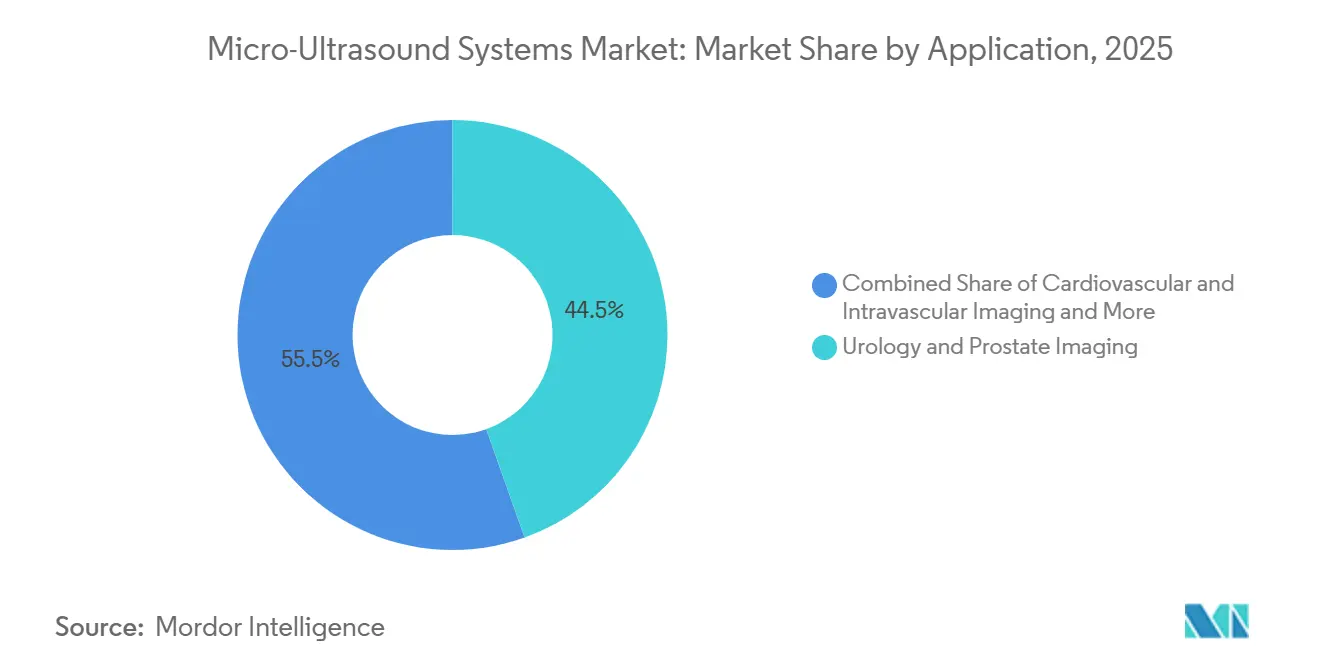
Urology and prostate imaging held 44.54% of the micro-ultrasound systems market share in 2025. This leadership is supported by the clinical evidence for targeted prostate biopsy and recognition of the OPTIMUM findings in 2025. The application uses real-time high-resolution imaging to guide a procedure that urologists already perform, which reduces the workflow change needed at the point of adoption. Evidence and workflow familiarity have given prostate care a clearer route to institutional procurement than many other uses, where the evidence and reimbursement case are less mature. ExactVu and Philips UroNav hold FDA clearances that support procurement confidence in the United States. Prostate imaging is likely to remain the principal clinical reference point for suppliers building proof of value in other applications, especially when they need to show that a device can improve diagnostic efficiency without creating another referral step.
Cardiovascular and intravascular imaging is forecast to grow at a 12.82% CAGR through 2031. In this use case, catheter-based imaging can work around the depth limitations that restrict external high-frequency imaging and can bring the transducer closer to the tissue being assessed. A 2025 review described intravascular ultrasound elastography as a potential tool for plaque stiffness assessment and rupture-risk stratification. Oncology research, ophthalmology, and musculoskeletal imaging are also developing niches as clinical studies and AI model libraries expand, although each needs evidence tailored to its own care setting. Obstetrics, gynecology, neurology, and neurovascular research remain smaller contributors that can benefit from 3D, 4D, and Doppler capabilities. The Micro-ultrasound systems market has a broader application base than prostate care alone, but these uses need stronger clinical data and reimbursement support. Commercial success outside urology will depend on evidence that demonstrates a clear advantage in defined care pathways and gives physicians a reason to change an established imaging routine.
By End User: Outpatient Care Shifting System Demand
Hospitals and health systems held 32.64% of market revenue in 2025, making them the largest end-user group. Early deployments were concentrated in tertiary hospitals and academic medical centers because cart-based systems require capital budgets, technical support, specialist users, and clear ownership within the imaging or procedural department. Hospitals continue to provide an important base for high-volume urology and cardiovascular procedures, where coordinated teams can use specialized equipment regularly. Academic and research institutions form another established buyer group through preclinical studies in oncology, cardiology, and neuroscience. Diagnostic centers are also expanding their use of outpatient high-frequency imaging as reimbursement conditions develop and referrers seek faster access to targeted examinations. These settings give vendors opportunities to combine equipment sales with maintenance, training, and image analysis support, which can be important where users need help adopting a new procedure.
Specialized clinics and ambulatory surgery centers are forecast to grow at a 13.25% CAGR through 2031. This trend reflects the movement of targeted prostate biopsy and point-of-care musculoskeletal imaging into cost-conscious outpatient settings, where patients and providers may prefer fewer visits. The Micro-ultrasound systems market size for these end users grows when a system can fit into an existing office workflow and reduce reliance on a separate MRI visit. Pharmaceutical and biotechnology companies represent a separate buyer group because they purchase tabletop platforms for sustained preclinical programs and often need repeat imaging over long study periods. These companies can have lower price sensitivity and stronger demand for software modules that help them manage and compare research data. As procedures shift toward ambulatory settings, system prices may face pressure because clinic procurement teams are more cost-sensitive than hospital capital committees. Service contracts and software renewals can become more important as the installed base broadens and as suppliers support users outside major hospital networks.
Geography Analysis
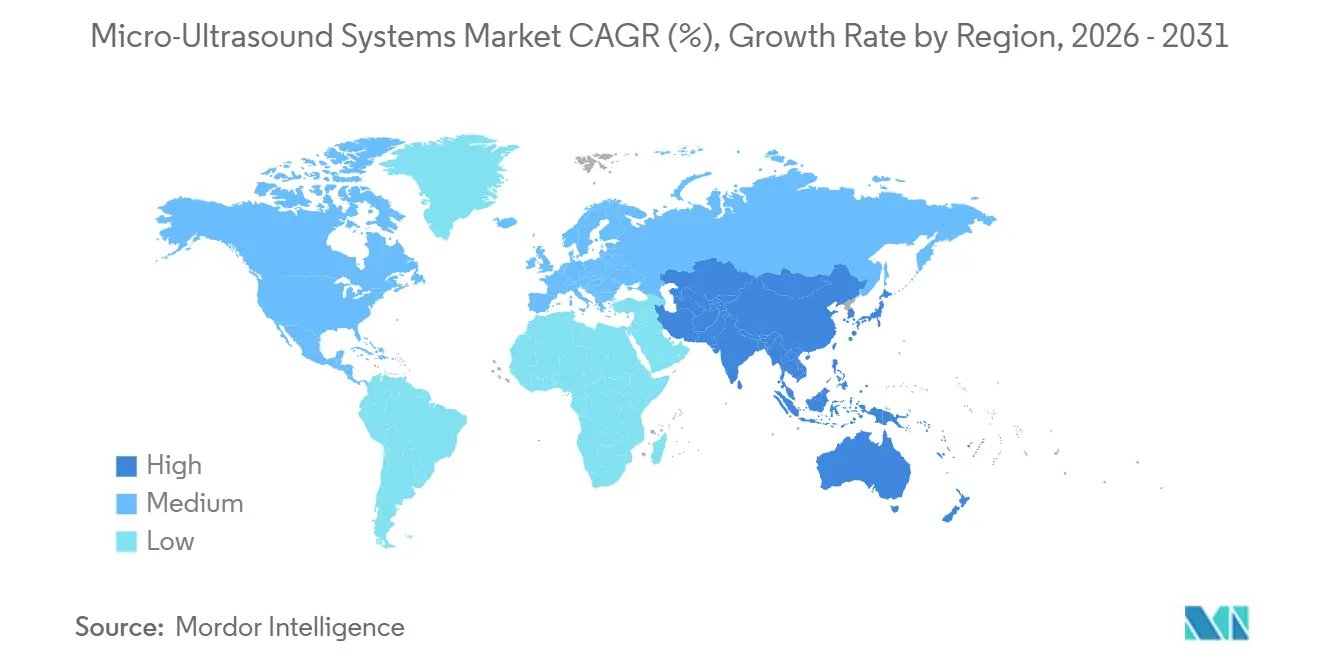
North America held 36.21% of the Micro-ultrasound systems market in 2025. The region’s position is supported by established reimbursement infrastructure, leading equipment manufacturers, and an active FDA clearance environment for ultrasound devices, which can make new systems easier for providers to evaluate and procure. The United States is the largest national market because its urology community has rapidly considered the clinical evidence for micro-ultrasound-guided prostate biopsy. Canada contributes through procurement by academic medical centers and Exact Imaging’s home-market presence in Toronto. Mexico remains at an earlier stage, although specialty urology clinics are building demand through distributor relationships and introducing the technology within focused prostate care services. Long MRI wait times and high procedure costs can increase the appeal of office-based micro-ultrasound for initial prostate cancer assessment, particularly where providers can perform imaging and biopsy within a coordinated local pathway.
Europe remained the second-largest regional base for the Micro-ultrasound systems market, with Germany, the United Kingdom, and France as key procurement countries. The EU Medical Device Regulation has standardized market access requirements while increasing post-market surveillance responsibilities, creating greater administrative demands for suppliers and health care providers. The United Kingdom’s NHS Shared Business Services framework and Germany’s IQWiG process can create different reimbursement timelines for new imaging technologies. European urology bodies have made more guideline progress for prostate biopsy than comparable Asian systems, which supports earlier adoption where providers can connect clinical guidance to payment pathways. Italy and Spain are gaining demand through oncology screening activity and private health care networks. The Nordics and the Netherlands contribute through preclinical research purchases. Philips launched the Alturion ultrasound system in July 2026 with AI-powered workflows, FDA 510(k) clearance, and a CE mark, and received FDA clearance for Elevate Plus in June 2026.
Asia-Pacific is forecast to grow at a 12.15% CAGR through 2031, the fastest regional rate. China’s health care modernization is extending diagnostic infrastructure into tier-2 and tier-3 cities, where mid-tier systems can meet cost-sensitive demand and help providers offer imaging services closer to patients outside the largest metropolitan areas. India’s Production Linked Incentive scheme for medical devices is building local capacity for ultrasound components and can reduce import dependence. This local manufacturing focus can also support more competitive institutional pricing when hospitals compare imported equipment with systems assembled through domestic supply chains. South Korea and Australia serve as early-adoption and reference-site markets for new releases from GE HealthCare, Philips, and Siemens. Japan’s aging population remains relevant to demand for diagnostic services, although reimbursement review and clinical adoption can take time. The Middle East, Africa, and South America are earlier-stage regions, with GCC countries investing in tertiary-care imaging and Brazil building specialist oncology workflows through distribution relationships, local training, and more focused engagement with urology providers.

Competitive Landscape
The Micro-ultrasound systems market has a concentrated competitive structure. GE HealthCare, Koninklijke Philips, Siemens Healthineers, Fujifilm Holdings, and Samsung Medison compete through broad product portfolios, AI-enabled workflow tools, and global service networks that can support customers across different care settings. Exact Imaging, Kolo Medical, Verasonics, and Vermon S.A.S. focus more closely on high-frequency transducers and clinical-use-specific systems. Larger companies can serve a wide range of hospital needs, while specialized suppliers can compete through resolution, probe design, focused applications, and a close understanding of a particular user group. This mix creates competition between platform breadth and purpose-built clinical capability. The Micro-ultrasound systems industry has not yet settled on one standard approach to combining high-frequency imaging, portable form factors, validated AI tools, and the service support needed for routine clinical use.
GE HealthCare launched the Vivid Explorer, Vivid Advanced, and Vivid Focus cardiovascular ultrasound portfolio in August 2026. The portfolio uses the cSound imaging architecture and includes AI Auto Measure 2D and Easy AutoEF tools[3]“GE HealthCare Unveils the Next Generation of the Vivid Cardiovascular Ultrasound Portfolio,” GE HealthCare, gehealthcare.com.. This move shows how large suppliers are using shared software foundations across platform families and care settings. Philips launched Alturion in July 2026 with AI-powered workflows for high-volume clinical environments. Philips also received FDA 510(k) clearance for Elevate Plus for EPIQ Elite and Affiniti in June 2026. These releases strengthen the commercial infrastructure for high-resolution imaging and automated workflow features.
The competitive opportunity remains in a handheld device that combines 29 MHz imaging, validated AI scoring, and a lower entry price without sacrificing the image consistency and application support expected in specialty care. The Micro-ultrasound systems market is therefore likely to reward suppliers that make specialized imaging easier to buy, operate, integrate with clinical records, and support after installation through reliable training, responsive service, and software updates that remain useful across the life of a system.
Micro-Ultrasound Systems Industry Leaders
Fujifilm Holdings Corporation
Exact Imaging Inc.
Butterfly Network, Inc.
Verasonics, Inc.
Vermon S.A.S.
- *Disclaimer: Major Players sorted in no particular order

Recent Industry Developments
- June 2026: Exact Imaging, the creator of a first-of-its-kind high-resolution micro-ultrasound system for targeted prostate cancer biopsies, announced expansion of its U.S. commercial team as the company continues to build momentum across major health systems.
- November 2025: Exact Imaging announced results from its OPTIMUM clinical trial demonstrating the non-inferiority of its ExactVu micro-ultrasound platform to MRI fusion-guided biopsy for diagnosing prostate cancer.


Global Micro-Ultrasound Systems Market Report Scope
As per the scope of the report, micro-ultrasound systems are advanced medical imaging devices that utilize very high-frequency ultrasound waves, typically in the range of 20 to 50 MHz, to produce high-resolution images of superficial tissues and small anatomical structures. These systems are particularly useful for detailed visualization in areas such as the prostate, skin, superficial vessels, and small organs, providing clinicians with precise diagnostic information at a microscopic level.
The micro-ultrasound systems market is segmented by product type into imaging consoles, high-frequency probes and transducers, software platforms, and accessories and consumables; by form factor into cart-based systems, handheld systems, tabletop research systems, and other form factors; by technology into high-frequency ultrasound, 2D micro-ultrasound, 3D and 4D micro-ultrasound, Doppler micro-ultrasound, elastography, and other technologies; by application into urology and prostate imaging, oncology research, cardiovascular and intravascular imaging, ophthalmology and anterior segment imaging, obstetrics and gynecology, musculoskeletal and rheumatology imaging, neurology and neurovascular research, and other applications; by end user into hospitals and health systems, diagnostic centers, specialized clinics and ambulatory surgery centers, academic and research institutions, pharmaceutical and biotechnology companies, and other end users; and by geography into North America, Europe, Asia-Pacific, the Middle East and Africa, and South America. The market report also covers the estimated market sizes and trends for 17 countries across major regions globally. For each segment, the market size and forecast are provided in terms of value (USD).
| Imaging Consoles |
| High-Frequency Probes and Transducers |
| Software Platforms |
| Accessories and Consumables |
| Cart-Based Systems |
| Handheld Systems |
| Tabletop Research Systems |
| Others |
| High-Frequency Ultrasound |
| 2D Micro-Ultrasound |
| 3D and 4D Micro-Ultrasound |
| Doppler Micro-Ultrasound |
| Elastography |
| Other Technologies |
| Urology and Prostate Imaging |
| Oncology Research |
| Cardiovascular and Intravascular Imaging |
| Ophthalmology and Anterior-Segment Imaging |
| Obstetrics and Gynecology |
| Musculoskeletal and Rheumatology Imaging |
| Neurology and Neurovascular Research |
| Other Applications |
| Hospitals and Health Systems |
| Diagnostic Centers |
| Specialized Clinics and Ambulatory Surgery Centers |
| Academic and Research Institutions |
| Pharmaceutical and Biotechnology Companies |
| Other End Users |
| North America | United States |
| Canada | |
| Mexico | |
| Europe | Germany |
| United Kingdom | |
| France | |
| Italy | |
| Spain | |
| Rest of Europe | |
| Asia-Pacific | China |
| Japan | |
| India | |
| Australia | |
| South Korea | |
| Rest of Asia-Pacific | |
| Middle East and Africa | GCC |
| South Africa | |
| Rest of Middle East and Africa | |
| South America | Brazil |
| Argentina | |
| Rest of South America |
| By Product Type | Imaging Consoles | |
| High-Frequency Probes and Transducers | ||
| Software Platforms | ||
| Accessories and Consumables | ||
| By Form Factor | Cart-Based Systems | |
| Handheld Systems | ||
| Tabletop Research Systems | ||
| Others | ||
| By Technology | High-Frequency Ultrasound | |
| 2D Micro-Ultrasound | ||
| 3D and 4D Micro-Ultrasound | ||
| Doppler Micro-Ultrasound | ||
| Elastography | ||
| Other Technologies | ||
| By Application | Urology and Prostate Imaging | |
| Oncology Research | ||
| Cardiovascular and Intravascular Imaging | ||
| Ophthalmology and Anterior-Segment Imaging | ||
| Obstetrics and Gynecology | ||
| Musculoskeletal and Rheumatology Imaging | ||
| Neurology and Neurovascular Research | ||
| Other Applications | ||
| By End User | Hospitals and Health Systems | |
| Diagnostic Centers | ||
| Specialized Clinics and Ambulatory Surgery Centers | ||
| Academic and Research Institutions | ||
| Pharmaceutical and Biotechnology Companies | ||
| Other End Users | ||
| By Geography | North America | United States |
| Canada | ||
| Mexico | ||
| Europe | Germany | |
| United Kingdom | ||
| France | ||
| Italy | ||
| Spain | ||
| Rest of Europe | ||
| Asia-Pacific | China | |
| Japan | ||
| India | ||
| Australia | ||
| South Korea | ||
| Rest of Asia-Pacific | ||
| Middle East and Africa | GCC | |
| South Africa | ||
| Rest of Middle East and Africa | ||
| South America | Brazil | |
| Argentina | ||
| Rest of South America | ||


Key Questions Answered in the Report
What is the 2026 size of the micro-ultrasound systems market?
The micro-ultrasound systems market is valued at USD 2.53 billion in 2026 and is forecast to reach USD 3.68 billion by 2031.
What growth rate is forecast for micro-ultrasound systems through 2031?
The market is forecast to grow at a 7.75% CAGR from 2026 to 2031.
Which product category led revenue in 2025?
High-frequency probes and transducers led product revenue with a 39.31% share in 2025.
Which clinical use accounted for the largest revenue share in 2025?
Urology and prostate imaging held the largest application share at 44.54% in 2025.
Which region is expanding fastest through 2031?
Asia-Pacific is forecast to expand at a 12.15% CAGR through 2031.
Why are targeted prostate biopsy workflows important?
Clinical evidence supporting micro-ultrasound-guided biopsy can help providers integrate targeted imaging into an existing transrectal workflow and reduce dependence on a separate MRI appointment.
Page last updated on:





