
Micro-LED and Mini-LED AOI Systems Market Size and Share
Market Overview
| Study Period | 2020 - 2031 |
|---|---|
| Market Size (2026) | USD 161.86 Million |
| Market Size (2031) | USD 244.59 Million |
| Growth Rate (2026 - 2031) | 8.61 % |
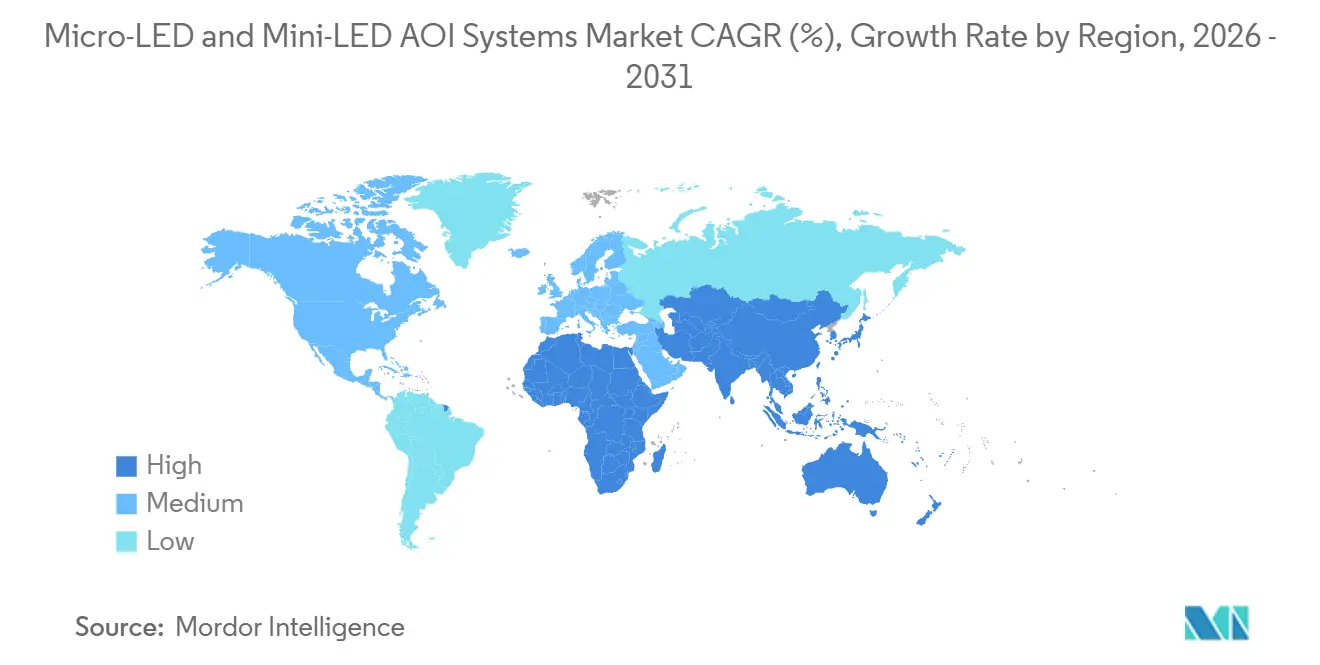
| Fastest Growing Market | Middle East and Africa |
| Largest Market | Asia |
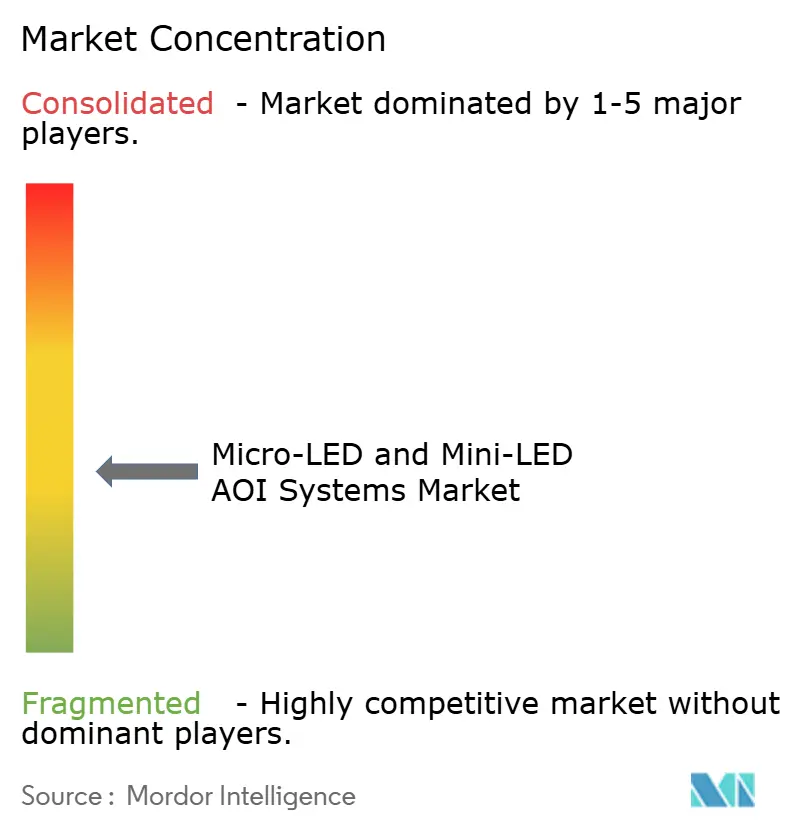
| Market Concentration | Medium |
Major Players *Disclaimer: Major Players sorted in no particular order Image © Mordor Intelligence. Reuse requires attribution under CC BY 4.0. | |
Micro-LED and Mini-LED AOI Systems Market Analysis by Mordor Intelligence
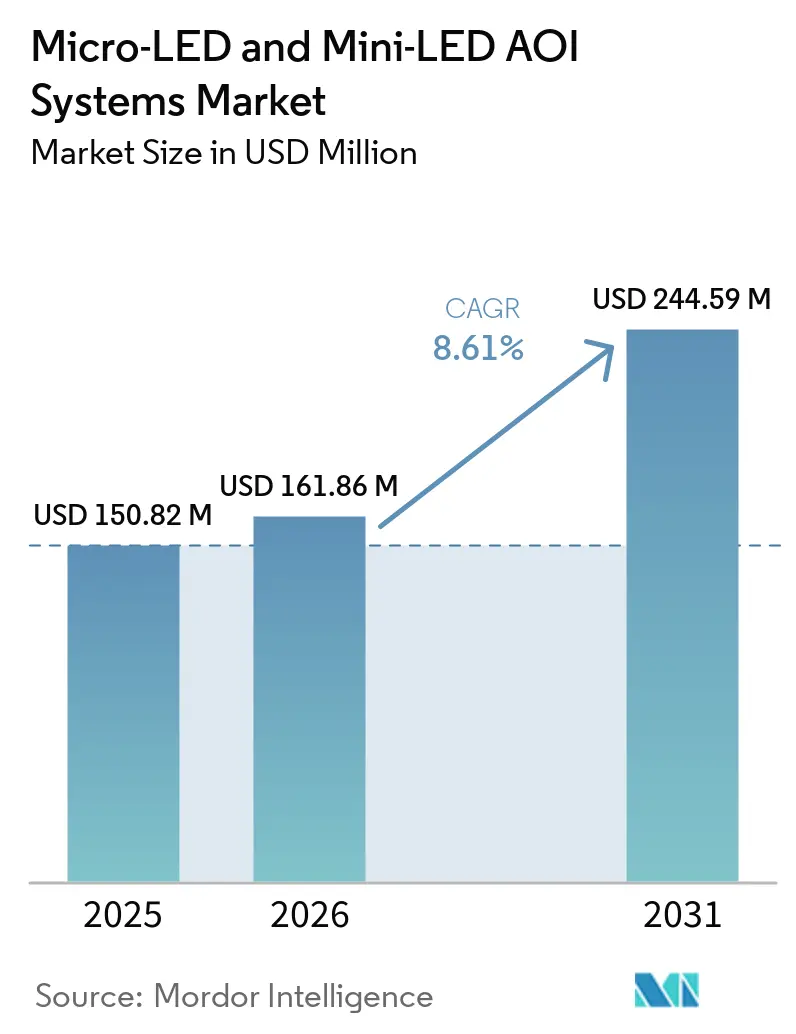
The Micro-LED and Mini-LED AOI Systems Market size is projected to expand from USD 150.82 million in 2025 to USD 161.86 million in 2026, and to USD 244.59 million by 2031, registering an 8.61% CAGR between 2026 and 2031. The Micro-LED and Mini-LED AOI Systems Market is supported by panel makers in China, Taiwan, and South Korea as they move into pre-commercial Micro-LED production. Smaller chip geometries are making conventional optical tools less effective at finding mura, dead-pixel, and wavelength-shift defects. This is increasing demand for electroluminescence, photoluminescence, and integrated automated optical inspection platforms that work at the wafer scale. The Micro-LED and Mini-LED AOI Systems Market also depends on the pace of display commercialization, as delayed launches can delay capital spending on dedicated inspection tools. Vendors are responding with faster inspection, software-based classification, and platforms that combine several measurement methods.
Key Report Takeaways
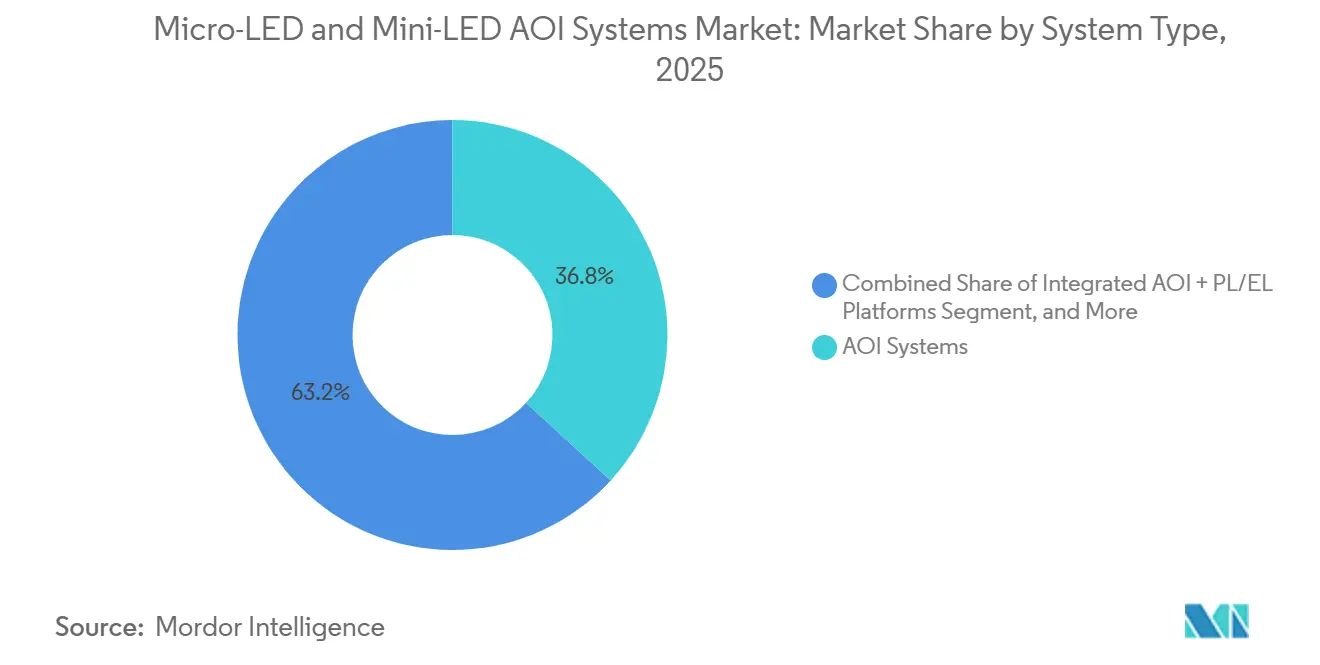
- By system type, AOI systems held 36.83% of the Micro-LED and Mini-LED AOI Systems Market share in 2025, while integrated AOI, PL, and EL platforms are projected to expand at an 11.73% CAGR through 2031.
- By the inspection stage, chip and die inspection accounted for 29.67% of revenue in 2025, while mass-transfer and bonding inspection is projected to expand at an 11.47% CAGR through 2031.
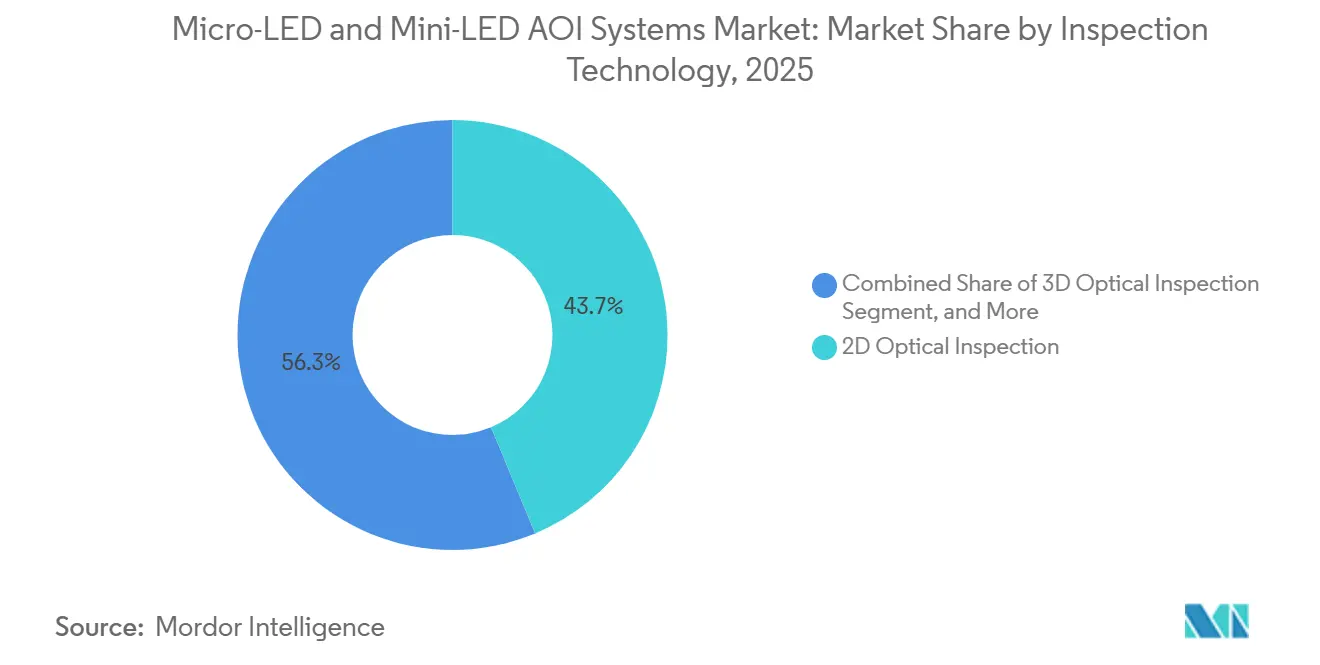
- By inspection technology, 2D optical inspection accounted for 43.72% of Micro-LED and Mini-LED AOI Systems Market revenue in 2025, while 3D optical inspection is projected to expand at an 11.92% CAGR through 2031.
- By end-user industry, semiconductors held 38.94% revenue share in 2025, while automotive is projected to expand at an 11.28% CAGR through 2031.
- By geography, Asia-Pacific accounted for 54.37% of Micro-LED and Mini-LED AOI Systems Market revenue share in 2025, while the Middle East and Africa are projected to expand at a 10.17% CAGR through 2031.
Note: Market size and forecast figures in this report are generated using Mordor Intelligence’s proprietary estimation framework, updated with the latest available data and insights as of January 2026.
Global Micro-LED and Mini-LED AOI Systems Market Trends and Insights
Drivers Impact Analysis*
| Driver | (~) % Impact on CAGR Forecast | Geographic Relevance | Impact Timeline |
|---|---|---|---|
| Micro-LED and Mini-LED Commercialization | +3.2% | Global, led by Asia-Pacific, China, Taiwan, and South Korea | Short term (≤ 2 years) |
| Yield Improvement and Manufacturing Efficiency | +2.1% | Global, concentrated in Asia-Pacific advanced fabs | Medium term (2-4 years) |
| Sub-Micron Defect Detection and Zero-Defect Quality | +1.6% | Global, particularly U.S., Japan, and South Korea RandD centers | Medium term (2-4 years) |
| Automotive and AR/VR Display Adoption | +1.2% | North America, Europe, and Asia-Pacific automotive clusters | Medium term (2-4 years) |
| Non-Destructive High-Throughput Electroluminescence Inspection | +0.8% | Global, with early gains in U.S., Israel, Taiwan, and Japan | Long term (≥ 4 years) |
| Inspection Data Integration With Closed-Loop Process Control | +0.5% | Global, North America and EU advanced manufacturing hubs | Long term (≥ 4 years) |
| Source: Mordor Intelligence | |||
Micro-LED and Mini-LED Commercialization
The commercial deployment of Micro-LED and Mini-LED products supports the Micro-LED and Mini-LED AOI Systems Market. Mini-LED backlighting is used in premium tablets, monitors, and automotive instrument clusters, while Micro-LED production is moving beyond pilot work. Samsung Display presented a stretchable Micro-LED panel with 200 PPI resolution at SID Display Week 2026, which was 67% higher than its 2025 prototype and targeted automotive instrument clusters.[1] Mercedes-Benz extended its Micro-LED Digital Light headlamp system from the S-Class to the C-Class in August 2026, expanding the range of vehicles requiring component inspection. Each production SKU requires a dedicated inspection qualification cycle, thereby increasing demand for system vendors. These customer-specific recipes are also increasing the role of recurring software and calibration revenue.
Yield Improvement and Manufacturing Efficiency Imperatives
Yield management drives procurement because manufacturers consider the cost of yield loss as well as display volume. Chip fabrication, mass transfer, and post-transfer detection are the 3 main yield-loss stages in Micro-LED production, and each requires a different inspection method.[2] A wafer using sub-3 µm Micro-LED pixels can produce more than 10 billion inspection data points. This volume requires classification tools that separate actual defects from measurement artifacts at the wafer level. Toray Engineering stated that its INSPECTRA® PL series provides 0.325 µm pixel resolution and completes PL inspection of a 4-inch wafer in 10 minutes. Finding a defective die before bonding reduces the need for later rework and supports continued investment in the Micro-LED and Mini-LED AOI Systems Market.[3]
Demand for Sub-Micron Defect Detection and Zero-Defect Quality
Micro-LED quality requirements make inspection sensitivity a central purchasing consideration. Each pixel emits light independently, so a dead, dim, or wavelength-shifted LED can remain visible to the viewer. Hamamatsu Photonics reported that its MiNY PL system offers 0.5 µm per pixel resolution in high-resolution mode and measures shape, PL intensity, and wavelength in 12 minutes per 4-inch wafer.[4] These requirements are encouraging the use of confocal and interferometric subsystems alongside mainstream AOI tools. Semiconductor-grade standards for cleanliness and positional accuracy are also becoming a qualification requirement for display inspection tools used in compound semiconductor fabs. The Micro-LED and Mini-LED AOI Systems Market, therefore, requires both optical sensitivity and dependable process control.
Automotive and AR/VR Display Adoption
Automotive applications are the fastest-growing end-user area and require inspection systems that address different reliability needs. Automotive display and lighting components must meet AEC-Q102 requirements for temperature cycling and vibration. BMW presented Panoramic iDrive with Mini-LED backlighting at CES 2025, while Samsung received a CES 2025 Innovation Award for a transparent Micro-LED windshield concept. Plessey Semiconductors uses sub-3 µm pixels and luminance of several million nits in monolithic Micro-LED displays for near-eye AR systems. These designs create inspection data volumes that standard yield platforms cannot process easily. The split between automotive-grade and consumer-grade certification gives vendors in the Micro-LED and Mini-LED AOI Systems Market an opportunity to differentiate their systems.
Restraints Impact Analysis*
| Restraint | (~) % Impact on CAGR Forecast | Geographic Relevance | Impact Timeline |
|---|---|---|---|
| High Capital Cost and Long Qualification Cycles | -2.5% | Global, particularly smaller fabs in South and Southeast Asia | Short term (≤ 2 years) |
| Competition From OLED, Quantum-Dot, and Advanced LCD Technologies | -1.8% | Global, North America, Europe, and leading Asia-Pacific OEM markets | Medium term (2-4 years) |
| Low-Yield Learning Curves and Limited Production Reference Data | -1.2% | Global, with greater exposure in greenfield Micro-LED lines | Medium term (2-4 years) |
| Asia-Pacific Manufacturing Concentration and Export-Control Exposure | -0.8% | Cross-regional, North America and Europe sourcing from Asia-Pacific | Medium term (2-4 years) |
| Source: Mordor Intelligence | |||
High Capital Cost and Long Qualification Cycles
Advanced Micro-LED inspection platforms can limit adoption of Micro-LED and Mini-LED AOI Systems Market, particularly among second-tier display manufacturers and contract manufacturers. Integrated AOI, PL, and EL systems require multimodal optics and precise probe-card systems, making them more expensive than standalone 2D AOI tools. Production-fab qualification typically takes 6 to 18 months and involves process matching across several wafer generations. Large fabs can better absorb these costs and timelines than newer Micro-LED manufacturers. Vendors must show cost-per-wafer improvements that justify the initial investment. Modular architectures and subscription-based inspection services are emerging but remain in their early stages in 2026.
Competition From OLED, Quantum-Dot, and Advanced LCD Technologies
The Micro-LED and Mini-LED AOI Systems Market is exposed to improvements in competing display technologies. OLED products continue to improve in brightness and lifetime, reducing a former performance advantage of Micro-LED. Samsung Display launched a KRW 67 trillion investment program in Asan, South Korea, focused on OLED and next-generation display production lines. Quantum-dot color-conversion layers can provide Mini-LED-backlit LCDs with a wider color gamut without the manufacturing complexity of full Micro-LED arrays. This can reduce the urgency for OEMs to make dedicated Micro-LED AOI purchases while they are still selecting display technologies. A delayed ramp decision at a major OEM can lower near-term inspection-tool orders and lengthen vendor sales cycles.
*Our forecasts treat driver/restraint impacts as directional, not additive. The impact forecasts reflect baseline growth, mix effects, and variable interactions.
Segment Analysis
By System Type: AOI Leads While Integrated Platforms Advance
AOI systems accounted for 36.83% of system-type revenue in 2025, the largest share among system categories. The installed base comes from camera-based defect detection used on flat-panel display lines. Micro-LED manufacturers are extending these tools with improved optics and AI-based classification firmware. PL inspection is the second-largest category because it can map the wavelength at the wafer level without contact. Toray Engineering's INSPECTRA® PL and Hamamatsu's MiNY PL show that production systems can cover 4-inch to G2.5 formats with pixel resolution below 1 µm.
Integrated AOI, PL, and EL platforms are projected to expand at an 11.73% CAGR from 2026 to 2031. They combine inspection steps that would otherwise use separate tools. This reduces wafer handling and contamination risk while creating correlated defect maps. InZiv states that its R-EL Glide performs up to 6 million EL tests per hour using soft-touch probing, while its second-generation platform targets 12 million tests per hour. This shift is changing purchasing decisions across the Micro-LED and Mini-LED AOI Systems Market.

By Inspection Stage: Mass-Transfer Needs More Attention
Chip and die inspection held 29.67% of inspection-stage revenue in 2025. It finds geometry, electrode, and luminescence defects before downstream assembly begins. Wafer and epitaxy inspection acts as the upstream quality gate for crystal defects, etch variation, and contamination. PL mapping tools with sub-1 µm spatial resolution are increasingly used to assess GaN and AlGaInP epitaxial wafers. This early work supports stable production yields in the Micro-LED and Mini-LED AOI Systems Market.
Mass transfer and bonding inspection are projected to expand at an 11.47% CAGR from 2026 to 2031. High-resolution displays require near-seven-nines transfer yield, while laser-induced simultaneous transfer and bonding achieved 99.80% pixel yield under optimized conditions. Favite reported that its post-AOI system detects defects as small as 1 µm and measures die offset and rotation with 0.7 µm repeatability. Panel, backlight, final assembly, repair, and rework inspections serve as later quality gates. Laser-based repair enables selective pixel replacement without discarding an entire panel.
By Inspection Technology: 2D Retains Scale While 3D Gains Use
2D optical inspection held 43.72% of revenue in 2025 and led the technology categories. Its lower cost and established defect-classification software support broad use on existing semiconductor and flat-panel lines. These systems identify particles, surface cracks, electrode shorting, and die-placement errors visible in the XY plane. They are commonly the first inspection equipment to be installed as manufacturers move from R&D to pilot production. Interferometric, microscopic, and confocal systems address specialized needs in the Micro-LED and Mini-LED AOI Systems Market.
3D optical inspection is projected to expand at an 11.92% CAGR from 2026 to 2031. Single-digit-micron chip heights in chip-on-wafer and chip-on-board assemblies expose the limits of 2D systems for tilt, coplanarity variation, and underfill voids. Koh Young presented its ZenStar wafer-level 2D and 3D platform at SEMICON Taiwan 2026 for bump, pillar, and micro-feature inspection. The system supports automated wafer handling in equipment front-end module and front-opening unified pod environments. Multimodal tools are also attracting RandD investment to connect optical and electrical defect signals.
By End-User Industry: Semiconductor Fabs Lead, Automotive Expands
Semiconductor customers held 38.94% of the Micro-LED and Mini-LED AOI Systems Market share in 2025. Compound semiconductor fabs producing GaN-on-sapphire and GaN-on-silicon wafers are the first inspection point in the supply chain. They need high-throughput wafer AOI and PL tools before value is added through later processing. Consumer electronics is the second-largest end-user area. Mini-LED backlighting in premium devices requires checks for chip density and binning accuracy.
The automotive sector is projected to expand at an 11.28% CAGR from 2026 to 2031. Mercedes-Benz introduced Micro-LED Digital Light in the C-Class in August 2026, adding to the updated GLE, refreshed S-Class, and electric GLC SUV. AEC-Q102 requirements add reliability checks across temperature and humidity conditions to the normal production AOI. Healthcare, medical, aerospace, defense, and industrial uses favor high-accuracy systems with low false-positive results. These categories extend demand across the Micro-LED and Mini-LED AOI Systems Industry.
Geography Analysis
Asia-Pacific accounted for 54.37% of revenue in 2025 and remains the Micro-LED and Mini-LED AOI Systems Market's principal production and consumption hub. China, Taiwan, South Korea, and Japan combine panel makers, compound semiconductor capacity, display equipment, and precision optics. Cognex launched the In-Sight 6900 Vision Controller in April 2026 and made OneVision AI generally available in May 2026, after more than 100 customers had used it since its June 2025 beta launch. Toray Engineering and Hamamatsu Photonics supply Japanese-developed PL systems worldwide. Samsung Display's KRW 67 trillion Asan program is planned to bring its first-phase production line online by June 2028.
North America and Europe supply high-value inspection intellectual property, although their display-production volumes are lower than those of the Asia-Pacific. KLA, Cognex, and InZiv sell metrology and EL platforms to Asian display fabs, reducing reliance on domestic manufacturing. U.S. semiconductor reshoring incentives are directing capital toward fabs and electronics manufacturing services in Ohio, Arizona, and New York. This provides the Micro-LED and Mini-LED AOI Systems Market with a technology export channel. Germany combines automotive OEM demand with suppliers such as Viscom, which provides 3D AOI and automated X-ray inspection for electronics assembly.
The Middle East and Africa are projected to expand at a 10.17% CAGR from 2026 to 2031. Saudi Arabia and the United Arab Emirates are investing in semiconductor and electronics manufacturing as part of economic diversification. Saudi Arabia's KACST-linked Saudi Semiconductor Program is a visible regional industrial-policy effort. Gulf governments and selected African countries are expanding electronics manufacturing infrastructure. South America has limited near-term demand due to a lack of major compound semiconductor and panel manufacturing capacity, although Mini-LED product assembly and repair are potential uses.
Competitive Landscape
The Micro-LED and Mini-LED AOI Systems Market is moderately fragmented. Large suppliers such as KLA and Cognex have broad customer access and substantial intellectual property. Specialists, including InZiv and Favite, bring deeper expertise in Micro-LED metrology but have narrower portfolios. Chinese and Korean mid-tier vendors are pursuing production AOI volume with domestic platforms. Camtek's Hawk system accumulated more than USD 600 million in orders through August 2026 and provides defect sensitivity below 0.5 µm with overlay-metrology repeatability below 15 nm.
Camtek signed an agreement to acquire Visual Layer in April 2026 to strengthen its visual analytics capabilities. Koh Young uses GPU-accelerated processing in Smart AI Solutions and extends wafer-level coverage through ZenStar. Cognex introduced the In-Sight 3900 in May 2026, with processing up to 4 times faster than earlier Cognex systems and imaging up to 25 megapixels. These moves shape competition in the Micro-LED and Mini-LED AOI Systems Market. SEMI compliance remains a qualification filter for tier-1 fab approval.
Post-transfer inline inspection in the Micro-LED and Mini-LED AOI Systems Market must match the output of high-speed mass-transfer equipment. Cost-optimized integrated AOI and EL platforms are another opportunity for mid-scale Micro-LED producers. Youngwoo DSP, GEEYOO Vision Technology, and Hefei Sineva Intelligent Machine are pursuing lower-cost systems and faster local support. JUTZE Intelligence Technology is less directly relevant because its public portfolio focuses on SMT and PCB AOI rather than dedicated Micro-LED inspection.
Micro-LED and Mini-LED AOI Systems Industry Leaders
-
Cognex Corporation
-
Favite, Inc.
-
KLA Corporation
-
Nordson Corporation
-
InZiv Ltd.
- *Disclaimer: Major Players sorted in no particular order
Recent Industry Developments
- September 2026: SAKI Corporation announced the launch of its 3Xi-ZS1EX automated X-ray inspection (AXI) system, designed for XXL-sized printed circuit boards (PCBs) used in data center and AI server applications, with orders scheduled to begin in October 2026. The system delivers 1.6 times higher throughput compared to previous SAKI models, reinforcing the company's position in high-complexity electronics inspection for adjacent semiconductor markets.
- September 2026: Koh Young Technology announced the establishment of a new branch office in Noida, Uttar Pradesh, India, coinciding with its participation in productronica India 2026 South (September 16 to 18). The regional expansion places additional technical and applications support closer to India's growing electronics manufacturing cluster and signals commercial intent to serve emerging South Asian display and semiconductor assembly markets.
- September 2026: Koh Young Technology showcased its Meister series, including Meister S for transparent material inspection, and ZenStar wafer-level 2D/3D AOI at SEMICON Taiwan 2026 (September 2 to 4), targeting semiconductor advanced packaging and wafer-level packaging inspection applications including Micro-LED bump and pillar metrology.
- September 2026: Samsung Display formally launched its KRW 67 trillion (USD 48.5 billion) multi-phase investment program in Asan, South Korea, targeting OLED and next-generation display production line construction. The first-phase production line is planned to come online by June 2028, generating sustained downstream demand for advanced display inspection infrastructure.
Global Micro-LED and Mini-LED AOI Systems Market Report Scope
Micro-LED and Mini-LED AOI Systems are advanced automated optical inspection solutions designed to detect microscopic defects, verify pixel integrity, and ensure uniformity in next-generation display manufacturing. They utilize high-resolution imaging and specialized luminescence techniques to maintain yield and quality standards for ultra-high-density LED arrays.
The Micro-LED and Mini-LED AOI Systems Market Report is Segmented by System Type (AOI Systems, Photoluminescence (PL) Inspection Systems, Electroluminescence (EL) Inspection Systems, and Integrated AOI + PL/EL Platforms), Inspection Stage (Wafer and Epitaxy Inspection, Chip and Die Inspection, Mass-Transfer and Bonding Inspection, Panel and Backlight Inspection, and Final Assembly, Repair and Rework Inspection), Inspection Technology (2D Optical Inspection, 3D Optical Inspection, Interferometric Inspection, Microscopic and Confocal Inspection, and Multimodal and Hybrid Inspection), End-User Industry (Semiconductors, Consumer Electronics, Automotive, Healthcare and Medical, Aerospace, Defense and Industrial, and Other End-User Industries), and Geography (North America, South America, Europe, Asia-Pacific, Middle East and Africa). The Market Forecasts are Provided in Terms of Value (USD).
| AOI Systems |
| Photoluminescence (PL) Inspection Systems |
| Electroluminescence (EL) Inspection Systems |
| Integrated AOI + PL/EL Platforms |
| Wafer and Epitaxy Inspection |
| Chip and Die Inspection |
| Mass-Transfer and Bonding Inspection |
| Panel and Backlight Inspection |
| Final Assembly, Repair and Rework Inspection |
| 2D Optical Inspection |
| 3D Optical Inspection |
| Interferometric Inspection |
| Microscopic and Confocal Inspection |
| Multimodal and Hybrid Inspection |
| Semiconductors |
| Consumer Electronics |
| Automotive |
| Healthcare and Medical |
| Aerospace, Defense and Industrial |
| Other End-User Industries |
| North America | United States | |
| Canada | ||
| Mexico | ||
| South America | Brazil | |
| Argentina | ||
| Rest of South America | ||
| Europe | Germany | |
| United Kingdom | ||
| France | ||
| Italy | ||
| Spain | ||
| Rest of Europe | ||
| Asia-Pacific | China | |
| Japan | ||
| India | ||
| South Korea | ||
| Rest of Asia-Pacific | ||
| Middle East and Africa | Middle East | Saudi Arabia |
| United Arab Emirates | ||
| Turkey | ||
| Rest of the Middle East | ||
| Africa | South Africa | |
| Nigeria | ||
| Rest of Africa | ||
| By System Type | AOI Systems | ||
| Photoluminescence (PL) Inspection Systems | |||
| Electroluminescence (EL) Inspection Systems | |||
| Integrated AOI + PL/EL Platforms | |||
| By Inspection Stage | Wafer and Epitaxy Inspection | ||
| Chip and Die Inspection | |||
| Mass-Transfer and Bonding Inspection | |||
| Panel and Backlight Inspection | |||
| Final Assembly, Repair and Rework Inspection | |||
| By Inspection Technology | 2D Optical Inspection | ||
| 3D Optical Inspection | |||
| Interferometric Inspection | |||
| Microscopic and Confocal Inspection | |||
| Multimodal and Hybrid Inspection | |||
| By End-User Industry | Semiconductors | ||
| Consumer Electronics | |||
| Automotive | |||
| Healthcare and Medical | |||
| Aerospace, Defense and Industrial | |||
| Other End-User Industries | |||
| By Geography | North America | United States | |
| Canada | |||
| Mexico | |||
| South America | Brazil | ||
| Argentina | |||
| Rest of South America | |||
| Europe | Germany | ||
| United Kingdom | |||
| France | |||
| Italy | |||
| Spain | |||
| Rest of Europe | |||
| Asia-Pacific | China | ||
| Japan | |||
| India | |||
| South Korea | |||
| Rest of Asia-Pacific | |||
| Middle East and Africa | Middle East | Saudi Arabia | |
| United Arab Emirates | |||
| Turkey | |||
| Rest of the Middle East | |||
| Africa | South Africa | ||
| Nigeria | |||
| Rest of Africa | |||
Key Questions Answered in the Report
What is the size of the Micro-LED and Mini-LED AOI Systems Market?
The market was valued at USD 161.86 million in 2026 and is projected to reach USD 244.59 million by 2031 at an 8.61% CAGR.
What is driving demand for Micro-LED and Mini-LED inspection systems?
The Micro-LED and Mini-LED AOI Systems Market is supported by smaller chip geometries and higher yield requirements, which increase the need for AOI, PL, and EL inspection.
Which system type leads demand?
AOI systems led system-type revenue with 36.83% in 2025, while integrated AOI, PL, and EL systems have the highest projected CAGR at 11.73%.
Why is mass-transfer inspection important for Micro-LED production?
Mass transfer requires near-seven-nines yield for high-resolution applications and needs tools that can detect missing or misaligned dies at high speed.
Which region has the largest deployment base?
Asia-Pacific held 54.37% revenue share in 2025 because it combines major panel makers, compound semiconductor fabs, and inspection equipment suppliers.
Which end user is expanding most quickly?
Automotive is projected to expand at an 11.28% CAGR through 2031, supported by Micro-LED headlamps and high-brightness in-cabin displays.