
Flexible Electronics AOI Systems Market Size and Share
Market Overview
| Study Period | 2020 - 2031 |
|---|---|
| Market Size (2026) | USD 310.44 Million |
| Market Size (2031) | USD 556.49 Million |
| Growth Rate (2026 - 2031) | 12.38 % |
| Fastest Growing Market | Asia-Pacific |
| Largest Market | North America |
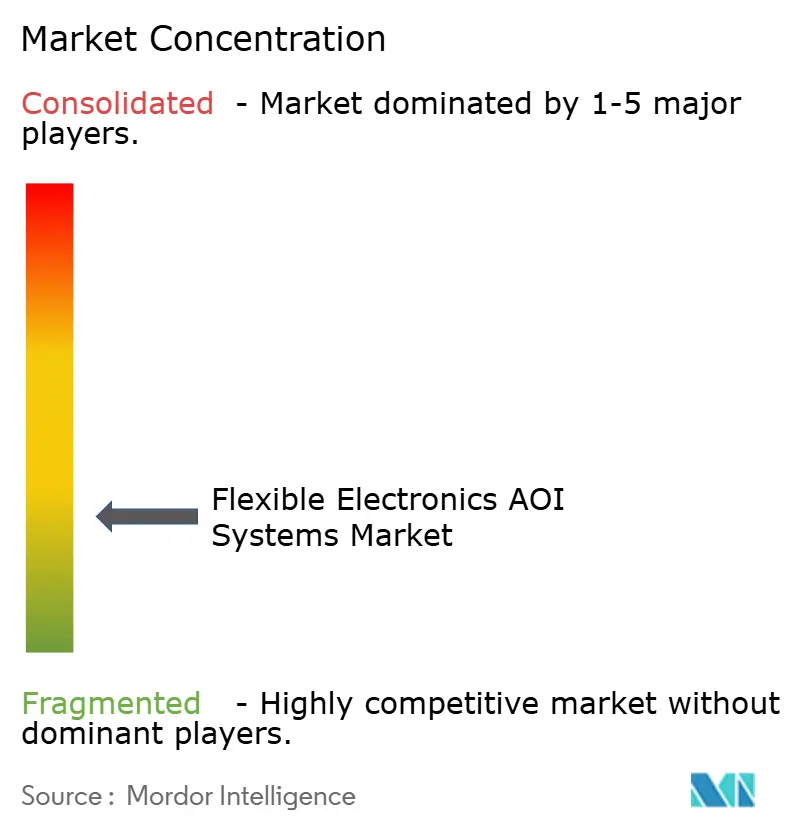
| Market Concentration | Low |
Major Players *Disclaimer: Major Players sorted in no particular order Image © Mordor Intelligence. Reuse requires attribution under CC BY 4.0. | |
Flexible Electronics AOI Systems Market Analysis by Mordor Intelligence
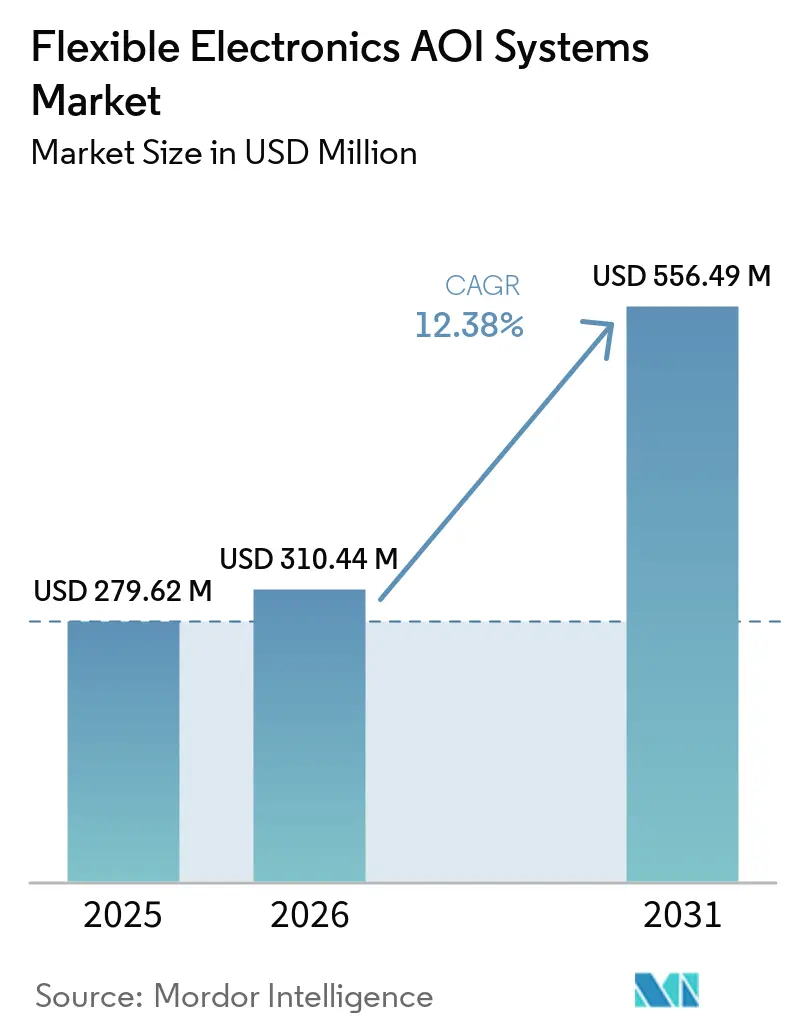
The Flexible Electronics AOI Systems Market size is expected to increase from USD 279.62 million in 2025 to USD 310.44 million in 2026 and reach USD 556.49 million by 2031, at a CAGR of 12.38% over 2026-2031. Demand is tied to the expansion of flexible printed circuit board production and to more complex devices, including wearables and foldable smartphones. Automotive electrification also raises the need for defect-free assembly on non-planar substrates. AI-based classification is moving inspection beyond a final quality check by allowing manufacturers to correct upstream processes. This improves the case for investment where production margins are under pressure. Suppliers are responding with AI programming tools, modular platforms, and regional support for growing electronics production centers.
Key Report Takeaways
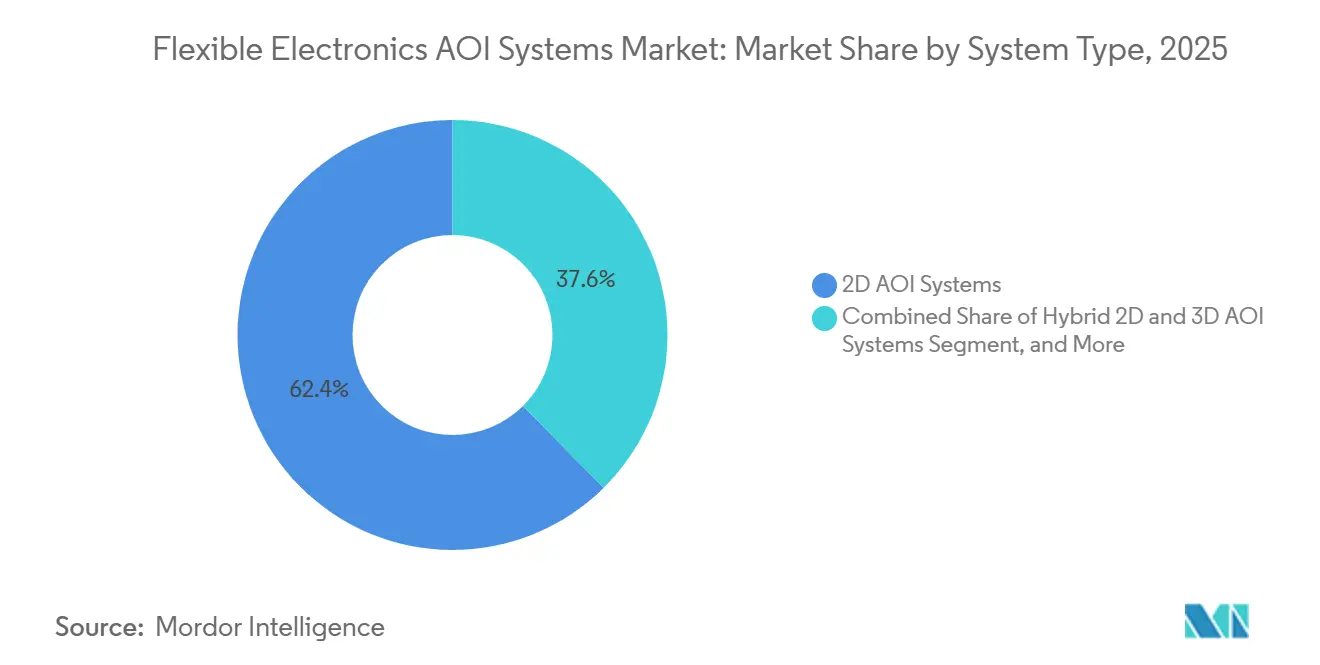
- By system type, 2D AOI systems held 62.43% Flexible Electronics AOI Systems Market share in 2025, while Hybrid 2D and 3D AOI Systems are projected to expand at a 15.83% CAGR through 2031.
- By deployment mode, Inline AOI systems held 71.63% share in 2025, while Offline and Desktop AOI Systems are projected to expand at a 14.17% CAGR through 2031.
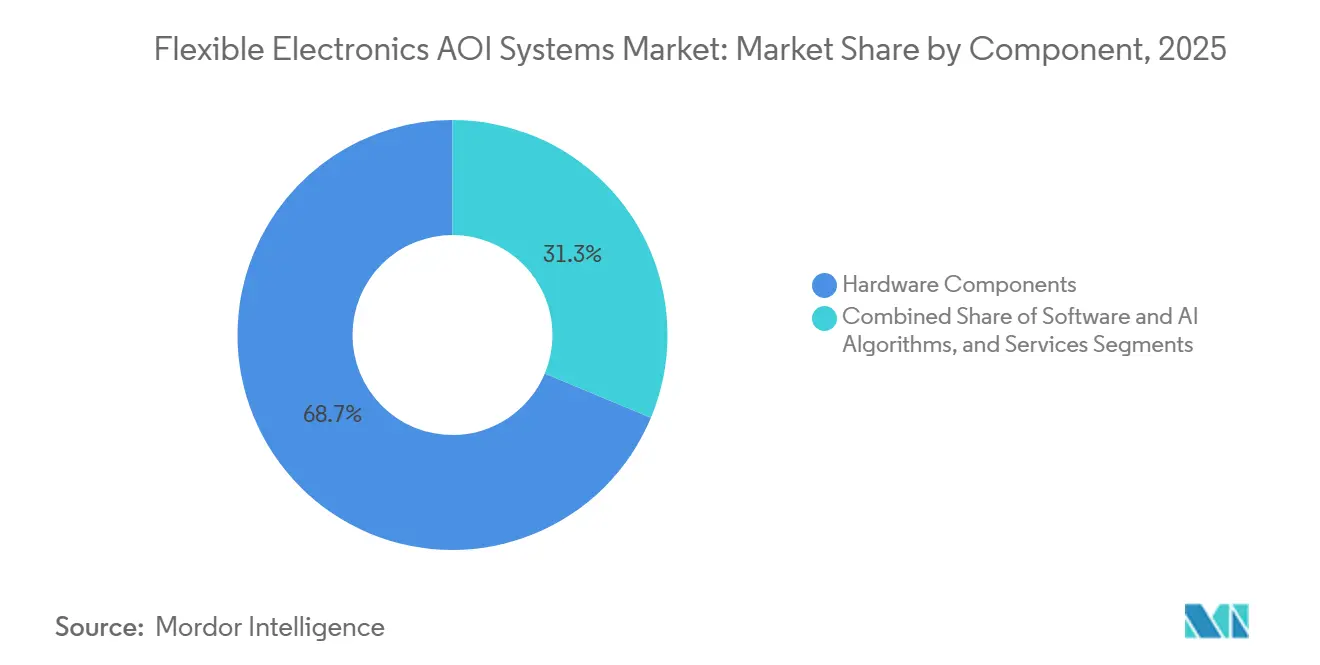
- By component, Hardware Components accounted for 68.71% Flexible Electronics AOI Systems Market share in 2025, while Software and AI Algorithms are projected to expand at a 15.73% CAGR through 2031.
- By end-user industry, Consumer Electronics and Wearables held 41.87% share in 2025, while Automotive Electronics is projected to expand at a 15.27% CAGR through 2031.
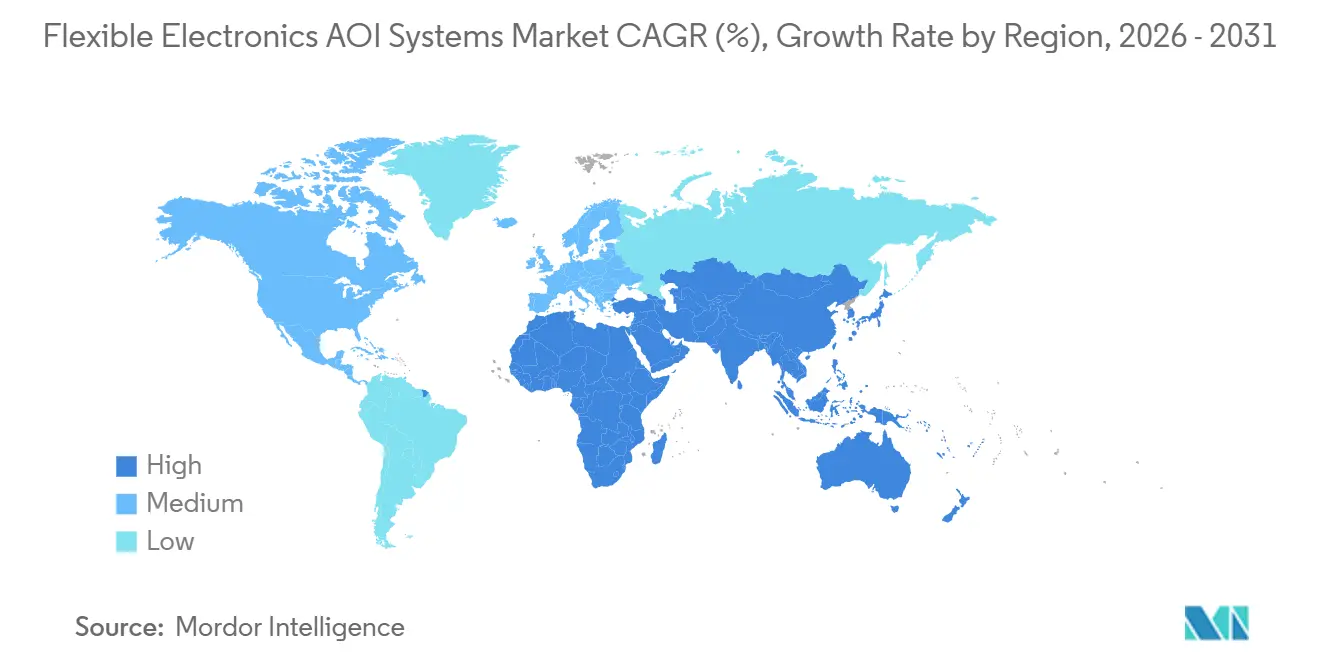
- By geography, North America held 58.69% of the Flexible Electronics AOI Systems Market in 2025, while Asia-Pacific is projected to expand at a 14.39% CAGR through 2031.
Note: Market size and forecast figures in this report are generated using Mordor Intelligence’s proprietary estimation framework, updated with the latest available data and insights as of January 2026.
Global Flexible Electronics AOI Systems Market Trends and Insights
Drivers Impact Analysis*
| Driver | (~) % Impact on CAGR Forecast | Geographic Relevance | Impact Timeline |
|---|---|---|---|
| AI-Enabled Defect Classification and Closed-Loop Process Control | +2.5% | Global, with intensity in East Asia and North America | Medium term (2-4 years) |
| Flexible Electronics Production Scale-Up | +2.2% | Asia-Pacific core, with spillover to North America and Europe | Short term (≤ 2 years) |
| Foldable and Wearable Device Complexity | +1.9% | Global, centered on China, South Korea, and the United States | Short term (≤ 2 years) |
| Roll-to-Roll Manufacturing Adoption | +1.6% | Asia-Pacific core, with early gains in Germany and Japan | Medium term (2-4 years) |
| 3D Metrology for Warped and Non-Planar Substrates | +1.3% | Global, concentrated in Japan, South Korea, and Germany | Long term (≥ 4 years) |
| Zero-Defect Automotive and Medical Electronics Requirements | +1.1% | North America and Europe, with spillover to Asia-Pacific automotive hubs | Long term (≥ 4 years) |
| Source: Mordor Intelligence | |||
AI-Enabled Defect Classification and Closed-Loop Process Control
AI integration is changing flexible-substrate inspection from a separate detection task into a source of feedback for production adjustments. Koh Young Technology and Delvitech have embedded neural networks in inspection hardware, enabling on-machine model training and reducing knowledge loss during staffing changes.[1] Viscom introduced vAI ProVision at Productronica 2025 to generate 3D AOI and 3D AXI programs almost automatically in minutes. Faster program creation can make deployment more practical for lines that frequently change products. It also gives suppliers a way to compete on yield improvement rather than camera specifications alone. The Flexible Electronics AOI Systems Market therefore benefits when inspection data can be used to improve process settings during production.
Flexible Electronics Production Scale-Up
FPCB capacity expansion in East Asia is creating immediate demand for inspection equipment. Advanced packaging programs using FC-BGA, chiplets, and panel-level packaging need dense substrates and inspection at several process stages. AT&S announced agreements in June 2026 to expand IC substrate capacity in Kulim, Malaysia, with fully financed investment commitments of EUR 1.5-2.0 billion (USD 1.70-2.26 billion) and planned capital expenditure of EUR 1.0-1.2 billion (USD 1.13-1.36 billion).[2] Such investment creates demand for equipment that can identify defects on substrate and flexible-circuit lines. GigaVis secured a KRW 9.47 billion (USD 6.2 million) AOI and automated optical repair equipment contract from a Japanese semiconductor substrate maker in 2026. This expansion supports the Flexible Electronics AOI Systems Market, as capacity additions require reliable inspection coverage before production ramps up.
Foldable and Wearable Device Complexity
Foldable smartphones and advanced wearables require inspection tolerances that rigid-board AOI systems struggle to meet. Hinge structures have several stress points where top-down imaging can miss angled solder fillets and micro-cracks at flex transition zones. Wuxi Lead Intelligent Equipment and OPPO reported a June 2026 commercial deployment of an inline AOI-integrated micron-scale 3D-printing platform for foldable hinge structures, with printing speeds of up to 1,000 mm/s and motion accuracy of ±3 µm. These requirements increase the value of systems that combine surface imaging with depth measurement. They also make false negatives more costly at device assembly stages. The Flexible Electronics AOI Systems Market gains from a shift toward 3D and hybrid inspection, where product geometry makes 2D checks insufficient.[3]
Roll-to-Roll Manufacturing Adoption
Roll-to-roll processing supports large-area flexible electronics, including printed sensors, flexible photovoltaics, and e-textiles. It also produces rapid defect-data streams that differ from those on conventional rigid-board lines. A 2025 study in IEEE Transactions on Industrial Informatics described an in-situ metrology system for roll-to-roll microcontact printing that achieved 94.4% line-width estimation accuracy at up to 15 measurements per second with 1,080p resolution. This supports a move from offline sampling toward continuous inline monitoring. Such systems require suitable optics, web handling, and data throughput to move flexible materials. The Flexible Electronics AOI Systems Market presents an opportunity for suppliers to provide roll-to-roll fixtures and web-tension compensation for energy, battery, and photovoltaic applications.[4]
Restraints Impact Analysis*
| Restraint | (~) % Impact on CAGR Forecast | Geographic Relevance | Impact Timeline |
|---|---|---|---|
| High Capital Cost of Specialized Flex Fixturing and Optics | -1.8% | Global, with the highest friction among cost-sensitive Asia-Pacific contract manufacturers | Medium term (2-4 years) |
| False Calls on Transparent, Reflective, and Warped Substrates | -1.4% | Global, particularly Asia-Pacific flexible display and semiconductor packaging lines | Short term (≤ 2 years) |
| Shortage of Flexible-Circuit Inspection Programmers | -0.9% | North America and Europe, with added pressure in emerging Asia-Pacific markets | Long term (≥ 4 years) |
| Frequent Revalidation After Material and Design Changes | -0.6% | Global, especially consumer electronics contract manufacturers | Medium term (2-4 years) |
| Source: Mordor Intelligence | |||
High Capital Cost of Specialized Flex Fixturing and Optics
Purpose-built FPCB inspection needs optical assemblies, vacuum fixtures, and conveyor systems that cost more than rigid-board equivalents. Koh Young's Zenith F uses a 12-megapixel camera, 10 µm XY-resolution optics, and a 1 mm focused Z-measurement range for low-profile FPCB components. These specialized features can limit adoption among small and mid-sized electronics manufacturers. Cost pressure is strongest in Southeast Asian and South Asian contract-manufacturing tiers. Delvitech offers configurable Horus systems with add-on HD, XP, ITU, and DUO elements, helping buyers align system capabilities with their requirements. Subscription-based software can also shift part of the outlay from initial capital spending to recurring operating costs.
False Calls on Transparent, Reflective, and Warped Substrates
Transparent coverlay windows, reflective copper traces, and thermal warpage make flexible substrates difficult to inspect consistently. These conditions create false positives that increase manual review work and reduce the throughput benefit of automated inspection. Suppliers are developing AI functions to reduce post-AOI manual inspection on EMS production lines. This response shows that false-call reduction is becoming an operating requirement rather than an optional software feature. Buyers still need defect libraries that reflect flexible-circuit materials and product designs. Until these tools are more widely available, false-call overhead will remain a cost issue for the Flexible Electronics AOI Systems Market.
*Our forecasts treat driver/restraint impacts as directional, not additive. The impact forecasts reflect baseline growth, mix effects, and variable interactions.
Segment Analysis
By System Type: 2D Platforms Lead While Hybrid Architectures Gain Share
2D AOI systems held 62.43% share in 2025. Their position reflected lower unit costs, simpler programming, and suitability for surface defects such as missing solder, polarity errors, and foreign material. These systems remain common on controlled FPCB lines used for consumer electronics. Chinese and Taiwanese contract manufacturers value their speed and total cost of ownership. The Flexible Electronics AOI Systems Market continues to rely on 2D systems for high-volume inspection, while 3D systems serve semiconductor packaging and automotive uses requiring coplanarity checks and solder-paste volume measurement.
Hybrid 2D and 3D AOI Systems are projected to expand at a 15.83% CAGR through 2031. They combine surface imaging and volumetric measurement without requiring a full 3D-only toolset. A 2025 Journal of Intelligent Manufacturing paper identified cross-scene object relationship detection as an important capability for FPC production. Multi-camera and multi-angle illumination can help hybrid systems meet this requirement, while Koh Young applies IPC-A-610 inspection criteria to FPCB assembly solutions. This capability supports the Flexible Electronics AOI Systems Market as product tolerances become more demanding and quantitative deviation reporting becomes more prevalent, favoring hybrid architectures.

By Deployment Mode: Inline Systems Retain Scale While Offline Platforms Expand Faster
Inline AOI systems held 71.63% share in 2025. Their installed base is tied to high-volume FPCB assembly lines that require inspection at production speed. These systems can support 100% inspection at several stages of manufacturing. Their main challenge is reducing false calls without slowing the line. The Flexible Electronics AOI Systems Market relies on inline platforms where speed, repeatability, and acceptable yield are essential.
Offline and Desktop AOI Systems are projected to expand at a 14.17% CAGR through 2031. They serve prototype-intensive operations, high-mix contract manufacturers, and small-series production where conveyor integration is not practical. This format creates an opportunity in the Flexible Electronics AOI Systems Market for precision electronics and medical-device contract manufacturing while reducing site-preparation work. Saki deployed 3D SPI and 3D AOI systems at Alps Alpine's Kakuda factory with Fuji Smart Factory machine-to-machine communication. That deployment shows how inline equipment can also operate as part of a wider factory-automation network.
By Component: Hardware Holds Revenue While Software Gains Strategic Importance
Hardware Components accounted for 68.71% of the Flexible Electronics AOI Systems Market in 2025. Optical heads, illumination modules, precision linear motors, and high-resolution cameras are the physical core of inspection equipment. The inspection head remains the main unit purchased by customers and a large cost driver. Services and lifecycle support create recurring activity through calibration, optics replacement, and algorithm retraining. This installed base drives continuing demand for service support in the Flexible Electronics AOI Systems Market, especially among Korean and Japanese suppliers with global networks.
Software and AI Algorithms are projected to expand at a 15.73% CAGR through 2031. This reflects a greater demand for programmable inspection models rather than fixed optical rules. AI-based self-learning and faster program initialization can lower retraining demands for smaller manufacturers. These functions address costs that can discourage software upgrades, while AI licensing can separate software revenue from inspection hardware. The Flexible Electronics AOI Systems Market is therefore becoming more software-defined.
By End-User Industry: Consumer Electronics Anchor Demand While Automotive Electronics Advance Fastest
Consumer Electronics and Wearables held 41.87% share in 2025. Smartphone, tablet, and wearable assembly lines require FPCB inspection at several production gates. Their large volumes also provide extensive inspection data for AI defect libraries. These high-throughput lines anchor the Flexible Electronics AOI Systems Market, while telecommunications, networking, semiconductors, advanced packaging, and industrial automation add demand. Chiplet designs increase the number of substrate-to-die interconnect points that require inspection.
Automotive Electronics are projected to expand at a 15.27% CAGR through 2031. Battery management systems, advanced driver-assistance modules, and in-vehicle infotainment systems are using more FPCBs. Automotive production requires process control and AOI data logging, while medical devices and healthcare electronics require detailed traceability. Energy, battery, and photovoltaic electronics are emerging roll-to-roll inspection applications that require checks for battery separator and electrode pattern defects. The Flexible Electronics AOI Systems Market has room to serve these specialized quality requirements.
Geography Analysis
North America held 58.69% of the Flexible Electronics AOI Systems Market share in 2025. Aerospace and defense supply chains, medical device production, and inspection requirements for large OEMs supported this position. The United States led regional demand through investment in advanced semiconductor packaging. Canada and Mexico also supported demand where automotive electronics manufacturing required quality-compliant flex-circuit inspection. The Flexible Electronics AOI Systems Market benefits in the region from buyers that prioritize qualified inspection processes.
Europe was the second-largest geography. Germany's automotive supplier base and medical device manufacturing in France, Switzerland, and the United Kingdom supported regional demand. German equipment suppliers maintained a technology and brand position in the installed base, supported by European standards activity through CENELEC and alignment with IEC quality standards. South America remained smaller, with Brazil leading regional demand through consumer electronics assembly, while infrastructure investment cycles and limited flexible-substrate supply chains constrained expansion.
Asia-Pacific is projected to expand at a 14.39% CAGR through 2031. China’s FPCB output, South Korea’s flexible OLED inspection activity, and Japan’s precision equipment base supported regional demand. Koh Young established a branch office in Noida in September 2026 to support India’s expanding electronics manufacturing sector. This expansion positions the Flexible Electronics AOI Systems Market closer to new demand in electronics contract manufacturing. The Middle East and Africa remain underserved, with demand centered on the Gulf states and South Africa as investment in electronics assembly and industrial automation advances.
Competitive Landscape
The Flexible Electronics AOI Systems Market is fragmented at the technology frontier. Koh Young Technology and OMRON hold brand recognition in True 3D measurement and AI-assisted programming. Taiwanese, German, Malaysian, and Swiss suppliers compete with different optical configurations and application-specific systems. The mid-tier is more fragmented, particularly among Chinese and Taiwanese suppliers competing for high-volume consumer electronics contracts. Price-performance remains important in this part of the market.
Companies are prioritizing AI software, modular hardware, and expansion into India, Southeast Asia, and South America. Koh Young established a Noida branch in September 2026 to increase its technical, applications, and business support in India. GOEPEL electronic’s Vario Line 3D platform uses a rotary-drive inspection axis with 360° coverage in 1° increments. Delvitech is targeting microelectronics and multi-facility data sharing with its ATON and HORUS platforms. These moves support the Flexible Electronics AOI Systems Market by addressing programming speed, adaptable hardware, and usable inspection data.
White space remains in roll-to-roll AOI for energy and photovoltaic electronics, AI-enabled desktop systems for low-volume medical and aerospace production, and connected inspection-data platforms. Delvitech’s continuous neural-network learning and multi-facility data sharing address 2 of these areas. Chinese vendors are becoming more competitive in mid-tier Asia-Pacific contracts by leveraging domestic demand. High capital requirements for optical-head development and long customer qualification cycles still limit entry.
Flexible Electronics AOI Systems Industry Leaders
-
Koh Young Technology Inc.
-
OMRON Corporation
-
Test Research, Inc.
-
Viscom AG
-
Saki Corporation
- *Disclaimer: Major Players sorted in no particular order
Recent Industry Developments
- September 2026: GOEPEL electronic GmbH unveiled a new generation of Multi Line and Vario Line AOI inspection systems and an AXI platform at electronica Munich 2026, introducing 360° variable-angle inspection in 1° increments and an intelligent 2D and 3D hybrid inspection architecture designed for high-mix and low-volume flexible electronics lines.
- September 2026: Koh Young Technology Inc. established a new branch office in Noida, Uttar Pradesh, India, expanding its technical, applications, and business support infrastructure to serve the country's rapidly growing electronics manufacturing sector, including flexible circuit assembly customers, directly from the sub-continent.
- July 2026: Oki Electric Industry Co., Ltd. (OKI) began sequentially deploying its Visual Inspection Judgment AI Technology on customer EMS production lines under its Marugoto EMS service, demonstrating an 80% reduction in post-AOI manual re-inspection time on large high-density PCBs by automating solder wetting, misalignment, missing component, and component-lift judgment.
- June 2026: Shenzhen Hanhuaweiye Technology Co., Ltd. launched the Zeus HS1000 TGV incoming-material AOI system, achieving 200 nm defect-detection sensitivity for transparent glass substrates, with a built-in SPC reporting system intended to reduce an industry-wide 15%-20% missed-detection rate to near-zero across advanced packaging and flexible substrate production lines.
Global Flexible Electronics AOI Systems Market Report Scope
Flexible Electronics AOI Systems are specialized automated optical inspection solutions designed to detect defects and verify quality on non-rigid, bendable, or stretchable electronic substrates, ensuring high yield and reliability in the manufacturing of next-generation devices such as foldable displays, wearable sensors, and flexible printed circuits.
The Flexible Electronics AOI Systems Market Report is Segmented by System Type (2D AOI Systems, 3D AOI Systems, and Hybrid 2D and 3D AOI Systems), Deployment Mode (Inline AOI Systems and Offline and Desktop AOI Systems), Component (Hardware Components, Software and AI Algorithms, and Services), End-User Industry (Consumer Electronics and Wearables, Automotive Electronics, Medical Devices and Healthcare Electronics, Telecommunications and Networking, Semiconductors and Advanced Packaging, Industrial Electronics and Automation, Aerospace and Defense, Energy, Battery, and Photovoltaic Electronics, and Other End-User Industries), and Geography (North America, South America, Europe, Asia-Pacific, Middle East and Africa). The Market Forecasts are Provided in Terms of Value (USD).
| 2D AOI Systems |
| 3D AOI Systems |
| Hybrid 2D and 3D AOI Systems |
| Inline AOI Systems |
| Offline and Desktop AOI Systems |
| Hardware Components |
| Software and AI Algorithms |
| Services |
| Consumer Electronics and Wearables |
| Automotive Electronics |
| Medical Devices and Healthcare Electronics |
| Telecommunications and Networking |
| Semiconductors and Advanced Packaging |
| Industrial Electronics and Automation |
| Aerospace and Defense |
| Energy, Battery, and Photovoltaic Electronics |
| Other End-User Industries |
| North America | United States | |
| Canada | ||
| Mexico | ||
| South America | Brazil | |
| Argentina | ||
| Rest of South America | ||
| Europe | Germany | |
| United Kingdom | ||
| France | ||
| Italy | ||
| Spain | ||
| Rest of Europe | ||
| Asia-Pacific | China | |
| Japan | ||
| India | ||
| South Korea | ||
| Rest of Asia-Pacific | ||
| Middle East and Africa | Middle East | Saudi Arabia |
| United Arab Emirates | ||
| Turkey | ||
| Rest of the Middle East | ||
| Africa | South Africa | |
| Nigeria | ||
| Rest of Africa | ||
| By System Type | 2D AOI Systems | ||
| 3D AOI Systems | |||
| Hybrid 2D and 3D AOI Systems | |||
| By Deployment Mode | Inline AOI Systems | ||
| Offline and Desktop AOI Systems | |||
| By Component | Hardware Components | ||
| Software and AI Algorithms | |||
| Services | |||
| By End User-Industry | Consumer Electronics and Wearables | ||
| Automotive Electronics | |||
| Medical Devices and Healthcare Electronics | |||
| Telecommunications and Networking | |||
| Semiconductors and Advanced Packaging | |||
| Industrial Electronics and Automation | |||
| Aerospace and Defense | |||
| Energy, Battery, and Photovoltaic Electronics | |||
| Other End-User Industries | |||
| By Geography | North America | United States | |
| Canada | |||
| Mexico | |||
| South America | Brazil | ||
| Argentina | |||
| Rest of South America | |||
| Europe | Germany | ||
| United Kingdom | |||
| France | |||
| Italy | |||
| Spain | |||
| Rest of Europe | |||
| Asia-Pacific | China | ||
| Japan | |||
| India | |||
| South Korea | |||
| Rest of Asia-Pacific | |||
| Middle East and Africa | Middle East | Saudi Arabia | |
| United Arab Emirates | |||
| Turkey | |||
| Rest of the Middle East | |||
| Africa | South Africa | ||
| Nigeria | |||
| Rest of Africa | |||
Key Questions Answered in the Report
What is the Flexible Electronics AOI Systems Market size?
The market is USD 310.44 million in 2026 and is projected to reach USD 556.49 million by 2031 at a 12.38% CAGR.
What is driving demand for Flexible Electronics AOI Systems?
FPCB capacity expansion, foldable devices, AI-enabled inspection, and roll-to-roll production are supporting demand.
Which system type leads Flexible Electronics AOI adoption?
2D AOI systems led with 62.43% share in 2025, while hybrid 2D and 3D systems have the highest projected CAGR of 15.83%.
Why are hybrid 2D and 3D systems gaining adoption?
They combine surface imaging with depth measurement for warped and non-planar flexible substrates.
Which end-user application is expanding fastest?
Automotive Electronics are projected to expand at a 15.27% CAGR through 2031, supported by battery, driver-assistance, and infotainment applications.
Which region is expanding fastest through 2031?
Asia-Pacific is projected to expand at a 14.39% CAGR, supported by FPCB production in China, South Korea, Japan, and India.