
Wire Bond AOI Systems Market Size and Share
Market Overview
| Study Period | 2020 - 2031 |
|---|---|
| Market Size (2026) | USD 109.52 Million |
| Market Size (2031) | USD 166.94 Million |
| Growth Rate (2026 - 2031) | 8.80 % |
| Fastest Growing Market | Europe |
| Largest Market | Asia-Pacific |
| Market Concentration | Medium |
Major Players *Disclaimer: Major Players sorted in no particular order Image © Mordor Intelligence. Reuse requires attribution under CC BY 4.0. | |
Wire Bond AOI Systems Market Analysis by Mordor Intelligence
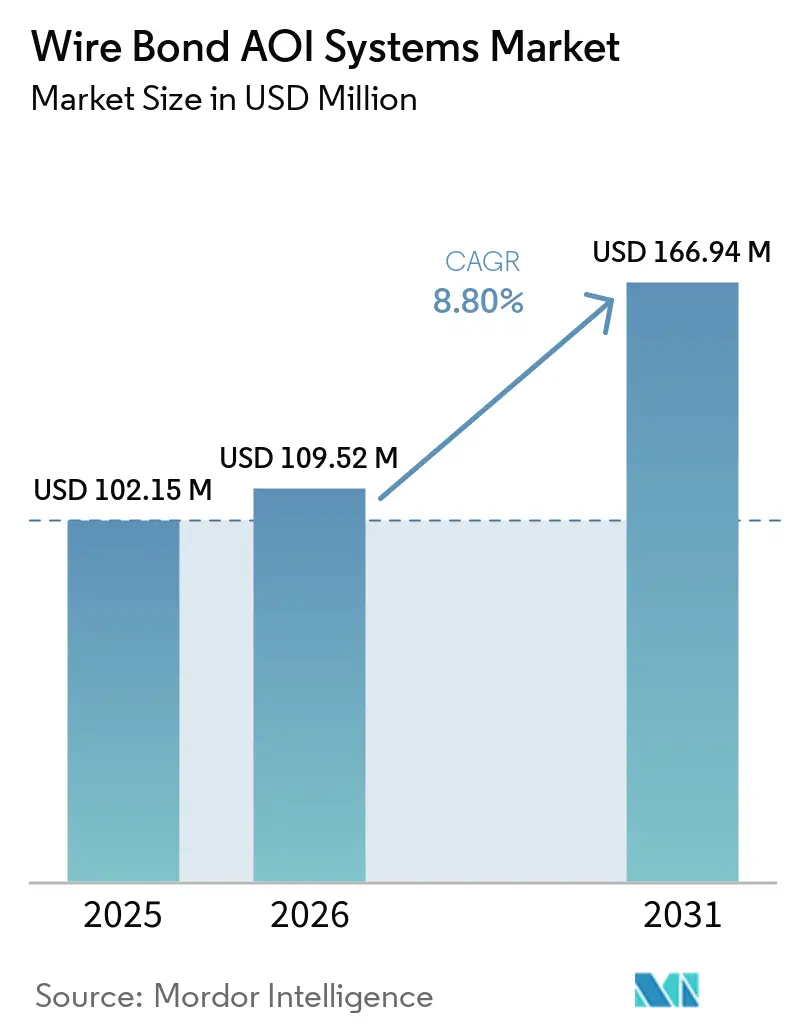
The Wire Bond AOI Systems Market size is projected to expand from USD 102.15 million in 2025 to USD 109.52 million in 2026, and to USD 166.94 million by 2031, registering an CAGR of 8.80% between 2026 and 2031. New semiconductor packaging lines require matched inspection capacity, which ties demand for the Wire Bond AOI Systems Market to investment by outsourced semiconductor assembly and test providers. Advanced and conventional packaging lines are increasingly located at the same sites, increasing the need for systems capable of inspecting both high-volume and complex bond layouts. Automotive power modules are creating demand for more detailed measurements and documented quality records. Standard 2D platforms face price pressure, while hybrid 2D and 3D systems can support higher-value use cases. Customer concentration among Asia-Pacific packaging providers can make equipment orders sensitive to changes in capital spending.
Key Report Takeaways
- By inspection dimension, 2D systems held 58.43% Wire Bond AOI Systems Market share in 2025, while hybrid 2D/3D systems are projected to expand at an 11.63% CAGR through 2031.
- By bond type, ball-wedge bonding held 61.72% share in 2025, while ribbon bonding is projected to expand at a 10.27% CAGR through 2031.
- By deployment, inline systems held a 72.34% share of the Wire Bond AOI Systems Market in 2025, and is forecasted to exapnd at 10.46% through 2031.
- By end-user industry, the semiconductor and electronics industry held a 46.83% share in 2025, while automotive is projected to expand at a 10.18% CAGR through 2031.
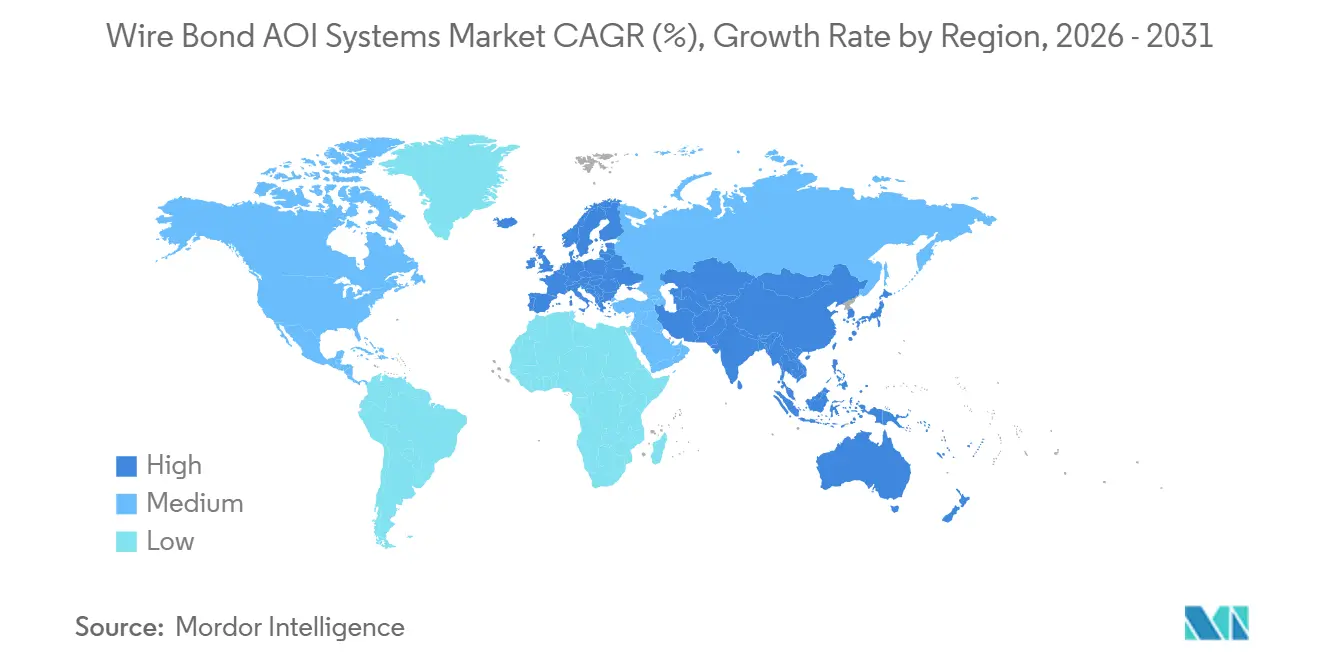
- By geography, Asia-Pacific held 58.67% Wire Bond AOI Systems Market share in 2025, while Europe is projected to expand at a 10.07% CAGR through 2031.
Note: Market size and forecast figures in this report are generated using Mordor Intelligence’s proprietary estimation framework, updated with the latest available data and insights as of January 2026.
Global Wire Bond AOI Systems Market Trends and Insights
Drivers Impact Analysis*
| Driver | (~) % Impact on CAGR Forecast | Geographic Relevance | Impact Timeline |
|---|---|---|---|
| Semiconductor Packaging Capacity Expansion | +2.0% | Global, centered in Asia-Pacific, with early gains in the United States | Short term (≤ 2 years) |
| Automotive and Power Electronics Reliability Requirements | +1.7% | Europe, North America, Japan, South Korea, and China | Medium term (2-4 years) |
| Fine-Pitch and Low-Loop Bond Inspection Requirements | +1.3% | Asia-Pacific and Europe | Medium term (2-4 years) |
| 3D Metrology and AI-Assisted Defect Detection | +1.0% | Global, led by Asia-Pacific and Europe | Medium term (2-4 years) |
| Outsourced Assembly and Test Capacity Expansion | +0.8% | Asia-Pacific, Southeast Asia, South Asia, and the United States | Short term (≤ 2 years) |
| Earlier Detection Before Encapsulation | +0.5% | Global | Short term (≤ 2 years) |
| Source: Mordor Intelligence | |||
Semiconductor Packaging Capacity Expansion
Outsourced semiconductor assembly and test providers are expanding capacity in 2026, creating demand for inline inspection equipment on new wire bonding lines. Each added line requires inspection before encapsulation, because defects become more difficult to identify after molding and can otherwise progress to downstream handling, assembly, and reliability testing. Amkor plans a second phase at its Arizona advanced packaging and test campus, expanding planned investment to USD 12 billion and adding 60,000 m² of cleanroom space. The project is expected to create a large-scale outsourced assembly and test presence in the United States by the end of 2029.[1] Demand in the Wire Bond AOI Systems Market benefits when conventional wire bonding and advanced packaging operate on the same production floor. This arrangement increases the value of platforms that can inspect standard bonds and more complex package geometries without repeated tool changes, separate programming environments, or an added offline verification step.
Automotive and Power Electronics Reliability Requirements
Automotive wire-bond inspection requires stricter process control than many consumer semiconductor applications. A failure in an inverter or battery management system can result in a field issue rather than a routine yield loss. The Automotive Electronics Council issued AEC-Q006 Rev B in June 2025, setting qualification requirements for components that use copper and copper-alloy wire interconnections.[2] The standard includes ball shear, wire pull, and pad-crater testing at multiple stress stages, which raises the importance of stable bond placement, loop geometry, and process records. These requirements favor systems that generate dimensional and traceable inspection data rather than simple pass-or-fail results, providing manufacturers with documentation that can be reviewed across qualification and production stages. Research presented at PCIM Asia 2026 found that copper bonding can provide at least a 12% increase in power rating over aluminum round wire in thin automotive inverter chips.[3]
Fine-Pitch and Low-Loop Bond Inspection Requirements
Smaller wire diameters and lower loop heights are making conventional top-down inspection less reliable, as reflective surfaces and closely spaced loops reduce the clarity of a single planar image. Advanced package designs can use finer wires and lower loops, increasing the difficulty of detecting defects and confirming the complete wire profile at production speed. Inspection must account for loop geometry, bond placement, and Z-height across reflective wire surfaces. Conventional 2D systems cannot obtain all of these measurements from planar images, especially when another structure partially hides the relevant defect or wire section. A 2025 IEEE study reported 96.19% accuracy for copper ball-wedge defects and 97.43% for aluminum wedge-wedge defects using point-cloud-based 3D detection. The Wire Bond AOI Systems Market has a clear upgrade path, in which finer structures make 3D profile data necessary.
3D Metrology and AI-Assisted Defect Detection
AI-assisted classification is broadening the role of inspection systems from quality gates to sources of process data. A CVPR 2026 workshop paper reported up to 50.7% relative improvement in segmentation quality for wedge bond structures through self-supervised learning under limited training budgets.[4] This approach addresses a practical issue: defect-positive images are often scarce for specialized packages, whereas the volume of normal production images is much greater and easier to obtain. IEEE EPTC 2025 research showed that multi-view modeling could reconstruct wire trajectories with 15.55 µm loop-height accuracy within 30 ms. The result supports the technical viability of production-speed 3D profiling. Suppliers in the Wire Bond AOI Systems Market that combine inspection data with yield-management connectivity can give customers faster feedback to upstream bonders, helping process engineers respond to recurring placement or loop-profile issues during production.
Restraints Impact Analysis*
| Restraint | (~) % Impact on CAGR Forecast | Geographic Relevance | Impact Timeline |
|---|---|---|---|
| High Capital Cost and Long Qualification Cycles | -1.5% | Global, especially tier-2 and tier-3 providers in Southeast Asia and South Asia | Long term (≥ 4 years) |
| Limited Inspection Data for New Packages | -1.2% | Asia-Pacific and North America | Medium term (2-4 years) |
| False Rejects From Reflective Surfaces and Complex Geometry | -0.9% | Global | Short term (≤ 2 years) |
| Limited Standardization of Defect Taxonomies | -0.6% | Global, especially multi-site operations | Long term (≥ 4 years) |
| Source: Mordor Intelligence | |||
High Capital Cost and Long Qualification Cycles
Hybrid systems that combine 2D, 3D, and AI functions require significant upfront investment. This cost can delay purchases by smaller outsourced semiconductor assembly and test providers with tighter capital budgets. Qualification also takes time because a new system requires internal validation, process audits, and correlation with known defects, with timelines ranging from 6 months to more than 1 year for packages without established acceptance thresholds. Viscom reported weaker-than-planned demand for bond wire inspection in Europe during 2025, as demand in microelectronics and power electronics fell short of its expectations. The company guided for 2026 revenue of EUR 80-90 million (USD 86-97 million), reflecting a period of consolidation. A delayed qualification can shift Wire Bond AOI Systems Market adoption from one package-generation ramp to the next.
Limited Inspection Data for New Packages
New substrate materials, wire alloys, and multi-tier bond layouts require package-specific inspection data. Defect reference libraries can lag the first production ramp by months or years, leaving manufacturers to evaluate inspection settings while the package process itself is still reaching stable production conditions. This creates a difficult situation because inspection models are least mature when early-stage fault detection is most valuable. A Chinese patent application in 2026 stated that existing wire-bond detection solutions may struggle to maintain reliability and repeatability in mass production for new package types without sufficient process-specific data. Multi-site operators face an added burden when they must requalify a package across different bonders, materials, and factory conditions. Tools that use limited labeled samples and reusable package libraries can reduce delays in the Wire Bond AOI Systems Market.
*Our forecasts treat driver/restraint impacts as directional, not additive. The impact forecasts reflect baseline growth, mix effects, and variable interactions.
Segment Analysis
By Inspection Dimension: 2D Leadership Is Under Pressure From Hybrid Systems
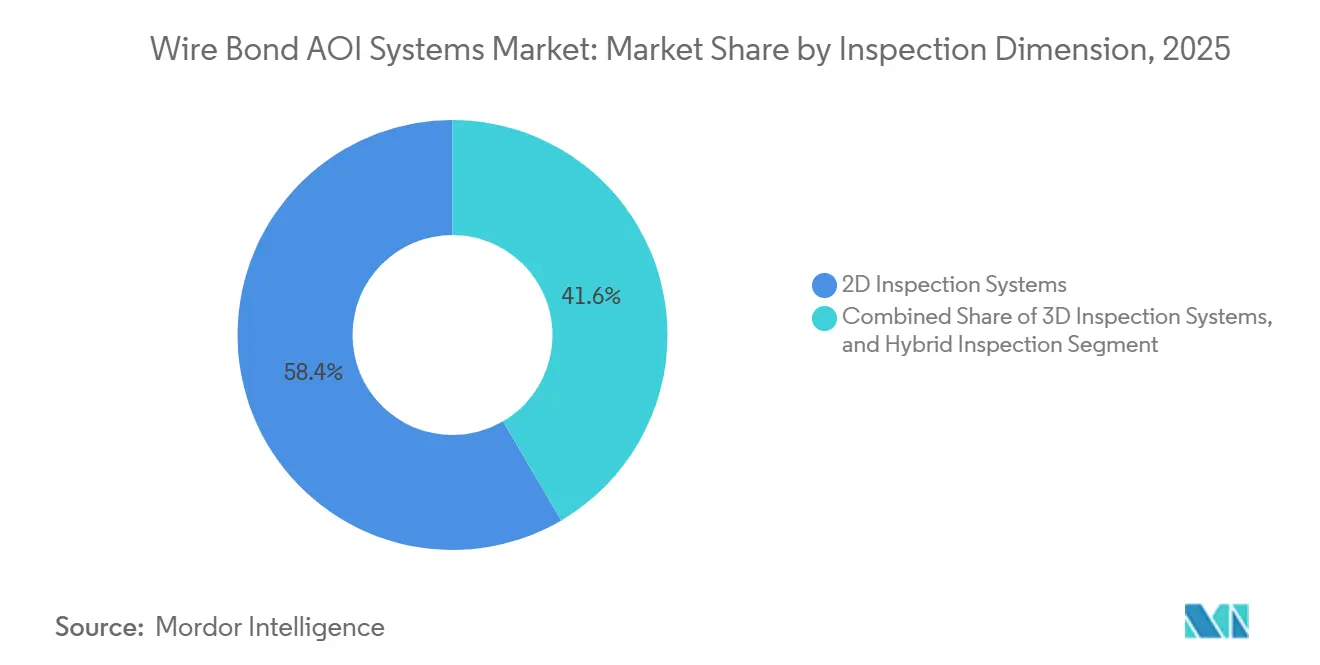
2D systems held 58.43% of the Wire Bond AOI Systems Market share in 2025. Their installed base is substantial in facilities that process standard ball-wedge and wedge-wedge configurations, where established process windows and familiar defect signatures simplify inspection program setup and operator training. These platforms support high throughput at a lower capital cost than more complex systems, which remains important for mature packages where customers prioritize predictable cycle time and equipment utilization. They remain suitable when defects can be identified with top-down, multi-angle illumination. Their practical value in the Wire Bond AOI Systems Market is strongest in high-volume packages with established defect patterns.
Hybrid 2D/3D systems are projected to expand at an 11.63% CAGR through 2031. Fine wires below 10 µm, loop heights below 50 µm, and stacked packages increase the risk of occlusion, shadowing, and glare, particularly where top-down imaging cannot see wire sections behind adjacent loops or package features. These conditions can lead to false alarms or undetected defects when only 2D images are used. The Wire Bond AOI Systems Market size for hybrid platforms is supported by customers seeking selective 3D data without a full-volume scan. IEEE research has demonstrated production-speed wire profiling, which supports practical hybrid deployment.

By Bond Type: Ball-Wedge Retains Scale While Ribbon Gains Relevance
Ball-wedge bonding accounted for 61.72% of the bond-type segment in 2025. It is widely used in consumer electronics, networking equipment, industrial products, and general semiconductor packaging, where established bonding processes support high production volumes and the need for repeatable inspection. Established materials, tools, and inspection criteria make it a lower-risk format for high-volume output, because assembly providers can use familiar consumables, bonding programs, and acceptance limits. Wedge-wedge bonding has a stable role in heavy-wire aluminum interconnects for high-current devices. These factors sustain ball-wedge bonding as the largest bond type within the Wire Bond AOI Systems Industry.
Ribbon bonding is projected to expand at a 10.27% CAGR through 2031. Automotive traction inverters and silicon carbide power modules are increasingly using structures with higher current-carrying requirements. Ribbon bonds require different inspection logic because edge lifting and broad geometries differ from ball-based pull failure patterns, while wider bond footprints require illumination and classification methods tailored to the material and layout. Research in Micromachines describes ultrasonic ribbon bonding as offering wire-bonding flexibility, strong current capacity, and a broader bonding parameter window. Less standardized ribbon criteria create an opening in the Wire Bond AOI Systems Market for suppliers with dedicated inspection modules.
By Deployment: Inline Platforms Set Production Inspection Requirements
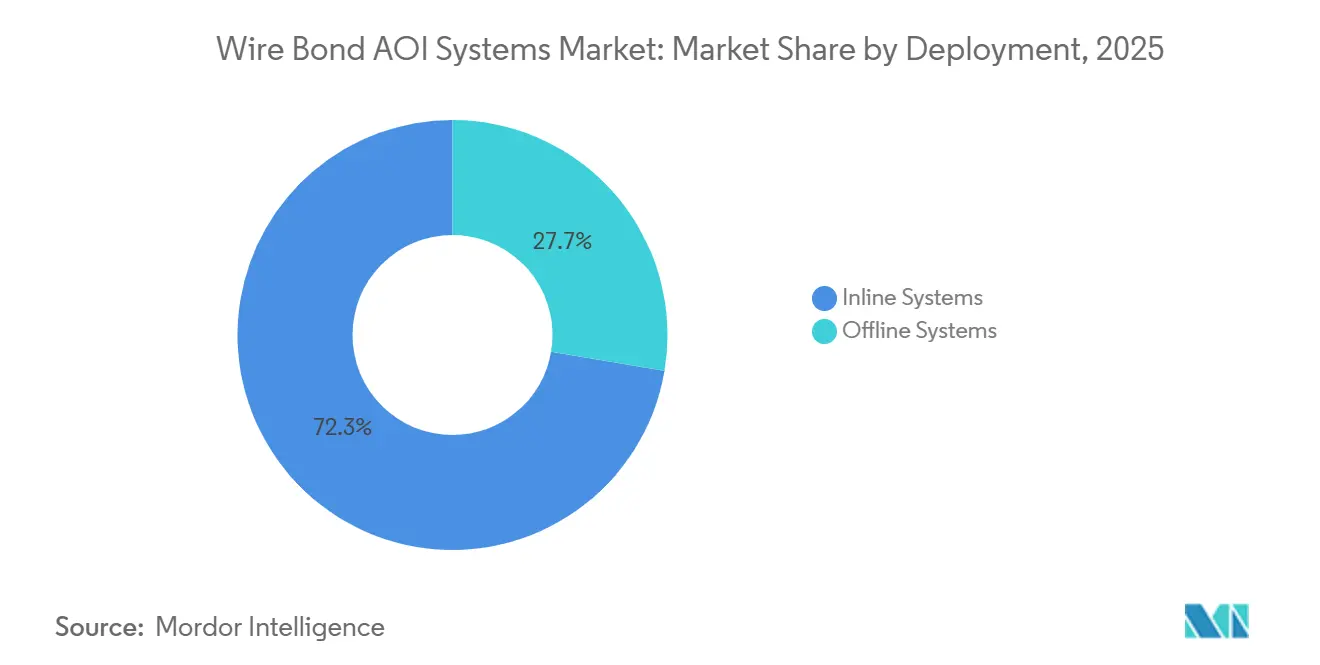
Inline systems held 72.34% share of the deployment segment in 2025 and further it is expected to expand at 10.46% through 2031. Their lead reflects the need for 100% inspection at wire-bonder throughput rates exceeding 20 bonds per second. A separate inspection step can introduce handling risk, increase cycle time, and create a point where defects can move farther along the line before they are detected. Inline placement reduces the chance that a defect passes unnoticed before later production stages. This makes continuous inspection the typical choice in the Wire Bond AOI Systems Market for high-volume assembly.
Offline systems remain important for process development, first-article inspection, qualification, and failure analysis. These uses prioritize inspection depth over production throughput, allowing engineers to study unusual defects, validate bond parameters, and establish acceptance criteria before a package enters volume production. Specifications established on offline systems can later shape requirements for inline systems at production scale. Viscom’s iS6059 supports 2D and 3D inspection across aluminum, copper, silver, gold, and ribbon materials. Aerospace and defense programs also require non-destructive inspection before encapsulation, which helps sustain offline demand.
By End-User Industry: Automotive Raises the Value of Inspection
Semiconductor and electronics accounted for 46.83% of the end-user segment in 2025. Consumer devices, networking infrastructure, and general-purpose integrated circuits create the volume behind this position. The category is sensitive to broad semiconductor demand cycles because assembly providers can delay discretionary inspection upgrades when utilization and customer order visibility decline. Outsourced providers can defer inspection upgrades when end demand weakens. High-throughput lines still require reliable inspection because low defect rates can still affect large production volumes.
The automotive industry is projected to expand at a 10.18% CAGR through 2031. Electric vehicles require power semiconductors in traction inverters, charging systems, and battery controls, increasing the number of packages that need robust interconnections under demanding electrical and thermal conditions. These packages require more detailed bond characterization and more auditable process records than many consumer packages. AEC-Q006 Rev B reinforces the importance of qualified copper-wire interconnections in automotive-grade components. Medical manufacturers in the Wire Bond AOI Systems Market also require traceable inspection output for life-critical electronics.
Geography Analysis
Asia-Pacific held 58.67% of the Wire Bond AOI Systems Market share in 2025. Taiwan, South Korea, Malaysia, China, and Japan contain the largest concentration of outsourced assembly and test operations. The region combines high-volume wire-bond packaging with a broad equipment-supplier base, giving customers access to global vendors as well as regional providers with local service and pricing options. Domestic procurement can challenge overseas suppliers in the Wire Bond AOI Systems Market even as regional inspection demand rises. Asia-Pacific remains central because most production capacity and inspection purchasing decisions are located there.
Europe is projected to expand at a 10.07% CAGR through 2031. Automotive and industrial power electronics support demand across Germany, France, the United Kingdom, Italy, and Spain. Germany has a dense automotive and industrial power-electronics base. These customers often need metrology records that support automotive qualification requirements, which can favor inspection platforms that provide dimensional evidence and traceable process information. North America is an emerging opportunity in the Wire Bond AOI Systems Market as Amkor develops its Arizona packaging and test campus.
South America has a limited current role in wire-bond inspection. Its activity is concentrated in Mexico’s electronics manufacturing corridor, where multinational companies guide purchasing decisions. The Middle East and Africa also have a modest current presence in back-end packaging. Demand in both regions is expected to develop gradually as industrial electronics assembly matures.
Competitive Landscape
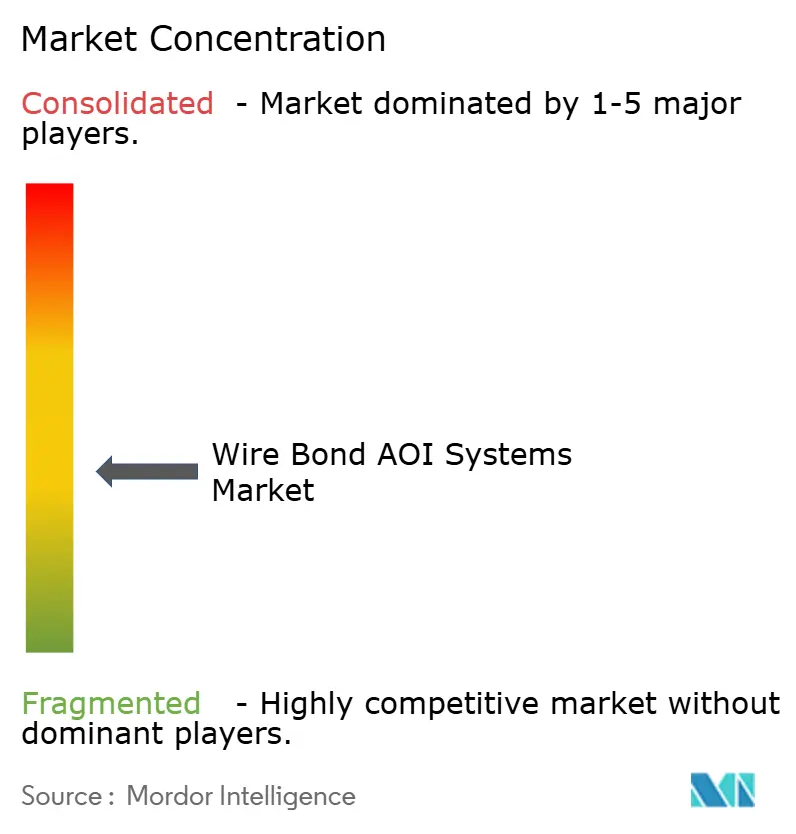
The Wire Bond AOI Systems Market is moderately fragmented across capability, geography, and price tiers. Koh Young Technology, ViTrox Corporation, PARMI, Viscom SE, and GÖPEL electronic GmbH compete at the higher end of the market. Their offers emphasize 3D measurement, software, and production-system connectivity, targeting customers who need inspection data to guide process adjustments rather than only identify defective units. Regional suppliers compete more directly on 2D-system pricing and local service. Standard 2D tools in the Wire Bond AOI Systems Market face stronger price competition than systems with advanced metrology functions.
ViTrox introduced the V510i Smart 3D AOI System in 2026 for wire-bond and lead-frame inspection. The system provides 3D measurement, closed-loop data, and inspection-stage cross-referencing. PARMI has developed PRECION as a wire-bond platform using multi-illumination and vertical Z-scan imaging. Viscom created a Microelectronics Inspection unit as part of its 2025 reorganization. These moves place greater emphasis on specialized inspection and connected process control in the Wire Bond AOI Systems Market.
Competitive opportunity in the Wire Bond AOI Systems Market is strongest in ribbon-bond inspection and faster model transfer for new packages. Suppliers that reduce false calls have an advantage with reflective wires and complex loops. Product qualification can embed a tool in a customer’s production process, because validated defect libraries, operating recipes, and audit records can make replacement more difficult after a system is accepted. The Wire Bond AOI Systems Market rewards suppliers that combine measurement quality with production-speed operation.
Wire Bond AOI Systems Industry Leaders
-
Viscom SE
-
Nordson Corporation
-
PARMI Co., Ltd.
-
TT Vision Holdings Berhad
-
QES Group Berhad
- *Disclaimer: Major Players sorted in no particular order
Recent Industry Developments
- July 2026: PARMI exhibited at JPCA Show 2026 at Tokyo Big Sight for the Wire Bond AOI Systems Market, showcasing the Xceed II MICRO IGBT 3D AOI for IGBT inspection supporting 75-500 µm wire diameters and the Xceed II MICRO for semiconductor packaging inspection, targeting Japanese automotive and power electronics manufacturers with a platform built around IGBT-specific defect taxonomy.
- March 2026: ViTrox Corporation launched the V510i Smart 3D AOI System at IPC APEX EXPO 2026, delivering high-speed, high-accuracy 3D measurement of reflective die and wire bonds in advanced packaging, with unique test coverage for lead frames and wire bonds via real-time closed-loop data and cross-referencing across inspection stages.
- March 2026: PARMI showcased the PRECION 2D/3D AOI system at APEX EXPO 2026, a wire bond-specific platform using multi-illumination and vertical Z-scan imaging to detect bonds down to Ø 0.6 mil wire diameter across copper, gold, and aluminum materials, with AI Teaching capabilities that automatically generate inspection models from physical PCB and BOM to reduce setup time and false-call rates.
- November 2025: PARMI exhibited 7 inspection systems at productronica 2025 in Munich, including the PRECION wire bond AOI, the Xceed IGBT 3D AOI for IGBT inspection, and the Xceed BSI for bottom-side inspection, with live demonstrations of real-time AI teaching targeting European automotive and power electronics production lines.
Global Wire Bond AOI Systems Market Report Scope
Wire Bond AOI Systems are specialized automated optical inspection solutions designed to verify the quality, integrity, and geometric accuracy of wire bonds in semiconductor and electronic packages, ensuring reliable electrical connections and preventing defects such as broken wires, poor bonding, or misalignment during high-volume manufacturing.
The Wire Bond AOI Systems Market Report is Segmented by Inspection Dimension (2D Inspection Systems, 3D Inspection Systems, and Hybrid 2D/3D Inspection Systems), Bond Type (Ball-Wedge Bonding, Wedge-Wedge Bonding, and Ribbon Bonding), Deployment (Inline Systems and Offline Systems), End-User Industry (Semiconductor and Electronics, Automotive, Aerospace and Defense, Medical and Healthcare, Industrial and Consumer Electronics, Optoelectronics and Photonics, and Other End-User Industries), and Geography (North America, South America, Europe, Asia-Pacific, Middle East and Africa). The Market Forecasts are Provided in Terms of Value (USD).
| 2D Inspection Systems |
| 3D Inspection Systems |
| Hybrid 2D/3D Inspection Systems |
| Ball-Wedge Bonding |
| Wedge-Wedge Bonding |
| Ribbon Bonding |
| Inline Systems |
| Offline Systems |
| Semiconductor and Electronics |
| Automotive |
| Aerospace and Defense |
| Medical and Healthcare |
| Industrial and Consumer Electronics |
| Optoelectronics and Photonics |
| Other End-User Industries |
| North America | United States | |
| Canada | ||
| Mexico | ||
| South America | Brazil | |
| Argentina | ||
| Rest of South America | ||
| Europe | Germany | |
| United Kingdom | ||
| France | ||
| Italy | ||
| Spain | ||
| Rest of Europe | ||
| Asia-Pacific | China | |
| Japan | ||
| India | ||
| South Korea | ||
| Rest of Asia-Pacific | ||
| Middle East and Africa | Middle East | Saudi Arabia |
| United Arab Emirates | ||
| Turkey | ||
| Rest of the Middle East | ||
| Africa | South Africa | |
| Nigeria | ||
| Rest of Africa | ||
| By Inspection Dimension | 2D Inspection Systems | ||
| 3D Inspection Systems | |||
| Hybrid 2D/3D Inspection Systems | |||
| By Bond Type | Ball-Wedge Bonding | ||
| Wedge-Wedge Bonding | |||
| Ribbon Bonding | |||
| By Deployment | Inline Systems | ||
| Offline Systems | |||
| By End-User Industry | Semiconductor and Electronics | ||
| Automotive | |||
| Aerospace and Defense | |||
| Medical and Healthcare | |||
| Industrial and Consumer Electronics | |||
| Optoelectronics and Photonics | |||
| Other End-User Industries | |||
| By Geography | North America | United States | |
| Canada | |||
| Mexico | |||
| South America | Brazil | ||
| Argentina | |||
| Rest of South America | |||
| Europe | Germany | ||
| United Kingdom | |||
| France | |||
| Italy | |||
| Spain | |||
| Rest of Europe | |||
| Asia-Pacific | China | ||
| Japan | |||
| India | |||
| South Korea | |||
| Rest of Asia-Pacific | |||
| Middle East and Africa | Middle East | Saudi Arabia | |
| United Arab Emirates | |||
| Turkey | |||
| Rest of the Middle East | |||
| Africa | South Africa | ||
| Nigeria | |||
| Rest of Africa | |||
Key Questions Answered in the Report
What is the Wire Bond AOI Systems Market size?
The Wire Bond AOI Systems Market is USD 109.52 million in 2026 and is projected to reach USD 166.94 million by 2031 at an 8.80% CAGR.
What is driving demand for wire bond AOI systems?
Packaging capacity expansion, automotive power electronics, fine-pitch bonds, and greater use of 3D metrology are supporting demand.
Which inspection dimension has the largest share?
2D systems held 58.43% share in 2025, supported by their installed base and high-throughput role in standard packages.
Which deployment model leads wire bond inspection?
Inline systems led with 72.34% share in 2025 because high-volume lines require continuous inspection at production speed.
Which end-user application is expanding fastest?
Automotive is projected to expand at a 10.18% CAGR through 2031 as electric power modules require more rigorous bond inspection.
Which region is projected to expand fastest?
Europe is projected to expand at a 10.07% CAGR through 2031, supported by automotive and industrial power-electronics demand.