
Market Overview
| Study Period | 2020 - 2031 |
|---|---|
| Forecast Data Period | 2026 - 2031 |
| Base Year Market Size (2025) | 7.62 gigawatt |
| Market Volume (2026) | 7.73 gigawatt |
| Market Volume (2031) | 8.32 gigawatt |
| Growth Rate (2026 - 2031) | 1.45 % |
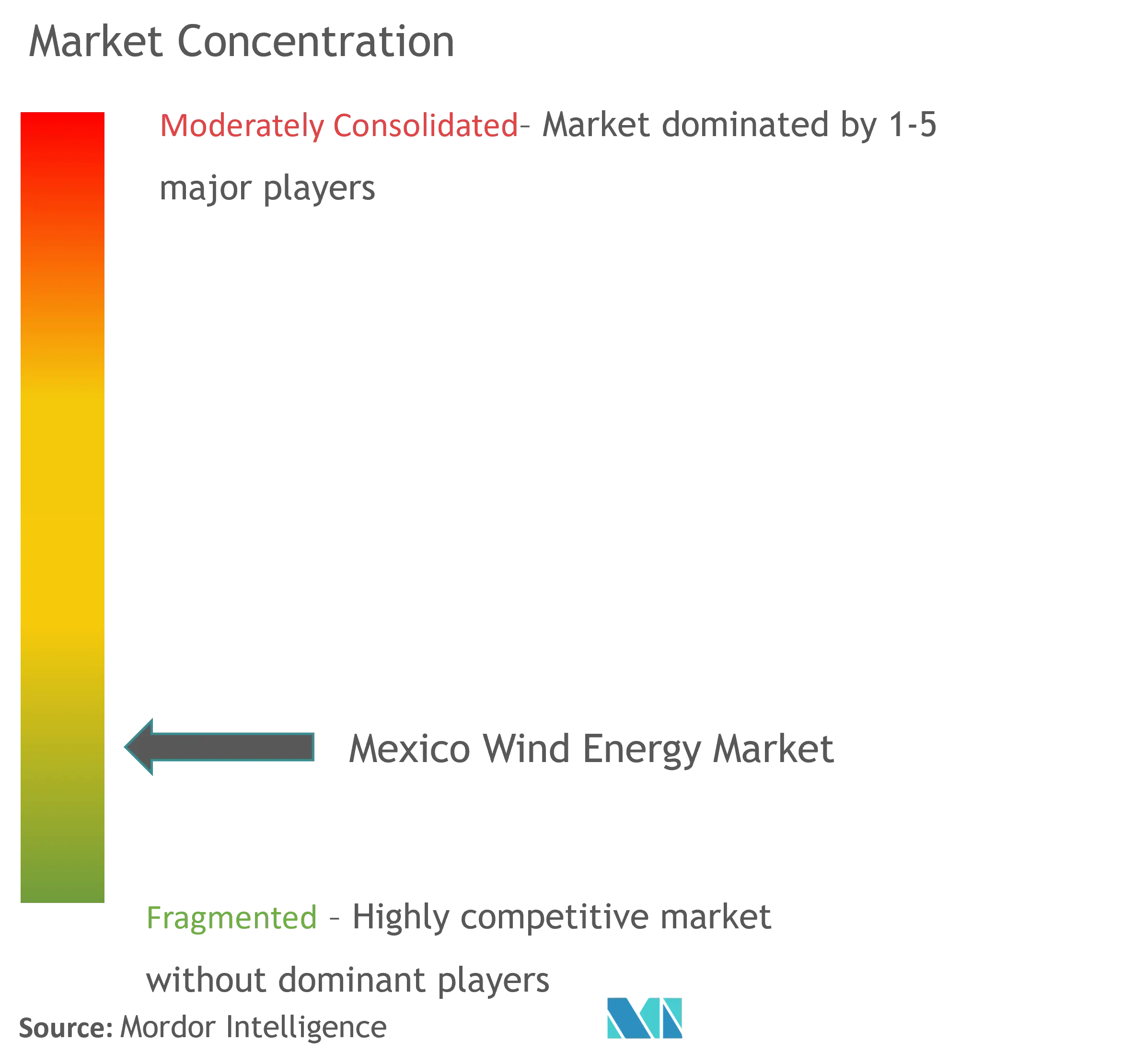
| Market Concentration | Low |
Major Players *Disclaimer: Major Players sorted in no particular order Image © Mordor Intelligence. Reuse requires attribution under CC BY 4.0. | |
Mexico Wind Energy Market Analysis by Mordor Intelligence
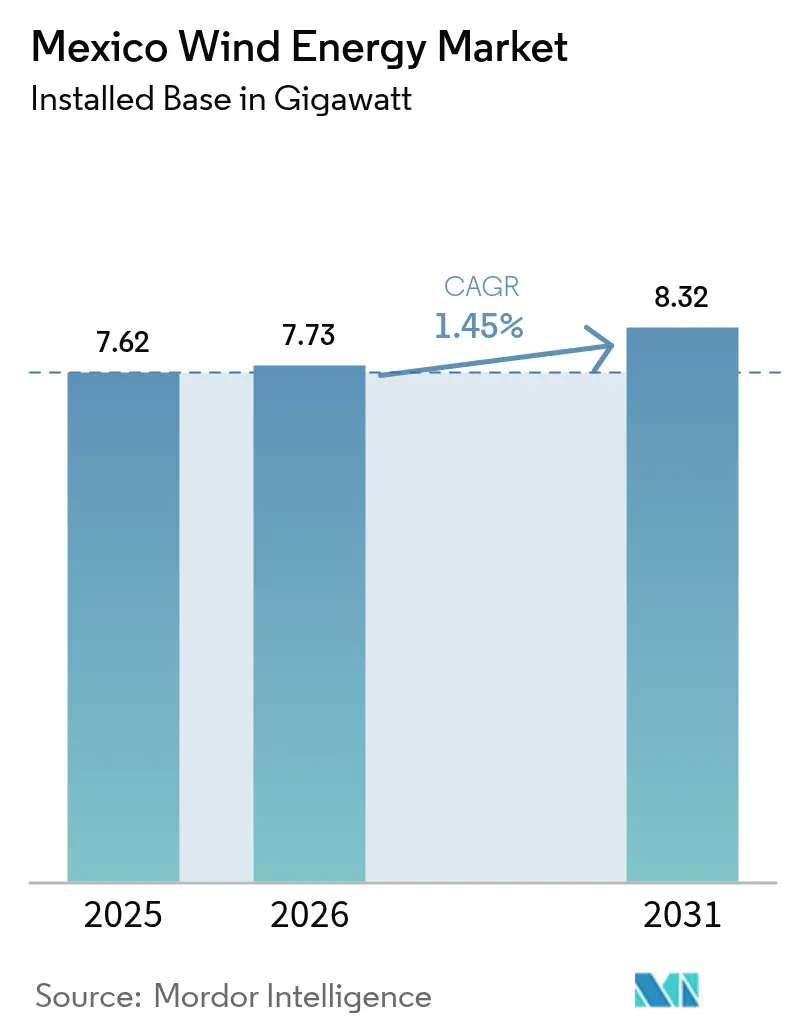
Mexico Wind Energy Market size in 2026 is estimated at 7.73 gigawatt, growing from 2025 value of 7.62 gigawatt with 2031 projections showing 8.32 gigawatt, growing at 1.45% CAGR over 2026-2031.
- Factors such as the declining costs of wind technologies and additional subsidies on wind energy systems, demand for cleaner energy, and supportive government policies are expected to drive the wind energy market.
- On the other hand, in the absence of new initiatives, an underdeveloped power grid in Mexico is expected to hinder the growth of the wind energy market in the coming years.
- Mexico is focusing on onshore wind power, which may dominate the market due to high investment and better wind current, providing economic viability for large projects. This, in turn, is expected to provide better opportunities for the Mexican wind energy market in the future.
Note: Market size and forecast figures in this report are generated using Mordor Intelligence’s proprietary estimation framework, updated with the latest available data and insights as of 2026.
Mexico Wind Energy Market Trends and Insights
Onshore Wind Power is Expected to Dominate the Mexican Wind Energy Market
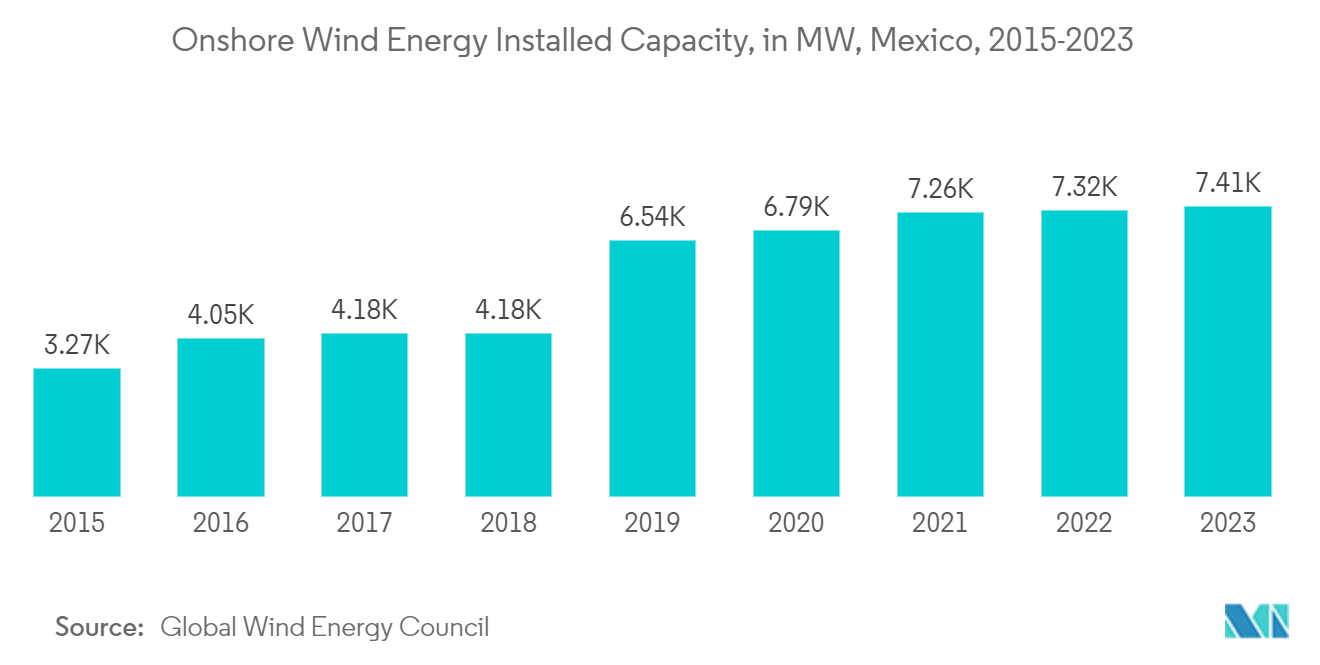
- In 2023, Mexico registered an increase of about 1.3% in its onshore installed wind power capacity. The country installed 96 MW of new wind power capacity, which increased the total installed wind power capacity to 7413 MW.
- Under its Energy Transition Law, the country aims to generate half of its electricity using clean energy sources by 2034. This goal is supported by the requirements of the Clean Energy Certificate (CEC) and long-term electricity auctions. The Mexican government was primarily focusing on liberalizing the electricity market.
- In March 2024, Sempra Infrastructure, a subsidiary of Sempra, placed a 319 MW order for the Cimarron wind farm in Tecate, in the state of Baja California, Mexico. This is the third phase of the Energia Sierra Juarez Wind Complex, which will have a total installed capacity of 582 MW. The order includes supply and installation of 46 V163-4.5 MW turbines and 18 V162-6.2 MW turbines. Upon completion, Vestas is expected to deliver a 10-year service agreement that will optimize energy production while providing long-term business case certainty for wind farm operations.
- In addition, the opening of the industry to private and foreign investments may drive the onshore wind energy market during the forecast period. Furthermore, the production of wind power in the country was initially driven by environmental concerns. However, these concerns have been superseded by commercial interests.
- Moreover, the increased reliability convinced large companies to invest in renewable energies, such as wind, to fulfill the increasing demand for electricity. In January 2023, the Government of Mexico announced the Sonora plan, which aims at investments of USD 48 billion in solar parks in Sonora state and wind farms in Oaxaca by 2030.
- Hence, with several onshore wind energy projects under operation and others in the planning and construction phase, owing to investment and government policies, the Mexican wind energy market is expected to grow further during the forecast period.


Increasing Investment in Wind Energy Likely to Drive the Market
- Mexico has set ambitious targets for renewable energy capacity expansion for 35% clean energy by 2024. This is in line with its international commitments to combat climate change and is consistent with its local laws, which include the General Climate Change Law and the Energy Transition Law. Though the country-initiated wind power production, due to increasing environmental concerns, the market is largely driven by commercial interests.
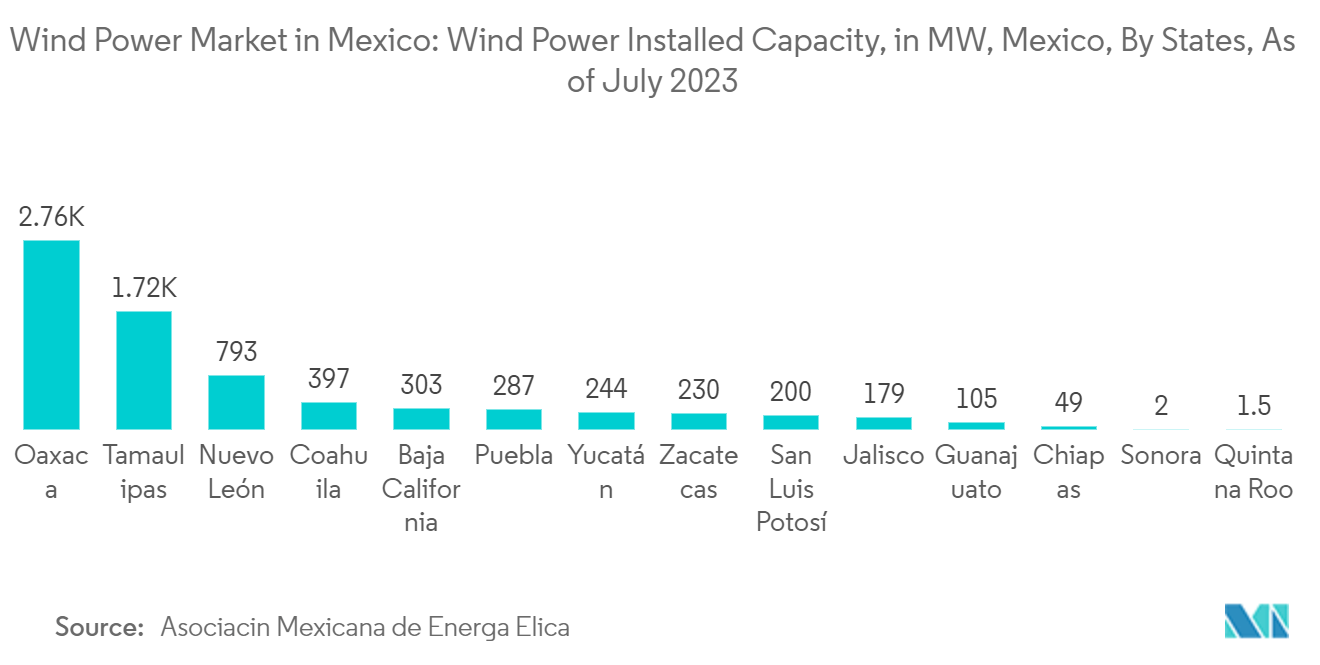
- Moreover, factors like escalating demand for renewable energy, favorable government policies, and decreasing cost of equipment are attracting foreign investors for higher investment in the Mexican wind energy market. As of July 2023, Mexico had wind energy infrastructure installed in 14 states around the country. Oaxaca was the state with the highest installed capacity as of that date, with more than 2.7 gigawatts. It was followed by Tamaulipas and Nuevo León. In the past decade
- However, in February 2024, the Mexican Wind Energy Association announced USD 5.8 billion in investment, which remains stalled due to regulatory hurdles affecting 35 wind power generation parks in Mexico. The association also reveals that CRE has held up permits for seven completed plants, totaling 800 MW of installed capacity, along with 28 parks at various development stages, collectively amounting to 5,000 MW.
- In Tamaulipas, there are only 2.3 MW in operation with a wind potential of 22,558 MW. The State Energy Commission also suspended at least 30 wind projects due to a lack of transmission lines from the CFE3. Thus, to boost generation, SENER announced an investment of approximately MXN 8 billion in developing the necessary infrastructure.
- Hence, the aforementioned factors, such as investment and policies, are likely to drive the market studied during the forecast period.
Regulatory Landscape
Mexico's wind power regulation operates within the electricity-sector legal framework administered by SENER, with system operation and interconnection overseen by CENACE and permitting handled by the national energy regulator (CNE). A key anchor is the publication of Regulations to the Electricity Sector Law in the DOF on October 3, 2025, which reinforced a planning-led approach that links new generation to binding planning priorities focused on grid stability, reliability, and security.
In 2026, the permitting pathway tightened further through SENER actions that align renewable additions with the binding planning agenda. SENER published guidelines in April 2026 for the voluntary migration of legacy independent power production permits into the current framework, and issued a Second Call in May 2026 for priority attention to generation-permit and interconnection applications. In parallel, new integration rules increased the compliance burden for variable renewables by embedding energy storage requirements in the approval pathway, requiring developers to pair battery storage with new wind capacity to meet interconnection and reliability criteria.
Value Chain Analysis
Mexico's wind value chain covers project origination and resource assessment, land acquisition and community engagement, environmental and social permitting, equipment procurement (turbines, towers, blades, substations, and controls), civil works and balance-of-plant, grid interconnection with CFE and system coordination via CENACE, and long-term operations and maintenance (O&M). OEMs and EPCs anchor the equipment supply and construction layers, while domestic participation is more concentrated in construction services and O&M, with higher-value components (such as key power electronics and specialized systems) remaining import-dependent.
Interconnection and permitting are the most time-critical choke points shaping how the chain executes. This shows up in 2026 activity where regulators approved grid interconnection milestones and CFE interconnection progress, while the permitting calendar and SENER's May 2026 priority call pushed projects to align with binding planning and new technical requirements. The chain is also adapting to hybridization, with battery energy storage systems increasingly treated as a standard design-and-procurement line item for new wind builds. This is changing contracting scopes, financing packages, and O&M capabilities for wind assets moving through mixed schemes and utility-facing offtake structures.
Competitive Landscape
The Mexican wind energy market is moderately fragmented. The major companies include (in no particular order) Siemens Gamesa Renewable Energy SA, General Electric Company, Vestas Wind Systems, Acciona SA, EDF Renewables Inc., and Enel SpA.
Mexico Wind Energy Industry Leaders
Siemens Gamesa Renewable Energy SA
General Electric Company
Vestas Wind Systems
Acciona SA
EDF Renewables Inc.
- *Disclaimer: Major Players sorted in no particular order

Market Opportunities and Future Outlook
Near-term whitespace in Mexico's wind market centers on projects moving through the updated permitting and mixed-development framework, alongside the operational need to address grid constraints using hybrid configurations. A tangible opportunity set is the active project pipeline reported at 2,159 MW, which is in regulatory and permitting processes and ties directly to new bidding and evaluation timelines. With regulatory instruments emphasizing binding planning and interconnection readiness, developers that package wind with storage and secure CFE interconnection routes can move from permit stage to execution.
Battery integration has shifted from a project differentiator to a mainstream requirement and commercial lever in tendering and grid-access discussions. This is evidenced by wind awards under mixed schemes that pair large wind blocks with sizable BESS (for example, a 705 MW wind project paired with a 317 MW battery system in Tamaulipas), and by the policy direction linking renewable growth to system reliability and security. As a result, opportunities extend beyond pure generation into storage supply, hybrid plant design, grid-services capability, and long-term O&M models tailored to wind-plus-storage assets operating under CFE-linked structures.
Recent Industry Developments
- July 2026: Polaris Renewable Energy Inc. executed a Mixed Investment Agreement (Contrato de Inversion Mixta) with Banca Mifel acting on behalf of CFE, covering three renewable energy projects under Mexico's mixed development program. The agreement formalizes a utility-linked route to market for private developers and reflects a shift toward structured partnerships rather than purely merchant buildouts. It also reinforces the need for bankable contracting frameworks and standardized risk allocation in new renewable project delivery.
- June 2026: Terralia Energia y Campo secured a contract under the CFE mixed scheme for the 705 MW El Chorro wind project in Tamaulipas, incorporating a 317 MW battery energy storage system. The award highlights how wind-plus-storage configurations are being used to support grid integration and dispatchability needs within tendered procurement. It also raises the importance of storage sizing, EPC scope, and hybrid O&M capabilities as factors in winning new wind capacity.
- April 2026: Acciona Energia received approval from the national energy regulator (CNE) to modify the generation permit for the 198 MW San Carlos wind farm in Tamaulipas, enabling power supply to the wholesale electricity market. The permit change improves commercial flexibility for an operating asset and shows active regulatory processing for wind plants under the evolving ruleset. It also signals that portfolio optimization through permit and offtake adjustments is part of how established players manage value in Mexico's wind fleet.


Research Methodology Framework and Report Scope
Market Definition and Coverage
For this study, the Mexico wind energy market is defined as the country level installed wind power capacity that is grid connected and operational, tracked in gigawatts across the stated time period.
Scope exclusions: It excludes short term construction activity, standalone off grid projects, and broader renewable power assets that are not wind based.
Segmentation Overview
- Location of Deployment
- Onshore
- Offshore
Data Sources, Market Sizing, and Validation
Desk Research
Desk research sets the base facts for a capacity model that stays reproducible even when project announcements shift. We anchor the historical installed base and operating dates using public sources such as Mexico energy regulator publications, grid planning updates from the national system operator, and international energy statistics from IEA and IRENA releases.
To keep assumptions practical, we also review turbine and project level information that is available through developer press releases, environmental filings, and credible press coverage, and then cross check it with customs trade statistics for key wind components where this helps explain delays or surges. Paid subscriptions for company financials and for patent databases are used selectively to confirm ownership changes, technology shifts, and commissioning timelines that are not consistently captured in public summaries. These desk sources are illustrative only, and many other public references were also used for data collection, validation, and clarification.
Primary Interviews and Surveys
Primary work focuses on reality checking what is operational versus what is only planned in Mexico, and it also helps us stress test the timing assumptions that drive the installed base. We spoke with a mix of project developers, EPC and component ecosystem participants, grid and policy experts, and large buyers to validate pipeline maturity, commissioning risk, and typical repowering triggers across Mexico.
Distribution of primary research fieldwork respondents
| Company type | Respondent position |
|---|---|
| Top tier: 26% | CXOs: 15% |
| Mid tier: 58% | Functional/Unit leaders: 36% |
| Smaller Players: 16% | Managers: 49% |
Market-Sizing & Forecasting
Sizing is built mainly from a top down capacity accounting view, where official installed capacity totals are reconstructed year by year and then extended using the verified project pipeline and expected commissioning dates. We then use selective bottom up approximations, like rolling up a sample of named projects and applying typical MW blocks and slippage factors, which helps adjust totals when public pipeline lists are incomplete.
A few inputs matter most for Mexico in this model, and they are kept easy to audit. Installed base by year and retirement assumptions are tracked alongside project status (announced, permitted, under construction, operating), interconnection and grid readiness signals, expected capacity additions by state level wind resource corridors, and repowering timing for older fleets. When gaps show up, conservative placeholders are used and then replaced after follow up checks with industry participants, so the model does not over count capacity that is still stuck at the proposal stage.
For forecasting, scenario analysis is applied around two practical levers, pipeline conversion rates and schedule delays, and the ranges are narrowed using what experts said about permitting pace and offtake visibility. The final forecast is presented as a single central case after the downside and upside runs are reviewed against observed build rates and the latest operating capacity totals.
Data Validation & Update Cycle
Validation is done through a triangulation routine that compares modeled capacity with multiple independent signals, including official installed capacity publications, grid planning snapshots, and confirmed commissioning announcements. Outliers are flagged when a project appears in more than one source but its operating status or COD differs, and then the assumption is rechecked before it is allowed into the installed base.
Before sign off, the model goes through more than one analyst review so unit handling, timing, and carryover logic are consistent across years. If large policy shifts, interconnection rule changes, or major project cancellations occur, we trigger re contacts to confirm how the pipeline should be re weighted. Reports refresh annually, and before delivery a fresh pass is completed so clients receive the latest updated view available at that time.
Mordor Intelligence's Mexico Wind Energy Market Estimate Compared With Other Published Estimates
Published estimates for Mexico wind energy often disagree because the underlying measure is not always the same, and some sources mix capacity, generation, and investment value in one headline number. Differences also come from how developers count pipeline projects, and from whether repowering and life extension are treated as new additions.
Some published figures lean toward electricity output or equipment value, and they can also embed aggressive build schedules from early stage announcements. In contrast, Mordor Intelligence counts only installed, operational wind capacity in Mexico (in GW) and keeps projects out of the base until commissioning is supported by commissioning dated signals, which reduces inflation from stalled or unpermitted plans.
Benchmark comparison
| Source | Market Size | Gaps in Research Methodology |
|---|---|---|
| Mordor Intelligence | USD 7.62 B (2025) | |
| Trade Journal A | USD 23.20 B (2025) | Uses electricity generation units converted into a market headline (GWh based) and can mix demand output with capacity stock, which makes it difficult to match to an installed base view. |
| Industry Data Provider B | USD 7.48 B (2022) | Reports cumulative installed capacity for a different base year and pairs it with long horizon growth rates, so timing shifts and commissioning lags can cause non comparable point estimates. |
The comparison shows that the spread is mostly explained by unit choice and what is allowed into the count before a project is operating. By keeping the model tied to commissioning timing, retirements, and a validated pipeline conversion rate, the final number stays traceable to clear steps that can be repeated each year.


Key Questions Answered in the Report
How big is the Mexico Wind Energy Market?
The Mexico Wind Energy Market size is expected to reach 7.73 gigawatt in 2026 and grow at a CAGR of 1.45% to reach 8.32 gigawatt by 2031.
What is the current Mexico Wind Energy Market size?
In 2026, the Mexico Wind Energy Market size is expected to reach 7.73 gigawatt.
Who are the key players in Mexico Wind Energy Market?
Siemens Gamesa Renewable Energy SA, General Electric Company, Vestas Wind Systems, Acciona SA and EDF Renewables Inc. are the major companies operating in the Mexico Wind Energy Market.
What years does this Mexico Wind Energy Market cover, and what was the market size in 2025?
In 2025, the Mexico Wind Energy Market size was estimated at 7.73 gigawatt. The report covers the Mexico Wind Energy Market historical market size for years: 2019, 2020, 2021, 2022, 2023 and 2024. The report also forecasts the Mexico Wind Energy Market size for years: 2026, 2027, 2028, 2029, 2030 and 2031.
Page last updated on:





