
Market Overview
| Study Period | 2020 - 2031 |
|---|---|
| Forecast Data Period | 2026 - 2031 |
| Historical Data Period | 2020 - 2024 |
| Market Size (2026) | USD 2.54 Billion |
| Market Size (2031) | USD 3.31 Billion |
| Growth Rate (2026 - 2031) | 5.41 % |
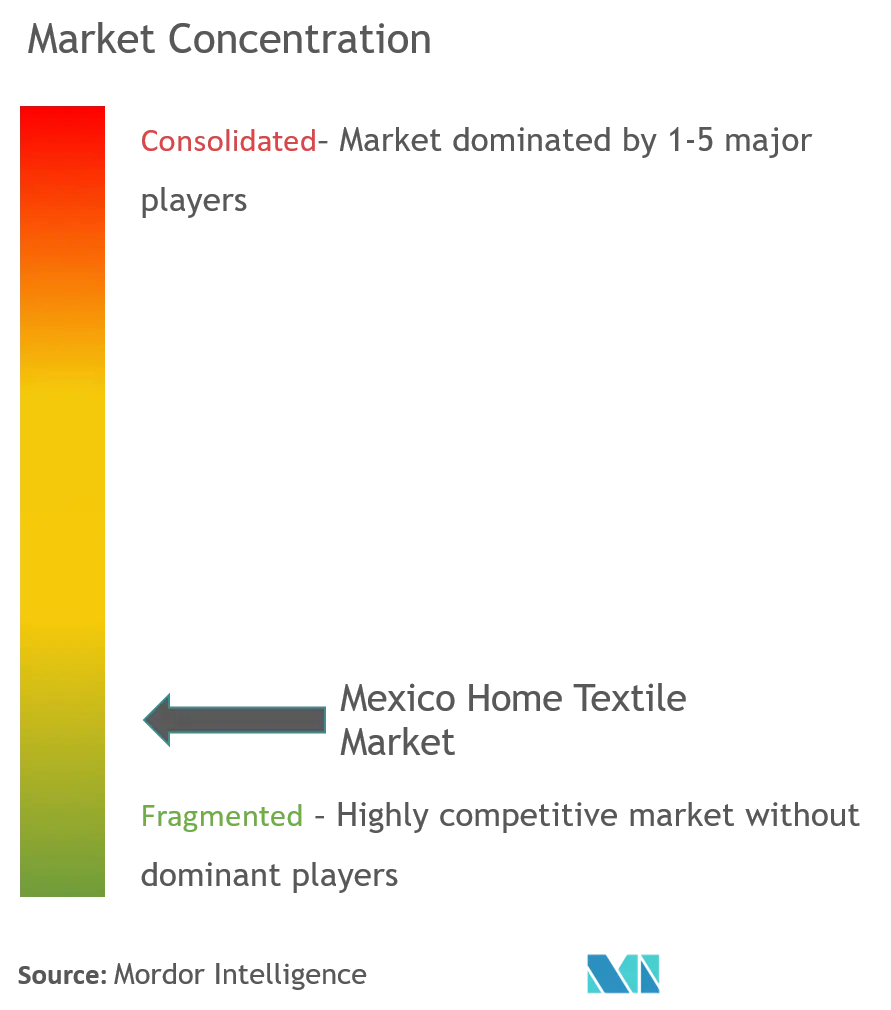
| Market Concentration | Medium |
Major Players *Disclaimer: Major Players sorted in no particular order Image © Mordor Intelligence. Reuse requires attribution under CC BY 4.0. | |
Mexico Home Textile Market Analysis by Mordor Intelligence
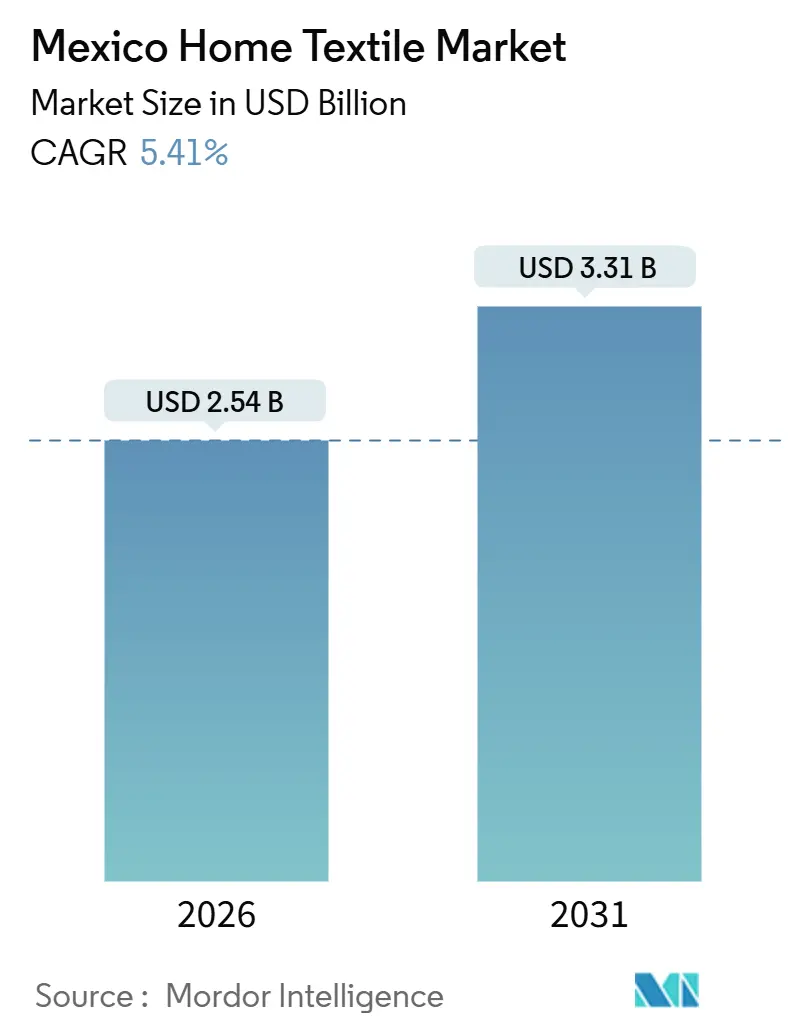
The Mexico Home Textile Market size is estimated at USD 2.54 billion in 2026, and is expected to reach USD 3.31 billion by 2031, at a CAGR of 5.41% during the forecast period (2026-2031).
The Mexico home textile market advances on structural drivers tied to housing formation, hospitality activity, and retail modernization that shorten replacement cycles and broaden assortment depth across price tiers. Momentum concentrates in Northern and Central metros where manufacturing inflows, retail investments, and logistics upgrades strengthen product availability and the uptake of premium and performance ranges in the Mexico home textile market. Nearshoring and foreign investment add office and hotel capacity, which intensifies demand for upholstery, linens, and technical fabrics used in frequent-use environments. Omnichannel retail builds scale as large chains enhance click-and-collect, two-day delivery, and marketplace assortments, a shift that accelerates style discovery and purchase frequency in the Mexico home textile market[1].
Key Report Takeaways
- By application, bed linen led with 41.53% of the Mexico home textile market share in 2025. Upholstery is forecast to expand at a 6.14% CAGR through 2031.
- By material, cotton accounted for 54.25% of the Mexico home textile market share in 2025, while synthetic fibres are projected to expand at a 5.93% CAGR through 2031.
- By end-user, residential held 67.92% of the Mexico home textile market share in 2025, while the Mexico home textile market size serving commercial end-users is projected to grow at a 5.62% CAGR through 2031.
- By distribution channel, offline captured 76.34% of the Mexico home textile market share in 2025. The Mexico Home Textile market size for online channels is projected to expand at a 6.45% CAGR through 2031.
- By geography, Central Mexico captured 35.31% of the Mexico home textile market share in 2025. Northern Mexico is forecast to grow at a 6.18% CAGR through 2031.
Note: Market size and forecast figures in this report are generated using Mordor Intelligence’s proprietary estimation framework, updated with the latest available data and insights as of January 2026.
Market Trends and Insights
Drivers Impact Analysis of Mexico Home Textile Market*
| Driver | (~) % Impact on CAGR Forecast | Geographic Relevance | Impact Timeline |
|---|---|---|---|
| Replacement-Driven Demand from Housing Resale & Rental Turnover | +1.2% | National; strongest in Mexico City, Monterrey, Guadalajara | Medium term (2-4 years) |
| Hospitality & Short-Stay Accommodation Refresh Cycles | +0.9% | Riviera Maya, Puerto Vallarta, Mexico City core | Short term (≤ 2 years) |
| Premiumisation through Wellness, Sleep Quality & Climate-Adaptive Fabrics | +0.8% | National, premium pockets in Central and Northern Mexico | Long term (≥ 4 years) |
| E-commerce-Led Product Discovery and Faster Style Obsolescence | +1.1% | National, led by metropolitan zones | Short term (≤ 2 years) |
| Sustainability-Linked Material Substitution | +0.7% | Export clusters and compliant retailers nationwide | Long term (≥ 4 years) |
| AI-enabled Demand Forecasting by Major Retailers | +0.6% | National networks of leading omnichannel retailers | Medium term (2-4 years) |
| Source: Mordor Intelligence | |||
Replacement-Driven Demand from Housing Resale & Rental Turnover
A persistent housing deficit and multi-year construction programs keep initial outfitting and replacement cycles elevated for sheets, towels, and curtains across ownership and rental units. Government-backed initiatives and lender commitments sustain homebuilding pipelines, while urban migration and nearshoring-related job growth add household formation that feeds steady demand in the Mexico home textile market. Northern metros such as Monterrey add formal jobs and attract investment, which supports residential leasing and resale activity and increases purchase frequency for everyday home textiles. Each completed dwelling requires a full initial kit of bed linen, bath sets, and basic window treatments, and turnover events trigger refresh cycles as landlords and sellers prepare units for the next occupant. The combined effect is a visible pull on high-velocity categories where value and durability matter, alongside selective premium upgrades where budgets allow.
Hospitality & Short-Stay Accommodation Refresh Cycles: High-Turnover Catalyst
New and refurbished hotels, plus professionally managed rentals, operate on intensive laundering and service schedules that accelerate wear, tightening replacement intervals for bed linens and bath textiles[2]. The Mexico Home Textile Market benefits from openings in business hubs and tourist corridors, where occupancy peaks compress maintenance windows and raise the need for duplicate inventories. Hotel and rental operators prioritize consistent guest experience, which lifts demand for durable, easy-care textiles that retain quality through frequent wash cycles. Retailers that offer rapid fulfillment and broad assortments help operators refresh rooms on a tight timeline, reducing downtime and missed bookings. This steady cadence supports mix upgrades toward performance towels and higher thread-count sheets, where guest ratings and branding justify the spend.
Premiumization through Wellness, Sleep Quality & Climate-Adaptive Fabrics: A Strategic Shift
Consumers associate better sleep and wellness with breathable, skin-safe, and temperature-adaptive fabrics, which shifts selection criteria from price alone to material attributes and certifications. Retailers and brands respond with higher-spec collections and tighter quality control that elevate the perceived value of premium bedding and performance upholstery in the Mexico home textile market. Product roadmaps emphasize safe chemistry and circular design, aligning with global standards for restricted substances and aiming to reduce environmental load in production and use. Logistics and planning upgrades enable more frequent collection refreshes and faster flow of on-trend designs that still meet elevated durability requirements. The result is a gradual migration from basic cotton toward blends and specialty fibres where comfort, care ease, and longevity intersect.
Sustainability-Linked Material Substitution: From Compliance to Competitive Advantage
Circularity and low-impact inputs are becoming baseline expectations, pushing suppliers to shift from virgin materials toward recycled polyester and certified cotton where traceability is verifiable. Global brands driving circular initiatives transfer know-how into local sourcing and production practices that reduce water and energy intensity across the value chain. Social enterprise partnerships and repair, reuse, and recycling programs support closed-loop pilots that channel textile waste into new product lines. Domestic contract manufacturers that invest in cleaner processes and recycled inputs can differentiate on compliance and durability, a position that strengthens export and retail partnerships. Over time, these moves expand the premium subset of the Mexico home textile market while lowering the lifecycle cost and footprint of mainstream assortments.
Restraints Impact Analysis of Mexico Home Textile Market*
| Restraint | (~) % Impact on CAGR Forecast | Geographic Relevance | Impact Timeline |
|---|---|---|---|
| Volatility in Cotton, Polyester & Yarn Input Costs | -1.0% | National, acute in the Puebla-Tlaxcala textile belt | Short term (≤ 2 years) |
| High Price Sensitivity Limiting Premium Textile Penetration | -0.7% | National; most acute in Southern and lower-income areas | Medium term (2-4 years) |
| High Water Footprint of Conventional Dyeing | -0.5% | Puebla, Tlaxcala, and Estado de México dyeing clusters | Long term (≥ 4 years) |
| Low Brand Loyalty and Intense Private-Label Competition | -0.8% | National; mass merchandiser channels | Medium term (2-4 years) |
| Source: Mordor Intelligence | |||
Volatility in Cotton, Polyester & Yarn Input Costs: The Perennial Margin Squeeze
Domestic cotton production is forecast to be lower while consumption and import needs persist, exposing mills to global pricing and currency swings that pressure margins. Mexico’s MY 2025/26 cotton production drop and higher imports highlight vulnerability to drought, input inflation, and supply disruptions that flow into yarn and fabric costs[3]. Polyester costs also track petrochemical markets, complicating long-range pricing for blended fabrics even when capacity is available. High import content for textile inputs increases exposure to freight and tariff shifts, which filter into shelf prices in the Mexico home textile market.
High Price Sensitivity Limiting Premium Textile Penetration: The Affordability Ceiling
Households prioritize essentials when inflation bites, which constrains the addressable pool for high-thread-count or specialty-fibre linens in mass channels. Apparel and textiles carry a smaller budget share than food and staples, so upgrades must deliver visible quality and care benefits to justify the premium. Private labels and large-format retailers use scale to offer attractive value in core items, which sets a stringent reference price for national brands. E-commerce intensifies price transparency, and cross-border platforms raise competitive benchmarks on basic sheets, towels, and curtains. As a result, the premium subset of the Mexico home textile market leans toward affluent urban districts and design-led retailers while value-engineered blends dominate volume.
*Our forecasts treat driver/restraint impacts as directional, not additive. The impact forecasts reflect baseline growth, mix effects, and variable interactions.
Mexico Home Textile Market Segment Analysis
By Application:
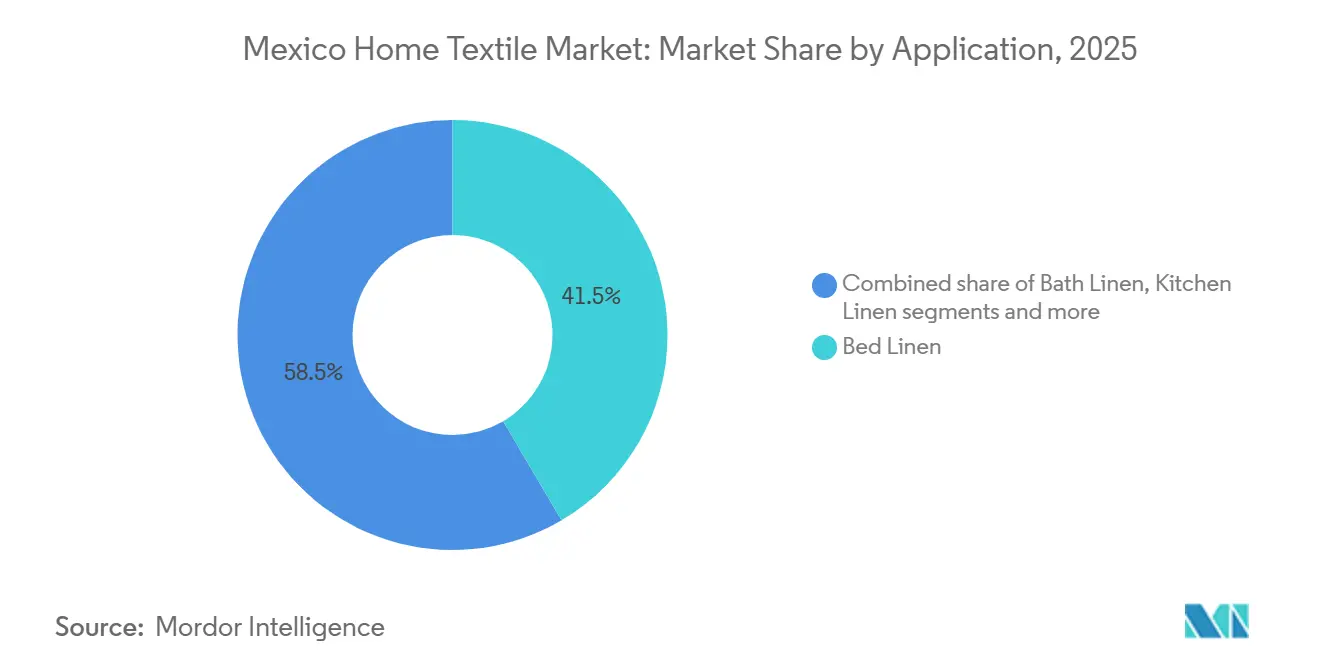
Bed Linen Dominates, Yet Upholstery Surges on Commercial Renovation WaveBed linen commanded a 41.53% share in 2025, reflecting its ubiquity across residential, hospitality, and institutional buyers in the Mexico home textile market. Upholstery is the fastest-growing application at a 6.14% forecast CAGR to 2031 as office and hotel investments expand seating, lounge, and performance fabric needs. Rental turnover and resale staging reinforce frequent refreshes of sheets and pillowcases, and value-focused buyers emphasize durable, easy-care weaves for everyday use. Nearshoring brings multinational openings and fit-outs that favor stain-resistant and high-traffic upholstery selections for reception and break areas. Retailers with fast fulfilment and broad bedding assortments support short-dated refreshes that keep inventories aligned with seasonality and style shifts.
The Mexico home textile market size for upholstery is projected to expand at a 6.14% CAGR between 2026 and 2031, aided by commercial renovations and a growing base of professionally managed rentals. In bed linens, shoppers weigh thread count, fabric blend, and care needs, while hospitality buyers prioritize longevity across many laundering cycles. Decorative textiles such as throws and cushion covers benefit from social and influencer discovery, which drives small-basket, high-frequency purchases. Office expansions in industrial metros add upholstered seating demand to outfitting lists alongside blinds and basic soft furnishings. Together, these patterns support a balanced mix of everyday essentials and performance-driven upholstery within the Mexico home textile market.

By Material:
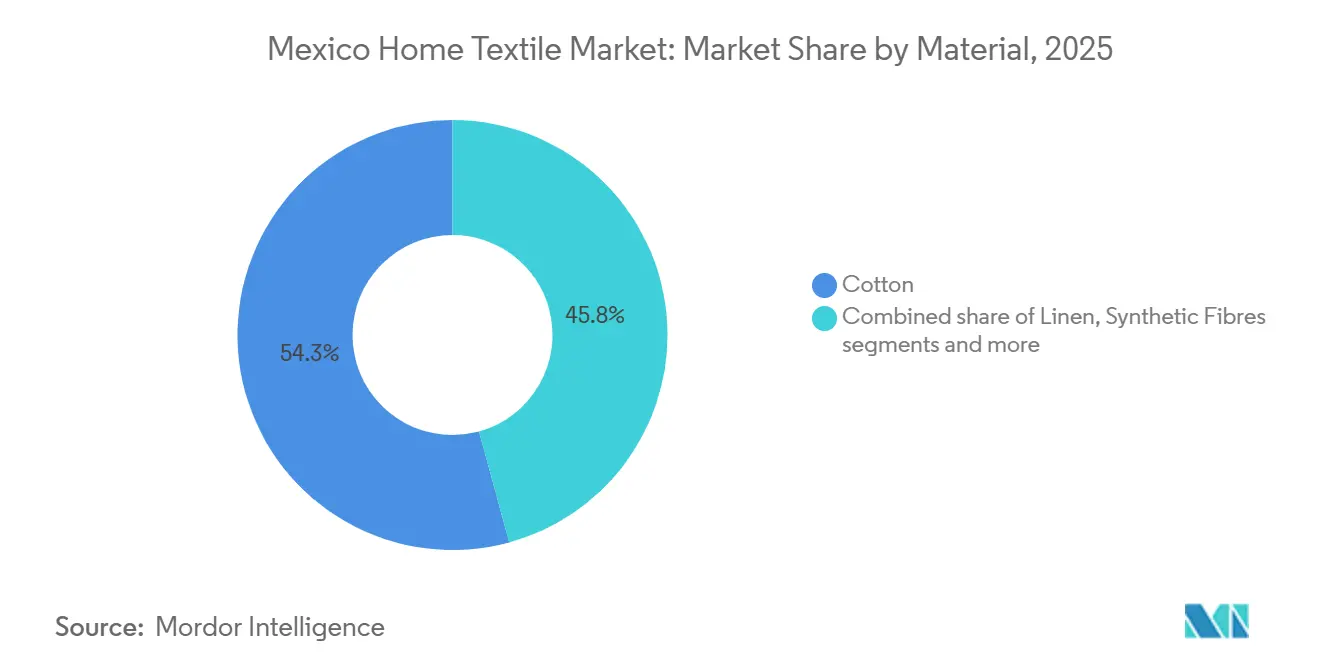
Cotton Retains Share, Yet Synthetic Fibres Accelerate on Durability and Sustainability PivotsCotton retained a 54.25% share in 2025 on the strength of its breathability and familiar hand-feel in the Mexico home textile market. Synthetic fibres are set to grow at a 5.93% CAGR to 2031, reflecting care convenience, wrinkle resistance, and colorfastness that extend service life. Domestic cotton production is forecast to decline in the future while imports rise, increasing exposure to global pricing and supply cycles. These shifts keep cost discipline central for blended fabrics as mills react to import costs and the reliability of upstream inputs. As retailers emphasize durability and total cost of ownership, polyester-rich blends hold share where maintenance costs matter most.
Circular economy priorities also steer mix changes. The Mexico home textile market is adopting more recycled polyester and certified natural inputs as brands codify traceability and low-impact processing. Global sustainability programs align suppliers to reduce water and energy use and to manage chemicals in finishing. Social enterprise collaborations and textile waste repurposing pilots demonstrate scalable alternatives for fiber sourcing and product development. Domestic contract manufacturers invest in cleaner manufacturing and rPET supply lines to meet retailer standards while preserving price competitiveness. These material shifts favour blends that balance comfort, care ease, and environmental performance in the Mexico home textile market.
By End-User:
Residential Prevails, Yet Commercial Accelerates on Nearshoring and Hospitality ExpansionResidential end-users accounted for 67.92% of the market in 2025, reflecting the large household base and steady replacement cadence for bed and bath essentials in the Mexico home textile market. Replacement frequency rises with tenancy turnover and lifestyle upgrades, with buyers trading up for better hand-feel and care characteristics in sheets and towels. Retailers’ digital tools and fast delivery ease periodic refresh cycles and support broader pattern experimentation in decor items. Local cloud infrastructure supports personalized product discovery and reliable order tracking in major metros. These dynamics anchor household-led volume while enabling gradual premium shifts in the Mexico home textile market.
Commercial end-users are forecast to grow at a 5.62% CAGR through 2031, with hotels, rentals, offices, and institutional buyers driving volume in high-duty textiles. Nearshoring brings corporate expansions and new offices that require upholstery and soft furnishings, along with basic linens for on-site accommodations. Business districts and logistics corridors see continuous outfitting and replacement as facilities open or scale capacity. Infrastructure projects in the south-east catalyze service growth that eventually boosts hospitality-related textile requirements. Over the forecast, this segment raises demand for performance materials and easy-care blends in the Mexico home textile market.
By Distribution Channel:
Offline Dominance Persists, Yet Online Explodes on Omnichannel MaturationOffline channels captured 76.34% share in 2025, anchored by mass merchandisers, department stores, and specialty formats that support tactile evaluation and immediate fulfillment in the Mexico home textile market. Large formats expand assortments and private labels in bed and bath basics, which set value points for national brands. Department stores invest in marketplace scale, fast delivery, and click-and-collect to blend in-store experience with digital convenience. Specialty home concepts push curated aesthetics and material innovation with strong visual merchandising. Together, these channels maintain category leadership while integrating digital journeys that lift conversion.
The Mexico home textile market size for online channels is projected to grow at a 6.45% CAGR through 2031, reflecting a mature omnichannel infrastructure and broader assortment online. Department stores report rising digital penetration and faster delivery windows that reduce cart abandonment for soft goods. Local cloud capacity improves app performance and recommendation latency, enabling higher degrees of personalization. Online marketplaces draw in long-tail sellers that extend choices in patterns, sizes, and bundle options. These elements reinforce a steady shift in discovery and replenishment toward digital paths within the Mexico home textile market.
Geography Analysis
Central Mexico is expected to hold 35.31% of the Mexico home textile market in 2025, supported by dense retail networks, strong department store presence, and higher-income households. Department stores in Mexico City lead omnichannel transitions, enabling two-day delivery across much of the region. Specialty home and lifestyle stores offer curated assortments for design-conscious consumers. Efficient last-mile logistics and digital adoption streamline replenishment, sustaining growth despite moderated housing demand in core neighborhoods.
Northern Mexico is projected to grow at a 6.18% CAGR through 2031, driven by manufacturing inflows, job creation, and corporate expansions. Monterrey and nearby areas see investments in transport, industrial real estate, and services, boosting demand for bed, bath, and upholstery products. New offices, hotels, and worker housing increase the need for durable, easy-care textiles. Retailers expand assortments and fulfillment capabilities to serve growth corridors, driving higher sell-through rates for home furnishings and above-average market gains.
Southern Mexico grows at a slower pace but includes hotspots tied to tourism and logistics improvements. Infrastructure projects like the Maya Train and the Interoceanic Corridor enhance connectivity and attract investments in services and manufacturing. Service sector growth drives demand for hospitality textiles in coastal municipalities and gateway cities. Retail penetration improves through new malls and omnichannel formats in second-tier locations, contributing to steady market growth over time.
Regulatory Landscape
Mexico home textiles are governed by commercial-information and labeling requirements enforced under the Secretaria de Economia framework, with NOM-004-SE-2021 as a key reference for textile products where the mass composition threshold applies. The standard requires disclosures such as responsible party information, country of origin, fiber composition, care instructions, and size or measurements, shaping both domestic manufacturing documentation and import readiness before products reach retail shelves.
Adjacent home-furnishings labeling and consumer information obligations also affect assortments that bundle textiles with furniture or decorative items, including guidance under NOM-117-SCFI-2005 for commercialization information. In parallel, electronic labeling specifications under NMX-R-116-SCFI-2021 provide a compliance pathway that supports omnichannel operations using QR codes and digital product pages to extend information beyond physical tags.
Value Chain Analysis
The Mexico home textile value chain covers fiber and polymer inputs (cotton, polyester), yarn formation, weaving or knitting, dyeing and finishing, and cut-and-sew manufacturing into finished categories such as bed linen, bath textiles, curtains, and upholstery fabrics. Mexico has a base of vertically integrated and specialized producers supporting these steps, including companies such as Grupo Kaltex, which operates across fibers, yarns, and home textile manufacturing, and suppliers such as Corporacion Lanera Mexico, which produces wool and jacquard blanket or home textile lines, including recycled-material options.
Downstream, the chain reaches brand owners and private-label programs, then wholesale and institutional buyers in hospitality and rentals, with retail distribution dominated by offline formats (mass merchants, department stores, specialty home). Online and marketplace assortments widen long-tail selection. Industry bodies such as CANAINTEX and CITEX support capability building through sector representation, training, and coordination across the Puebla-Tlaxcala textile belt and other manufacturing clusters, while the market continues to prioritize lead-time reduction, quality assurance, and compliance-ready labeling for store shelves and e-commerce listings.
Competitive Landscape
The Mexico home textile market is moderately fragmented, featuring global retailers, domestic brands, and strong private labels. Global retailers expand assortments and invest in circular material programs, setting benchmarks for suppliers. Fashion-driven players frequently update collections and enhance distribution to align with demand. Department stores combine marketplace scale with rapid delivery to capture replenishment and trend-driven purchases in bed and bath. Mass merchants grow private-label offerings, establishing competitive price points for entry to mid-tier categories.
Leading players demonstrate strategic directions. Inter IKEA invests in supply chain resilience and sustainability, influencing fiber selection, chemical management, and circular pilot programs. Inditex focuses on logistics upgrades and refreshed product cadences, enabling faster transitions and timely replenishment for home collections. Liverpool reports increased digital penetration, marketplace SKU growth, and faster deliveries, strengthening its omnichannel position. These strategies push suppliers to improve planning visibility, reduce lead times, and enhance quality assurance.
Private-label growth pressures mid-tier brands lacking differentiation. Costco’s Kirkland Signature sets price-value expectations and quality benchmarks, compelling national brands to meet these standards to maintain shelf presence[4]. Domestic brands launch seasonal collections and licensed designs to remain competitive, focusing on aesthetics and pricing. Some players invest in cleaner production, recycled materials, and waste reduction to secure partnerships with sustainability-focused retailers. The market is trending toward polarization between premium, sustainability-led offerings and value-driven private labels.
Mexico Home Textile Industry Leaders
-
Grupo Kaltex
-
Springs Global (Cannon Home)
-
Colchas Concord
-
Tramas y Cortinas
-
Svitex Home
- *Disclaimer: Major Players sorted in no particular order
Mexico Home Textile Market Companies Covered in this Report
- Grupo Kaltex
- Springs Global (Cannon Home)
- Colchas Concord
- Tramas y Cortinas
- Svitex Home
- Textiles JULI
- Sábanas Santa Amalia
- Liverpool Casa
- Vianney Grupo
- Casa Telas
- Lunatex
- Textiles ACSA
- Zara Home México
- IKEA Home Textiles México
- Costco Wholesale (Home & Living)
- Walmart Mexico
- Coppel
- Home Depot México (Decor)
- Amazon México (Home & Kitchen)
- Mercado Libre (Home & Living)
Market Opportunities and Future Outlook
Institutional and contract channels create a clear opportunity for domestic producers that can meet volume, durability, and traceability requirements, especially in categories adjacent to home textiles such as linens, towels, and curtains sold into organized buyers. CANAINTEX highlighted a sector initiative tied to supplying MXN 2 billion of hospital textiles and related items to public institutions in the second half of 2026, giving mills and converters a concrete route to scale standardized, easy-care assortments alongside compliance documentation and repeatable replenishment programs.
Premium and performance-led product development is another area where producers can capture higher value per unit through specifications aligned with hospitality refresh cycles and frequent laundering, including improved colorfastness and wear resistance. As omnichannel retail deepens, electronic labeling and QR-linked product information under NMX-R-116-SCFI-2021 can support richer material, care, and sustainability claims across marketplaces and retailer apps, helping brands and private labels differentiate beyond price while maintaining compliance and customer-service workflows across both offline and online fulfillment.
Recent Industry Developments in Mexico Home Textile Market
- May 2026: CANAINTEX leadership highlighted an initiative to supply around MXN 2 billion of textiles and related items such as linens, towels, and curtains to public hospitals, aiming to expand domestic sourcing in institutional procurement during the second half of 2026. The move increases visibility for contract demand for standardized, high-durability textile lines and encourages local producers to align capacity, quality systems, and compliance documentation to public-sector requirements.
- December 2025: Circulose partnered with Birla Cellulose to supply 100% recycled textile pulp for viscose staple fiber production used by Circulose brand partners. This collaboration reinforced circular-material pathways that influence sourcing choices and sustainability-led product roadmaps for home textile assortments, particularly where recycled or regenerated fibers are introduced into blends.
- January 2024: Mexico continued operating under the NOM-004-SE-2021 framework for textile commercial information and labeling, requiring disclosures such as fiber composition, country of origin, and care instructions on products sold in the market. As retailers expanded omnichannel listings, the standard increased the need for consistent, auditable product data across physical labels and digital catalogs, shaping onboarding processes for domestic suppliers and importers.
Mexico Home Textile Market Report Scope and Research Methodology
Market Definition and Coverage
For this study, the Mexico home textile market covers finished textile products mainly bought for household furnishing and daily use, and the value is measured as sales revenues generated within Mexico across domestic supply and imports.
Scope exclusions: This sizing does not count apparel textiles, industrial or technical textiles, and raw fiber or yarn traded without being made into a household-use product.
Segments Covered in This Report
- By Application
- Bed Linen
- Bath Linen
- Kitchen Linen
- Upholstery
- Carpets & Area Rugs
- By Material
- Cotton
- Linen
- Synthetic Fibres
- Other Materials
- By End-User
- Residential
- Commercial
- By Distribution Channel
- Offline
- Mass Merchandisers (Hypermarkets/Supermarkets)
- Home Centers
- Specialty Stores
- Other Offline Channels
- Online
- Offline
- By Geography
- Northern Mexico
- Central Mexico
- Southern Mexico
Data Sources, Market Sizing, and Validation
Desk Research
Desk research started by building a fact base for Mexico that can be verified in public records. We used sources such as INEGI industry statistics, Banco de Mexico inflation and FX series, UN Comtrade trade flows for relevant textile and made-up articles, and World Bank macro indicators that help explain consumer spending cycles.
To ground the model in real industry behavior, we also reviewed sources such as company annual reports, investor decks, audited financial statements where available, and retailer disclosures on category mix, promotions, and private label presence. Alongside this, peer reviewed papers on textile consumption and home furnishing demand were used to sanity check how products like bed linen and towels typically track household formation. We also used a paid subscription database for company financials and news to cross-check revenue exposure and major capacity moves. The desk sources listed here are not exhaustive, and additional public documents and data series were referenced for collection, validation, and clarification.
Primary Interviews and Surveys
Primary work focused on validating the demand pool and the pricing logic, since public sources rarely show clean splits for home textiles alone. We spoke with manufacturers, distributors, modern retail buyers, and hospitality procurement contacts across Mexico to confirm product mix, channel margins, and how imported goods influence local pricing.
To close gaps, survey inputs were used to test assumptions on replacement cycles for key items, the share of online sales within the category, and how promotional intensity changes reported average selling prices across the year.
Distribution of primary research fieldwork respondents
| Company type | Respondent position |
|---|---|
| Top tier: 32% | CXOs: 21% |
| Mid tier: 47% | Functional/Unit leaders: 28% |
| Smaller Players: 21% | Managers: 51% |
Market-Sizing & Forecasting
Sizing was built using a top-down and bottom-up approach, where consumption was reconstructed from a Mexico demand pool first and then checked against supply side signals. The top-down layer starts from household counts, housing completions, and hospitality room inventory, which are then combined with typical spend per household and replacement rates for items like bed linen, towels, and curtains.
To keep the totals realistic, selective bottom-up approximations were used as cross-checks, including sampled price points by channel, import trend direction for key made-up textile categories, and a roll up of revenue exposure for a set of visible suppliers and large sellers. When direct observations were missing, such as informal trade and small shop sales, the gap was handled through calibrated factors informed by interviews, and then re-tested against inflation adjusted retail spending patterns.
For forecasting, we used scenario analysis supported by trend smoothing on the historical run rate, with explicit drivers such as CPI for textiles, FX movement impacting landed costs, new housing delivery, tourism and hotel occupancy direction, and the pace of online penetration. Assumptions were stress-tested with interview feedback so the forecast reflects a practical base case rather than a single optimistic curve.
Data Validation & Update Cycle
Validation is done in layers so the final number is not driven by one data series. We compare model outputs against independent signals like trade movement, retailer category commentary, and observed price inflation, and then we investigate any large variance before sign-off.
A second analyst review is done to check formulas, units, and year mapping, followed by a final logic review that focuses on whether the story matches the numbers. Reports are refreshed annually, and interim updates are made when major events occur, such as a sharp FX shift, tariff changes, or a material change in housing or tourism indicators. Before delivery, we perform a fresh pass to ensure the latest public data releases and market moves are reflected.
Mordor Intelligence's Mexico Home Textile Market Size Versus Other Published Estimates
Published market sizes for Mexico home textiles can look far apart because each publisher draws the product scope and sales channel coverage in a different way, and then applies a different view on pricing progression. The year used as the anchor also matters, especially when inflation and FX are moving and imports change the effective price level.
The main gap comes from whether adjacent categories like home decor textiles and broader furnishing articles are blended into the total. Mordor Intelligence counts only finished home textile consumption sold into Mexico and keeps raw materials and non-household textile uses out of the revenue pool. Differences also show up when estimates lean on a single trade proxy, or when they use aggressive price escalation without checking retailer promotion cycles and channel mix shifts that can pull the average selling price up or down.
Benchmark comparison
| Source | Market Size | Gaps in Research Methodology |
|---|---|---|
| Mordor Intelligence | USD 2.54 B (2026) | |
| Industry Research Publisher A | USD 3.12 B (2025) | Uses a broader category that can blend home textiles with wider textile home decor, and applies a base-year value that is not directly comparable to a 2026 demand pool built from household and hospitality consumption. |
| Trade Analytics Outlet B | USD 2.12 M (2024) | Tracks a narrow set of trade exchange lines for selected furnishing articles, so it misses domestic production and most retail sales, which makes the figure too small to represent the full home textile market. |
The comparison shows that scope and measurement choice create most of the spread, not just different math. By keeping the scope tied to end-use household and hospitality consumption, and then cross-checking it with price and trade signals, the final estimate stays traceable to inputs that can be reviewed and repeated year after year.
Key Questions Answered in the Report
What is the 2026 size and 2031 outlook for Mexico's home textiles?
The Mexico Home Textile Market is estimated at USD 2.54 billion in 2026 and is projected to reach USD 3.31 billion by 2031 at a 5.41% CAGR. Growth is anchored in housing formation and hospitality demand.
Which application category leads growth in Mexico home textiles through 2031?
Upholstery is the fastest growing application at 6.14% CAGR to 2031, while bed linen holds the largest share at 41.53% in 2025.
How is the material mix evolving in Mexico home textiles?
Cotton holds 54.25% in 2025, while synthetic fibres are set to grow at 5.93% to 2031 as buyers emphasize durability and easy care.
How is the channel mix shifting for Mexico home textiles?
Offline holds 76.34% in 2025, while online is set to expand at 6.45% to 2031. Liverpool delivered 54.8% of digital orders within 48 hours in Q2 2025, which supports faster replenishment.
Which regions in Mexico show the strongest momentum for home textiles?
Northern Mexico is forecast to grow at 6.18% to 2031, while Central holds a 35.31% share in 2025.
What risks could slow Mexico's home textile growth over the next two years?
Input cost volatility and water-intensive dyeing strain margins and compliance. Cotton production decline and higher import reliance add exposure to global price swings.