
Market Overview
| Study Period | 2021 - 2031 |
|---|---|
| Forecast Data Period | 2026 - 2031 |
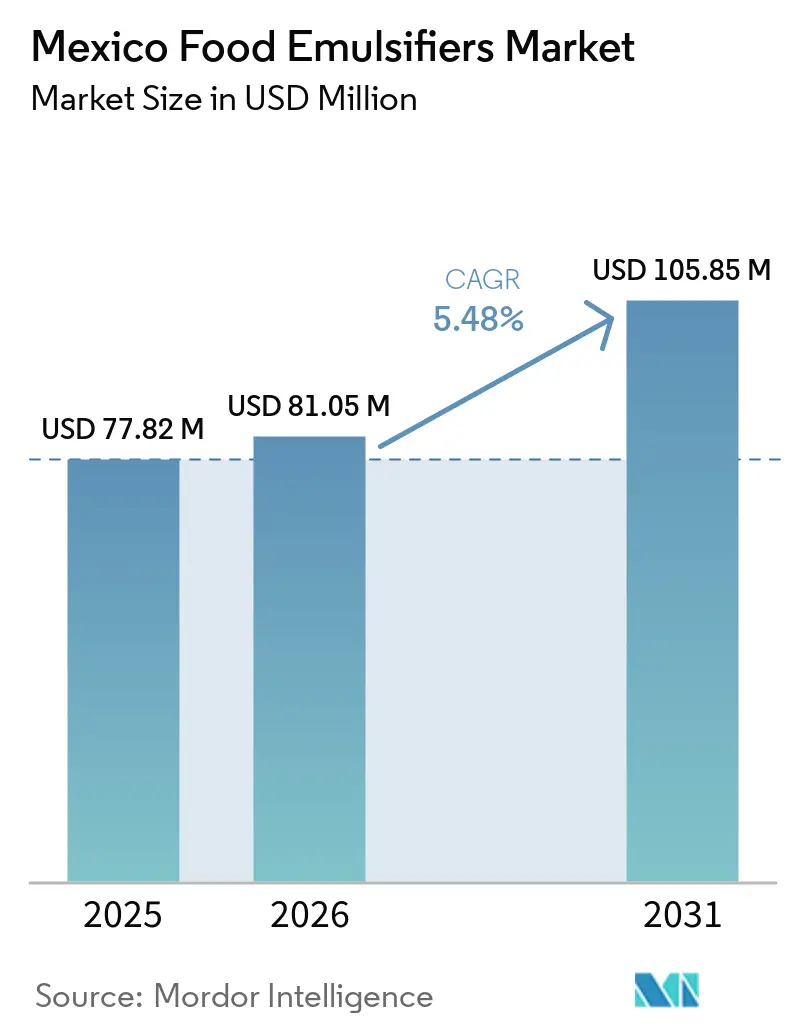
| Base Year Market Size (2025) | USD 77.82 Million |
| Market Size (2026) | USD 81.05 Million |
| Market Size (2031) | USD 105.85 Million |
| Growth Rate (2026 - 2031) | 5.48 % |
| Market Concentration | Low |
Major Players *Disclaimer: Major Players sorted in no particular order Image © Mordor Intelligence. Reuse requires attribution under CC BY 4.0. | |
Mexico Food Emulsifiers Market Analysis by Mordor Intelligence
The Mexico food emulsifiers market size was valued at USD 77.82 million in 2025 and estimated to grow from USD 81.05 million in 2026 to reach USD 105.85 million by 2031, at a CAGR of 5.48% during the forecast period (2026-2031). Mexico’s food and beverage processing sector represented 17.2% of national GDP in 2025, while the country ranked 4th globally in processed-food exports. Urbanization, a population above 131 million, and demand for packaged foods support steady consumption of functional ingredients in the Mexico food emulsifiers market. Processors are expanding output while also simplifying labels and improving product performance, which favors emulsifiers that offer several functions within one formulation. This shift changes competition in the Mexico food emulsifiers market from price alone toward formulation support, supply reliability, and practical clean-label alternatives. Import dependence also makes supplier relationships and regional logistics important to the Mexico food emulsifiers market.
Key Report Takeaways
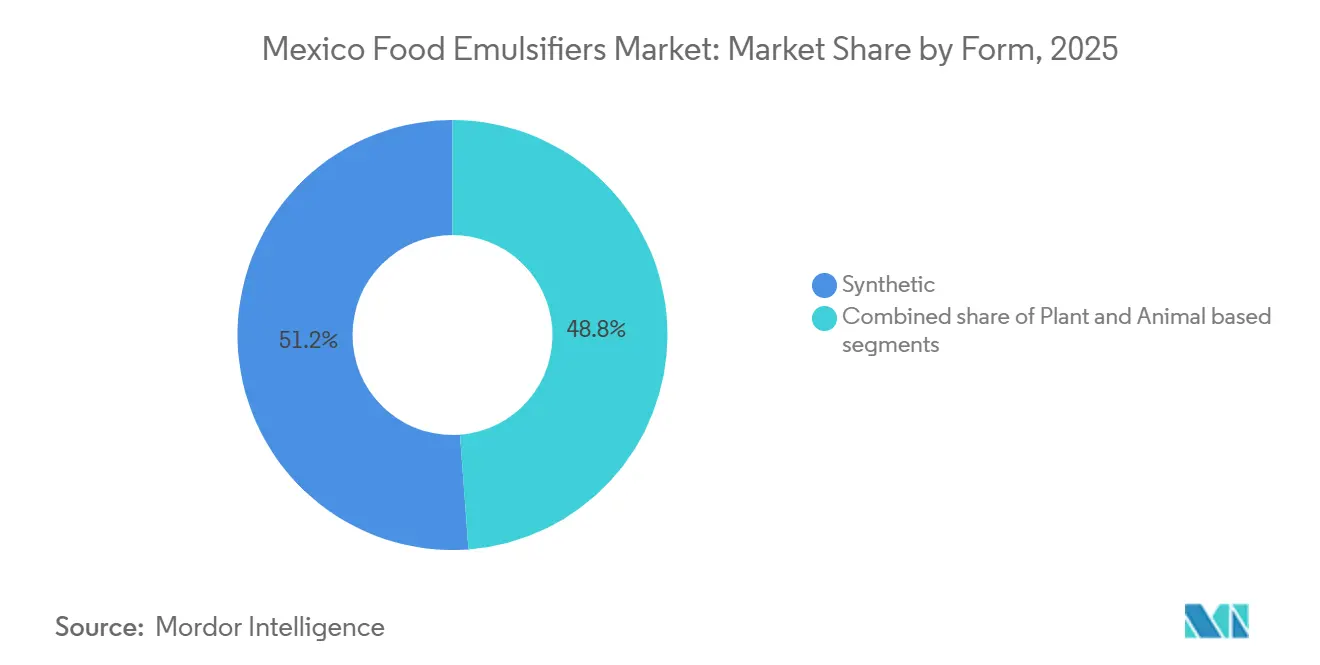
- By product type, mono- and di-glycerides and derivatives held 42.17% of the market revenue share in 2025, while lecithin is forecast to grow at a 6.41% CAGR through 2031.
- By form, powder held 63.13% of the market revenue share in 2025, while liquid emulsifiers are forecast to grow at a 6.63% CAGR through 2031.
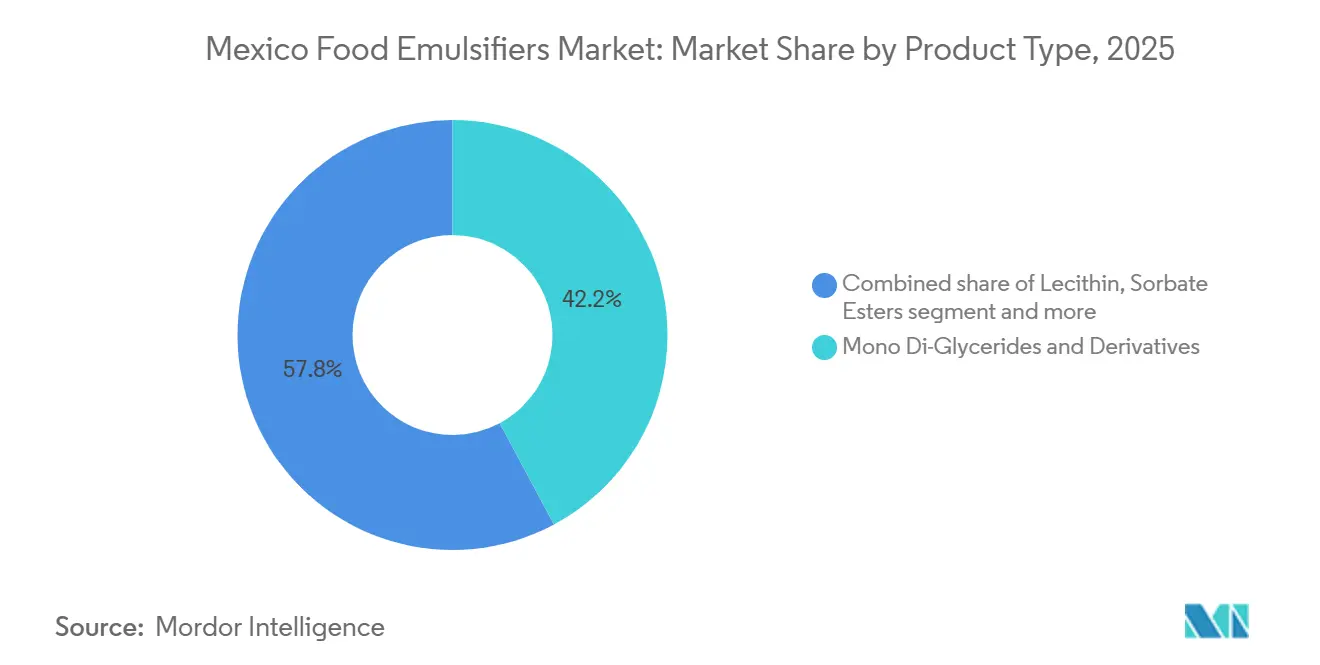
- By source, synthetic or chemically derived emulsifiers held 51.18% of the market revenue share in 2025, while plant-based emulsifiers are forecast to grow at a 6.74% CAGR through 2031.
- By application, bakery and confectionery held 32.16% of the market revenue share in 2025, while dairy and desserts are forecast to grow at a 6.32% CAGR through 2031.
Note: Market size and forecast figures in this report are generated using Mordor Intelligence’s proprietary estimation framework, updated with the latest available data and insights as of January 2026.
Mexico Food Emulsifiers Market Trends and Insights
Drivers Impact Analysis*
| Driver | (~) % Impact on CAGR Forecast | Geographic Relevance | Impact Timeline |
|---|---|---|---|
| Growing Demand for Processed and Packaged Foods | +1.6% | National, concentrated in Mexico City, Monterrey, Guadalajara | Medium term (2-4 years) |
| Rising Consumption of Bakery and Confectionery Products | +1.2% | National, with early gains in Estado de México and Jalisco | Medium term (2-4 years) |
| Growing Adoption of Plant-Based and Dairy Alternative Products | +0.9% | National, early gains in Mexico City and Guadalajara premium retail | Long term (≥4 years) |
| Expansion of the Dairy and Frozen Desserts Industry | +0.8% | National, with expansion into northern states and Bajío | Medium term (2-4 years) |
| Increasing Demand for Improved Food Texture and Product Stability | +0.5% | National | Short term (≤2 years) |
| Rising Demand for Longer Shelf Life and Consistent Product Quality | +0.5% | National, spillover to regional export markets | Short term (≤2 years) |
| Source: Mordor Intelligence | |||
Growing Demand for Processed and Packaged Foods
Emulsifiers are widely used in bakery products, confectionery, dairy products, sauces, dressings, and ready-to-eat foods to prevent ingredient separation and improve product quality during storage and distribution. As food manufacturers expand packaged product portfolios, the need for reliable ingredients that deliver consistent performance across large-scale production is increasing. According to Mexico’s Ministry of Agriculture, the country’s agro-food industry grew by 2.49% in the fourth quarter of 2024, supported by activities including grain milling, sugar production, bakery products, and tortilla manufacturing[1]. This expansion supports demand for functional ingredients, including emulsifiers, used to improve processing efficiency and maintain uniform product characteristics. Consequently, the continued development of Mexico’s processed-food manufacturing sector is expected to support food emulsifier consumption across multiple applications.
Rising Consumption of Bakery and Confectionery Products
Bakery remains a core demand center because emulsifiers help industrial producers control loaf volume, crumb structure, gas retention, and freshness. Mexico had 189,253 bakery and tortilla manufacturing units in 2025, showing the large production base that supports ingredient demand[2]. The Mexico food emulsifiers market serves both large industrial bakeries and smaller operators, although their requirements differ substantially. Large manufacturers usually need validated systems for continuous lines, while smaller firms value ease of handling and cost control. Seasonal confectionery demand also supports ongoing supplier relationships across the year. Clean-label reformulation may change the emulsifiers selected, but it does not remove the functional need for stability and texture in many baked products.
Growing Adoption of Plant-Based and Dairy Alternative Products
Growing adoption of plant-based and dairy alternative products in Mexico is creating opportunities for food emulsifiers, which help improve texture, mouthfeel, consistency, and stability in plant-based milk, yogurt, cheese alternatives, and other dairy-free formulations. Ingredients such as lecithin and mono- and diglycerides help manufacturers maintain uniform dispersion of fats and water, reduce separation, and achieve textures closer to conventional dairy products. As producers expand their portfolios of non-dairy beverages and plant-based foods, the need for functional ingredients that support product quality and processing efficiency is increasing. Continued innovation in plant-based formulations is expected to support demand for food emulsifiers in Mexico.
Expansion of the Dairy and Frozen Desserts Industry
Dairy and frozen dessert producers require emulsifiers for aeration, fat-network stability, and controlled melting behavior. Mexico’s dairy processing output reached USD 2.3 billion in 2025, providing a substantial base for ingredient consumption[3]. The Mexico food emulsifiers market gains from wider cold-chain access and the development of premium ice cream, yogurt, and dessert formats. DATEM and polyglycerol esters can support aeration and melt resistance in frozen desserts. Mono- and di-glycerides and sorbitan esters can stabilize fat systems in yogurt and dairy desserts. Dairy alternative products add another source of demand because their formulations often need precise stabilization to replicate conventional dairy attributes.
Restraints Impact Analysis*
| Restraint | (~) % Impact on CAGR Forecast | Geographic Relevance | Impact Timeline |
|---|---|---|---|
| Volatility in Raw Material Prices | -0.7% | Global, acutely felt in Mexico's import-dependent ingredient base | Short term (≤2 years) |
| High Costs of Specialty and Clean-Label Emulsifiers | -0.5% | National, greatest pressure on SME-dominated processing segments | Medium term (2-4 years) |
| Stringent Food Safety and Regulatory Compliance Requirements | -0.3% | National; compliance factors under COFEPRIS frameworks (NOM-251-SSA1-2009, Acuerdo 151) | Long term (≥4 years) |
| Consumer Preference for Natural and Minimally Processed Foods | -0.4% | National, early gains in premium urban retail in Mexico City and Guadalajara | Long term (≥4 years) |
| Source: Mordor Intelligence | |||
Volatility in Raw Material Prices
Volatility in raw material prices poses a restraint on the Mexico food emulsifiers market by increasing production costs and creating uncertainty in procurement and pricing decisions. Key inputs, including vegetable oils, glycerol, fatty acids, soy lecithin, and other chemical intermediates, are exposed to fluctuations in agricultural commodity prices, energy costs, and global supply conditions. These variations can increase manufacturing expenses for emulsifier producers and reduce profit margins when higher costs cannot be fully passed on to food manufacturers. Smaller suppliers may face additional pressure due to limited purchasing power and fewer opportunities to secure long-term supply contracts.
High Costs of Specialty and Clean-Label Emulsifiers
High costs of specialty and clean-label emulsifiers can restrain the growth of Mexico’s food emulsifiers market by increasing ingredient procurement and formulation expenses for food manufacturers. Emulsifiers derived from natural sources, including sunflower lecithin and other plant-based ingredients, may require specialized extraction, purification, and processing methods that increase production costs. Clean-label formulations can also involve additional research, testing, and reformulation to achieve the texture, stability, and shelf life provided by conventional emulsifiers. These expenses can be particularly challenging for small and medium-sized food processors operating with limited budgets.
*Our forecasts treat driver/restraint impacts as directional, not additive. The impact forecasts reflect baseline growth, mix effects, and variable interactions.
Segment Analysis
By Product Type: Established Mono- and Di-Glycerides Support Volume While Lecithin Leads Growth
Mono- and di-glycerides and their derivatives accounted for 42.17% of Mexico's food emulsifiers market revenue in 2025, making them the leading product segment. Their widespread use is driven by their ability to improve emulsification, texture, consistency, and product stability across various food applications. In bakery products, these ingredients help improve dough handling, maintain softness, and support crumb structure. They are also used in confectionery, dairy products, margarines, and processed foods to prevent ingredient separation and achieve consistent product quality. The expansion of industrial bakery production and packaged food manufacturing supports demand for these versatile emulsifiers.
Lecithin is projected to be the fastest-growing product segment in Mexico's food emulsifiers market, registering a CAGR of 6.41% through 2031. Its growth is supported by its multifunctional properties, which enable manufacturers to improve ingredient dispersion, texture, and product consistency. Lecithin is widely used in chocolate, bakery products, confectionery, margarine, and instant food formulations. Growing interest in recognizable ingredients and clean-label formulations is encouraging food manufacturers to consider lecithin as an alternative to certain synthetic emulsifiers, depending on the application.


By Form: Powder Retains Its Practical Advantage While Liquids Gain in Modern Lines
Powder food emulsifiers accounted for 63.13% of Mexico's food emulsifiers market revenue in 2025, making them the leading segment by form. Their dominance is supported by ease of handling, convenient storage, and compatibility with dry food ingredient blends. Powder emulsifiers are widely used in bakery mixes, confectionery, powdered beverages, and other processed food formulations to improve texture, consistency, and ingredient dispersion. Their relatively long shelf life and lower susceptibility to leakage during storage and transportation make them suitable for industrial food manufacturing.
Liquid food emulsifiers are projected to be the fastest-growing form in Mexico's food emulsifiers market, registering a CAGR of 6.63% through 2031. Their growth is supported by their ease of incorporation into liquid and semi-liquid formulations, including beverages, sauces, dressings, dairy products, and confectionery applications. Liquid emulsifiers can facilitate uniform dispersion of ingredients and help manufacturers achieve consistent product texture and stability. Their suitability for automated processing and continuous production systems also supports adoption among industrial food manufacturers.
By Source: Synthetic Materials Lead Current Use While Plant-Based Systems Advance
Synthetic or chemically derived emulsifiers accounted for 51.18% of Mexico's food emulsifiers market revenue in 2025, making them the leading segment by source. Their market position is supported by consistent functional performance, cost-effectiveness, and suitability for large-scale food manufacturing. These emulsifiers help stabilize mixtures of oil and water, improve texture, and maintain product consistency across bakery products, confectionery, dairy products, sauces, and processed foods. Their established use in industrial formulations allows manufacturers to maintain predictable processing characteristics and finished-product quality.
Plant-based emulsifiers are projected to be the fastest-growing source segment in Mexico's food emulsifiers market, registering a CAGR of 6.74% through 2031. Growth is supported by increasing interest in plant-derived ingredients and food formulations that align with clean-label preferences. Ingredients such as soy lecithin and sunflower lecithin are used in bakery products, chocolate, confectionery, and other processed foods to improve emulsification and ingredient dispersion. Sunflower lecithin may also appeal to manufacturers seeking alternatives to soy-derived ingredients, depending on formulation and sourcing requirements.


By Application: Bakery and Confectionery Is the Main Demand Base While Dairy and Desserts Grow Faster
Bakery and confectionery accounted for 32.16% of Mexico's food emulsifiers market revenue in 2025, making it the leading application segment. Emulsifiers are widely used in bread, cakes, pastries, biscuits, chocolates, and confectionery products to improve texture, consistency, and product stability. In bakery applications, they support dough handling, improve crumb structure, and help maintain softness during storage. In confectionery, emulsifiers facilitate ingredient dispersion, control fat distribution, and contribute to the desired texture and mouthfeel of finished products. The established consumption of bakery goods and confectionery, alongside the expansion of packaged food manufacturing, supports demand for these ingredients.
Dairy and desserts are projected to be the fastest-growing application segment in Mexico's food emulsifiers market, registering a CAGR of 6.32% through 2031. Growth is supported by demand for dairy-based products and desserts that offer consistent texture, creaminess, and stability. Emulsifiers help distribute fat uniformly, improve mouthfeel, and minimize ingredient separation in products such as ice cream, frozen desserts, dairy beverages, and dairy-based preparations. They also support the development of smooth textures and stable formulations during processing, freezing, and storage.
Geography Analysis
Mexico’s food production is concentrated in Greater Mexico City, the Bajío region, Monterrey, Guadalajara, and northern border states. Estado de México had 26,581 bakery and tortilla manufacturing units in 2025, the highest total among Mexican states. This concentration supports a large Mexico food emulsifiers market size around industrial bakeries and packaged food factories. Monterrey is an important dairy center, supported by Grupo Lala’s industrial presence. Guadalajara has a dense confectionery and snack manufacturing base, including operations associated with Barcel. The Bajío region is attracting mid-sized food processors and ingredient suppliers that want access to growing interior markets.
The northern border corridor is the main route for U.S. food ingredient imports into Mexico. U.S. suppliers accounted for 76% of Mexico’s consumer-oriented food ingredient imports in 2025 USMCA supports trade in soy lecithin, fatty acid derivatives, and specialty blends. This gives the Mexico food emulsifiers market access to a large regional supply base, while also leaving buyers exposed to currency and cross-border logistics conditions. ADM announced a cumulative USD 41 million investment in reformulation capabilities at its Erlanger, Kentucky campus in 2025 and 2026. European specialty ingredients also reach Mexico by maritime routes through Manzanillo and Veracruz.
Puebla had 18,440 food manufacturing units and Oaxaca had 20,643 units in 2025, showing the importance of secondary demand centers. These areas are likely to use more functional ingredients as packaged food consumption grows and semi-industrial operators modernize. Major urban centers remain the focus for product development, traceability, and clean-label reformulation. National distributors can help the Mexico food emulsifiers market reach buyers that are too small or dispersed for direct service. Suppliers that combine local technical support with broad distribution are better placed to serve this varied geography.
Competitive Landscape
Market Concentration
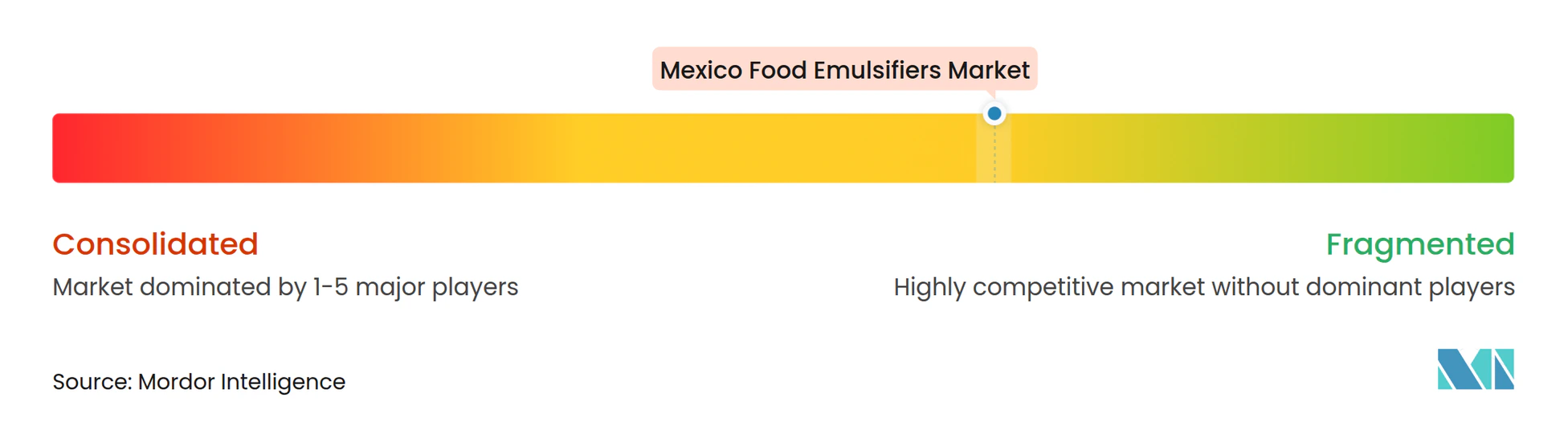
The Mexico food emulsifiers market is fragmented, with Cargill, ADM, Kerry Group, Corbion, IFF, Palsgaard, Ingredion, BASF, and AAK competing alongside distributors and domestic specialists. No player holds a decisive share, so technical support and portfolio range are important ways to differentiate. Suppliers must support both conventional and plant-based systems as customers manage cost, performance, and ingredient-list requirements. IFF opened its Mexico Business Hub at Tecnoparque in Mexico City in April 2025, consolidating up to 650 employees across several business areas.
Corbion’s acquisition of Granolife in Mexico reflects the value of local relationships and knowledge of regional requirements. Grupo Bimbo’s commitment to phase out emulsifiers from its daily consumption portfolio by 2027 changes supplier qualification toward functional outcomes and simpler product labels. Corbion introduced Ultra Fresh Plus 100 in September 2025 as a label-friendly bakery solution designed to replace synthetic emulsifiers while maintaining softness, sliceability, and freshness. Palsgaard began making Emulpals powdered cake emulsifiers in Brazil in September 2025, shortening regional supply routes for buyers in the Americas.
IFF agreed in May 2026 to sell its Food Ingredients business to CVC Capital Partners for USD 4.3 billion while retaining a 10% minority stake. The transaction creates a standalone business serving bakery, dairy, and meat applications, and its local organization will need to demonstrate supply continuity. Kerry launched Smart Taste in September 2025 to help food and beverage manufacturers reduce dependence on costly or volatile ingredients while supporting cleaner labels. Ingredion México also announced a collaboration with Oobli in February 2025 for sweet protein-based sweetener solutions.
Mexico Food Emulsifiers Industry Leaders
-
Cargill, Incorporated
-
AAK AB
-
Stepan Company
-
Palsgaard A/S
-
The Archer Daniels Midland Company
- *Disclaimer: Major Players sorted in no particular order
Recent Industry Developments
- July 2026: Mexico's Federal Commission for Protection against Sanitary Risks updated its food-additive information, covering substances with positive evaluations and extensions of use for previously permitted additives. The update is relevant to food emulsifier manufacturers because ingredient approvals and permitted applications must be verified against applicable Mexican regulations.
- July 2026: Döhler inaugurated a new production facility in the State of Mexico following an investment of more than MXN 1.2 billion. The facility strengthens domestic manufacturing capabilities for specialized food and beverage ingredients. The investment reflects continued development of Mexico's ingredient supply infrastructure, potentially supporting food manufacturers seeking functional ingredients for product formulation.
- April 2025: International Flavors & Fragrances announced the consolidation of most of its Mexican operations at the Tecnoparque business complex in Mexico City. The facility brings together teams across its food ingredients, taste, health and biosciences, and scent businesses, with capacity for up to 650 employees.
Mexico Food Emulsifiers Market Report Scope
Food emulsifiers are substances that enable the mixing and stabilization of otherwise immiscible ingredients, such as oil and water, in food products. The Mexican food emulsifiers market is segmented by product type, form, source, and application. Based on product type, the market is segmented into mono- di-glycerides and derivatives, lecithin, sorbate esters and other emulsifiers. Based on form, the market is segmented into powder and liquid. Based on source, the market is segmented into plant-based, animal-based and synthetic / chemically derived. Based on application, the market is segmented into bakery and confectionery, dairy and desserts, beverages, meat and seafood products, soups, sauces, and dressings and other applications. For each segment, the market sizing and forecasting have been done in value terms (USD million).
By Product Type
| Mono- Di-Glycerides and Derivatives |
| Lecithin |
| Sorbate Esters |
| Other Emulsifier |
By Form
| Powder |
| Liquid |
By Source
| Plant-based |
| Animal-based |
| Synthetic / Chemically Derived |
By Application
| Bakery and Confectionery |
| Dairy and Desserts |
| Beverages |
| Meat and Seafood Products |
| Soups, Sauces, and Dressings |
| Other Applications |
| By Product Type | Mono- Di-Glycerides and Derivatives |
| Lecithin | |
| Sorbate Esters | |
| Other Emulsifier | |
| By Form | Powder |
| Liquid | |
| By Source | Plant-based |
| Animal-based | |
| Synthetic / Chemically Derived | |
| By Application | Bakery and Confectionery |
| Dairy and Desserts | |
| Beverages | |
| Meat and Seafood Products | |
| Soups, Sauces, and Dressings | |
| Other Applications |
Key Questions Answered in the Report
What is the projected value of food emulsifiers in Mexico by 2031?
The Mexico food emulsifiers market is projected to reach USD 105.85 million by 2031, growing at a 5.48% CAGR from 2026.
Which product type is growing fastest in Mexico?
Lecithin is the fastest-growing product type, with a projected 6.41% CAGR through 2031.
Why are powder emulsifiers widely used in Mexico?
Powder products held 63.13% share in 2025 because they support ambient storage, dry blending, and simpler handling for dispersed food producers.
Which application uses the most emulsifiers in Mexico?
Bakery and confectionery is the largest application, with 32.16% share in 2025, supported by Mexico’s extensive bakery manufacturing base.