
Market Overview
| Study Period | 2020 - 2032 |
|---|---|
| Forecast Data Period | 2027 - 2032 |
| Base Year Market Size (2026) | USD 0.62 Billion |
| Market Size (2027) | USD 0.66 Billion |
| Market Size (2032) | USD 0.91 Billion |
| Growth Rate (2027 - 2032) | 6.31 % |
| Market Concentration | Medium |
Major Players *Disclaimer: Major Players sorted in no particular order Image © Mordor Intelligence. Reuse requires attribution under CC BY 4.0. | |
Mexico Automotive Electric Actuators Market Analysis by Mordor Intelligence
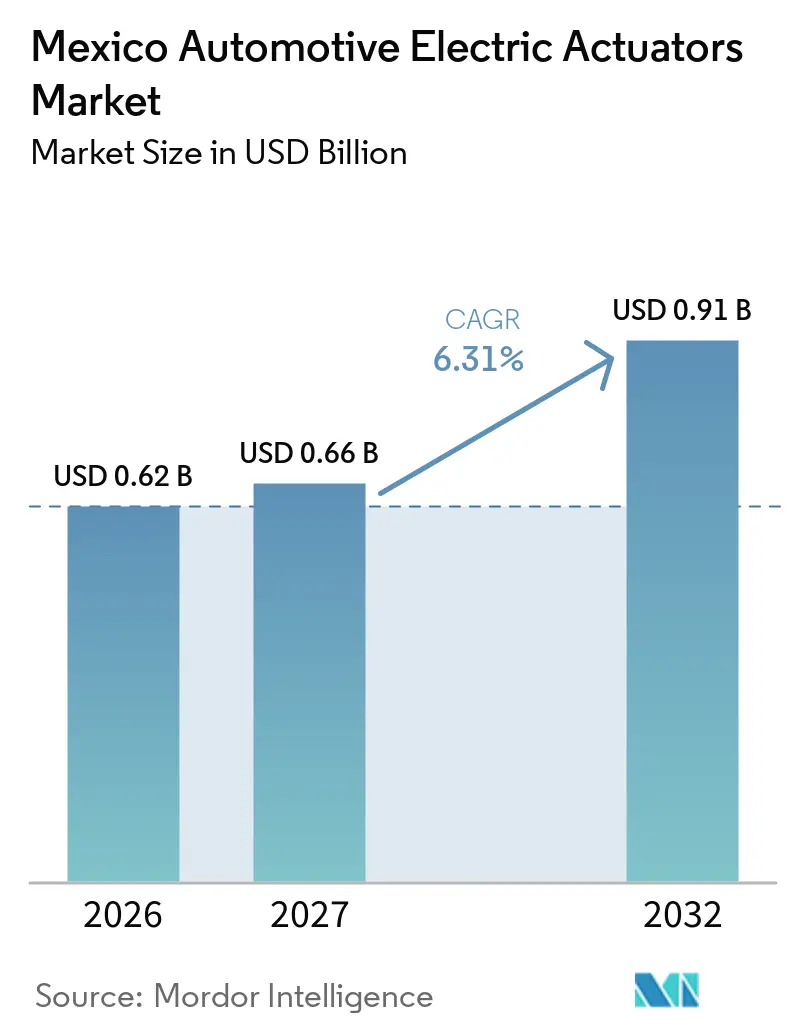
The Mexico automotive electric actuators market size was valued at USD 0.62 billion in 2026 and is projected to grow from USD 0.66 billion in 2027 to USD 0.91 billion by 2032, growing at a CAGR of 6.31% from 2027 to 2032. The Mexico automotive electric actuator market draws support from the country’s large light-vehicle production base and its role in North American vehicle exports. Assembly programs are adding electronic comfort, safety, and thermal-management functions to more vehicle trims. That increases actuator content in systems such as seats, doors, brakes, cooling circuits, and mirrors. The Mexico automotive electric actuator market also benefits from established supplier clusters in Bajío and the northern border states, where qualified tier-1 production supports OEM programs. Rules of origin and supply-chain risks remain important because they affect the cost, availability, and qualification of components.
Key Report Takeaways
- By vehicle type, passenger cars accounted for 68.27% of the Mexican automotive electric actuators market share in 2026, while light commercial vehicles are forecast to grow at a 6.18% CAGR through 2032.
- By application type, closure, door, and liftgate actuators held a 15.27% share of the Mexican automotive electric actuators market in 2026, while coolant and refrigerant valve actuators are forecast to grow at an 11.37% CAGR through 2032.
- By motion type, rotary actuators accounted for 56.83% of the Mexican automotive electric actuators market in 2026 and are forecast to grow at a 6.47% CAGR through 2032.
- By propulsion, internal combustion engine vehicles held a 76.18% share of the Mexican automotive electric actuators market in 2026, while battery electric vehicles are forecast to grow at a 14.27% CAGR through 2032.
- By sales channel, the OEM channel held an 86.18% share of the Mexican automotive electric actuators market in 2026 and is forecast to grow at a 6.53% CAGR through 2032.
- By geography, Bajío held a 46.27% share of the Mexican automotive electric actuators market in 2026, while the Northern Border States are forecast to grow at a 6.17% CAGR through 2032.
Note: Market size and forecast figures in this report are generated using Mordor Intelligence’s proprietary estimation framework, updated with the latest available data and insights as of 2026.
Mexico Automotive Electric Actuators Market Trends and Insights
Drivers Impact Analysis*
| Driver | (~) % Impact on CAGR Forecast | Geographic Relevance | Impact Timeline |
|---|---|---|---|
| Rising Integration of Comfort and Convenience Features | +1.8% | Bajío core (Guanajuato, Querétaro, Aguascalientes), with spill-over to Northern Border States | Medium term (2–4 years) |
| Vehicle Electrification and Thermal Management Requirements | +1.6% | APAC core, spill-over to Mexico Bajío and Northern Border States EV platforms | Medium term (2–4 years) |
| Increasing Electronic Braking and Vehicle Safety Content | +1.4% | Global, with concentrations in Bajío and Northern Border States OEM assembly corridors | Short term (≤ 2 years) |
| USMCA Regional Sourcing and Automotive Nearshoring | +1.2% | North America-wide, with impact concentrated in Northern Border States and Bajío | Short term (≤ 2 years) |
| Mexico Production of Compact Motors and Actuator Subassemblies | +0.9% | Bajío, with secondary activity in Zacatecas and Northern Border States | Long term (≥ 4 years) |
| Actuator Localization for Platform-Specific Export Programs | +0.7% | Bajío and Northern Border States, tied to specific OEM export platforms | Long term (≥ 4 years) |
| Source: Mordor Intelligence | |||
Rising Integration of Comfort, Convenience, and Safety Content
Closure, door, and liftgate actuators represent the largest application group in the Mexico automotive electric actuator market. Vehicle assemblers increasingly specify electronic closure, seat, mirror, and window systems in trims that previously used manual mechanisms. This shift is most evident in export programs serving North American passenger car, SUV, and light-truck customers. Manufacturers in Silao, Guanajuato, supply seat-memory controls, door controls, and window- and mirror-actuation systems for several OEM programs [1]. Production at these operations remains stable and strong. Increasing electronic braking and active safety content provides an additional source of demand, as electromechanical parking brakes and brake-by-wire systems require qualified actuator modules.
Mexico’s vehicle safety standard supports the broader adoption of enhanced active safety systems in new light vehicles. Bosch plans to commercially introduce hydraulic brake-by-wire technology and expects widespread adoption across vehicles. The increasing use of electronic parking brakes and advanced braking modules raises supplier validation requirements. Safety-related modules must meet stringent functional safety requirements before OEM nomination. This trend creates additional work for Mexican manufacturing plants and their parent engineering centers while favoring suppliers with proven designs, documented quality systems, and established OEM approvals.
Vehicle Electrification and Thermal Management Requirements
Battery electric vehicles represent the fastest-growing propulsion group. Their cooling systems require precise temperature control across the battery, cabin, and e-axle, increasing both the number of coolant and refrigerant valve actuators and the performance specifications required. Consequently, electrified platforms are driving demand in the Mexico automotive electric actuator market, although internal combustion engine vehicles remain the largest propulsion group.
Rising battery electric vehicle production indicates an expanding domestic base for electric drivetrain components and thermal-control subassemblies. Hybrid electric vehicles and plug-in hybrid electric vehicles require conventional engine-related actuation as well as electrified thermal-control systems. This combination can increase the actuator bill of materials compared with conventional internal combustion engine vehicles. In May 2025, NHK Spring announced a USD 55 million investment and the creation of 233 jobs for a motor-core plant in Irapuato, Guanajuato. The facility produces motor cores for hybrid and electric powertrain systems. This investment expanded the local component base supporting actuator subassemblies and strengthened the Bajío region’s role in the supply chain for electric and hybrid vehicle programs.
USMCA Regional Sourcing and Automotive Nearshoring
USMCA regional value content rules have made Mexico's manufacturing footprint more relevant to automotive sourcing decisions. Research published in Manufacturing & Service Operations Management found that U.S. automotive firms increased sourcing from Mexico and Canada after regional-content requirements tightened. The study did not find a comparable change in categories unaffected by those requirements. For actuator suppliers, local manufacturing can improve the case for nomination on vehicles shipped to the United States. It can also reduce the sourcing distance between component plants and assembly operations. The Mexican automotive electric actuator market, therefore, offers opportunities for suppliers to document origin and deliver parts within North American production schedules.
Nearshoring is particularly relevant to the northern border states and the Bajío because both areas have established logistics links to U.S. OEM programs. Investment in electrical components, aluminum processing, and electromobility has reinforced the industrial base in these areas. Mexico’s production clusters allow tier-1 suppliers to serve several vehicle platforms from nearby facilities. The six-year USMCA review still creates uncertainty because any change in origin requirements can alter component sourcing decisions. Suppliers with established operations in Mexico are better placed to adapt their documentation and sourcing practices. New entrants may find that compliance requirements add time and cost before they can win export-linked work.
Local Motor Production and Platform Localization
The Mexico automotive electric actuator market gains longer-term support when compact motors, housings, and actuator subassemblies are produced closer to assembly plants. Local production can shorten lead times and support platform-specific engineering changes. It can also reduce exposure to customs delays for selected components. Taigene México announced a USD 33.4 million expansion in León, Guanajuato, to produce electric motors for HVAC, fans, seats, and other automotive applications. The project reflects demand for locally available motor capacity in the Bajío corridor. It also supports applications that require repeated design adjustments across OEM vehicle programs.
Localization does not remove the need for imported high-value components, especially magnets, semiconductors, and precision electronics. It does, however, give suppliers more control over assembly, validation, and delivery. Platform-specific export programs can favor facilities that meet a customer’s production and documentation requirements. This approach is especially relevant in Bajío and the Northern Border States, where OEM plants and tier-1 networks are closely connected. The Mexico automotive electric actuator industry may see more value added locally when suppliers combine motor, gear, controller, and housing work. Those capabilities are harder to establish than basic component assembly and can reinforce existing supplier positions.
Restraints Impact Analysis*
| Restraint | (~) % Impact on CAGR Forecast | Geographic Relevance | Impact Timeline |
|---|---|---|---|
| OEM Cost Pressure and Long Automotive Qualification Cycles | -0.8% | Global, acute in Mexico where the OEM channel accounts for 86.18% of market demand | Short term (≤ 2 years) |
| Dependence on Imported Magnets, Semiconductors and Precision Components | -0.6% | Global, with acute impact on Bajío and Northern Border States tier-1 actuator plants | Short term (≤ 2 years) |
| Limited Domestic Capability for High-Precision Actuator Electronics | -0.5% | Bajío and Northern Border States; spill-over to Rest of Mexico | Medium term (2–4 years) |
| IMMEX Traceability, Origin Certification and Customs Compliance Burden | -0.4% | National, with early pressure on Northern Border States export corridors | Short term (≤ 2 years) |
| Source: Mordor Intelligence | |||
OEM Cost Pressure and Long Automotive Qualification Cycles
Automotive actuator programs typically operate under platform agreements that establish pricing when vehicle manufacturers nominate suppliers. Suppliers may need to absorb fluctuations in material, freight, and labor costs throughout multiyear vehicle programs. As a result, cost control remains critical in the Mexico automotive electric actuator market. Qualification for brake, steering, and thermal management actuators can require an extended period under applicable quality frameworks. This process delays revenue generation and requires early investment in testing, tooling, engineering, and production preparation. Smaller suppliers may face a greater financial burden while awaiting program approval.
The original equipment manufacturer channel accounts for the majority of demand, leaving limited aftermarket volume to offset pricing pressure in primary supply contracts. This concentration closely links supplier revenue to vehicle assembly volumes and customer sourcing decisions. It also increases the need to maintain quality, delivery, and pricing performance throughout each platform cycle. Uncertainty surrounding the regional trade agreement review may encourage vehicle manufacturers to seek lower variable costs from suppliers. Consequently, suppliers may face customer pricing pressure while managing rising costs from upstream providers. These conditions favor companies with scale, established qualification records, and diversified customer programs.
Dependence on Imported Magnets, Semiconductors, and Precision Components
China introduced export licensing restrictions on rare-earth elements and permanent magnets in April 2025. Electromechanical actuators depend on magnets such as neodymium-iron-boron and samarium-cobalt materials. The International Energy Agency states that China accounted for 94% of sintered permanent magnet production. That concentration makes short-term supply diversification difficult. Mexican actuator manufacturers can face higher schedule risk when their imported subassemblies include magnet-containing components. This risk is important for OEM programs that require predictable delivery and narrow production windows.
Imported semiconductors and precision electronics create supply and lead-time risks. IMMEX operations must maintain traceability, certificates of origin, and customs compliance for imported components and export production. These requirements increase administrative demands on suppliers serving vehicle programs destined for the United States. Although Mexico is exploring domestic rare-earth development, commercial-scale production capable of replacing imports remains a longer-term prospect. Therefore, the Mexico automotive electric actuator market will continue to depend on international component supply conditions. Suppliers that effectively manage inventory, supplier qualification, and customs documentation will be better positioned to protect deliveries.
*Our forecasts treat driver/restraint impacts as directional, not additive. The impact forecasts reflect baseline growth, mix effects, and variable interactions.
Segment Analysis
By Vehicle Type: Passenger Cars Remain the Largest Demand Base
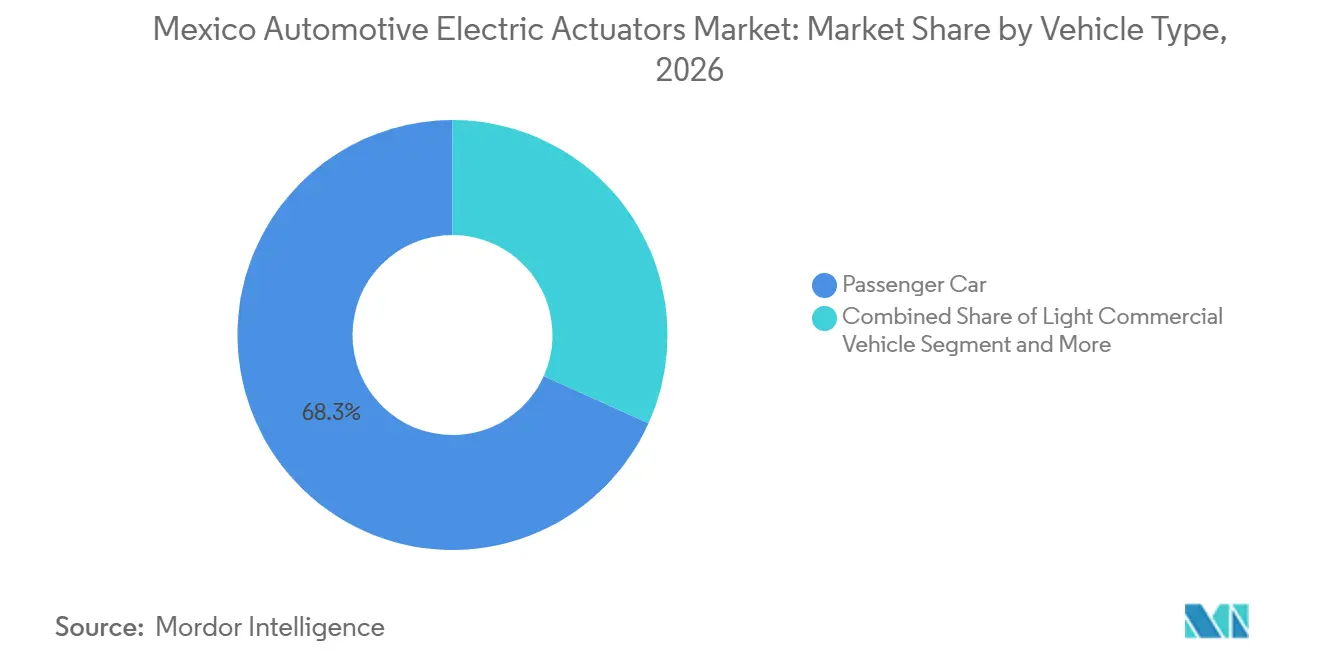
Passenger cars accounted for 68.27% of the Mexican automotive electric actuators market share in 2026. Their position reflects high-volume export programs and rising comfort and safety content in models produced for North American customers. Seats, doors, liftgates, mirrors, windows, and climate-control systems all add demand for actuator systems. Passenger cars remain important because their production volumes provide a broad base for standardized components.
Light commercial vehicles are forecast to grow at a 6.18% CAGR through 2032, the highest rate among vehicle types. Fleet programs are adding more electronic braking, safety, and monitoring functions to commercial platforms. These changes can increase demand for precise electromechanical control at multiple vehicle points. Medium and heavy commercial vehicles hold the smallest position within the vehicle-type split. They still require parking-brake, air-management, and safety-related actuation. The move toward digitally controlled chassis and fleet systems may support higher actuator content in commercial platforms over time. The strongest opportunities are likely to follow platforms that combine export production with updated safety and efficiency requirements.



By Application Type: Thermal Valves Lead Growth While Closure Systems Lead Demand
Closure, door, and liftgate actuators held 15.27% of the Mexican automotive electric actuators market share in 2026, making them the largest application group. Power liftgates, electronic door releases, smart-entry systems, and powered closures support that position. OEMs are using these systems across more passenger car and SUV programs built in Mexico. Seat-adjustment actuators form another major comfort application as multi-axis seat functionality expands. These products benefit from larger vehicles and from customer expectations for electronically controlled convenience features. The Mexico automotive electric actuator market size for closure systems remains tied to vehicle production volumes and the content level selected by OEMs.
Coolant and refrigerant valve actuators are forecast to grow at an 11.37% CAGR through 2032. Battery electric and plug-in hybrid vehicles need controlled cooling for batteries, cabins, power electronics, and e-axle systems. Brake actuators are also gaining relevance as electronic parking brakes replace cable-operated designs. Turbocharger, wastegate, and EGR actuators remain linked to internal combustion applications, while grille shutter, sunroof, and window systems add incremental demand.
By Motion Type: Rotary Designs Combine Scale and Growth
Rotary actuators held 56.83% of the Mexican automotive electric actuators market share in 2026. They are also forecast to grow at a 6.47% CAGR through 2032. The same segment leading on scale and growth indicates broad expansion rather than a major shift in motion configuration. Rotary designs serve throttle-body control, HVAC flap adjustment, mirror positioning, and seat-recliner functions. Their compact, motor-driven formats are well-suited to many high-volume automotive applications.
Linear actuators are used in power-seat travel, liftgate opening, and selected pedal-adjustment systems. They are also relevant to valve-control functions that require precise linear movement. Electric vehicle thermal systems can use linear valve control to regulate coolant flow. The use of integrated motor, gearbox, and controller modules is reducing the distinction between separate mechanical and electronic functions. This design shift raises the value of embedded electronics and software capability. Suppliers with internal expertise in motors and control systems may have an advantage over companies that only assemble purchased parts. The Mexico automotive electric actuator industry will continue to need both motion types because applications differ in force, travel, packaging, and precision requirements.
By Propulsion: Internal Combustion Engines Provide Volume While BEVs Drive Growth
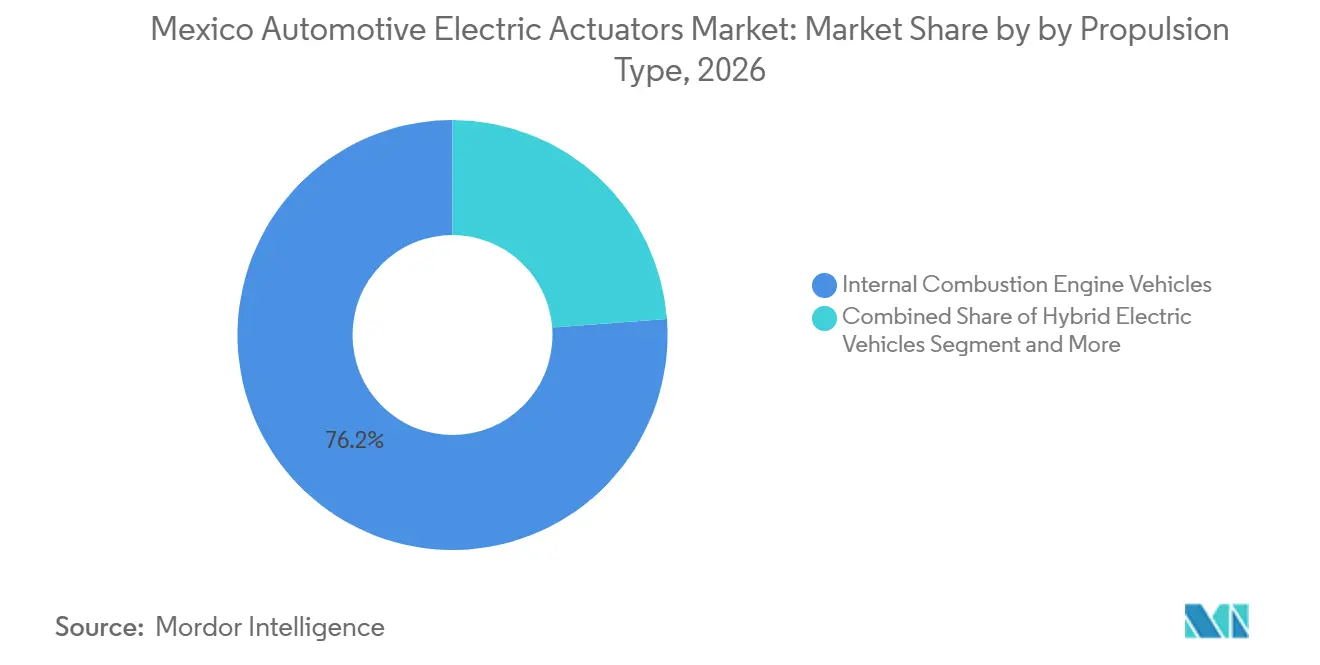
Internal combustion engine vehicles held 76.18% of the Mexican automotive electric actuators market share in 2026. They support high-volume throttle, EGR, turbocharger, conventional closure, and HVAC actuation. This installed production base provides the near-term demand foundation for the Mexico automotive electric actuator market. Battery electric vehicles are forecast to grow at a 14.27% CAGR through 2032. Their actuator needs are weighted toward battery thermal management, regenerative braking, and cabin comfort systems. The shift does not eliminate demand for internal combustion during the forecast period, but it changes the mix of applications suppliers must serve.
Mexico’s electric vehicle sales have grown significantly, while battery electric vehicles and plug-in hybrid electric vehicles account for a notable share of light-duty vehicle sales. Hybrid electric vehicles and plug-in hybrid electric vehicles occupy an important middle segment, as they require both engine-related and electrified thermal-management actuators. National regulations support improvements in CO2 emissions and fuel-economy performance for new light vehicles, strengthening the case for electrified vehicle programs in Mexico. Investment in San Luis Potosí focuses on expanding electric vehicle component and electronics manufacturing. This investment demonstrates how Tier-1 suppliers are positioning their production capacity to support increased vehicle electrification.

By Sales Channel: OEM Programs Define Demand
The Original Equipment Manufacturer (OEM) channel accounted for 86.18% of the Mexican automotive electric actuators market share in 2026 and is forecast to grow at a CAGR of 14.27% through the forecast period. The OEM channel’s significant share reflects the importance of platform nominations, as vehicle manufacturers define actuator specifications before production begins. Suppliers must meet technical, pricing, quality, and delivery requirements to secure these nominations. Mexico’s light-vehicle production declined, demonstrating how supplier demand can respond quickly to changes in vehicle assembly volumes. This concentration exposes suppliers without a meaningful replacement-parts business to greater risk.
The aftermarket represented 13.82% of demand in 2026. It remains comparatively limited despite Mexico’s large base of internal combustion vehicles. Replacement demand exists for closure, brake, and comfort actuators, but distribution is fragmented across regional parts sellers and repair networks. Fragmentation makes demand forecasting and SKU management more difficult. The OEM channel continues to favor companies with IATF 16949 quality systems and documented USMCA compliance. Those requirements act as practical access filters for many export-linked programs. An underserved aftermarket may offer a gradual opportunity for suppliers that can create dedicated replacement programs and reliable distribution coverage.
Geography Analysis
Bajío accounted for 46.27% of demand in 2026, giving it the largest share in the Mexican automotive electric actuators market. Guanajuato, Querétaro, Aguascalientes, and San Luis Potosí combine OEM assembly plants with dense tier-1 networks. Guanajuato’s light-vehicle production represents a significant share of Mexico’s national output. This production scale supports local demand for actuator manufacturing, validation, and logistics services. Bajío’s established industrial base also enables suppliers to serve multiple OEM programs from a single region.
Bajío’s share of Mexico's automotive electric actuators market means that changes in local vehicle production can quickly affect suppliers. A decline in Guanajuato’s light-vehicle production underscores this exposure. Nevertheless, the region remains central to Mexico’s automotive industry, as its mature industrial cluster and strong logistics connectivity support large-scale vehicle manufacturing.
The Northern Border States are forecast to grow at a 6.17% CAGR through 2032, the fastest rate among geographic regions. Nuevo León, Coahuila, and Chihuahua benefit from nearshoring activity and proximity to U.S. vehicle plants. Coahuila has attracted automotive investment, driven by activity in electrical components, aluminum processing, and electromobility manufacturing. An automotive supplier is relocating part of its Ciudad Juárez operations to Río Bravo and expanding the facility to produce higher-value vehicle technologies. This development reflects a shift from assembly activities toward more complex module production. The Rest of Mexico represents the smallest geographic segment but includes activity in Zacatecas and Puebla. Puebla’s established vehicle assembly base and dispersed domestic replacement demand provide a foundation for incremental actuator activity beyond the leading clusters.
Competitive Landscape
Market Concentration
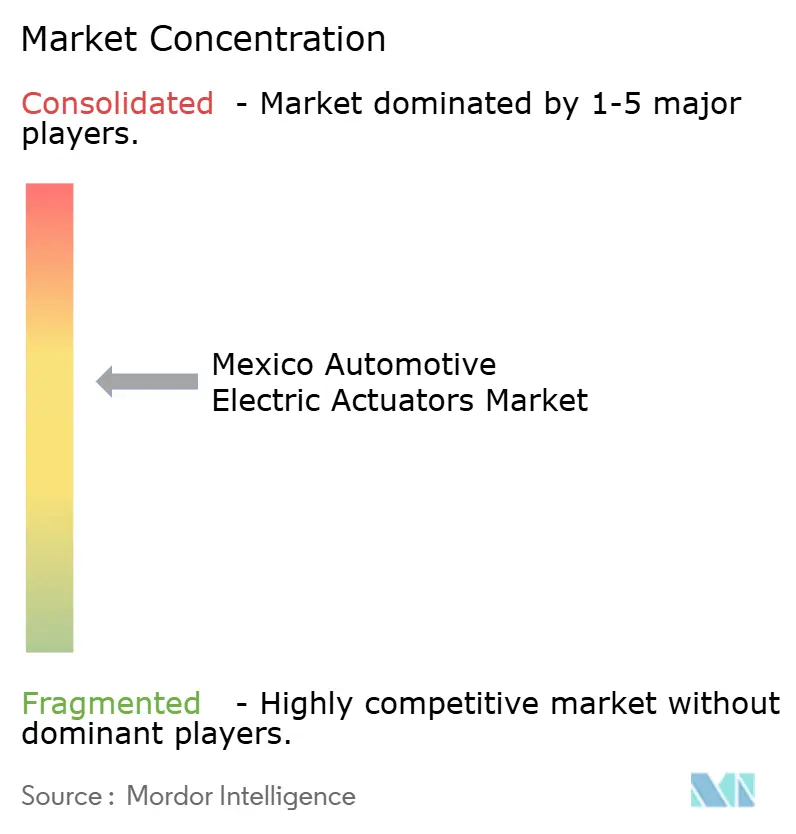
The Mexico automotive electric actuator market is moderately consolidated because global tier-1 suppliers hold many OEM platform nominations. Bosch, Denso, Nidec, BorgWarner, Brose, and Valeo have established roles in Mexico’s automotive supply base. Their manufacturing footprints and customer qualifications support supply arrangements for North American assembly programs. These incumbents also have experience with documentation required for USMCA-linked exports. The concentration of OEM demand raises the value of those approved supplier relationships [2].
Bosch plans to invest in its Mexican facilities following substantial investments in recent years. BorgWarner announced an expansion in San Luis Potosí to manufacture EV components and electronics. Brose announced an expansion in Querétaro to increase capacity for door modules and actuation mechanisms. Bosch’s planned introduction of hydraulic brake-by-wire technology further demonstrates product development focused on electronically controlled braking. These initiatives align production capacity and product portfolios with electrification, safety, and local manufacturing requirements.
Opportunities remain in aftermarket replacement parts and locally engineered thermal-management actuation systems for battery-electric and plug-in hybrid vehicles. The aftermarket remains small and fragmented, while established international supply networks provide much of the advanced thermal-control content. Taigene México’s expansion in León and Norcast’s machining investment in Torreón demonstrate that smaller regional suppliers can participate in the production of motors and housings. However, automotive quality certification and compliance with USMCA rules of origin remain significant barriers to entry for new suppliers. Therefore, the competitive landscape favors companies with established OEM qualifications, local production capacity, and the ability to manage complex sourcing requirements.
Mexico Automotive Electric Actuators Industry Leaders
-
Robert Bosch GmbH
-
DENSO Corporation
-
Mitsubishi Electric
-
Aptiv PLC
-
Nidec Corporation
- *Disclaimer: Major Players sorted in no particular order
Recent Industry Developments
- June 2026: BorgWarner announced a USD 49 million investment in San Luis Potosí to expand its EV component and electronics manufacturing operations from 2025 to 2028. The project is expected to create 663 specialized jobs by 2030. It directly supports EV technologies and strengthens the state’s role in North America’s electromobility supply chain.
- April 2026: At Hannover Messe 2026, Brose announced an investment of MXN 209 million (USD 11.34 million) in Querétaro. The investment strengthened the company’s administrative and operational capabilities for door-module and actuation-mechanism production.
Mexico Automotive Electric Actuators Market Report Scope
The Mexico Automotive Actuator Market Report is Segmented by Vehicle Type (Passenger Car, Light Commercial Vehicle, and Medium and Heavy Commercial Vehicle), Application Type (Throttle Actuators, Seat Adjustment Actuators, Brake Actuators, Closure, Door and Liftgate Actuators, HVAC Actuators, Turbocharger, Wastegate and EGR Actuators, Grille Shutter Actuators, Headlamp Levelling and Mirror Actuators, Coolant and Refrigerant Valve Actuators, Sunroof and Window Actuators, and Other Applications), Motion Type (Linear Actuators and Rotary Actuators), Propulsion (Internal Combustion Engine Vehicles, Hybrid Electric Vehicles, Plug-In Hybrid Electric Vehicles, Battery Electric Vehicles, and Other Propulsion Types), Sales Channel (Original Equipment Manufacturer and Aftermarket), and Geography (Bajío, Northern Border States, and Rest of Mexico). The Market Forecasts are Provided in Terms of Both Value (USD) and Volume (Units).
By Vehicle Type
| Passenger Car |
| Light Commercial Vehicle |
| Medium and Heavy Commercial Vehicle |
By Application Type
| Throttle Actuators |
| Seat Adjustment Actuators |
| Brake Actuators |
| Closure, Door and Liftgate Actuators |
| HVAC Actuators |
| Turbocharger, Wastegate and EGR Actuators |
| Grille Shutter Actuators |
| Headlamp Levelling and Mirror Actuators |
| Coolant and Refrigerant Valve Actuators |
| Sunroof and Window Actuators |
| Other Applications |
By Motion Type
| Linear Actuators |
| Rotary Actuators |
By Propulsion
| Internal Combustion Engine Vehicles |
| Hybrid Electric Vehicles |
| Plug-In Hybrid Electric Vehicles |
| Battery Electric Vehicles |
| Other Propulsion Types |
By Sales Channel
| Original Equipment Manufacturer |
| Aftermarket |
By Geography
| Bajío |
| Northern Border States |
| Rest of Mexico |
| By Vehicle Type | Passenger Car |
| Light Commercial Vehicle | |
| Medium and Heavy Commercial Vehicle | |
| By Application Type | Throttle Actuators |
| Seat Adjustment Actuators | |
| Brake Actuators | |
| Closure, Door and Liftgate Actuators | |
| HVAC Actuators | |
| Turbocharger, Wastegate and EGR Actuators | |
| Grille Shutter Actuators | |
| Headlamp Levelling and Mirror Actuators | |
| Coolant and Refrigerant Valve Actuators | |
| Sunroof and Window Actuators | |
| Other Applications | |
| By Motion Type | Linear Actuators |
| Rotary Actuators | |
| By Propulsion | Internal Combustion Engine Vehicles |
| Hybrid Electric Vehicles | |
| Plug-In Hybrid Electric Vehicles | |
| Battery Electric Vehicles | |
| Other Propulsion Types | |
| By Sales Channel | Original Equipment Manufacturer |
| Aftermarket | |
| By Geography | Bajío |
| Northern Border States | |
| Rest of Mexico |
Key Questions Answered in the Report
What is the current market size and growth forecast for the Mexico automotive electric actuator market?
The Mexico automotive electric actuator market size was valued at USD 0.62 billion in 2026 and is projected to grow from USD 0.66 billion in 2027 to USD 0.91 billion by 2032, growing at a CAGR of 6.31% from 2027 to 2032.
What factors limit new entrants into Mexico’s automotive actuator supply chain?
Long OEM qualification cycles, IATF 16949 quality requirements, USMCA origin documentation, and reliance on imported magnets and electronics create significant barriers to entry. Suppliers also contend with fixed platform pricing and must demonstrate reliable delivery performance before securing OEM nominations.
Which region leads automotive actuator demand in Mexico in 2026?
The Bajío region leads with a 46.27% market share in 2026, supported by major OEM assembly plants and Tier 1 supplier networks. The Northern Border States are projected to grow at a CAGR of 6.17%, driven by nearshoring trends and investments in electromobility that are strengthening the region’s manufacturing base.
How is vehicle electrification influencing actuator demand in Mexico?
Battery electric vehicles are forecast to grow at a 14.27% CAGR through 2032 and need additional thermal management, braking, and cabin-comfort actuation. Hybrid and plug-in hybrid vehicles also require conventional engine controls alongside electrified thermal-management functions.
Which actuator application is expected to grow the fastest in Mexico through 2032?
Coolant and refrigerant valve actuators are projected to grow at an 11.37% CAGR through 2032. Electrified powertrains require more precise control of battery, cabin, and e-axle thermal circuits than conventional vehicle architectures.