
Metallic Stearate Market Size and Share
Market Overview
| Study Period | 2020 - 2031 |
|---|---|
| Market Size (2026) | USD 5.08 Billion |
| Market Size (2031) | USD 6.42 Billion |
| Growth Rate (2026 - 2031) | 4.79 % |
| Fastest Growing Market | Asia Pacific |
| Largest Market | Asia Pacific |
| Market Concentration | Medium |
Major Players *Disclaimer: Major Players sorted in no particular order Image © Mordor Intelligence. Reuse requires attribution under CC BY 4.0. | |
Metallic Stearate Market Analysis by Mordor Intelligence
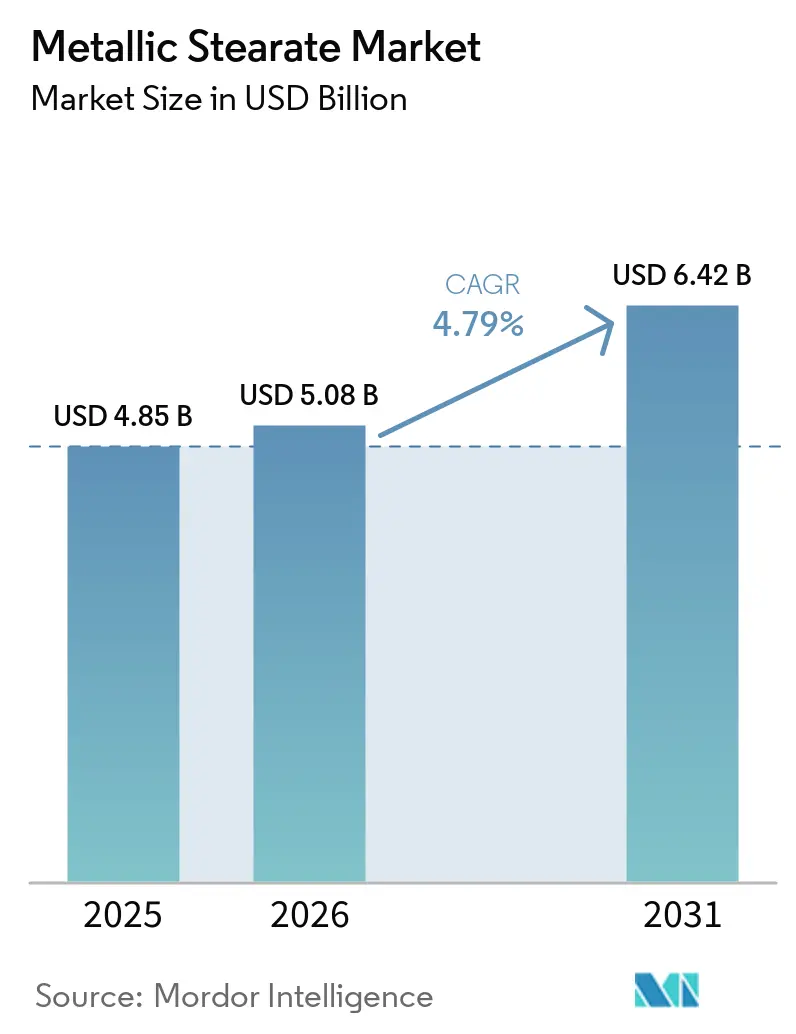
The Metallic Stearate Market size was valued at USD 4.85 billion in 2025 and estimated to grow from USD 5.08 billion in 2026 to reach USD 6.42 billion by 2031, at a CAGR of 4.79% during the forecast period (2026-2031). Combining polymer production growth, regulatory shifts favoring calcium-zinc stabilizer systems, and rising pharmaceutical tablet output reinforce demand stability. Steady appetite for lightweight plastics in automotive and packaging, coupled with robust Asian manufacturing capacity, underpins near-term momentum. At the same time, stricter limits on lead in PVC and improvements in drug-formulation technology are steering end users toward higher-purity products that comply with emerging quality norms. Feedstock price swings tied to palm-oil markets present cost headwinds, yet the metallic stearate market continues to expand as producers adopt vertical integration, diversify sourcing, and invest in low-dust dispersion technologies.
Key Report Takeaways
- By product type, zinc stearate led with 41.75% metallic stearate market share in 2025; magnesium stearate is projected to advance at a 5.72% CAGR through 2031.
- By form, powder held 46.90% share of the metallic stearate market size in 2025, whereas aqueous dispersions are set to grow at 6.78% CAGR by 2031.
- By end-use industry, plastics and polymers accounted for 37.25% of the metallic stearate market size in 2025, while pharmaceuticals are forecast to post the highest 5.92% CAGR to 2031.
- By geography, Asia-Pacific commanded 50.85% metallic stearate market share in 2025 and is forecast to expand at 5.61% CAGR to 2031.
Note: Market size and forecast figures in this report are generated using Mordor Intelligence’s proprietary estimation framework, updated with the latest available data and insights as of 2026.
Global Metallic Stearate Market Trends and Insights
Drivers Impact Analysis*
| Driver | (~) % Impact on CAGR Forecast | Geographic Relevance | Impact Timeline |
|---|---|---|---|
| Rapid expansion of global plastics production | +1.8% | Global, with APAC leading | Medium term (2-4 years) |
| Pharmaceutical tablet output surge | +1.2% | North America & Europe, expanding to APAC | Long term (≥ 4 years) |
| Rising cosmetics consumption | +0.9% | Global, with strong growth in emerging markets | Medium term (2-4 years) |
| Shift to lead-free PVC stabilizers | +1.1% | Europe & North America, spreading globally | Short term (≤ 2 years) |
| Rising Demand from Rubber Segment | +0.8% | APAC core, spill-over to North America | Medium term (2-4 years) |
| Source: Mordor Intelligence | |||
Rapid Expansion of Global Plastics Production
Escalating polyethylene and polypropylene output boosts additive demand as processors rely on metallic stearates to shorten cycle times and improve surface finish. Lightweight vehicle design and recycled-content packaging intensify the need for stable formulations that resist discoloration and thermal degradation. China’s polymer capacity leadership ensures regional consumption remains strong, while Southeast Asia’s integrated supply chains offer both feedstock availability and cost advantages. Emerging applications in battery casings and photovoltaic back-sheets extend growth beyond legacy sectors. This diversified pull across automotive, building-products, and flexible-packaging segments underlies a resilient outlook for the metallic stearate market[1]PMC Biogenix, “Metallic stearates in polymer processing,” pmcbiogenix.com.
Pharmaceutical Tablet Output Surge
Higher life-expectancy and biologic drug innovation push global solid-dosage production upward, elevating the role of magnesium stearate as a proven lubricant. Between 2012 and 2023, the United States Food and Drug Administration cleared 48 new drug approvals that rely on amorphous solid dispersions, a formulation class in which metallic stearates enhance stability and compressibility. Continuous-manufacturing platforms favor aqueous dispersions that reduce dust and speed cleaning cycles, further stimulating liquid-form uptake. Expansion of generics in India and injectable-to-oral switches in Latin America widen the demand base. Consequently, pharmaceutical preferences shift toward high-purity grades with strict endotoxin limits that support competitiveness in regulated markets[2]Roquette Frères, “Magnesium stearate excipient applications,” roquette.com.
Rising Cosmetics Consumption
Demand for long-lasting makeup, sunscreens, and men’s grooming products lifts usage of aluminum and zinc stearates that act as rheology modifiers and water-repellents. Emerging-market consumers are trading up to premium brands, increasing formulation complexity and requiring ingredients that maintain texture under humid conditions. Plant-based feedstocks resonate with sustainability-minded buyers, and suppliers now highlight palm-kernel-derived stearic acid traceability. Regulatory scrutiny of talc drives brand owners to favor metallic stearates as alternative slip agents in pressed powders. Digital commerce accelerates product-launch cadence, raising the need for multipurpose raw materials that streamline formulation libraries.
Shift to Lead-Free PVC Stabilizers
European Union Regulation 923/2023 caps lead in PVC below 0.1% by weight, which speeds adoption of calcium-zinc systems that depend on calcium stearate as a co-stabilizer. Building-material makers in cables, pipes, and siding have validated performance equivalency at similar dosage levels. Market leaders have introduced proprietary blends that lower plate-out and odor, meeting both technical and environmental targets. United States construction specifications are also moving toward lead-free content, broadening worldwide uptake. Producers with in-house calcium stearate capacity therefore secure early-mover benefits and strengthen customer lock-in.
Restraints Impact Analysis*
| Restraint | (~) % Impact on CAGR Forecast | Geographic Relevance | Impact Timeline |
|---|---|---|---|
| Stricter occupational exposure limits | -0.7% | Global, with stricter enforcement in developed markets | Short term (≤ 2 years) |
| Stearic-acid feedstock price volatility | -0.5% | Global, with higher impact in import-dependent regions | Medium term (2-4 years) |
| Substitution by montan-wax slip agents | -0.3% | Europe & North America, limited APAC impact | Long term (≥ 4 years) |
| Source: Mordor Intelligence | |||
Stricter Occupational Exposure Limits
The National Institute for Occupational Safety and Health sets a time-weighted average of 10 mg/m³ total particulate and 5 mg/m³ respirable particulate for zinc stearate dust. Updated Hazard Communication Standard alignment with the Globally Harmonized System obliges manufacturers to upgrade safety-data sheets, alter labels, and invest in dust-collection equipment. Workplaces shift toward granules and liquid dispersions that minimize airborne particles, adding conversion costs yet opening premium pricing opportunities. Smaller compounders may defer capital upgrades, temporarily damping demand for traditional powder grades. However, sustained enforcement is expected to push the metallic stearate market toward safer delivery formats by 2027.
Stearic-Acid Feedstock Price Volatility
Palm-oil production shortfalls linked to El Niño weather patterns and biodiesel mandates in Indonesia and Malaysia tighten stearic-acid supply, raising input prices for stearate manufacturers. Import-dependent regions face amplified cost swings because freight and currency movements compound raw-material volatility. Substitution with tallow-derived fatty acids or synthetic routes remains limited by higher purification costs and regulatory hurdles in pharmaceutical and food-contact uses. Forward-buying and hedging strategies lessen exposure yet tie up working capital. Overall, raw-material instability erodes margins for producers that lack backward integration into fatty-acid refining.
*Our forecasts treat driver/restraint impacts as directional, not additive. The impact forecasts reflect baseline growth, mix effects, and variable interactions.
Segment Analysis
By Product Type: Zinc Strength Maintains Position, Magnesium Picks Up Pace
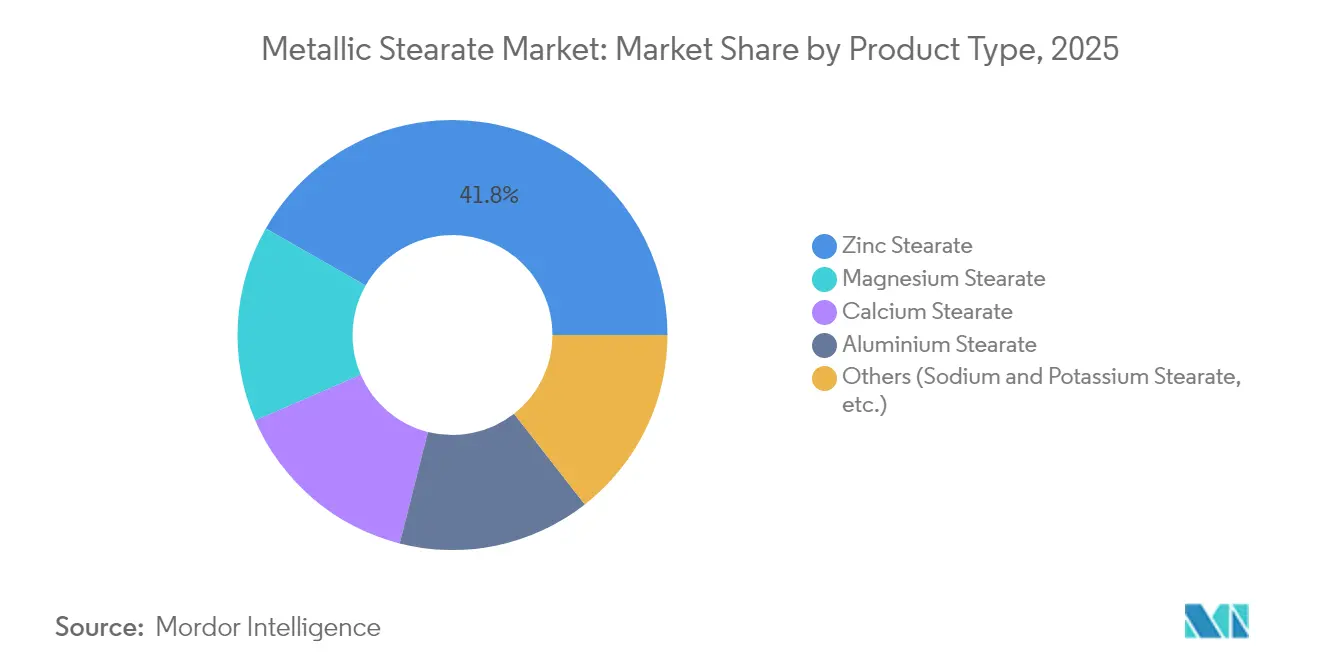
Zinc stearate captured 41.75% metallic stearate market share in 2025 as its versatility across PVC, rubber, and cosmetic formulations made it an indispensable additive. Demand remains steady because compounders value its balance of lubrication, mold-release, and heat-stability properties. Incremental gains arise from recyclate-rich polyolefin blends that need efficient internal lubricants to achieve uniform melt flow. In contrast, magnesium stearate is forecast at 5.72% CAGR through 2031 thanks to surging pharmaceutical tablet volumes that rely on concentrations between 0.25% and 5% weight for proper compressibility. Regulatory familiarity and low toxicity underpin this sustained lift. Calcium stearate absorbs stable growth from waterproofing admixtures in concrete and efflorescence mitigation in cementitious products, while aluminum stearate serves niche coatings and lubricating-grease uses where high gel strength is critical. Academic collaborations targeting hybrid zinc-calcium grades illustrate a broader trend toward tailored functionality, signaling renewed innovation despite zinc stearate’s mature status in the metallic stearate market.
A secondary tier comprising sodium and potassium stearates addresses personal-care cleansers and industrial detergents that seek biodegradable profiles. Potassium stearate’s high solubility gains traction in sulfate-free shampoos, while sodium stearate supports soap bar transparency. Market leaders differentiate by offering kosher and halal certifications to meet fast-growing consumer-goods regulatory requirements. Across all chemistries, buyers demand tighter metal content specifications and traceability to sustainably sourced fatty acids. Those attributes increasingly influence contract awards, reinforcing the competitive advantage of fully integrated suppliers that control both fatty-acid and metal-salt processing under one roof.



By Form: Powder Dominance Faces Rising Liquid Preference
Powder held 46.90% share of the metallic stearate market size in 2025 because it aligns with traditional batch mixing and extrusion processes in plastics and rubber. Users appreciate its free-flowing characteristics and wide compatibility with standard feeding systems. However, workplace exposure concerns prompt many multinational pharmaceutical firms to pivot toward aqueous dispersions that are growing at a 6.78% CAGR. Liquid formats integrate easily into continuous tablet presses, eliminate dust screens, and shorten change-over times, providing total cost benefits that offset their higher purchase price. Large compounders invest in closed-loop delivery tanks that minimize spills and further support adoption.
Flakes and prills remain relevant in rubber calendering where controlled dissolution is essential to process consistency. Producers fine-tune bulk density, particle size, and moisture profile to achieve reliable feeding within high-throughput internal mixers. Innovation in dispersion technology focuses on polymer-predispersed masterbatches that offer customers dosage accuracy and improved film clarity. Several leading suppliers have launched water-based systems free of volatile amines, which broadens appeal among environmentally conscious PE and PVC processors. Collectively, these shifts underline a gradual migration away from powder dominance toward higher-value, low-dust alternatives across the metallic stearate market.
By End-User Industry: Plastics Lead, Pharmaceuticals Accelerate
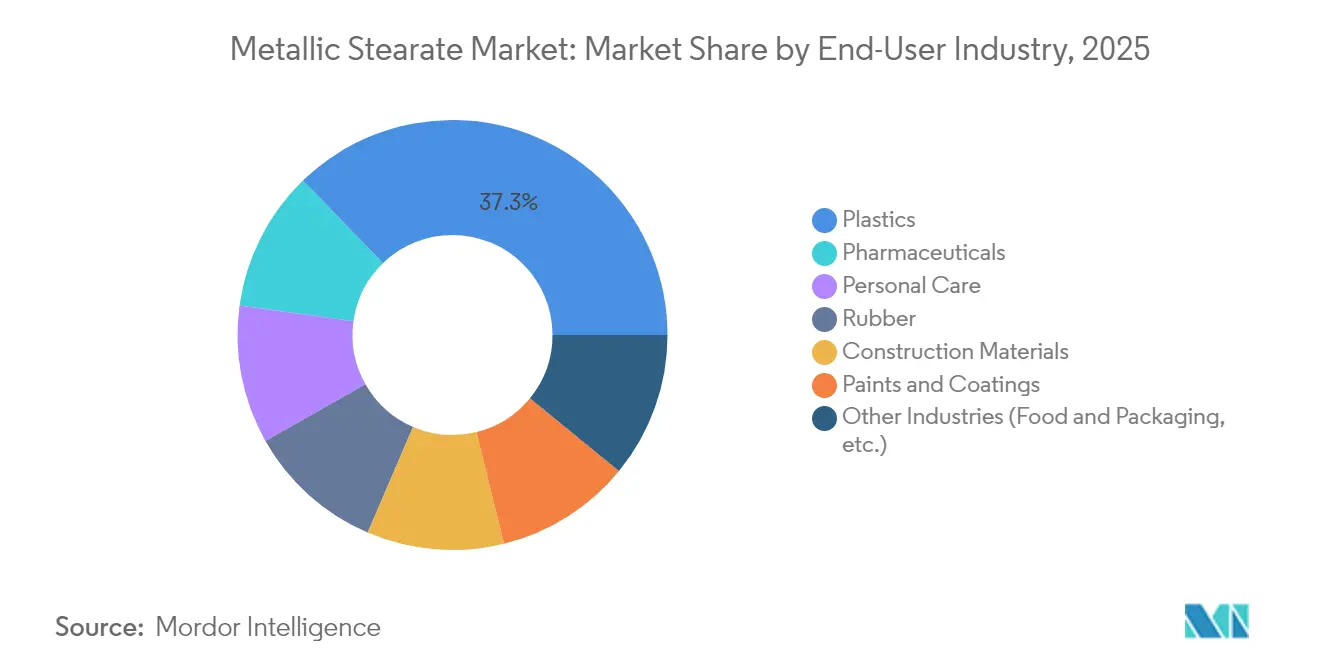
Plastics and polymers consumed 37.25% of global volume in 2025, driven by large-scale packaging, automotive, and pipe applications that benefit from metallic stearates’ melt-lubricating and heat-stabilizing roles. Additive functionality will remain essential as recycled resin content rises and processors face tighter thermal windows. Meanwhile, pharmaceuticals are expected to grow at a 5.92% CAGR through 2031 as multinationals expand capacity for continuous manufacturing and biologic therapeutics. Regulatory agencies increasingly prescribe data-rich excipient documentation, which positions established grades such as NF-compliant magnesium stearate for ongoing preference.
The rubber industry recovers alongside vehicle production, using zinc stearate as an anti-tack agent in styrene-butadiene and butyl rubber formulations. Personal care exhibits robust mid-single-digit growth because premium skin-care and color-cosmetics lines call for water-repellent aluminum and zinc stearates that improve product feel and pigment dispersion. Construction materials gain visibility through calcium stearate admixtures that guard against capillary water ingress in concrete façades, supporting the longevity of high-value building envelopes. Each segment’s distinct technical and regulatory demands lead suppliers to broaden their technical-service teams and invest in application-specific pilot lines that reinforce customer intimacy throughout the metallic stearate market.
Geography Analysis
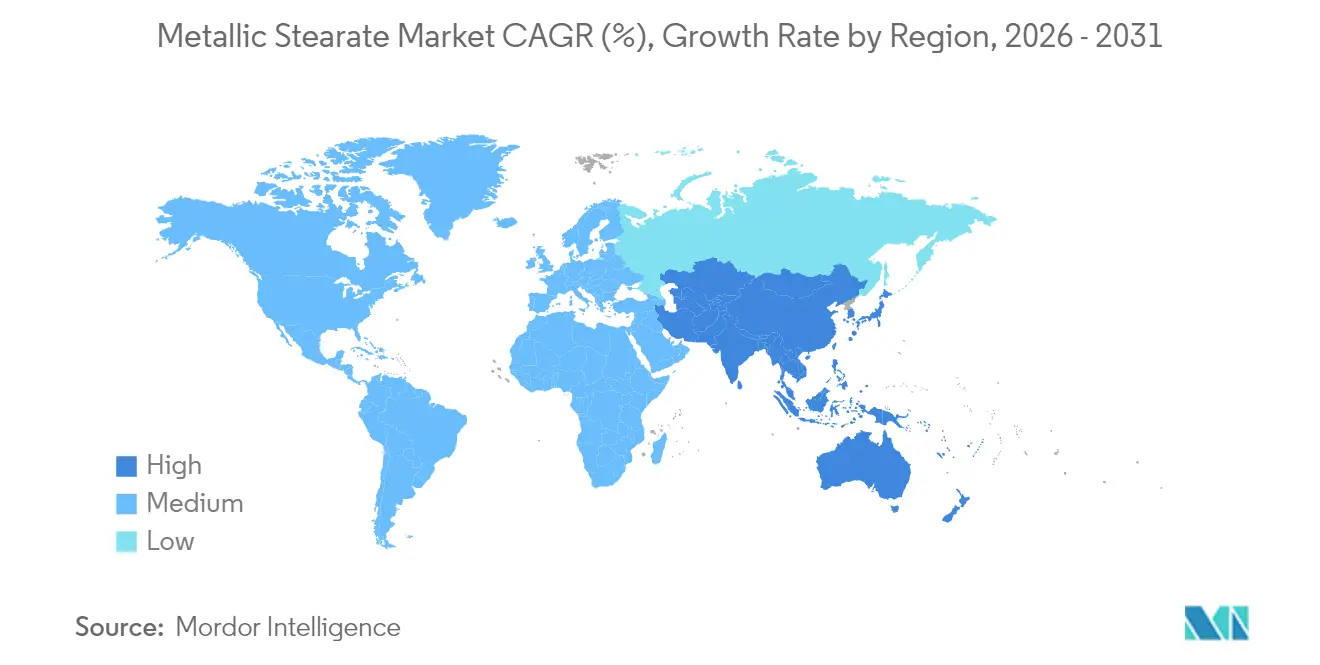
Asia-Pacific dominated with a 50.85% revenue contribution in 2025 and is projected to expand at 5.61% CAGR through 2031. China commands the bulk of resin and rubber output, reinforcing local consumption of both zinc and calcium stearates, while India’s chemical sector is on track to rise from USD 220 billion in 2022 to USD 300 billion in 2025, deepening regional specialty-additive requirement. Southeast Asian economies provide integrated palm-oil based fatty acids that feed export-oriented metallic stearate plants, thereby anchoring supply chain efficiency and competitive pricing.
North America ranks second in market size because its pharmaceutical manufacturing footprint concentrates large excipient buyers that insist on current Good Manufacturing Practice accreditation. The transition toward lead-free PVC compounds in wire, cable, and vinyl siding supplies incremental pull. Canada’s infrastructure stimulus directs calcium stearate-treated concrete additives into highway and bridge projects, supporting modest growth. Europe positions itself at the forefront of eco-design and circularity, hosting early adopters of calcium-zinc stabilizer systems for PVC and ramping up regulatory compliance investments that favor high-purity stearate grades. Germany and Italy house major masterbatch producers that serve the broader European plastics network.
South America records stable but lower base volumes, mainly in Brazil’s PVC pipe and footwear industries, while emerging pharmaceutical clusters in Mexico and Colombia create pockets of faster uptake. The Middle East and Africa currently consume a small share yet show long-term promise as refinery and polymer-conversion capacity grows. Gulf Cooperation Council investments in polyolefin derivatives spur additive demand, whereas African urbanization drives PVC pipe and cosmetic needs, positioning the metallic stearate market for gradual penetration as regional manufacturing deepens.

Value Chain Analysis
The metallic stearate value chain starts with fatty-acid feedstocks (stearic acid primarily sourced from vegetable oils such as palm and palm kernel, with limited substitution by tallow or synthetic routes in high-purity applications) and metal inputs (zinc oxide, calcium hydroxide, magnesium oxide, and related carbonates/hydroxides). Manufacturing typically follows direct neutralization or double-decomposition routes, with filtration, drying, and milling/classification before packaging. Many producers use automated process control (PLC/SCADA) to keep metal content and particle-size within the specifications required by plastics compounders and pharmaceutical excipient buyers.
Downstream, products are sold directly to large polymer compounders, PVC stabilizer and blend suppliers, rubber processors, and regulated end users in pharmaceuticals and personal care. Distributors also support smaller formulators and export channels. Competitive advantage often comes from backward integration into fatty-acid refining and proximity to logistics nodes, which can reduce exposure to stearic-acid price swings and freight variability. In India, for example, domestic capacity and export access support participation by producers such as Goldstab Organics (Sarigam) and Ravi Kiran Chemicals (Mumbai). Regional manufacturers are also differentiating through low-dust formats (granules, masterbatches, aqueous dispersions) that align with workplace exposure controls and faster-changeover processing lines.
Competitive Landscape
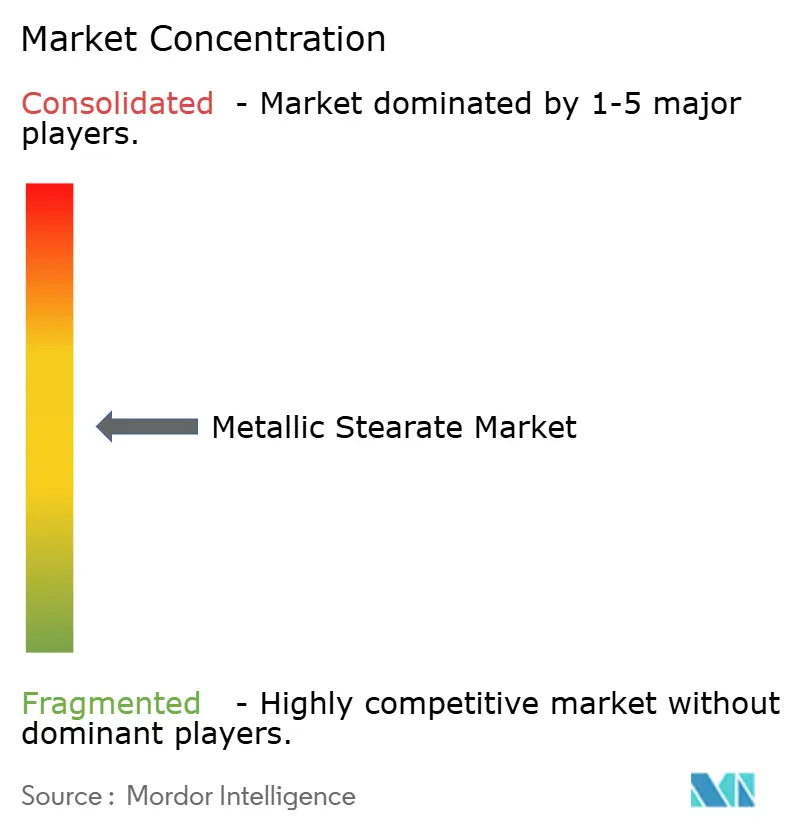
The metallic stearate market exhibits moderate fragmentation. Baerlocher remains a reference point through multi-continent plants and an extensive calcium-based stabilizer portfolio that aligns with the global shift to lead-free PVC. A new 10,000 tons per year expansion completed in May 2025 at its Cincinnati site underscores confidence in long-term additive demand. PMC Group leverages vertically integrated fatty-acid refining, offering pharma-grade magnesium stearate certified under US Pharmacopeia, while Dover Chemical maintains a niche in specialty zinc stearates used in flame retardants and wire enamels.
Strategic positioning centers on purity, dispersion technology, and compliance credentials such as ISO 9001, ICH Q7, and halal certification. Asian manufacturers like Mittal Dhatu and Shandong Heji benefit from domestic palm-oil derivative streams, providing cost advantages on commodity zinc and calcium grades. Western competitors counter by introducing solvent-free aqueous dispersions that cut facility dust load and fast-track Environmental Health and Safety approvals. Recent alliances link additive suppliers with polymer compounders to codevelop bespoke masterbatches that ease customer inventory complexity. Capital commitments have focused on energy-efficient reactor upgrades and automated packaging lines that preserve product integrity and minimize contamination risk.
Metallic Stearate Industry Leaders
Baerlocher GmbH
Faci Asia Pacific Pte Ltd
Peter Greven GmbH and Co. KG
PMC Group, Inc.
Valtris Specialty Chemicals
- *Disclaimer: Major Players sorted in no particular order

Market Opportunities and Future Outlook
There is a narrower opportunity in higher-purity and compliance-ready grades, where buyers want stronger documentation and process control, particularly for pharmaceutical magnesium stearate and polymer applications moving toward lead-free stabilization systems. As lead-containing PVC formulations face tighter scrutiny, calcium stearate demand rises as a co-stabilizer within calcium-zinc systems, and suppliers with integrated stearate and stabilizer portfolios have been investing to localize supply. Baerlocher has pointed to this direction through Asia expansion, including its MYR 220 million Malaysia project for 30 kta of Ca-Zn stearates announced in May 2025, which maps to customer demand for regional availability and shorter supply chains.
Format innovation is another active opportunity as occupational exposure management and continuous-processing preferences increase adoption of low-dust delivery forms, particularly aqueous dispersions for polymer processing and pharma operations that need faster cleaning and reduced airborne particulate. Evidence of this shift includes Norac Additives (Peter Greven) starting production on a new US dispersion line for LIGAFLUID calcium stearate dispersions (May 2024), supporting localized supply for processors moving to liquid or dispersion-based dosing. Sustainability-linked sourcing is also becoming a purchase criterion in personal care and pharma excipients, illustrated by Peter Greven introducing bio-based magnesium stearate grades derived from RSPO-certified palm oil (April 2025). This creates space for suppliers to combine traceable fatty-acid sourcing with tighter impurity control and end-use certifications.
Recent Industry Developments
- June 2026: Baerlocher announced the establishment of Baerlocher Germany GmbH & Co. KG, headquartered in Lingen, with the structure taking effect on July 1, 2026 to manage operational business and PVC stabilizers and specialty additives in Europe. The company said the new setup strengthens its regional operational focus for additive portfolios that include metal-stearate-based solutions used in PVC processing and polymer compounding. It is also expected to streamline decision-making for European customers navigating tighter materials compliance and performance requirements.
- April 2025: Peter Greven unveiled a new range of bio-based magnesium stearate grades derived from RSPO-certified palm oil for pharmaceutical tablet formulations. The company positioned the offering as a way to align magnesium stearate supply with sustainability and traceability requirements while maintaining excipient performance and quality expectations in regulated production. The launch adds competitive pressure on suppliers that lack certified feedstock sourcing and high-purity manufacturing controls.
- May 2024: Norac Additives, a Peter Greven subsidiary, commenced production at a new dispersion line in the United States for LIGAFLUID calcium stearate dispersions. The investment increases local availability of low-dust, process-friendly formats that support safer handling and more consistent dosing in polymer processing and related applications. It also reduces reliance on imported dispersions for North American customers seeking supply security and shorter lead times.


Research Methodology Framework and Report Scope
Market Definition and Coverage
This market is defined as revenue earned from the sale of metallic stearates that are produced and used as process aids and functional additives across industrial manufacturing, where demand moves with downstream output and additive loading needs.
Scope exclusions: Internal transfers, tolling-only revenues, and non-stearate fatty acid salts that are not marketed as metallic stearates are excluded, since they would not align with the product boundary used for this estimate.
Segmentation Overview
- By Product Type
- Zinc Stearate
- Calcium Stearate
- Magnesium Stearate
- Aluminium Stearate
- Others (Sodium and Potassium Stearate, etc.)
- By Form
- Powder
- Flakes
- Granules
- Aqueous Dispersion
- By End-User Industry
- Plastics
- Rubber
- Pharmaceuticals
- Personal Care
- Construction Materials
- Paints and Coatings
- Other Industries (Food and Packaging, etc.)
- By Geography
- Asia-Pacific
- China
- India
- Japan
- South Korea
- ASEAN Countries
- Rest of Asia-Pacific
- North America
- United States
- Canada
- Mexico
- Europe
- Germany
- United Kingdom
- France
- Italy
- NORDIC Countries
- Rest of Europe
- South America
- Brazil
- Argentina
- Rest of South America
- Middle East and Africa
- Saudi Arabia
- South Africa
- Rest of Middle-East and Africa
- Asia-Pacific
Data Sources, Market Sizing, and Validation
Desk Research
Desk work starts by aligning the product boundary and end-use linkages, so the same chemical family is not double counted across plastics, rubber, and coatings. For boundary checks, we rely on public source types such as UN Comtrade trade statistics, USITC data, Eurostat, and World Bank macro indicators, plus government environment and chemical safety portals that can signal compliance shifts affecting formulations.
After that, we stitch in supply-side and demand-side signals through company annual reports, investor presentations, industry association notes, and credible press coverage on capacity, feedstock cost moves, and downstream output. When disclosures are limited, we use paid subscription sources for company financials and patent database records to infer producer scale and innovation direction. The desk sources named here are illustrative and not exhaustive, and we reviewed many other public references for data collection, cross-checking, and clarification.
Primary Interviews and Surveys
Primary work focuses on validating what drives buying volumes and pricing, since metallic stearates often track processing rates and formulation choices rather than consumer sentiment. We spoke with stakeholders across producers, distributors, compounders, and end-use formulators, and we also compared views across APAC, EMEA, and the Americas to avoid assuming one region's consumption pattern transfers directly to the rest.
The respondent input was used to confirm which downstream application categories matter most for each region and to sanity-check additive loading assumptions applied in the sizing model.
Distribution of primary research fieldwork respondents
| Company type | Respondent position | Region |
|---|---|---|
| Top tier: 33% | CXOs: 16% | APAC: 47% |
| Mid tier: 48% | Functional/Unit leaders: 33% | EMEA: 32% |
| Smaller Players: 19% | Managers: 51% | Americas: 21% |
Market-Sizing & Forecasting
Sizing is built using a top-down and bottom-up logic, where production and trade data reconstruct the available demand pool by region before it is allocated to metallic stearate usage in key industrial applications. To keep it practical, we start from indicators like plastics and polymer processing output, rubber compounding activity, paints and coatings production trends, and construction materials demand, then apply typical additive loading patterns that were validated through interviews.
The model is stress tested using selective bottom-up approximations, such as sampled price ranges by metal type, channel markups, and a roll-up of visible supplier presence in large consuming regions. Where some parts of the market do not disclose clear splits, gaps are handled through proxy ratios based on similar end-use mix and confirmed regional consumption behavior, then adjusted only after primary checks. For forecasting, scenario analysis is used with a central case that links volume growth to downstream manufacturing indices and price movement to feedstock trends, with assumptions refreshed using expert consensus from the fieldwork.
Data Validation & Update Cycle
Validation is done by comparing the model outputs against independent signals such as trade flows, downstream production indices, and visible capacity announcements, and then checking that implied pricing stays within realistic ranges by region. If a variance looks too wide, we re-check definitions, rerun sensitivity on the key drivers, and reconnect with select interviewees to confirm whether the change is structural or temporary.
Before sign-off, the work passes through multiple analyst reviews so assumptions, conversions, and year alignment are consistently applied across regions. Reports are refreshed annually, and interim updates are triggered when material events occur, such as major capacity additions, regulation-driven formulation shifts, or sharp feedstock swings. Right before delivery, a final refresh pass is completed so the numbers reflect the latest available information.
Mordor Intelligence's Metallic Stearate Market Size Compared With Other Published Estimates
Published market sizes for metallic stearates often vary because the boundaries are not always identical, even when the titles sound similar. Differences usually come from what is counted as metallic stearates versus adjacent additives, the base year used, and whether pricing is modeled as a single global average or built up regionally.
By tracking end-use output indicators and refreshing currency timing and regional price spreads, Mordor Intelligence keeps the 2026 total tied to application-linked consumption rather than folding in non-stearate fatty acid salts or using one blended ASP across all regions. Gaps also show up when one estimate leans on a conservative demand case tied to slower plastics and rubber growth, while another assumes faster penetration in coatings and construction materials without enough validation checks.
Benchmark comparison
| Source | Market Size | Gaps in Research Methodology |
|---|---|---|
| Mordor Intelligence | USD 5.08 B (2026) | |
| Global Consultancy A | USD 4.69 B (2024) | Uses a 2024 base year and generally reports smoother price progression, which can compress implied 2026 value if regional feedstock-linked pricing swings are not carried through. |
| Industry Publisher B | USD 4.96 B (2025) | Anchors sizing to a 2025 base and appears to apply broader demand assumptions across end uses, which can shift totals when application-specific loading rates and trade checks are not emphasized. |
The spread across sources mainly comes from year alignment, what gets included near the product boundary, and how prices are carried across regions and years. When the market is built from clear demand indicators and then checked against trade and capacity signals, the end result is easier to trace and repeat, which helps users compare scenarios with fewer hidden assumptions.


Key Questions Answered in the Report
What is the current Metallic Stearate Market size?
The metallic stearate market was valued at USD 5.08 billion in 2026.
How fast is the metallic stearate market expected to grow?
The market is projected to rise at a 4.79% CAGR, reaching USD 6.42 billion by 2031.
Which product type leads the metallic stearate market?
Zinc stearate holds the top position with 41.75% share in 2025, supported by its broad use in PVC, rubber, and cosmetics.
Why is magnesium stearate demand increasing?
Growth in pharmaceutical tablet production and the shift to continuous-manufacturing platforms are driving a 6.15% CAGR for magnesium stearate through 2031.
Page last updated on:


 Your data is secure and never sold or shared.


