
Membrane Filters Market Size and Share
Market Overview
| Study Period | 2020 - 2031 |
|---|---|
| Market Size (2026) | USD 8.63 Billion |
| Market Size (2031) | USD 12.12 Billion |
| Growth Rate (2026 - 2031) | 7.03 % |
| Fastest Growing Market | Asia Pacific |
| Largest Market | Asia Pacific |
| Market Concentration | Medium |
Major Players *Disclaimer: Major Players sorted in no particular order Image © Mordor Intelligence. Reuse requires attribution under CC BY 4.0. | |
Membrane Filters Market Analysis by Mordor Intelligence
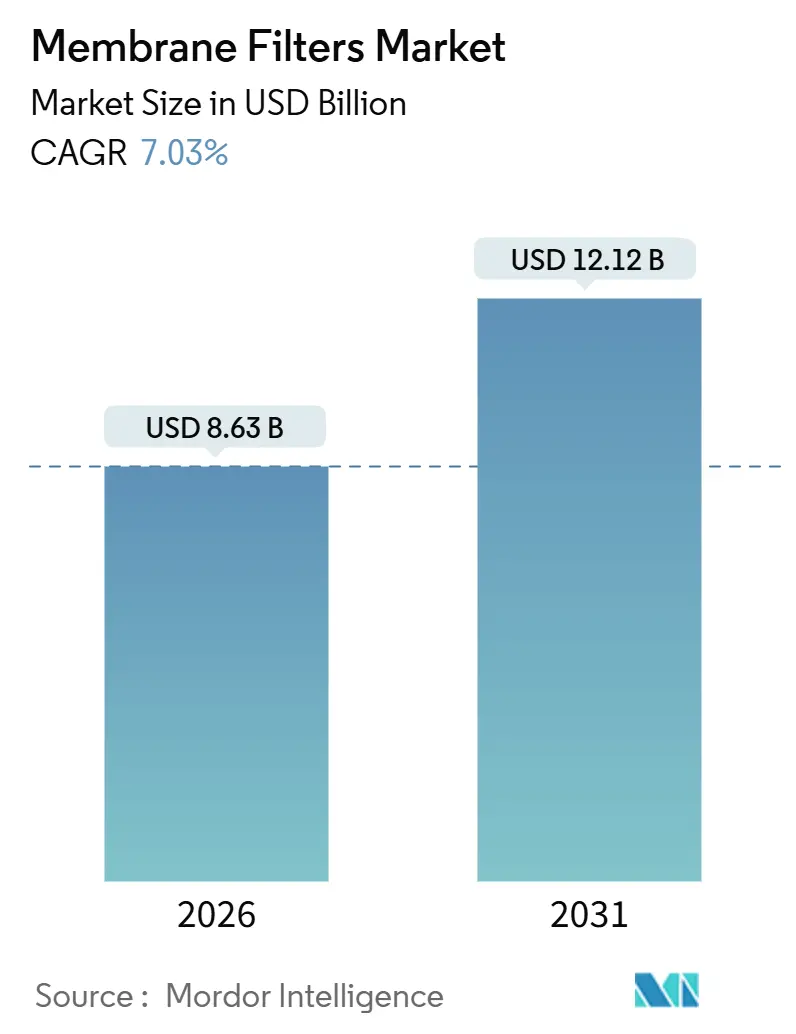
The Membrane Filters Market size is estimated at USD 8.63 billion in 2026, and is expected to reach USD 12.12 billion by 2031, at a CAGR of 7.03% during the forecast period (2026-2031).
Rising investments in municipal and industrial wastewater treatment, single-use biopharma production lines, semiconductor ultrapure-water upgrades, and direct-lithium-extraction plants are expanding the membrane filters market footprint. Tightening discharge regulations for PFAS and nutrients, paired with incentives for high-recovery desalination in the Middle East, are steering end users toward membranes that combine high selectivity with lower energy consumption. Leading suppliers secure long-term contracts by bundling membranes, housings, skid integration, and cloud-based performance monitoring, while start-ups target niches such as direct nanofiltration, ceramic ultrafiltration, and modular single-use assemblies. Asia-Pacific leads current demand and offers the steepest growth curve, followed by North America and the Gulf states where PFAS compliance deadlines and megascale desalination programs anchor order books.
Key Report Takeaways
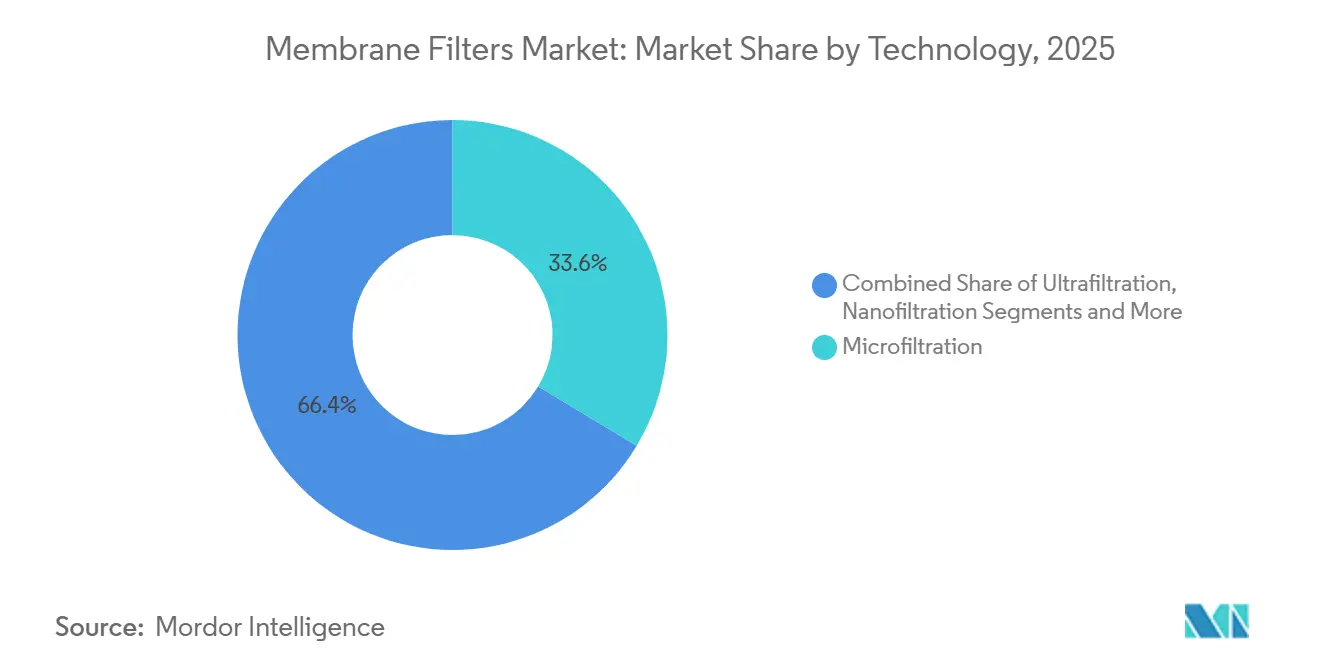
- By technology, microfiltration captured 33.62% of the membrane filters market share in 2025; nanofiltration is projected to expand at a 9.25% CAGR through 2031.
- By material, polyethersulfone accounted for 28.37% of the membrane filters market size in 2025, while ceramic and metallic membranes are advancing at an 8.24% CAGR.
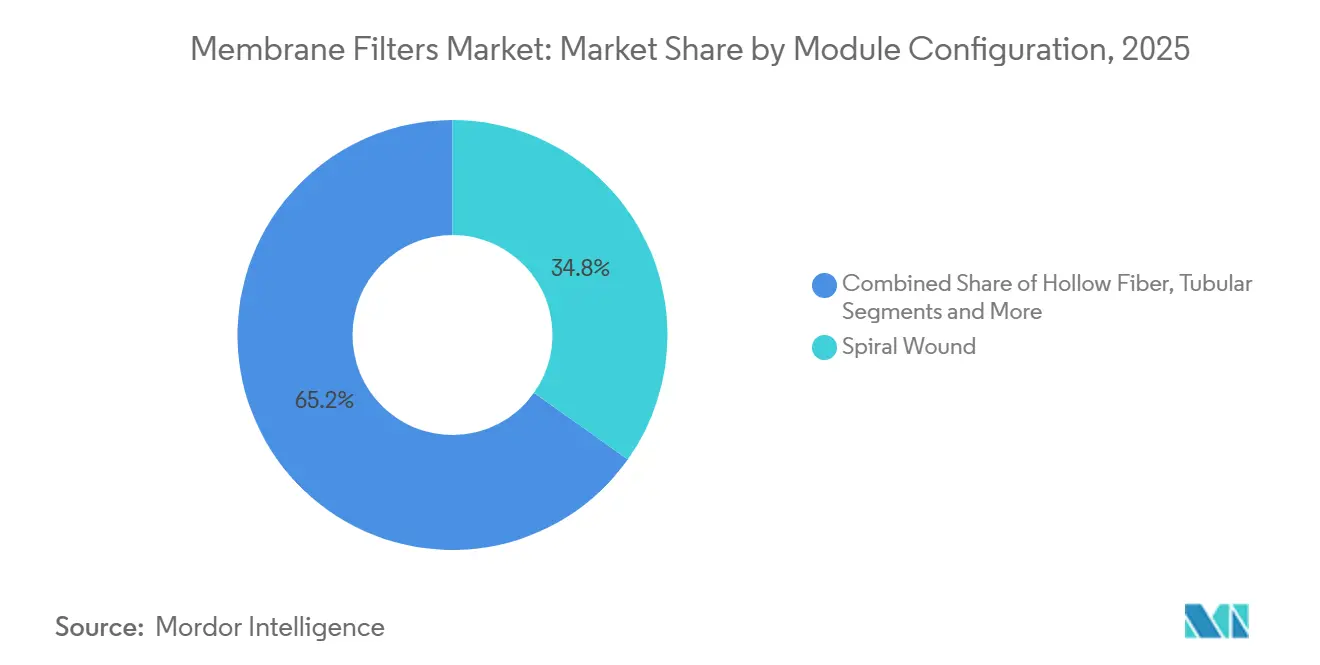
- By module configuration, spiral-wound units held 34.82% share in 2025, and hollow-fiber formats are rising at 7.82% CAGR.
- By application, water and wastewater treatment represented 42.21% revenue in 2025; micro-electronics ultrapure-water systems are forecast to grow at an 8.36% CAGR.
- By geography, Asia-Pacific dominated with 38.14% share in 2025 and is expected to post a 9.01% CAGR through 2031.
Note: Market size and forecast figures in this report are generated using Mordor Intelligence’s proprietary estimation framework, updated with the latest available data and insights as of January 2026.
Market Trends and Insights
Drivers Impact Analysis of Membrane Filters Market*
| Driver | (~) % Impact on CAGR Forecast | Geographic Relevance | Impact Timeline |
|---|---|---|---|
| Strict discharge norms for municipal and industrial wastewater | +1.2% | EU, North America, coastal China | Medium term (2-4 years) |
| Rising biopharma production volumes globally | +1.0% | North America, Europe, China, India, South Korea | Short term (≤2 years) |
| Food-grade filtration mandates in emerging economies | +0.6% | India, Southeast Asia, Latin America | Medium term (2-4 years) |
| CAPEX incentives for desalination projects (MENA) | +0.9% | UAE, Saudi Arabia, Qatar, North Africa | Long term (≥4 years) |
| Rapid uptake of single-use tangential-flow skids | +0.8% | North America, Western Europe, APAC biopharma hubs | Short term (≤2 years) |
| Lithium-extraction by direct-lithiation membranes | +0.5% | U.S., Argentina, Chile | Long term (≥4 years) |
| Source: Mordor Intelligence | |||
Strict Discharge Norms For Municipal & Industrial Wastewater
Regulators worldwide are lowering allowed contaminant thresholds, compelling utilities and factories to retrofit membrane bioreactors and advanced nanofiltration trains. The U.S. Environmental Protection Agency capped PFOA and PFOS at 4 ppt in April 2024, requiring full compliance by 2029.[1]U.S. Environmental Protection Agency, “Final PFAS National Primary Drinking Water Regulation,” EPA, epa.gov Similar moves by India’s Central Pollution Control Board are pushing tier-2 cities toward membrane upgrades. Project owners now budget for concentrate management options such as thermal oxidation or evaporative crystallization, each costing USD 2 million–10 million per site.
Rising Biopharma Production Volumes Globally
Biologic pipelines outstrip small-molecule launches, and virus filtration, buffer exchange, and sterile polishing rely on 0.1–0.2 µm pore-size membranes. FDA’s Q5A(R2) update in January 2024 reaffirmed virus filtration as a validated step, nudging contract manufacturers toward higher-capacity single-use skids.[2]U.S. Food & Drug Administration, “Q5A(R2) Viral Safety Evaluation,” FDA, fda.gov India’s Production Linked Incentive program earmarked INR 15,000 crore (USD 1.8 billion) to expand domestic biologics capacity, widening the addressable membrane filters market.[3]Government of India, “Production Linked Incentive Scheme for Pharmaceuticals,” Government of India, india.gov.in
Food-Grade Filtration Mandates In Emerging Economies
New hygiene standards for dairy and juice exports in Southeast Asia and Latin America require low-bacterial-count processing, accelerating sales of microfiltration and ultrafiltration cartridges certified under NSF/ANSI 61. Local processors previously relying on plate filters now retrofit hollow-fiber modules to meet export audit requirements.
CAPEX Incentives For Desalination Projects (MENA)
GCC governments back multibillion-dollar seawater reverse-osmosis initiatives. Dubai’s USD 920 million Hassyan plant will deliver 180 million IGD by 2027. NEOM is piloting high-recovery RO exceeding 60% to curb brine discharge. Incentives include 25-year offtake agreements, elevating bid volumes for thin-film-composite spiral-wound membranes.
Restraints Impact Analysis of Membrane Filters Market*
| Restraint | (~) % Impact on CAGR Forecast | Geographic Relevance | Impact Timeline |
|---|---|---|---|
| Membrane fouling and cleaning-chemical cost burden | -0.8% | Global, acute in high-solids wastewater and food processing | Short term (≤2 years) |
| Validation delays for GMP upgrades in pharma | -0.5% | North America, Europe, emerging APAC pharma hubs | Medium term (2-4 years) |
| PFAS disposal risk from concentrate streams | -0.6% | North America, Western Europe | Medium term (2-4 years) |
| Supply-chain crunch for high-grade PES resin | -0.4% | Global bottlenecks in specialty-polymer production | Short term (≤2 years) |
| Source: Mordor Intelligence | |||
Membrane Fouling & Cleaning-Chemical Cost Burden
Flux loss of 30–50% within weeks forces weekly or monthly clean-in-place cycles that cost USD 500–2,000 per module. Over a five-year life, cleaning chemicals can equal initial membrane capital. Ceramic ultrafiltration, such as Nanostone’s CM-151, extends cleaning intervals to three months and achieves 95% recovery, yet higher CAPEX slows adoption.
Validation Delays For GMP Upgrades In Pharma
Regulators mandate re-validation when facilities swap bulk filters for single-use variants. Complex documentation cycles can delay commercial runs by six to nine months, temporarily dampening membrane filters market orders.
*Our forecasts treat driver/restraint impacts as directional, not additive. The impact forecasts reflect baseline growth, mix effects, and variable interactions.
Membrane Filters Market Segment Analysis
By Technology:
Nanofiltration’s Climb Toward Higher RecoveriesIn 2025, microfiltration retained 33.62% share of the membrane filters market. Its broad use in municipal clarification, dairy protein fractionation, and biopharma harvest steps anchors demand, with pore sizes from 0.1 to 10 µm ensuring low pressure drops. Nanofiltration has become the fastest-growing slice at 9.25% CAGR as operators seek divalent-ion and micropollutant rejection while passing monovalent salts. The membrane filters market size allocated to nanofiltration is forecast to widen as direct configurations bypass conventional coagulation and media filters. NX Filtration’s hollow-fiber 1–2 nm pores cut chemical dosing by 80% and lower energy needs by 20%. Reverse osmosis remains mission-critical for seawater desalination and semiconductor ultrapure water, yet the entry of high-recovery NF pretreatment trains allows RO stages to run at lower pressures, extending element life.
Nanofiltration’s momentum spills into wastewater reuse, industrial water loops, and PFAS remediation. U.S. utilities bidding on EPA compliance view NF as a cost-competitive alternative to granular activated carbon when paired with advanced oxidation. In brackish-water desalination, NF lifts overall recovery to >85% by shedding hardness before RO. Growth also tracks lithium brine polishing, where NF removes magnesium and sulfate to protect downstream ion-exchange beads. As cost curves fall, nanofiltration may edge into low-pressure RO domains, eroding microfiltration’s share in pretreatment lines.



By Material:
Ceramic Membranes Challenge Polymer MainstaysPolyethersulfone posted 28.37% revenue share in 2025 owing to 180 °C heat tolerance and pH resilience, serving single-use bioprocess cassettes. The membrane filters market size tied to PES benefits from compatibility with gamma sterilization and long shelf life. Ceramic and metallic membranes, advancing at an 8.24% CAGR, threaten polymer dominance in high-solids or high-temperature fluids. Alumina and silicon-carbide grades survive aggressive caustic washes, facilitating >10-year service life in mining and pulp-and-paper loops. LiqTech’s silicon-carbide units reclaim process water in oil-sands operations that push temperatures beyond 80 °C.
Demand for ceramic units is strongest where downtime penalties dwarf upfront CAPEX—semiconductor fabs and offshore desalination rigs count every minute of outage. Still, polymer films such as PVDF and polysulfone remain cost winners in disposable cartridges where replacement intervals fall under one year. Future material splits will hinge on lifecycle costing models rewarding durability and chemical resistance.
By Module Configuration:
Hollow-Fiber Density Cuts FootprintSpiral-wound modules controlled 34.82% of 2025 sales, fueled by automated roll-stock manufacturing and ease of plant retrofits. Hollow-fiber formats, expanding at 7.82% CAGR, deliver packing densities of up to 9,000 m²/m³, lowering space and skid steel by as much as 40%. DuPont’s 19-capillary Multibore PRO fibers, introduced in 2025, squeeze more surface area into single-use housings for gene-therapy lines. The membrane filters market share for hollow-fiber units is expected to climb further in semiconductor cleanrooms where square-foot rents top USD 3,000 per year.
Tubular modules carve out niches in viscous streams like paint recovery, while plate-and-frame designs fade as gasket complexity and manual servicing deter operators. Capsule and cartridge layouts retain relevance in sterile filtration, benefitting from fast integrity testing and low hold-up volumes. Looking ahead, hybrid modules mixing flat-sheet and fiber inserts may surface to optimize pressure drop and back-washability.
By Application:
Ultrapure-Water Demand From Micro-Electronics AcceleratesWater and wastewater treatment represented 42.21% of 2025 revenue, encompassing municipal drinking-water, effluent polishing, and reuse schemes. Yet the micro-electronics segment is on an 8.36% CAGR trajectory, bolstered by silicon-wafer demand for AI data centers and electric vehicles. A single 200 mm wafer consumes up to 7,500 L of ultrapure water, and sub-3 nm nodes require silica below 0.3 ppb. The membrane filters market size dedicated to fabs climbs as chipmakers build plants in Arizona, Dresden, and Hsinchu.
Pharma and biotech remain high-value users owing to GMP validation requirements. Dairy processors, juice bottlers, and breweries add steady volumes but face margin pressure from commodity pricing. Mining and lithium extraction, alongside produced-water treatment in shale plays, emerge as growth pockets for high-durability ceramic stacks.
Geography Analysis
APAC Membrane Filters Market
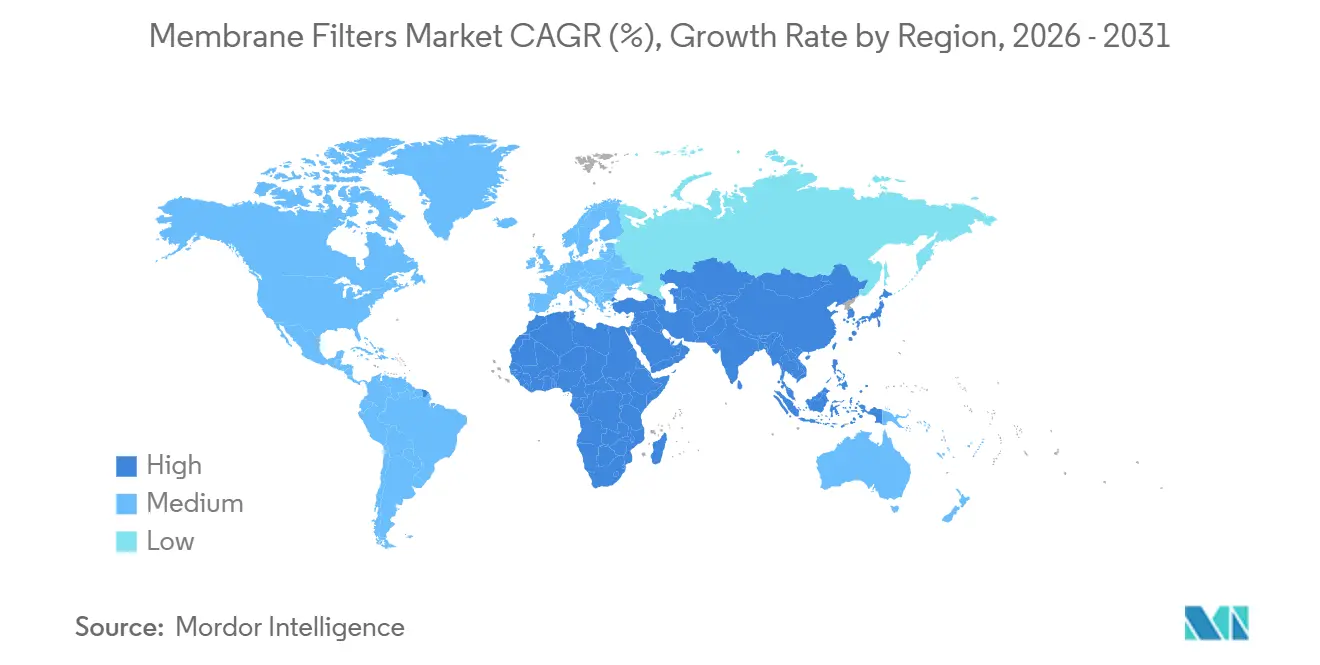
Asia-Pacific held 38.14% of the membrane filters market in 2025 and is poised for a 9.01% CAGR to 2031. China’s domestic-substitution push lifts local ultrafiltration and RO procurement as fabs expand 12-inch capacity at SMIC. India’s INR 15,000 crore incentive scheme spurs sterile cartridge purchases for biologics exports, and South Korea’s advanced nodes chase TOC limits under 1 ppb. Japanese suppliers leverage regional links; Toray opened a Taiwan R&D center in 2025 and delivered an ultrafiltration film that trims CO₂ emissions by 30%.
North America Membrane Filters Market
North America ranks second on the back of EPA PFAS rules, semiconductor reshoring, and early-stage lithium extraction. Intel’s net-positive water drive underpins large multistage RO orders, while ExxonMobil’s Arkansas brine project integrates direct nanofiltration to bypass ponds. Canada modernizes cold-climate membrane bioreactors, and Mexican dairies adopt UF modules to meet export audits.
Europe, Middle East and South America Membrane Filters Market
Europe enforces stringent nutrient and micropollutant caps under the Urban Wastewater Treatment Directive, fueling MBR retrofits. Germany and France anchor biotech demand, and Spain expands desalination for coastal cities. Scandinavia pilots ceramic membranes for pulp-and-paper process water. The Middle East rides mega-desalination: Dubai’s Hassyan and NEOM’s pilot hinge on 99.5% salt-rejection thin-film composites. South America’s lithium triangle adopts membrane routes to cut evaporation.

Regulatory Landscape
Regulation affecting membrane filters spans environmental discharge and drinking-water compliance for municipal and industrial treatment, along with quality-system and biocompatibility expectations for medical and bioprocess filtration. In the United States, the Environmental Protection Agency finalized National Primary Drinking Water Regulation limits for PFOA and PFOS at 4 ppt in April 2024, with compliance timelines extending to 2029. That has been pushing utilities toward nanofiltration and reverse osmosis trains alongside concentrate-management plans.
For medical and life-science filtration products, requirements increasingly converge on quality and safety frameworks used in regulated device approvals. The US FDA Quality Management System Regulation (QMSR) became effective on February 2, 2026, aligning device quality-system expectations with ISO 13485 principles, while the European Commission updated the list of harmonised standards under the EU MDR and IVDR through Commission Implementing Decisions published on June 17, 2026, including the addition of EN ISO 10993-1:2025 for biological evaluation. In parallel, membrane-based therapeutic device components continue moving through formal standardization, including plasmafilters for therapeutic plasmapheresis under ISO/FDIS 8637-3 at the formal approval stage in June 2026.
Value Chain Analysis
The membrane filters value chain starts with upstream suppliers of specialty polymers (such as PES and PVDF), ceramic and metal feedstocks, and high-purity solvents and additives. These inputs feed membrane-media manufacturing (including casting or phase inversion, track-etching, and sintering for ceramics) and then conversion into formats such as spiral-wound elements, hollow-fiber bundles, and capsule or cartridge assemblies. Midstream players provide module housings, potting materials, and skid integration, including pumps, controls, and integrity-test interfaces.
Downstream channels split between direct sales to large end users, including municipal utilities, biopharma, and semiconductor fabs, and specialty life-science distributors that maintain local inventory and provide application support. Qualification and compliance requirements shape lead times and supplier switching behavior, particularly for pharmaceutical, biotechnology, and dialysis-related uses where documentation and validation can extend procurement cycles. The chain is sensitive to bottlenecks in high-performance membrane casting capacity and the availability of high-grade resin inputs, reflecting the market restraint around specialty polymer supply tightness, and it is further constrained by longer qualification timelines for custom formats such as hollow-fiber modules. To support longer-term supply, leading vendors increasingly bundle membrane media with module assembly, validation support, and service capabilities that reduce end-user downtime and simplify regulatory documentation.
Competitive Landscape
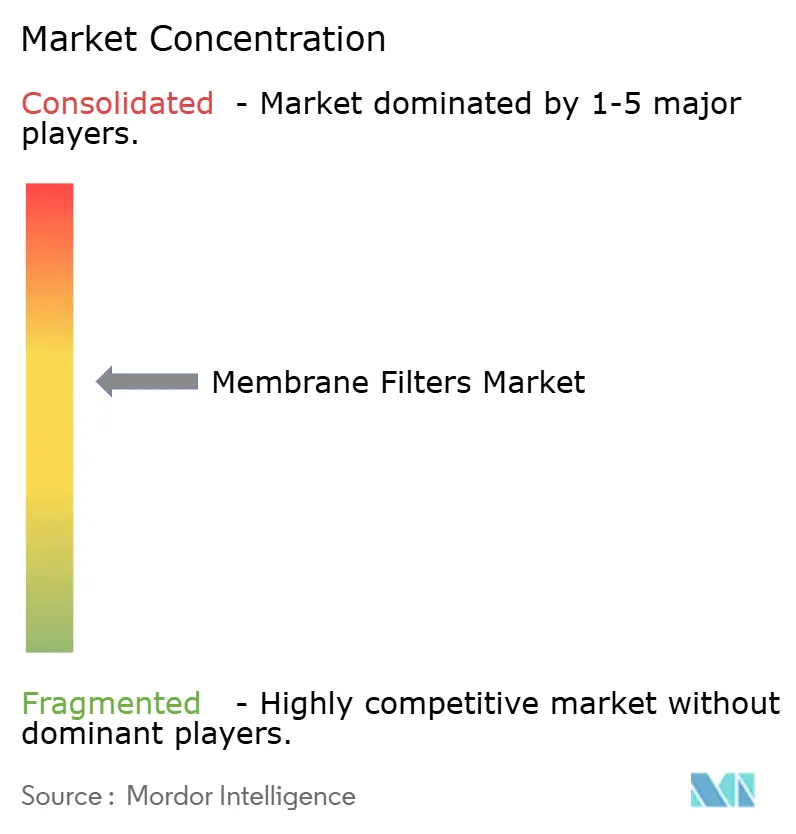
The top suppliers include DuPont, Danaher, Merck KGaA, and others, giving the membrane filters market a medium concentration. Incumbents pair vertical integration with R&D pipelines: Toray’s 2024 RO element doubled urea rejection for chip fabs, and DuPont’s Multibore PRO raised packing density in 2025. Thermo Fisher’s USD 4.1 billion takeover of Solventum’s filtration unit in February 2025 shows ongoing consolidation.
Disruptors mine white space. NX Filtration promotes direct nanofiltration that skips pre-clarification, while Nanostone’s CM-151 ceramic modules prolong cleaning cycles. Repligen scales single-use TFF skids for gene therapy. Partnerships with semiconductor toolmakers emerge as suppliers tailor filter cuts to sub-3 nm lithography steps.
Competition intensifies in biopharma disposables where switching costs are low and validation support is king. Municipal tenders favor vendors with NSF and ISO certifications plus local service crews. Growth opportunities center on ceramic stacks for harsh effluents, hollow-fiber compacts for space-limited fabs, and PFAS-capable NF membranes.
Membrane Filters Industry Leaders
Thermo Fisher Scientific
Merck KGaA
Danaher Corporation
Solventum
DuPont
- *Disclaimer: Major Players sorted in no particular order
Membrane Filters Market Companies Covered in this Report
- Advanced Microfiltration Systems (AMS)
- Alfa Laval AB
- Asahi Kasei
- CITIC Envirotech Ltd.
- Danaher
- DuPont
- GEA Group
- LiqTech International
- Koch Separation Solutions
- Membranium (RM Nanotech)
- Merck KGaA (MilliporeSigma)
- Nanostone Water
- NX Filtration
- Parker Hannifin
- Pentair plc
- Porvair plc
- Synder Filtration
- ThermoFisher Scientific Inc
- Toray Industries, Inc.

Market Opportunities and Future Outlook
Opportunities concentrate where compliance and process intensification create performance thresholds that favor advanced membranes over conventional filtration. In biopharma sterilizing filtration, validation practices anchored in standardized microbial-challenge expectations, including Brevundimonas diminuta retention at high challenge levels, and guidance-aligned documentation increase demand for suppliers that can provide complete validation packages, integrity-test compatibility, and single-use assemblies for flexible manufacturing. This demand intersects with modality growth in viral vectors and nucleic-acid delivery workflows, which tend to favor more selective, higher-permeability, isoporous structures and membrane chromatography formats, creating whitespace for vendors that can co-develop application-specific cutoffs and reduce fouling sensitivity.
In water, wastewater, and reuse, tightening PFAS and nutrient limits, exemplified by the US EPA final PFOA/PFOS 4 ppt rule in April 2024 and utility planning for the 2029 compliance window, supports projects combining nanofiltration or RO with concentrate-management solutions. Large desalination programs in the Gulf, including Dubai’s Hassyan seawater RO project (USD 920 million; targeted 180 million IGD by 2027) and NEOM’s high-recovery RO pilots exceeding 60% recovery, are driving demand for thin-film-composite spiral-wound membranes and pretreatment configurations that improve recovery while controlling brine discharge. On the manufacturing side, investments in filter capacity and lower-carbon production, such as Merck KGaA’s EUR 150 million climate-neutral filter manufacturing facility in Cork, Ireland (opened September 2025), signal continued customer focus on supply assurance and documented sustainability, which can differentiate suppliers in long-term tenders and framework agreements.
Recent Industry Developments in Membrane Filters Market
- June 2026: The European Commission published updates to the EU MDR and IVDR harmonised standards list through Commission Implementing Decisions, including the addition of EN ISO 10993-1:2025 for biological evaluation. This raises the bar for documented biocompatibility and risk-managed material assessment for membrane-based medical devices and filtration components used in regulated healthcare settings.
- September 2025: Merck KGaA opened a EUR 150 million, climate-neutral filter manufacturing facility in Blarney Business Park, Cork, Ireland. The added capacity and sustainability positioning support supply assurance for high-spec membrane and filtration demand in bioprocessing and other regulated applications.
- September 2025: Thermo Fisher Scientific completed its approximately USD 4.1 billion acquisition of Solventum’s purification and filtration business. The deal expanded Thermo Fisher’s filtration portfolio and integration capabilities, strengthening its ability to offer bundled single-use and filtration solutions across life-science and industrial end markets.


Membrane Filters Market Report Scope and Research Methodology
Market Definition and Coverage
This market covers revenues earned from membrane filters and membrane modules used to separate, purify, or concentrate fluids by pore size or selective barriers across major industrial and life science uses. We treat the market as a global value pool measured in USD for a defined year.
Scope exclusions: We exclude non-membrane depth media and consumables that do not perform filtration through a membrane barrier, and we also exclude downstream services unless they are bundled with the membrane product sale.
Segments Covered in This Report
- By Technology
- Microfiltration
- Ultrafiltration
- Nanofiltration
- Reverse Osmosis
- Membrane Chromatography
- Forward Osmosis
- Dialysis / Hemofiltration Membranes
- Others
- By Material
- Polyethersulfone (PES)
- Polysulfone (PS)
- Cellulose-based
- Polyvinylidene Fluoride (PVDF)
- Polytetrafluoroethylene (PTFE)
- Polyacrylonitrile (PAN)
- Polypropylene (PP)
- Ceramic & Metallic
- Others
- By Module Configuration
- Spiral Wound
- Hollow Fiber
- Tubular
- Plate & Frame
- Capsule / Cartridge
- By Application
- Water & Wastewater Treatment
- Food & Beverage Processing
- Pharmaceutical & Biotechnology
- Chemical & Petrochemical
- Micro-electronics
- Mining & Metallurgy
- Others
- By Geography
- North America
- United States
- Canada
- Mexico
- Europe
- Germany
- France
- United Kingdom
- Italy
- Spain
- Rest of Europe
- Asia-Pacific
- China
- Japan
- India
- South Korea
- Australia
- Rest of Asia-Pacific
- Middle East & Africa
- GCC
- South Africa
- Rest of Middle East & Africa
- South America
- Brazil
- Argentina
- Rest of South America
- North America
Data Sources, Market Sizing, and Validation
Desk Research
Desk research started with building the demand map around water and wastewater treatment, industrial separation, and regulated filtration uses, and then linking it back to membrane technologies and module formats. For this, we relied on public sources such as US EPA water program publications, USGS water-use and industrial data, World Bank water and sanitation indicators, UN Comtrade trade statistics for relevant membrane and filtration product codes, and peer-reviewed journals that report adoption and performance benchmarks.
On the supply side, we reviewed company annual reports, investor presentations, and product catalogs to understand where revenue is booked and how membrane types are positioned across applications. We also used paid database subscriptions for company financials and intelligence, plus patent databases to spot material shifts and configuration focus over time. These named examples are illustrative only, and many other public sources were reviewed for data collection, cross-checks, and clarification.
Primary Interviews and Surveys
Primary work focused on interviews and structured surveys with manufacturers, distributors, system integrators, and large end users across water treatment, food and beverage, chemicals, and pharma and biotech. Inputs were used to confirm what gets counted as membrane filter revenue, validate typical pricing moves by membrane type, and pressure-test regional demand signals across APAC, EMEA, and the Americas.
Distribution of primary research fieldwork respondents
| Company type | Respondent position | Region |
|---|---|---|
| Top tier: 34% | CXOs: 18% | APAC: 51% |
| Mid tier: 47% | Functional/Unit leaders: 40% | EMEA: 31% |
| Smaller Players: 19% | Managers: 42% | Americas: 18% |
Market-Sizing & Forecasting
Sizing was built using top-down and bottom-up logic, where macro and industry activity levels first define the addressable filtration demand pool and then results are checked using selective supplier and channel approximations. In practice, we reconstructed demand using application signals like municipal water and wastewater investment cycles, industrial water reuse activity, and regulated filtration intensity in pharma and biotech, and then translated that into membrane adoption by technology.
To keep the model tied to real buying behavior, we tracked and updated a few core inputs: installed base additions in water treatment projects, replacement cycles for membrane modules, mix shifts across microfiltration, ultrafiltration, nanofiltration, and reverse osmosis, and typical ASP ranges by material and configuration (spiral wound, hollow fiber, flat sheet, and others). Where bottom-up line items were incomplete, gaps were handled through bounded assumptions anchored to trade flows, capacity additions, and interview-based penetration ranges, and then revisited during analyst review.
Forecasting relied mainly on scenario analysis supported by short series trend smoothing, because demand can move with policy spending, industrial output, and energy and chemical cost changes. Assumptions on volume growth and ASP movement were taken from expert consensus first, and then stress-tested against public indicators so the final curve does not depend on a single variable.
Data Validation & Update Cycle
Validation was done through multiple checks that compare the model outputs with independent signals, such as regional water infrastructure spending direction, trade and shipment trends for membrane-related categories, and the implied replacement demand derived from installed base logic. When outliers appeared, we revisited the driver inputs, rechecked conversion factors, and, in some cases, re-contacted industry participants to clarify whether a shift was real or a definition mismatch.
Before sign-off, the numbers go through step-wise analyst reviews so assumptions are traceable and variances are explained in plain terms. Reports are refreshed annually, and interim updates are made when material events occur that can change pricing, capacity, or demand, followed by a final pre-delivery pass so clients receive the latest updated view.
Mordor Intelligence's Membrane Filters Market Sizing Compared With Other Published Estimates
Published market sizes for membrane filters can look far apart even when the topic sounds the same, because the update timing, currency conversion month, and what is treated as a membrane product versus a broader filtration market can quietly shift the totals. We also see differences when one estimate leans more on long-cycle infrastructure assumptions, while another uses shorter replacement and consumables logic.
In our refresh-led checks, the pricing layer matters, since polymer material moves and mix changes across RO, NF, UF, and MF can change the average selling price even if volumes rise steadily. When exchange rates are locked at different points in the year, or when regional weights are updated at different times, the spread becomes larger. In that context, the latest annual refresh and the same-year currency timing applied by Mordor Intelligence help keep the value aligned to the current demand and ASP reality for membrane modules.
Benchmark comparison
| Source | Market Size | Gaps in Research Methodology |
|---|---|---|
| Mordor Intelligence | USD 8.63 B (2026) | |
| Industry Publisher A | USD 7.53 B (2024) | Uses an earlier base year and can blend membrane filters with broader membrane filtration spending, which can change what is counted as product revenue and how pricing is carried into the forecast years. |
| Global Market Tracker B | USD 5.31 B (2024) | Revenue sizing appears more tightly tied to membrane filter sales definitions and may understate value by leaning on volume-led reporting and a slower ASP progression, with fewer visible validation checks against application demand pools. |
The comparison shows that year selection and refresh cadence are not minor details in this market, since currency timing and ASP updates can materially move the headline value. By anchoring the size to clear application demand signals and then rechecking pricing and mix assumptions during reviews, we end up with a number that is easier to reconcile and repeat when market conditions shift.


Key Questions Answered in the Report
What is the forecast value of the membrane filters market by 2031?
The membrane filters market is projected to reach USD 12.12 billion by 2031.
Which technology is expected to grow fastest through 2031?
Nanofiltration is forecast to expand at a 9.25% CAGR as operators chase higher recoveries and micropollutant removal.
Why is Asia-Pacific the largest regional buyer?
The region combines rapid semiconductor fab construction, expanding biopharma exports, and aggressive municipal wastewater upgrades, yielding a 38.14% share in 2025.
How are PFAS rules influencing membrane demand in North America?
The EPA’s 4 ppt limit for PFOA and PFOS compels utilities to add nanofiltration or RO units before the 2029 deadline.
What materials are disrupting traditional polymer membranes?
Alumina, silicon-carbide, and other ceramic membranes are gaining traction where foulant loads or high temperatures shorten polymer life cycles.
Page last updated on:





