
Melatonin Market Size and Share
Market Overview
| Study Period | 2020 - 2031 |
|---|---|
| Market Size (2026) | USD 2.07 Billion |
| Market Size (2031) | USD 3.22 Billion |
| Growth Rate (2026 - 2031) | 9.28 % |
| Fastest Growing Market | Asia Pacific |
| Largest Market | North America |
| Market Concentration | Low |
Major Players *Disclaimer: Major Players sorted in no particular order Image © Mordor Intelligence. Reuse requires attribution under CC BY 4.0. | |
Melatonin Market Analysis by Mordor Intelligence
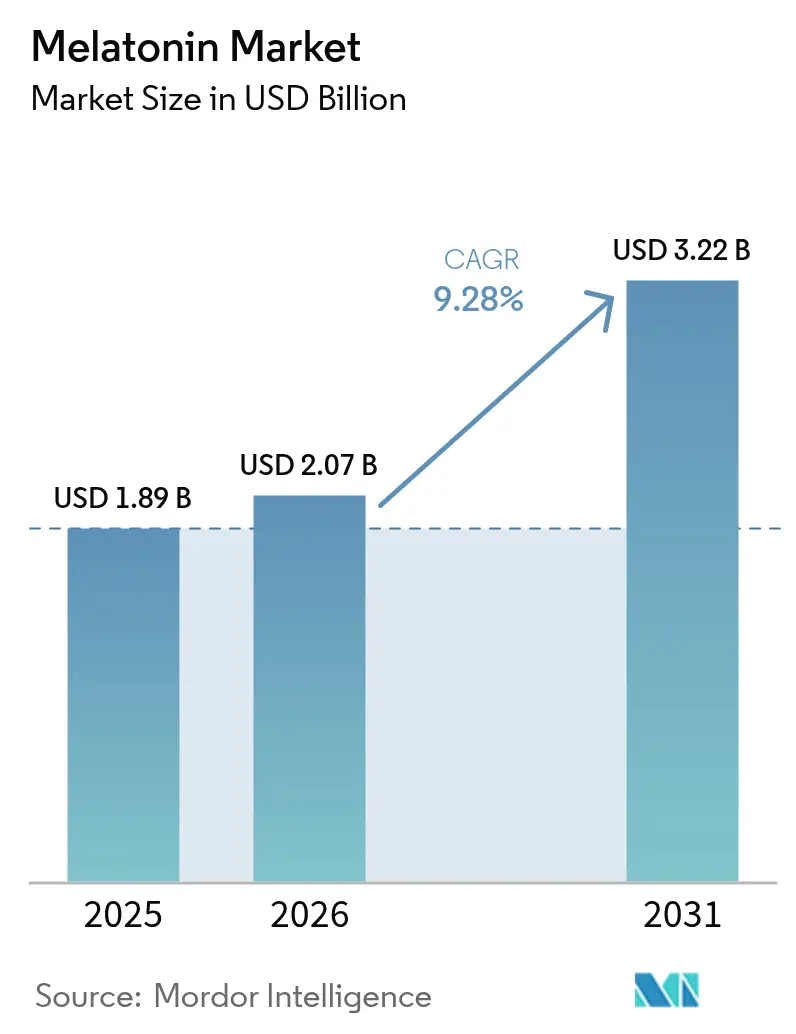
The Melatonin Market size was valued at USD 1.89 billion in 2025 and estimated to grow from USD 2.07 billion in 2026 to reach USD 3.22 billion by 2031, at a CAGR of 9.28% during the forecast period (2026-2031). The expansion is propelled by prescription growth for circadian-rhythm disorders, synthetic-biology cost breakthroughs that lower manufacturing expenses, and regulatory liberalization in high-growth regions. Synthetic melatonin’s 55.67% 2024 share anchors cost efficiency, while gummies outpace tablets on the back of consumer demand for palatable dosing formats. Prescription-only pediatric protocols, orphan-drug designations, and specialized extended-release delivery systems elevate medical uptake. Meanwhile, agricultural post-harvest applications open non-traditional demand channels that diversify revenue streams within the melatonin market.
Key Report Takeaways
- By type, Synthetic melatonin led with 55.02% melatonin market share in 2025 and is forecast to expand at a 9.96% CAGR through 2031.
- By dosage form, Tablets retained 45.10% revenue share in 2025, while gummies recorded the fastest 9.74% CAGR through 2031.
- By formulation, Immediate-release products accounted for 63.30% of the melatonin market size in 2025; extended-release solutions are projected to rise at 10.32% CAGR to 2031.
- By application, Dietary supplements captured 42.60% of the melatonin market size in 2025; medical applications post the highest 11.88% CAGR through 2031.
- By geography, North America commanded 38.20% of the melatonin market share in 2025, whereas Asia-Pacific is poised for a 9.88% CAGR through 2031.
Note: Market size and forecast figures in this report are generated using Mordor Intelligence’s proprietary estimation framework, updated with the latest available data and insights as of 2026.
Market Trends and Insights
Drivers Impact Analysis of Melatonin Market*
| Drivers | (~) % Impact on CAGR Forecast | Geographic Relevance | Impact Timeline |
|---|---|---|---|
| Prescription uptake for circadian-rhythm disorders | 2.8% | Global, with concentration in North America and EU | Medium term (2-4 years) |
| Pediatric Atrial Septal Defect (ASD) sleep-management protocols | 1.9% | North America, EU, expanding to APAC | Long term (≥ 4 years) |
| Demand for "clean-label" plant-derived melatonin | 1.5% | North America and EU primarily | Short term (≤ 2 years) |
| Synthetic-biology cost breakthroughs | 2.1% | Global manufacturing hubs | Medium term (2-4 years) |
| Agricultural post-harvest anti-bruising use cases | 0.9% | Global agricultural regions | Long term (≥ 4 years) |
| Source: Mordor Intelligence | |||
Prescription Uptake for Circadian-Rhythm Disorders
Accelerating prescription volumes validate melatonin’s transition from over-the-counter supplement to reimbursable pharmaceutical solution. Pediatric prescriptions in the United Kingdom rose 245% over nine years, mirroring FDA orphan-drug designations for non-24-hour sleep-wake disorder that expand insurance coverage pathways. European guidance now names melatonin first-line therapy for childhood sleep-onset insomnia, and products such as tasimelteon highlight pipelines targeting blind patients and shift-work populations.
Pediatric ASD Sleep-Management Protocols
Randomized trials consistently show that melatonin shortens sleep-onset latency and raises total sleep time in autism spectrum disorder cohorts with minimal adverse reactions. The prolonged-release product Slenyto earned EU approval for children with ASD, while Stanford clinical guidelines recommend 3-10 mg dosages before bedtime. This therapeutic confidence accelerates adoption across pediatric neurology practices, reinforcing long-term medical demand across the melatonin market.
Demand for “Clean-Label” Plant-Derived Melatonin
Consumers scrutinize supplement labels, spurring interest in phytomelatonin extracted from cherry, rice, and other botanical sources. Laboratory tests found 11 of 13 commercial products carried 5-68% less melatonin than indicated, motivating premium payments for traceable plant-based alternatives. Agricultural-biotech firms are engineering high-melatonin crops, while brands leverage “clean-label” credentials to differentiate in the crowded melatonin market.
Synthetic-Biology Cost Breakthroughs
Engineered Escherichia coli strains now synthesize 1.13 mg/L melatonin from L-tryptophan, lowering costs by up to 30% against chemical routes. Fermentation optimization—glucose control, nitrogen management, and pH at 6.5-7.2 pushes yields further. These efficiencies reinforce synthetic melatonin’s dominance and underpin forecast margin stability through 2030.
Restraints Impact Analysis of Melatonin Market*
| Restraints | (~) % Impact on CAGR Forecast | Geographic Relevance | Impact Timeline |
|---|---|---|---|
| Tightening maximum-dosage regulations | -1.8% | EU, expanding to North America | Short term (≤ 2 years) |
| Clinical safety concerns in long-term use | -1.2% | Global, particularly pediatric markets | Medium term (2-4 years) |
| Raw-material price spikes for indole feedstocks | -0.7% | Global manufacturing hubs, Asia-Pacific core | Short term (≤ 2 years) |
| Source: Mordor Intelligence | |||
Tightening Maximum-Dosage Regulations
The Council for Responsible Nutrition now requires child-deterrent packaging after pediatric emergency-room visits tied to melatonin rose 420% from 2009 to 2020[1]. France’s ANSES caps daily dosage at 2 mg and advises high-risk groups to avoid supplements, while an emerging EU framework seeks harmonized labeling. These measures increase compliance costs and may slow new-product timelines, especially for gummy formats favored by children.
Clinical Safety Concerns in Long-Term Use
WHO VigiBase lists 35,479 adverse-event reports, with 21 potential safety signals including tic onset and growth retardation that warrant further study. Pediatric sleep specialists call for expanded sleep-hygiene programs before prescribing and push regulators to standardize long-term monitoring. Precautionary sentiment could temper high-dose formulation roll-outs and dampen growth in sensitive sub-populations.
*Our forecasts treat driver/restraint impacts as directional, not additive. The impact forecasts reflect baseline growth, mix effects, and variable interactions.
Melatonin Market Segment Analysis
By Type:
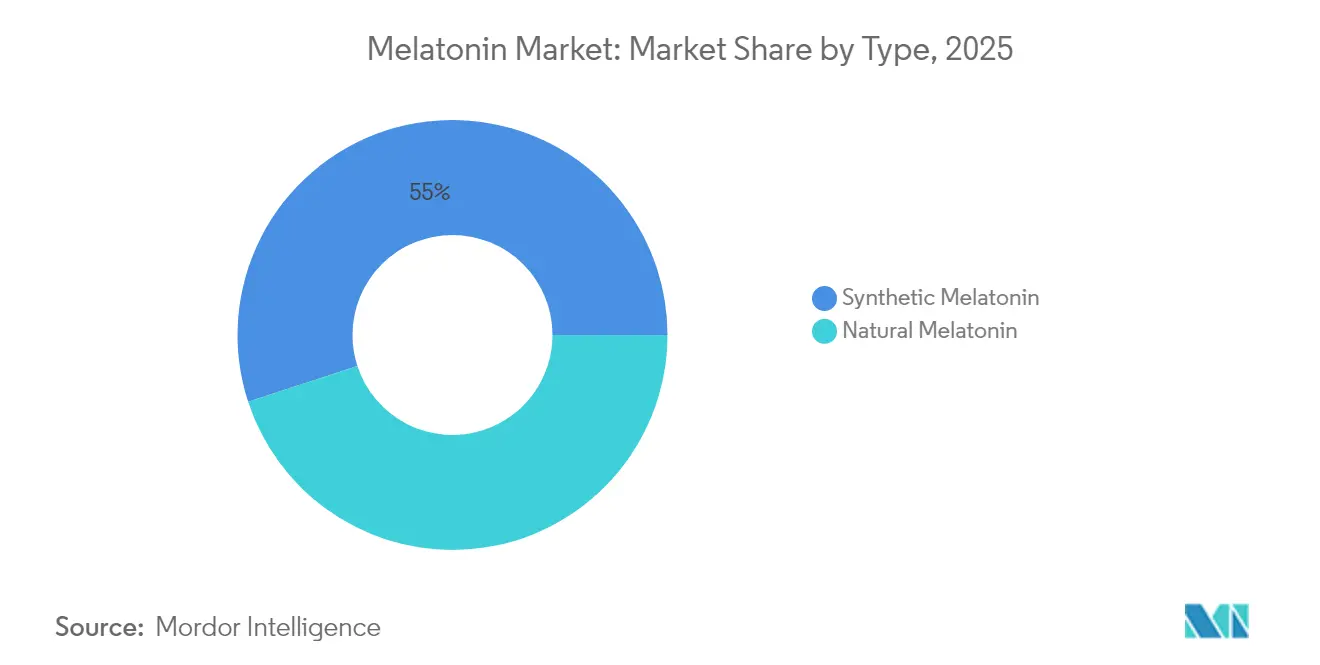
Synthetic Dominance Drives Cost EfficiencySynthetic melatonin accounted for a 55.02% melatonin market share in 2025 as pharmaceutical buyers prioritize batch-to-batch consistency and price advantages. Synthetic-biology gains, such as E. coli fermentation that halves manufacturing costs, support a 9.96% CAGR outlook, maintaining scale economies integral to the melatonin market. Natural melatonin, although pricier, appeals to consumers pursuing “clean-label” positioning and may see upside as agricultural biotechnology improves crop yields.
The melatonin industry continues investing in precision fermentation lines that limit solvent use and shrink carbon footprints. Regulatory bodies, keen on sustainability metrics, increasingly view microbial methods favorably. Meanwhile, phytomelatonin supply chains experiment with enzyme-assisted extraction to lift purity, yet still struggle to match synthetic volumes.

By Dosage Form:
Gummies Disrupt Traditional TabletsTablets delivered 45.10% of 2025 revenue as clinicians prefer fixed-dose accuracy and established pharmacopoeia standards. Gummies, however, grow 9.74% annually, propelled by flavor, chewability, and rising pediatric demand. The melatonin market size for gummies is on track to double by 2030, though new child-proof mandates elevate packaging expenses.
Liquid drops and capsules meet niche needs such as titratable pediatric dosing and vegetarian shell preferences. Extended-release tablets, featuring dual-layer designs, mitigate melatonin’s short half-life to enhance sleep maintenance and could shift share away from immediate-release presentations.
By Formulation:
Extended-Release Innovation AcceleratesImmediate-release products held 63.30% melatonin market size in 2025 yet extended-release lines chart 10.32% CAGR as pharmacokinetic enhancements gain prescriber confidence. Bilayer tablets achieve 7-hour plasma coverage with a peak at 3 hours; clinical data show improved sleep maintenance relative to quick-release counterparts.
Nanocarriers and ocular gels surface in research and development pipelines, seeking higher bioavailability for neuroprotective indications. Cost remains a hurdle, but price premiums are offset by reduced dosing frequency and better compliance. As patents on delivery technology accumulate, innovators can shield margins while broadening therapeutic scope inside the melatonin market.
By Application:
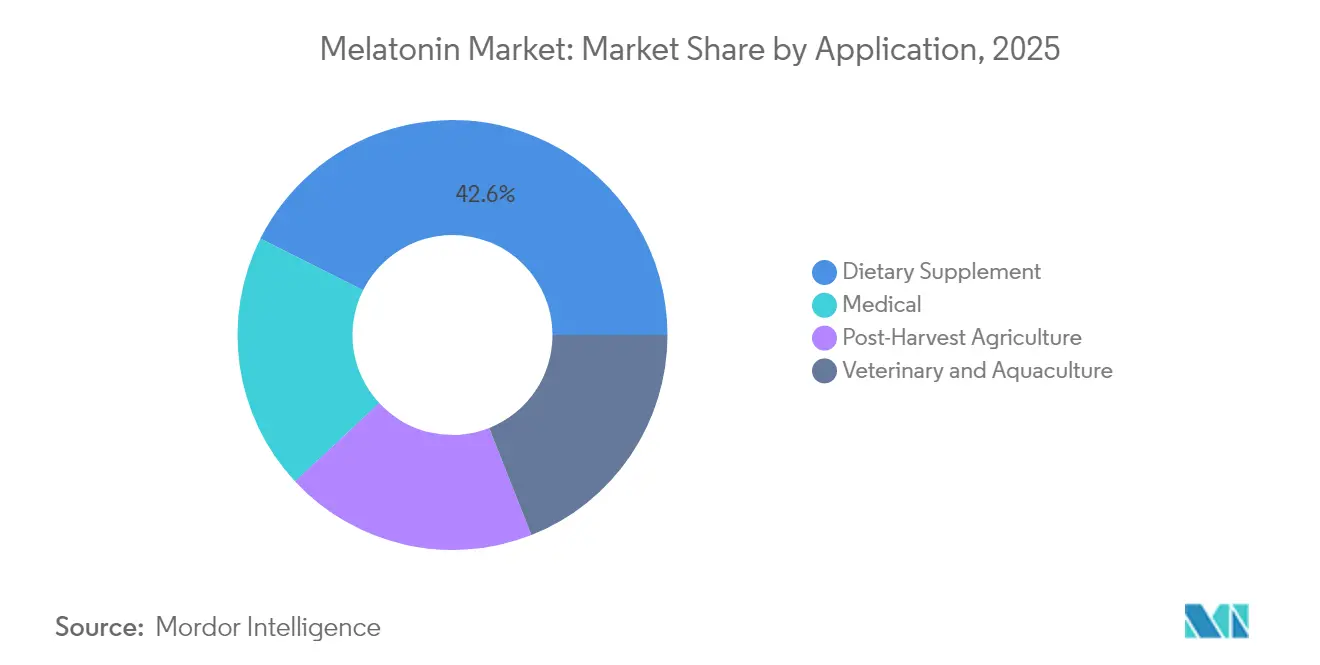
Medical Segment Outpaces SupplementsDietary supplements commanded 42.60% of melatonin market size in 2025, sustained by easy retail access and wellness trends. Yet medical prescriptions grow at 11.88% yearly, underpinned by FDA orphan-drug incentives and ASD-focused formulations that outperform sedatives on efficacy and safety.
Veterinary reproductive aids and aquaculture stress reducers gain traction, while post-harvest crop protection introduces melatonin into ag-input portfolios. Supplement makers confront potency deviations and stricter testing, nudging a segment shift toward clinically validated, higher-margin pharmaceutical channels.
Geography Analysis
North America Melatonin Market
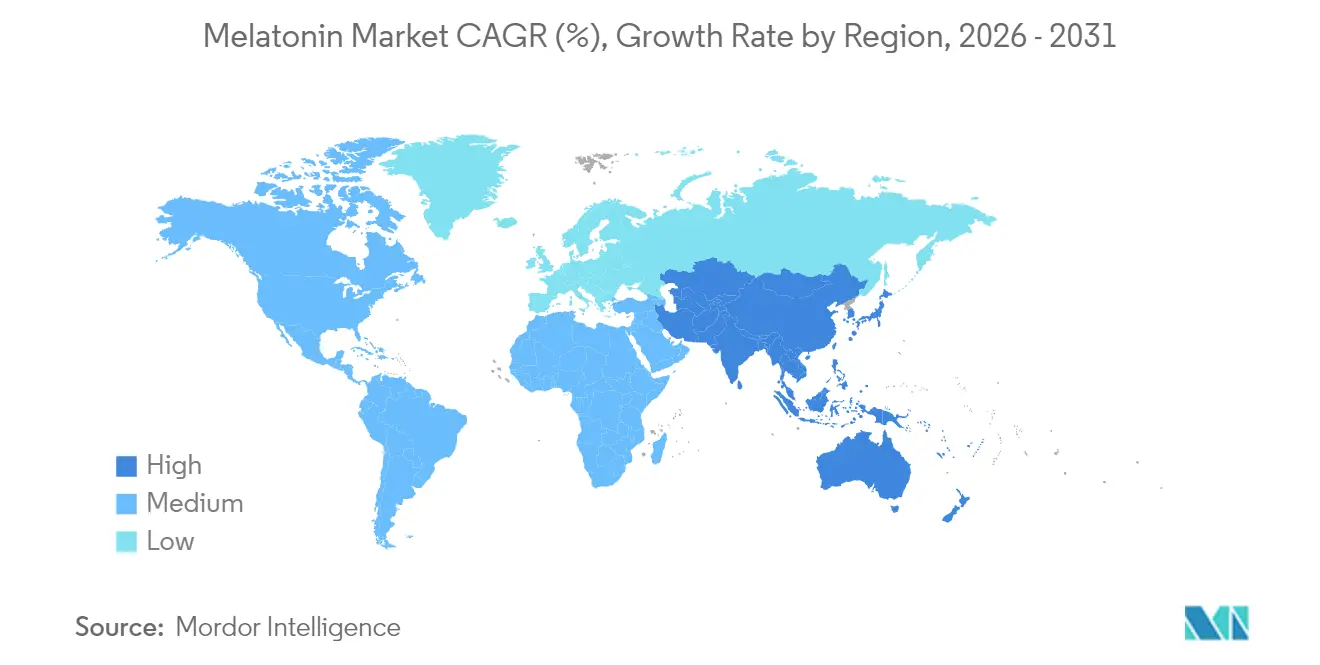
North America retained a 38.20% melatonin market share in 2025, thanks to mature retail infrastructure and payer acceptance of prescription formulations. Rising pediatric prescribing and OTC uptake sustain steady revenue, though new CRN labeling rules raise cost overhead. Extended-release innovations and ASD protocols are key catalysts that help offset compliance spend.
APAC Melatonin Market
Asia-Pacific is the fastest-growing territory, posting a 9.88% CAGR. China’s revised health-food code now fast-tracks melatonin claims for sleep support, spurring domestic brand launches and cross-border e-commerce. Japan links higher dietary melatonin intake to lower liver cancer risk, feeding functional-food product pipelines. Regulatory openness plus middle-class wellness spending positions the region as the next volume driver within the melatonin market.
Europe and Oceania Melatonin Market
Europe presents a mixed picture: Germany and Austria welcomed pediatric ADHD formulation Mellozzan, while France’s ANSES remains cautious, capping dosage and advising susceptible groups to abstain. New Zealand’s 2025 OTC decision, allowing up to 5 mg pharmacy sales, signals gradual liberalization in other OECD states.
Regulatory Landscape
Melatonin regulation remains fragmented across major markets, shaping product strategy by application and age group. In the United States, melatonin is sold as a dietary supplement under DSHEA, and manufacturers must comply with dietary supplement cGMP requirements (21 CFR Part 111). This has kept OTC innovation active even as industry self-regulation tightens (including CRN child-safety and labeling guidance referenced in the report context). In Canada, Health Canada signaled a move toward clinical oversight for minors, with a June 2026 intent to amend the Prescription Drug List so melatonin products for pediatric sleep-related use (under 18 years) are classified as prescription drugs.
Across Europe and other OECD markets, authorization pathways and dose limits differ by country and product type, leading companies to run parallel supplement and Rx-grade strategies. Ireland’s HPRA granted marketing authorization in September 2024 for Pinewood Laboratories Ltd, for Melnite 2 mg prolonged-release tablets indicated for short-term primary insomnia in patients over 55, reinforcing the prescription-grade route for defined uses. Quality and testing requirements are also tightening through standards: British Pharmacopoeia 2025 updates quality expectations for melatonin capsules (including dissolution and content uniformity), while China issued GB/T 45443-2025 to standardize HPLC determination of melatonin in health-food formats. Together, these developments raise the bar for analytical control in both domestic and export-oriented supply chains.
Value Chain Analysis
The melatonin value chain begins with feedstocks and intermediates, notably L-tryptophan for many routes, and then moves into API production via chemical synthesis or emerging bio-based fermentation. Finished dosage forms follow, and distribution splits across supplement and pharmaceutical channels. Chemical synthesis still drives most industrial volume, while engineered microbial platforms, including E. coli strains using L-tryptophan and glucose, increasingly act as a cost and impurity-control lever. This aligns with the report’s emphasis on synthetic-biology cost breakthroughs. A smaller, premium stream involves phytomelatonin sourced from plant materials, which still requires substantial processing and purification to sustain consistent therapeutic concentrations.
Analytical testing and quality compliance are key nodes because potency variation and impurity control can determine market access and brand trust. USP monographs and related compendial expectations anchor assay and impurity testing, including RPLC on C18 columns, and method modernization reported in 2024, such as faster columns aligned with USP General Chapter 621 approaches, supports higher-throughput QC with lower solvent burden. Downstream, supplement brands and contract manufacturers handle labeling and packaging, including child-deterrent formats referenced in the report context, as well as retailer and e-commerce requirements. Prescription products, by contrast, rely on regulatory dossiers, pharmacovigilance, and payer or formulary processes that tend to favor prolonged-release formats and clinically validated pediatric protocols.
Competitive Landscape
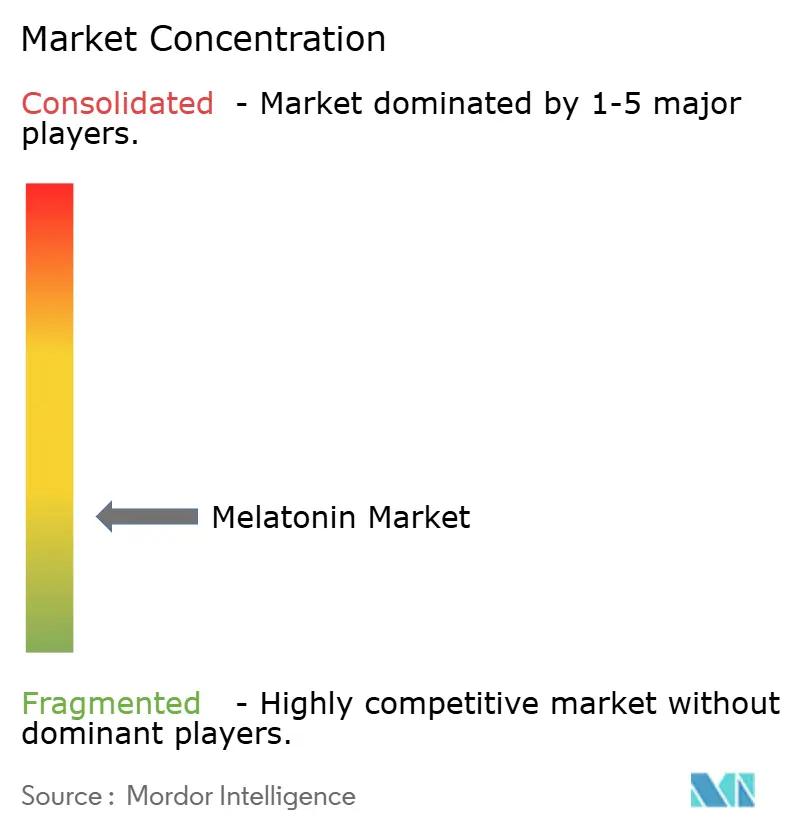
The melatonin market features high fragmentation: legacy supplement houses, prescription-drug developers, and synthetic-biology startups all contest for share. Natrol dominates U.S. retail with cGMP plants and rigorous purity testing, supporting brand trust among pharmacists and consumers. Nature’s Bounty leverages omnichannel distribution and gummy innovations, yet faces added compliance costs under child-proof rules.
Melatonin Industry Leaders
-
Natrol
-
Nature’s Bounty
-
Church & Dwight Co., Inc.
-
Jamieson Vitamins
-
Pharmavite
- *Disclaimer: Major Players sorted in no particular order
Melatonin Market Companies Covered in this Report
- Aspen
- Aurobindo
- B. Joshi Agrochem Pharma
- Biotics Research
- Church & Dwight Co., Inc.
- Jamieson Vitamins
- Life Extension
- Natrol
- Nature's Bounty
- NCFI
- Pfizer
- Pharmavite
- Puritan's Pride
- Rexall Sundown, Inc.
- Solgar Inc.
Market Opportunities and Future Outlook
The main opportunity sits where tighter pediatric oversight intersects with differentiated, clinically positioned products. Health Canada’s June 2026 intent to classify melatonin for pediatric sleep-related use as prescription-only shifts part of demand toward prescription-grade manufacturing, extended-release technologies, and medical distribution models that can support defined indications, dosing control, and post-market monitoring. This environment favors companies that already operate in regulated pathways, consistent with prolonged-release authorizations and expanded access for pediatric insomnia products (for example, SLENYTO distribution arrangements in Canada after Health Canada authorization).
Supply-chain diversification and manufacturing technology upgrades are another concrete opportunity area, particularly as concentration risks remain and expectations for analytical rigor rise. With more than 70% of global melatonin API cited as originating from Zhejiang and Jiangsu in China, finished-goods producers have an incentive to qualify multiple API sources and invest in cGMP-aligned identity and impurity testing tied to pharmacopeial methods (USP, BP 2025, and China’s GB/T 45443-2025). Bio-based, continuous fermentation and process-intensified routes provide a second lever alongside supplier diversification, helping address purity and by-product concerns from legacy chemical synthesis while improving cost positions for high-volume formats such as gummies and immediate-release tablets.
Recent Industry Developments in Melatonin Market
- July 2026: Natrol expanded its partnership with Josh Allen around a broader 24-hour wellness positioning. The update extends melatonin beyond a single sleep SKU into a wider day-and-night message that can support cross-sell into adjacent routines. It also reinforces retail pull-through for branded lines.
- June 2025: Natrol teamed up with Josh Allen to launch its Sleep + Restore product line. By linking product innovation to a high-visibility partnership, the company raised competitive intensity in branded sleep supplements and reinforced the shift toward multi-ingredient, benefits-led formulations.
- May 2024: Natrol launched Time Release Melatonin gummies in 3 mg and 10 mg strengths featuring dual-action delivery for sleep onset and maintenance. The introduction broadened extended-release style positioning within the gummy format, while also increasing the focus on packaging and compliance as child-safety scrutiny rises for pediatric-adjacent products.
Melatonin Market Report Scope and Research Methodology
Market Definition and Coverage
This market covers revenues generated from melatonin sold for sleep and related wellness uses across consumer supplement and medical settings, including natural and synthetic sources and common delivery forms, tracked across major regions.
Scope exclusions: We exclude non-melatonin sleep aids and broader sleep-disorder therapies where melatonin is not the active ingredient being counted.
Segments Covered in This Report
- By Type
- Natural Melatonin
- Synthetic Melatonin
- By Dosage Form
- Tablets
- Capsules
- Gummies
- Liquid Drops
- Others
- By Formulation
- Immediate-Release
- Extended-Release
- By Application
- Medical
- Dietary Supplement
- Veterinary and Aquaculture
- Post-Harvest Agriculture
- By Geography
- Asia-Pacific
- China
- India
- Japan
- South Korea
- Rest of Asia-Pacific
- North America
- United States
- Canada
- Mexico
- Europe
- Germany
- United Kingdom
- France
- Italy
- Rest of Europe
- South America
- Brazil
- Argentina
- Rest of South America
- Middle-East and Africa
- Saudi Arabia
- South Africa
- Rest of Middle-East and Africa
- Asia-Pacific
Data Sources, Market Sizing, and Validation
Desk Research
Desk research starts with public health and regulatory context because melatonin classification and labeling rules vary by country. We reviewed sources such as FDA supplement and labeling information, NIH Office of Dietary Supplements material, CDC sleep and health statistics, and WHO health indicators to anchor the demand backdrop and usage patterns.
On the supply and commercialization side, we checked signals from company annual reports, investor presentations, product labeling and pack information visible on public listings, and reputable press coverage of launches and recalls. Where available, we also used paid subscriptions focused on company financials and intelligence, patent databases, and shipment-level import and export data to sanity-check manufacturer footprint and cross-border flows. These sources are illustrative, and many other references were also used for data collection, validation, and clarification during the study.
Primary Interviews and Surveys
Primary work focused on validating what is actually sold as melatonin and how the mix is shifting across OTC supplement use and medical use, especially where dosage rules differ by country. We spoke with a spread of manufacturers, brand and channel executives, and domain specialists across APAC, EMEA, and the Americas so assumptions on pricing, formulation mix, and application demand could be checked and adjusted where needed.
Distribution of primary research fieldwork respondents
| Company type | Respondent position | Region |
|---|---|---|
| Top tier: 34% | CXOs: 13% | APAC: 45% |
| Mid tier: 49% | Functional/Unit leaders: 28% | EMEA: 29% |
| Smaller Players: 17% | Managers: 59% | Americas: 26% |
Market-Sizing & Forecasting
Market sizing uses a top-down and bottom-up approach, starting from region-level demand pools for sleep and wellness use, which are then translated into melatonin consumption using adoption and usage assumptions by channel and regulatory availability. The totals are corroborated with selective bottom-up approximations, like sampled price points by dosage form and roll-ups of visible product portfolios, before final values are locked.
Key inputs in the model include dosage-form mix (tablets, capsules, gummies, and liquid drops), the split between immediate-release and extended-release products, average selling price progression by format, and application weightings across dietary supplement, medical, and other uses that show up in labeling and buyer behavior. Regional regulatory posture is treated as a practical constraint, since prescription-only markets typically show different pack sizes and price bands than open OTC markets.
For forecasting, scenario analysis is used, supported by expert views on how quickly new formats and extended-release products are likely to penetrate and how price points are trending in key retail channels. When bottom-up visibility is thinner in a country, assumptions are filled using nearby comparable markets with similar rules and channel structure, and then re-checked through interviews.
Data Validation & Update Cycle
Outputs are checked against independent signals such as region demand indicators, observed price bands by format, and the expected direction of mix shift across OTC and medical use. If a country total looks out of line with the regulatory setting or the implied per-capita consumption, the drivers are revisited and the assumptions are reworked before sign-off.
A multi-step review is followed, where model logic, inputs, and calculations are independently inspected and then reconciled to remove avoidable variance. When new rules, major recalls, or meaningful channel changes occur, we re-contact selected respondents to confirm the impact and update key parameters. The report is refreshed annually, and a final pre-delivery pass is done so clients receive the latest updated view.
Mordor Intelligence's Melatonin Market Size Versus Other Published Estimates
Published market sizes for melatonin can vary even when the topic looks similar, because the scope and counting logic are not always aligned across studies. Differences typically come from what forms are counted, whether medical use is included alongside supplements, and how pricing is built up across regions.
The main gap comes from whether the sizing counts only consumer supplements or also includes medical, veterinary, and post-harvest agriculture demand, which is why Mordor Intelligence keeps these applications inside the model and then filters pricing and volumes by formulation mix and region-level regulatory access.
Benchmark comparison
| Source | Market Size | Gaps in Research Methodology |
|---|---|---|
| Mordor Intelligence | USD 1.89 B (2025) | |
| Global Consultancy A | USD 2.03 B (2025) | Uses a factory-gate framing with broader inclusion of combination sleep aids and formats like patches and sprays, and it can pull the 2025 value upward where blended products are counted more fully. |
| Industry Publisher B | USD 2.10 B (2024) | Leans toward OTC and nutraceutical retail sales, and it also includes melatonin embedded in wider wellness SKUs, which can raise the base year total while giving less weight to regulated medical-only markets. |
The spread in the table is mostly explained by application scope and product counting, followed by how price is averaged across formats and regions. By keeping assumptions tied to clear demand indicators, regulatory availability, and observed format-level pricing, the estimate stays traceable and repeatable even when public data is uneven by country.
Key Questions Answered in the Report
What is the current size of the melatonin market?
The melatonin market stands at USD 2.07 billion in 2026 and is forecast to reach USD 3.22 billion by 2031.
Which segment is growing fastest within the melatonin market?
Medical applications post the highest 11.88% CAGR as prescriptions rise for circadian-rhythm and pediatric ASD disorders.
How large is the synthetic melatonin segment?
Synthetic variants hold 55.02% melatonin market share in 2025 thanks to cost-efficient microbial production advances.
Which region will lead growth through 2031?
Asia-Pacific is projected to expand at a 9.88% CAGR on the back of regulatory liberalization and growing middle-class supplement demand.
What key regulation will shape product strategy?
Council for Responsible Nutrition rules mandating child-deterrent packaging and stricter labeling will influence new-product costs and formulation choices in North America and potentially Europe.