
Managed XDR (MXDR) Services Market Size and Share
Market Overview
| Study Period | 2021 - 2032 |
|---|---|
| Market Size (2027) | USD 5.58 Billion |
| Market Size (2032) | USD 11.53 Billion |
| Growth Rate (2027 - 2032) | 15.62 % |
| Fastest Growing Market | Asia-Pacific |
| Largest Market | North America |
| Market Concentration | Medium |
Major Players *Disclaimer: Major Players sorted in no particular order Image © Mordor Intelligence. Reuse requires attribution under CC BY 4.0. | |
Managed XDR (MXDR) Services Market Analysis by Mordor Intelligence
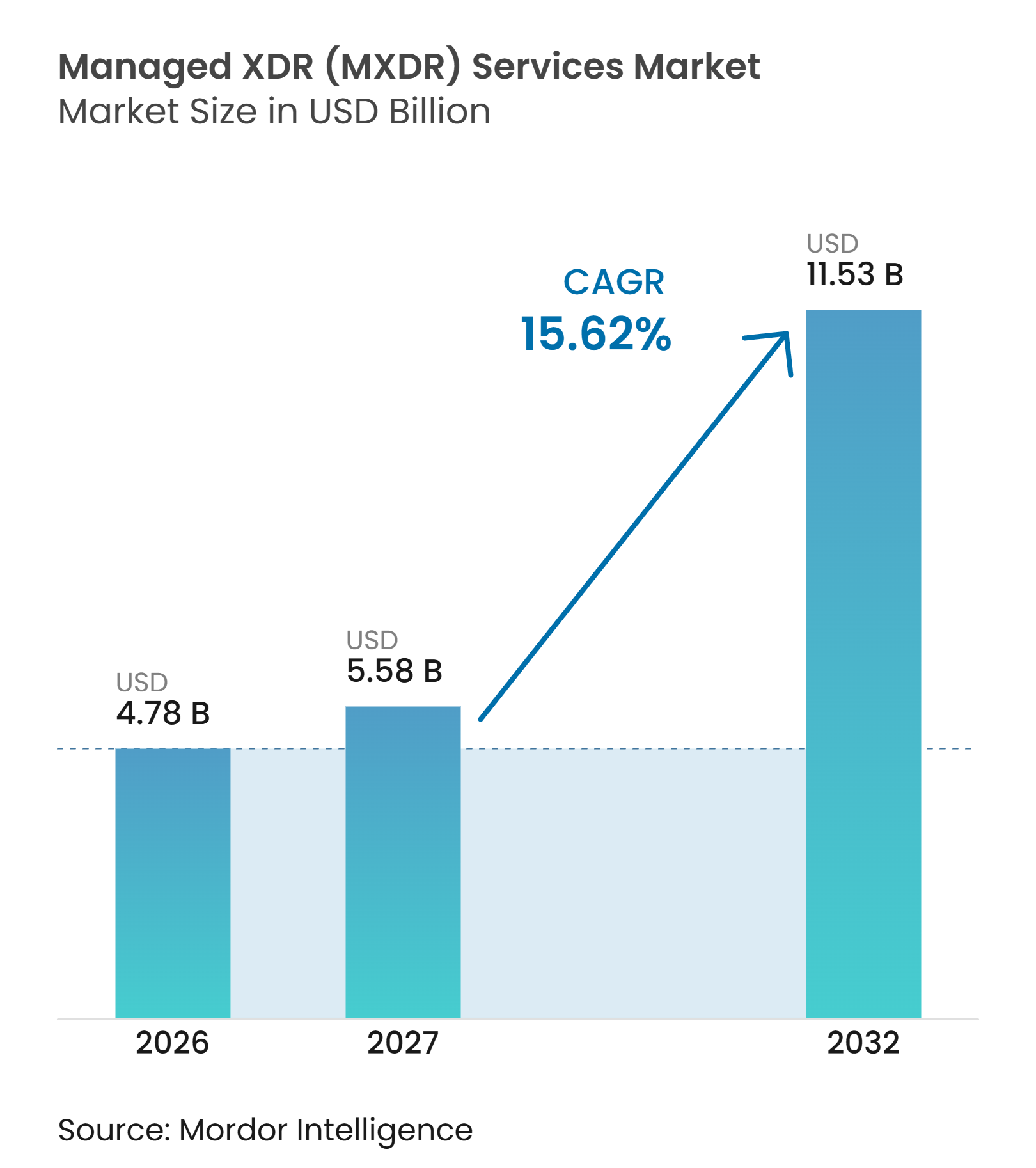
The managed XDR services market size is projected to expand from USD 4.78 billion in 2026 and USD 5.58 billion in 2027 to USD 11.53 billion by 2032, registering a CAGR of 15.62% between 2027 and 2032. Demand is being shaped by a shortage of qualified analysts and by the need for continuous security coverage across distributed business operations. Cloud workloads, SaaS applications, identity systems, operational technology, and connected devices have widened the set of security signals that organizations must review. Buyers increasingly seek providers that can connect those signals and respond to attacks spanning several systems. Competitive strategies are moving toward AI-supported investigation, integrated delivery platforms, and partnerships that simplify purchasing. Provider trust, data sovereignty, and local control over telemetry remain important conditions for winning regulated and public-sector business.
Key Report Takeaways
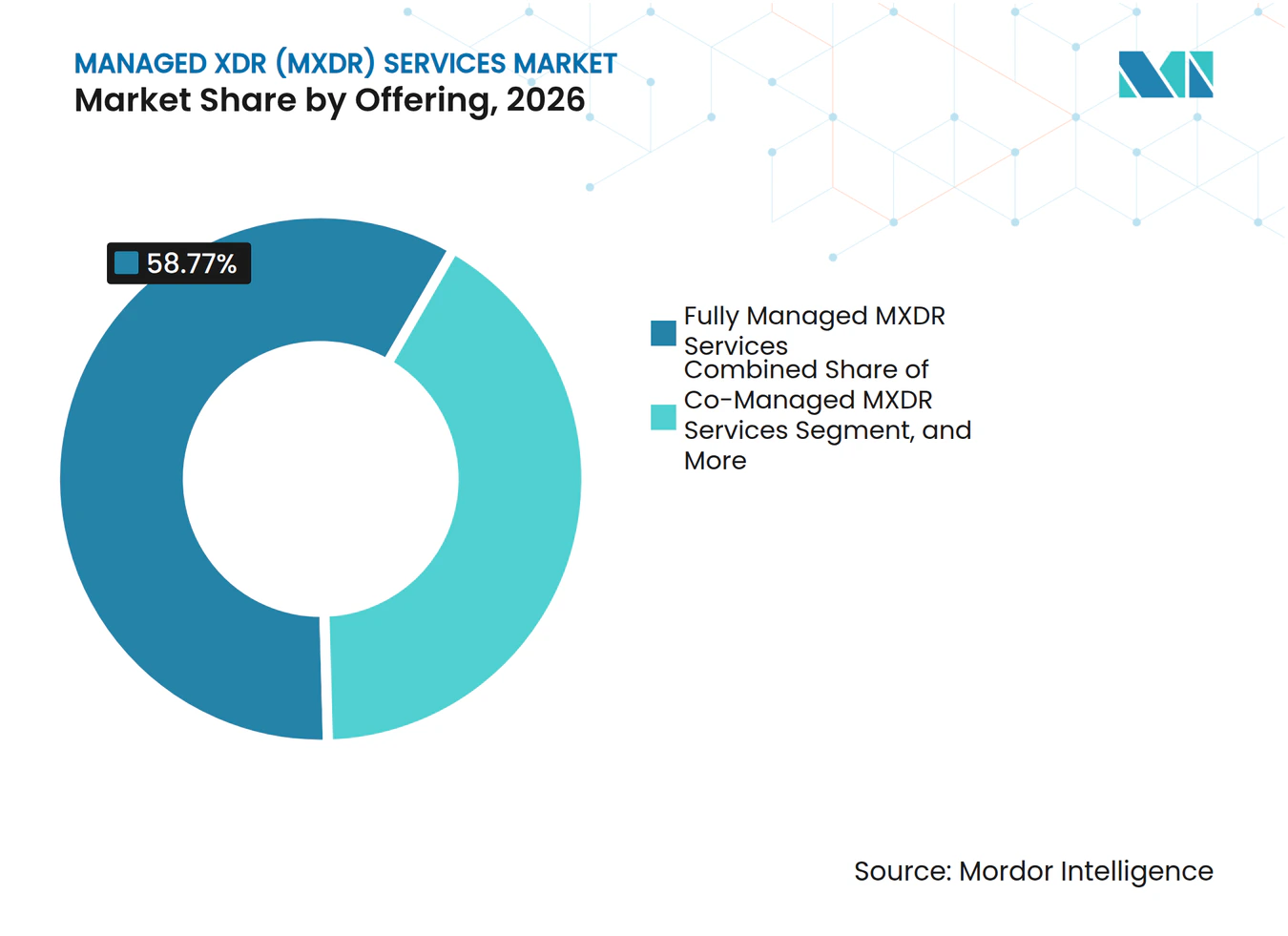
- By offering fully managed MXDR services, it held 58.77% of the managed XDR services market share in 2026, while Co-Managed MXDR Services is projected to expand at an 18.62% CAGR through 2032.
- By deployment mode, Cloud-Native deployment accounted for 51.93% of the managed XDR services market size in 2026 and is expected to expand at an 18.80% CAGR through 2032.
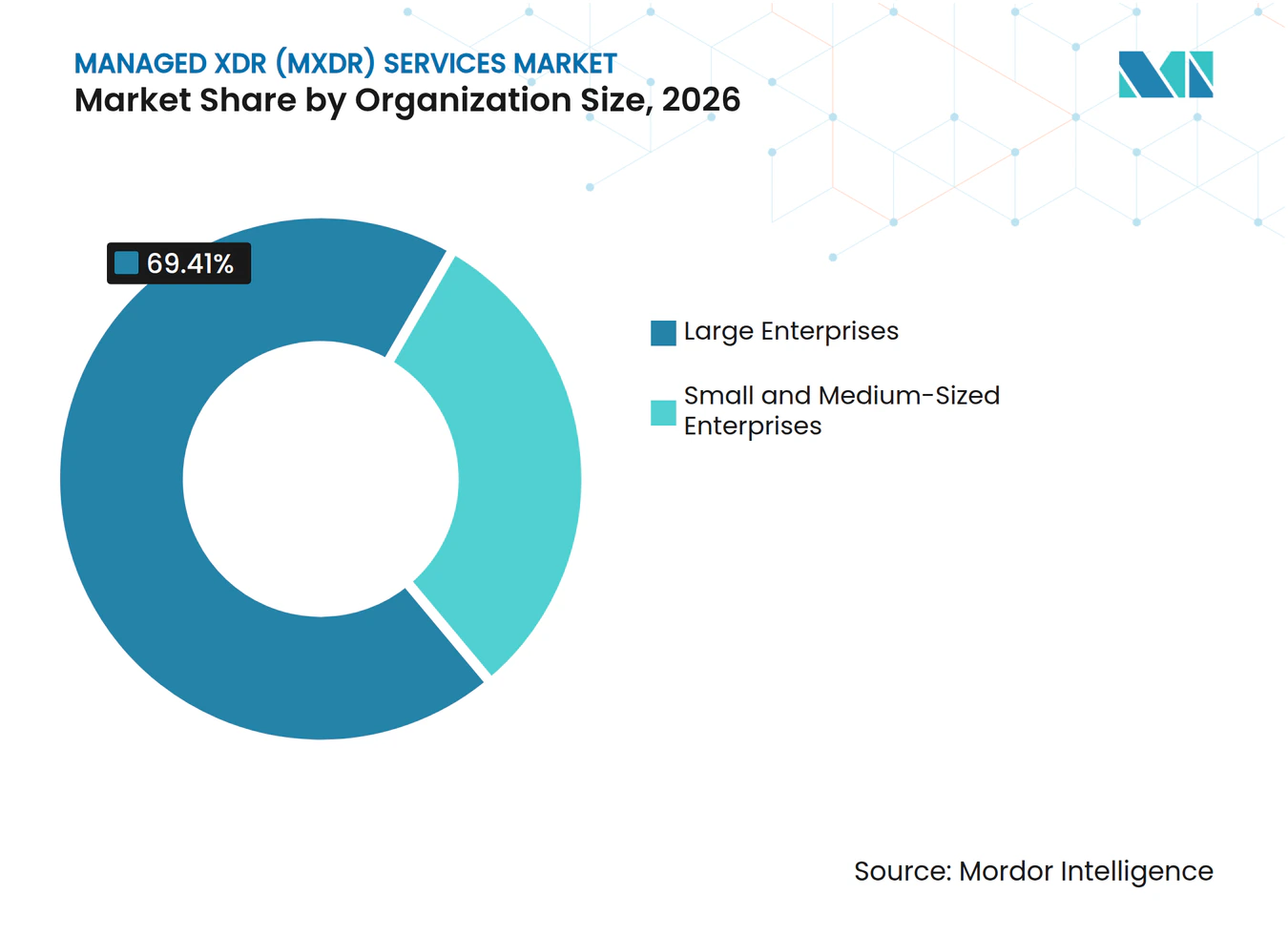
- By organization size, Large Enterprises accounted for 69.41% of revenue in 2026, while SMEs are projected to expand at a 19.38% CAGR through 2032.
- By industry vertical, BFSI held 24.87% of revenue in 2026, while Healthcare and Life Sciences is projected to expand at an 18.25% CAGR through 2032.
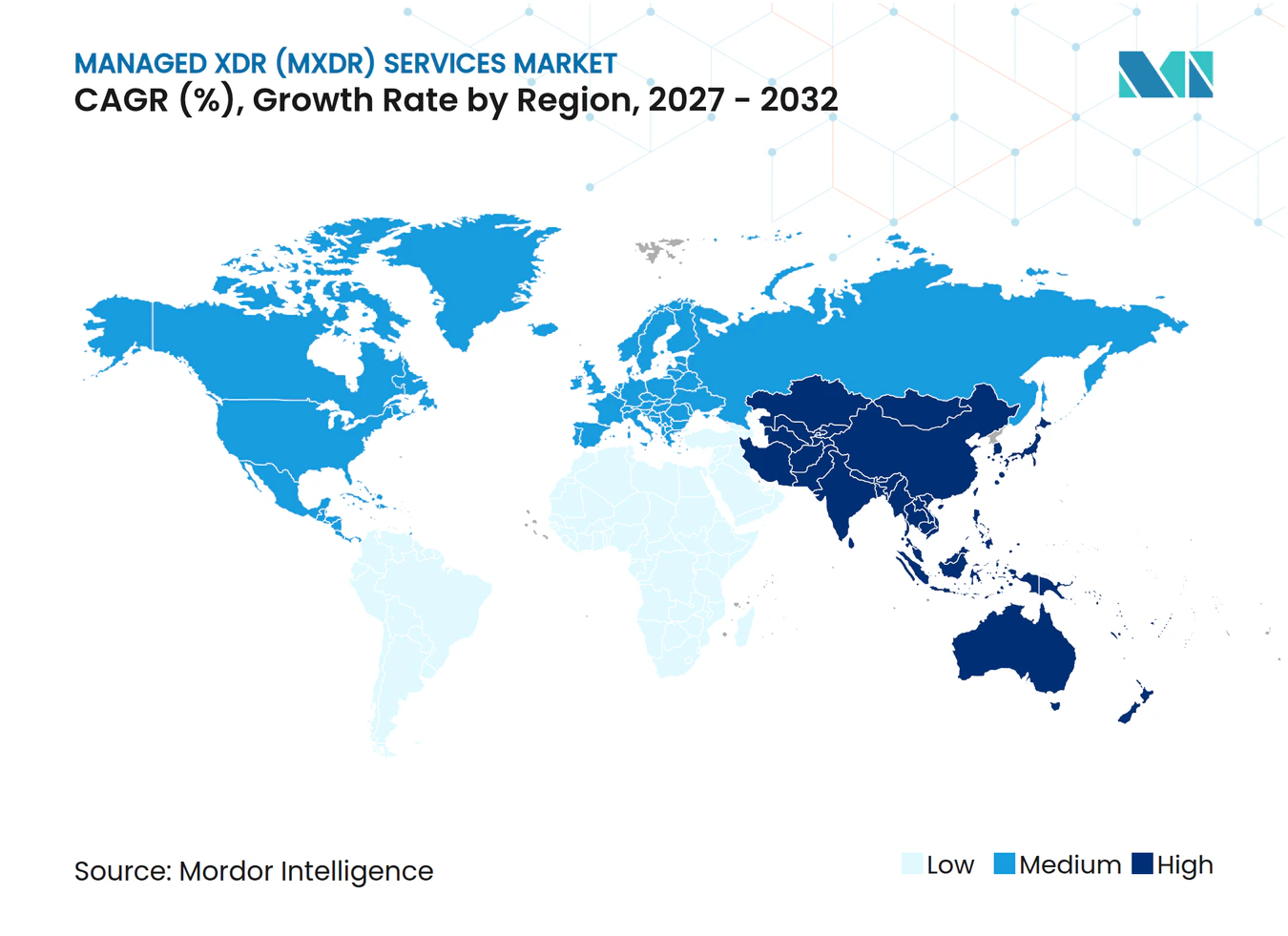
- By geography, North America held 40.32% of the managed XDR services market revenue in 2026, while Asia-Pacific is projected to expand at an 18.59% CAGR through 2032.
Note: Market numbers in this report are based on Mordor Intelligence's proprietary estimation framework, which combines nine months of actuals with Q4 projections for base year 2026.
Market Trends and Insights
Drivers Impact Analysis of Managed XDR (MXDR) Services Market*
| Driver | (~) % Impact on CAGR Forecast | Geographic Relevance | Impact Timeline |
|---|---|---|---|
| Cybersecurity Talent Shortage and 24/7 Coverage Needs | +4.2% | Global, most acute in North America, the United Kingdom, and Australia | Short term (≤ 2 years) |
| Hybrid Cloud, SaaS, Identity, and IoT Attack Surface Expansion | +3.5% | Global, accelerating in Asia-Pacific and Europe | Medium term (2-4 years) |
| Ransomware, Business Email Compromise, and Identity-Led Intrusions | +3.0% | Global, with BFSI and healthcare most exposed | Short term (≤ 2 years) |
| Regulatory, Cyber-Insurance, and Audit-Readiness Requirements | +2.3% | European Union, North America, and Asia-Pacific frameworks | Medium term (2-4 years) |
| Security-Tool Consolidation and Alert-Fatigue Reduction | +1.8% | Global, strongest in mid-sized North American and European organizations | Medium term (2-4 years) |
| AI-Augmented Detection, Investigation, and Response | +3.0% | Global, with early adoption in North America and Western Europe | Long term (≥ 4 years) |
| Source: Mordor Intelligence | |||
Cybersecurity Talent Shortage and 24/7 Coverage Requirements
The shortage of cybersecurity talent is widening faster than many organizations can recruit, particularly for advanced investigation and cloud forensics roles. A 2025 Barracuda survey found that 48% of organizations required 24/7 managed security coverage, with higher demand reported in healthcare and manufacturing. The need is not limited to additional personnel because incident response depends on practitioners who can assess identity activity, cloud behavior, and endpoint evidence together. Managed providers can spread those scarce skills across several customers and maintain coverage outside normal business hours. Ontinue stated in June 2025 that its autonomous investigations reduced the mean time to investigate by 50% and resolved 99.5% of incidents without customer involvement.[1] The Managed XDR services market, therefore, benefits when buyers compare continuous service coverage with the cost and difficulty of staffing an internal security operations center.
Expansion of Hybrid Cloud, SaaS, Identity, and IoT Attack Surfaces
Enterprise telemetry is now dispersed across endpoints, cloud workloads, SaaS platforms, identity directories, operational technology networks, and connected devices. This distribution makes isolated security tools less useful when an attack moves from stolen credentials to cloud resources or user endpoints. The Managed XDR services market addresses this problem by combining data from several domains into a common investigation workflow. Arctic Wolf stated that its Aurora Platform processes more than 9 trillion security observations each week. Its October 2025 collaboration with AWS was intended to extend coverage to AWS-native feeds through the Open Cybersecurity Schema Framework. As identity theft and lateral movement become more common, buyers are placing greater value on providers that can investigate identity signals alongside endpoint and cloud events.
Ransomware, Business Email Compromise, and Identity-Led Intrusions
Ransomware and identity-led campaigns are making faster detection and response a central reason for managed security procurement. Organizations assess these services as a way to reduce attacker dwell time and contain incidents before they disrupt operations. In healthcare, ransomware can interrupt clinical delivery and force patient diversion, which can accelerate decisions on continuous monitoring. In financial services, business email compromise and credential misuse exploit high transaction volumes and accessible information about organizational roles. The Managed XDR services market also faces a provider-side risk because a compromise at an external provider can expose telemetry across many customer environments. This risk is making zero-trust architecture, access controls, and clear incident-accountability terms more important in provider selection.
Regulatory, Cyber-Insurance, and Audit-Readiness Requirements
Regulatory obligations have become more immediate purchasing considerations for organizations that must show continuous oversight of technology risks. DORA applied from January 17, 2025, and it requires European Union financial entities to manage information and communication technology risks and third-party technology risks. These obligations encourage financial institutions to seek monitoring and response arrangements that can provide evidence for controls and audits. Cyber-insurance renewal processes also increase interest in retaining documented monitoring capabilities rather than relying on informal incident arrangements. The Managed XDR services market is supported when providers can supply reporting, incident records, and documented response processes suited to regulated customers. The effect is strongest where security requirements, insurer expectations, and audit procedures are assessed together during procurement.
Restraints Impact Analysis of Managed XDR (MXDR) Services Market*
| Restraint | (~) % Impact on CAGR Forecast | Geographic Relevance | Impact Timeline |
|---|---|---|---|
| Customer Distrust of Provider Control Over Security Architecture | -1.5% | Global, acute in government and critical infrastructure | Short term (≤ 2 years) |
| Integration, Data Portability, and Deployment Complexity | -1.2% | Global, with highest friction in legacy-heavy Asia-Pacific and European enterprises | Medium term (2-4 years) |
| Privacy, Data Residency, and Cross-Border Telemetry Constraints | -0.8% | European Union, Middle East, and Asia-Pacific markets with data-localization rules | Long term (≥ 4 years) |
| Skilled-Analyst Scarcity, False Positives, and Response-Liability Exposure | -0.9% | Global, most limiting for smaller specialized providers | Medium term (2-4 years) |
| Source: Mordor Intelligence | |||
Customer Distrust of Provider Control Over Security Architecture
Giving an external provider access to security telemetry can raise concerns about data access, accountability, and new exposure within sensitive environments. These concerns are especially important in government, critical infrastructure, defense, and financial services. Atos UK and Ireland launched its Sovereign MXDR service in March 2026 using Microsoft Azure delegated access architecture. Atos stated that telemetry analysis would remain within the customer environment and be performed by security-cleared United Kingdom nationals. Such models respond to customer demands for jurisdictional control without removing specialist monitoring support. Providers that cannot explain their access model, data location, and incident responsibilities may face longer procurement cycles in regulated settings.
Integration, Data Portability, and Deployment Complexity
Organizations with several endpoint agents, cloud controls, identity systems, and legacy SIEM platforms can face difficult onboarding processes. Connecting these tools to a common detection pipeline can extend time to value and increase the effort required to change providers. The same 2025 Barracuda survey reported that 52% of respondents sought managed providers because their security tools had become unmanageable. Historical threat context and tuned detection logic may also stay within an outgoing provider platform, which can make data portability a concern during contract negotiations. ReliaQuest stated that its GreyMatter Transit service detects threats before data reaches SIEM or storage layers, reducing the need to rearchitect customer data flows.[2] The Managed XDR services market remains exposed to deployment friction until more providers offer practical integration and transfer approaches for complex customer environments.
*Our forecasts treat driver/restraint impacts as directional, not additive. The impact forecasts reflect baseline growth, mix effects, and variable interactions.
Managed XDR (MXDR) Services Market Segment Analysis
By Offering:
Co-Managed Models Signal a Structural ShiftFully Managed MXDR Services held 58.77% of Managed XDR services market revenue in 2026, reflecting the needs of organizations that prefer a provider to assume broad responsibility for threat detection, investigation, response coordination, reporting, and continuous monitoring across distributed technology environments. These buyers often have complex estates, require defined service levels and escalation procedures, and do not want to staff a complete security operations function internally, especially when they must extend coverage beyond normal hours across several locations and business units. The offering is particularly relevant where endpoint, identity, cloud, and network controls operate through separate teams or platforms. Providers are responding with integrated arrangements that bring detection, incident coordination, prevention, and reporting into a common delivery model. This can limit the operational handoffs that otherwise occur when individual security products are managed independently.
Co-Managed MXDR Services is projected to expand at an 18.62% CAGR through 2032, as larger organizations retain strategic oversight and business-risk decisions while using providers for Tier 1 and Tier 2 investigation work and additional coverage. This structure suits customers with internal security staff that require automation, round-the-clock support, and broader telemetry analysis without surrendering accountability for high-impact response choices. Co-managed service designs can give customer teams access to provider tooling, shared automation, and broader telemetry while maintaining customer control of strategic response decisions. This arrangement reflects the need for a practical division of responsibility between provider analysts and internal security teams. Fully managed and co-managed services are consequently becoming points on a flexible delivery spectrum, allowing customers to change the provider role as their security capacity and risk requirements develop.



By Deployment Mode:
Cloud-Native Architecture Anchors MXDR DeliveryCloud-Native deployment accounted for 51.93% of Managed XDR services market revenue in 2026 because it allows providers to aggregate substantial telemetry volumes, correlate activity across distributed environments, and operate a centralized service without extensive customer-owned infrastructure. The model supports investigations that need to connect endpoint, identity, email, and cloud activity in a common platform, which helps service teams assess whether separate alerts reflect a single coordinated intrusion or unrelated routine activity. It can also shorten implementation by reducing the need for customers to install or maintain additional on-premises systems. CrowdStrike made Falcon available through Microsoft Marketplace in February 2026 with eligibility against Azure Consumption Commitments.[3] This arrangement illustrates how cloud-based security purchases can be connected to established cloud billing and procurement processes, while supporting the event volumes needed for AI-assisted triage and investigation.
Cloud-Native deployment is projected to expand at an 18.80% CAGR through 2032, the highest rate among the deployment options described, while hybrid delivery remains important for customers that must retain sensitive telemetry within a specific jurisdiction or their own controlled environment. Atos launched its Sovereign MXDR service in March 2026 using delegated access designed to analyze customer telemetry without moving that telemetry from the customer environment. This approach offers a compliance-oriented hybrid option for organizations that need centralized specialist monitoring alongside local control. On-premises deployment still serves classified and air-gapped settings where cloud connectivity is unacceptable, though its role is narrowing as hybrid models meet more data-residency requirements. The Managed XDR services market will retain more than one delivery model because customer policies, technical architectures, and sovereignty obligations differ materially across organizations and jurisdictions.
By Organization Size:
Large Enterprise Dominance Masks an SME OpportunityLarge Enterprises accounted for 69.41% of Managed XDR services market revenue in 2026, reflecting the historical focus of these services on organizations with extensive multi-vendor estates, hybrid cloud systems, several business units, and mature internal governance processes. Their scale creates a sustained need for cross-domain visibility and continuous support, even where internal security teams are well established. Many large enterprises still experience fragmented detection across legacy systems and new cloud environments, creating an opening for providers that can integrate signals without requiring a wholesale replacement of controls, preserve earlier technology investments, and support established internal response and governance structures. These buyers commonly seek detailed reporting, defined incident responsibilities, and service arrangements that fit existing risk and audit structures. Sales cycles can be longer because these requirements are complex, but the segment remains important for providers pursuing broad contract scope and multi-year relationships.
SMEs are projected to expand at a 19.38% CAGR through 2032 because many smaller organizations face ransomware, credential theft, and cloud-security risks without having a dedicated security operations team or the resources to build one. Managed service provider channels can address this gap through packaged tiers, usage-based billing, pre-authorized actions, and access to continuous investigation and response. Arctic Wolf launched Aurora MDR Connect in September 2026 to help managed service providers deliver 24/7 detection and pre-authorized response without building their own security operations center. SK Shields committed KRW 20 billion (USD 14.7 million) in September 2025 to advance Secudium into AI-based MXDR for enterprises with fewer than 1,000 employees. The opportunity in the Managed XDR services market depends on reducing onboarding and service complexity while keeping response authority, costs, and service levels clear for customers with lean technology teams.

By Industry Vertical:
Financial Services Leads, Healthcare Drives Fastest ExpansionBFSI held 24.87% of Managed XDR services market revenue in 2026 because financial institutions manage sensitive information, high transaction volumes, and external compliance expectations that place a premium on continuous monitoring, identity-focused detection, and documented response arrangements. DORA has increased attention to technology-risk management and third-party oversight among European Union financial entities. The segment also faces credential stuffing, business email compromise, synthetic identity fraud, and insider-risk scenarios that favor services able to investigate identity signals as part of normal workflows. Buyers often require evidence of controls, escalation procedures, service accountability, and incident reporting that supports their audit processes. Providers that pair security operations capability with third-party assurance and documented governance are better aligned with these requirements.
Healthcare and Life Sciences is projected to expand at an 18.25% CAGR through 2032 because the sector combines sensitive information, limited security resources, compliance-reporting needs, and ransomware risks that can interrupt clinical operations and affect patient care. Rapid investigation and clear incident coordination are especially important where disruption can force patient diversion or restrict access to clinical systems. Lumifi received a Vizient contract in February 2026 that gives the member network access to 24/7 managed detection and response and SOC-as-a-Service at negotiated pricing. The agreement shows how group purchasing arrangements can extend managed security options to resource-constrained healthcare and specialty buyers. Manufacturing, energy, government, IT and telecommunications, retail, and other verticals also provide meaningful demand as operational technology becomes more connected to corporate IT and increases the need for cross-domain detection.
Geography Analysis
North America Managed XDR (MXDR) Services Market
North America held 40.32% of Managed XDR services market revenue in 2026, supported by a concentration of specialist providers, established enterprise security budgets, cyber-insurance expectations, and mature customer demand for outcome-based monitoring and response services. The United States hosts Arctic Wolf, CrowdStrike, ReliaQuest, Expel, Red Canary, Ontinue, and eSentire, giving the region a deep provider base across managed detection and response, platform technology, channel partnerships, and related services. Cyber-insurance practices strengthen the value of documented monitoring, rapid response, and defensible incident records, particularly for organizations facing demanding oversight requirements. Canada is expanding through financial services alignment with the United States and technology-sector demand for scalable cloud-native protection, while Mexico remains an emerging market where multinational manufacturers and financial institutions need to meet security expectations set by the United States and European operations.
Europe and South America Managed XDR (MXDR) Services Market
Europe is the second-largest regional market, with Germany and the United Kingdom representing important demand centers as DORA and NIS2-related obligations focus attention on monitoring, incident documentation, and third-party oversight. The United Kingdom is moving toward sovereignty-assured service models for government and critical infrastructure customers that require explicit control over telemetry, personnel, and incident responsibilities. Atos launched its Sovereign MXDR service in March 2026 with a United Kingdom Sovereign Delivery Centre and security-cleared United Kingdom analysts. France, Benelux, and the Nordic countries are also shaped by regulatory timelines and local-presence needs, which can favor providers with regional infrastructure, delivery teams, and strong data-governance practices. South America is at an earlier adoption stage, led by Brazil and Argentina in financial services, government, and large manufacturing, while Sophos's February 2025 Secureworks acquisition supports channel-oriented delivery of the combined endpoint prevention and Taegis XDR and MDR platform.
APAC and MEA Managed XDR (MXDR) Services Market
Asia-Pacific is projected to expand at an 18.59% CAGR through 2032, supported by investment in AI-supported security operations, increasing demand from smaller enterprises, and the creation of local delivery capacity. Japan is one of the region's more advanced managed detection markets, where AI-supported operations and Japanese-language alert triage are viewed as ways to lower adoption costs for mid-sized organizations. SK Shields committed KRW 20 billion (USD 14.7 million) in September 2025 to develop Secudium into AI-based MXDR for enterprises with fewer than 1,000 employees and to support overseas expansion through a SaaS conversion. India is becoming both a demand center and delivery hub, illustrated by Arctic Wolf's October 2025 expansion of its Bengaluru Global Capability Center from 75 to more than 300 employees in under 1 year.[4] The Middle East and Africa remain less mature, but national cybersecurity strategies and critical-infrastructure mandates are building early demand for in-country, data-residency-compliant services that pair global expertise with credible local governance.
Competitive Landscape
Market Concentration
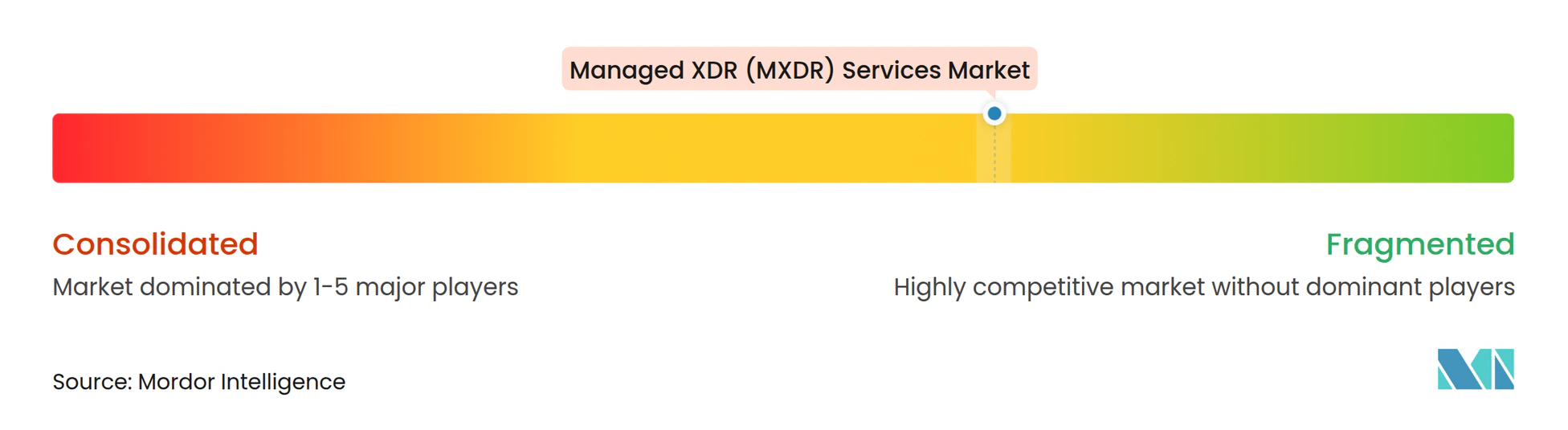
The Managed XDR services market is moderately fragmented, although consolidation is accelerating through acquisitions, platform integration, and partnerships with large cloud ecosystems. Pure-play specialists including Arctic Wolf, Expel, Red Canary, Ontinue, and ReliaQuest compete through investigation speed, service design, and managed response capability, while platform-native providers such as CrowdStrike, Microsoft, Palo Alto Networks, and SentinelOne bundle services with proprietary analytics. Telecommunications and IT services firms including NTT DATA Corporation, BT Group, Verizon Communications, Orange Cyberdefense, and Telefónica add broad customer access, regional delivery infrastructure, and established enterprise relationships. This mix gives buyers in the Managed XDR services market a choice among specialist services, technology platforms, and large multi-country service partners, while creating pressure on providers to connect endpoint, cloud, email, and identity telemetry without unnecessary operational handoffs.
AI-supported delivery is a central competitive focus in 2026 because vendors are trying to address high event volumes while reserving experienced analysts for complex incidents and customer coordination. CrowdStrike stated that Falcon Complete processed more than 10,000 daily AI-workflow triage decisions and had a 1-minute median time to contain. Ontinue stated that its autonomous investigation capability resolved 99.5% of incidents without customer involvement. These efforts shift competition toward automation design, investigation quality, data integration, response authority, and the governance used to supervise automated actions. Buyers are likely to evaluate whether a provider's automation can meet internal policy requirements and preserve accountable human judgment, rather than simply whether the provider has incorporated AI capabilities.
Partnerships are another route to scale and more straightforward procurement, as shown by CrowdStrike and Microsoft's February 2026 arrangement to offer Falcon through Microsoft Marketplace with Azure Consumption Commitment eligibility. LevelBlue and SentinelOne expanded their global partnership in March 2026, combining Purple AI and the Singularity Platform with the LevelBlue Indigo platform. Sophos also integrated endpoint prevention with Taegis XDR and MDR after acquiring Secureworks, creating a more unified prevention, detection, and response portfolio. These strategic moves support offerings with fewer contracts and fewer operating handoffs, while white space remains in identity-centered security and specialist coverage for healthcare operational technology and AI workloads. Recent Industry Developments
Managed XDR (MXDR) Services Industry Leaders
-
Arctic Wolf
-
CrowdStrike Holdings, Inc.
-
Microsoft Corporation
-
Sophos Limited
-
eSentire, Inc.
- *Disclaimer: Major Players sorted in no particular order
Managed XDR (MXDR) Services Market Companies Covered in this Report
- Arctic Wolf
- CrowdStrike Holdings, Inc.
- Microsoft Corporation
- Sophos Limited
- eSentire, Inc.
- SecureWorks Corp.
- Palo Alto Networks, Inc.
- Rapid7, Inc.
- IBM Corporation
- Google Cloud / Mandiant
- SentinelOne, Inc.
- Expel, Inc.
- Red Canary
- ReliaQuest, LLC
- Trustwave Holdings, Inc.
- LevelBlue Holdings, Inc.
- Ontinue, Inc.
- NTT DATA Corporation
- BT Group plc
- Telefónica, S.A.
- Eviden, an Atos Business
- Verizon Communications Inc.
- Kroll, LLC
- Orange Cyberdefense
Recent Industry Developments in Managed XDR (MXDR) Services Market
- September 2026: Arctic Wolf launched Aurora MDR Connect for MSPs, enabling managed service providers to extend 24/7 detection, investigation, and pre-authorized response from the Aurora Agentic SOC, which processes over 10 trillion security events weekly, to organizations of all sizes without building their own SOC.
- July 2026: Nordanex and G DATA CyberDefense launched a channel partnership in Germany, introducing G DATA's Managed XDR portfolio, developed and hosted exclusively in Germany, to Nordanex's IT system integrator network to address NIS2-driven sovereign cybersecurity demand.
- March 2026: CrowdStrike unveiled Falcon Next-Gen SIEM support for Microsoft Defender for Endpoint telemetry, enabling Microsoft endpoint customers to correlate Defender data with Falcon threat intelligence without additional sensors, accelerating SOC modernization in mixed-vendor environments.
- March 2026: Atos UK and Ireland launched a Sovereign MXDR service for United Kingdom government and critical infrastructure using Microsoft Azure delegated access architecture, ensuring customer telemetry never leaves the customer environment, operated exclusively by security-cleared United Kingdom nationals from a United Kingdom Sovereign Delivery Centre.
Global Managed XDR (MXDR) Services Market Report Scope
The managed extended detection and response (XDR) Services, known as MXDR, are outsourced cybersecurity solutions where a specialized third-party provider assumes 24/7 operational responsibility for threat detection, investigation, and incident response across an enterprise's entire digital ecosystem.
The Managed XDR (MXDR) Services Market Report is Segmented by Offering (Fully Managed MXDR Services, Co-Managed MXDR Services, and Incident Response and Retainer Services), Deployment Mode (Cloud-Native, Hybrid, and On-Premises), Organization Size (Large Enterprises and Small and Medium-Sized Enterprises), Industry Vertical (BFSI, Healthcare and Life Sciences, IT and Telecommunications, Government and Defense, Manufacturing, Energy and Utilities, Retail and E-Commerce, and Other Industry Verticals) and Geography (North America, South America, Europe, Asia-Pacific, Middle East, and Africa). The Market Forecasts are Provided in Terms of Value (USD).
Segmentation Overview
| Fully Managed MXDR Services |
| Co-Managed MXDR Services |
| Incident Response and Retainer Services |
| Cloud-Native |
| Hybrid |
| On-Premises |
| Large Enterprises |
| Small and Medium-Sized Enterprises |
| BFSI |
| Healthcare and Life Sciences |
| IT and Telecommunications |
| Government and Defense |
| Manufacturing |
| Energy and Utilities |
| Retail and E-Commerce |
| Other Industry Verticals |
| North America | United States |
| Canada | |
| Mexico | |
| South America | Brazil |
| Argentina | |
| Rest of South America | |
| Europe | United Kingdom |
| Germany | |
| France | |
| Italy | |
| Rest of Europe | |
| Asia-Pacific | China |
| India | |
| Japan | |
| South Korea | |
| Rest of Asia-Pacific | |
| Middle East | Saudi Arabia |
| United Arab Emirates | |
| Rest of Middle East | |
| Africa | South Africa |
| Nigeria | |
| Rest of Africa |
| By Offering | Fully Managed MXDR Services | |
| Co-Managed MXDR Services | ||
| Incident Response and Retainer Services | ||
| By Deployment Mode | Cloud-Native | |
| Hybrid | ||
| On-Premises | ||
| By Organization Size | Large Enterprises | |
| Small and Medium-Sized Enterprises | ||
| By Industry Vertical | BFSI | |
| Healthcare and Life Sciences | ||
| IT and Telecommunications | ||
| Government and Defense | ||
| Manufacturing | ||
| Energy and Utilities | ||
| Retail and E-Commerce | ||
| Other Industry Verticals | ||
| By Geography | North America | United States |
| Canada | ||
| Mexico | ||
| South America | Brazil | |
| Argentina | ||
| Rest of South America | ||
| Europe | United Kingdom | |
| Germany | ||
| France | ||
| Italy | ||
| Rest of Europe | ||
| Asia-Pacific | China | |
| India | ||
| Japan | ||
| South Korea | ||
| Rest of Asia-Pacific | ||
| Middle East | Saudi Arabia | |
| United Arab Emirates | ||
| Rest of Middle East | ||
| Africa | South Africa | |
| Nigeria | ||
| Rest of Africa | ||
Key Questions Answered in the Report
What is the Managed XDR services market size?
The Managed XDR services market is projected to expand from USD 4.78 billion in 2026 and USD 5.58 billion in 2027 to USD 11.53 billion by 2032, at a 15.62% CAGR. The forecast reflects broader demand for continuous detection and response across cloud, identity, endpoint, and connected-device environments, and it also reflects the difficulty of recruiting experienced analysts for continuous operations. Provider trust, data sovereignty, and clear response responsibilities remain important conditions for adoption in regulated customer environments.
Which deployment approach is expanding fastest?
Cloud-Native deployment is projected to expand at an 18.80% CAGR through 2032 and held 51.93% of revenue in 2026. Its adoption is supported by centralized telemetry analysis, links to established cloud procurement processes, and the ability to investigate data from several distributed systems through a common service platform.
Why are SMEs adopting managed XDR services?
SMEs often lack dedicated security operations teams, while managed service provider channels can offer continuous monitoring, investigation, and response through packaged service tiers. This makes enterprise-grade security support more accessible without requiring an in-house SOC, while pre-authorized response and managed service provider delivery can reduce the operational burden on lean technology teams.
Which end-user sector has the largest share?
BFSI held 24.87% of revenue in 2026 because financial institutions need continuous monitoring, identity-focused detection, and audit-ready reporting. The sector also faces business email compromise, credential misuse, and third-party technology-risk oversight requirements, which increases the importance of documented controls and defined escalation procedures.
Which region is projected to expand fastest?
Asia-Pacific is projected to expand at an 18.59% CAGR through 2032, supported by investment in AI-assisted security operations and in-country service delivery. Japan, South Korea, and India each contribute to regional adoption through automation initiatives and local delivery capacity, while data-residency needs are encouraging providers to adapt services to local governance expectations.
What is changing competition among managed security providers?
The Managed XDR services market is shaped by specialist providers, platform-native vendors, and telecommunications or IT services firms. Differentiation increasingly depends on integrated telemetry, governed automation, local delivery, and accountable response procedures, rather than only the size of a provider’s analyst workforce. Buyers are also examining whether the provider can preserve existing technology investments and maintain local control of sensitive telemetry where required, particularly in public-sector and critical-infrastructure deployments worldwide, where public accountability and service continuity carry added weight.