
Co-Managed XDR Services Market Size and Share
Market Overview
| Study Period | 2021 - 2032 |
|---|---|
| Market Size (2027) | USD 2.57 Billion |
| Market Size (2032) | USD 5.69 Billion |
| Growth Rate (2027 - 2032) | 17.23 % |
| Fastest Growing Market | Asia-Pacific |
| Largest Market | North America |
| Market Concentration | Medium |
Major Players *Disclaimer: Major Players sorted in no particular order Image © Mordor Intelligence. Reuse requires attribution under CC BY 4.0. | |
Co-Managed XDR Services Market Analysis by Mordor Intelligence
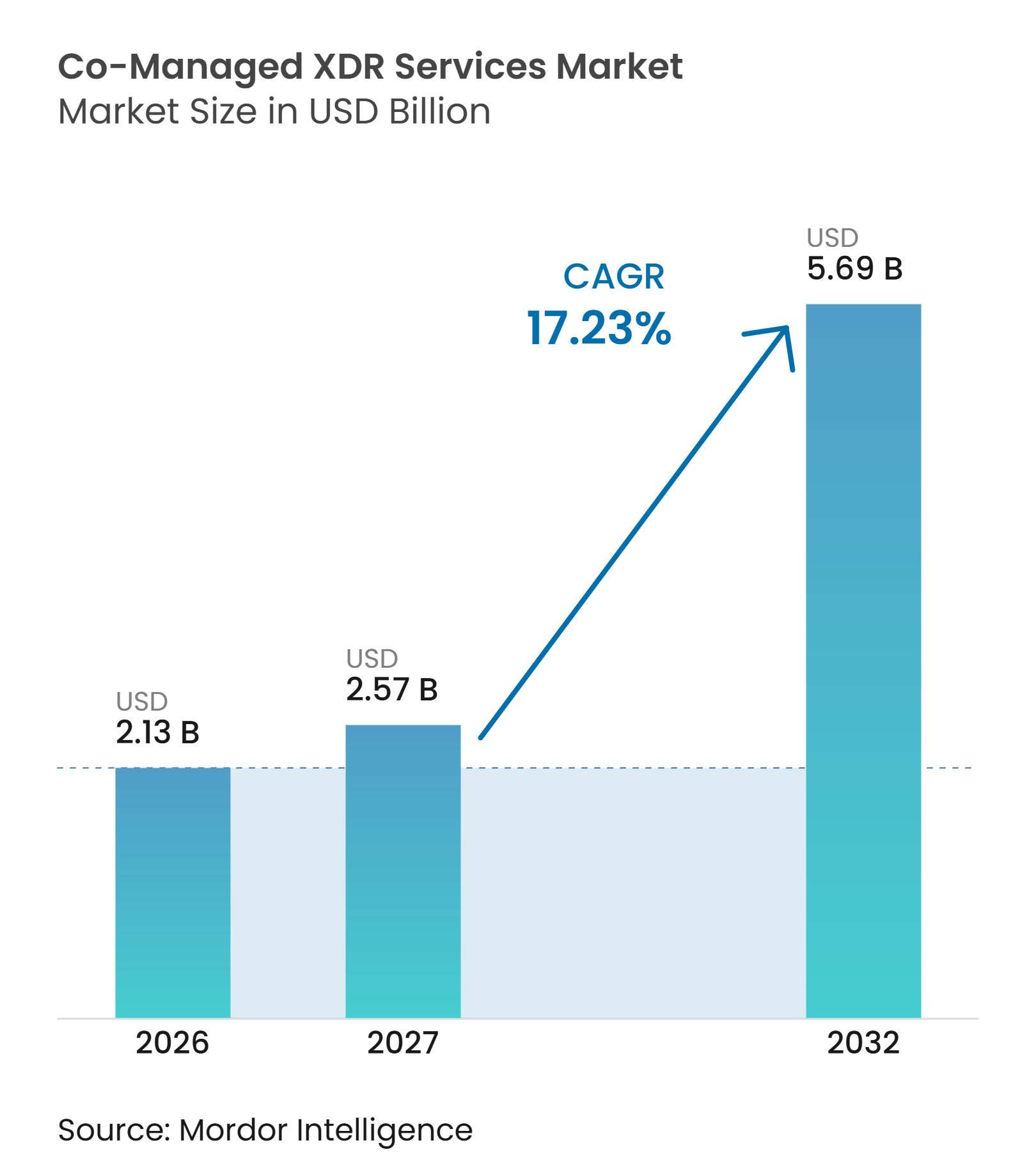
The Co-managed XDR services market size is projected to be USD 2.13 billion in 2026, USD 2.57 billion in 2027, and reach USD 5.69 billion by 2032, growing at a CAGR of 17.23% from 2027 to 2032. The Co-managed XDR services market is moving beyond a choice between an in-house security operations center and full outsourcing. Organizations want to retain knowledge of their environments while obtaining continuous access to specialized analysts. Persistent skills shortages, stricter reporting duties, and wider cloud exposure are supporting this model. AI-enabled triage is also improving the economics of round-the-clock coverage by shifting analysts toward complex investigations. The model can preserve customer decision rights while giving provider analysts the context needed to investigate events across a complex technology environment. The Co-managed XDR services market therefore offers providers an opportunity to pair customer-owned tools with focused operational support, although local data rules and unclear response authority can delay purchasing decisions.
Key Report Takeaways
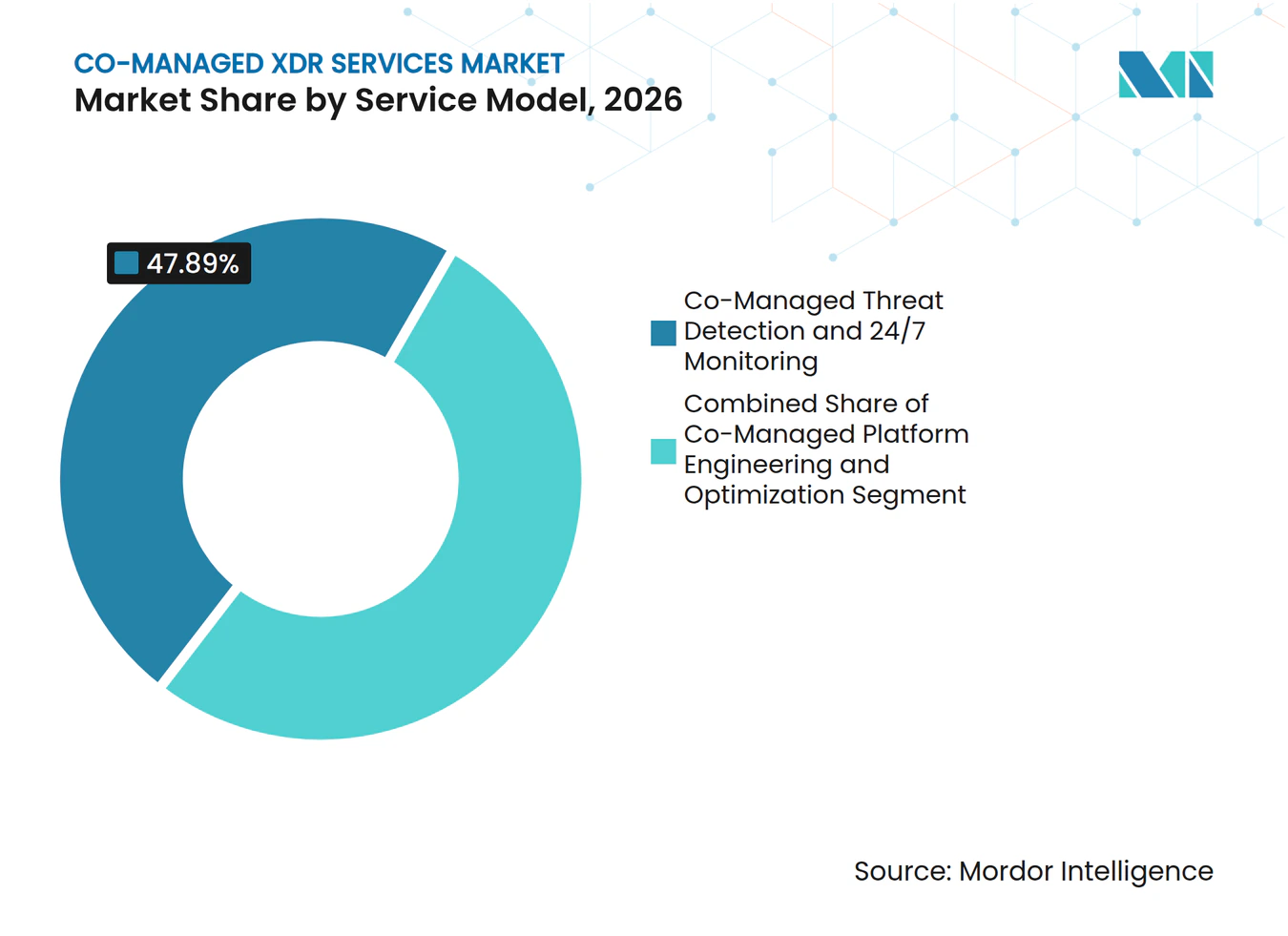
- By service model, co-managed threat detection and 24/7 monitoring held 47.89% of the Co-managed XDR services market in 2026, while co-managed threat hunting and incident response support is projected to expand at an 18.73% CAGR through 2032.
- By deployment model, cloud-based deployment held 60.72% share in 2026 and is projected to expand at a 19.21% CAGR through 2032.
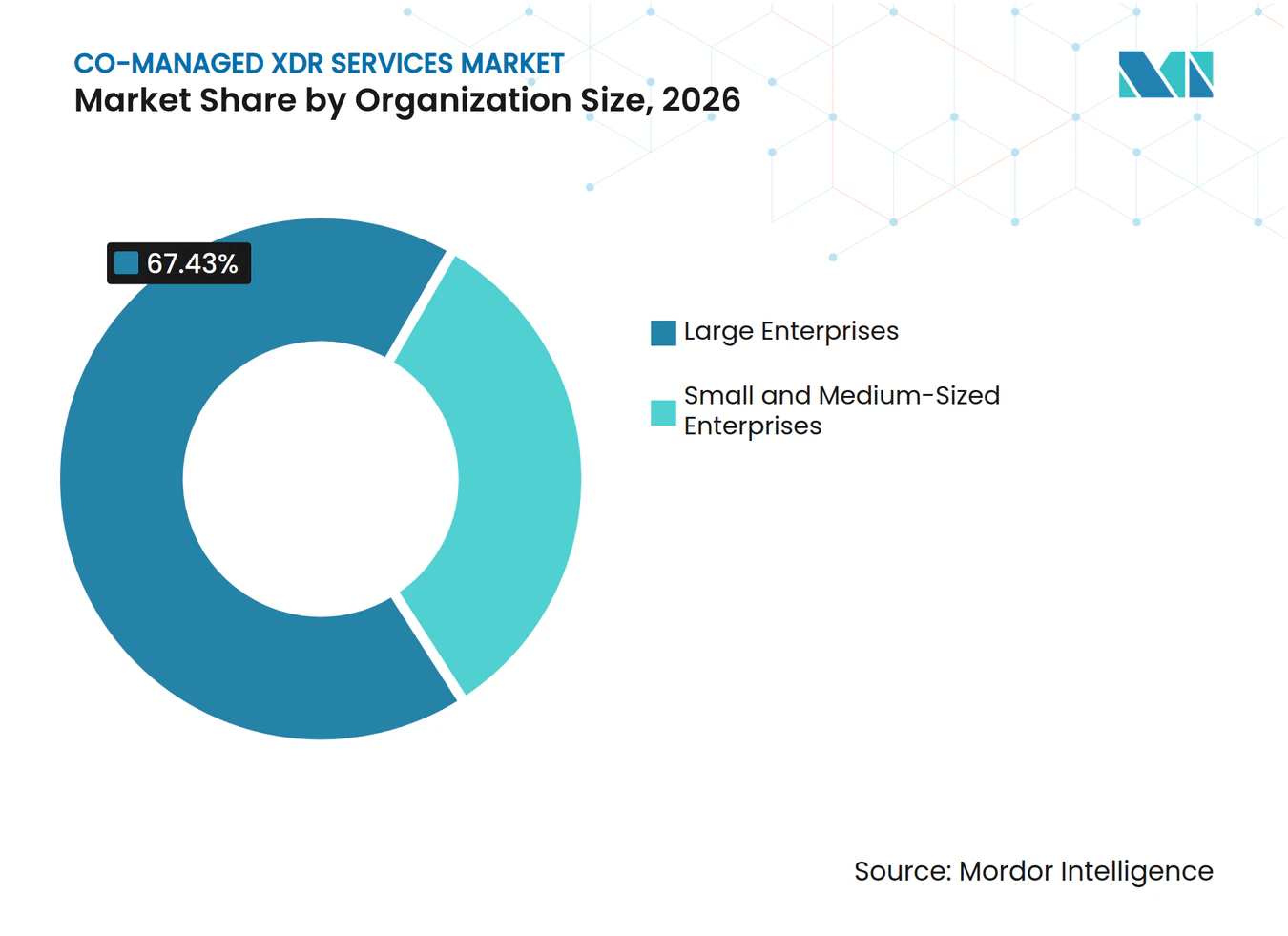
- By organization size, large enterprises held 67.43% share in 2026, while small and medium-sized enterprises are projected to expand at a 19.87% CAGR through 2032.
- By industry vertical, BFSI held 26.67% of the Co-managed XDR services market share in 2026, while manufacturing is projected to expand at a 19.60% CAGR through 2032.
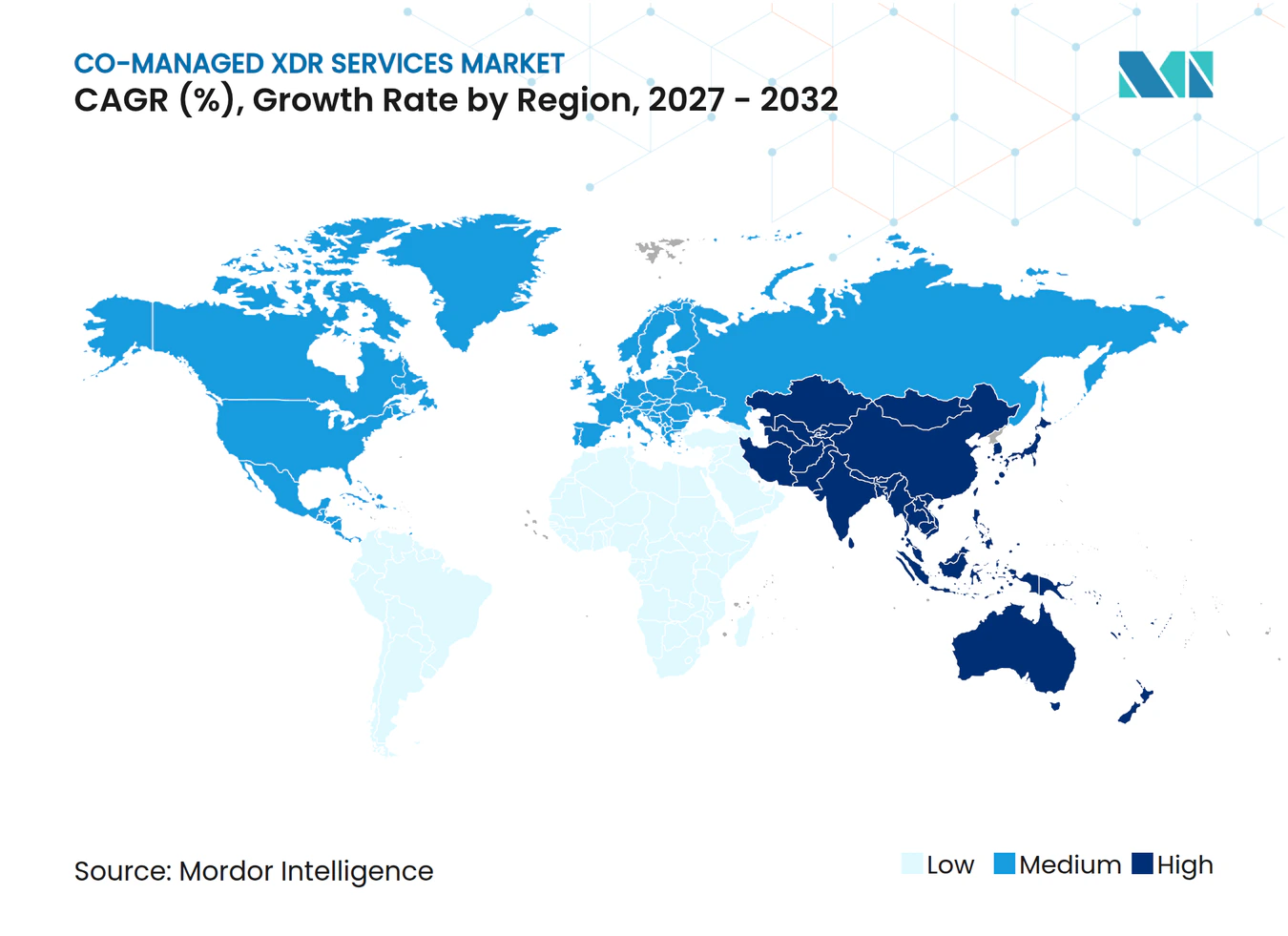
- By geography, North America held 42.31% share in 2026, while Asia-Pacific is projected to expand at a 20.17% CAGR through 2032.
Note: Market numbers in this report are based on Mordor Intelligence's proprietary estimation framework, which combines nine months of actuals with Q4 projections for base year 2026.
Market Trends and Insights
Drivers Impact Analysis of Co-Managed XDR Services Market*
| Driver | (~) % Impact on CAGR Forecast | Geographic Relevance | Impact Timeline |
|---|---|---|---|
| Cybersecurity Talent Shortages and 24/7 Coverage Economics | +3.5% | Global | Short term (≤ 2 years) |
| AI-Assisted Detection, Triage, and Response Automation | +2.8% | Global | Medium term (2-4 years) |
| Regulatory Reporting and Cyber-Insurance Control Requirements | +2.3% | North America and EU | Medium term (2-4 years) |
| Hybrid and Multicloud Attack-Surface Expansion | +1.8% | Global | Short term (≤ 2 years) |
| Need to Extend Customer-Owned XDR Investments Without Full Outsourcing | +1.5% | North America, EU, Asia-Pacific core | Medium term (2-4 years) |
| Identity, Cloud, and Supply-Chain Telemetry Convergence | +1.2% | Global | Long term (≥ 4 years) |
| Source: Mordor Intelligence | |||
Cybersecurity Talent Shortages and 24/7 Coverage Economics
The cost case for continuous coverage is becoming stronger because the shortage concerns specialized skills as much as headcount. ISC2 found that 59% of respondents reported critical or significant cybersecurity skills needs in 2025, compared with 44% in 2024, and 88% reported at least 1 measurable consequence from skills shortages. ISACA reported that 65% of organizations had unfilled cybersecurity positions and 55% of teams were understaffed in 2025. It also found that 50% of organizations struggled to retain talent, while 38% needed 3 to 6 months to fill entry-level roles. The Co-managed XDR services market benefits when organizations use provider analysts to extend customer-owned detection platforms without losing local knowledge of their systems.
AI-Assisted Detection, Triage, and Response Automation
AI is changing the service proposition from simple analyst availability to better use of analyst time. Rapid7 reported in June 2025 that its agentic AI workflows resolved benign alerts with 99.93% accuracy and recovered more than 200 security operations analyst hours per week. That capacity can be redirected to investigations that need human judgment and contextual knowledge. Trend Micro introduced Agentic SIEM in October 2025 to route hunting and intelligence work to specialized agents that can convert new threat intelligence into detection rules in minutes. SANS found that 73% of organizations identified false positives as their leading detection challenge, and 76% planned to increase AI and machine learning use in 2026. The Co-managed XDR services market favors providers that can demonstrate reliable AI triage without reducing customer oversight of response decisions.
Regulatory Reporting and Cyber-Insurance Control Requirements
Regulatory duties and insurance controls are creating a parallel demand for documented detection and response processes. The SEC requires registrants to disclose material cybersecurity incidents on Form 8-K or Form 6-K within 4 business days after determining that an incident is material.[1] This timetable makes continuous monitoring and defined escalation procedures more relevant to public companies. The Co-managed XDR services market can benefit when firms need provider support that complements internal teams and creates auditable response records. Providers still need to differentiate through investigation quality, response speed, and transparent reporting as baseline monitoring becomes a common requirement.
Hybrid and Multicloud Attack-Surface Expansion
The expansion of cloud environments is increasing the volume and variety of security telemetry that teams must monitor. Thales found that the average enterprise used 2.1 public cloud providers in 2025, while 55% of respondents considered cloud security more complex than on-premises security. Check Point reported that 65% of organizations experienced a cloud-related security incident in the preceding year, but only 9% detected the incident within the first hour. SANS identified limited cloud security expertise and multicloud complexity as key barriers for organizations managing several cloud environments. Co-managed providers can consolidate identity, workload, email, network, and endpoint signals into a shared operating model. This gives the Co-managed XDR services market a clear role where internal teams cannot build equivalent continuous coverage across every environment.
Restraints Impact Analysis of Co-Managed XDR Services Market*
| Restraint | (~) % Impact on CAGR Forecast | Geographic Relevance | Impact Timeline |
|---|---|---|---|
| Data Sovereignty, Privacy, and Third-Party Trust Concerns | -2.2% | EU, Asia-Pacific, Middle East and Africa | Medium term (2-4 years) |
| Heterogeneous Tool Integration and Data Normalization Delays | -1.7% | Global | Short term (≤ 2 years) |
| Ambiguous Response Authority Between Provider and Customer | -1.3% | Global | Short term (≤ 2 years) |
| Budget Pressure and Unclear Outcome-Based Pricing | -1.0% | Small and medium-sized enterprises globally | Medium term (2-4 years) |
| Source: Mordor Intelligence | |||
Data Sovereignty, Privacy, and Third-Party Trust Concerns
Cross-border telemetry handling can restrict the provider options available to regulated customers. Bitdefender found that 77% of surveyed security professionals considered data sovereignty increasingly important in cybersecurity purchasing decisions, and 76% would consider changing vendors because of concerns over data jurisdiction or foreign government access.[2] Data residency requirements can favor providers with local infrastructure and established regional operating procedures. The Co-managed XDR services market faces longer procurement cycles when a customer must validate where data is stored, accessed, and retained. This issue is especially material in jurisdictions where local rules are developing faster than a provider can establish in-country capacity.
Heterogeneous Tool Integration and Data Normalization Delays
Co-managed delivery depends on the quality of telemetry drawn from the customer’s existing tools. SANS reported that 60% of organizations encountered false positives frequently or very frequently in 2025, including 20% facing them at very high rates. The same research found that 59% cited a lack of skilled personnel as a leading detection challenge and 56% identified skills gaps as a leading response barrier. Enterprises often operate endpoint, cloud, network, and SIEM platforms that use different schemas and collection methods. This extends onboarding as providers build parsers and normalize data before detections can become reliable. The Co-managed XDR services market will continue to face deployment friction until the wider adoption of common telemetry frameworks reduces this preparatory work.
*Our forecasts treat driver/restraint impacts as directional, not additive. The impact forecasts reflect baseline growth, mix effects, and variable interactions.
Co-Managed XDR Services Market Segment Analysis
By Service Model:
Detection Leads Revenue as Threat Hunting Scales FastestCo-managed threat detection and 24/7 monitoring held 47.89% of the Co-managed XDR services market size in 2026. This service is the basic tier that many customers purchase before adding other capabilities. Organizations with limited internal security operations coverage use it to close continuous monitoring gaps. ISC2 reported that 20% of cybersecurity teams were using external service providers to offset skills shortages in 2025. The segment’s position reflects the need to establish persistent coverage before pursuing more specialized services.
Co-managed threat hunting and incident response support is projected to expand at an 18.73% CAGR from 2027 to 2032. Buyers are treating proactive investigation as a necessary complement to alert monitoring, rather than a premium optional service. Regulatory examinations and insurance-related controls are raising expectations for documented response readiness. Platform engineering and optimization is also expanding as customers seek help tuning detections, managing detection-as-code workflows, and reducing alert volumes. Rapid7’s agentic AI workflows show why providers are under pressure to combine automation with experienced investigation capability.



By Deployment Model:
Cloud Commands Both Share and MomentumCloud-based deployment held 60.72% of the Co-managed XDR services market size in 2026 and is projected to expand at a 19.21% CAGR through 2032. Cloud-native ingestion can connect new sources faster than deployments that require physical sensors and local access cycles. This timing matters when customers must establish coverage before a reporting deadline or insurance renewal. Thales reported that 4 of the 5 most commonly identified attack targets were cloud-based in its 2025 study. The Co-managed XDR services market is therefore aligned with an environment where the threat surface and monitoring architecture increasingly occupy the same cloud layer.
Hybrid deployment remains relevant for customers with operational technology, protected health data, or legacy workloads that cannot easily forward telemetry to external processing. These organizations may retain certain sources on premises while using a provider for other domains. On-premises deployment is declining in new contracts but remains necessary where air-gapped systems limit cloud connectivity. European data residency obligations can extend the life of hybrid configurations for regulated organizations. Providers that can support these boundaries without reducing detection quality will retain a practical advantage in the Co-managed XDR services market.
By Organization Size:
Enterprises Anchor Demand as Small and Medium-Sized Enterprises AccelerateLarge enterprises held 67.43% of the Co-managed XDR services market share in 2026. They generally operate more complex technology environments and face greater regulatory, contractual, and insurance scrutiny. Their internal security teams are also better positioned to work with a co-managed provider than to hand over all operational responsibility. These customers can combine monitoring, threat hunting, engineering, and incident response retainers within multiyear engagements. The Co-managed XDR services market consequently draws substantial revenue from enterprise buyers that need shared operating models across several security tools.
Small and medium-sized enterprises are projected to expand at a 19.87% CAGR from 2027 to 2032. Per-endpoint commercial models and partner distribution are making advanced protection more accessible for organizations that have limited internal resources. SentinelOne launched Managed AI Defense through the Pax8 Marketplace in September 2025, offering AI-driven endpoint detection and response, managed threat hunting, and vulnerability management for small and mid-sized businesses.[3] Awareness and procurement access remain important constraints for this buyer group. The Co-managed XDR services market has room to expand as providers and channel partners simplify adoption for organizations that cannot build a dedicated security operations center.

By Industry Vertical:
BFSI Leads Revenue While Manufacturing Exposure Supports Fast GrowthBFSI held 26.67% of the Co-managed XDR services market in 2026. The sector combines sensitive data, formal reporting obligations, and security teams that need continuous visibility across many systems. Financial institutions face resilience requirements that support monitoring arrangements with structured evidence of operational preparedness. Healthcare and life sciences, government and defense, IT and telecommunications, and energy and utilities also contribute to a diversified customer base. Each of these sectors has risk profiles that support a co-managed model instead of complete operational outsourcing.
Manufacturing is projected to expand at a 19.60% CAGR from 2027 to 2032. Dragos reported that only 30% of operational technology networks had meaningful visibility, 88% struggled with detection and response, and 56% could not see below the IT and OT boundary. TXOne found that 96% of operational technology security incidents originated from IT-level compromises. Providers can address this need by correlating IT and OT telemetry without requiring manufacturers to create specialized in-house OT security operations centers. The Co-managed XDR services market is well placed where industrial customers need stronger visibility but must preserve production continuity.
Geography Analysis
North America Co-Managed XDR Services Market
North America held 42.31% of the Co-managed XDR services market share in 2026. The region combines a large base of regulated enterprises with mature managed security buying practices. SEC incident disclosure requirements reinforce the need for documented monitoring and escalation processes among public companies. The United States has a significant workforce gap, with CyberSeek reporting 457,398 active cybersecurity job openings in 2025.[4] Canada is also expanding through insurance-led demand, while Mexico remains at an earlier stage of adoption centered on export manufacturing and financial services.
Europe Co-Managed XDR Services Market
Europe is shaped by formal resilience requirements, customer demand for local infrastructure, and data sovereignty concerns. Bitdefender found that 77% of surveyed security professionals viewed data sovereignty as increasingly important in cybersecurity purchasing decisions. Germany and France are especially important for providers that can meet sovereignty expectations with European data residency. The United Kingdom, Italy, and Spain also offer demand from financial services and energy organizations with complex compliance needs.
South America, APAC and MEA Co-Managed XDR Services Market
Asia-Pacific is projected to expand at a 20.17% CAGR from 2027 to 2032. India, Japan, China, South Korea, and Australia each present different combinations of cloud adoption, skills gaps, supply-chain risk, and regulatory development. The region’s growing digital economies expand the number of organizations that need access to advanced monitoring without creating a full internal security operations center. South America is developing through banking and telecommunications demand in Brazil and Argentina, although uneven security maturity and currency volatility can slow uptake. The Middle East, led by Saudi Arabia and the United Arab Emirates, is investing in security capabilities for critical infrastructure, while Africa is at an earlier stage where multinational subsidiaries and financial institutions are key sources of demand.
Competitive Landscape
Market Concentration
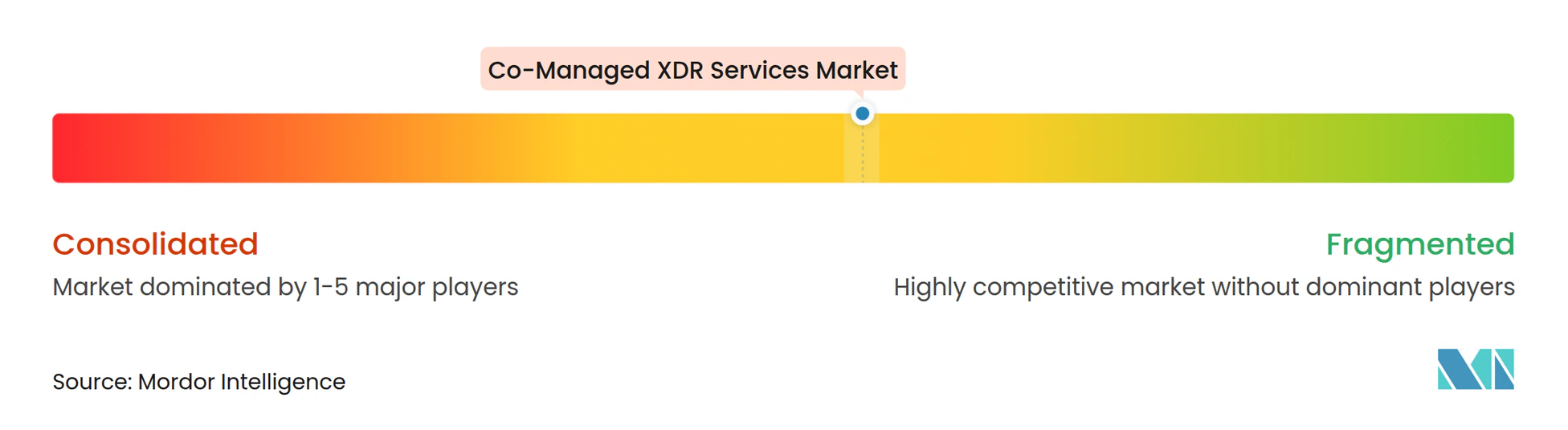
The Co-managed XDR services market is moderately fragmented globally, with different levels of concentration across platform vendors, managed detection specialists, and global systems integrators. CrowdStrike and Microsoft expanded their alliance in February 2026, making the Falcon platform available through Microsoft Marketplace for customers using Azure Consumption Commitment funds. This arrangement can reduce procurement friction while increasing competitive pressure on partner-led service delivery. Fortinet advanced its Security Operations Platform in March 2026 with unified security operations, agentic AI integrations, and expanded endpoint security within its Security Fabric architecture.
The Co-managed XDR services market has opportunities in small and medium-sized enterprise coverage, IT and OT monitoring for industrial customers, and sovereign delivery models for customers with residency obligations. Providers that accept third-party telemetry can offer an alternative to proprietary platforms when customers seek lower lock-in and more flexible operations. LevelBlue acquired Fortra’s Alert Logic MDR, XDR, and web application firewall managed businesses in January 2026, adding customers and telemetry capabilities more quickly than an organic sales approach could achieve. It had also signed an agreement to acquire Cybereason in October 2025 to add XDR, incident response, and threat intelligence capabilities. These transactions reflect the value of established client relationships and ready-to-use telemetry pipelines in a service category where onboarding quality affects customer retention.
Procurement standards also influence the competitive field, particularly in enterprise and government settings. ISO/IEC 27001 certification and SOC 2 Type II attestation are increasingly used as practical qualifying criteria for providers seeking regulated customer contracts. Smaller entrants can face a disadvantage if they lack the operational controls and documentation needed to pass these reviews. Huntress expanded distribution through Sherweb in October 2025, increasing access to its services for managed service providers across North America, Ireland, and the United Kingdom. The Co-managed XDR services market will remain shaped by the balance between platform control, service depth, local delivery capacity, and customer demand for open integration.
Co-Managed XDR Services Industry Leaders
-
Accenture plc
-
Arctic Wolf Networks, Inc.
-
Broadcom Inc.
-
Check Point Software Technologies Ltd.
-
Cisco Systems, Inc.
- *Disclaimer: Major Players sorted in no particular order
Co-Managed XDR Services Market Companies Covered in this Report
- Accenture plc
- Arctic Wolf Networks, Inc.
- Avertium, LLC
- Broadcom Inc.
- Check Point Software Technologies Ltd.
- Cisco Systems, Inc.
- CrowdStrike Holdings, Inc.
- eSentire, Inc.
- Expel, Inc.
- Fortinet, Inc.
- Google LLC
- Huntress Labs Incorporated
- International Business Machines Corporation
- LevelBlue LLC
- Microsoft Corporation
- Optiv Security Inc.
- Palo Alto Networks, Inc.
- Rapid7, Inc.
- ReliaQuest, LLC
- SentinelOne, Inc.
- Sophos Limited
- Tata Consultancy Services Limited
- Trend Micro Incorporated
- Trustwave Holdings, Inc.
- Verizon Communications Inc.
Recent Industry Developments in Co-Managed XDR Services Market
- March 2026: Fortinet announced major advances to its Security Operations Platform at Accelerate 2026, introducing a unified SOC capability, agentic AI integrations across detection and response workflows, and expanded endpoint security within a single Security Fabric architecture, extending co-managed security operations to organizations of any size without requiring standalone SOC infrastructure investment.
- February 2026: CrowdStrike and Microsoft expanded their strategic alliance, making the CrowdStrike Falcon platform available on the Microsoft Azure Marketplace against customers' existing Azure Consumption Commitment funds, reducing procurement friction for organizations seeking to layer co-managed detection on top of existing Microsoft estate investments.
- January 2026: LevelBlue and Fortra announced a strategic partnership under which LevelBlue acquired Fortra's Alert Logic MDR, XDR, and Web Application Firewall managed businesses, significantly expanding LevelBlue's global client footprint, threat telemetry volume, and cross-platform detection coverage across complex hybrid environments.
- October 2025: LevelBlue signed a definitive agreement to acquire Cybereason, adding advanced XDR, incident response, and threat intelligence capabilities to its managed security portfolio, strengthening its competitive position as a pure-play managed security provider with a broader detection platform.
Global Co-Managed XDR Services Market Report Scope
Co-Managed Extended Detection and Response (XDR) Services are collaborative cybersecurity models where an organization’s internal Security Operations Center (SOC) partners with an external managed security service provider (MSSP) to jointly operate a unified XDR technology platform. Unlike fully outsourced Managed XDR (MXDR) models, this framework provides shared visibility, control, and accountability.
The Co-Managed XDR Services Market Report is Segmented by Service Model (Co-Managed Threat Detection and 24/7 Monitoring, Co-Managed Threat Hunting and Incident Response (IR) Support, and Co-Managed Platform Engineering and Optimization), Deployment Model (Cloud-Based, Hybrid, and On-premises), Organization Size (Large Enterprises and Small and Medium-Sized Enterprises), Industry Vertical (Banking, Financial Services, and Insurance [BFSI], Healthcare and Life Sciences, IT and Telecommunications, Government and Defense, Manufacturing, Energy and Utilities, and Other Industry Verticals), and Geography (North America, South America, Europe, Asia-Pacific, Middle East, and Africa). The Market Forecasts are Provided in Terms of Value (USD).
Segmentation Overview
| Co-Managed Threat Detection and 24/7 Monitoring |
| Co-Managed Threat Hunting and Incident Response (IR) Support |
| Co-Managed Platform Engineering and Optimization |
| Cloud-Based |
| Hybrid |
| On-Premises |
| Large Enterprises |
| Small and Medium-Sized Enterprises |
| Banking, Financial Services, and Insurance (BFSI) |
| Healthcare and Life Sciences |
| IT and Telecommunications |
| Government and Defense |
| Manufacturing |
| Energy and Utilities |
| Other Industry Verticals |
| North America | United States |
| Canada | |
| Mexico | |
| South America | Brazil |
| Argentina | |
| Rest of Soutth America | |
| Europe | Germany |
| United Kingdom | |
| France | |
| Italy | |
| Spain | |
| Rest of Europe | |
| Asia-Pacific | China |
| Japan | |
| India | |
| South Korea | |
| Rest of Asia-Pacific | |
| Middle East | Saudi Arabia |
| United Emirates | |
| Rest of Middle East | |
| Africa | South Africa |
| Nigeria | |
| Rest of South Africa |
| By Service Model | Co-Managed Threat Detection and 24/7 Monitoring | |
| Co-Managed Threat Hunting and Incident Response (IR) Support | ||
| Co-Managed Platform Engineering and Optimization | ||
| By Deployment Model | Cloud-Based | |
| Hybrid | ||
| On-Premises | ||
| By Organization Size | Large Enterprises | |
| Small and Medium-Sized Enterprises | ||
| By Industry Vertical | Banking, Financial Services, and Insurance (BFSI) | |
| Healthcare and Life Sciences | ||
| IT and Telecommunications | ||
| Government and Defense | ||
| Manufacturing | ||
| Energy and Utilities | ||
| Other Industry Verticals | ||
| By Geography | North America | United States |
| Canada | ||
| Mexico | ||
| South America | Brazil | |
| Argentina | ||
| Rest of Soutth America | ||
| Europe | Germany | |
| United Kingdom | ||
| France | ||
| Italy | ||
| Spain | ||
| Rest of Europe | ||
| Asia-Pacific | China | |
| Japan | ||
| India | ||
| South Korea | ||
| Rest of Asia-Pacific | ||
| Middle East | Saudi Arabia | |
| United Emirates | ||
| Rest of Middle East | ||
| Africa | South Africa | |
| Nigeria | ||
| Rest of South Africa | ||
Key Questions Answered in the Report
What is the size of the Co-managed XDR services market?
The Co-managed XDR services market is projected to be USD 2.57 billion in 2027 and reach USD 5.69 billion by 2032, at a 17.23% CAGR from 2027 to 2032.
Which service model has the largest revenue position?
Co-managed threat detection and 24/7 monitoring held 47.89% share in 2026 because continuous monitoring is often the first coverage gap customers address.
Why is cloud deployment important for co-managed XDR services?
Cloud-based deployment held 60.72% share in 2026 and is projected to expand at a 19.21% CAGR through 2032 because it can connect data sources quickly across distributed environments.
Which customer group is expanding fastest?
Small and medium-sized enterprises are projected to expand at a 19.87% CAGR through 2032 as channel distribution and per-endpoint pricing improve access to managed protection.
Which vertical has the strongest projected expansion?
Manufacturing is projected to expand at a 19.60% CAGR through 2032 because industrial firms need better visibility across connected IT and OT environments.
Which region has the fastest projected expansion?
Asia-Pacific is projected to expand at a 20.17% CAGR through 2032, supported by digitalization, evolving security requirements, and continuing skills gaps.