
Managed Wireless IDS/IPS Services Market Size and Share
Market Overview
| Study Period | 2021 - 2032 |
|---|---|
| Market Size (2027) | USD 1.7 Billion |
| Market Size (2032) | USD 3.09 Billion |
| Growth Rate (2027 - 2032) | 12.69 % |
| Fastest Growing Market | Asia-Pacific |
| Largest Market | North America |
| Market Concentration | Medium |
Major Players *Disclaimer: Major Players sorted in no particular order Image © Mordor Intelligence. Reuse requires attribution under CC BY 4.0. | |
Managed Wireless IDS/IPS Services Market Analysis by Mordor Intelligence
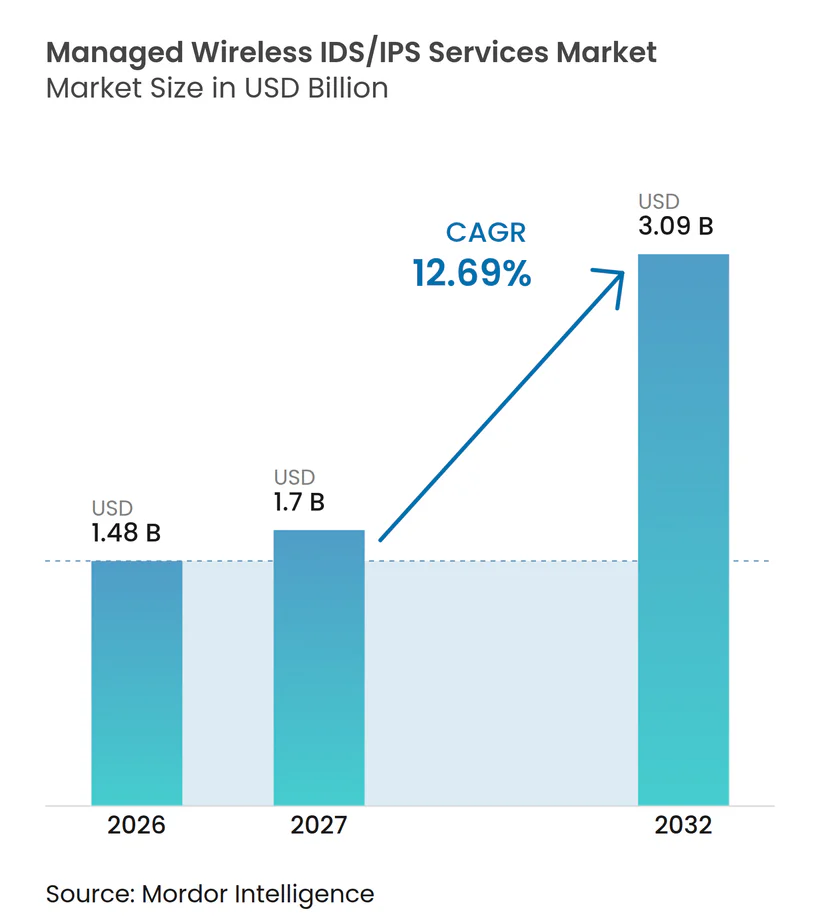
The managed wireless IDS/IPS services market size was valued at USD 1.48 billion in 2026 and is estimated to expand from USD 1.70 billion in 2027 to reach USD 3.09 billion by 2032, at a CAGR of 12.69% during the forecast period (2027-2032). Enterprise networks increasingly connect managed laptops, IoT sensors, and 5G-enabled operational technology, which gives the managed wireless IDS/IPS services market a broader security role. Organizations are deploying wireless infrastructure faster than they can build internal wireless security teams. Providers are responding with monitoring, threat hunting, and policy services that reduce the operational burden on customers. The managed wireless IDS/IPS services market also benefits as wireless telemetry becomes an input for zero-trust access policies rather than a source of alerts alone.
Key Report Takeaways
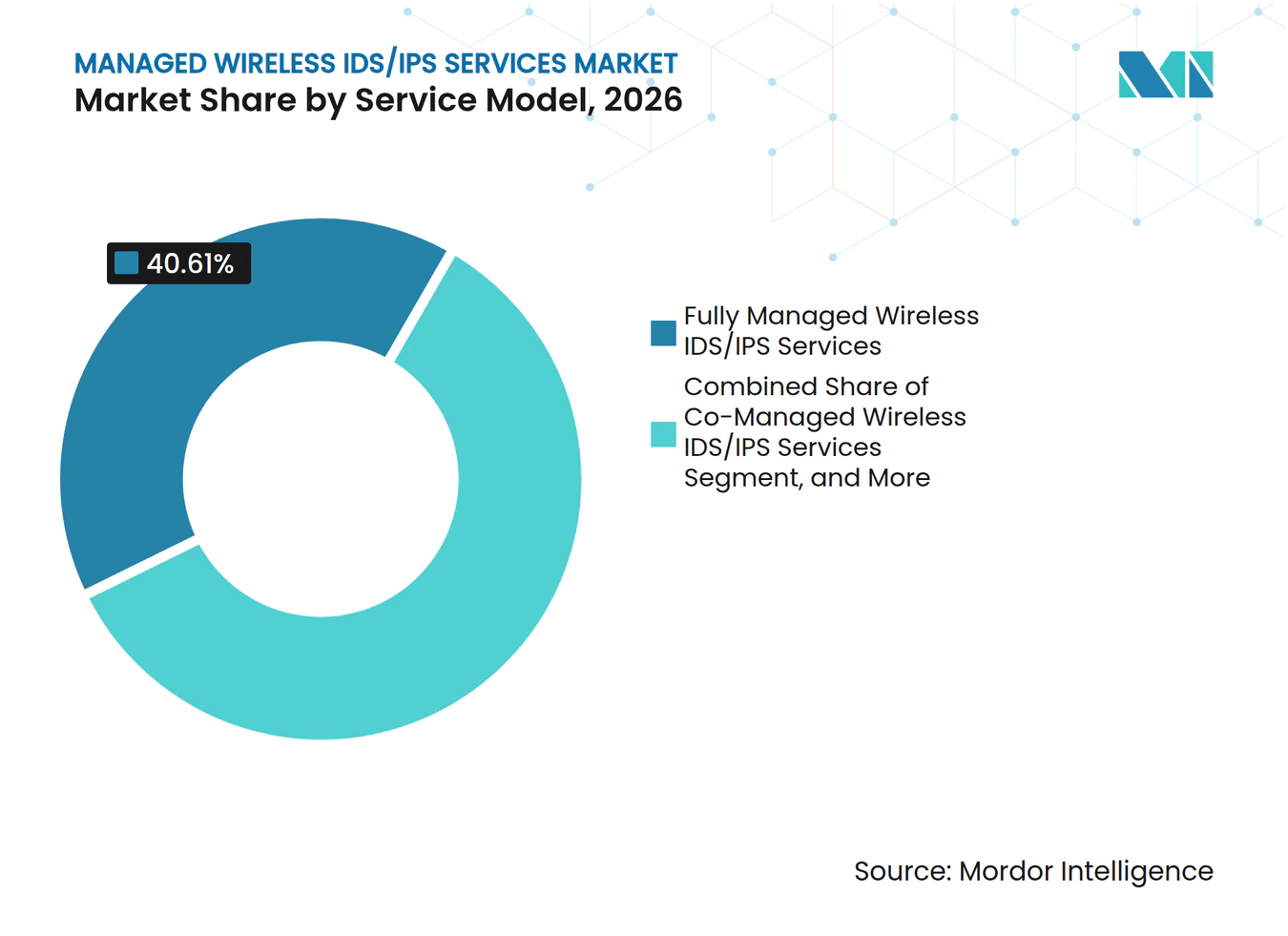
- By service model, fully managed services held 40.61% of the managed wireless IDS/IPS services market share in 2026, while co-managed services are projected to expand at a 13.72% CAGR through 2032.
- By deployment model, cloud-based services accounted for 46.27% of revenue in 2026 and are expected to register the highest CAGR of 14.69% through 2032.
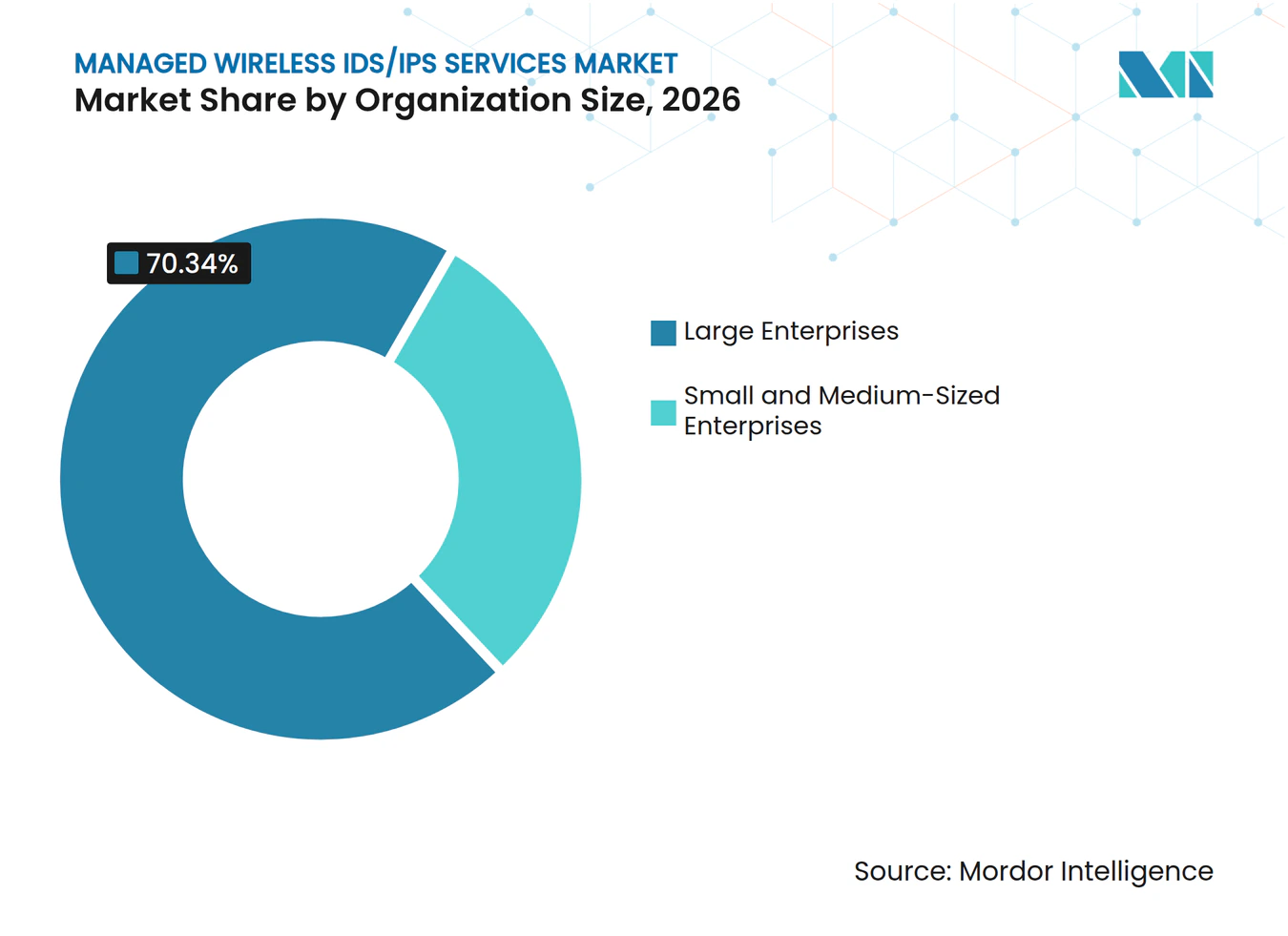
- By organization size, large enterprises accounted for 70.34% the managed wireless IDS/IPS services market share in 2026, while small and medium-sized enterprises are projected to record a 14.41% CAGR through 2032.
- By end-user industry, BFSI held 22.43% of revenue in 2026, while healthcare and life sciences are projected to advance at a 14.89% CAGR through 2032.
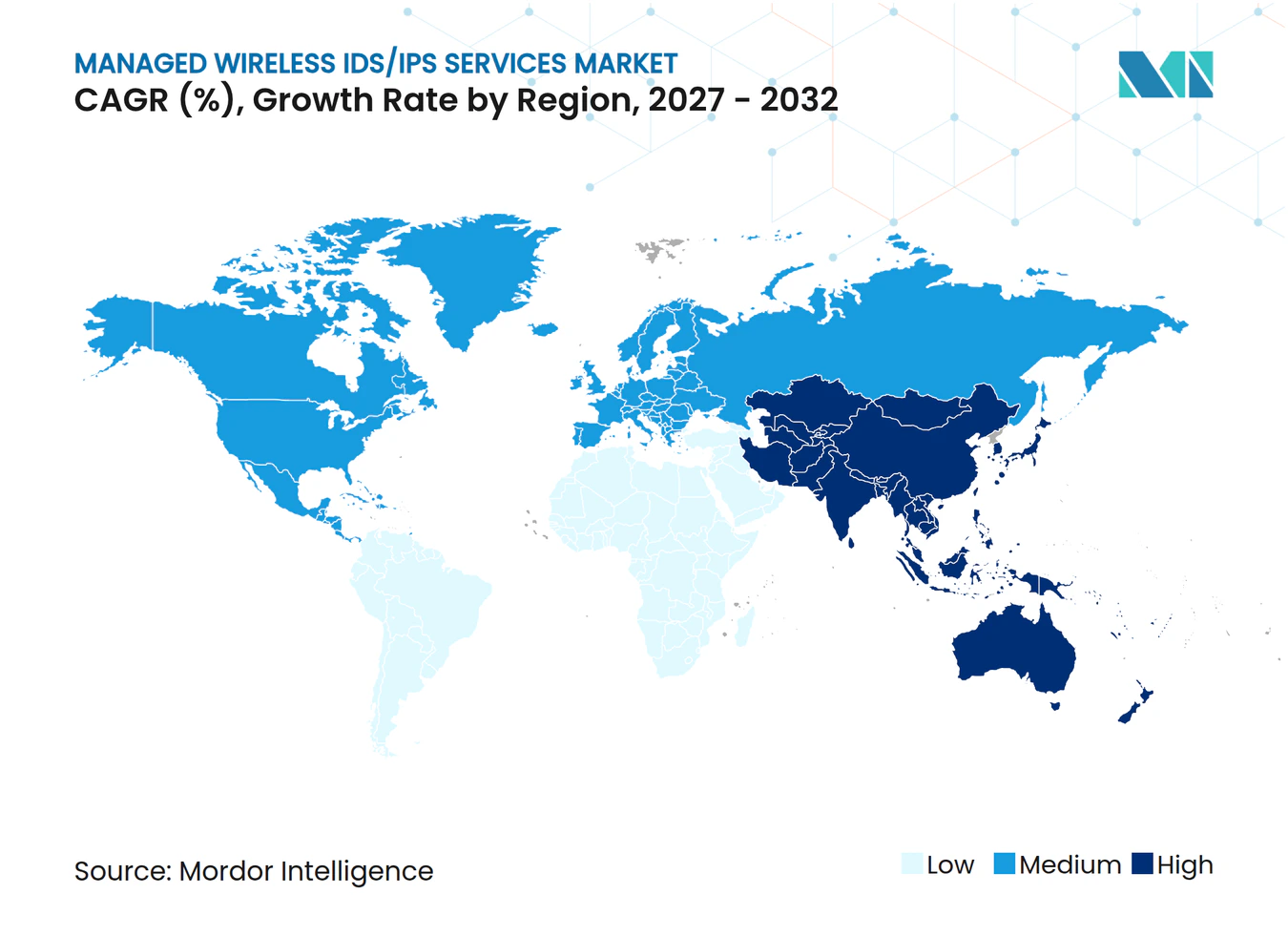
- By geography, North America accounted for 35.27% of the managed wireless IDS/IPS services market share in 2026, while Asia-Pacific is projected to expand at a 15.12% CAGR through 2032.
Note: Market numbers in this report are based on Mordor Intelligence's proprietary estimation framework, which combines nine months of actuals with Q4 projections for base year 2026.
Market Trends and Insights
Drivers Impact Analysis of Managed Wireless IDS/IPS Services Market*
| Driver | (~) % Impact on CAGR Forecast | Geographic Relevance | Impact Timeline |
|---|---|---|---|
| Escalating Wireless Attack Surface Across IoT, BYOD, and 5G Networks | +3.5% | Global | Short term (≤ 2 years) |
| Rising Demand for 24/7 Monitoring and Rapid Incident Response | +2.8% | Global | Short term (≤ 2 years) |
| Regulatory Requirements for Continuous Network Monitoring | +2.1% | North America and Europe, spillover to Asia-Pacific | Medium term (2-4 years) |
| Cybersecurity Skills Shortages and Outsourcing Demand | +1.9% | Global, accelerated in Asia-Pacific and Middle East and Africa | Medium term (2-4 years) |
| Private 5G and Industrial Wireless Deployment | +1.4% | Asia-Pacific core, spillover to North America and Europe | Long term (≥ 4 years) |
| Wireless Security Telemetry as a Control Layer for Zero-Trust Access | +1.0% | North America and Europe | Medium term (2-4 years) |
| Source: Mordor Intelligence | |||
Escalating Wireless Attack Surface Across IoT, BYOD, and 5G Networks
IoT devices, personal devices, and 5G connections have widened the wireless attack surface for many organizations. Eseye reported that 75% of surveyed businesses experienced an IoT security breach in the preceding 12 months, compared with 50% in 2024, while 76% linked most IoT project failures to device-level vulnerabilities.[1] Forescout recorded a 15% year-over-year increase in average enterprise device risk and found that routers represented more than 50% of devices with the most dangerous vulnerabilities. Zscaler recorded a 67% year-over-year increase in Android malware transactions, with attacks rising 387% in energy and 224% in healthcare. The managed wireless IDS/IPS services market is therefore moving toward coverage that can recognize device behavior, radio-frequency activity, and traffic patterns across different wireless environments, including networks that combine Wi-Fi, Bluetooth, industrial radio, and private 5G devices. A compromised IoT endpoint can enable lateral movement when a network lacks sufficient segmentation and monitoring.
Rising Demand for 24/7 Monitoring and Rapid Incident Response
Continuous monitoring has become a central reason for organizations to use managed security services. Barracuda found that 73% of surveyed organizations already use managed service providers for security, and 48% identified 24/7 coverage as the main value provided. The same survey found that 85% of organizations with 1,000 to 2,000 employees rely on managed service providers for security support. The managed wireless IDS/IPS services market is supported by demand for specialists who can interpret rogue access points, evil-twin activity, and radio-frequency anomalies across locations that may not have dedicated staff. Internal security operations teams often lack this specific experience. In the managed wireless IDS/IPS services market, providers with wireless-focused threat intelligence, clear response procedures, and tested detection processes can strengthen customer retention.
Regulatory Requirements for Continuous Network Monitoring
Compliance requirements create demand for continuous wireless monitoring that does not depend only on changes in the threat environment. The U.S. Department of Defense requires wireless IDS/IPS capabilities on unclassified and classified WLANs under DoDI 8420.01, including continuous scanning, location of unauthorized devices, systems integration, and response planning. In October 2026, NIST published IR 8625 on security requirements for RAN Intelligent Controllers in 5G Open RAN deployments and released draft IR 8623 for agencies adopting Open RAN.[2] These requirements support the managed wireless IDS/IPS services market because many organizations need documented monitoring, response controls, and evidence that their wireless environments are assessed on a continuing basis. Financial institutions and retailers also face wireless testing and network separation requirements under payment security rules. Within the managed wireless IDS/IPS services market, providers can support buyers by aligning service reports, response processes, and audit evidence with their applicable controls and internal review requirements.
Cybersecurity Skills Shortages and Outsourcing Demand
A shortage of cybersecurity talent continues to support outsourced monitoring arrangements. ISACA found that 54% of cybersecurity teams are understaffed and 58% have unfilled positions in its 2025 survey. Hiring for non-entry-level roles took 3 to 6 months at nearly half of the surveyed organizations. The managed wireless IDS/IPS services market addresses this gap by providing continuous monitoring and threat hunting without requiring every customer to employ radio-frequency security specialists, an especially practical option for teams that operate outside normal business hours. Larger organizations often retain responsibility for incident decisions while using a provider for day-to-day monitoring. Smaller organizations more often choose fully managed services because they need a simpler operating model, giving the managed wireless IDS/IPS services market a broad range of buyer requirements.
Restraints Impact Analysis of Managed Wireless IDS/IPS Services Market*
| Restraint | (~) % Impact on CAGR Forecast | Geographic Relevance | Impact Timeline |
|---|---|---|---|
| High Integration and Sensor Deployment Costs | -1.8% | Global, most acute in North America and Europe | Short term (≤ 2 years) |
| Data Sovereignty and Trust Concerns With Outsourced Monitoring | -1.2% | Europe, Asia-Pacific, Middle East | Medium term (2-4 years) |
| Wireless Telemetry Blind Spots Caused by Encryption and Protocol Diversity | -0.9% | Global | Long term (≥ 4 years) |
| RF Calibration, False Positives, and Operational Tuning Burden | -0.7% | Global | Short term (≤ 2 years) |
| Source: Mordor Intelligence | |||
High Integration and Sensor Deployment Costs
Sensor deployment and integration costs remain a material obstacle, particularly for organizations operating across many sites. Dedicated wireless IDS/IPS architectures require specialized radio-frequency engineering, sensor placement, threshold tuning, and integration with security information and event management platforms. Large distributed sites can take several months to deploy. Hardware and calibration services can extend payback periods beyond 3 years for organizations with hundreds of branches or facilities. This pressure is strongest for mid-sized buyers that do not have a separate wireless security budget. For the managed wireless IDS/IPS services market, providers that can use existing Wi-Fi 6E or Wi-Fi 7 access point fleets for software-defined monitoring can reduce the need for separate sensor hardware.
Data Sovereignty and Trust Concerns With Outsourced Monitoring
Outsourced monitoring requires customers to transmit radio-frequency telemetry, device behavior records, and network topology information to a service provider. This can raise questions about data residency and the handling of operational technology communications. Organizations in regulated sectors may require documented controls, data-processing agreements, and detailed audit trails before allowing telemetry to leave their environment. Banking and healthcare buyers can take longer to approve services when their legal and compliance teams identify risks related to sensitive data. The managed wireless IDS/IPS services market must address these concerns through localized infrastructure and clear data-handling processes. These requirements can slow procurement even when the buyer lacks the internal expertise needed to monitor wireless threats, which creates a practical delivery challenge for the managed wireless IDS/IPS services market.
*Our forecasts treat driver/restraint impacts as directional, not additive. The impact forecasts reflect baseline growth, mix effects, and variable interactions.
Managed Wireless IDS/IPS Services Market Segment Analysis
By Service Model:
Co-Managed Configurations Gain Ground in Enterprise AccountsFully managed services held 40.61% of revenue in 2026. This position reflects the needs of mid-sized and public-sector organizations that do not have sufficient in-house radio-frequency security expertise. Co-managed services are projected to record the highest service model CAGR of 13.72% through 2032. Large enterprises are moving toward shared operating models in which the provider monitors and hunts for threats while the customer retains authority over escalation, response, and policy decisions. This preference reflects greater buyer experience with wireless security incidents and a reluctance to give an external team complete incident authority.
In the managed wireless IDS/IPS services market, managed wireless security operations center services support organizations that have some internal security capability but require continuous monitoring. Managed incident response services are often structured around pre-authorized playbooks and defined escalation paths, which can provide financial institutions with more certainty when fast containment is needed. The managed wireless IDS/IPS industry is shifting toward modular arrangements that allow customers to select the level of operational control they need. Providers that let a customer move between fully managed and co-managed tiers can support changes in internal security maturity. This flexibility can also support larger commitments and stronger renewal performance.



By Deployment Model:
Cloud Delivery Accelerates Across Multi-Site Wireless EstatesCloud-based delivery accounted for 46.27% of revenue in 2026. It is also projected to register the highest deployment model CAGR of 14.69% through 2032. Cloud-hosted policy engines can apply the same detection logic across dispersed wireless sites. They also allow threat signatures and radio-frequency fingerprinting models to be updated without a manual firmware process at every location. This model is particularly useful for organizations that manage many sites with limited local security staff.
For the managed wireless IDS/IPS services market, on-premises deployments remain important for government, defense, and critical infrastructure customers with strict data sovereignty and network separation requirements. DoDI 8420.01 establishes wireless security requirements for Department of Defense WLAN environments.[3] Hybrid models allow organizations to send some telemetry to cloud analysis systems while keeping sensitive network segments on premises. A unified policy console can give customers consistent monitoring across these environments and reduce the need to reconcile alerts from several separate tools. Providers that support this approach can replace disconnected tools used by different parts of the same organization. The managed wireless IDS/IPS services market benefits when these customers can manage their mixed deployment environments without separate workflows.
By Organization Size:
SMEs Emerge as the High-Growth Buyer SegmentLarge enterprises accounted for 70.34% of revenue in 2026. Their position is linked to the scale of their wireless estates, regulatory obligations, and established cybersecurity budgets. Small and medium-sized enterprises are projected to expand at a 14.41% CAGR through 2032. Providers are offering subscription and consumption-based services to make managed coverage more accessible to buyers without dedicated wireless security teams. This creates a different buying pattern from that of large enterprises.
Large organizations in the managed wireless IDS/IPS services market increasingly seek co-managed services and deep integration with security information and event management and security orchestration platforms. Small and medium-sized enterprises place greater value on straightforward deployment and ready-to-use protection. Fully managed, cloud-based services are therefore a common fit for smaller buyers. Barracuda found that 52% of surveyed organizations want managed service providers to help manage disconnected security tools, while 51% seek help evolving their security strategy as the business expands. These requirements place managed wireless monitoring within a wider security service relationship. The managed wireless IDS/IPS industry will need service packages that address both integration needs and operational simplicity.

By End-User Industry:
BFSI Anchors the Market While Healthcare and Life Sciences AccelerateBFSI accounted for 22.43% of revenue in 2026. Branch network density and payment security obligations make continuous wireless monitoring relevant for this segment. Healthcare and life sciences are projected to record the highest vertical CAGR of 14.89% through 2032. Connected medical devices, imaging equipment, and nurse call systems have added wireless endpoints that traditional information technology security tools were not designed to monitor. Wireless security is becoming more closely connected to patient safety and operational continuity.
IT and telecommunications is the third-largest end-user vertical in the managed wireless IDS/IPS services market, where providers can include wireless monitoring in broader network operations contracts. Government and defense buyers remain strategically important because their wireless environments are subject to specific federal requirements. NIST guidance on Open RAN security adds a further reference point for 5G deployments.[4] Manufacturing organizations are adopting private 5G in smart facilities and need monitoring for 3GPP protocol activity. Retail and e-commerce organizations are adding wireless threat monitoring as point-of-sale security and loss-prevention systems become more connected. These end-user requirements broaden the managed wireless IDS/IPS services market beyond conventional office WLAN environments.
Geography Analysis
North America Managed Wireless IDS/IPS Services Market
North America accounted for 35.27% of revenue in the managed wireless IDS/IPS services market in 2026. The region has a dense base of large enterprise buyers and mature managed security service provider ecosystems. Federal and sector-specific requirements also support continuous wireless monitoring. In July 2026, AT&T Business and Palo Alto Networks made AT&T Dynamic Defense with Palo Alto Networks and AT&T SASE with Palo Alto Networks generally available.[5] These offerings combine network-integrated threat protection across wireline and wireless connections in a managed framework.
Europe Managed Wireless IDS/IPS Services Market
Europe is the second-largest regional market for managed wireless IDS/IPS services, led by Germany, the United Kingdom, and France. Demand is linked to security and supply-chain risk management requirements across energy, transport, banking, and healthcare. Telecommunications carriers can help reach markets where enterprise-direct security procurement is less developed. Orange Cyberdefense expanded into Spain through a partnership with MasOrange in May 2026. This model shows how carrier relationships can extend managed security services into additional European markets.
APAC and MEA Managed Wireless IDS/IPS Services Market
Asia-Pacific is projected to record the highest regional CAGR of 15.12% in the managed wireless IDS/IPS services market through 2032. China, India, Japan, and South Korea are increasing wireless infrastructure deployment while their exposure to cyber threats is also rising. Financial services, manufacturing, and telecommunications are important sources of demand in the region. Private 5G projects are creating monitoring requirements for 3GPP protocol stacks that many older wireless security platforms do not address. India is an important growth area as digital programs and data protection requirements encourage security operations modernization. Middle East and Africa remain earlier-stage opportunities, with smart city programs, private 5G deployments, and national cybersecurity initiatives supporting institutional demand.
Competitive Landscape
Market Concentration
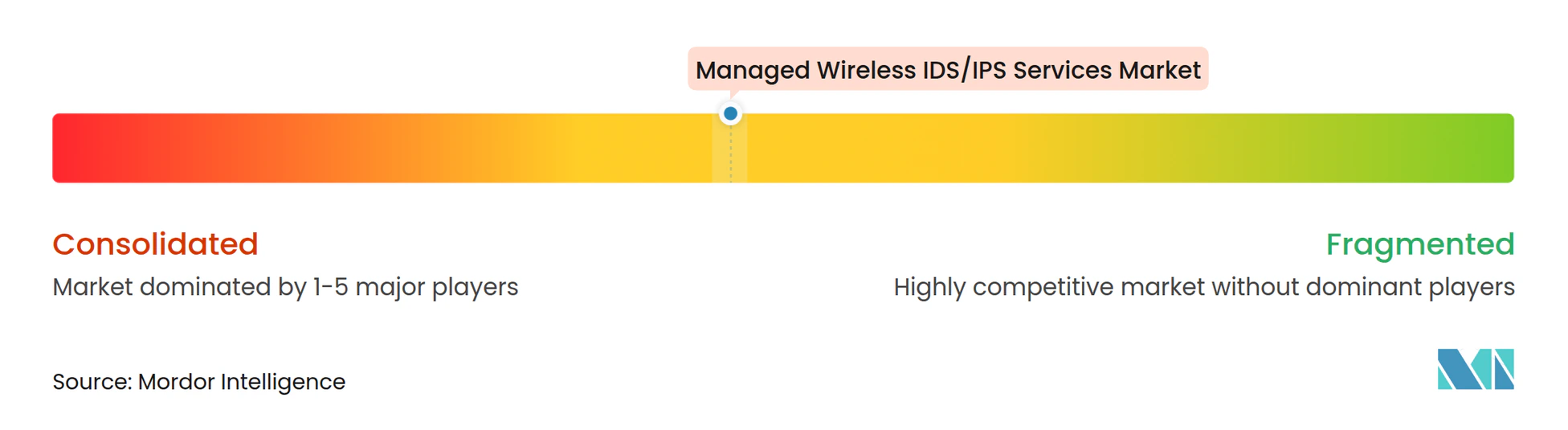
The managed wireless IDS/IPS services market is moderately consolidated. In the managed wireless IDS/IPS services market, established network security vendors compete with managed security providers, telecommunications carriers, and cloud-native security platforms. Leading providers are consolidating wireless, endpoint, cloud, and identity telemetry in unified management environments. This can reduce investigation time and position wireless monitoring as part of a broader security operations contract. Cisco introduced Security Cloud Control capabilities for managed service providers in November 2025, including multi-customer management for Hybrid Mesh Firewall and Secure Access deployments.
An important opportunity in the managed wireless IDS/IPS services market lies in private 5G environments, where many existing wireless intrusion platforms do not integrate 3GPP protocol telemetry. Co-managed services for organizations with 500 to 2,000 employees are also an opening because these customers may outgrow fully managed arrangements, but lack a dedicated wireless security function. NIST IR 8625 establishes security requirements for RAN Intelligent Controllers and can influence future procurement for validated 5G monitoring capabilities. NTT DATA and Palo Alto Networks introduced a private 5G managed security service in February 2025 that combines Private 5G architecture, Next-Generation Firewall capabilities, device profiling, and zero-trust controls.
Telecommunications carriers are a disruptive force because they can deliver security at the network layer without endpoint agents or separately managed sensor hardware. This approach can reduce the integration cost that limits adoption among mid-sized accounts. AT&T and Palo Alto Networks began a strategic collaboration on Dynamic Defense in April 2025, with enterprise customer trials planned for mid-2025. Providers without network-layer integration are focusing on threat intelligence, radio-frequency fingerprinting, and vertical packages for healthcare, financial services, and manufacturing. WatchGuard launched Total MDR in June 2025, extending managed detection and response across endpoint, identity, network, and third-party cloud applications. The managed wireless IDS/IPS services market therefore centers competition on integrated delivery, specialized detection capability, and a service model that matches customer control requirements.
Managed Wireless IDS/IPS Services Industry Leaders
-
Cisco Systems, Inc.
-
Palo Alto Networks, Inc.
-
Extreme Networks, Inc.
-
WatchGuard Technologies, Inc.
-
Sophos Limited
- *Disclaimer: Major Players sorted in no particular order
Managed Wireless IDS/IPS Services Market Companies Covered in this Report
- Cisco Systems, Inc.
- Palo Alto Networks, Inc.
- Fortinet, Inc.
- Check Point Software Technologies Ltd.
- Juniper Networks, Inc.
- Hewlett Packard Enterprise Company
- Extreme Networks, Inc.
- WatchGuard Technologies, Inc.
- Sophos Limited
- Trend Micro Incorporated
- IBM Corporation
- Trellix HoldCo, LLC
- Arctic Wolf Networks
- NETSCOUT SYSTEMS, INC.
- Dell Technologies Inc.
- Huawei Technologies Co., Ltd.
- AT&T Corp.
- NTT Security Holdings Corporation
- Accenture plc
- Verizon Communications Inc.
- Orange Cyberdefense SA
- Tata Consultancy Services Limited
Recent Industry Developments in Managed Wireless IDS/IPS Services Market
- October 2026: WatchGuard Technologies announced a series of major platform innovations at its IMPACT North America conference in Nashville, including agentic AI-powered security operations, intelligent network security, AI governance capabilities, and frictionless secure access, reinforcing its position as a unified security platform for MSPs managing wireless and hybrid security environments.
- October 2026: CBTS and Fortinet launched CBTS Fortinet Managed Services, a fully managed secure networking service targeting mid-market and multi-site organizations. The offering integrates Fortinet firewalls, switching, wireless infrastructure, and SD-WAN onto a single platform under 24/7 CBTS operations and a single monthly subscription, addressing the convergence of wireless infrastructure and security management.
- July 2026: AT&T Business and Palo Alto Networks announced the general availability of AT&T Dynamic Defense with Palo Alto Networks and AT&T SASE with Palo Alto Networks, delivering network-integrated threat protection with AI-driven security across wireline and wireless enterprise connections within a unified, fully managed security framework.
- January 2026: WatchGuard Technologies launched Open MDR, a managed detection and response service that layers expert monitoring and real-time response onto customers' existing security tools across endpoint, identity, network, and cloud environments, without requiring changes to the existing security stack.
Global Managed Wireless IDS/IPS Services Market Report Scope
Managed Wireless Intrusion Detection and Prevention Systems (IDS/IPS) Services are outsourced, network-security solutions where a specialized third-party provider assumes 24/7/365 operational responsibility for monitoring, defending, and hardening an organization's radio frequency (RF) spectrum and wireless network infrastructure.
The Managed Wireless IDS/IPS Services Market Report is Segmented by Service Model (Fully Managed Wireless IDS/IPS Services, Co-Managed Wireless IDS/IPS Services, Managed Wireless SOC and Monitoring Services, and Managed Wireless Incident Response Services), Deployment Model (Cloud-Based, On-Premises, and Hybrid) Organization Size (Large Enterprises and Small and Medium-Sized Enterprises), End-User Industry (Banking, Financial Services, and Insurance (BFSI), IT and Telecommunications, Government and Defense, Healthcare and Life Sciences, Retail and E-Commerce, Manufacturing and Industrial, and Other End-User Industries), and Geography (North America, South America, Europe, Asia-Pacific, Middle East, and Africa). The Market Forecasts are Provided in Terms of Value (USD).
Segmentation Overview
| Fully Managed Wireless IDS/IPS Services |
| Co-Managed Wireless IDS/IPS Services |
| Managed Wireless SOC and Monitoring Services |
| Managed Wireless Incident Response Services |
| Cloud-Based |
| On-Premises |
| Hybrid |
| Large Enterprises |
| Small and Medium-Sized Enterprises |
| Banking, Financial Services, and Insurance (BFSI) |
| IT and Telecommunications |
| Government and Defense |
| Healthcare and Life Sciences |
| Retail and E-Commerce |
| Manufacturing and Industrial |
| Other End-User Industries |
| North America | United States |
| Canada | |
| Mexico | |
| Europe | Germany |
| United Kingdom | |
| France | |
| Italy | |
| Rest of Europe | |
| Asia-Pacific | China |
| Japan | |
| India | |
| South Korea | |
| Rest of Asia-Pacific | |
| Middle East | Saudi Arabia |
| United Arab Emirates | |
| Rest of Middle East | |
| Africa | South Africa |
| Nigeria | |
| Rest of South Africa |
| By Service Model | Fully Managed Wireless IDS/IPS Services | |
| Co-Managed Wireless IDS/IPS Services | ||
| Managed Wireless SOC and Monitoring Services | ||
| Managed Wireless Incident Response Services | ||
| By Deployment Model | Cloud-Based | |
| On-Premises | ||
| Hybrid | ||
| By Organization Size | Large Enterprises | |
| Small and Medium-Sized Enterprises | ||
| By End-User Industry | Banking, Financial Services, and Insurance (BFSI) | |
| IT and Telecommunications | ||
| Government and Defense | ||
| Healthcare and Life Sciences | ||
| Retail and E-Commerce | ||
| Manufacturing and Industrial | ||
| Other End-User Industries | ||
| By Geography | North America | United States |
| Canada | ||
| Mexico | ||
| Europe | Germany | |
| United Kingdom | ||
| France | ||
| Italy | ||
| Rest of Europe | ||
| Asia-Pacific | China | |
| Japan | ||
| India | ||
| South Korea | ||
| Rest of Asia-Pacific | ||
| Middle East | Saudi Arabia | |
| United Arab Emirates | ||
| Rest of Middle East | ||
| Africa | South Africa | |
| Nigeria | ||
| Rest of South Africa | ||
Key Questions Answered in the Report
What is the managed wireless IDS/IPS services market size?
The sector is valued at USD 1.48 billion in 2026 and is projected to reach USD 3.09 billion by 2032, with a 12.69% CAGR from 2027 to 2032.
What is driving demand for managed wireless intrusion detection and prevention services?
Greater use of IoT devices, personal devices, and 5G-connected equipment is increasing the need for continuous wireless monitoring, specialized threat response, consistent security policy enforcement across sites, and support for teams without radio-frequency security specialists.
Which service model is expanding fastest?
Co-managed services are projected to record a 13.72% CAGR through 2032 as enterprises retain response authority while outsourcing monitoring, threat hunting, and the review of radio-frequency events.
Why are cloud-based managed wireless security services important?
Cloud-based delivery held 46.27% of revenue in 2026 and allows providers to apply consistent monitoring policies, update detection logic, and maintain visibility across dispersed sites.
Which customer group has the strongest projected expansion?
Small and medium-sized enterprises are projected to advance at a 14.41% CAGR through 2032 because managed services reduce the need for dedicated wireless security staff and simplify daily operations.
Which region is projected to expand fastest?
Asia-Pacific is projected to record a 15.12% CAGR through 2032 as wireless deployment, private 5G projects, and managed security demand increase across major regional economies.