
Managed OT IDS/IPS Services Market Size and Share
Market Overview
| Study Period | 2021 - 2032 |
|---|---|
| Market Size (2027) | USD 4.04 Billion |
| Market Size (2032) | USD 8.07 Billion |
| Growth Rate (2027 - 2032) | 14.84 % |
| Fastest Growing Market | Asia-Pacific |
| Largest Market | North America |
| Market Concentration | Medium |
Major Players *Disclaimer: Major Players sorted in no particular order Image © Mordor Intelligence. Reuse requires attribution under CC BY 4.0. | |
Managed OT IDS/IPS Services Market Analysis by Mordor Intelligence
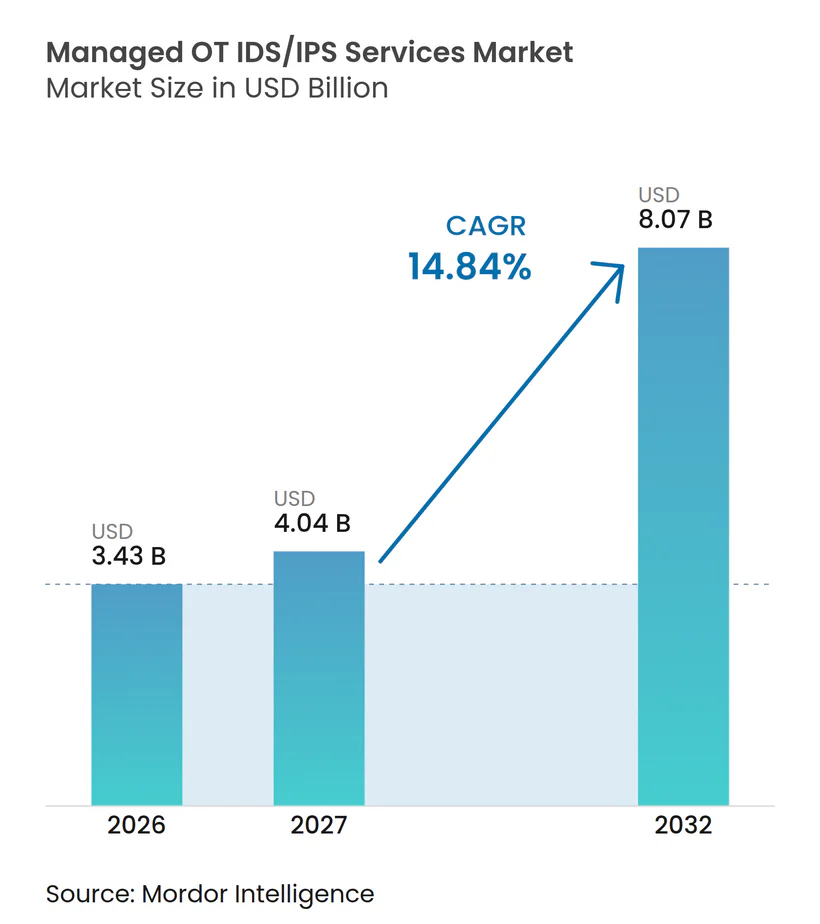
The Managed OT IDS/IPS services market size is projected to expand from USD 3.43 billion in 2026 and USD 4.04 billion in 2027 to USD 8.07 billion by 2032, registering a CAGR of 14.84% between 2027 to 2032. Ransomware activity, connected industrial assets, and formal monitoring obligations are increasing the need for continuous visibility across control environments. The Managed OT IDS/IPS services market is also shaped by the limited availability of specialists who understand both industrial processes and cyber defense. Providers are therefore moving toward shared operating models that combine external monitoring with internal engineering knowledge. The strongest opportunity is for services that can protect connected assets without interrupting production, while modular contracts can lower adoption barriers for smaller operators.
Key Report Takeaways
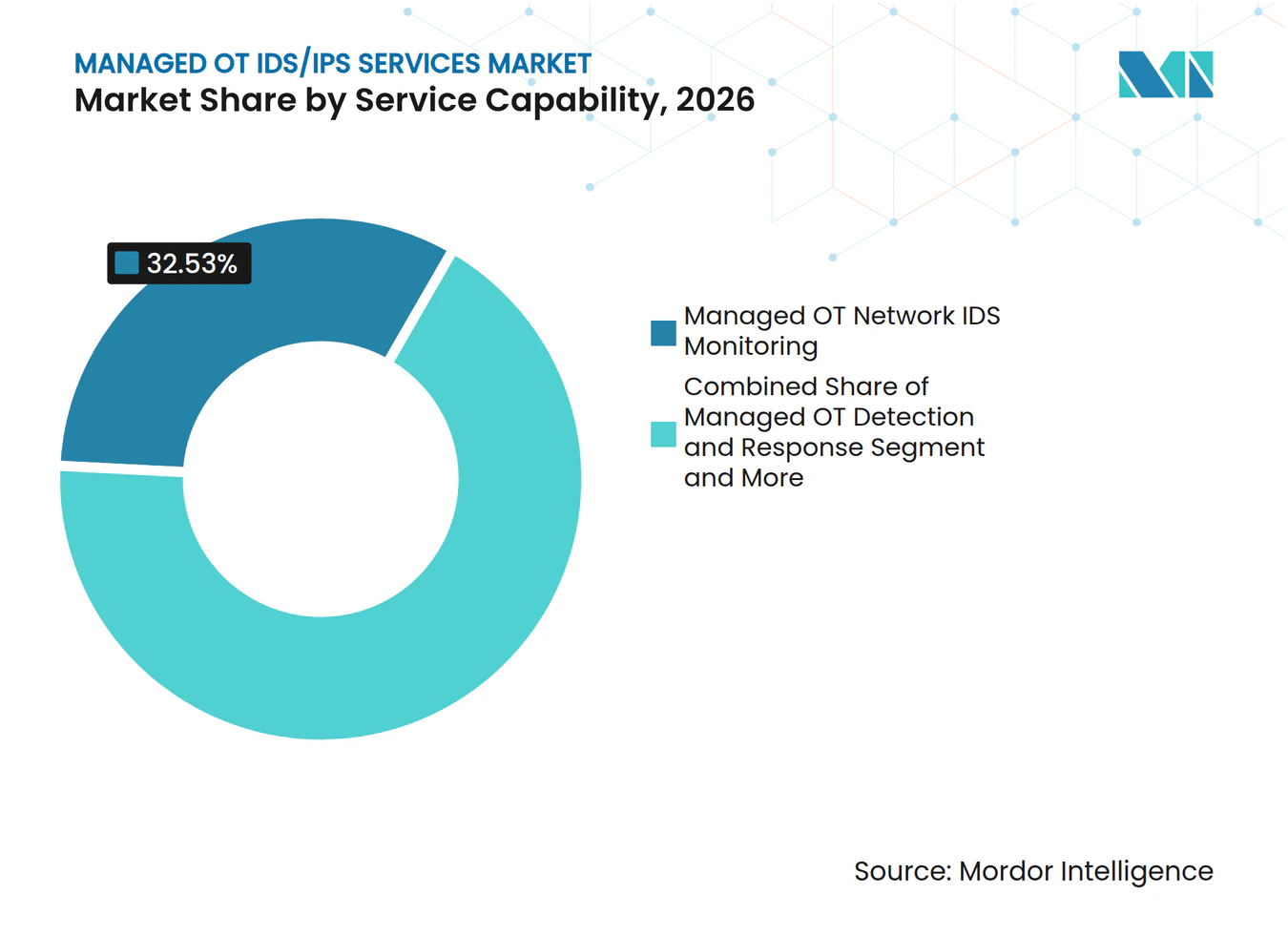
- By service capability, Managed OT Network IDS Monitoring held 32.53% of the managed OT IDS/IPS services market share in 2026, while Managed OT Intrusion Prevention and Policy Enforcement is projected to expand at a 16.92% CAGR through 2032.
- By delivery model, Co-Managed OT SOC accounted for 43.29% of the market share in 2026 and is projected to expand at a 15.93% CAGR through 2032.
- By deployment mode, Hybrid held 51.49% of the managed OT IDS/IPS services market share in 2026 and is projected to expand at a 16.22% CAGR through 2032.
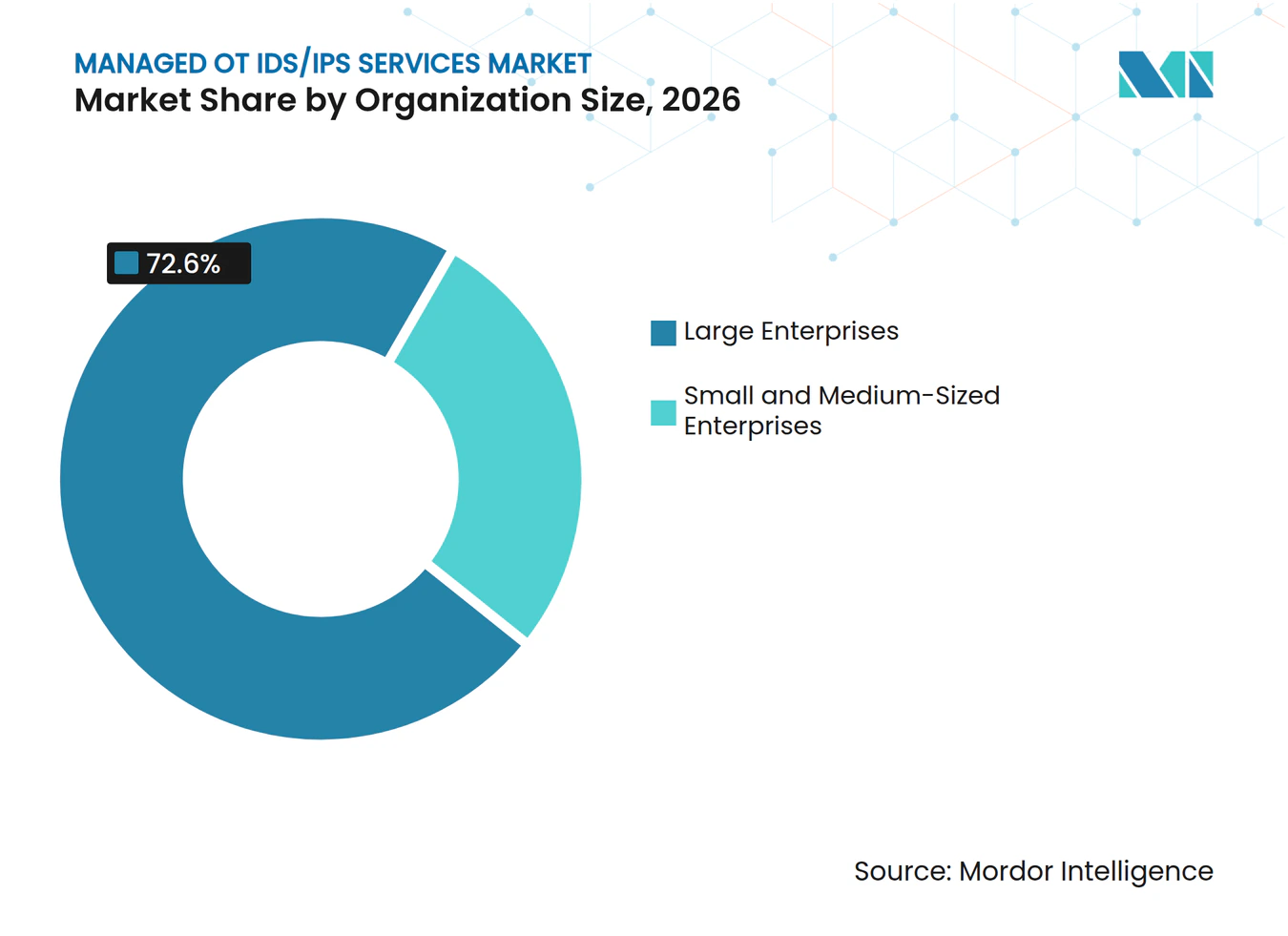
- By organization size, Large Enterprises accounted for 72.60% of the market share in 2026, while Small and Medium-Sized Enterprises are projected to expand at a 17.31% CAGR through 2032.
- By industry vertical, Energy and Utilities held 27.13% of the market share in 2026, while Pharmaceuticals, Life Sciences, and Biotech are projected to expand at a 16.53% CAGR through 2032.
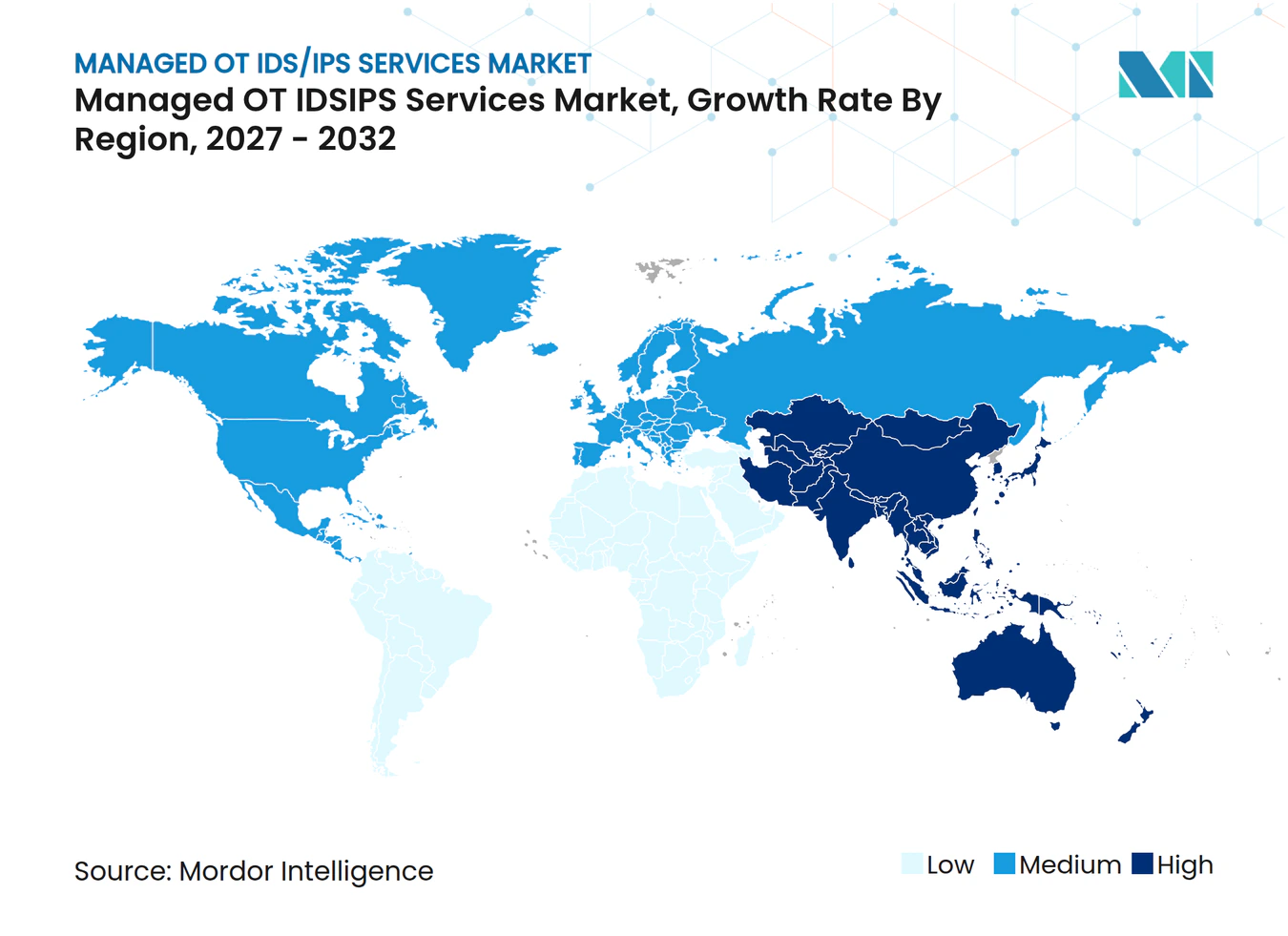
- By geography, North America held 36.81% of the managed OT IDS/IPS services market share in 2026, while Asia-Pacific is projected to expand at a 17.14% CAGR through 2032.
Note: Market numbers in this report are based on Mordor Intelligence's proprietary estimation framework, which combines nine months of actuals with Q4 projections for base year 2026.
Market Trends and Insights
Drivers Impact Analysis of Managed OT IDS/IPS Services Market*
| Driver | (~) % Impact on CAGR Forecast | Geographic Relevance | Impact Timeline |
|---|---|---|---|
| Ransomware and State-Linked Attacks on Critical Infrastructure | +3.2% | Global | Short term (≤ 2 years) |
| IT-OT Convergence and Industrial Digitalization | +2.8% | Global | Medium term (2-4 years) |
| Regulatory Mandates for Continuous Monitoring and Incident Response | +2.5% | North America and Europe | Medium term (2-4 years) |
| Shortage of OT Cybersecurity Specialists | +2.0% | Global | Long term (≥ 4 years) |
| Expansion of Distributed and Remote Industrial Assets | +1.6% | Global | Medium term (2-4 years) |
| Demand for Vendor-Neutral 24/7 OT SOC Coverage | +1.3% | Global | Short term (≤ 2 years) |
| Source: Mordor Intelligence | |||
Ransomware and State-Linked Attacks on Critical Infrastructure
Ransomware groups targeting industrial organizations increased 49% year over year in 2025, with 119 groups affecting 3,300 organizations globally. The same record describes a change from network positioning toward mapping control loops and assessing conditions that could disrupt processes. Average ransomware dwell time in OT environments reached 42 days in 2025, compared with 5 days for organizations using comprehensive OT monitoring. CISA, the FBI, and international partners urged organizations to mitigate threats from pro-Russia hacktivist groups targeting internet-facing OT devices in December 2025. These conditions favor the Managed OT IDS/IPS services market because uninterrupted monitoring can shorten the period between a compromise and an informed operational response.
IT-OT Convergence and Industrial Digitalization
The integration of enterprise systems with operational environments expands the number of routes through which an IT compromise can reach plant networks. In the SANS 2025 survey, 58% of respondents identified IT compromises spreading into OT networks as the leading initial attack vector. A 2026 IEEE Access study found that SMEs often lack a structured method for mapping ISO 27001 and NIST SP 800-82 controls to individual Purdue model levels. IIoT devices, cloud-connected SCADA platforms, and predictive maintenance systems add more assets and telemetry for internal teams to oversee. The Managed OT IDS/IPS services market benefits when a provider can monitor the IT-OT boundary and the OT interior through one coordinated service.
Regulatory Mandates for Continuous Monitoring and Incident Response
Regulatory expectations have increasingly moved from voluntary guidance toward enforceable monitoring and incident response obligations for critical infrastructure. FERC Order 907 approved NERC CIP-015-1 in June 2025, requiring internal network security monitoring within the Electronic Security Perimeter for applicable electric utilities. The NIS2 Directive requires risk management, monitoring, and incident reporting across essential sectors in the European Union. CISA and the UK National Cyber Security C issued joint guidance in September 2025 that called for OT practices aligned with IEC 62443 and ISO/IEC 27001. The Managed OT IDS/IPS services market can benefit from these requirements because service delivery can combine collection, triage, and reporting in a defined operating model.
Shortage of OT Cybersecurity Specialists
The limited supply of personnel with OT security experience makes internal program development difficult for many industrial operators. The SANS 2025 survey reported that only 9% of professionals spend all of their time on ICS or OT security. CREST found that 85% of surveyed organizations believed skills shortages constrained service quality, while 76% identified specialist personnel as the largest market-entry barrier.[1] Managed providers can spread specialist capacity, training costs, and analytical tools across several client engagements. This staffing structure supports the Managed OT IDS/IPS services market because it gives operators access to expertise that would be costly to build and retain internally.
Restraints Impact Analysis of Managed OT IDS/IPS Services Market*
| Restraint | (~) % Impact on CAGR Forecast | Geographic Relevance | Impact Timeline |
|---|---|---|---|
| Operational Disruption Risk During Security Deployment | -1.4% | Global | Short term (≤ 2 years) |
| Legacy and Proprietary OT Integration Complexity | -1.1% | Global | Long term (≥ 4 years) |
| Limited OT Telemetry and Unmanaged Asset Visibility | -0.8% | Asia-Pacific and South America | Medium term (2-4 years) |
| Budget Friction from Multi-Year Service Commitments | -0.6% | Asia-Pacific and South America | Long term (≥ 4 years) |
| Source: Mordor Intelligence | |||
Operational Disruption Risk During Security Deployment
Inline packet inspection and blocking can interfere with deterministic, real-time protocols that control physical processes. A misconfigured control in a SCADA environment can cause safety, regulatory, and production consequences that are more serious than a brief interruption in an IT network. This risk keeps some operators in passive IDS-only positions and delays their move to active prevention services. Sensor installation can also require planned maintenance windows in brownfield facilities. The Managed OT IDS/IPS services market is better positioned where providers use phased methods that start with passive visibility and introduce prevention controls only after baselines and response processes are established.
Legacy and Proprietary OT Integration Complexity
Proprietary communication protocols can create detection blind spots when a platform cannot decode them. Legacy PLCs and DCS installations were built for reliability in isolated networks, not integration with modern security sensors. A 2026 survey in the Journal of Network and Computer Applications found that IT-OT cybersecurity integration must address distinct communication layers across the Purdue model.[2] Custom parser development and manual asset inventories add time and cost to onboarding. The Managed OT IDS/IPS services market faces slower deployment in multi-vendor brownfield sites, where service providers must maintain broad protocol libraries and explain remaining coverage limits clearly.
*Our forecasts treat driver/restraint impacts as directional, not additive. The impact forecasts reflect baseline growth, mix effects, and variable interactions.
Managed OT IDS/IPS Services Market Segment Analysis
By Service Capability:
Network IDS Monitoring Anchors the Revenue FoundationManaged OT Network IDS Monitoring accounted for 32.53% of the Managed OT IDS/IPS services market share in 2026. Passive network monitoring is commonly the first managed control that industrial operators adopt because it observes traffic without directly changing the process. The service relies on OT-specific protocol decoders and behavioral baselines that are difficult for many operators to create and maintain internally. This technical requirement makes an established outsourcing relationship harder to replace once detection processes are tuned to a site. Detection and response, threat hunting, and managed vulnerability monitoring can then be added as clients need more active support. Compliance expectations under NERC CIP-015 and NIS2 also encourage a gradual move from visibility to response readiness. Managed OT Security Control Administration reduces the burden of maintaining sensor settings and rule libraries across multiple locations. That work becomes important when configuration drift causes duplicated alerts or weakens the reliability of detection rules. The Managed OT IDS/IPS services industry, therefore, has a stable entry point in network monitoring, with later expansion into higher-value service capabilities.
Managed OT Intrusion Prevention and Policy Enforcement is projected to expand at a 16.92% CAGR from 2027 to 2032. Clients that begin with IDS contracts can move toward prevention after monitoring has established a clearer picture of normal network behavior. This progression remains cautious because operators must be confident that an automated response will not disrupt a critical process. Nozomi Networks introduced active threat prevention in Nozomi Arc in October 2025, including OT-safe endpoint quarantine designed to avoid disrupting production. The development shows how prevention features are being integrated with monitored endpoints rather than offered as a separate technology layer. Providers must still prove that enforcement policies reflect site-specific safety and operating requirements. Passive monitoring remains the foundation for that proof because it provides the data needed to tune rules before they are activated. As clients gain confidence, prevention services can raise contract depth without requiring a complete replacement of their existing monitoring architecture. This staged path supports broader adoption across the Managed OT IDS/IPS services market.



By Delivery Model:
Co-Managed OT SOC Sets the Dominant Operating PreferenceCo-Managed OT SOC held 43.29% of the market share in 2026, making it the largest delivery model. The model combines external detection expertise and 24/7 coverage with the internal engineers who understand equipment behavior and production constraints. Internal teams remain essential during alert escalation because a response can require physical intervention at the equipment level. A fully managed model can be appropriate when an operator has little internal security capacity or faces a short compliance deadline. Larger operators, however, often retain co-management to keep critical process knowledge close to decision making. Retainer and specialized services address demand for defined incident response, threat hunting, and expert support assignments. The delivery choice reflects the safety-sensitive nature of OT operations rather than a simple preference for outsourcing. Shared dashboards and joint escalation playbooks can reduce delays between a provider’s detection and a plant team’s decision. This makes co-management a durable operating preference within the Managed OT IDS/IPS services market.
NTT DATA launched UnifiedMDR for OT Security in Japan in March 2025 for electric power, gas, water, and manufacturing clients.[3] The service combines consulting, solution deployment, and 24/7 SOC operations. That integrated approach reduces handoffs between assessment, deployment, monitoring, and response. It also illustrates how a provider can structure a service around the customer’s existing operational team rather than replace it entirely. The Managed OT IDS/IPS services industry can gain where providers give customers clear visibility into case status, asset context, and escalation decisions. A centralized SOC without this collaboration can struggle to interpret the operational importance of an alert. Co-managed services are particularly relevant for distributed environments where local engineering teams hold different forms of process knowledge. Standardized service design may also make co-management more accessible to smaller multi-site companies. The model therefore links technical coverage with the trust needed to authorize timely action.
By Deployment Mode:
Hybrid Architecture Captures the Operational Middle GroundHybrid held 51.49% of the market share in 2026 and is projected to expand at a 16.22% CAGR through 2032. This architecture balances the isolation requirements of safety-critical assets with the scale offered by cloud analytics. On-premises-only deployments preserve local separation but can create growing infrastructure requirements across multi-site operations. Cloud-only approaches can simplify management but may require telemetry to leave the operating environment. Some energy and defense settings restrict that data transfer or require an additional justification. Hybrid designs process raw packet data locally and forward enriched, de-identified information for centralized analysis. This approach preserves a local security boundary while allowing a service team to compare patterns across locations. It also gives providers a workable route to support remote monitoring without requiring full cloud migration. The Managed OT IDS/IPS services market benefits because a hybrid design addresses a central operational concern without removing analytical scale.
Cloud-native OT security platforms, including Nozomi Vantage and Claroty xDome, are designed to support selective telemetry offload rather than a full transfer of plant data. Claroty’s collaboration with Google Security Operations in August 2025 connected its xDome and Continuous Threat Detection capabilities with a cloud-native security operations platform.[4] The integration can help customers correlate IT and OT events through a unified workflow. Cloud-based deployments are more viable in food manufacturing, consumer goods, and logistics when data sovereignty concerns are less restrictive. They may also reduce the local maintenance burden for organizations with limited technical staff. Hybrid delivery remains more suitable where raw packet data must stay inside the facility. The operational choice is therefore driven by asset criticality, regulatory obligations, and the sensitivity of telemetry. Providers that offer both local collection and centralized analysis can serve a broader range of deployment requirements. This flexibility supports competition across the Managed OT IDS/IPS services market.
By Organization Size:
SMEs Chart the Fastest Growth PathLarge Enterprises accounted for 72.60% of the market in 2026. Their lead reflects denser asset bases, more regulatory exposure, and larger cybersecurity budgets than smaller operators. These organizations often operate many plants, substations, or field sites that need centrally coordinated monitoring. Their need for consistent coverage supports sizable managed service contracts. SMEs have a different starting point because they may have limited internal resources dedicated to OT security. The SANS survey found that only 9% of ICS and OT security professionals devote all of their time to OT security. This staffing limitation can make continuous coverage difficult to sustain without external support. Large enterprise demand provides current revenue scale, but it does not remove the importance of smaller operators as a future customer base. Different onboarding, pricing, and support models are required across the Managed OT IDS/IPS services market.
Small and Medium-Sized Enterprises are projected to expand at a 17.31% CAGR from 2027 to 2032. Supply-chain cybersecurity requirements from tier-1 manufacturers can extend compliance expectations to smaller contractors without providing a matching increase in budget or staff. The 2026 IEEE Access study identified gaps in the application of established IT controls to SME OT environments. This creates room for services that combine guidance, asset visibility, and continuous monitoring. Multi-tenant sensor management can help providers serve smaller sites without making each deployment prohibitively expensive. Standardized onboarding for common ICS platforms can also reduce the time before a customer receives useful monitoring. Contract terms need to match SME budget cycles and provide a clear service outcome. These measures can lower the cost and complexity that otherwise delay adoption. The Managed OT IDS/IPS services market size for SMEs can expand as providers align service design with these constraints.

By Industry Vertical:
Energy Leads, Life Sciences AcceleratesEnergy and Utilities accounted for 27.13% of the market in 2026. The sector combines high consequences of disruption with broad regulatory obligations and assets dispersed across large areas. Generation plants, substations, pipeline control nodes, and field equipment all require monitoring that can be difficult for one internal team to cover. State-affiliated threats also keep operational cybersecurity close to executive and regulatory attention. Oil and gas, chemicals and process manufacturing, and government and defense face similar concerns where a successful intrusion can affect production, safety, or public services. Those conditions support managed IDS and IPS contracts even where service pricing is high. Energy customers also need providers that understand both centralized control rooms and remote assets. This requirement favors services that can maintain consistent visibility across varied industrial locations. The Managed OT IDS/IPS services industry remains closely tied to the sector’s compliance and resilience needs.
Pharmaceuticals, Life Sciences, and Biotech are projected to expand at a 16.53% CAGR from 2027 to 2032. FDA data integrity obligations under 21 CFR Part 11 can extend monitoring requirements from production systems into automated research and laboratory environments. This creates a compliance case for continuous visibility that is distinct from the traditional critical infrastructure rationale. Claroty reported record OT vulnerability disclosures in 2025, which adds to the workload facing teams responsible for connected manufacturing systems. Managed services can help prioritize relevant advisories and connect them to the assets and processes affected. Transportation and logistics is another developing area as smart ports, airports, and rail systems add connected operational infrastructure. These environments need monitoring approaches that accommodate availability requirements and many physical locations. Industrial vertical expansion broadens the customer base beyond the sectors that historically led OT security spending. This diversity creates more paths for the Managed OT IDS/IPS services market to develop.
Geography Analysis
North America Managed OT IDS/IPS Services Market
North America held 36.81% of the market in 2026. The United States has a high concentration of regulated critical infrastructure, and FERC Order 907 approved NERC CIP-015-1 in June 2025, creating an internal monitoring obligation for applicable electric utilities. Canada adds demand through its connected electric grid and related protections. Mexico remains at an earlier stage, with adoption centered on oil and gas and automotive manufacturing sites that follow multinational cybersecurity standards. The region’s compliance framework and larger managed security budgets sustain demand for specialized services in the Managed OT IDS/IPS services market.
Europe and South America Managed OT IDS/IPS Services Market
Europe has a complex compliance environment because NIS2 establishes security, monitoring, and reporting requirements across essential sectors. Germany’s automotive, chemicals, and mechanical engineering base creates concentrated demand, while the United Kingdom, France, and Italy are also important markets. CISA and the UK NCSC guidance calls for OT practices aligned with IEC 62443 and ISO/IEC 27001, reinforcing standard-based service delivery. This setting gives the Managed OT IDS/IPS services market a regulatory basis for adoption across Europe and South America, where demand is concentrated in Brazil’s oil and gas sector and Argentina’s energy and utilities operators.
APAC and MEA Managed OT IDS/IPS Services Market
Asia-Pacific is projected to expand at a 17.14% CAGR from 2027 to 2032. Industrial digitalization and national cybersecurity requirements in China, India, Japan, South Korea, and Singapore are increasing the need for OT monitoring. Japan’s Ministry of Economy, Trade and Industry issued OT security guidelines for semiconductor factories in 2025, linking plant security expectations with recognized international practices. The Middle East is developing quickly, particularly in Saudi Arabia and the United Arab Emirates, where national programs set cybersecurity standards for critical infrastructure. Africa remains at an earlier stage outside South Africa and Nigeria, although mining, energy, and utilities operators are beginning to formalize needs that support the Managed OT IDS/IPS services market.
Competitive Landscape
Market Concentration
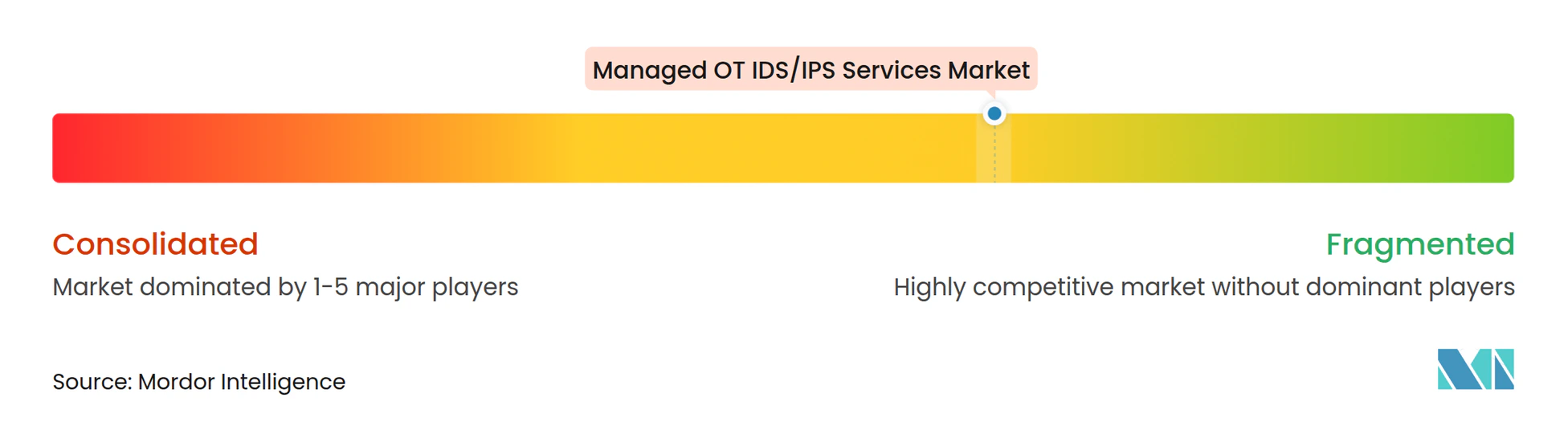
The Managed OT IDS/IPS services market is moderately fragmented across OT-focused security specialists, global managed security providers, systems integrators, and industrial automation companies. OT-native providers compete through threat intelligence, industrial protocol knowledge, and tailored SOC workflows, while larger providers contribute scale and established IT security relationships. Automation vendors can combine cybersecurity services with engineering, control systems, and lifecycle support. This mix leaves room for differentiated co-managed services, especially for multi-site SMEs with annual cybersecurity budgets below USD 500,000. IEC 62443 alignment and the ability to work safely with internal plant teams are important procurement considerations within the Managed OT IDS/IPS services market.
Accenture entered into agreements in June 2026 to acquire a majority stake in Dragos, along with runZero and NetRise, at a combined enterprise value of USD 4.175 billion. The transactions combine OT threat intelligence, exposure assessment, and firmware-level device security capabilities. Honeywell expanded its OT Cybersecurity Suite in June 2026 with a vendor-agnostic OT SOC managed service and an AI-powered Cyber Proactive Defense capability. Nozomi Networks also introduced an automated OT endpoint response capability in October 2025 that included detection, quarantine, and delete modes. These actions show that platform integration and automated response are central competitive priorities.
Managed OT IDS/IPS Services Industry Leaders
-
Accenture plc
-
ABB Ltd.
-
Atos SE
-
Capgemini SE
-
Honeywell International Inc.
- *Disclaimer: Major Players sorted in no particular order
Managed OT IDS/IPS Services Market Companies Covered in this Report
- Accenture plc
- ABB Ltd.
- Atos SE
- Capgemini SE
- Cisco Systems, Inc.
- Claroty Ltd.
- Deloitte Touche Tohmatsu Limited
- Dragos, Inc.
- Honeywell International Inc.
- IBM Corporation
- Kyndryl, Inc.
- NTT DATA Group Corporation
- Nozomi Networks Inc.
- Orange Cyberdefense International
- Rockwell Automation, Inc.
- Schneider Electric SE
- Siemens AG
- Tenable Holdings, Inc.
- TXOne Networks Inc.
- Wipro Limited
- Yokogawa Electric Corporation
- Palo Alto Networks, Inc.
- Fortinet, Inc.
- Microsoft Corporation
- Armis, Inc.
Recent Industry Developments in Managed OT IDS/IPS Services Market
- June 2026: Accenture plc entered into agreements to acquire a majority stake in Dragos, Inc. and 100% of runZero and NetRise at a combined enterprise value of USD 4.175 billion, subject to regulatory approvals. The transaction combines Dragos’s OT threat intelligence and detection platform with exposure assessment and firmware-level device security capabilities, establishing the most comprehensive OT security offering attached to a global systems integrator.
- June 2026: Honeywell International Inc. expanded its OT Cybersecurity Suite with 5 capabilities, including a 24/7 vendor-agnostic OT Security Operations Center managed service and an AI-powered Cyber Proactive Defense monitoring solution. The expansion directly extends Honeywell’s managed services addressable market across manufacturing, energy, and critical infrastructure.
- October 2025: Nozomi Networks Inc. announced the industry’s first automated threat response capability for OT endpoints within Nozomi Arc, introducing detection, quarantine, and delete modes for active threat prevention without disrupting production. The announcement shifts the service boundary from passive managed IDS toward active managed IPS within a single platform.
- September 2026: Dragos, Inc. launched Dragos Platform 3.0, introducing an Insights Hub consolidating risk-based vulnerability and threat alerts into a prioritized view, AI-enhanced vulnerability analysis, and streamlined response workflows designed to accelerate managed OT defense engagements.
Global Managed OT IDS/IPS Services Market Report Scope
Managed OT IDS/IPS (Operational Technology Intrusion Detection and Prevention Systems) services are outsourced, industrial cybersecurity solutions where a specialized third-party provider assumes 24/7 operational responsibility for monitoring, detecting, and mitigating cyber threats across an organization’s physical infrastructure, industrial control systems (ICS), and supervisory control and data acquisition (SCADA) networks.
The Managed OT IDS/IPS Services Market Report is Segmented by Service Capability (Managed OT Network IDS Monitoring, Managed OT Intrusion Prevention and Policy Enforcement, Managed OT Detection and Response, OT Threat Hunting and Managed Vulnerability Monitoring, and Managed OT Security Control Administration), Delivery Model (Fully Managed OT SOC, Co-Managed OT SOC, and Retainer and Specialized OT Services), Deployment Mode (On-Premises, Cloud-Based, and Hybrid), Organization Size (Large Enterprises and Small and Medium-Sized Enterprises), Industry Vertical (Energy and Utilities, Oil and Gas, Chemicals and Process Manufacturing, Pharmaceuticals, Life Sciences, and Biotech, Transportation and Logistics, Government and Defense, and Other Industry Verticals), and Geography (North America, South America, Europe, Asia-Pacific, Middle East, and Africa). The Market Forecasts are Provided in Terms of Value (USD).
Segmentation Overview
| Managed OT Network IDS Monitoring |
| Managed OT Intrusion Prevention and Policy Enforcement |
| Managed OT Detection and Response |
| OT Threat Hunting and Managed Vulnerability Monitoring |
| Managed OT Security Control Administration |
| Fully Managed OT SOC |
| Co-Managed OT SOC |
| Retainer and Specialized OT Services |
| On-Premises |
| Cloud-Based |
| Hybrid |
| Large Enterprises |
| Small and Medium-Sized Enterprises |
| Energy and Utilities |
| Oil and Gas |
| Chemicals and Process Manufacturing |
| Pharmaceuticals, Life Sciences, and Biotech |
| Transportation and Logistics |
| Government and Defense |
| Other Industry Verticals |
| North America | United States |
| Canada | |
| Mexico | |
| South America | Brazil |
| Argentina | |
| Rest of South America | |
| Europe | United Kingdom |
| Germany | |
| France | |
| Italy | |
| Rest of Europe | |
| Asia-Pacific | China |
| Japan | |
| India | |
| South Korea | |
| Rest of Asia-Pacific | |
| Middle East | Saudi Arabia |
| United Arab Emirates | |
| Rest of Middle East | |
| Africa | South Africa |
| Nigeria | |
| Rest of Africa |
| By Service Capability | Managed OT Network IDS Monitoring | |
| Managed OT Intrusion Prevention and Policy Enforcement | ||
| Managed OT Detection and Response | ||
| OT Threat Hunting and Managed Vulnerability Monitoring | ||
| Managed OT Security Control Administration | ||
| By Delivery Model | Fully Managed OT SOC | |
| Co-Managed OT SOC | ||
| Retainer and Specialized OT Services | ||
| By Deployment Mode | On-Premises | |
| Cloud-Based | ||
| Hybrid | ||
| By Organization Size | Large Enterprises | |
| Small and Medium-Sized Enterprises | ||
| By Industry Vertical | Energy and Utilities | |
| Oil and Gas | ||
| Chemicals and Process Manufacturing | ||
| Pharmaceuticals, Life Sciences, and Biotech | ||
| Transportation and Logistics | ||
| Government and Defense | ||
| Other Industry Verticals | ||
| By Geography | North America | United States |
| Canada | ||
| Mexico | ||
| South America | Brazil | |
| Argentina | ||
| Rest of South America | ||
| Europe | United Kingdom | |
| Germany | ||
| France | ||
| Italy | ||
| Rest of Europe | ||
| Asia-Pacific | China | |
| Japan | ||
| India | ||
| South Korea | ||
| Rest of Asia-Pacific | ||
| Middle East | Saudi Arabia | |
| United Arab Emirates | ||
| Rest of Middle East | ||
| Africa | South Africa | |
| Nigeria | ||
| Rest of Africa | ||
Key Questions Answered in the Report
What is the size of the managed OT IDS/IPS services market?
The managed OT IDS/IPS services market is projected at USD 4.04 billion in 2027 and USD 8.07 billion by 2032, at a 14.84% CAGR.
Why are industrial operators adopting managed OT security services?
Ransomware, connected industrial assets, monitoring obligations, and specialist shortages are increasing the need for continuous external support.
Which service capability leads managed OT IDS/IPS services?
Managed OT Network IDS Monitoring led with 32.53% share in 2026 because passive monitoring is often the first control adopted in operational settings.
Why is hybrid deployment important for OT security?
Hybrid deployment held 51.49% share in 2026 because it supports local data handling while allowing centralized analytics and managed monitoring.
Which customer group has the strongest projected expansion?
Small and Medium-Sized Enterprises are projected to expand at a 17.31% CAGR through 2032 as supply-chain requirements reach smaller industrial operators.
Which region is projected to expand fastest?
Asia-Pacific is projected to expand at a 17.14% CAGR through 2032 as industrial digitalization and national security requirements progress.