
Managed IDS/IPS Services Market Size and Share
Market Overview
| Study Period | 2021 - 2032 |
|---|---|
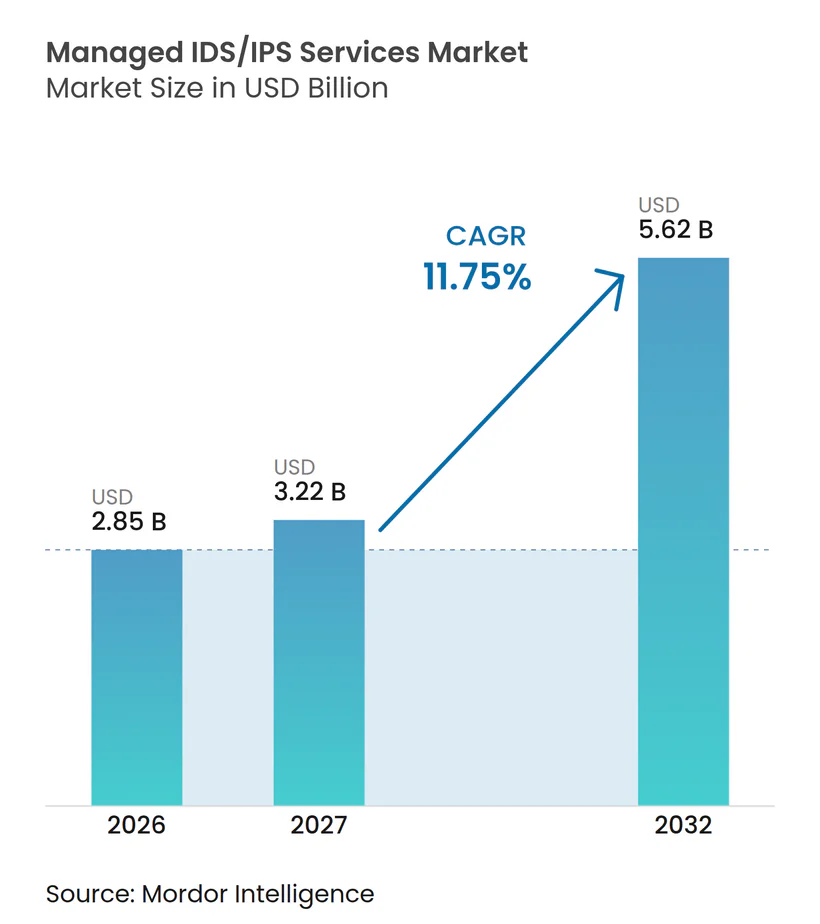
| Market Size (2027) | USD 3.22 Billion |
| Market Size (2032) | USD 5.62 Billion |
| Growth Rate (2027 - 2032) | 11.75 % |
| Fastest Growing Market | Asia-Pacific |
| Largest Market | North America |
| Market Concentration | Medium |
Major Players *Disclaimer: Major Players sorted in no particular order Image © Mordor Intelligence. Reuse requires attribution under CC BY 4.0. | |
Managed IDS/IPS Services Market Analysis by Mordor Intelligence
The managed IDS/IPS services market size is projected to expand from USD 2.85 billion in 2026 and USD 3.22 billion in 2027 to USD 5.62 billion by 2032, registering a CAGR of 11.75% between 2027 to 2032. Ransomware, supply-chain exposure, and vulnerability exploitation are making continuous detection a priority for enterprise security teams. Regulatory obligations in financial services and critical infrastructure are also turning continuous monitoring into a documented compliance requirement. Providers are responding with managed detection offerings that combine network visibility, analyst support, and automated investigation. Demand is shifting toward services that can monitor cloud workloads, internal network activity, and industrial environments without separating these security domains. The managed IDS/IPS services market also favors providers that can support local data processing where customers face data-residency obligations.
Key Report Takeaways
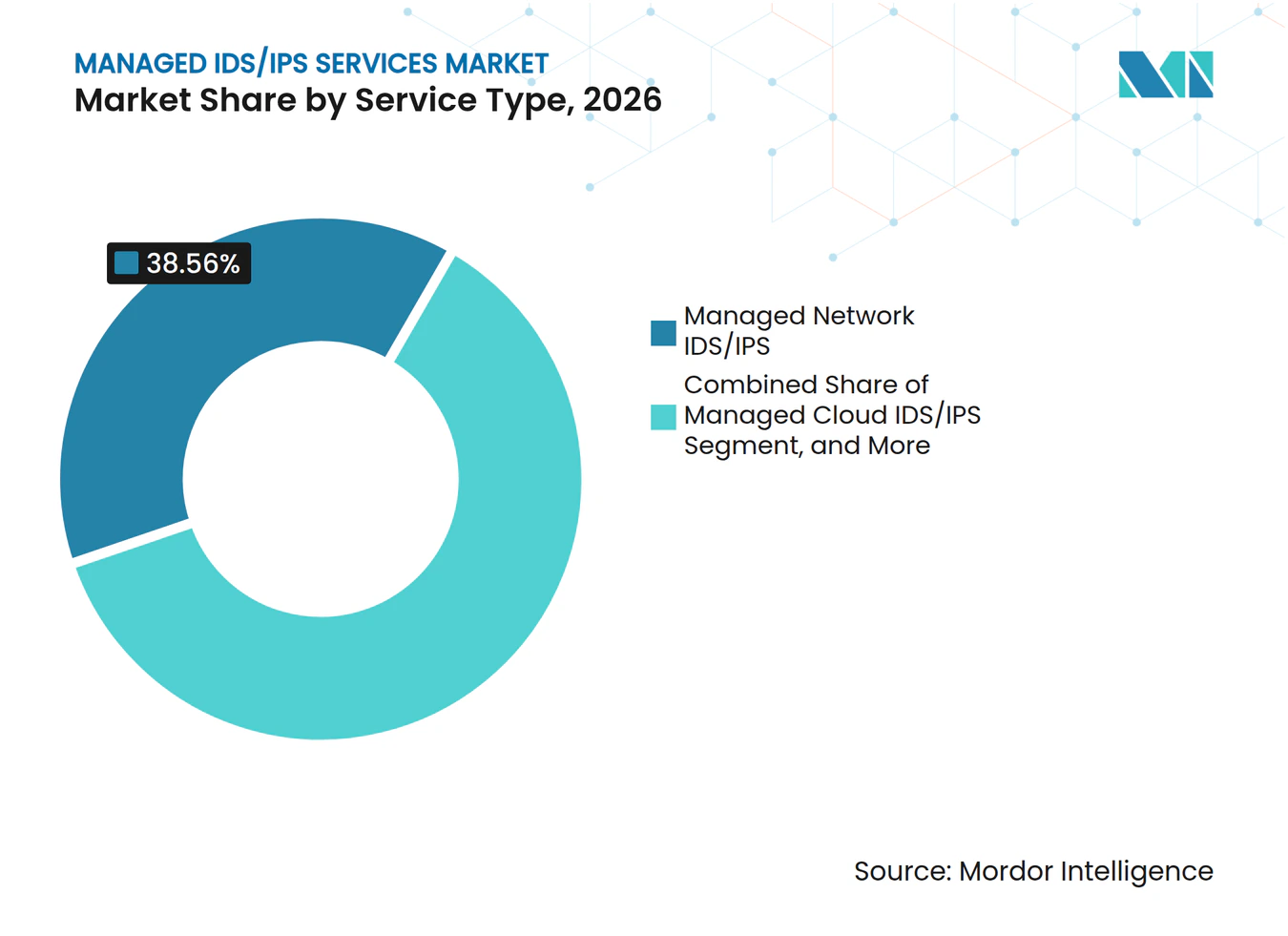
- By service type, Managed Network IDS/IPS held 38.56% of the managed IDS/IPS services market share in 2026, while Managed Cloud IDS/IPS is projected to expand at a 12.56% CAGR through 2032.
- By end-user industry, BFSI accounted for 23.44% of revenue in 2026, while Energy and Utilities is projected to expand at a 12.74% CAGR through 2032.
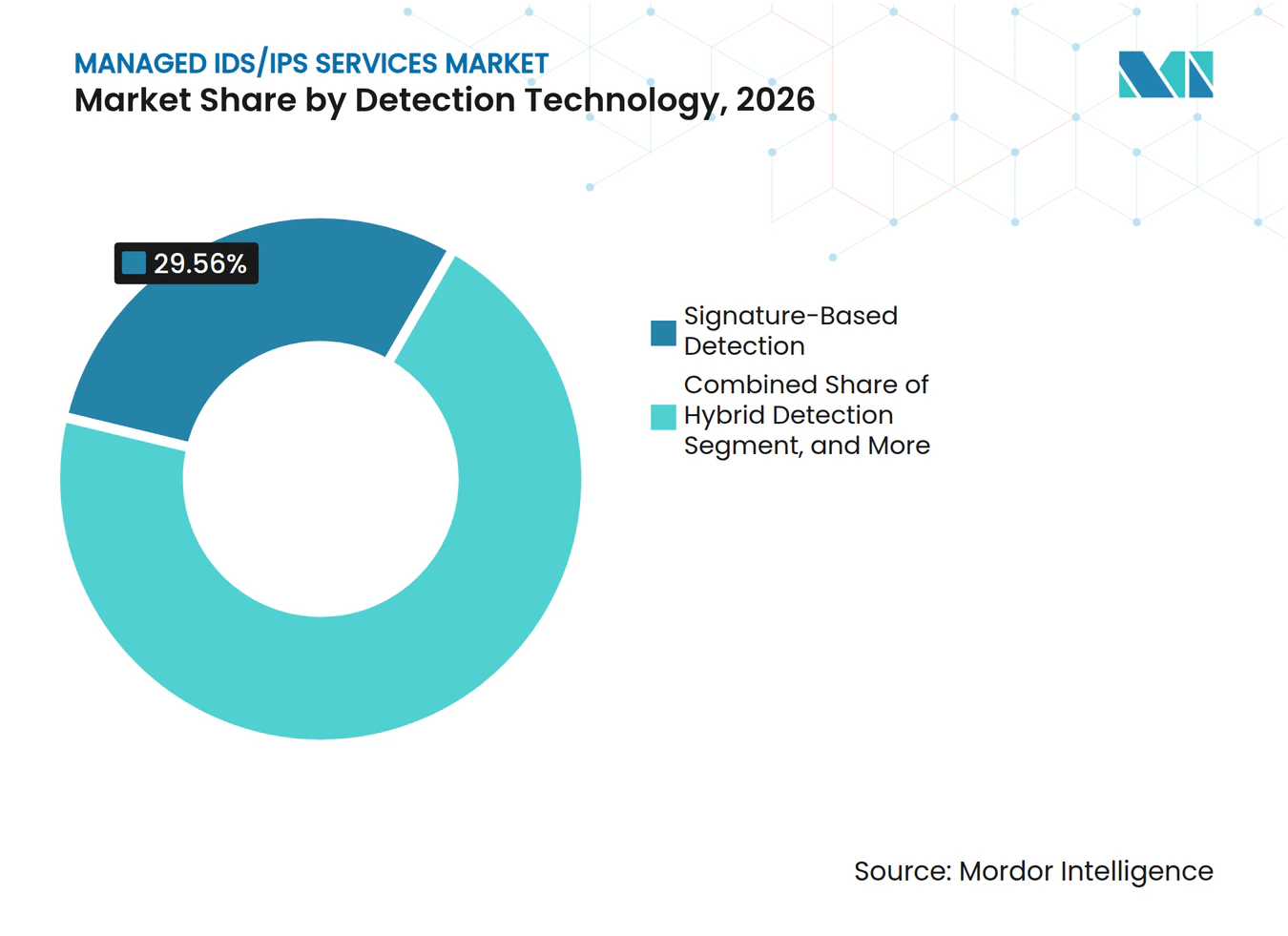
- By detection technology, Signature-Based Detection held 29.56% of revenue in 2026, while Hybrid Detection is projected to expand at a 12.54% CAGR through 2032.
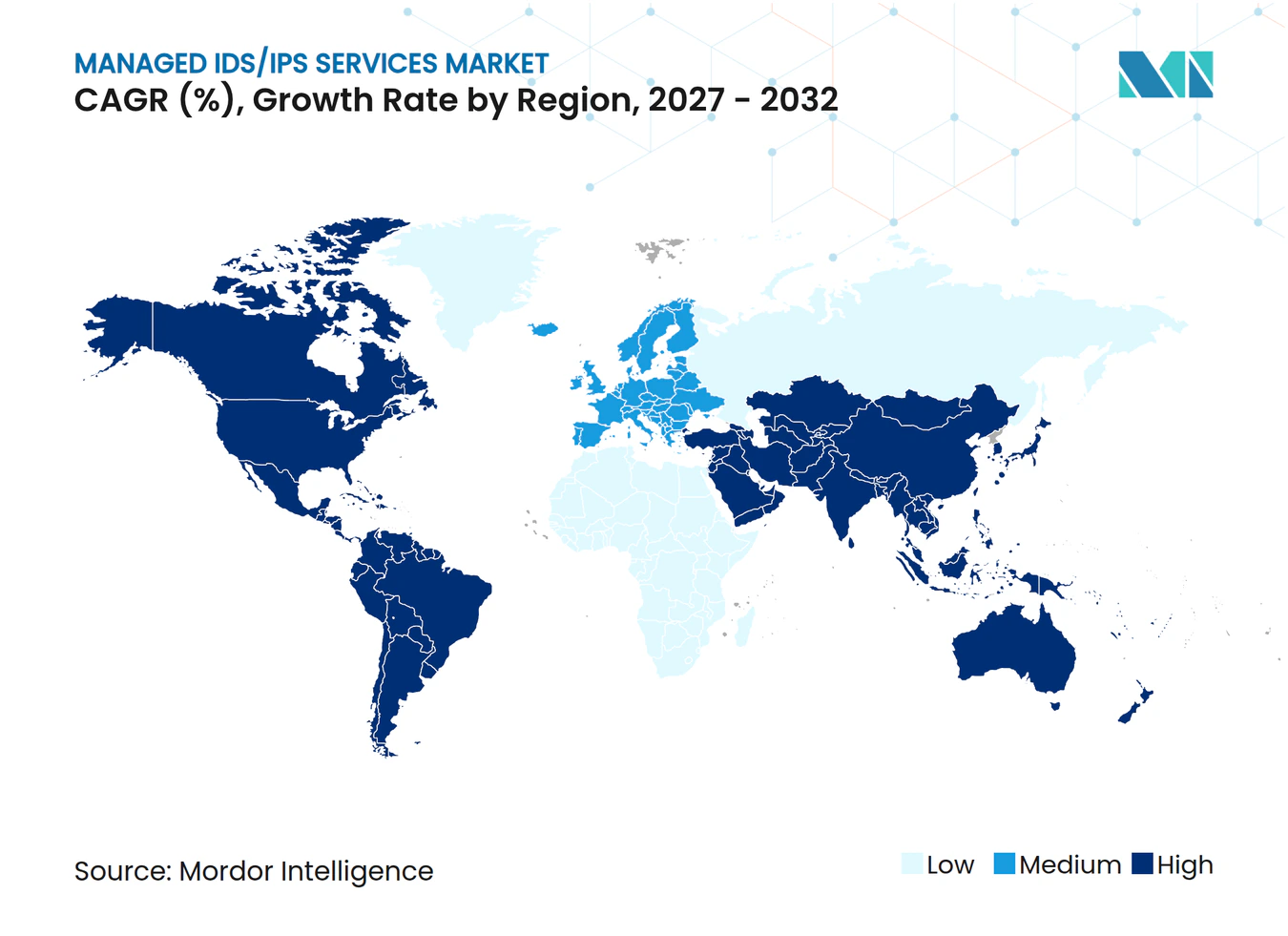
- By geography, North America held 42.34% of revenue in 2026, while Asia-Pacific is projected to expand at a 12.82% CAGR through 2032.
Note: Market numbers in this report are based on Mordor Intelligence's proprietary estimation framework, which combines nine months of actuals with Q4 projections for base year 2026.
Market Trends and Insights
Drivers Impact Analysis of Managed IDS/IPS Services Market*
| Driver | (~) % Impact on CAGR Forecast | Geographic Relevance | Impact Timeline |
|---|---|---|---|
| Escalating Ransomware and Supply-Chain Intrusions | +2.8% | Global | Short term (≤ 2 years) |
| Shortage of In-House Security Operations Talent | +2.1% | Global, acute in North America and Western Europe | Medium term (2-4 years) |
| Cloud and Hybrid-Network Expansion | +1.9% | Global, led by North America and Asia-Pacific | Medium term (2-4 years) |
| Compliance Mandates for Continuous Monitoring | +1.5% | North America and Europe | Medium term (2-4 years) |
| Managed IDS/IPS as a Lower-Capex SOC Entry Point | +1.1% | South America, Asia-Pacific, Middle East and Africa | Long term (≥ 4 years) |
| Network Telemetry Convergence Across IT, OT, and Cloud | +0.8% | North America, Europe, Asia-Pacific industrial markets | Long term (≥ 4 years) |
| Source: Mordor Intelligence | |||
Escalating Ransomware and Supply-Chain Intrusions Drive Urgent Procurement
Ransomware appeared in 48% of breaches analyzed in Verizon's 2026 report, compared with 44% in the preceding report.[1] Vulnerability exploitation became the leading initial access method after 19 years in which stolen credentials had held that position. This change raises the value of managed monitoring because known weaknesses can be exploited before internal teams complete remediation. Supply-chain attacks also require visibility beyond inbound traffic because trusted third-party connections can carry activity inside an established perimeter. The managed IDS/IPS services market benefits when providers can analyze supplier traffic and internal movement together. Behavioral baselining is relevant in this setting because it can identify unusual activity even where a connection already has trusted access.
Shortage of In-House Security Operations Talent Accelerates Outsourcing
ISACA reported that 58% of cybersecurity teams were understaffed in 2026, while 49% had open roles that required 3 to 6 months to fill.[2] ISC2 found that 95% of surveyed organizations had at least 1 critical cybersecurity skills need, and 59% described that need as significant or critical. The issue extends beyond staffing numbers because teams may lack skills to tune behavioral analytics or investigate identity-related activity. ISACA also identified LLM SecOps skills as a gap for 45% of respondents in 2026. Managed IDS/IPS services can provide investigation capacity and analyst expertise where customers cannot build the same capability internally. Providers that shorten the path from alert to a confirmed decision can support renewals and broader service adoption.
Cloud and Hybrid-Network Expansion Outpaces On-Premises Sensor Coverage
Cloud and hybrid environments create telemetry across containers, serverless functions, application programming interfaces, and virtual networks. Traditional on-premises sensors cannot provide full coverage of these layers. Detection methods must therefore work across varied cloud environments and changing application components. Temporary cloud workloads may be created and removed before conventional sensor coverage is applied. This creates short periods in which an attacker can operate without the visibility available in a fixed network environment. The managed IDS/IPS services market is therefore moving toward cloud-native inspection of lateral traffic and workload anomalies. Kubernetes-aware detection can help providers observe pod-to-pod activity and unusual serverless behavior.
Compliance Mandates for Continuous Monitoring Create Recurring Contract Floors
The Digital Operational Resilience Act took effect on January 17, 2025, and requires covered EU financial entities to manage ICT risk and classify incidents.[3] NIS2 is being implemented across EU member states and covers 18 critical sectors, with fines that can reach EUR 10 million for essential entities. U.S. listed companies must disclose material cybersecurity incidents within 4 business days under SEC rules. These obligations make real-time evidence and documented monitoring processes more important in procurement. The managed IDS/IPS services market can benefit where providers map telemetry to regulatory controls and preserve audit records. Customers may change a detection service, but replacing the evidence process connected to regulatory reporting is more difficult.
Restraints Impact Analysis of Managed IDS/IPS Services Market*
| Restraint | (~) % Impact on CAGR Forecast | Geographic Relevance | Impact Timeline |
|---|---|---|---|
| Alert-Fatigue and False-Positive Costs | -1.4% | Global | Short term (≤ 2 years) |
| Data Sovereignty and Cross-Border Telemetry Restrictions | -1.1% | Europe, Asia-Pacific | Medium term (2-4 years) |
| Resistance to Outsourcing High-Privilege Blocking Decisions | -0.8% | North America, Europe | Medium term (2-4 years) |
| Encrypted Traffic Visibility Gaps in Hybrid Networks | -0.6% | Global | Long term (≥ 4 years) |
| Source: Mordor Intelligence | |||
Alert-Fatigue and False-Positive Costs Erode Contract Value
High false-positive volumes can reduce confidence in a managed IDS/IPS service and consume analyst time. Large environments can produce more alerts than human analysts can investigate quickly. This creates a practical challenge for managed monitoring teams that must sort and prioritize large alert volumes. False-positive overflow also limits proactive threat hunting and detection tuning. Providers can reduce this problem by routing high-confidence cases through automation and directing unfamiliar cases to analysts with investigation context. The managed IDS/IPS services market faces slower contract adoption when customers expect a service to add noise rather than improve prioritization.
Data Sovereignty and Cross-Border Telemetry Restrictions Constrain Architecture
Data-localization rules can require network telemetry to remain within national borders for processing. This requirement can conflict with a centralized cloud architecture that serves customers from a single processing location. ISACA identifies third-party ICT service providers as part of the contractual resilience obligations associated with NIS2 and DORA. Separate regional processing nodes can increase operating costs and make signature updates more complex. They can also limit cross-customer threat intelligence aggregation that supports behavioral detection. Smaller providers may find it difficult to fund sovereign processing capacity in regulated European and Asia-Pacific markets. The result can favor providers with local infrastructure and established regional operations.
*Our forecasts treat driver/restraint impacts as directional, not additive. The impact forecasts reflect baseline growth, mix effects, and variable interactions.
Managed IDS/IPS Services Market Segment Analysis
By Service Type:
Cloud Workloads Redraw the Detection PerimeterManaged Network IDS/IPS accounted for 38.56% of the managed IDS/IPS services market share in 2026. Enterprises with large on-premises footprints in BFSI, government, and manufacturing continue to require deterministic perimeter enforcement and low-latency blocking. Managed Host IDS/IPS supports file-integrity monitoring and host-behavior auditing, while Managed Wireless IDS/IPS supports spectrum anomaly detection in campus and industrial environments. These services allow customers to align monitoring coverage with their network architecture and operational requirements. Fixed infrastructure and established traffic routes continue to support network-based monitoring in these settings.
Managed Cloud IDS/IPS is projected to expand at a 12.56% CAGR through 2032. Multi-cloud and hybrid deployments are moving relevant traffic beyond the reach of on-premises sensors. The managed IDS/IPS services industry is responding with services designed to observe cloud-native layers and internal traffic within virtual private clouds. Inspection of east-west traffic can identify lateral movement that perimeter devices may not see. Providers are also seeking coverage for temporary workloads that are provisioned and removed rapidly.



By End-User Industry:
Energy and Utilities Emerges as the Growth CatalystBFSI accounted for 23.44% of managed IDS/IPS services revenue in 2026. Financial institutions face continuing obligations for incident management, audit evidence, and ICT risk oversight. Mature security operations centers can create pressure on service pricing, but compliance requirements sustain baseline demand. Government and Defense is a stable end-user area because some environments require air-gapped detection and controlled service delivery. Healthcare and Life Sciences is expanding as connected medical devices and patient-data protection requirements add monitoring needs.
Energy and Utilities is projected to expand at a 12.74% CAGR through 2032. Internal network security monitoring requirements for bulk electric systems are widening OT asset coverage obligations for grid operators. OT and IT convergence brings industrial control activity into network monitoring decisions. Utility operators can use managed services to support the compliance evidence needed for these environments. The managed IDS/IPS services market has an opportunity where providers understand both utility operations and security monitoring requirements.
By Detection Technology:
Hybrid Models Gain Ground on Signature-Only StacksSignature-Based Detection held 29.56% of revenue in 2026. Its defined matching logic and audit-trail clarity remain useful where detection decisions must be tied to known threat indicators. This approach can operate with lower computational demands than some model-based techniques. Anomaly-Based Detection identifies departures from a statistical baseline, while Behavior-Based Detection examines activity sequences that may indicate a multi-step intrusion. Network Behavior Analysis extends visibility across internal traffic without requiring an endpoint agent on every device.
Hybrid Detection is projected to expand at a 12.54% CAGR through 2032. The approach combines rule-based methods with model-driven analysis to balance coverage and precision. It is relevant for attacks that use both known techniques and unfamiliar behavior. Providers can build proprietary detection content around their own operational experience rather than relying only on standard signature libraries. Within the managed IDS/IPS services industry, this can differentiate providers that deliver deeper detection coverage from those that offer signature-only monitoring.

Geography Analysis
North America Managed IDS/IPS Services Market
North America held 42.34% of revenue in 2026. The United States supports this position through requirements that affect critical infrastructure and public-company cyber disclosures. NERC's roadmap addresses internal network security monitoring within its critical infrastructure protection framework. Canada adds demand from financial services and critical infrastructure operators that follow continuous-monitoring guidance. North America's regulated enterprise base supports service demand where audit evidence and timely investigation are required.
APAC Managed IDS/IPS Services Market
Asia-Pacific is projected to expand at a 12.82% CAGR through 2032. 5G deployment, digital payments, and wider digital infrastructure increase the volume and diversity of network activity that enterprises need to secure. India’s Digital Personal Data Protection Act and CERT-In reporting requirements support demand for continuous monitoring services. Indonesia and Japan are relevant because OT and IT convergence in their industrial bases creates demand for services aligned with IEC 62443 practices. China’s preference for indigenous security technologies favors domestic providers in government and critical infrastructure, while Singapore and Australia serve as regional procurement hubs.
EMEA and South America Managed IDS/IPS Services Market
Europe’s demand is shaped by NIS2 and DORA, including the financial-entity deadline that took effect in January 2025. Germany and the United Kingdom remain important procurement centers for BFSI and critical infrastructure operators. Italy, Spain, and the Netherlands can gain momentum as national NIS2 implementation creates compliance timelines. The Middle East is supported by Saudi Arabia’s digital infrastructure investment and the NCA Essential Cybersecurity Controls framework, while South American and African demand is developing in Brazil, South Africa, Kenya, and Nigeria.
Competitive Landscape
Market Concentration
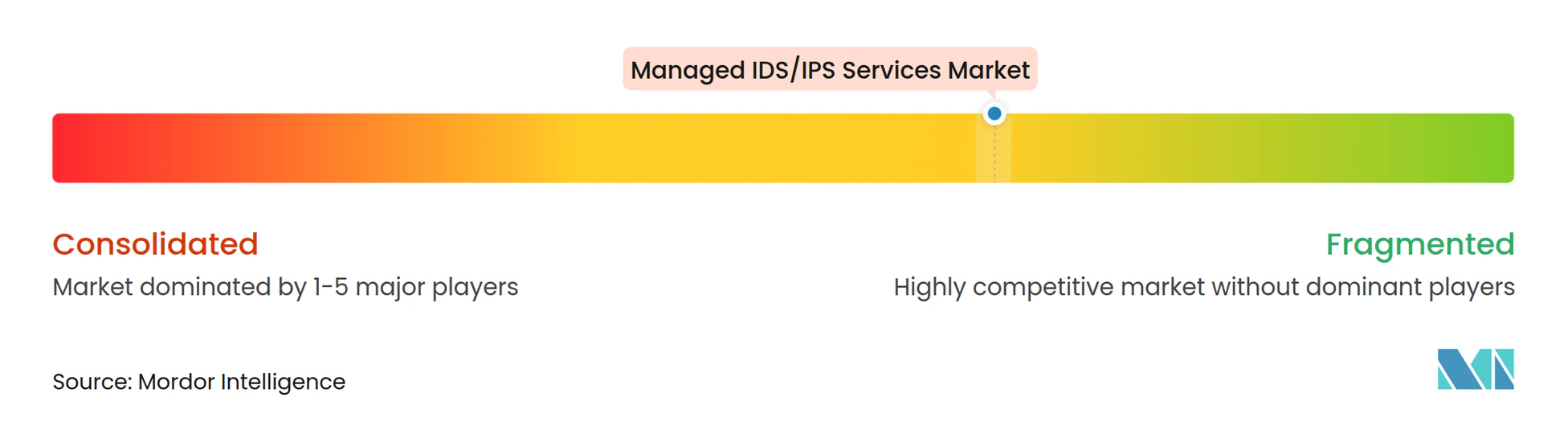
The managed IDS/IPS services market is moderately fragmented. LevelBlue, Arctic Wolf Networks, eSentire, Deepwatch, Expel, and ReliaQuest form a specialist layer in managed detection. CrowdStrike and SentinelOne extend endpoint telemetry into network-related detection through platform-based offerings. Standalone service providers face pricing pressure when customers can buy detection as part of a wider platform. Specialists differentiate through detection quality, analyst-led investigations, and operational support.
Product strategy centers on AI-supported investigation, data-residency capacity, and broader service portfolios. Arctic Wolf launched Aurora Agentic SOC in March 2026, using AI agents for triage and investigation while keeping high-impact blocking decisions with human analysts. Deepwatch achieved ISO/IEC 42001 certification for its NEXA Agentic AI Ecosystem in May 2026. LevelBlue announced its acquisition of Cybereason in October 2025 to add XDR, digital forensics, incident response, and threat intelligence capabilities. Sophos completed its USD 859 million acquisition of Secureworks in February 2025, adding the Counter Threat Unit to Sophos X-Ops and integrating Sophos Endpoint with Taegis MDR and XDR.
OT-aware managed detection is an important area for service development in the managed IDS/IPS services market. Trellix announced native NDR integration with Nozomi Networks in 2025 to correlate IT and OT alerts and identify cross-domain attack paths. Providers that develop or acquire these capabilities can compete for energy, utilities, and manufacturing work where compliance needs are becoming more demanding. Behavioral analysis of encrypted traffic is also relevant where full TLS decryption is impractical because of data-protection concerns.
Managed IDS/IPS Services Industry Leaders
-
LevelBlue, Inc.
-
Arctic Wolf Networks, Inc.
-
eSentire, Inc.
-
Secureworks Corp.
-
Zscaler
- *Disclaimer: Major Players sorted in no particular order
Managed IDS/IPS Services Market Companies Covered in this Report
- LevelBlue, Inc.
- Arctic Wolf Networks, Inc.
- eSentire, Inc.
- Secureworks Corp.
- Zscaler
- Binary Defense Systems, Inc.
- Expel, Inc.
- Proficio, Inc.
- ReliaQuest Holdings, Inc.
- Deepwatch, Inc.
- Huntress Labs Incorporated
- Sophos Limited
- Rapid7, Inc.
- SentinelOne, Inc.
- CrowdStrike, Inc.
- Cybereason Inc.
- Kudelski Security, Inc.
- Kroll, LLC
- Vectra AI, Inc.
- Vijilan Security, LLC
- UltraViolet Cyber, Inc.
- Trustwave Holdings, Inc.
Recent Industry Developments in Managed IDS/IPS Services Market
- October 2026: SentinelOne named LevelBlue its global exclusive delivery partner for Wayfinder Threat Detection and Response services, encompassing MDR, incident readiness and response, and threat hunting. The arrangement leveraged LevelBlue's global SOC infrastructure and incident response heritage to extend Wayfinder's reach across the Americas, EMEA, and Asia-Pacific, significantly expanding the managed network detection delivery footprint for both companies.
- September 2026: eSentire acquired a stealth-mode AI security startup to integrate AI observability and control capabilities into its Atlas Platform, extending managed detection coverage into AI-specific risk surfaces including shadow AI usage and model inference anomalies, risk categories that conventional IDS/IPS signature engines are not designed to address.
- July 2026: eSentire opened a new U.S. security operations center dedicated to U.S. data residency, directly resolving the data-sovereignty barrier that had restricted managed IDS/IPS procurement in regulated U.S. sectors including defense contracting, healthcare, and financial services.
- May 2026: Deepwatch achieved ISO/IEC 42001 certification for its NEXA Agentic AI Ecosystem, establishing the first AI management system standard certification applied to a managed security operations platform and creating an auditable governance framework for agentic-AI-driven IDS/IPS decision-making.
Global Managed IDS/IPS Services Market Report Scope
The Managed IDS/IPS Services Market refers to the industry focused on outsourced monitoring, management, optimization, and maintenance of Intrusion Detection Systems (IDS) and Intrusion Prevention Systems (IPS) by specialized security service providers to help organizations detect, analyze, and mitigate cyber threats in real time.
The Managed IDS/IPS Services Market Report is Segmented by Service Type (Managed Network IDS/IPS, Managed Host IDS/IPS, Managed Cloud IDS/IPS, Managed Wireless IDS/IPS), by End-User Industry (Banking, Financial Services and Insurance (BFSI), Government and Defense, Healthcare and Life Sciences, Information Technology and Telecom, Manufacturing and Industrial, Retail and E-Commerce, Energy and Utilities, Other End-User Industries), by Detection Technology (Signature-Based Detection, Anomaly-Based Detection, Behavior-Based Detection, Network Behavior Analysis, Hybrid Detection), and by Geography (North America [United States, Canada, Mexico], South America [Brazil, Argentina, Chile, Colombia, Rest of South America], Europe [Germany, United Kingdom, France, Italy, Spain, Netherlands, Rest of Europe], Asia-Pacific [China, Japan, India, South Korea, Australia, Singapore, Indonesia, Rest of Asia-Pacific], Middle East [Saudi Arabia, United Arab Emirates, Turkey, Israel, Qatar, Rest of Middle East], Africa [South Africa, Nigeria, Egypt, Kenya, Rest of Africa]. The Market Forecasts are Provided in Terms of Value (USD).
Segmentation Overview
| Managed Network IDS/IPS |
| Managed Host IDS/IPS |
| Managed Cloud IDS/IPS |
| Managed Wireless IDS/IPS |
| Banking, Financial Services and Insurance (BFSI) |
| Government and Defense |
| Healthcare and Life Sciences |
| Information Technology and Telecom |
| Manufacturing and Industrial |
| Retail and E-Commerce |
| Energy and Utilities |
| Other End-User Industries |
| Signature-Based Detection |
| Anomaly-Based Detection |
| Behavior-Based Detection |
| Network Behavior Analysis |
| Hybrid Detection |
| North America | United States |
| Canada | |
| Mexico | |
| South America | Brazil |
| Argentina | |
| Chile | |
| Colombia | |
| Rest of South America | |
| Europe | Germany |
| United Kingdom | |
| France | |
| Italy | |
| Spain | |
| Netherlands | |
| Rest of Europe | |
| Asia-Pacific | China |
| Japan | |
| India | |
| South Korea | |
| Australia | |
| Singapore | |
| Indonesia | |
| Rest of Asia-Pacific | |
| Middle East | Saudi Arabia |
| United Arab Emirates | |
| Turkey | |
| Israel | |
| Qatar | |
| Rest of Middle East | |
| Africa | South Africa |
| Nigeria | |
| Egypt | |
| Kenya | |
| Rest of Africa |
| By Service Type | Managed Network IDS/IPS | |
| Managed Host IDS/IPS | ||
| Managed Cloud IDS/IPS | ||
| Managed Wireless IDS/IPS | ||
| By End-User Industry | Banking, Financial Services and Insurance (BFSI) | |
| Government and Defense | ||
| Healthcare and Life Sciences | ||
| Information Technology and Telecom | ||
| Manufacturing and Industrial | ||
| Retail and E-Commerce | ||
| Energy and Utilities | ||
| Other End-User Industries | ||
| By Detection Technology | Signature-Based Detection | |
| Anomaly-Based Detection | ||
| Behavior-Based Detection | ||
| Network Behavior Analysis | ||
| Hybrid Detection | ||
| By Geography | North America | United States |
| Canada | ||
| Mexico | ||
| South America | Brazil | |
| Argentina | ||
| Chile | ||
| Colombia | ||
| Rest of South America | ||
| Europe | Germany | |
| United Kingdom | ||
| France | ||
| Italy | ||
| Spain | ||
| Netherlands | ||
| Rest of Europe | ||
| Asia-Pacific | China | |
| Japan | ||
| India | ||
| South Korea | ||
| Australia | ||
| Singapore | ||
| Indonesia | ||
| Rest of Asia-Pacific | ||
| Middle East | Saudi Arabia | |
| United Arab Emirates | ||
| Turkey | ||
| Israel | ||
| Qatar | ||
| Rest of Middle East | ||
| Africa | South Africa | |
| Nigeria | ||
| Egypt | ||
| Kenya | ||
| Rest of Africa | ||
Key Questions Answered in the Report
What is the managed IDS/IPS services market size?
The managed IDS/IPS services market is projected at USD 3.22 billion in 2027 and USD 5.62 billion by 2032, with an 11.75% CAGR over 2027 to 2032. The forecast reflects demand for continuous monitoring across cloud, on-premises, and industrial environments.
What is driving demand for managed IDS/IPS services?
Ransomware, vulnerability exploitation, skills shortages, cloud adoption, and regulatory monitoring obligations are supporting demand. These factors increase the need for continuous visibility, documented evidence, and timely investigation.
Which service type leads managed IDS/IPS services?
Managed Network IDS/IPS led service-type revenue with 38.56% in 2026, while Managed Cloud IDS/IPS is projected to expand at a 12.56% CAGR through 2032. The managed IDS/IPS services market is shifting toward coverage that includes virtual private clouds and temporary workloads.
Which end-user sector has the highest projected expansion?
Energy and Utilities is projected to expand at a 12.74% CAGR through 2032 as OT monitoring and utility security requirements increase. Providers need operational knowledge of industrial systems as well as network monitoring processes.
Which region has the strongest position in managed IDS/IPS services?
North America held 42.34% of revenue in 2026, while Asia-Pacific is projected to expand at a 12.82% CAGR through 2032. North American demand is supported by regulated enterprises, while Asia-Pacific demand is supported by digital infrastructure expansion.
Why does data residency matter for managed detection services?
Customers in regulated sectors may require telemetry to be processed within national borders, which favors providers with regional processing and SOC capacity. The managed IDS/IPS services market therefore rewards local delivery capacity in addition to detection capability.