
Managed Windows Server Services Market Size and Share
Market Overview
| Study Period | 2021 - 2032 |
|---|---|
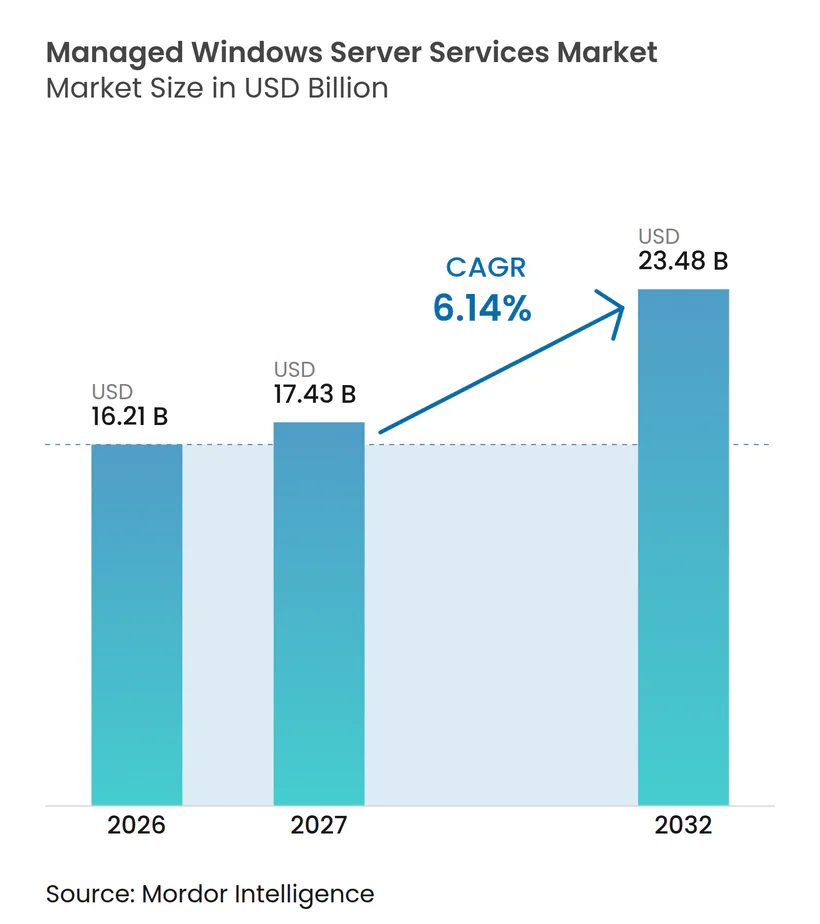
| Market Size (2027) | USD 17.43 Billion |
| Market Size (2032) | USD 23.48 Billion |
| Growth Rate (2027 - 2032) | 6.14 % |
| Fastest Growing Market | Asia-Pacific |
| Largest Market | North America |
| Market Concentration | Medium |
Major Players *Disclaimer: Major Players sorted in no particular order Image © Mordor Intelligence. Reuse requires attribution under CC BY 4.0. | |
Managed Windows Server Services Market Analysis by Mordor Intelligence
The Managed Windows Server Services market size is projected to expand from USD 16.21 billion in 2026 and USD 17.43 billion in 2027 to USD 23.48 billion by 2032, registering a CAGR of 6.14% between 2027 and 2032. The Managed Windows Server Services market is supported by enterprises that need specialist support for complex Windows estates across on-premises infrastructure and cloud environments. Server lifecycle deadlines are pushing organizations to reconsider patching, migration, and extended security update arrangements. Regulatory duties are also making reliable operational controls more important in financial services and other regulated settings. Providers that combine infrastructure administration with security, identity management, and resilience services are better positioned for broader contracts. The Managed Windows Server Services market also benefits from the continued need to operate hybrid environments rather than move every workload to the public cloud.
Key Report Takeaways
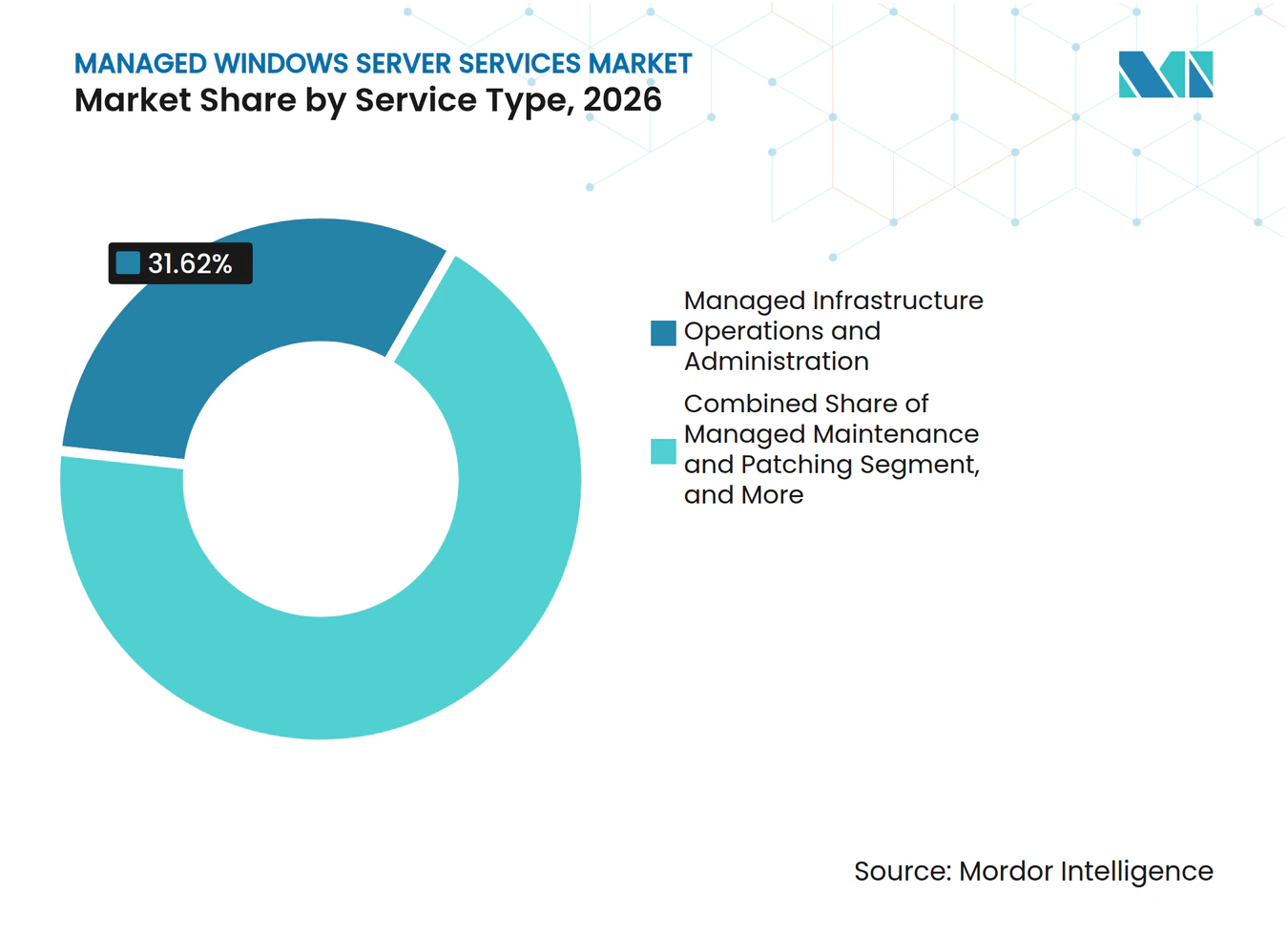
- By service type, Managed Infrastructure Operations and Administration held 31.62% of the Managed Windows Server Services market share in 2026, while Advanced Threat Detection and Managed Security are projected to expand at a 7.64% CAGR through 2032.
- By deployment model, Hybrid Cloud accounted for 40.29% of the Managed Windows Server Services market share in 2026 and is projected to expand at a 7.93% CAGR through 2032.
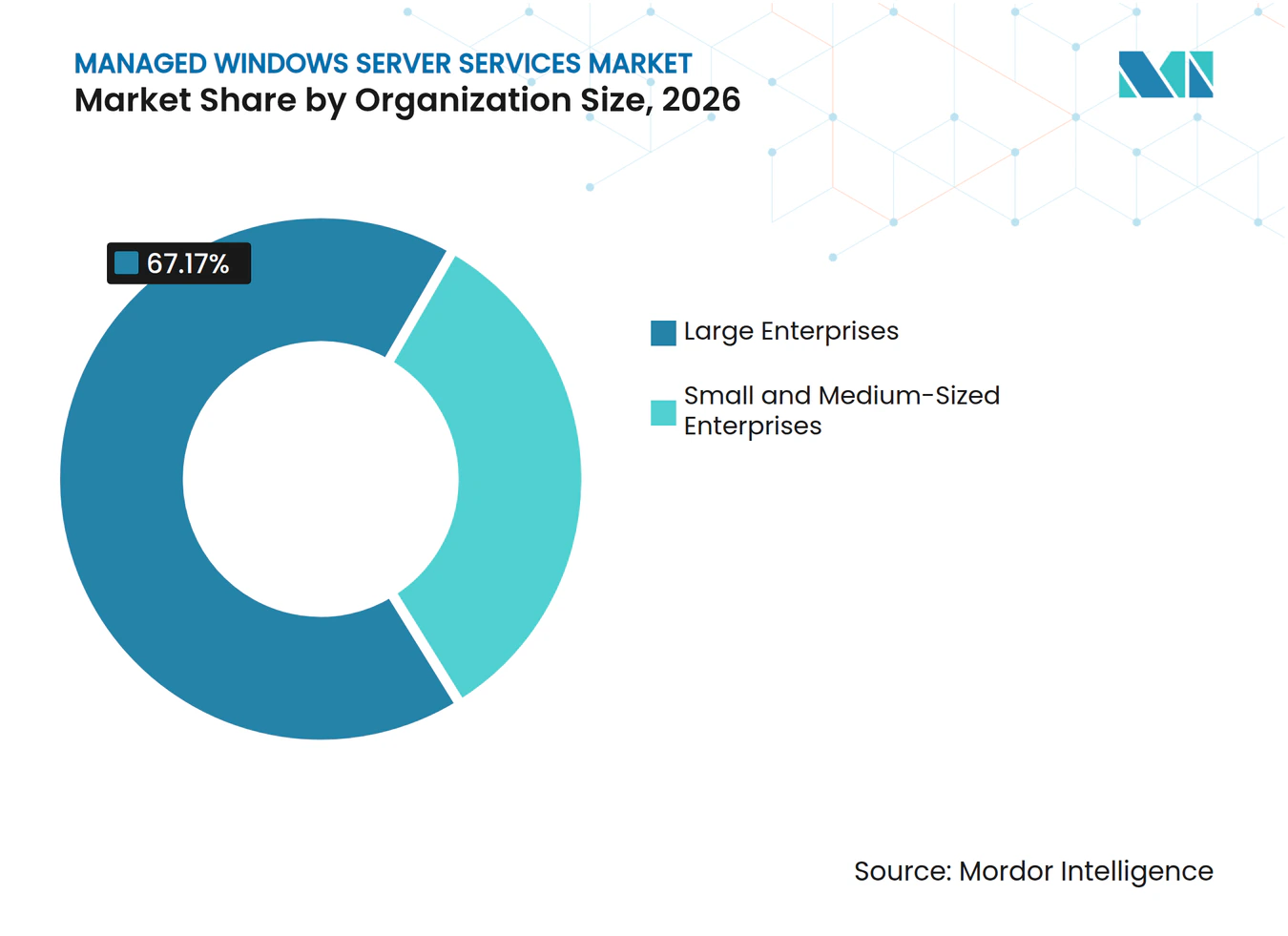
- By organization size, Large Enterprises held 67.17% of the Managed Windows Server Services market share in 2026, while Small and Medium-Sized Enterprises are projected to expand at a 8.13% CAGR through 2032.
- By end-user industry, BFSI held 23.76% of the Managed Windows Server Services market share in 2026, while Healthcare and Life Sciences are projected to expand at a 8.53% CAGR through 2032.
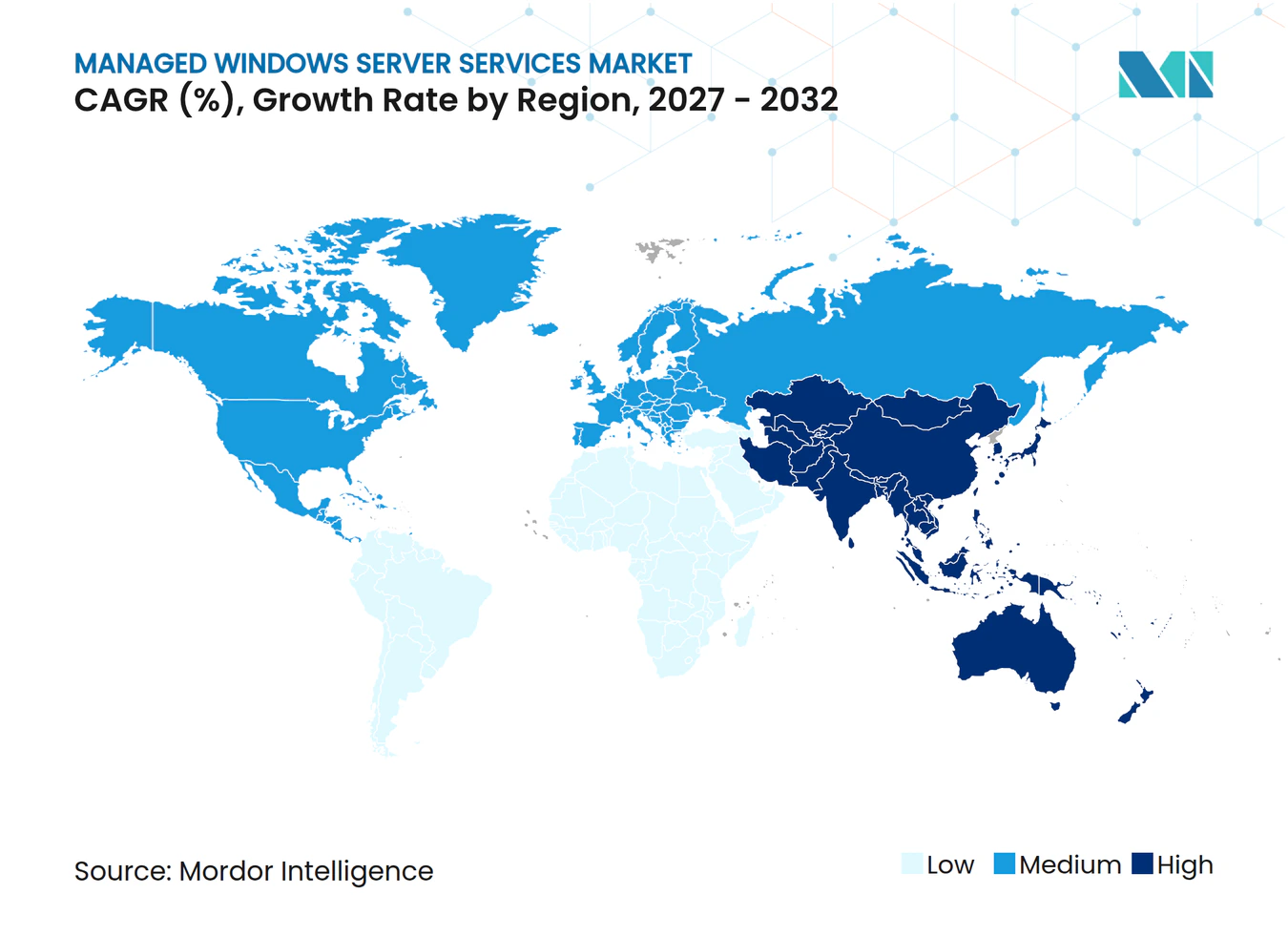
- By geography, North America held 36.12% of the Managed Windows Server Services market share in 2026, while Asia-Pacific is projected to expand at a 8.29% CAGR through 2032.
Note: Market numbers in this report are based on Mordor Intelligence's proprietary estimation framework, which combines nine months of actuals with Q4 projections for base year 2026.
Market Trends and Insights
Drivers Impact Analysis of Managed Windows Server Services Market*
| Driver | (~) % Impact on CAGR Forecast | Geographic Relevance | Impact Timeline |
|---|---|---|---|
| Hybrid and Multi-Cloud Windows Estate Complexity | +2.0% | Global, with concentration in North America and Europe | Long term (≥ 4 years) |
| Windows Server Lifecycle and Extended Support Requirements | +1.6% | Global, with early gains in North America and Asia-Pacific digital-first enterprises | Medium term (2-4 years) |
| Shortage of Windows Infrastructure and Active Directory Specialists | +1.0% | North America and Europe, with spillover to Asia-Pacific and Middle East and Africa | Long term (≥ 4 years) |
| Security, Compliance, and Cyber-Insurance Requirements | +0.9% | Global, with the highest density in the European Union and North America | Medium term (2-4 years) |
| Azure Arc and Unified Hybrid Server Management Adoption | +0.7% | North America and European Union core markets, with early gains in Asia-Pacific and Middle East and Africa | Medium term (2-4 years) |
| AI-Assisted Monitoring, Patching, and Incident Remediation | +0.5% | Global, with advanced deployment in North America and Australia | Long term (≥ 4 years) |
| Source: Mordor Intelligence | |||
Hybrid and Multi-Cloud Windows Estate Complexity
The Managed Windows Server Services market is gaining support as enterprises manage Windows Server workloads across on-premises data centers, Azure, AWS, and private clouds. These settings require knowledge of identity, policy, networking, and workload operations that many internal teams cannot maintain at the same depth. A Microsoft-commissioned 2025 study found that Azure Arc users achieved a 304% return on investment over 3 years and reduced on-premises Windows Server and SQL Server licensing costs by 10% through pay-as-you-go conversion. One manufacturing architect in that study reported that server updates and rollouts took 75% less time after the change. The greater the number of cloud control planes, the more difficult it becomes to separate infrastructure operations from identity governance, network policy, and security management. This gives providers an opening to secure longer contracts that cover several services rather than isolated administration tasks.
Windows Server Lifecycle and Extended Support Requirements
The Managed Windows Server Services market has a recurring source of demand in Microsoft’s product support timetable. Windows Server 2016 reaches the end of extended support in January 2027, Windows Server 2019 in January 2029, and Windows Server 2022 in October 2031. These dates keep migration, security, and patch-management decisions active throughout the forecast period. Extended Security Updates can provide up to 3 years of critical and important security updates, but they do not include new features, non-security fixes, or technical support. Organizations using this bridge still need a plan for the later migration, which creates work for providers that can coordinate both requirements. Mid-sized organizations that delayed cloud migration face shorter planning cycles and may favor managed services that combine enrollment, patching, and migration support.
Shortage of Windows Infrastructure and Active Directory Specialists
The Managed Windows Server Services market benefits when organizations cannot recruit or retain specialists in Active Directory, Group Policy, Windows Server roles, and systems management. The shortage transfers more operational responsibility from internal infrastructure teams to service providers. Leading providers are responding with automation that reduces manual work per server while retaining oversight by experienced operations staff. IBM reported in March 2026 that 53% of organizations use AI agents for at least 1-quarter of ITOps tasks, while 86% still considered human oversight critical.[1] This combination favors providers that can integrate automation with senior Windows operations expertise. It can also widen the gap between large providers with investment capacity and smaller firms that rely more heavily on manual delivery.
Security, Compliance, and Cyber-Insurance Requirements
The Managed Windows Server Services market is increasingly tied to patch compliance, privileged-account controls, and endpoint security. The Digital Operational Resilience Act became applicable to European Union financial entities on January 17, 2025. It requires covered entities to maintain records of ICT third-party providers and to assess their operational resilience. These obligations make documentation of access control, encryption-key management, network separation, and continuity testing more important in provider selection. The buying group, therefore, extends beyond IT leadership to compliance and risk teams. Providers that can supply clear evidence of their operational controls are likely to be stronger participants in regulated procurement processes.
Restraints Impact Analysis of Managed Windows Server Services Market*
| Restraint | (~) % Impact on CAGR Forecast | Geographic Relevance | Impact Timeline |
|---|---|---|---|
| Data Sovereignty and Privileged-Access Concerns | -0.5% | European Union, Asia-Pacific, and Middle East and Africa | Long term (≥ 4 years) |
| Vendor Lock-In Across Microsoft Licensing and Cloud Control Planes | -0.4% | Global, with the greatest relevance in North America and Europe | Long term (≥ 4 years) |
| Migration Downtime and Application Compatibility Risk | -0.2% | Global, especially legacy-heavy manufacturing and government | Medium term (2-4 years) |
| Shortage of Senior Windows Operations Talent at Service Providers | -0.1% | North America and Europe, emerging in Asia-Pacific | Medium term (2-4 years) |
| Source: Mordor Intelligence | |||
Data Sovereignty and Privileged-Access Concerns
The Managed Windows Server Services market faces limits where organizations cannot separate privileged administration from sensitive identity and configuration data. Domain Administrator credentials, Group Policy overrides, and certificate-authority administration require deep system access. Kyndryl reported in the context of its May 2026 Japan launch that 75% of IT leaders were concerned about geopolitical cloud data risks, and 65% had changed sourcing strategies because of sovereignty regulations.[2] Local residency rules can restrict delivery from offshore centers and require local personnel to update caches and support processes. These arrangements raise provider costs and may increase minimum contract sizes. They can leave smaller clients with fewer options for sovereign-compliant services.
Vendor Lock-In Across Microsoft Licensing and Cloud Control Planes
The Managed Windows Server Services market can be constrained when Azure Arc links policy, updates, monitoring, and licensing within one control plane. Organizations may depend on Windows Server licensing, Azure subscriptions, Defender for Servers, Azure Monitor, and Sentinel configurations at the same time. This creates switching costs for a client that wants to change platforms or divide operations between providers. Fujitsu used Azure Arc for 134 servers and reported a 40% annual licensing-fee saving after moving to monthly pay-as-you-go consumption. The example shows the operational value of a unified management layer while also showing why future platform changes can become more difficult. Multi-cloud management tools may reduce this constraint over time, but providers with strong Microsoft qualifications hold an advantage in the near term.
*Our forecasts treat driver/restraint impacts as directional, not additive. The impact forecasts reflect baseline growth, mix effects, and variable interactions.
Managed Windows Server Services Market Segment Analysis
By Service Type:
Security Services Accelerate Beyond Infrastructure MaintenanceManaged Infrastructure Operations and Administration held 31.62% of the Managed Windows Server Services market size in 2026. Organizations use these services for provisioning, operating-system configuration, Active Directory replication, DNS, and DHCP management. They often use external teams to free internal staff for application and business-system work. Demand is stable because routine infrastructure tasks generally rise with the installed fleet of servers and cloud instances. Advanced Threat Detection and Managed Security is projected to expand at a 7.64% CAGR through 2032. Its faster pace reflects demand for managed endpoint detection, identity threat protection, and monitoring across hybrid estates.
Managed Maintenance and Patching and Managed Backup and Business Continuity remain important because support deadlines and ransomware concerns increase the need for dependable recovery processes. Migration, Modernization, and Optimization services are supported by the January 2027 end of support for Windows Server 2016. Windows Server 2025, Microsoft’s current Long-Term Servicing Channel release, has been available since November 2024 and has mainstream support through November 2029. Automation is becoming more relevant in advanced managed offerings, especially for monitoring and incident resolution. DORA also increases the value of documented resilience testing and backup arrangements for affected financial institutions. This shifts more backup and continuity work from an embedded capability to a separately managed service.



By Deployment Model:
Hybrid Cloud Drives Sustained Demand, On-Premises Retains Strategic ImportanceHybrid Cloud accounted for 40.29% of the Managed Windows Server Services market size in 2026 and is projected to expand at a 7.93% CAGR through 2032. Large organizations commonly retain some Windows workloads on-site because of latency, regulation, sovereignty, or integration needs. They need one operating model that covers those workloads along with public-cloud tenants. On-Premises deployments remain relevant in manufacturing, government, and defense, where operational technology and sensitive workloads can limit full migration. In May 2025, Kyndryl and Microsoft expanded services that use Azure Arc and Azure Local across hybrid, multicloud, edge, and Internet of Things environments. This type of arrangement supports providers that can manage a mixed estate rather than only a cloud tenant.
Public Cloud deployments suit clients that accept provider-defined control planes and seek flexible consumption. Private Cloud deployments remain relevant for institutions that require dedicated computing environments. Changes in virtualization licensing have also created migration work for providers that can move and operate Windows workloads in alternate environments. In March 2026, Red Hat and AWS introduced integrated Windows licensing for Red Hat OpenShift Service on AWS.[3] The change integrates Windows licensing into AWS compute consumption for clients moving Windows-based applications. It can reduce friction in cloud migration projects that also require continuing operational support.
By Organization Size:
Large Enterprises Anchor Revenue, SMEs Drive GrowthLarge Enterprises held 67.17% of the Managed Windows Server Services market size in 2026. Their Windows environments often include several Active Directory domains, extensive audit requirements, and sites in multiple locations. These organizations tend to use multi-year contracts for patching, security, and identity governance across many endpoints. Service-level agreements increasingly address patch compliance and time to remediation. The scale of those requirements favors providers with global delivery resources and experienced specialist teams. It also gives buyers meaningful negotiating leverage when they procure broad, outcome-based agreements.
Small and Medium-Sized Enterprises are projected to expand at a 8.13% CAGR through 2032. Standardized subscription packages can bring monitoring, patching, and security services to organizations with smaller server fleets. Automation is important because providers need to serve smaller contracts without relying on the same level of manual effort. Common compliance practices, including alignment with the NIST Cybersecurity Framework and ISO 27001 certification for delivery centers, are becoming more relevant to mid-market buyers. This raises the basic service threshold for the Managed Windows Server Services industry. It also makes it harder for providers that offer only low-cost administration without mature operational controls to compete in formal bids.

By End-User Industry:
BFSI Leads, Healthcare Accelerates FastestBFSI held 23.76% of the Managed Windows Server Services market size in 2026. The segment uses complex Windows-based core banking and insurance platforms that require high availability and close regulatory oversight. DORA requires European Union financial entities to maintain registers of ICT third-party relationships and assess relevant providers. These requirements make resilience, access controls, and continuity processes part of provider due diligence. In September 2025, Kyndryl signed a 6-year agreement with Cesce to manage and modernize critical IT infrastructure while supporting DORA compliance. Such contracts illustrate why service quality and regulatory evidence can take precedence over a narrow focus on management fees.
Healthcare and Life Sciences is projected to expand at a 8.53% CAGR through 2032. Clinical digitization and data-protection obligations raise the importance of uptime, backup, and controlled access to healthcare information systems. IT and Telecommunications, Government and Public Sector, Manufacturing, Retail and E-Commerce, and other end-user industries use managed services primarily to improve operational efficiency. Manufacturing also faces a growing need to manage Windows-based interfaces that connect operational technology and industrial control systems. This can create a security-management requirement outside the scope of traditional industrial-control vendors. Managed Windows providers with both infrastructure and security capabilities can address that requirement within a single service model.
Geography Analysis
North America Managed Windows Server Services Market
North America held 36.12% of the Managed Windows Server Services market size in 2026. The region has a high concentration of regulated financial, healthcare, and government workloads. It also has a mature ecosystem of cloud platforms, Microsoft partners, and managed service providers. United States organizations are managing Windows Server 2016 transitions while increasing the use of unified hybrid management. Cyber-insurance expectations for patching and endpoint detection also support demand for managed operational controls.
EMEA and South America Managed Windows Server Services Market
Europe is the second-largest regional area for the Managed Windows Server Services market. Germany, the United Kingdom, France, Italy, and Spain are important demand centers because of large enterprise estates and intensive regulation. DORA has been applied since January 2025 and has strengthened the need for controlled ICT third-party relationships in financial services. The region’s sovereign and compliant delivery requirements create a premium category for providers with local capability. Nordic, Eastern European, and Benelux markets also offer modernization work linked to digital-government programs. South America, the Middle East, and Africa are smaller regional markets, although Brazil and Saudi Arabia have activity related to financial-services digitization and government cloud requirements.
APAC Managed Windows Server Services Market
Asia-Pacific is projected to expand at a 8.29% CAGR through 2032. China requires providers to balance digital-infrastructure programs with local delivery requirements for sensitive workloads. India is both a consumption center for managed services and a delivery location for global providers. Japan faces workforce pressure that makes internal Windows infrastructure operations more difficult to sustain. In May 2026, Kyndryl launched Cloud Uplift Japan in Tokyo and Osaka Azure regions to modernize legacy applications while retaining data residency in Japan.[4] South Korea and Southeast Asian economies add demand through cloud adoption by smaller firms and public digitization programs.
Competitive Landscape
Market Concentration
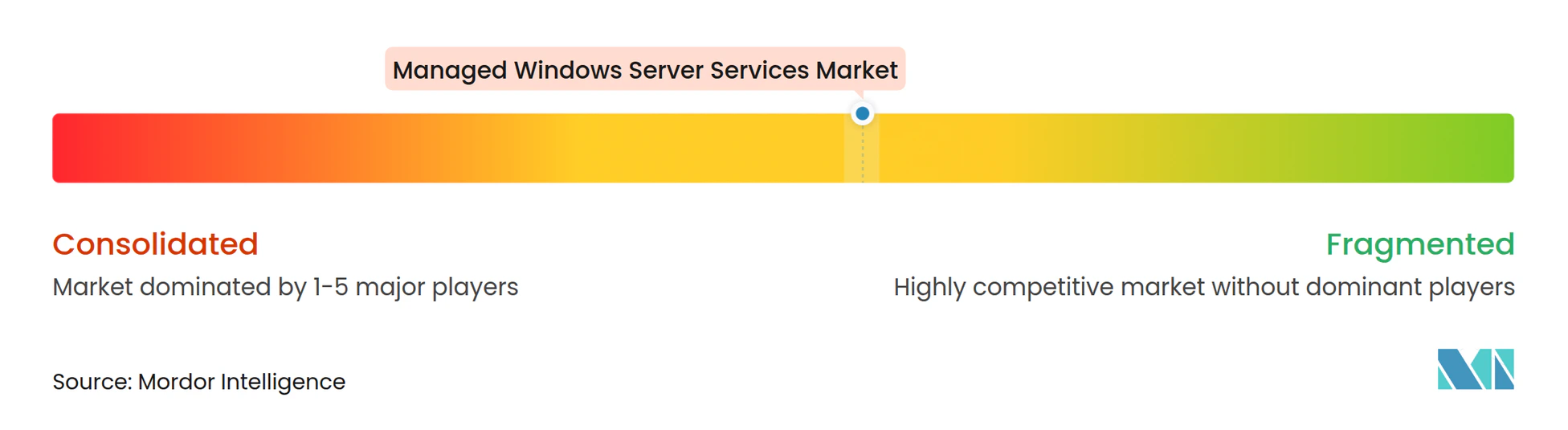
The Managed Windows Server Services market is moderately fragmented. Microsoft, IBM, Kyndryl, Accenture, DXC Technology, HCL Technologies, Tata Consultancy Services, Wipro, Capgemini, and NTT DATA compete for large-enterprise contracts, while Ensono and Rackspace Technology serve specialized and regional needs. Competition has moved beyond per-server administration pricing toward platforms that combine automation, cloud management, identity, security, and resilience. Large providers can support complex estates because they have broad delivery resources and established relationships with cloud platforms. Mid-market firms can still compete where clients want customized support or local knowledge.
Kyndryl has expanded its Microsoft-related capability through the Kyndryl Microsoft Acceleration Hub, launched in July 2025 with Azure AI Foundry and Copilot technology in its client-engagement approach. IBM launched Red Hat AI Inference and Red Hat OpenShift Virtualization Service on IBM Cloud in May 2026 for managed, governance-controlled hybrid environments. DXC described its Global Infrastructure Services offering as a human-led, AI-driven Intelligent Operations approach in its fiscal 2026 Form 10-K. These moves show how service providers are combining operational personnel with automation. They also raise the importance of tools that can manage hybrid cloud, data center, and network operations together.
Sovereign and regulated delivery is an important opportunity in the Managed Windows Server Services market. Providers that can meet residency, cleared-personnel, and continuous-compliance requirements can pursue contracts that are harder for generalist providers to serve. Smaller cloud-native providers may use hyperscaler tools to reduce delivery overhead, but they may find it harder to meet extensive audit expectations. IBM’s virtualization service illustrates how platform services can take on some work that once sat wholly within a managed-service contract. The competitive outcome depends on whether providers can retain responsibility for security, identity, compliance, and complex migration work.
Managed Windows Server Services Industry Leaders
-
Microsoft Corporation
-
IBM Corporation
-
Kyndryl Holdings, Inc.
-
Rackspace Technology, Inc.
-
NTT DATA Corporation
- *Disclaimer: Major Players sorted in no particular order
Managed Windows Server Services Market Companies Covered in this Report
- Microsoft Corporation
- IBM Corporation
- Kyndryl Holdings, Inc.
- Accenture plc
- DXC Technology Company
- HCL Technologies Limited
- Rackspace Technology, Inc.
- Hewlett Packard Enterprise Company
- Amazon Web Services, Inc.
- Fujitsu Limited
- NTT DATA Corporation
- Tata Consultancy Services Limited
- Wipro Limited
- Capgemini SE
- Cognizant Technology Solutions Corporation
- Dell Technologies Inc.
- Verizon Communications Inc.
- Ensono, LLC
Recent Industry Developments in Managed Windows Server Services Market
- May 2026: Kyndryl launched Cloud Uplift Japan in the Tokyo and Osaka Azure regions, enabling enterprises to modernize legacy applications, including AIX, IBM i, Linux on IBM Power, and x86 workloads, while retaining full data residency within Japan. The offering incorporates planning, migration, managed services, AI, security, and resilience capabilities.
- May 2026: IBM announced Red Hat AI Inference on IBM Cloud and Red Hat OpenShift Virtualization Service on IBM Cloud, enabling enterprises to operationalize AI and run virtualized workloads, including Windows virtual machines, in a managed, governance-controlled hybrid cloud environment.
- March 2026: Red Hat and AWS introduced integrated Windows licensing for Red Hat OpenShift Service on AWS, embedding Windows licensing directly into AWS compute consumption for enterprises migrating Windows-based applications to the cloud and lowering operational friction for managed Windows workload migrations.
- November 2025: Kyndryl launched an agentic AI framework and managed services for IBM Z mainframe customers, enabling IBM z/OS environments to use agentic AI for application and infrastructure management, incident handling, and operational agility improvement.
Global Managed Windows Server Services Market Report Scope
Managed Windows server services are outsourced IT management solutions where a specialized third-party provider takes full operational responsibility for the administration, hosting, optimization, and security of an enterprise's Microsoft Windows Server environments. These services encompass the entire lifecycle of physical, virtual, or cloud-based server infrastructure running the Windows Server operating system, ensuring high availability, peak performance, and regulatory compliance under strict Service Level Agreements (SLAs).
The Managed Windows Server Services Market Report is Segmented by Service Type (Managed Infrastructure Operations and Administration, Managed Maintenance and Patching, Managed Backup and Business Continuity, Migration, Modernization, and Optimization, Advanced Threat Detection and Managed Security, and Other Service Types), Deployment Model (On-Premises, Public Cloud, Private Cloud, and Hybrid Cloud), Organization Size (Large Enterprises and Small and Medium-Sized Enterprises), End-User Industry (IT and Telecommunications, Banking, Financial Services and Insurance (BFSI), Healthcare and Life Sciences, Government and Public Sector, Manufacturing, Retail and E-Commerce, and Other End-User Industries), and Geography (North America, South America, Europe, Asia-Pacific, Middle East, and Africa). The Market Forecasts are Provided in Terms of Value (USD).
Segmentation Overview
| Managed Infrastructure Operations and Administration |
| Managed Maintenance and Patching |
| Managed Backup and Business Continuity |
| Migration, Modernization, and Optimization |
| Advanced Threat Detection and Managed Security |
| Other Service Types |
| On-Premises |
| Public Cloud |
| Private Cloud |
| Hybrid Cloud |
| Large Enterprises |
| Small and Medium-Sized Enterprises |
| IT and Telecommunications |
| Banking, Financial Services and Insurance (BFSI) |
| Healthcare and Life Sciences |
| Government and Public Sector |
| Manufacturing |
| Retail and E-Commerce |
| Other End-User Industries |
| North America | United States |
| Canada | |
| Mexico | |
| South America | Brazil |
| Argentina | |
| Rest of South America | |
| Europe | Germany |
| United Kingdom | |
| France | |
| Italy | |
| Spain | |
| Rest of Europe | |
| Asia-Pacific | China |
| India | |
| Japan | |
| South Korea | |
| Rest of Asia-Pacific | |
| Middle East | Saudi Arabia |
| United Arab Emirates | |
| Rest of Middle East | |
| Africa | South Africa |
| Nigeria | |
| Rest of Africa |
| By Service Type | Managed Infrastructure Operations and Administration | |
| Managed Maintenance and Patching | ||
| Managed Backup and Business Continuity | ||
| Migration, Modernization, and Optimization | ||
| Advanced Threat Detection and Managed Security | ||
| Other Service Types | ||
| By Deployment Model | On-Premises | |
| Public Cloud | ||
| Private Cloud | ||
| Hybrid Cloud | ||
| By Organization Size | Large Enterprises | |
| Small and Medium-Sized Enterprises | ||
| By End-User Industry | IT and Telecommunications | |
| Banking, Financial Services and Insurance (BFSI) | ||
| Healthcare and Life Sciences | ||
| Government and Public Sector | ||
| Manufacturing | ||
| Retail and E-Commerce | ||
| Other End-User Industries | ||
| By Geography | North America | United States |
| Canada | ||
| Mexico | ||
| South America | Brazil | |
| Argentina | ||
| Rest of South America | ||
| Europe | Germany | |
| United Kingdom | ||
| France | ||
| Italy | ||
| Spain | ||
| Rest of Europe | ||
| Asia-Pacific | China | |
| India | ||
| Japan | ||
| South Korea | ||
| Rest of Asia-Pacific | ||
| Middle East | Saudi Arabia | |
| United Arab Emirates | ||
| Rest of Middle East | ||
| Africa | South Africa | |
| Nigeria | ||
| Rest of Africa | ||
Key Questions Answered in the Report
What is the size of the Managed Windows Server Services market?
The Managed Windows Server Services market size is USD 16.21 billion in 2026 and is projected to reach USD 23.48 billion by 2032 at a 6.14% CAGR.
Which service type leads managed Windows Server services?
Managed Infrastructure Operations and Administration leads with a 31.62% share in 2026.
Why are companies using managed Windows Server services?
Organizations use providers to manage hybrid infrastructure, patching, identity systems, security controls, backup, and migration activity.
Which deployment model is most important for Windows Server management?
Hybrid Cloud leads with a 40.29% share in 2026 and is projected to expand at a 7.93% CAGR through 2032.
Which end-user sector has the strongest demand?
BFSI leads with a 23.76% share in 2026, while Healthcare and Life Sciences is projected to expand fastest at a 8.53% CAGR through 2032.
Which region is projected to expand fastest?
Asia-Pacific is projected to expand at a 8.29% CAGR through 2032, while North America leads with a 36.12% share in 2026.