
Managed Server and Storage Hardware Support Services Market Size and Share
Market Overview
| Study Period | 2021 - 2032 |
|---|---|
| Market Size (2027) | USD 17.08 Billion |
| Market Size (2032) | USD 25.74 Billion |
| Growth Rate (2027 - 2032) | 8.56 % |
| Fastest Growing Market | Asia-Pacific |
| Largest Market | North America |
| Market Concentration | Medium |
Major Players *Disclaimer: Major Players sorted in no particular order Image © Mordor Intelligence. Reuse requires attribution under CC BY 4.0. | |
Managed Server and Storage Hardware Support Services Market Analysis by Mordor Intelligence
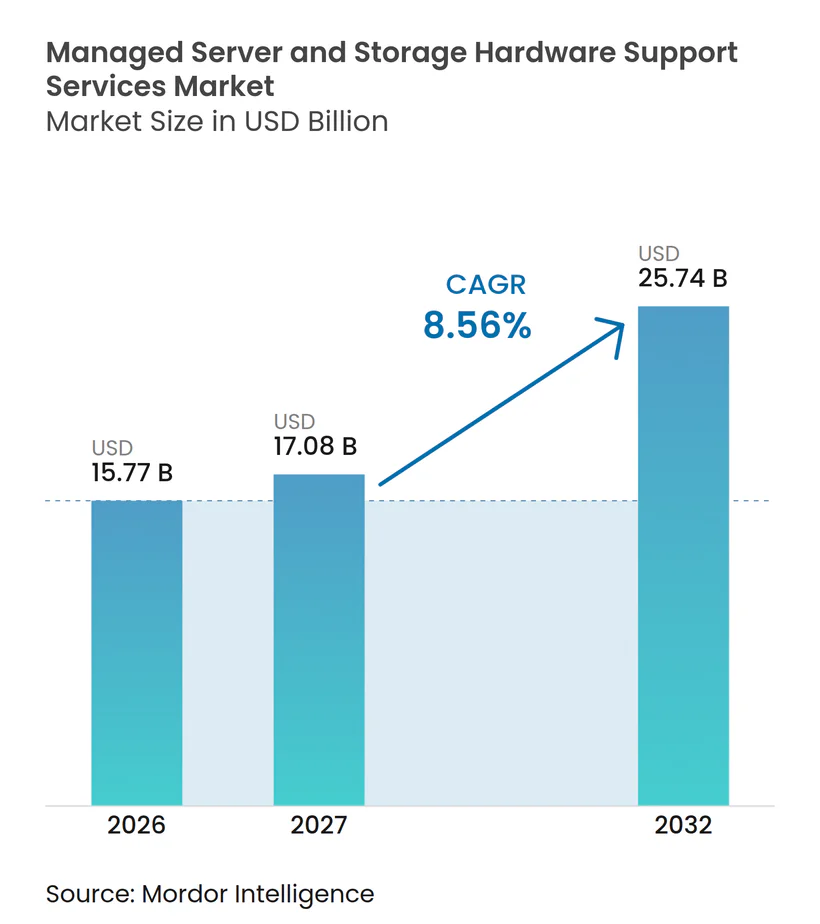
The managed server and storage hardware support services market size is projected to expand from USD 15.77 billion in 2026 to USD 17.08 billion in 2027, and to USD 25.74 billion by 2032, registering a CAGR of 8.56% between 2027 and 2032. Enterprise buyers are extending the use of server and storage assets beyond original equipment manufacturer end-of-service-life dates, which redirects refresh budgets toward other IT priorities. This shift supports third-party maintenance contracts that can cover multiple hardware brands under a single agreement and reduce post-warranty maintenance costs. The managed server and storage hardware support services market is also being reshaped by distributed data center estates, where more on-premises and edge hardware requires support after warranty coverage ends. Providers are improving remote diagnostics, predictive maintenance, GPU servicing, and liquid-cooling capabilities to address changing hardware estates. Regulatory requirements for data security, data residency, and uptime also encourage organizations to retain controlled on-premises infrastructure and maintain documented support arrangements.
Key Report Takeaways
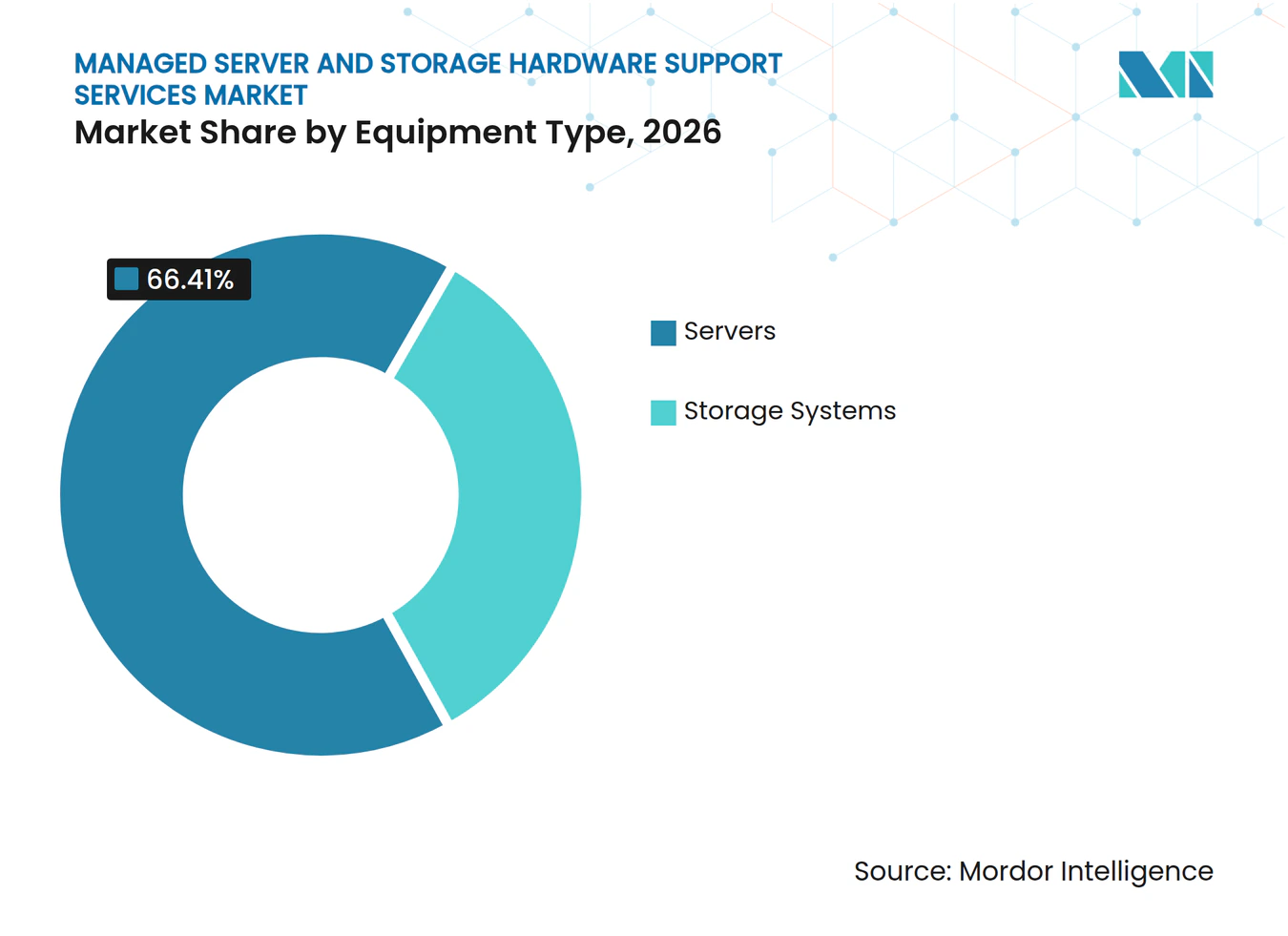
- By equipment type, servers led with 66.41% of the managed server and storage hardware support services market revenue share in 2026, while storage systems are projected to expand at a 10.04% CAGR through 2032.
- By service type, hardware maintenance and repair held 45.23% of the managed server and storage hardware support services market revenue share in 2026, while technical support and remote diagnostics are projected to expand at a 9.71% CAGR through 2032.
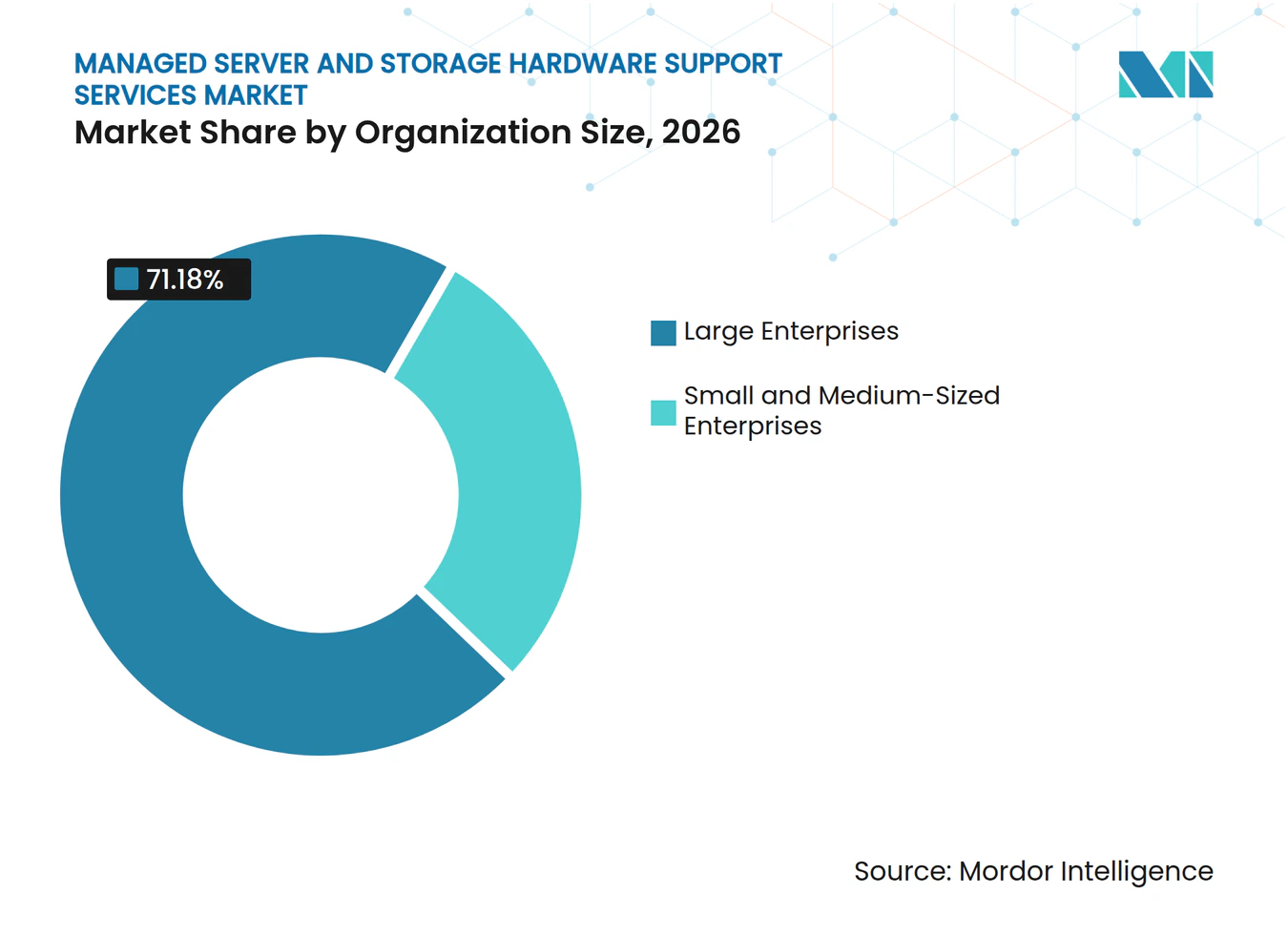
- By organization size, large enterprises accounted for 71.18% of the managed server and storage hardware support services market revenue share in 2026, while small and medium-sized enterprises are projected to expand at a 10.35% CAGR through 2032.
- By end-user industry, IT and telecommunication accounted for 29.66% of the managed server and storage hardware support services market revenue share in 2026, while healthcare and life sciences are projected to expand at a 9.11% CAGR through 2032.
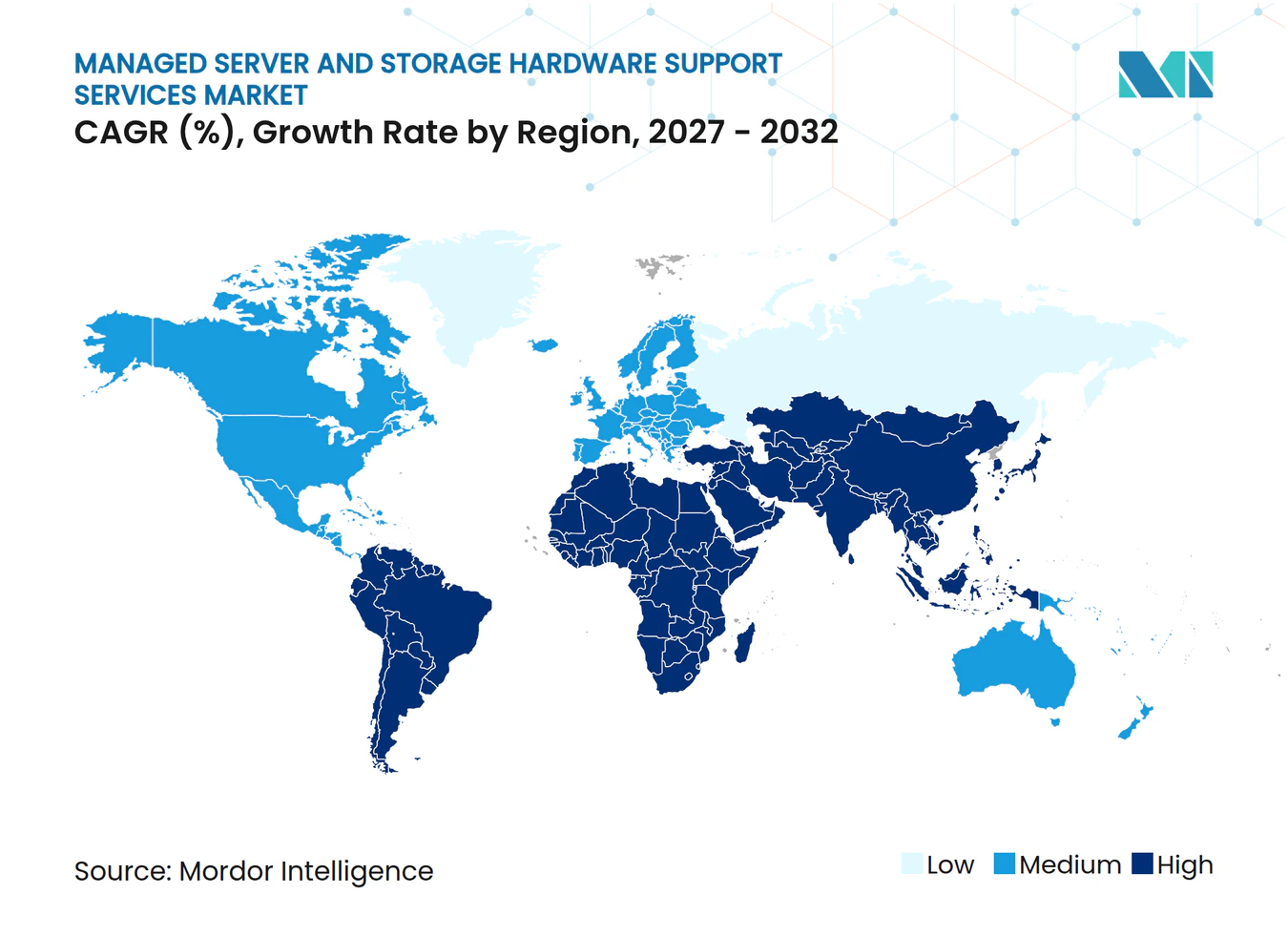
- By geography, North America held 38.14% of the managed server and storage hardware support services market in 2026, while Asia-Pacific is projected to expand at a 9.41% CAGR through 2032.
Note: Market numbers in this report are based on Mordor Intelligence's proprietary estimation framework, which combines nine months of actuals with Q4 projections for base year 2026.
Global Managed Server and Storage Hardware Support Services Market Trends and Insights
Drivers Impact Analysis*
| Driver | (~) % Impact on CAGR Forecast | Geographic Relevance | Impact Timeline |
|---|---|---|---|
| Extension of Enterprise Hardware Lifecycles | +2.5% | Global, highest concentration in North America and Europe | Long term (≥ 4 years) |
| Demand for Multi-Vendor Support Contracts | +1.8% | Global, most acute in North America and Asia-Pacific core | Medium term (2-4 years) |
| Growth of Hybrid and Distributed Data Centers | +1.4% | Global, Asia-Pacific and North America leading | Long term (≥ 4 years) |
| Rising Predictive Maintenance Adoption | +1.0% | North America and Europe, spillover to Asia-Pacific | Medium term (2-4 years) |
| Expansion of Post-EOSL Infrastructure Fleets | +0.8% | Global, concentrated in South America and Middle East | Long term (≥ 4 years) |
| Increasing Spare-Parts and Field-Engineering Localization | +0.5% | Asia-Pacific core, spillover to Middle East and Africa | Short term (≤ 2 years) |
| Source: Mordor Intelligence | |||
Extension of Enterprise Hardware Lifecycles
Enterprise IT teams are deferring server and storage refreshes as equipment costs, supply constraints, and tariff uncertainty affect procurement decisions. Support extensions give buyers a practical reason to retain functioning equipment beyond its original support period, which strengthens the managed server and storage hardware support services market. Trifecta Networks reported that pricing volatility and uncertain supply conditions were causing enterprises to favor support extensions over new multi-year hardware commitments. Longer use periods increase the role of the managed server and storage hardware support services market in preserving operational continuity for aging infrastructure. They also create recurring contract relationships because each deferred refresh can make replacement planning increasingly dependent on the support provider that already manages the installed base.
Demand for Multi-Vendor Support Contracts
Enterprise data centers commonly use servers, storage arrays, and network equipment from several manufacturers, which makes separate support agreements difficult to coordinate. IBM describes multivendor support as a single point of contact that can simplify coordination across supported hardware.[1] A unified arrangement can reduce the risk that equipment falls between different renewal dates or service responsibilities. Procurri explains that co-term support aligns equipment with different end-of-service-life dates to one renewal point. This structure improves procurement visibility and supports the managed server and storage hardware support services market by giving buyers more consistent planning cycles. For the managed server and storage hardware support services market, a synchronized multi-vendor agreement also makes switching providers more disruptive because it would require the customer to recreate coverage across many hardware models and locations.
Growth of Hybrid and Distributed Data Centers
Hybrid infrastructure is expanding the number of locations where organizations operate physical servers and storage systems. Hybrid operating models leave organizations responsible for a mix of cloud resources and physical equipment. Cloud adoption does not eliminate the need for hardware support, as enterprises retain equipment in data centers, colocation sites, and edge facilities. Each retained physical node will eventually move outside its original warranty period and require a maintenance decision. Distributed estates can also increase the role of the managed server and storage hardware support services market through providers that can stage parts and dispatch field engineers across locations. The managed server and storage hardware support services market therefore benefits when a hybrid design spreads hardware ownership across a larger operational footprint.
Rising Predictive Maintenance Adoption
Condition-based maintenance is replacing time-based service schedules for parts of the data center support environment. Compass Datacenters and Schneider Electric reported a 40% reduction in on-site maintenance interventions and a 20% reduction in operating expenses from their AI-driven maintenance collaboration. These systems use equipment signals to identify issues before they become failures requiring urgent replacement. An IEEE conference paper reported 84.8% precision for predicting solid-state drive failures 14 days before failure across more than 5 million enterprise SSDs. Earlier detection helps the managed server and storage hardware support services market by enabling providers to pre-position parts and schedule interventions with less disruption. It also allows managed server and storage hardware support services market participants to offer service commitments based on availability and prevention rather than only on break-fix response.
Restraints Impact Analysis*
| Restraint | (~) % Impact on CAGR Forecast | Geographic Relevance | Impact Timeline |
|---|---|---|---|
| Firmware, Security and Diagnostic Access Restrictions | -1.2% | Global, most acute in North America and Europe | Medium term (2-4 years) |
| Scarcity of Skilled Legacy-System Engineers | -0.9% | Global, most acute in North America and Western Europe | Long term (≥ 4 years) |
| Fragmented Global Spare-Parts Standards | -0.7% | Middle East, Africa, and South America | Medium term (2-4 years) |
| Customer Risk Aversion for Mission-Critical Workloads | -0.5% | Global, most pronounced in BFSI and healthcare | Short term (≤ 2 years) |
| Source: Mordor Intelligence | |||
Firmware, Security, and Diagnostic Access Restrictions
Original equipment manufacturer controls over firmware and management interfaces can limit the diagnostic access available to independent maintainers. NVIDIA identified 18 vulnerabilities in baseboard management controller firmware and recommended that these interfaces be isolated on dedicated management networks with strict firmware controls. Dell’s iDRAC9 System Lockdown can place firmware and hardware configuration in a read-only state, including for users with administrative credentials, until an authorized sequence turns off the lock. Security controls are important for customers, but they can constrain the managed server and storage hardware support services market by reducing the information a third-party technician can use during diagnosis. Providers may need to invest in telemetry tools or establish formal access procedures with manufacturers. These costs can be more difficult for mid-sized operators to absorb, limiting their ability to support complex server and storage estates in the managed server and storage hardware support services market.
Scarcity of Skilled Legacy-System Engineers
The availability of engineers familiar with older server and storage platforms is narrowing as experienced field personnel approach retirement. Computer Weekly reported that the global field-service sector could lose up to 40% of an estimated 20 million personnel over the following 3-4 years, while half of field-service operations reported staffing shortages. Maintaining IBM i systems, early-generation HPE and Dell arrays, and Sun SPARC equipment requires operational knowledge that newer technical programs do not always emphasize. J.D. Power found that system manager training and education were a leading operational challenge for 34% of respondents in its 2025 Japan server maintenance study. A thin talent pipeline can constrain the managed server and storage hardware support services market by raising labor costs, lengthening response times, and limiting service coverage for legacy equipment. The issue is most material where customers depend on long-lived hardware and require engineers who can work safely within tightly controlled production environments.
*Our forecasts treat driver/restraint impacts as directional, not additive. The impact forecasts reflect baseline growth, mix effects, and variable interactions.
Segment Analysis
By Equipment Type: Servers Anchor Revenue While Storage Systems Lead Expansion
Servers held 66.41% of the managed server and storage hardware support services market share in 2026, reflecting the broad installed base of x86 compute equipment across enterprise data centers. The segment generates a high volume of service activity because compute-intensive environments require regular component replacement, diagnostics, and field support. Mature spare parts and replacement component supply chains can lower delivery costs for support providers. Existing engineer certifications also help providers serve server estates across multiple locations. Server support remains central to the managed server and storage hardware support services market because most customers maintain a large core fleet even as they use cloud services for selected workloads.
Storage systems are projected to expand at a 10.04% CAGR through 2032, the fastest pace among equipment types. Generative AI training, clinical imaging archives, and financial transaction records are increasing the operational importance of storage arrays. Organizations often retain these systems beyond original support periods when migration would be costly or operationally difficult. Post-end-of-service-life maintenance helps preserve access to equipment while managing refresh timing. Providers that can support both server and storage equipment can reduce coordination demands for customers with mixed infrastructure. The resulting opportunity favors companies with access to qualified storage engineers, tested parts, and practical knowledge of complex array configurations.


By Service Type: Maintenance Leads While Remote Diagnostics Change Delivery
Hardware maintenance and repair commanded 45.23% of 2026 service revenue, making it the primary entry point for many customer relationships. This service includes the break-fix work needed to keep servers and storage systems available after manufacturer coverage ends. Customers value a defined response process because unplanned outages can interrupt applications and internal operations. Maintenance agreements also establish the service history that helps providers understand a customer’s installed hardware. Spare parts and logistics management complement these contracts by ensuring that necessary components can reach the correct location. Installation and relocation support adds another practical service for organizations adjusting the physical layout of their technology estates.
Technical support and remote diagnostics are projected to expand at a 9.71% CAGR through 2032. Remote monitoring can identify abnormal equipment conditions before a technician travels to a site. Schneider Electric reports that condition-based maintenance can reduce on-site interventions by up to 40%.[2] Fewer unnecessary site visits can lower delivery costs and help providers focus field engineers on incidents that need physical action. Better telemetry can also strengthen service-level commitments when customers need faster diagnosis across widely distributed assets. The managed server and storage hardware support services industry is therefore moving toward a service model that combines remote information with targeted on-site repair rather than relying solely on scheduled visits.
By Organization Size: Large Enterprises Lead While SMEs Add Demand
Large enterprises accounted for 71.18% of 2026 revenue because they operate sizable legacy estates across multiple sites. These organizations can negotiate multi-year, multi-vendor contracts with defined response times and coverage terms. Their procurement teams also tend to seek consolidated support arrangements that align with annual planning cycles. Large contracts create predictable recurring revenue for providers with a broad geographic reach. Their operational scale can justify dedicated parts inventory and tailored service procedures. Large enterprise demand remains a key driver of the managed server and storage hardware support services market, as these buyers require stable support for extensive server and storage fleets.
Small and medium-sized enterprises are projected to expand at a 10.35% CAGR through 2032. Subscription-priced agreements can lower the upfront cost that previously kept smaller organizations tied to original equipment manufacturer contracts. These customers may find post-warranty costs difficult to absorb when budgets are constrained. Hybrid designs can also leave them with on-premises equipment that remains necessary for specific applications, resilience, or data handling. Third-party support gives these organizations a way to continue using that equipment without committing to an immediate full refresh. Providers that offer clear pricing, practical response coverage, and simple contract administration can address this customer group as it becomes more aware of available alternatives.

By End-User Industry: IT and Telecom Lead While Healthcare Gains Importance
IT and telecommunication held 29.66% of 2026 end-user revenue, supported by high server density and long-lived network infrastructure. Carriers and technology operators need stable support for equipment that underpins 5G activity and other service platforms. Hardware refresh budgets do not always move at the same pace as network expansion, which can extend the useful period of installed assets. These customers often require defined response times because service outages affect business customers and internal operations. The sector’s hardware intensity keeps it important to the managed server and storage hardware support services market. Its requirements also favor providers that can maintain parts availability and dispatch coverage across many locations.
Healthcare and life sciences are projected to expand at a 9.11% CAGR through 2032. Clinical imaging, electronic health records, and genomics workloads continue to rely on dedicated server and storage infrastructure. Uptime and data integrity requirements can make maintenance a necessary operational expenditure rather than a discretionary purchase. Dell states that 65% of storage infrastructure in US hospitals runs on Dell hardware. This installed base illustrates the volume of equipment that will move through warranty and post-warranty stages over time. Support providers must meet demanding documentation, security, and response expectations when serving this customer group.
Geography Analysis
North America held 38.14% of 2026 revenue, making it the largest regional contributor to the managed server and storage hardware support services market. The region has a high concentration of multi-vendor enterprise data centers and an established base of buyers familiar with third-party maintenance procurement. The United States leads regional demand because financial services, technology, healthcare, and public-sector organizations maintain substantial server and storage estates. Blackstone and Ares provided USD 3.6 billion in private debt financing for the Park Place Technologies and Service Express transaction, which reflected investor interest in the scale of the sector. Canada provides a secondary base through financial services and public-sector technology estates. Mexico’s nearshore data center development adds equipment that will require support as it passes beyond original warranty periods.
Europe is the second-largest regional contributor, with Germany, the United Kingdom, and France providing much of the region’s demand. Financial services, manufacturing, and public-sector organizations rely on long-term maintenance arrangements that reflect investor interest in the sector's scalability, ensuring stable access to established infrastructure. The GDPR, NIS2 Directive, and the EU Data Act strengthen focus on data controls and can support the retention of on-premises assets. Evernex expanded its European coverage through acquisitions, including Ultra Support in the United Kingdom, Comptest in Poland, Integra in Northern Europe, and Empowered and OrderWork in the United Kingdom.[3] These moves add local service and infrastructure capabilities across key markets. South America remains an emerging opportunity, with Brazil and Argentina offering growing installed bases that may require post-warranty support.
Asia-Pacific is projected to expand at a 9.41% CAGR through 2032, the fastest regional rate in the managed server and storage hardware support services market. China’s data center programs are increasing server installations, while India’s IT services sector is extending demand for support outside the largest cities. Japan places strong value on security and operational confidence when selecting support partners. J.D. Power reported that security reinforcement was the leading IT operations challenge for 42% of respondents in its 2025 Japan study. South Korea’s semiconductor and manufacturing sectors maintain dense server environments with recurring support needs. Malaysia, Indonesia, and Vietnam are attracting data center investment that can expand the future pool of post-warranty equipment. The Middle East and Africa are earlier-stage opportunities, supported by Saudi Arabian data center investment and United Arab Emirates free-zone activity.
Competitive Landscape
Market Concentration
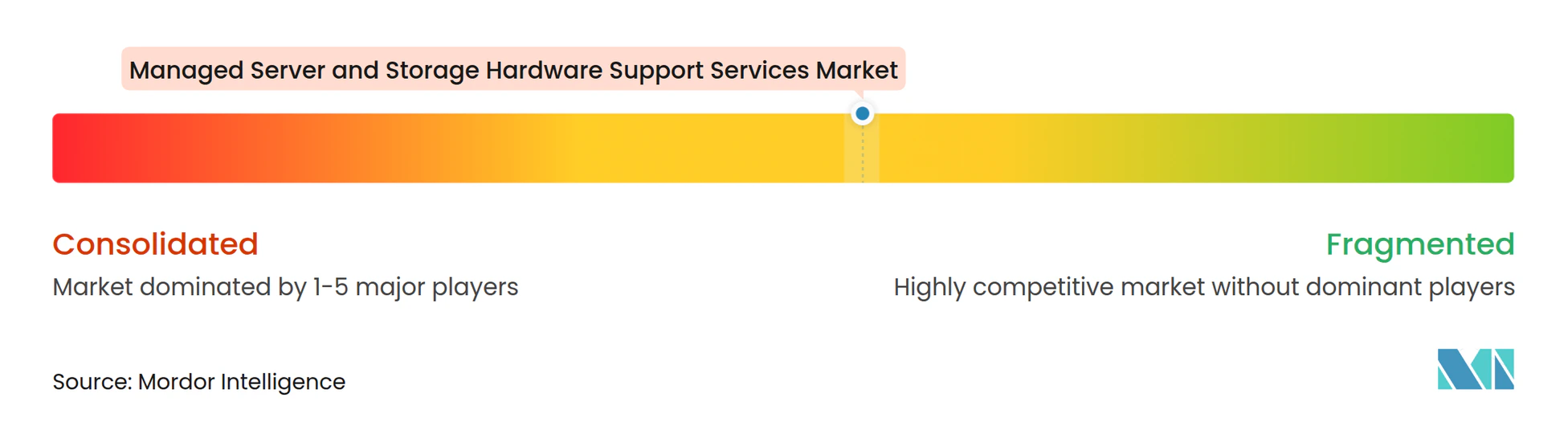
The managed server and storage hardware support services market is moderately concentrated, with large global providers operating alongside many regional specialists. Global providers compete through geographic coverage, multi-vendor service capabilities, spare parts availability, and, increasingly, remote diagnostic tools. Regional specialists compete through knowledge of specific equipment models, local inventory, and response-time advantages. The competitive structure is changing as larger providers pursue acquisitions to build broader field-engineering and logistics networks. This combination leaves customers with a choice between one large provider that can support several countries and a focused operator that may offer deep local expertise.
Park Place Technologies completed its merger with Service Express in January 2026. The combined entity reported USD 1.2 billion in annual revenue, 3,300 employees, and more than 25,000 customers across 180 countries.[4] Its combined offering includes hardware maintenance, GPU servicing, liquid-cooling support, and managed infrastructure. Evernex has also pursued acquisitions to expand its presence across Morocco, Poland, the United Kingdom, Northern Europe, Brazil, and North America. 3i Group announced Evernex’s acquisition of Empowered and OrderWork in June 2026, adding deployment services and the OrderWork field-service management platform. GPU support remains an emerging service area as providers build capability for newer infrastructure.
GPU maintenance and liquid-cooling support are important areas of competition as AI hardware moves through its operational lifecycle. Few providers have scaled their capabilities across both newer GPU clusters and traditional x86 servers, creating a meaningful service gap. Smart 3rd Party, M Global Services, OSI Global IT, Basis Bay, and TERiX continue to compete by specializing in equipment and maintaining regionally focused parts inventories. Predictive maintenance platforms are another area of differentiation because providers can use equipment telemetry to forecast failures and plan parts deployment. These tools can shift contracts away from a simple repair model toward service commitments linked to uptime and prevention. The managed server and storage hardware support services market remains open to specialists, but consolidation gives the largest providers broader reach and greater resources for advanced capabilities.
Managed Server and Storage Hardware Support Services Industry Leaders
-
Park Place Technologies, LLC
-
Evernex International SAS
-
CXtec, Inc.
-
Smart 3rd Party Ltd.
-
M Global Services Ltd.
- *Disclaimer: Major Players sorted in no particular order
Recent Industry Developments
- October 2026: Evernex opens a new regional hub in Bogotá, Colombia, centralizing operations for Colombia and neighboring Andean countries, extending its South American enterprise IT support network.
- June 2026: Evernex, supported by 3i Group, acquires Empowered and OrderWork, two UK-based IT infrastructure deployment services companies, adding large-scale deployment capabilities and the proprietary OrderWork field-service management platform to its third-party maintenance business.
- June 2026: Evernex acquires Maminfo, a Brazil-based specialist in network-related IT services, strengthening its South American presence and expanding managed support capabilities in the region’s largest market.
- January 2026: Park Place Technologies completes its merger with Service Express, creating a USD 1.2 billion revenue entity with 3,300 employees and more than 25,000 customers across 180 countries, the largest M&A consolidation in the third-party hardware maintenance sector to date.
Global Managed Server and Storage Hardware Support Services Market Report Scope
The Managed Server and Storage Hardware Support Services Market comprises outsourced services that provide maintenance, repair, technical support, diagnostics, spare parts management, logistics, installation, and relocation for enterprise server and storage infrastructure. These services are intended to maximize uptime, extend hardware lifecycles, improve performance, and reduce infrastructure ownership costs.
The Managed Server and Storage Hardware Support Services Market Report is Segmented by Equipment Type (Servers, and Storage Systems), Service Type (Hardware Maintenance and Repair, Technical Support and Remote Diagnostics, Spare Parts and Logistics Management, Installation and Relocation Support, and Other Service Types), Organization Size (Large Enterprises, and Small and Medium-Sized Enterprises), End-User Industry (Banking, Financial Services, and Insurance [BFSI], Government and Public Administration, Healthcare and Life Sciences, IT and Telecommunication, Industrial Manufacturing, Retail and E-commerce, Education and Research Institutions, and Other End-User Industries), and Geography (North America, South America, Europe, Asia-Pacific, Middle East, and Africa). The Market Forecasts are Provided in Terms of Value (USD).
| Servers |
| Storage Systems |
| Hardware Maintenance and Repair |
| Technical Support and Remote Diagnostics |
| Spare Parts and Logistics Management |
| Installation and Relocation Support |
| Other Service Types |
| Large Enterprises |
| Small and Medium-Sized Enterprises |
| Banking, Financial Services, and Insurance (BFSI) |
| Government and Public Administration |
| Healthcare and Life Sciences |
| IT and Telecommunication |
| Industrial Manufacturing |
| Retail and E-commerce |
| Education and Research Institutions |
| Other End-User Industries |
| North America | United States |
| Canada | |
| Mexico | |
| South America | Brazil |
| Argentina | |
| Rest of South America | |
| Europe | Germany |
| United Kingdom | |
| France | |
| Italy | |
| Russia | |
| Rest of Europe | |
| Asia-Pacific | China |
| Japan | |
| India | |
| South Korea | |
| Rest of Asia-Pacific | |
| Middle East | Saudi Arabia |
| United Arab Emirates | |
| Rest of Middle East | |
| Africa | South Africa |
| Nigeria | |
| Rest of Africa |
| By Equipment Type | Servers | |
| Storage Systems | ||
| By Service Type | Hardware Maintenance and Repair | |
| Technical Support and Remote Diagnostics | ||
| Spare Parts and Logistics Management | ||
| Installation and Relocation Support | ||
| Other Service Types | ||
| By Organization Size | Large Enterprises | |
| Small and Medium-Sized Enterprises | ||
| By End-User Industry | Banking, Financial Services, and Insurance (BFSI) | |
| Government and Public Administration | ||
| Healthcare and Life Sciences | ||
| IT and Telecommunication | ||
| Industrial Manufacturing | ||
| Retail and E-commerce | ||
| Education and Research Institutions | ||
| Other End-User Industries | ||
| By Geography | North America | United States |
| Canada | ||
| Mexico | ||
| South America | Brazil | |
| Argentina | ||
| Rest of South America | ||
| Europe | Germany | |
| United Kingdom | ||
| France | ||
| Italy | ||
| Russia | ||
| Rest of Europe | ||
| Asia-Pacific | China | |
| Japan | ||
| India | ||
| South Korea | ||
| Rest of Asia-Pacific | ||
| Middle East | Saudi Arabia | |
| United Arab Emirates | ||
| Rest of Middle East | ||
| Africa | South Africa | |
| Nigeria | ||
| Rest of Africa | ||
Key Questions Answered in the Report
What is the managed server and storage hardware support services market size?
The market is projected to expand from USD 15.77 billion in 2026 and USD 17.08 billion in 2027 to USD 25.74 billion by 2032, at an 8.56% CAGR.
Why do enterprises use third-party hardware maintenance?
Enterprises use it to extend equipment life after original warranty coverage ends, consolidate support across hardware brands, and manage maintenance spending.
Which equipment type has the largest revenue contribution?
Servers led equipment revenue with a 66.41% share in 2026, supported by the large installed base of enterprise compute infrastructure.
Which service is expanding fastest?
Technical support and remote diagnostics are projected to expand at a 9.71% CAGR through 2032 as remote monitoring reduces unnecessary site visits.
Which end-user group is expected to expand fastest?
Healthcare and life sciences are projected to expand at a 9.11% CAGR through 2032, supported by clinical imaging, health records, and genomics workloads.
Which region is expected to expand fastest?
Asia-Pacific is projected to expand at a 9.41% CAGR through 2032 as data center development and hybrid hardware deployments continue.