
Managed Server Services Market Size and Share
Market Overview
| Study Period | 2021 - 2032 |
|---|---|
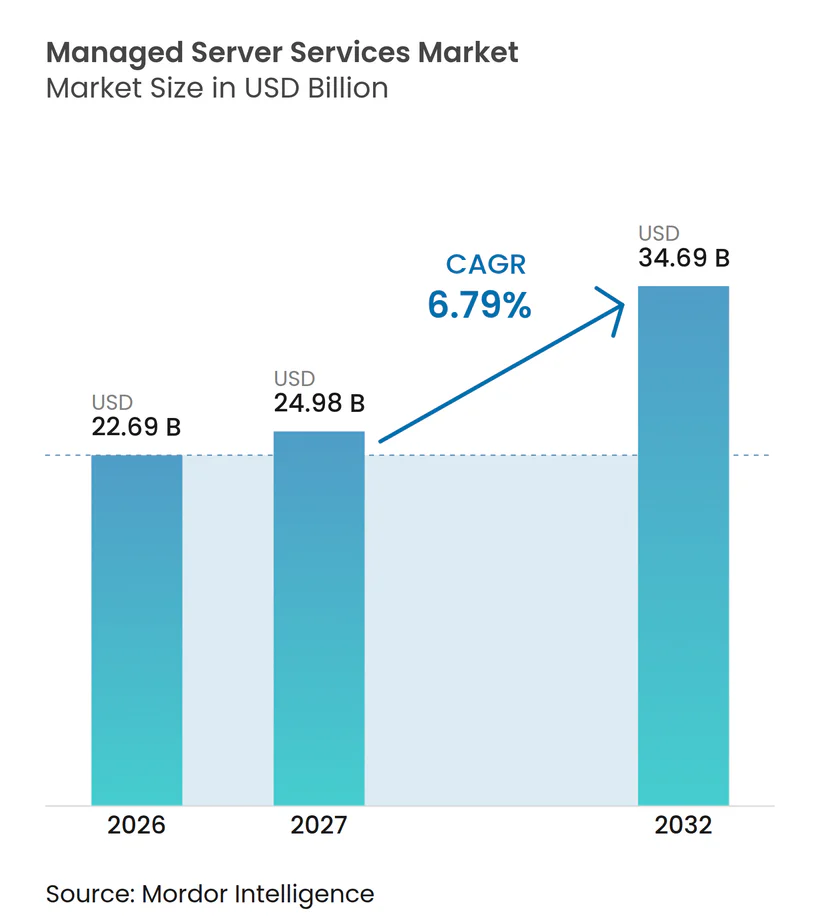
| Market Size (2027) | USD 24.98 Billion |
| Market Size (2032) | USD 34.69 Billion |
| Growth Rate (2027 - 2032) | 6.79 % |
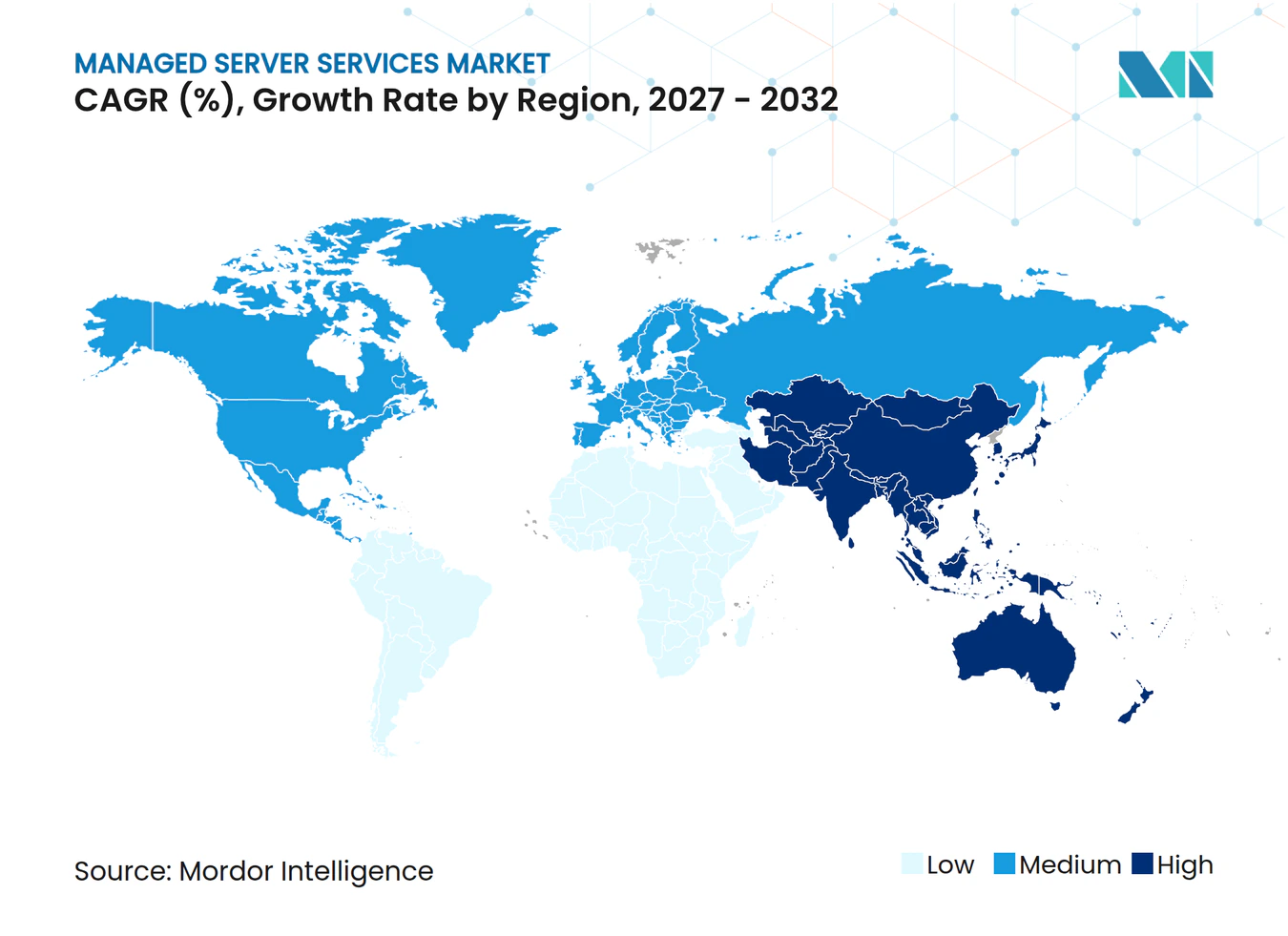
| Fastest Growing Market | Asia-Pacific |
| Largest Market | North America |
| Market Concentration | Medium |
Major Players *Disclaimer: Major Players sorted in no particular order Image © Mordor Intelligence. Reuse requires attribution under CC BY 4.0. | |
Managed Server Services Market Analysis by Mordor Intelligence
The managed server services market size is projected to expand from USD 22.69 billion in 2026 and USD 24.23 billion in 2027 to USD 34.69 billion by 2032, registering a CAGR of 6.79% between 2027 to 2032. Demand is shifting from routine infrastructure outsourcing toward services that support hybrid operations, AI-ready server estates, stronger governance, and continuous availability for applications that cannot tolerate disruption. Enterprises need providers that can manage complex server configurations across cloud and on-premises environments under consistent service levels, while giving internal teams a clear view of performance, incidents, operating responsibilities, and the effect of changes across connected workloads, support processes, service commitments, infrastructure dependencies, security configurations, operational risk, and client accountability needs. Compliance expectations also favor providers with mature security controls, clearly documented operating processes, reliable escalation procedures, and the capacity to work within industry-specific requirements. The managed server services market is increasingly shaped by automation capability, certified controls, practical support for local data requirements, disciplined capacity planning, and the ability to manage specialized infrastructure without weakening accountability in regulated settings or losing visibility across a customer’s full infrastructure estate.
Key Report Takeaways
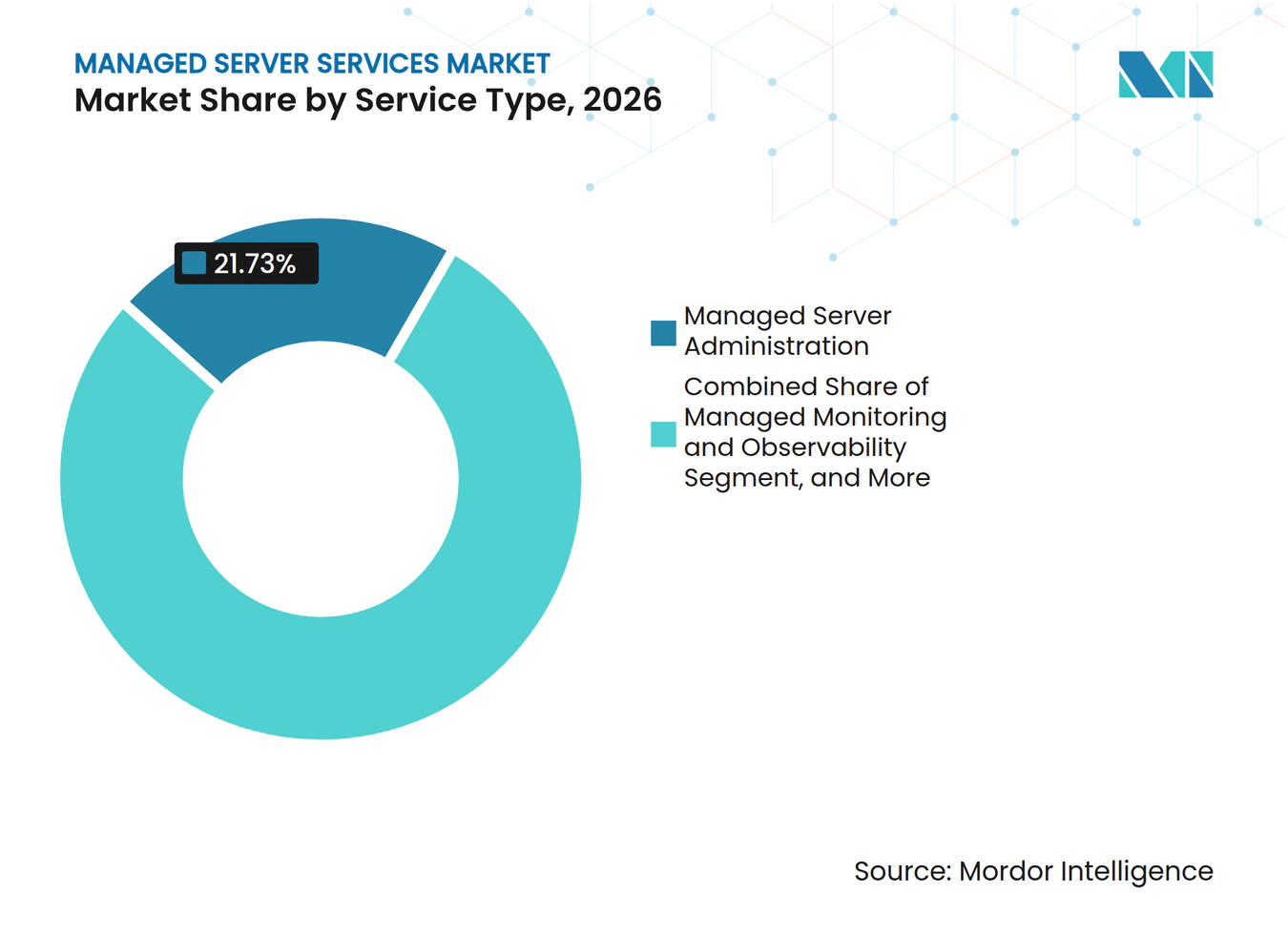
- By service type, managed server administration held 21.73% of the managed server services market in 2026, while managed network automation and AIOps operations is projected to expand at an 8.29% CAGR through 2032.
- By deployment model, cloud-based services held 68.58% share in 2026 and are projected to expand at a 9.34% CAGR through 2032.
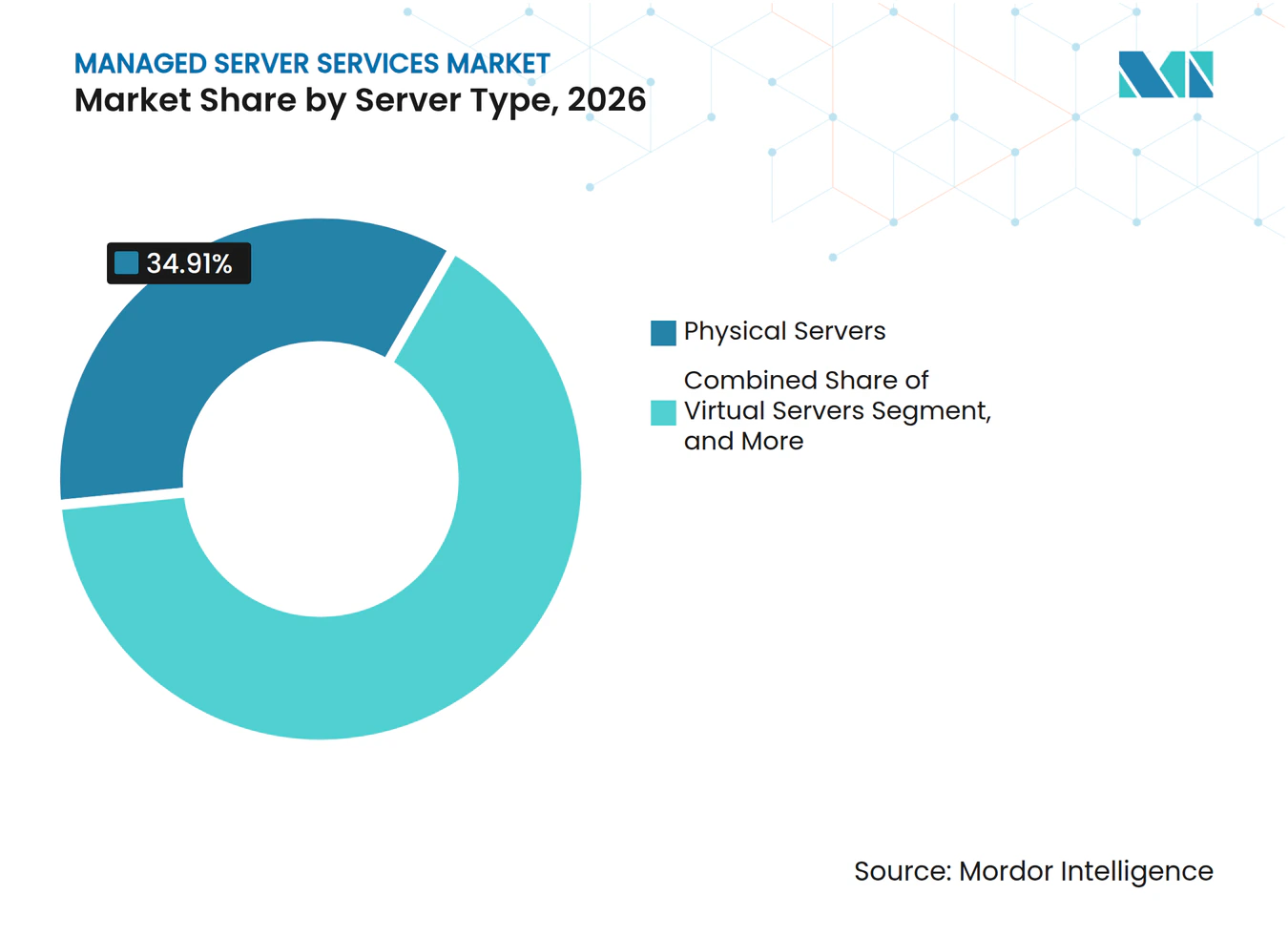
- By server type, physical servers accounted for 34.91% share in 2026, while GPU and AI servers are projected to expand at a 7.38% CAGR through 2032.
- By operating environment, Linux held 36.22% share in 2026, while container and Kubernetes environments are projected to expand at a 9.59% CAGR through 2032.
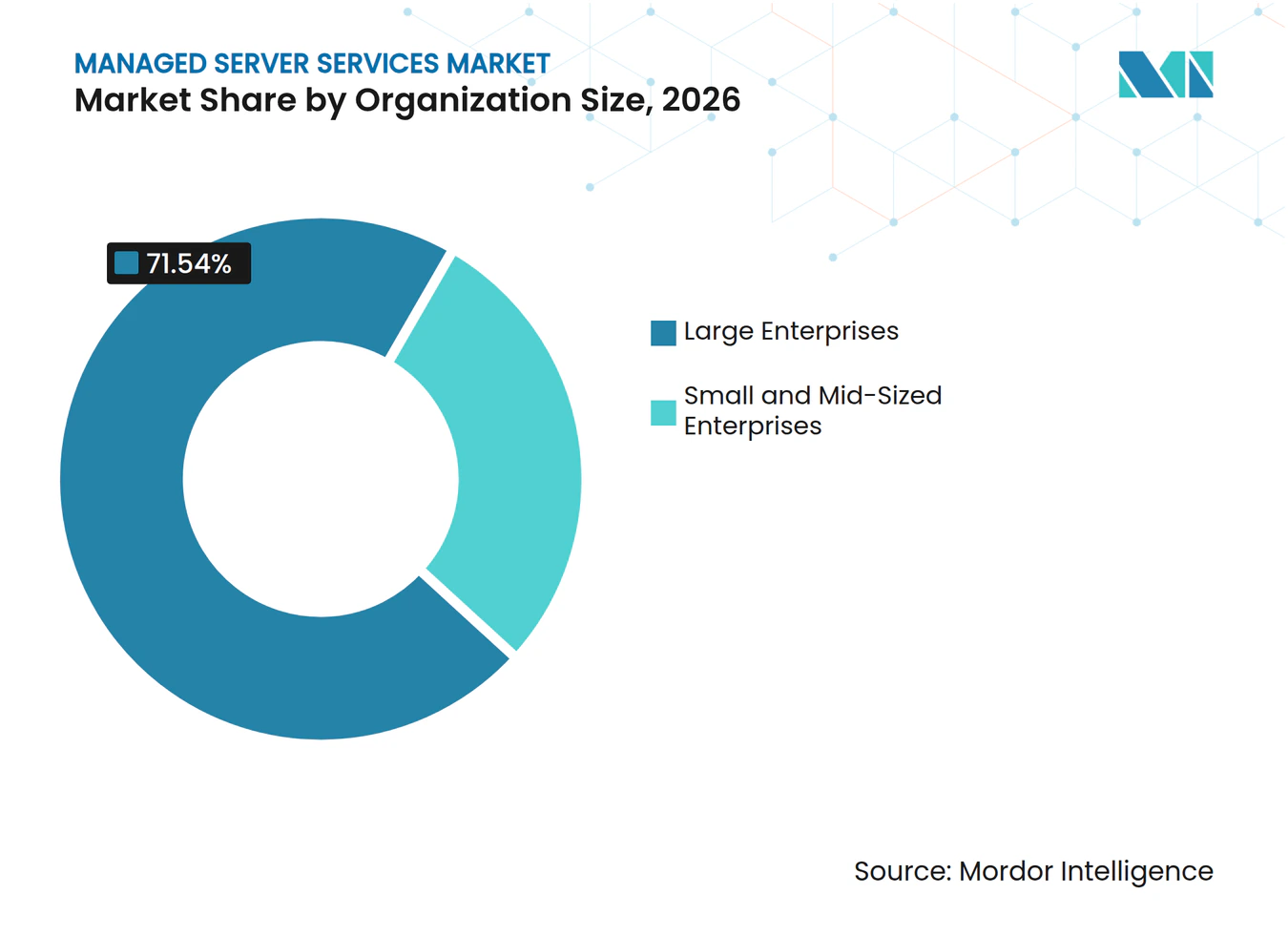
- By organization size, large enterprises held 71.54% of the managed server services market share in 2026, while small and medium-sized enterprises are projected to expand at an 8.64% CAGR through 2032.
- By end-user industry, BFSI held 71.54% share in 2026, while healthcare and life sciences is projected to expand at a 9.27% CAGR through 2032.
- By geography, North America held 38.64% of the managed server services market share in 2026, while Asia-Pacific is projected to expand at an 8.91% CAGR through 2032.
Note: Market numbers in this report are based on Mordor Intelligence's proprietary estimation framework, which combines nine months of actuals with Q4 projections for base year 2026.
Market Trends and Insights
Drivers Impact Analysis of Managed Server Services Market*
| Driver | (~) % Impact on CAGR Forecast | Geographic Relevance | Impact Timeline |
|---|---|---|---|
| Hybrid and Multi-Cloud Complexity | +1.8% | Global, concentrated in North America and Europe | Medium term (2-4 years) |
| Rising Cybersecurity and Compliance Requirements | +1.5% | Global, particularly North America, Europe, and Asia-Pacific core markets | Short term (≤ 2 years) |
| Growth of AI, Big Data, and High-Performance Workloads | +1.4% | Global, with fastest adoption in Asia-Pacific and spillover to the Middle East and Africa | Long term (≥ 4 years) |
| Demand for Predictable Infrastructure Costs and Specialized Expertise | +0.9% | Global, with early concentration in North America and South America | Short term (≤ 2 years) |
| High-Density AI Server Power and Cooling Optimization | +0.7% | North America and Asia-Pacific core markets, with early gains in the Middle East | Medium term (2-4 years) |
| Sovereign Infrastructure and Localized Managed Operations | +0.7% | Global, with early concentration in North America and South America | Medium term (2-4 years) |
| Source: Mordor Intelligence | |||
Hybrid and Multi-Cloud Complexity
Multi-cloud architecture is now an operating reality for many enterprises, and it increases the need for coordinated server oversight. Each environment can use different configurations, network rules, access controls, and monitoring tools. This makes internal management more difficult when workloads run across public cloud platforms and on-premises systems. The managed server services market benefits when providers offer a unified view of these environments and handle routine administration under a single operating model. Generative AI workloads add new layers to infrastructure estates, which adds to the management work facing enterprise teams.
Rising Cybersecurity and Compliance Requirements
Security and compliance requirements are changing both the scope and the value of managed server contracts. The New York Department of Financial Services issued guidance in October 2025 on how covered financial institutions should manage risks posed by third-party service providers, including controls on authentication, encryption, and data governance.[1] Providers serving regulated customers must therefore maintain clear operating controls, retain relevant evidence, and show that these controls are working over time. These expectations make mature service providers more attractive to financial institutions and other organizations with sensitive data. The managed server services market also gains support where clients need external specialists to manage ongoing security operations without increasing internal staffing.
Growth of AI, Big Data, and High-Performance Workloads
AI training and inference workloads place different demands on server operations than conventional enterprise applications. GPU-based systems require close attention to power use, thermal conditions, utilization, capacity allocation, and uptime. These conditions create demand for service teams that can manage hardware and software performance together without interrupting critical workloads. The managed server services market is therefore moving beyond patching and incident response toward ongoing operational support for specialized infrastructure. This work can include monitoring the underlying server environment while supporting the availability needs of AI applications and the governance needs of enterprise users.
Demand for Predictable Infrastructure Costs and Specialized Expertise
Organizations continue to seek a more predictable cost model for operating server estates. Managed contracts can shift part of the infrastructure burden from internal teams to an external provider with defined service responsibilities, reporting routines, and support coverage. This approach is particularly relevant when enterprises need cloud architecture, server administration, security, and operations skills simultaneously. Small and medium-sized enterprises can use standardized service packages to access these capabilities without maintaining a large in-house team. The managed server services market reaches a broader customer base through this model, extending beyond established users in large enterprises and BFSI.
Restraints Impact Analysis of Managed Server Services Market*
| Restraint | (~) % Impact on CAGR Forecast | Geographic Relevance | Impact Timeline |
|---|---|---|---|
| Vendor Lock-In and Migration Complexity | -0.8% | Global, most acute in North America and Europe | Medium term (2-4 years) |
| Shortage of Skilled Cloud and Infrastructure Architects | -0.6% | Global, with early acute shortfalls in Asia-Pacific and Europe | Short term (≤ 2 years) |
| Data Center Power and Grid-Capacity Constraints | -0.4% | North America and Europe core markets, with spillover to Asia-Pacific | Medium term (2-4 years) |
| Margin Pressure from Hyperscaler-Bundled Managed Services | -0.3% | Global | Long term (≥ 4 years) |
| Source: Mordor Intelligence | |||
Vendor Lock-In and Migration Complexity
Long-term contracts can embed proprietary monitoring agents, automation tools, and service processes that make a change of provider difficult. Moving a server environment can also require customers to test configurations, migrate data, validate controls, and maintain service availability during the transition. This work is more demanding in regulated sectors where a new provider may need to demonstrate compliance with established security standards. Hybrid estates add further complexity because the transition can span on-premises infrastructure and multiple cloud regions. These conditions tend to favor incumbents in the managed server services market and can slow the movement of accounts between providers.
Shortage of Skilled Cloud and Infrastructure Architects
The same shortage of cloud and infrastructure skills that encourages outsourcing can limit providers' ability to expand delivery teams. Providers need experienced personnel to build automation platforms, manage complex client environments, interpret operating data, and respond to operational issues. The constraint is important in container-based and AI-ready environments, which require specialized engineering skills and disciplined operating practices. Asia-Pacific faces particular pressure as digital transformation programs advance faster than the local supply of certified infrastructure architects. Providers in the managed server services market are responding by increasing automation, although developing and maintaining automation tools still require skilled teams.
*Our forecasts treat driver/restraint impacts as directional, not additive. The impact forecasts reflect baseline growth, mix effects, and variable interactions.
Managed Server Services Market Segment Analysis
By Service Type:
Administration Supports Revenue While AIOps Expands the Premium TierManaged server administration held 21.73% of the managed server services market share in 2026. The service includes provisioning, operating system patching, configuration management, first-line incident response, access management, and routine performance checks across physical, virtual, and cloud-based estates. It remains central because these recurring tasks are required across most enterprise infrastructure environments, including systems that support internal business applications and customer-facing services. The category provides a stable base of work for service providers that manage established client accounts and need clear operational responsibilities. Providers also use administration contracts as a foundation for selling security, backup, cloud, storage, monitoring, and disaster recovery services.
Managed network automation and AIOps operations are projected to expand at an 8.29% CAGR through 2032. Customers are seeking earlier fault identification, improved event correlation, and more automated remediation, rather than relying solely on manual ticket resolution. Kyndryl launched Agentic Service Management in April 2026, combining assessments, a maturity model, and an ISO 42001-aligned AI governance framework for service operations.[2] The company stated that the service builds on nearly 200 million monthly automations and more than 8,000 certified playbooks. Managed security, backup, disaster recovery, storage, database, cloud, and data center services extend the provider role beyond routine server administration and increase the scope of long-running client relationships.



By Deployment Model:
Cloud-Based Delivery Leads While Hybrid Operations Remain ImportantCloud-based services held 68.58% of revenue in 2026, making them the largest deployment model in the managed server services industry. The position reflects the broad use of cloud infrastructure for enterprise applications and the need for continuous operational support once workloads are in production. Cloud deployments allow providers to deliver standardized monitoring, administration, security support, and incident management across distributed customer environments. Many enterprises still retain on-premises systems for workloads that cannot be migrated due to latency, sovereignty, application dependencies, or internal operational requirements. This leaves providers managing a mix of cloud and locally hosted server resources, often under a single service agreement.
Cloud-based delivery is also projected to expand at a 9.34% CAGR through 2032. IBM announced Red Hat OpenShift Virtualization Service on IBM Cloud as a managed offering in May 2026 to support the operation and migration of virtual machine workloads on Kubernetes-based infrastructure. The offering addresses organizations that need to modernize workloads while preserving hybrid operating controls and service continuity. On-premises managed services remain relevant in government, manufacturing, and other settings that require locally governed operations. Hybrid deployments provide a role for providers that can maintain consistent observability, accountability, and service levels across both cloud and on-premises environments.
By Server Type:
Physical Servers Lead While GPU and AI Systems ExpandPhysical servers accounted for 34.91% of revenue in 2026. Financial institutions, government agencies, and manufacturing facilities maintain substantial installed bases of physical hardware for critical applications and locally controlled workloads. These environments require predictable patching, firmware management, hardware maintenance, capacity planning, and incident handling. The work is well established but can face price pressure when vendors bundle basic support with infrastructure platforms. Virtual and dedicated servers serve organizations that need performance or isolation without owning dedicated hardware, while retaining flexible provisioning options.
GPU and AI servers are projected to expand at a 7.38% CAGR through 2032. These systems support AI inference and training workloads that require specialized power, cooling, capacity planning, and performance monitoring. IBM introduced Power11 in July 2025, describing a new generation of IBM Power servers designed for hybrid deployment across on-premises and IBM Cloud environments.[3] The launch reflects the infrastructure refresh cycle supporting managed contracts in sectors with mission-critical workloads and strict continuity requirements. Bare metal and high-performance computing servers remain important where applications need performance levels that are not suited to virtualized environments.

By Operating Environment:
Linux Leads While Containers and Kubernetes AdvanceLinux held 36.22% of the managed server services market in 2026. Linux remains widely used across cloud platforms and AI-oriented server estates, which supports its role in outsourced operations for modern workloads. Providers must manage operating system maintenance, security configurations, workload performance, application dependencies, and routine updates in these environments. Windows services also remain important for enterprises with Microsoft-based applications, directory services, and legacy enterprise resource planning systems. Unix and proprietary environments continue to serve selected financial and mainframe estates where older applications are difficult to replace without operational risk.
Container and Kubernetes environments are projected to expand at a 9.59% CAGR through 2032. The shift from virtual machine-centered deployment to cloud-native orchestration increases the need for providers capable of managing clusters, policies, upgrades, workload availability, and application release processes. Managed Kubernetes can reduce the operational burden for enterprises without specialized platform teams or continuous internal coverage. The managed server services industry benefits when these customers seek external operational support for container platforms and related infrastructure. Virtualized server environments also remain an important part of private-cloud infrastructure, particularly for regulated organizations running large enterprise applications.
By Organization Size:
Large Enterprises Provide Volume While SMEs Add New DemandLarge enterprises held 71.54% of revenue in 2026. Their server estates are typically larger, more geographically distributed, and subject to more complex compliance expectations than those of smaller organizations. Multi-year contracts, extensive integration requirements, and established service processes can make these client relationships durable. Contract renewals, therefore, remain important for established providers serving large enterprise accounts. The large-enterprise segment also creates opportunities to expand managed scope across security, cloud, data center, backup, and application-adjacent operations.
Small and medium-sized enterprises are projected to expand at an 8.64% CAGR through 2032. Standardized, consumption-based contracts lower the entry barrier for organizations that cannot justify extensive internal infrastructure teams or lengthy service onboarding. These customers can obtain administration, monitoring, backup, security support, and defined response coverage through packaged services. This creates volume opportunities for providers that can offer repeatable services at an efficient delivery cost. The segment also changes the economics of the managed server services market as providers adapt contracts and support models to a wider base of smaller buyers.
By End-User Industry:
BFSI Leads Spending While Healthcare and Life Sciences AdvanceBFSI held 71.54% of spending in 2026. The sector requires high availability for transaction processing, disaster-recovery capability, and extensive controls over sensitive information. Financial institutions use managed providers to support server operations that must meet rigorous security, resilience, and governance expectations. The New York Department of Financial Services' guidance, published in October 2025, reinforces the importance of managing third-party service provider risk in this environment. IT and telecommunications are another important end-user group because they operate both commercial service platforms and internal infrastructure estates.
The healthcare and life sciences industry is projected to expand at a 9.27% CAGR through 2032. AI-supported diagnostic, research, and drug discovery workloads can increase the need for GPU-capable server operations and reliable data handling. Providers can support these workloads when internal teams lack sufficient capacity to manage specialized systems on an ongoing basis. Government demand is linked to locally governed operations and sovereign infrastructure requirements. Industrial manufacturing, retail, and e-commerce also require reliable server operations to support production processes, transactions, supply chains, and customer-facing services.
Geography Analysis
North America Managed Server Services Market
North America held 38.64% of the managed server services market share in 2026. The region combines a mature outsourcing culture with a high concentration of large enterprises and regulated workloads across financial services, healthcare, and defense. These users require auditable server management, stable operations, and strong service controls for sensitive workloads. The New York Department of Financial Services issued its third-party service provider risk guidance in October 2025, which makes governance of external technology providers especially important for covered financial institutions. Canada is also relevant for services that keep sensitive workloads within the country, and Kyndryl made Cloud Uplift available in Canadian Microsoft data center regions in March 2026 to help enterprises move IBM Power workloads to Azure while maintaining in-country data residency.
APAC Managed Server Services Market
Asia-Pacific is projected to expand at an 8.91% CAGR through 2032, the fastest regional rate in the managed server services market. Demand is supported by cloud adoption, infrastructure modernization, and local requirements for data handling across a varied group of national markets. Japan remains important for mainframe modernization and hybrid operations, and Kyndryl Japan launched a zCloud managed mainframe service on IBM Z infrastructure in February 2025 for organizations modernizing mission-critical workloads. In India, Bharti Airtel and IBM announced a partnership in October 2025 to deploy IBM Power11 servers as a service on Airtel Cloud for regulated sectors, including banking, healthcare, and government. China, South Korea, and Australia are established markets where localization rules, national data policies, and domestic infrastructure preferences shape provider selection.
EMEA and South America Managed Server Services Market
Europe remains a compliance-intensive region because customers must address data protection, cybersecurity, and sovereignty requirements. Germany has a strong base of industrial and manufacturing users, while the United Kingdom is focused on cybersecurity-related operating controls and the management of external providers. France, Italy, and Spain are important for sovereign-cloud managed operations, while South America is developing as organizations modernize older systems and increase their use of managed cloud services. Middle East markets, especially Saudi Arabia and the United Arab Emirates, are attracting infrastructure investment connected with sovereign AI programs, while African demand is primarily linked to BFSI and telecommunications, with South Africa and Nigeria among the more active markets.
Competitive Landscape
Market Concentration
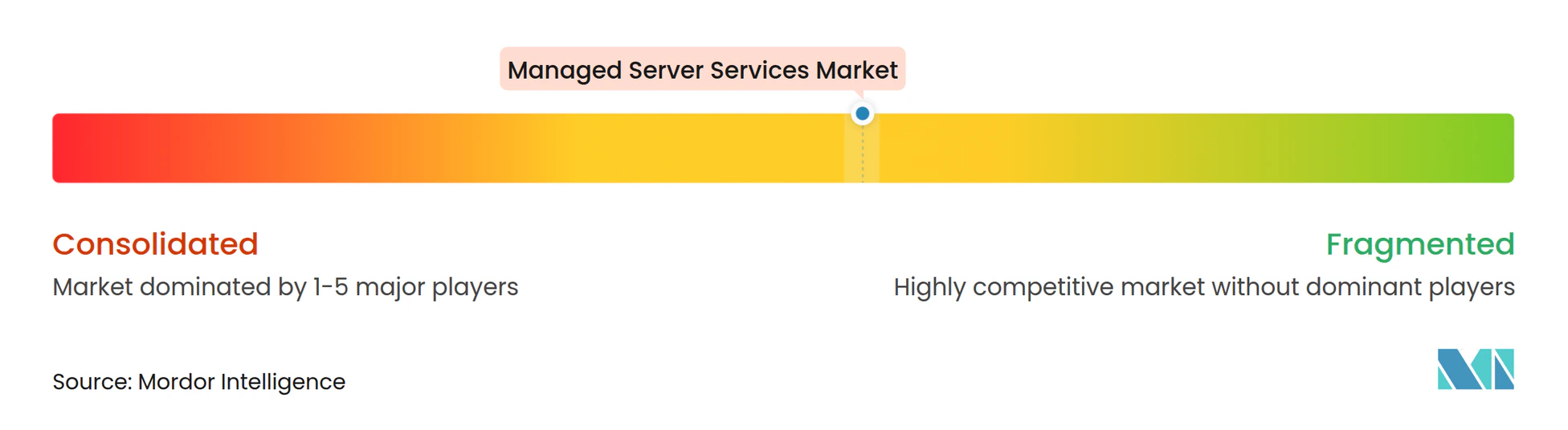
The managed server services market is moderately fragmented among global IT services providers and hyperscaler-aligned service organizations. IBM, Kyndryl, Accenture, DXC Technology, Tata Consultancy Services, Capgemini, HCL Technologies, and Wipro compete for large enterprise accounts. AWS, Microsoft, and Google also influence the competitive environment through cloud-native services and partner ecosystems. Providers differentiate through automation, compliance certifications, and their ability to manage workloads in jurisdictions with data residency requirements. Mid-tier providers, including Rackspace Technology, OVH Groupe, and regional specialists, often compete through price, local delivery capacity, and standardized service-level agreements.
Kyndryl launched Agentic Service Management in April 2026 with an AI governance framework aligned to ISO 42001 and a large existing automation base. The move illustrates the emphasis on operational automation and governed AI use in managed services. Accenture and Dell Technologies formed the Accenture Dell Business Group in October 2026 to support private AI and infrastructure modernization, including full-lifecycle managed services for regulated industries. This partnership addresses demand for on-premises AI infrastructure where clients require data-sovereign operations. IBM also expanded its managed hybrid portfolio in May 2026 with Red Hat AI Inference and Red Hat OpenShift Virtualization Service on IBM Cloud.
DXC Technology introduced DXC Complete with SAP and Microsoft in May 2025 to deliver managed SAP workloads on Microsoft Azure under a single contract. This strategy shows how providers are using ecosystem relationships to retain large accounts and reduce the burden of multi-vendor coordination for customers. Rackspace Technology launched a cloud management platform in August 2025 with AI-enabled observability, application optimization, and a consumption-based model for hybrid environments. Opportunities remain in managed GPU server operations, container environments for mid-market customers, and sovereign-cloud operations for public sector users, favoring providers that combine specialized infrastructure operations with consistent governance.
Managed Server Services Industry Leaders
-
International Business Machines Corporation
-
Accenture plc
-
Microsoft Corporation
-
Fujitsu Limited
-
Cisco Systems, Inc.
- *Disclaimer: Major Players sorted in no particular order
Managed Server Services Market Companies Covered in this Report
- International Business Machines Corporation
- Accenture plc
- Microsoft Corporation
- Fujitsu Limited
- Cisco Systems, Inc.
- Amazon Web Services, Inc.
- Google LLC
- Kyndryl Holdings, Inc.
- Tata Consultancy Services Limited
- Capgemini SE
- DXC Technology Company
- Hewlett Packard Enterprise Company
- Dell Technologies Inc.
- NTT DATA Group Corporation
- Verizon Communications Inc.
- Orange S.A.
- Atos SE
- Rackspace Technology, Inc.
- DigitalOcean Holdings, Inc.
- OVH Groupe S.A.
- Equinix, Inc.
- Alibaba Group Holding Limited
- Oracle Corporation
- HCL Technologies Limited
- Wipro Limited
Recent Industry Developments in Managed Server Services Market
- October 2026: Accenture and Dell Technologies announced the formation of the Accenture Dell Business Group, expanding a 20-year collaboration to help enterprises scale private AI and modernize infrastructure. The group delivers AI Factories built on Dell's full-stack portfolio with full-lifecycle managed services, targeting regulated industries requiring data-sovereign on-premises AI infrastructure. Accenture is training more than 3,000 practitioners across the Dell portfolio to support the initiative.
- May 2026: IBM launched Red Hat AI Inference and Red Hat OpenShift Virtualization Service on IBM Cloud as managed offerings. Red Hat AI Inference standardizes AI model orchestration across hybrid environments with built-in governance controls. Red Hat OpenShift Virtualization Service provides a managed path to migrate and operate virtual machine workloads at scale on Kubernetes-based infrastructure, directly addressing the VM-to-container transition reshaping managed operating environments.
- April 2026: Kyndryl launched Agentic Service Management, combining a maturity model, structured assessments, and an ISO 42001-aligned AI governance framework to help enterprises transition from traditional service operations to autonomous, intelligent workflows at scale. The service builds on Kyndryl's existing automation foundation of nearly 200 million monthly automations and more than 8,000 certified playbooks.
- March 2026: Kyndryl made Cloud Uplift available in Microsoft Canadian data center regions, enabling Canadian enterprises to migrate mission-critical IBM Power workloads to Microsoft Azure without application refactoring while maintaining in-country data residency. Canada became the 5th geographic region and 14th Azure region where the solution is available.
Global Managed Server Services Market Report Scope
Managed server services market involves third-party providers operating and supporting physical, virtual, or cloud-based servers on behalf of an organization. Typical services include provisioning, operating-system management, patching, monitoring, capacity management, security hardening, backup coordination, performance tuning, and incident resolution to maintain server availability and performance.
The Managed Server Services Market Report is Segmented by Service Type (Managed Server Administration, Managed Monitoring and Observability, Managed Security Services for Servers, Managed Backup and Disaster Recovery, Managed Storage and Database Services, Managed Cloud and Data Center Services, Managed Network and Connectivity Services, and Other Service Types), Deployment Mode (Cloud-Based, On-Premises, and Hybrid), Server Type (Physical Servers, Virtual Servers, Dedicated Servers, Bare Metal Servers, GPU and AI Servers, and High-Performance Computing (HPC) Servers), Operating Environment (Linux Server, Windows Server, Unix and Other Proprietary Operating Environments, Container and Kubernetes Environments, and Virtualized Server Environments), Organization Size (Large Enterprises, and Small and Mid-Sized Enterprises), End User Industry (Banking, Financial Services and Insurance (BFSI), IT and Telecommunications, Healthcare and Life Sciences, Government and Public Administration, Industrial Manufacturing, Retail and E-Commerce, and Other End-User Industries), and Geography (North America, South America, Europe, Asia-Pacific, Middle East, and Africa). The Market Forecasts are Provided in Terms of Value (USD).
Segmentation Overview
| Managed Server Administration |
| Managed Monitoring and Observability |
| Managed Security Services for Servers |
| Managed Backup and Disaster Recovery |
| Managed Storage and Database Services |
| Managed Cloud and Data Center Services |
| Managed Network and Connectivity Services |
| Other Service Types |
| On-Premises |
| Cloud-Based |
| Hybrid |
| Physical Servers |
| Virtual Servers |
| Dedicated Servers |
| Bare Metal Servers |
| GPU and AI Servers |
| High-Performance Computing (HPC) Servers |
| Linux Server |
| Windows Server |
| Unix and Other Proprietary Operating Environments |
| Container and Kubernetes Environments |
| Virtualized Server Environments |
| Large Enterprises |
| Small and Mid-Sized Enterprises |
| Banking, Financial Services and Insurance (BFSI) |
| IT and Telecommunications |
| Healthcare and Life Sciences |
| Government and Public Sector |
| Industrial Manufacturing |
| Retail and E-Commerce |
| Other End-User Industries |
| North America | United States |
| Canada | |
| Mexico | |
| South America | Brazil |
| Argentina | |
| Rest of South America | |
| Europe | Germany |
| United Kingdom | |
| France | |
| Italy | |
| Rest of Europe | |
| Asia-Pacific | China |
| India | |
| Japan | |
| South Korea | |
| Rest of Asia-Pacific | |
| Middle East | Saudi Arabia |
| United Arab Emirates | |
| Rest of Middle East | |
| Africa | South Africa |
| Nigeria | |
| Rest of Africa |
| By Service Type | Managed Server Administration | |
| Managed Monitoring and Observability | ||
| Managed Security Services for Servers | ||
| Managed Backup and Disaster Recovery | ||
| Managed Storage and Database Services | ||
| Managed Cloud and Data Center Services | ||
| Managed Network and Connectivity Services | ||
| Other Service Types | ||
| By Deployment Model | On-Premises | |
| Cloud-Based | ||
| Hybrid | ||
| By Server Type | Physical Servers | |
| Virtual Servers | ||
| Dedicated Servers | ||
| Bare Metal Servers | ||
| GPU and AI Servers | ||
| High-Performance Computing (HPC) Servers | ||
| By Operating Environment | Linux Server | |
| Windows Server | ||
| Unix and Other Proprietary Operating Environments | ||
| Container and Kubernetes Environments | ||
| Virtualized Server Environments | ||
| By Organization Size | Large Enterprises | |
| Small and Mid-Sized Enterprises | ||
| By End-User Industry | Banking, Financial Services and Insurance (BFSI) | |
| IT and Telecommunications | ||
| Healthcare and Life Sciences | ||
| Government and Public Sector | ||
| Industrial Manufacturing | ||
| Retail and E-Commerce | ||
| Other End-User Industries | ||
| By Geography | North America | United States |
| Canada | ||
| Mexico | ||
| South America | Brazil | |
| Argentina | ||
| Rest of South America | ||
| Europe | Germany | |
| United Kingdom | ||
| France | ||
| Italy | ||
| Rest of Europe | ||
| Asia-Pacific | China | |
| India | ||
| Japan | ||
| South Korea | ||
| Rest of Asia-Pacific | ||
| Middle East | Saudi Arabia | |
| United Arab Emirates | ||
| Rest of Middle East | ||
| Africa | South Africa | |
| Nigeria | ||
| Rest of Africa | ||
Key Questions Answered in the Report
What is the managed server services market size?
The managed server services market size is projected to expand from USD 22.69 billion in 2026 and USD 24.23 billion in 2027 to USD 34.69 billion by 2032, registering a CAGR of 6.79% between 2027 to 2032.
What is driving demand for managed server services?
The managed server services market is supported by hybrid and multi-cloud complexity, cybersecurity requirements, AI workloads, predictable operating costs, and limited specialist skills. Enterprises also need coordinated monitoring, faster incident response, and defined responsibility across cloud and on-premises resources, which encourages the use of external operators.
Which deployment model leads managed server services?
Cloud-based delivery held 68.58% share in 2026 and is projected to expand at a 9.34% CAGR through 2032. The managed server services market still includes on-premises and hybrid workloads where customers need a consistent operating model, common reporting, and dependable support coverage across different environments.
Which server type is expanding fastest?
GPU and AI servers are projected to expand at a 7.38% CAGR through 2032 as organizations deploy infrastructure for training and inference workloads. The managed server services market needs capabilities for power, cooling, performance monitoring, capacity coordination, and reliable workload availability in these specialized settings.
Which end-user sector is expanding fastest?
Healthcare and life sciences is projected to expand at a 9.27% CAGR through 2032, supported by AI-enabled diagnostic, research, and drug discovery workloads. The managed server services market supports organizations that need specialized operational capacity, secure environments, and continuous infrastructure oversight for these demanding systems.
Which region is expected to expand fastest?
Asia-Pacific is projected to expand at an 8.91% CAGR through 2032, supported by cloud adoption, modernization, and local data requirements. The managed server services market in the region is shaped by different national policies, local infrastructure preferences, data location needs, and varying levels of enterprise technology maturity.