
Managed Server Virtualization Services Market Size and Share
Market Overview
| Study Period | 2021 - 2032 |
|---|---|
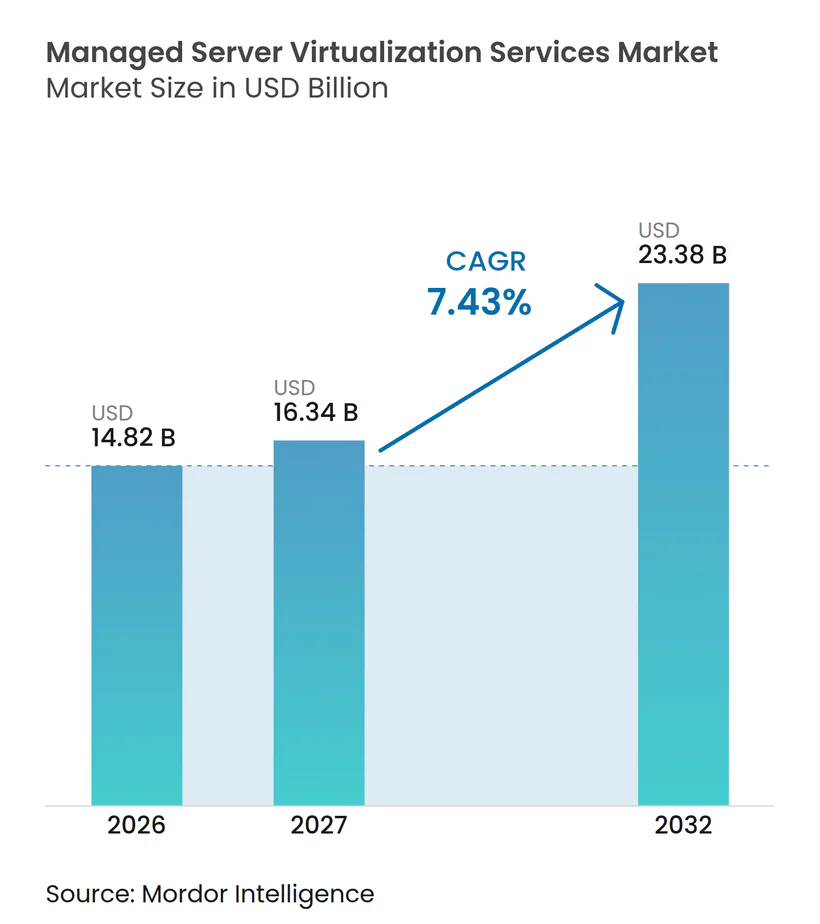
| Market Size (2027) | USD 16.34 Billion |
| Market Size (2032) | USD 23.38 Billion |
| Growth Rate (2027 - 2032) | 7.43 % |
| Fastest Growing Market | Asia-Pacific |
| Largest Market | North America |
| Market Concentration | Medium |
Major Players *Disclaimer: Major Players sorted in no particular order Image © Mordor Intelligence. Reuse requires attribution under CC BY 4.0. | |
Managed Server Virtualization Services Market Analysis by Mordor Intelligence
The Managed Server Virtualization Services Market size is projected to expand from USD 14.82 billion in 2026 and USD 16.34 billion in 2027 to USD 23.38 billion by 2032, registering a CAGR of 7.43% between 2027 to 2032. The Managed Server Virtualization Services Market is moving toward outsourced operations because organizations need support for patching, workload governance, lifecycle management, and security controls across mixed infrastructure estates that remain difficult to operate consistently. Enterprises are keeping critical workloads under direct control while using hybrid and multicloud environments for AI, containerized applications, and cost-sensitive workloads. Licensing changes in the VMware ecosystem have made provider selection, price certainty, and migration planning central commercial issues. Skills shortages also make managed delivery more attractive because many organizations cannot build large internal teams for complex virtual estates. Providers that combine infrastructure operations with security, compliance, and automation are better positioned to serve regulated and distributed environments, particularly when workload placement and auditability must be maintained across several locations, while preserving clear responsibility for incident response, recovery, reporting, and routine service delivery.
Key Report Takeaways
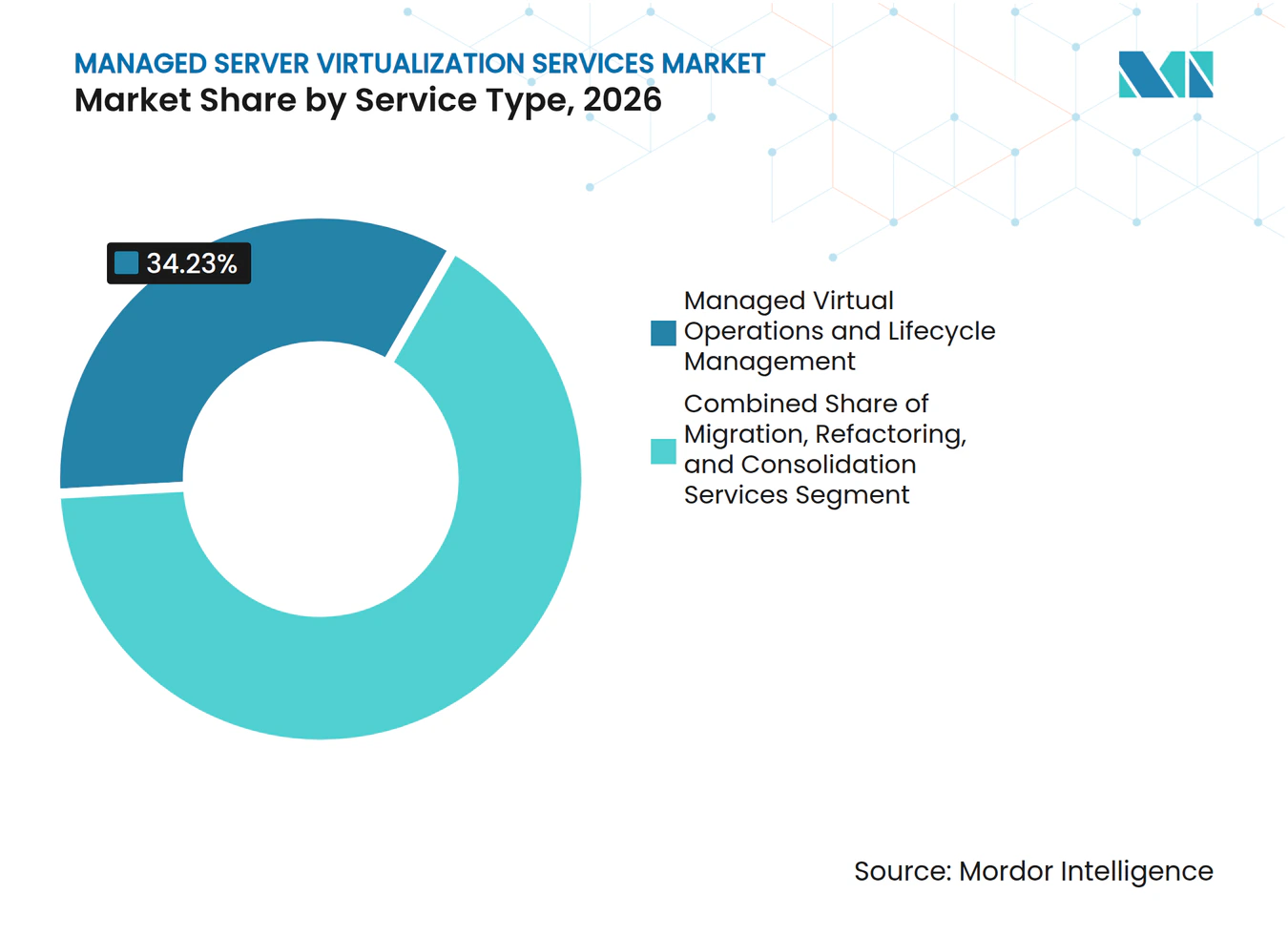
- By service type, Managed Virtual Operations and Lifecycle Management held 34.23% of the Managed Server Virtualization Services Market share in 2026, while Virtual Infrastructure Security, Monitoring, and Compliance Operations is projected to expand at an 8.94% CAGR through 2032.
- By deployment model, Hybrid Cloud accounted for 39.63% of the Managed Server Virtualization Services Market size in 2026 and is expected to expand at an 8.77% CAGR through 2032.
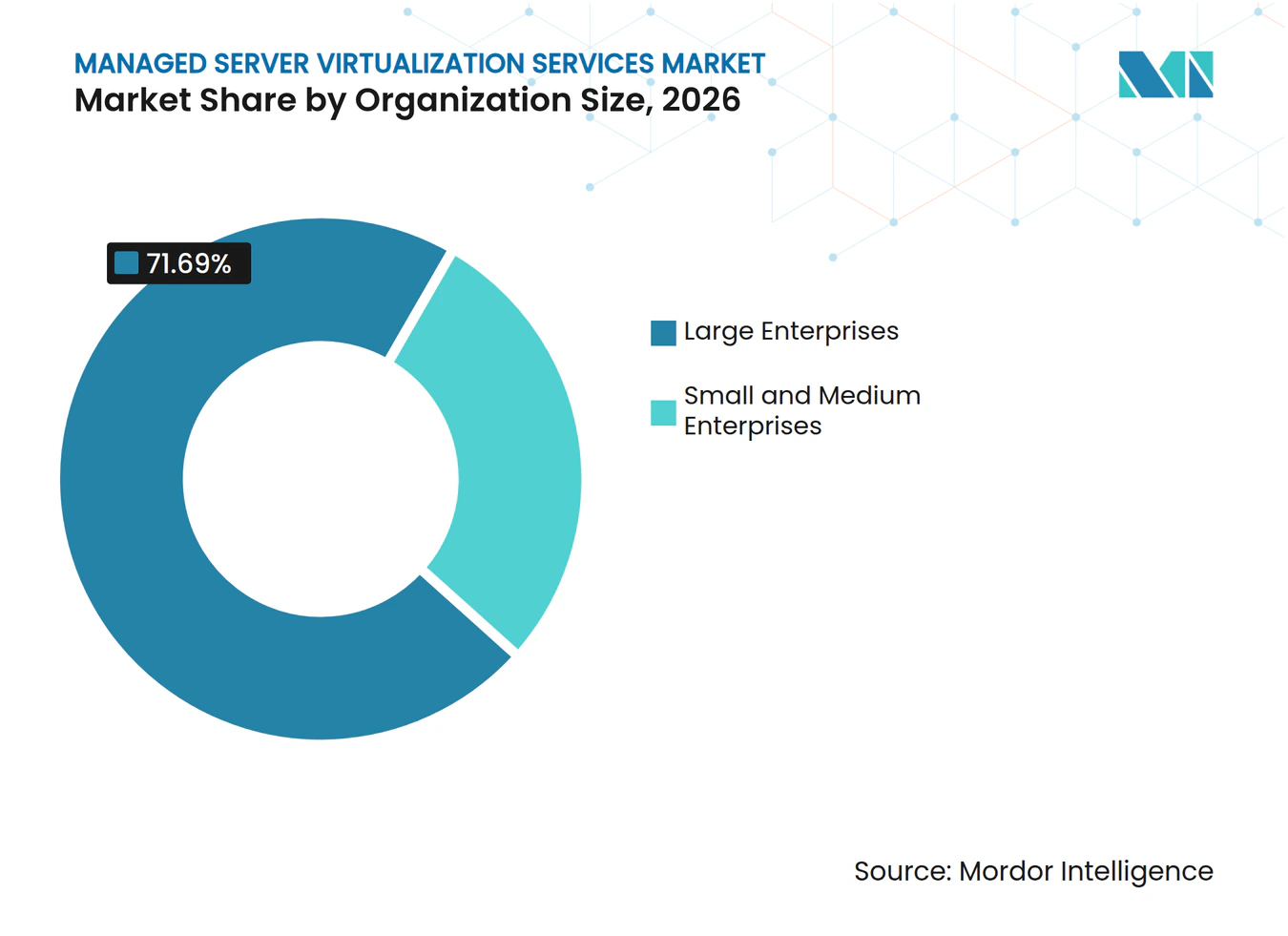
- By organization size, Large Enterprises held 71.69% revenue share in 2026, while SMEs are projected to expand at an 8.91% CAGR through 2032.
- By end-user industry, BFSI held 27.33% revenue share of the Managed Server Virtualization Services Market in 2026, while Healthcare and Life Sciences are projected to expand at a 9.17% CAGR through 2032.
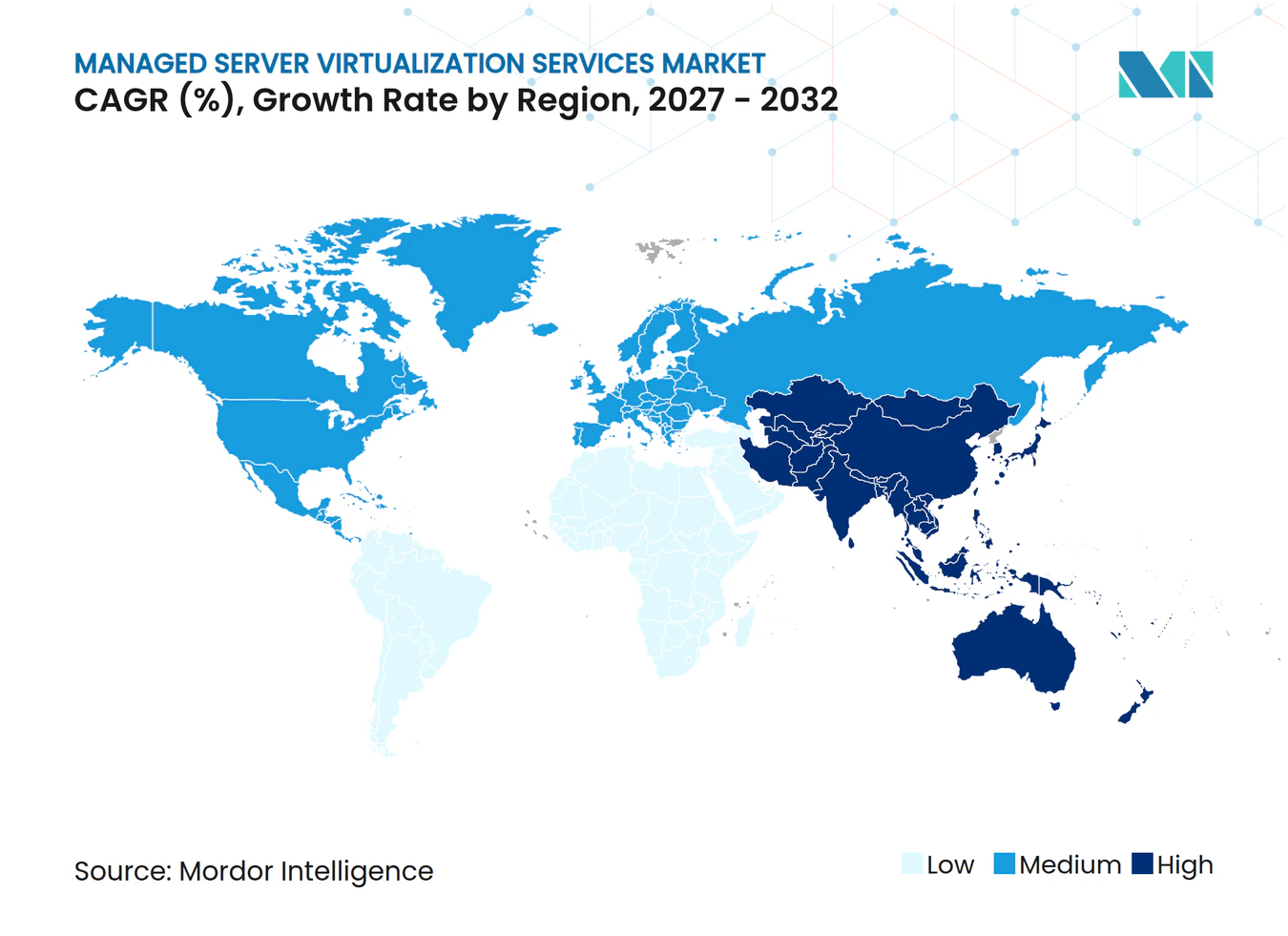
- By geography, North America held 35.53% revenue share in 2026, while Asia-Pacific is projected to expand at a 9.34% CAGR through 2032.
Note: Market numbers in this report are based on Mordor Intelligence's proprietary estimation framework, which combines nine months of actuals with Q4 projections for base year 2026.
Market Trends and Insights
Drivers Impact Analysis of Managed Server Virtualization Services Market*
| Driver | (~) % Impact on CAGR Forecast | Geographic Relevance | Impact Timeline |
|---|---|---|---|
| Hybrid and Multicloud Virtual Machine Management Complexity | +2.1% | Global, concentrated in North America and Europe | Short term (≤ 2 years) |
| Demand for Predictable Infrastructure Operating Expense | +1.7% | Global, with largest gains in North America and Asia-Pacific | Short term (≤ 2 years) |
| Shortage of Certified Virtualization and Cloud Operations Talent | +1.4% | Global, acute in Asia-Pacific, Middle East, and Africa | Medium term (2-4 years) |
| AI-Enabled Observability and Predictive Remediation | +1.2% | North America and Europe initially, Asia-Pacific expanding | Medium term (2-4 years) |
| Sovereign and Regulated Workload Placement Requirements | +0.9% | Europe, Middle East, Asia-Pacific government and regulated sectors | Long term (≥ 4 years) |
| Edge Virtualization for Distributed and Latency-Sensitive Workloads | +0.7% | Asia-Pacific and Europe, driven by telecom and industrial IoT | Long term (≥ 4 years) |
| Source: Mordor Intelligence | |||
Hybrid and Multicloud Virtual Machine Management Complexity
Managing virtual estates across on-premises data centers, private sovereign zones, and public cloud platforms can exceed the capacity of internal IT teams. The Managed Server Virtualization Services Market benefits when clients need one provider to govern VMware, KVM, Nutanix AHV, and Microsoft Hyper-V environments. HPE found that 57% of enterprises were using a phased approach to infrastructure modernization in 2026, while 61% of workloads remained on virtualized on-premises clusters alongside public cloud services. The same research found that only 5% of respondents were fully prepared for the infrastructure changes their boards required. This combination keeps hybrid operating models relevant even where cloud adoption is advanced. Providers that can govern several hypervisors without forcing a full platform replacement can lower operational disruption for clients.
Demand for Predictable Infrastructure Operating Expense
Organizations are shifting from capital-intensive virtualization contracts toward managed agreements with predictable operating costs. The Managed Server Virtualization Services Market supports this shift by combining licensing, patching, monitoring, and helpdesk work into a single service relationship. VMware licensing compliance requirements have added recurring administrative work for enterprises using its software. This burden makes managed contracts more appealing when a provider can take responsibility for operational governance. Clients also seek multiyear price stability because platform transition costs and license terms can change their budget assumptions. Consumption-based packages are especially relevant when customers need to scale infrastructure without committing to new in-house teams.
Shortage of Certified Virtualization and Cloud Operations Talent
The shortage of experienced virtualization and cloud operations personnel remains a durable reason to use managed services. The Managed Server Virtualization Services Market offers access to specialized operations skills that may be difficult for individual enterprises to hire and retain. HPE reported that skills gaps ranked among the leading barriers to virtualization transformation for global enterprise IT leaders in 2026. Kyndryl stated that its AI-assisted Bridge platform had freed more than 13,000 delivery professionals from manual work by fiscal year 2025.[1] Automation can help providers manage more client environments without equivalent increases in staffing. This operating leverage can strengthen the service capacity gap between large providers and smaller competitors.
AI-Enabled Observability and Predictive Remediation
AI-enabled observability is changing managed virtualization from a reactive support activity into a more predictive service. A 2026 peer-reviewed study reported that an AIOps decision layer reduced median detection time from 18.0 minutes to 6.1 minutes and median remediation time from 42.0 minutes to 11.1 minutes. The study also reported a 9x reduction in alert storms in its production setting. Splunk expanded its AI Site Reliability Engineer capability to create code-level remediation pull requests after root-cause diagnosis in September 2026. These tools can support stricter service-level commitments when the provider has mature security and change-control processes. They also make observability and remediation a more visible point of differentiation in the Managed Server Virtualization Services Market.
Restraints Impact Analysis of Managed Server Virtualization Services Market*
| Restraint | (~) % Impact on CAGR Forecast | Geographic Relevance | Impact Timeline |
|---|---|---|---|
| Licensing Cost Volatility and Platform Transition Risk | -1.8% | Global, most acute in North America and Europe where VMware penetration is highest | Short term (≤ 2 years) |
| Security Exposure Across Hypervisors, Virtual Machines, and Management Planes | -1.5% | Global, especially acute in BFSI, government, and healthcare | Medium term (2-4 years) |
| Workload Discovery, Testing, and Validation Burden During Migration | -1.0% | Global, higher complexity in large enterprises and regulated environments | Medium term (2-4 years) |
| Fragmented Data Sovereignty and Cross-Border Data Processing Rules | -0.6% | Europe, Asia-Pacific, and Middle East, with growing influence in South America | Long term (≥ 4 years) |
| Source: Mordor Intelligence | |||
Licensing Cost Volatility and Platform Transition Risk
VMware licensing changes have created budget uncertainty for many organizations using established virtual infrastructure. The Managed Server Virtualization Services Market can face longer sales cycles when buyers delay decisions until licensing terms and platform options are clear. Some service providers also need to revise offerings that were built around prior VMware partner arrangements. This can delay client migrations and make fixed-price commitments harder to provide. It can also lead customers to request price locks that do not align easily with changing vendor costs. Providers with credible migration, assessment, and alternative-platform capabilities can reduce this friction, but the transition work still adds complexity.
Security Exposure Across Hypervisors, Virtual Machines, and Management Planes
Security exposure across the hypervisor, virtual machine, and management plane can constrain service adoption in regulated environments. The Managed Server Virtualization Services Market must address concerns that compromise of a guest environment could affect a host or a broader management layer. A security advisory reported active exploitation of critical ESXi vulnerabilities in 2025, including CVE-2025-22224, CVE-2025-22225, and CVE-2025-22226.[2] This threat environment makes continuous vulnerability monitoring, fast patching, and auditable access controls important in BFSI, healthcare, and government procurement. Management tools such as vCenter and related orchestration platforms require controls that account for lateral movement risk. Providers with formal information security controls and clear response commitments are more likely to meet buyer requirements.
*Our forecasts treat driver/restraint impacts as directional, not additive. The impact forecasts reflect baseline growth, mix effects, and variable interactions.
Managed Server Virtualization Services Market Segment Analysis
By Service Type:
Security and Compliance Operations Support Higher-Value DeliveryManaged Virtual Operations and Lifecycle Management held 34.23% revenue share in 2026. This category covers virtual machine provisioning, patching, capacity management, and lifecycle event handling for the Managed Server Virtualization Services Market. It remains the largest category because clients need dependable daily operations across broad virtual estates. IBM and Red Hat launched Red Hat OpenShift Virtualization Service on IBM Cloud in May 2026, combining VM operations on OpenShift with automated lifecycle management and enterprise security controls. The launch shows how providers are placing governance and lifecycle tools closer to the application platform.
Virtual Infrastructure Security, Monitoring, and Compliance Operations is projected to expand at an 8.94% CAGR through 2032. Its expansion is supported by the need for round-the-clock monitoring and auditable controls rather than periodic assessments. Security teams in the Managed Server Virtualization Services Market need visibility across hypervisors, virtual machines, and the management plane. Migration, Refactoring, and Consolidation Services are also gaining attention where customers assess alternatives to existing VMware deployments. Backup, Disaster Recovery, and Business Continuity Services are becoming more accessible to SMEs through managed backup-as-a-service packages that avoid the need for internal virtualization teams.



By Deployment Model:
Hybrid Cloud Combines Scale With MomentumHybrid Cloud accounted for 39.63% of the Managed Server Virtualization Services Market size in 2026. It was the largest deployment model because Managed Server Virtualization Services Market clients need to keep selected workloads near their own data centers or within controlled environments. The model also gives clients a path to use public cloud services without abandoning established virtual infrastructure. HPE reported that hybrid cloud was the preferred operating model for AI performance demands among the enterprise leaders it surveyed in 2026.[3] This preference supports managed service demand because hybrid estates require coordination across several operational domains. It also creates demand for providers that can manage policy, capacity, and security across different locations.
Hybrid Cloud is projected to expand at an 8.77% CAGR through 2032, the highest rate among deployment models. Private Cloud holds the second-largest position because Managed Server Virtualization Services Market clients in regulated sectors continue to value physically isolated workloads and predictable operational control. On-premises systems remain important for latency-sensitive applications and workloads with data sovereignty constraints. Public Cloud has the smallest managed service revenue share because enterprises often use native operations tools for purely public cloud workloads.
By Organization Size:
SMEs Expand Access to Managed VirtualizationLarge Enterprises held 71.69% of revenue in 2026. Their virtual estates in the Managed Server Virtualization Services Market are often spread across jurisdictions and include security, network, and compliance requirements. Large contracts are commonly multiyear and include several service towers, which keeps average contract values high. These characteristics also make switching providers difficult once the operating model is established. This keeps large organizations central to revenue even as smaller clients adopt more managed services across the Managed Server Virtualization Services industry.
SMEs are projected to expand at an 8.91% CAGR through 2032. Standardized, cloud-delivered service packages are lowering the entry cost in the Managed Server Virtualization Services Market because they rely more on templates than on custom architectures. Smaller firms can access enterprise-grade backup, monitoring, and operational support without forming dedicated internal teams. The economics of minimum licensing quantities can make self-managed environments less attractive for small virtual estates. Compliance obligations also bring more SMEs in critical sectors into scope for infrastructure security requirements.

By End-User Industry:
BFSI Maintains Scale While Healthcare AcceleratesBFSI held 27.33% of end-user revenue in 2026. Banks, insurers, and financial institutions in the Managed Server Virtualization Services Market require high availability, audit trails, and resilient operating procedures. Basel III, PCI DSS, and DORA-related expectations support demand for providers that can document controls and sustain demanding uptime commitments. These organizations also manage sensitive data across established systems, which can make broad infrastructure changes difficult. Managed service contracts can help them consolidate operations while retaining governance over key workloads.
Healthcare and Life Sciences is projected to expand at a 9.17% CAGR through 2032. Telehealth activity, medical imaging storage, and data handling requirements are increasing the need for well-managed virtual infrastructure. Providers in the Managed Server Virtualization Services Market need to support availability, backup, and security controls that align with healthcare data protection obligations. Manufacturing and Automotive clients in the Managed Server Virtualization Services industry use managed virtualization for industrial IoT integration and operational technology network segmentation. Government and Public Sector buyers seek services that meet national digital transformation and sovereign cloud requirements.
Geography Analysis
North America Managed Server Virtualization Services Market
North America held 35.53% revenue share in 2026. The region has a deep pool of enterprise VMware estates and a large Managed Server Virtualization Services Market provider ecosystem. Government procurement requirements also support demand for providers that can meet security and data handling expectations. The United States remains the largest market in the region. Canada is an active secondary geography because data residency needs to reinforce demand for managed services that can operate regulated workloads.
APAC Managed Server Virtualization Services Market
Asia-Pacific is projected to expand at a 9.34% CAGR through 2032, making it the fastest-growing regional area. Regional demand is supported by concurrent infrastructure expansion and diversification across several countries. India has a strong Managed Server Virtualization Services Market demand from BFSI modernization, while Japan offers opportunities to move legacy Unix-server estates to managed virtual platforms. NTT DATA and Hitachi announced a 2025 collaboration to expand Prossione Virtualization, a KVM-based managed service designed around digital sovereignty requirements for Japanese enterprises.
EMEA and South America Managed Server Virtualization Services Market
Europe is a substantial but complex Managed Server Virtualization Services Market geography because cloud sovereignty requirements influence provider selection. The European Commission awarded a EUR 180 million contract (USD 203.4 million) for sovereign cloud procurement in April 2026 and set assurance expectations for sensitive public-sector workloads.[4] Germany, the United Kingdom, and France remain the largest country markets in Europe, with distinct compliance requirements that favor providers operating regional infrastructure. South America and Africa are developing from smaller bases, where financial services and telecommunications create targeted demand. The Middle East is an emerging managed virtualization area, where digital transformation and data governance requirements increase the value of managed operating models.
Competitive Landscape
Market Concentration
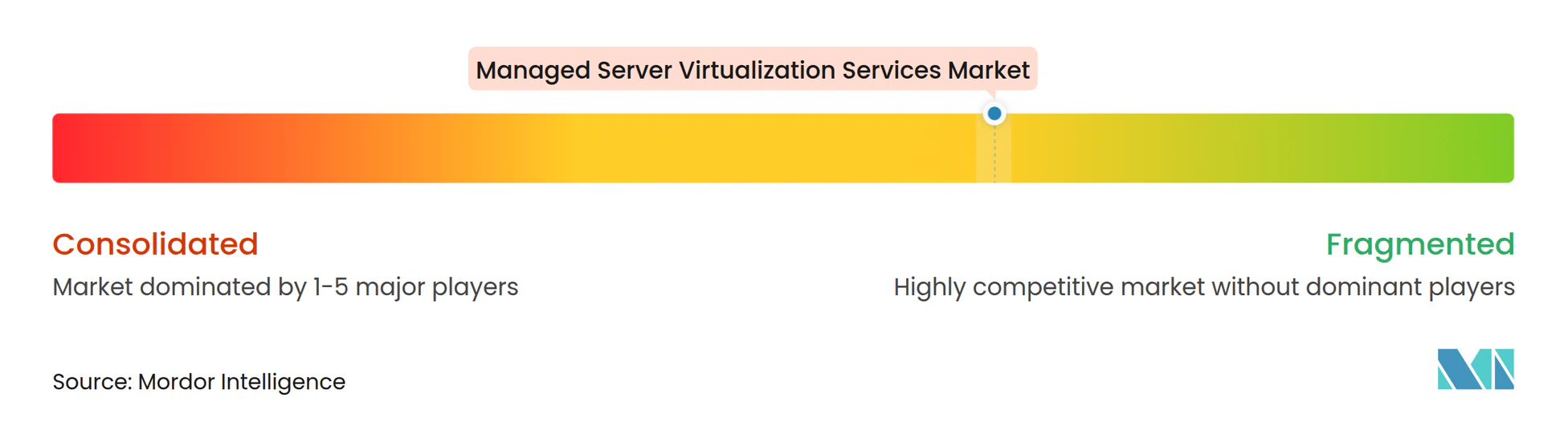
The Managed Server Virtualization Services Market is moderately fragmented. Global systems integrators such as Kyndryl, IBM, DXC Technology, Accenture, HCLTech, TCS, and Capgemini compete for large multiyear contracts. Microsoft, Amazon Web Services, and Google offer adjacent managed capabilities through their cloud platforms. Nutanix and Rackspace Technology compete as platform and managed service specialists. Competitive strength in the Managed Server Virtualization Services Market depends on service breadth, operating scale, security controls, and the ability to work across virtual machine and cloud environments.
Providers are increasingly combining virtual machine and Kubernetes management within a shared operating plane. IBM announced in October 2026 that it was embedding Red Hat OpenShift Virtualization into IBM Infrastructure, giving customers a Kubernetes-native path for virtual machine operations. Rackspace Technology launched Rackspace Cloud on VMware Cloud Foundation 9.1 in August 2026 as a managed multitenant platform for virtual machine and Kubernetes operations. Kyndryl and Microsoft expanded sovereignty solutioning in July 2026 to help enterprises design and operate architectures aligned with GDPR, DORA, and NIS2 obligations. These moves show that infrastructure management, application platforms, and compliance delivery are becoming more closely linked.
AI-driven observability is another area of competitive differentiation in the Managed Server Virtualization Services Market, especially for providers that support demanding availability commitments. Nutanix announced Service Provider Central in April 2026 to give service providers a shared control plane for multiple customer environments on common infrastructure. Citrix and HPE also announced plans in June 2026 to advance Citrix Desktop-as-a-Service on GreenLake by HPE for organizations with data sovereignty and regulatory requirements. No combined market share is provided for the leading companies, so a concentration score cannot be assigned from the available data without estimating their positions.
Managed Server Virtualization Services Industry Leaders
-
Accenture plc
-
Atos SE
-
Cisco Systems, Inc.
-
Fujitsu Limited
-
DXC Technology Company
- *Disclaimer: Major Players sorted in no particular order
Managed Server Virtualization Services Market Companies Covered in this Report
- Accenture plc
- Atos SE
- Capgemini SE
- Cognizant Technology Solutions Corporation
- DXC Technology Company
- Fujitsu Limited
- Hewlett Packard Enterprise Company
- HCLTech
- IBM Corporation
- Kyndryl, Inc.
- Microsoft Corporation
- NTT DATA Corporation
- Nutanix, Inc.
- Oracle Corporation
- Rackspace Technology, Inc.
- Red Hat, Inc.
- Tata Consultancy Services Limited
- VMware by Broadcom
- Wipro Limited
- Amazon Web Services, Inc.
- Google LLC
Recent Industry Developments in Managed Server Virtualization Services Market
- October 2026: IBM announced the embedding of Red Hat OpenShift Virtualization directly into IBM Infrastructure, coinciding with Red Hat being named a Leader for Server Virtualization Platforms by a major analyst firm. The announcement positions IBM to offer a Kubernetes-native managed virtualization path for enterprises migrating from traditional VM architectures, deepening its share of hybrid managed infrastructure contracts.
- July 2026: Kyndryl and Microsoft announced the expansion of Kyndryl Sovereignty Solutioning combined with Microsoft Sovereign Cloud capabilities, enabling enterprises to design, build, and operate cloud architectures aligned with GDPR, DORA, and NIS2 data-residency obligations. The offering spans Azure public cloud and Azure Local private cloud in connected and disconnected deployment models.
- June 2026: Citrix and HPE announced plans to deepen their strategic collaboration, with an initial focus on delivering Citrix Desktop-as-a-Service on GreenLake by HPE for organizations facing data-sovereignty and regulatory requirements, combining on-premises control with a cloud-consumption operating model.
- August 2025: Nutanix signed a long-term contract with Finanz Informatik, the central IT service provider for Germany's Savings Banks Finance Group serving 50 million customers. Finanz Informatik will migrate its Windows and Linux virtual machines to Nutanix AHV over 2 years.
Global Managed Server Virtualization Services Market Report Scope
Managed Server Virtualization Services comprise an outsourced information technology solution wherein a specialized service provider deploys, configures, monitors, and maintains a virtualized server infrastructure, utilizing hypervisors to partition physical hardware into isolated virtual machines on behalf of a client organization.
The Managed Server Virtualization Services Market Report is Segmented by (Managed Virtual Operations and Lifecycle Management, Virtual Infrastructure Security, Monitoring, and Compliance Operations, Migration, Refactoring, and Consolidation Services, Managed Virtual DR, Optimization, and Platform Engineering, Backup, Disaster Recovery, and Business Continuity Services, and Other Service Types), Deployment Model (On-Premises, Private Cloud, Hybrid Cloud, and Public Cloud), Organization Size (Large Enterprises and Small and Medium Enterprises), End-User Industry (IT and Telecommunications, Banking, Financial Services, and Insurance [BFSI], Healthcare and Life Sciences, Manufacturing and Automotive, Government and Public Sector, Retail and E-Commerce, and Other End-User Industries), and Geography (North America, South America, Europe, Asia-Pacific, Middle East, and Africa). The Market Forecasts are Provided in Terms of Value (USD).
Segmentation Overview
| Managed Virtual Operations and Lifecycle Management |
| Virtual Infrastructure Security, Monitoring, and Compliance Operations |
| Migration, Refactoring, and Consolidation Services |
| Managed Virtual DR, Optimization, and Platform Engineering |
| Backup, Disaster Recovery, and Business Continuity Services |
| Other Service Types |
| On-Premises |
| Private Cloud |
| Hybrid Cloud |
| Public Cloud |
| Large Enterprises |
| Small and Medium Enterprises |
| IT and Telecommunications |
| Banking, Financial Services, and Insurance (BFSI) |
| Healthcare and Life Sciences |
| Manufacturing and Automotive |
| Government and Public Sector |
| Retail and E-Commerce |
| Other End-User Industries |
| North America | United States |
| Canada | |
| Mexico | |
| South America | Brazil |
| Argentina | |
| Rest of South America | |
| Europe | Germany |
| United Kingdom | |
| France | |
| Italy | |
| Spain | |
| Rest of Europe | |
| Asia-Pacific | China |
| Japan | |
| India | |
| South Korea | |
| Rest of Asia-Pacific | |
| Middle East | Saudi Arabia |
| United Arab Emirates | |
| Rest of Middle East | |
| Africa | South Africa |
| Nigeria | |
| Rest of Africa |
| By Service Type | Managed Virtual Operations and Lifecycle Management | |
| Virtual Infrastructure Security, Monitoring, and Compliance Operations | ||
| Migration, Refactoring, and Consolidation Services | ||
| Managed Virtual DR, Optimization, and Platform Engineering | ||
| Backup, Disaster Recovery, and Business Continuity Services | ||
| Other Service Types | ||
| By Deployment Model | On-Premises | |
| Private Cloud | ||
| Hybrid Cloud | ||
| Public Cloud | ||
| By Organization Size | Large Enterprises | |
| Small and Medium Enterprises | ||
| By End-User Industry | IT and Telecommunications | |
| Banking, Financial Services, and Insurance (BFSI) | ||
| Healthcare and Life Sciences | ||
| Manufacturing and Automotive | ||
| Government and Public Sector | ||
| Retail and E-Commerce | ||
| Other End-User Industries | ||
| By Geography | North America | United States |
| Canada | ||
| Mexico | ||
| South America | Brazil | |
| Argentina | ||
| Rest of South America | ||
| Europe | Germany | |
| United Kingdom | ||
| France | ||
| Italy | ||
| Spain | ||
| Rest of Europe | ||
| Asia-Pacific | China | |
| Japan | ||
| India | ||
| South Korea | ||
| Rest of Asia-Pacific | ||
| Middle East | Saudi Arabia | |
| United Arab Emirates | ||
| Rest of Middle East | ||
| Africa | South Africa | |
| Nigeria | ||
| Rest of Africa | ||
Key Questions Answered in the Report
What is the size of the Managed Server Virtualization Services Market?
The Managed Server Virtualization Services Market is projected to increase from USD 14.82 billion in 2026 and USD 16.34 billion in 2027 to USD 23.38 billion by 2032, at a 7.43% CAGR.
Which service type leads managed server virtualization services?
Managed Virtual Operations and Lifecycle Management leads with 34.23% revenue share in 2026, covering provisioning, patching, capacity management, and lifecycle activities.
Why are enterprises adopting hybrid managed virtualization services?
Hybrid Cloud supports control of critical workloads while enabling public cloud use for AI, containerized applications, and cost-sensitive workloads. It held 39.63% share in 2026.
Which customer group is expanding fastest in managed server virtualization?
SMEs are projected to expand at an 8.91% CAGR through 2032 as standardized managed offerings reduce the cost of accessing operational, backup, and security support.
Which end-user sector has the fastest projected expansion?
Healthcare and Life Sciences is projected to expand at a 9.17% CAGR through 2032, supported by telehealth workloads, medical imaging storage, and data protection needs.
Which region has the highest projected CAGR?
Asia-Pacific is projected to expand at a 9.34% CAGR through 2032, supported by infrastructure development and modernization across India, Japan, South Korea, Australia, and Southeast Asia.