
Managed Video Conferencing Services Market Size and Share
Market Overview
| Study Period | 2021 - 2032 |
|---|---|
| Market Size (2027) | USD 5.61 Billion |
| Market Size (2032) | USD 8.51 Billion |
| Growth Rate (2027 - 2032) | 8.68 % |
| Fastest Growing Market | Asia-Pacific |
| Largest Market | North America |
| Market Concentration | Medium |
Major Players *Disclaimer: Major Players sorted in no particular order Image © Mordor Intelligence. Reuse requires attribution under CC BY 4.0. | |
Managed Video Conferencing Services Market Analysis by Mordor Intelligence
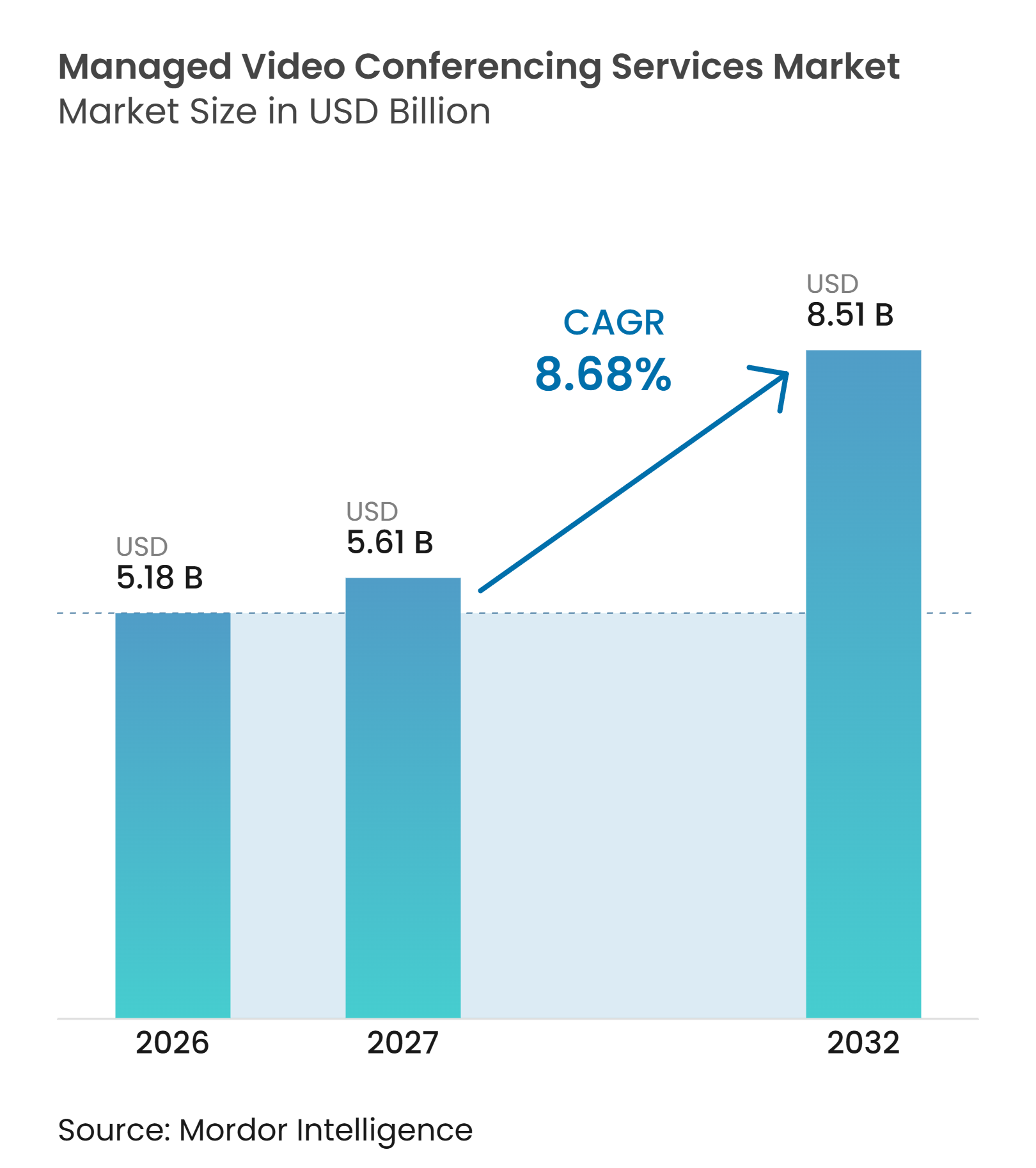
The managed video conferencing services market size is projected to expand from USD 5.18 billion in 2026 and USD 5.61 billion in 2027 to USD 8.51 billion by 2032, registering a CAGR of 8.68% between 2027 to 2032. Hybrid work has made reliable meeting rooms, device support, and platform administration a continuing operating requirement for many employers. Buyers are moving collaboration operations to managed providers when internal teams lack the capacity to oversee rooms, voice systems, cloud platforms, and endpoints across several locations. Providers are responding with remote monitoring, artificial intelligence-enabled meeting tools, and unified service-level agreements. This favors providers that can combine technical operations, security controls, and support across different collaboration platforms. Data residency requirements and legacy room infrastructure still add cost and slow some transitions to managed arrangements.
Key Report Takeaways
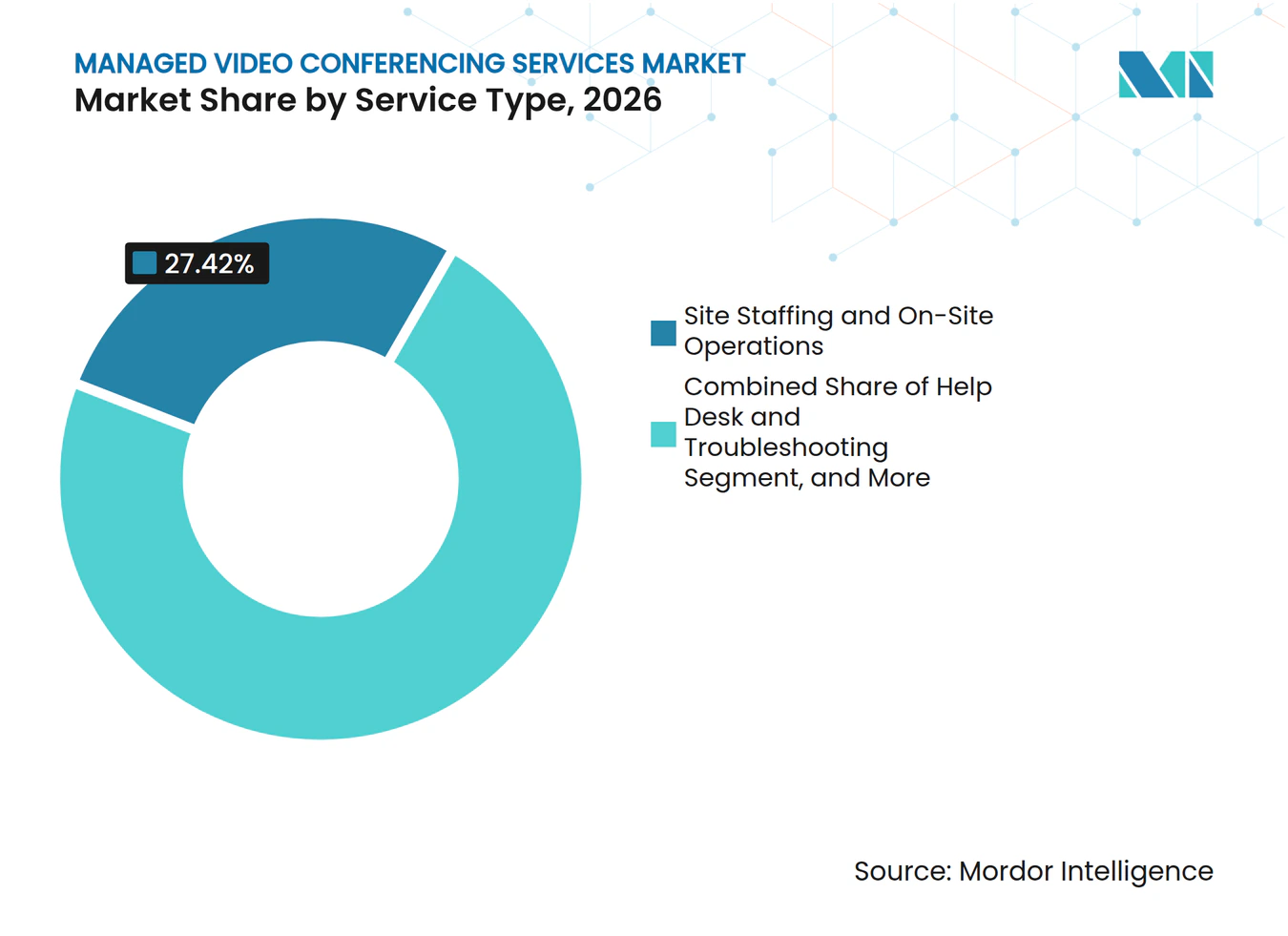
- By service type, Site Staffing and On-Site Operations held 27.42% of the managed video conferencing services market share in 2026, while Remote Management and Monitoring is projected to expand at a 9.88% CAGR through 2032.
- By deployment model, Cloud accounted for 62.84% of the managed video conferencing services market size in 2026 and is projected to expand at a 9.27% CAGR through 2032.
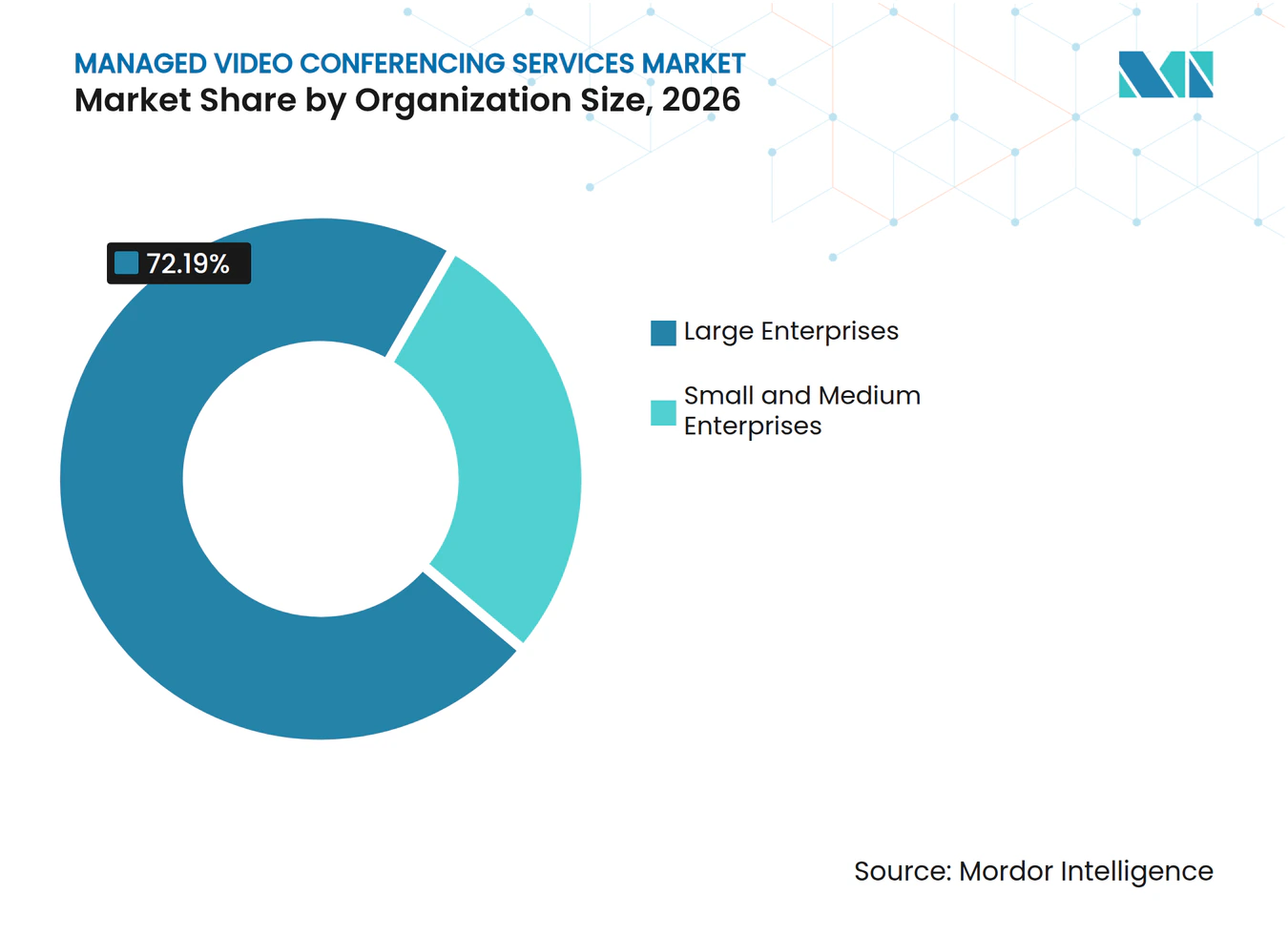
- By organization size, Large Enterprises held 72.19% of the managed video conferencing services market share in 2026, while SMEs are projected to expand at a 9.06% CAGR through 2032.
- By end-user industry, IT and Telecom held 21.61% share in 2026, while Healthcare and Life Sciences is projected to expand at a 10.04% CAGR through 2032.
- By geography, North America held 39.27% share in 2026, while Asia-Pacific is projected to expand at a 9.71% CAGR through 2032.
Note: Market numbers in this report are based on Mordor Intelligence's proprietary estimation framework, which combines nine months of actuals with Q4 projections for base year 2026.
Market Trends and Insights
Drivers Impact Analysis of Managed Video Conferencing Services Market*
| Driver | (~) % Impact on CAGR Forecast | Geographic Relevance | Impact Timeline |
|---|---|---|---|
| Hybrid-Work Operating Models | +2.5% | Global, led by North America and Europe | Medium term (2-4 years) |
| Outsourcing Collaboration Operations to Managed Service Providers | +2.0% | Global, enterprise-led | Medium term (2-4 years) |
| AI Meeting Intelligence and Accessibility Requirements | +1.7% | North America and Asia-Pacific, with expansion into Europe | Medium term (2-4 years) |
| 5G, Edge Connectivity, and Mobile-First Collaboration | +1.2% | Asia-Pacific, with expansion into the Middle East, Africa, and Europe | Long term (≥ 4 years) |
| Enterprise Shift From CAPEX to OPEX Consumption Models | +0.9% | North America and Asia-Pacific | Medium term (2-4 years) |
| Sustainability-Led Reduction in Business Travel | +0.6% | Europe and North America | Long term (≥ 4 years) |
| Source: Mordor Intelligence | |||
Hybrid-Work Operating Models
Hybrid work has become an established operating model, increasing the need for dependable collaboration systems and managed support. A 2025 ZEW Mannheim survey found that 82% of German information-economy firms offered hybrid work, and 88% expected to do so in 2026. Meeting quality is more important when remote and in-room participants must contribute equally in customer, executive, and team meetings. Technical failures can disrupt participation and create pressure for more consistent room operations. AVIXA identified managed services as a leading AV growth category in its 2026 channel survey, with hybrid workplace enablement supporting contract activity. This supports continued demand in the managed video conferencing services market for service models that maintain room readiness across distributed workplaces.
Outsourcing of Collaboration Operations to Managed Service Providers
Many enterprises operate multiple platforms, device types, and office locations, making internal management difficult. AVI-SPL stated that its Enterprise Managed Services platform supports more than 86% of Fortune 100 companies across collaboration rooms, voice environments, devices, and cloud platforms. This kind of operating scope favors providers that can deliver standardized support and reporting across an international estate. ISO/IEC 27001 certification is also becoming more relevant in procurement, particularly for providers serving regulated customers. The acquisition of a controlling interest in AVI-SPL by 26North Partners in June 2025 showed investor support for scaled managed collaboration platforms. The managed video conferencing services market, therefore, gives larger providers an advantage when customers want a single accountable partner for operations, governance, and support.
AI Meeting Intelligence and Accessibility Requirements
Artificial intelligence is expanding the scope of services from technical support to meeting preparation, transcription, summarization, and action tracking. Google announced Ask Gemini for Google Meet in September 2025 for eligible Workspace users, including summaries and meeting recaps. Pexip introduced translated live captions in 36 languages through its collaboration with NVIDIA in 2025. These functions can help organizations support multilingual collaboration and improve meeting accessibility. Providers must be able to manage the identity, security, and workflow requirements that accompany these features. Otter.ai also introduced an enterprise suite in October 2025, featuring meeting intelligence capabilities and support for regulated use cases. The managed video conferencing services market is gaining contracts where providers can operate these functions within existing governance and support processes.
5G, Edge Connectivity, and Mobile-First Collaboration
Fifth-generation connectivity enables video collaboration on mobile devices and in locations beyond traditional meeting rooms. Ericsson reported that 5G can improve sustained uplink performance for high-definition video conferencing on smartphones. This broadens the range of endpoints that a managed provider may need to monitor and support. NTT Data and Eurofiber announced Connected Workspace in July 2025, a managed private 5G service for Dutch enterprises.[1] The service demonstrates the convergence of telecom connectivity and workplace collaboration into a single contract. The expansion of 5G networks in India, Japan, South Korea, and Southeast Asia is increasing the relevance of mobile collaboration management. The managed video conferencing services market can benefit when providers develop expertise that connects room systems, employee devices, and network performance.
Restraints Impact Analysis of Managed Video Conferencing Services Market*
| Restraint | (~) % Impact on CAGR Forecast | Geographic Relevance | Impact Timeline |
|---|---|---|---|
| Data Sovereignty and Cross-Border Meeting-Data Restrictions | -0.8% | Europe and Asia-Pacific regulatory jurisdictions | Medium term (2-4 years) |
| Platform Fragmentation and Interoperability Gaps | -0.6% | Global | Medium term (2-4 years) |
| Meeting Fatigue and Declining Usage Intensity | -0.4% | North America and Europe mature markets | Short term (≤ 2 years) |
| Legacy-Room Integration and Total-Cost Complexity | -0.3% | Global, large brownfield estates | Long term (≥ 4 years) |
| Source: Mordor Intelligence | |||
Data Sovereignty and Cross-Border Meeting-Data Restrictions
Data residency rules complicate the delivery of managed services for multinational organizations. Providers may need separate architectures to meet legal requirements in individual jurisdictions, which raises delivery and compliance costs. European customers often assess hosting location and ISO/IEC 27001 controls when selecting video service providers. Pexip has stated that public-sector and defense customers increasingly seek self-hosted or private-cloud video systems to retain jurisdictional control. These requirements can limit the scale benefits of a standardized public-cloud model. They also create a greater need for providers capable of supporting private, sovereign, or locally hosted deployments. The managed video conferencing services market remains exposed to delays when customers must reconcile technology decisions with cross-border legal and security obligations.
Platform Fragmentation and Interoperability Gaps
Enterprises often operate several collaboration systems due to departmental requirements, acquisitions, legacy investments, and security policies. This makes it harder to deliver a consistent managed experience and increases support work for each meeting room. Pexip has described the operational challenge of connecting Microsoft Teams, Zoom, Google Meet, and legacy video systems across mixed estates. Older H.323 endpoints and incompatible application programming interfaces can require custom support processes. The European Commission's 2025 commitments concerning Microsoft Teams interoperability and data portability indicate continuing attention to platform lock-in.[2] Full interoperability is not yet available across the installed base. This constraint can reduce delivery margins in the managed video conferencing services market, especially for large brownfield room estates.
*Our forecasts treat driver/restraint impacts as directional, not additive. The impact forecasts reflect baseline growth, mix effects, and variable interactions.
Managed Video Conferencing Services Market Segment Analysis
By Service Type:
Remote Monitoring Gains on On-Site StaffingSite Staffing and On-Site Operations held 27.42% of the managed video conferencing services market share in 2026. The segment remains important in regulated workplaces, executive settings, and other environments where a meeting failure can have an immediate operational cost. On-site teams provide direct support for high-value rooms, event spaces, and complex integration issues. Help Desk and Troubleshooting remain recurring operational functions because users need rapid assistance across different platforms and devices. Infrastructure and Endpoint Management are gaining importance as organizations standardize devices and room technology across several locations. New Era Technology reported that automated troubleshooting in one enterprise case study resolved 70% of support tickets within 1 hour and reduced operating costs by 40%. These results illustrate why buyers are increasingly interested in automated service delivery.
Remote Management and Monitoring is projected to expand at a 9.88% CAGR through 2032. Providers can use cloud telemetry and AIOps tools to monitor device status, room availability, and recurring faults without sending staff to every site. This can improve response speed and help providers apply a consistent service model across a larger estate. Professional Services and Advisory is also becoming more relevant when customers need help with platform strategy, artificial intelligence integration, and workplace planning. Room Scheduling and Resource Management can support evidence-based facility decisions in hybrid workplaces. Yorktel and Utelogy expanded their partnership in June 2025 to combine agentic artificial intelligence, configuration tools, and analytics in managed AV operations. The managed video conferencing services industry is shifting toward predictive support, although on-site assistance remains necessary for complex locations.



By Deployment Model:
Cloud Leads in Share and GrowthCloud accounted for 62.84% of the managed video conferencing services market in 2026. It is also projected to expand at a 9.27% CAGR through 2032, making it the largest and fastest-growing deployment model. Cloud systems allow centralized monitoring, automated software updates, subscription billing, and support for multiple locations. These functions can lower the provider's per-room operating cost and simplify contract management. NEC Australia offers Meeting Room as a Service through a per-room subscription model within an ISO 27001-certified managed framework. This approach aligns with customer interest in predictable spending and defined accountability.
Private Cloud plays a distinct role in government, defense, finance, and other settings where public cloud data storage may not meet policy requirements. Pexip reported 30% year-over-year expansion in its Secure and Custom private-cloud segment in the third quarter of fiscal 2025. Such demand provides providers with a way to serve clients who require greater control over meeting data. On-Premises systems are declining as a share of new deployments, but they remain relevant in large buildings with existing hardware and specialized technical needs. Migration may take time when organizations are balancing replacement cost, business continuity, and integration risk. Managed providers can use migration advisory and transitional support to serve these customers. The managed video conferencing services market thus includes both public-cloud scale opportunities and private deployment needs.
By Organization Size:
Large Enterprises Lead, SMEs AccelerateLarge Enterprises accounted for 72.19% of the managed video conferencing services market share in 2026. Their meeting estates often cover several countries, numerous room types, and large numbers of endpoints under a common service-level agreement. These customers need lifecycle management, 24/7 help desk support, monitoring, analytics, and platform administration. Their requirements create high barriers to entry for smaller regional providers that cannot easily match global coverage. AVI-SPL has stated that it serves customers through more than 70 offices and employs more than 4,400 people. The depth of this operating model is suited to global organizations that need consistent delivery.
SMEs are projected to expand at a 9.06% CAGR through 2032. Per-room subscription pricing can lower the initial cost barrier for companies that could not previously justify a large capital purchase. Cisco reported strong seat expansion among small and medium business channel partners in its Webex wholesale program in 2025. The same ZEW research found that 50% of German manufacturing companies offered hybrid work in 2025. This extends demand beyond technology businesses and large urban employers. Service providers can reach smaller organizations through standardized packages, indirect channels, and simplified deployment. The managed video conferencing services market has room for providers that combine enterprise-grade oversight with pricing suited to smaller teams.

By End-User Industry:
Healthcare Leads Segment GrowthIT and Telecom held 21.61% of the managed video conferencing services market share in 2026. This sector has many technically experienced users and was an early adopter of unified communications systems. Its large installed base creates ongoing needs for multi-platform administration, endpoint support, and service-level management. BFSI is also an important customer group because regulated communications and executive collaboration require secure, reliable operations. Government and Defense customers often require self-hosted or private cloud systems that provide greater jurisdictional control. Pexip has positioned its Secure and Custom offering for these demanding use cases. These requirements support a premium category for providers with strong security and compliance capabilities.
Healthcare and Life Sciences are projected to expand at a 10.04% CAGR through 2032. The segment needs secure video systems for telehealth, specialist consultations, staff coordination, and administrative meetings across distributed locations. Healthcare buyers also require controls that support privacy and the regulated handling of data. Vision One documented the deployment of Microsoft Teams Rooms for Mercy Health across more than 80 rooms and 35 sites in Australia, completed in 2025. Education is also building demand as institutions manage several conferencing platforms for teaching, administration, and support. Manufacturing and other end-user industries have earlier-stage adoption in parts of the Asia-Pacific, where digitalization is expanding the potential customer base. The managed video conferencing services industry can benefit from sector packages that address security, interoperability, and specialized workflows.
Geography Analysis
North America Managed Video Conferencing Services Market
North America held 39.27% of the managed video conferencing services market share in 2026. The region has a mature enterprise AV ecosystem, a high concentration of large organizations, and substantial investment in national and global service platforms. The United States is the largest country contributor because hybrid work, Microsoft Teams, Zoom, and managed service providers are well established. Canada contributes to demand in healthcare and government applications. Mexico is becoming more relevant as nearshoring expands enterprise activity and the need for multi-site collaboration. The June 2025 AVI-SPL transaction reflected confidence in the region's outsourced collaboration model.
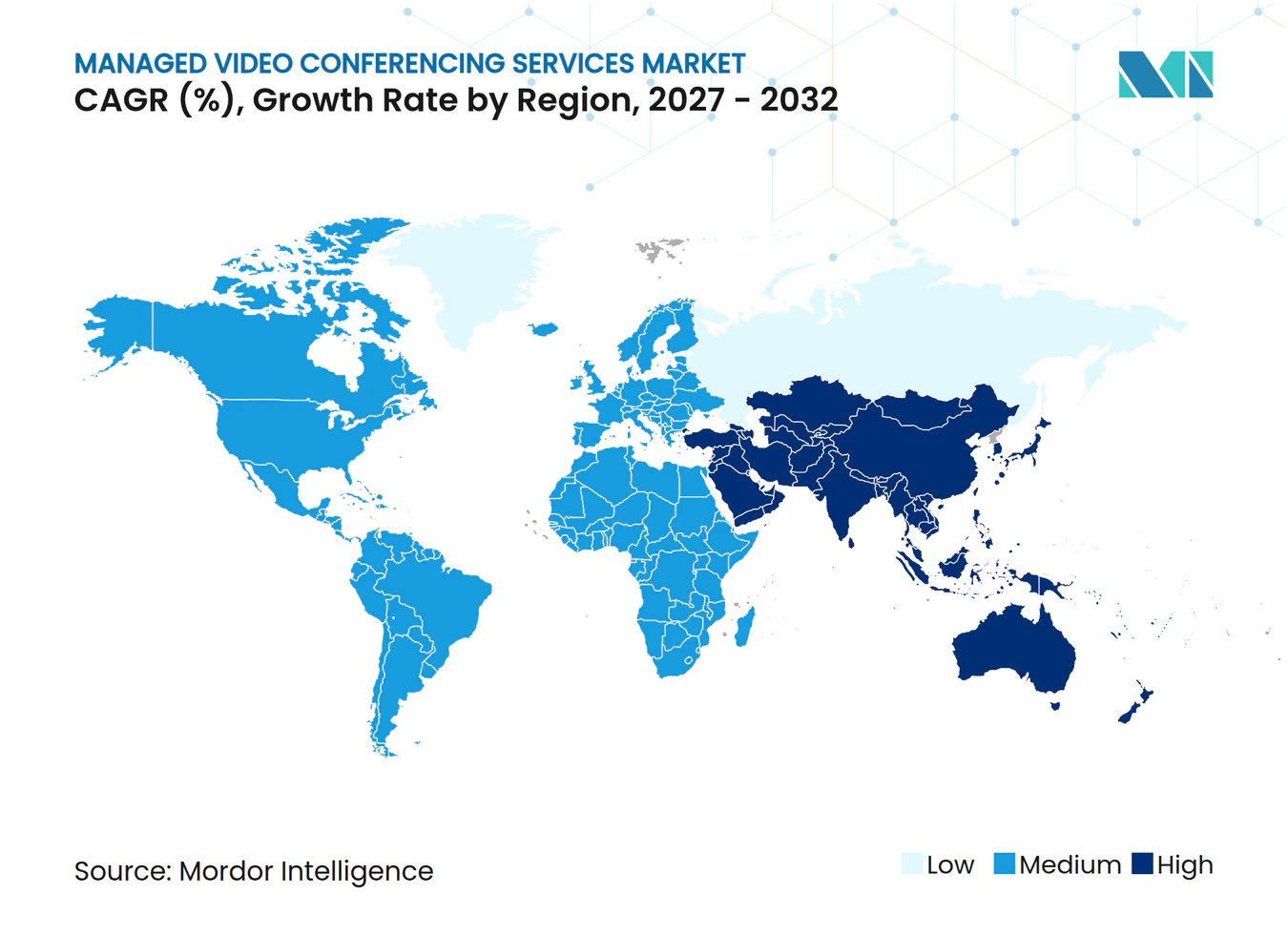
APAC Managed Video Conferencing Services Market
Asia-Pacific is projected to expand at a 9.71% CAGR through 2032. Enterprise digitalization in India, China, and Southeast Asia, along with wider 5G availability, is increasing the need for consistent collaboration management. AVIXA described the Asia-Pacific UC and collaboration opportunity as exceeding USD 12 billion and forecast a 17.8% CAGR through 2028.[3] Regional multinationals are seeking common operating standards across a wider range of sites and user devices. Japan, South Korea, and India offer additional demand as enterprises modernize workplace technology and network infrastructure. The managed video conferencing services market size in Asia-Pacific is supported by these conditions, while local security and hosting requirements may shape deployment choices.
EMEA and South America Managed Video Conferencing Services Market
Europe remains a significant region because hybrid work, data governance, and local hosting are influential purchase factors. ZEW found that 82% of German information-economy firms offered hybrid work in 2025, with a higher expected share in 2026. The Deutsches Forschungsnetz introduced videoconferencing framework contracts effective in March 2026, adding 10 approved platforms for research and education customers. South America has earlier-stage demand centered on Brazil and Argentina. The Middle East is expanding its collaboration infrastructure as digital economy programs increase enterprise technology investment. Africa remains in an earlier stage of adoption, with activity centered on South Africa, Egypt, and Nigeria.
Competitive Landscape
Market Concentration
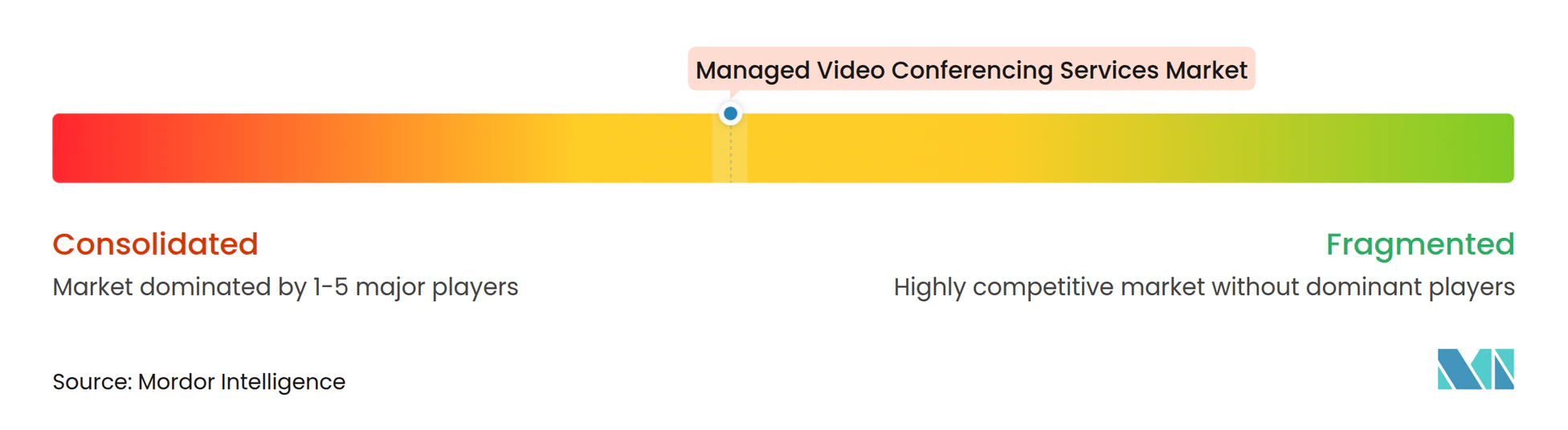
The managed video conferencing services market is moderately concentrated, with large systems integrators and managed service providers serving major enterprises alongside many regional specialists. Scale is important because multinational contracts require common support processes, security policies, service desks, and coverage across locations. AVI-SPL, Kinly, Yorktel, Ricoh, FORTÉ, Pexip, and telecommunications providers operate across different parts of this competitive field. Smaller providers can remain relevant in local markets or specialized verticals, especially when customers need on-site coverage or a narrow technical capability. The competitive structure leaves room for both international platforms and focused specialists.
Consolidation was an important theme in 2025 and 2026. Yorktel and Kinly completed their merger in November 2025, creating an organization serving more than 2,500 clients across 27 offices and employing more than 1,600 people. In March 2026, the combined organization announced that it would use the Kinly name across its 27 global locations. Kinly also introduced its PACE framework and Structured Data Services offering in September 2025 to improve program governance and visibility into the room estate. These moves show how providers are using acquisition and governance services to compete for complex enterprise accounts. The 26North investment in AVI-SPL follows the same focus on scale, operational reach, and long-term enterprise relationships.
Technology partnerships are also changing competition in the managed video conferencing services industry. Ricoh and Neat announced a global Mastery-level partnership in November 2025, pairing Ricoh AV Managed Services with Neat's audio and video technology. NTT Data and Eurofiber combined managed private 5G with workplace connectivity through Connected Workspace. Pexip has focused on interoperability, including a product developed with Google that allows Google Meet hardware to join Teams meetings. AI-based monitoring, meeting intelligence, and certified security controls are becoming practical ways to distinguish a service offering. Mid-market opportunities, sovereign cloud arrangements, and managed services for mixed-platform estates remain open areas for competitive development.
Managed Video Conferencing Services Industry Leaders
-
AVI-SPL, LLC
-
Applied Global Technologies, LLC
-
Yorktel Corporation
-
Kinly AS
-
New Era Technology, Inc.
- *Disclaimer: Major Players sorted in no particular order
Managed Video Conferencing Services Market Companies Covered in this Report
- Applied Global Technologies, LLC
- AVI-SPL, LLC
- Yorktel Corporation
- Kinly AS
- Vega Global Group Pte. Ltd.
- New Era Technology, Inc.
- Cenero, LLC
- Diversified Communications, Inc.
- Solutionz, Inc.
- Ford Audio-Video Systems, LLC
- CCS Presentation Systems, LLC
- Verrex, Inc.
- Mechdyne Corporation
- Electrosonic Group Limited
- Continuant, Inc.
- Bluewater Technologies Group, Inc.
- Pro-Tech Management, Inc.
- ACT Conferencing, Inc.
- Pexip ASA
- Enghouse Systems Limited
- Lifesize, Inc.
- Qumu Corporation
- Logitech International S.A.
- AVer Information Inc.
Recent Industry Developments in Managed Video Conferencing Services Market
- March 2026: Kinly and Yorktel completed their brand consolidation, with the combined organization announcing it will operate solely under the Kinly name across all 27 global locations. The rebrand unified executive leadership under CEO Ken Scaturro, positioning the entity as a top-five global managed collaboration services provider covering AV lifecycle management, cloud voice, and AI-powered room monitoring.
- November 2025: Yorktel and Kinly completed their merger, creating a global managed services leader serving more than 2,500 enterprise and public-sector clients with over 1,600 employees and 900-plus specialist accreditations across 27 locations in North America, Europe, and Asia-Pacific, backed by ISO-certified security practices and 24/7 global support coverage.
- November 2025: Ricoh and Neat announced a global Mastery-level partnership integrating Ricoh's AV Managed Services (AVMS) with Neat's AI-driven audio and video technology, including the Neat Board and Neat Bar product lines. The agreement extends Ricoh's AVMS capabilities within its Workplace Experience business and reflects the broader trend of hardware leaders forming managed service alliances.
- October 2025: Otter.ai launched an enterprise suite for meeting intelligence reporting, with over USD 1 billion in cumulative customer ROI and 1 FTE savings per 20 users, including HIPAA compliance for regulated industries, agentic AI chat, and MCP Server integration enabling meeting data to power cross-platform AI workflows.
Global Managed Video Conferencing Services Market Report Scope
The managed video conferencing services market comprises services that enable organizations to outsource the deployment, operation, management, monitoring, maintenance, and optimization of video conferencing systems and collaboration environments to specialized service providers. These services include on-site staffing and operational support, remote management and monitoring, help desk and technical assistance, infrastructure and endpoint management, room scheduling and resource management, and professional consulting and advisory services.
The Managed Video Conferencing Services Report is Segmented by Service Type (Site Staffing and On-Site Operations, Remote Management and Monitoring, Help Desk and Technical Support, Infrastructure Management and Endpoint Management, Room Scheduling and Resource Management, and Professional Services and Advisory), Deployment Model (Cloud, Private Cloud, and On-Premises), Organization Size (Large Enterprises and Small and Medium Enterprises), End-User Industry (IT and Telecom, BFSI, Healthcare and Life Sciences, Government and Public Sector, Education, Manufacturing, and Other End-User Industries), and Geography (North America, South America, Europe, Middle East and Africa, and Asia-Pacific). The Market Forecasts are Provided in Terms of Value (USD).
Segmentation Overview
| Site Staffing and On-Site Operations |
| Remote Management and Monitoring |
| Help Desk and Troubleshooting |
| Infrastructure and Endpoint Management |
| Room Scheduling and Resource Management |
| Professional Services and Advisory |
| Cloud |
| Private Cloud |
| On-Premises |
| Large Enterprises |
| Small and Medium Enterprises |
| IT and Telecom |
| BFSI |
| Healthcare and Life Sciences |
| Government and Defense |
| Education |
| Manufacturing |
| Other End-User Industries |
| North America | United States |
| Canada | |
| Mexico | |
| South America | Brazil |
| Argentina | |
| Rest of South America | |
| Europe | Germany |
| United Kingdom | |
| France | |
| Italy | |
| Spain | |
| Russia | |
| Rest of Europe | |
| Asia-Pacific | China |
| Japan | |
| South Korea | |
| India | |
| Australia | |
| New Zealand | |
| Rest of Asia-Pacific | |
| Middle East | Türkiye |
| United Arab Emirates | |
| Saudi Arabia | |
| Israel | |
| Rest of Middle East | |
| Africa | South Africa |
| Egypt | |
| Nigeria | |
| Rest of Africa |
| By Service Type | Site Staffing and On-Site Operations | |
| Remote Management and Monitoring | ||
| Help Desk and Troubleshooting | ||
| Infrastructure and Endpoint Management | ||
| Room Scheduling and Resource Management | ||
| Professional Services and Advisory | ||
| By Deployment Model | Cloud | |
| Private Cloud | ||
| On-Premises | ||
| By Organization Size | Large Enterprises | |
| Small and Medium Enterprises | ||
| By End-User Industry | IT and Telecom | |
| BFSI | ||
| Healthcare and Life Sciences | ||
| Government and Defense | ||
| Education | ||
| Manufacturing | ||
| Other End-User Industries | ||
| By Geography | North America | United States |
| Canada | ||
| Mexico | ||
| South America | Brazil | |
| Argentina | ||
| Rest of South America | ||
| Europe | Germany | |
| United Kingdom | ||
| France | ||
| Italy | ||
| Spain | ||
| Russia | ||
| Rest of Europe | ||
| Asia-Pacific | China | |
| Japan | ||
| South Korea | ||
| India | ||
| Australia | ||
| New Zealand | ||
| Rest of Asia-Pacific | ||
| Middle East | Türkiye | |
| United Arab Emirates | ||
| Saudi Arabia | ||
| Israel | ||
| Rest of Middle East | ||
| Africa | South Africa | |
| Egypt | ||
| Nigeria | ||
| Rest of Africa | ||
Key Questions Answered in the Report
What is the managed video conferencing services market size?
The managed video conferencing services market is projected to expand from USD 5.18 billion in 2026 and USD 5.61 billion in 2027 to USD 8.51 billion by 2032, at an 8.68% CAGR. This outlook is tied to demand for externally managed rooms, endpoints, cloud platforms, and user support across hybrid workplaces. It also reflects the migration from internally maintained collaboration systems toward service contracts that provide standardized operations, monitoring, user assistance, and lifecycle accountability.
What is driving demand for managed video conferencing services?
Hybrid work makes dependable room performance more important when employees, customers, and external participants join the same meeting from different places. Organizations also use managed services when internal teams cannot easily cover rooms, devices, cloud platforms, security processes, and user support across several locations. Procurement teams can place responsibility for service levels, incident response, reporting, and continuous improvement with a defined external provider.
Which service type is expanding fastest?
Remote Management and Monitoring is projected to expand at a 9.88% CAGR through 2032. It uses telemetry and automation to identify room status, device availability, and recurring faults, while on-site staff remain relevant for complex sites, high-priority meetings, and physical integration work. This model is useful where customers need consistent room readiness but do not require a technician permanently located at every workplace.
Why is cloud deployment important for managed video conferencing?
Cloud held 62.84% share in 2026 and is projected to expand at a 9.27% CAGR. Centralized monitoring, software updates, subscription billing, and scalable support make it useful for multi-site organizations, while Private Cloud and On-Premises systems remain needed where privacy, sovereignty, or legacy equipment influence deployment choices. The managed video conferencing services market therefore includes both standard cloud services and more controlled deployment options for regulated customers.
Which end-user vertical has the strongest projected expansion?
Healthcare and Life Sciences is projected to expand at a 10.04% CAGR through 2032. Telehealth, specialist consultations, staff coordination, and administration create a need for secure video operations across distributed sites, with privacy and compliance controls remaining central to provider selection. A managed model can support common operating procedures and responsive assistance across clinical, administrative, and specialist locations.
Which region is projected to expand fastest?
Asia-Pacific is projected to expand at a 9.71% CAGR through 2032. Digitalization, wider 5G availability, and the need for technology standards across regional operations support demand, although local security, hosting, language, and support requirements can shape the service model. The managed video conferencing services market in the region can benefit when providers combine regional coverage with local delivery capabilities.