
South America Video Conferencing Hardware Market Size and Share
Market Overview
| Study Period | 2020 - 2031 |
|---|---|
| Forecast Data Period | 2026 - 2031 |
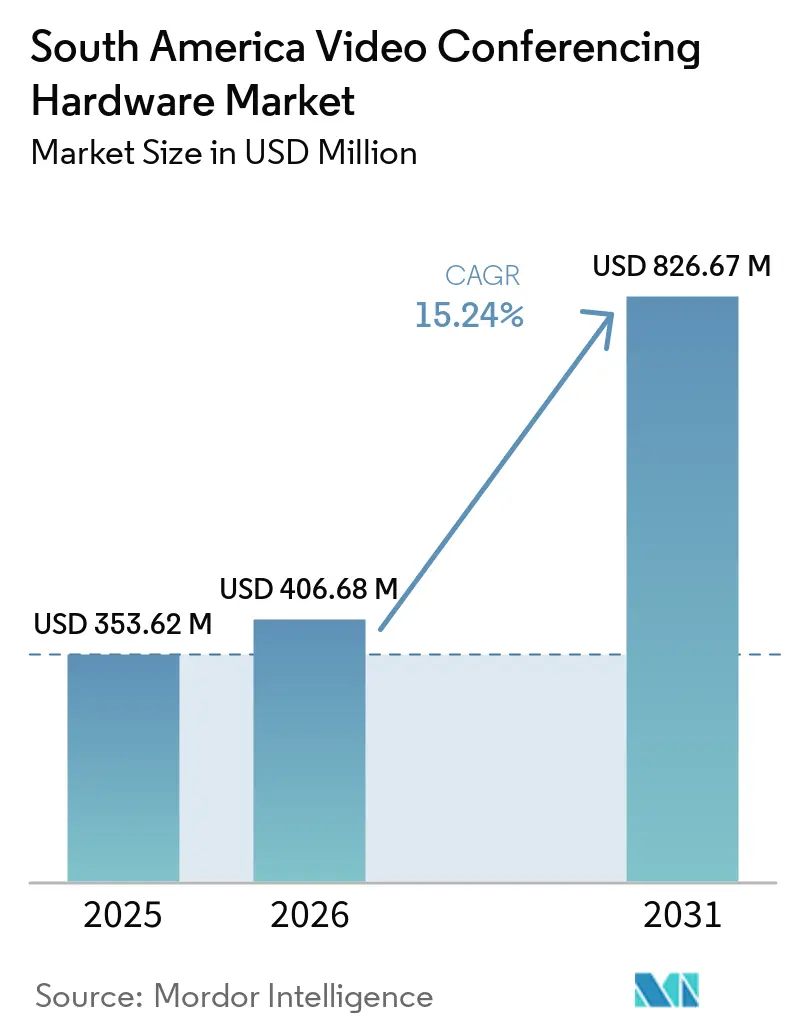
| Base Year Market Size (2025) | USD 353.62 Million |
| Market Size (2026) | USD 406.68 Million |
| Market Size (2031) | USD 826.67 Million |
| Growth Rate (2026 - 2031) | 15.24 % |
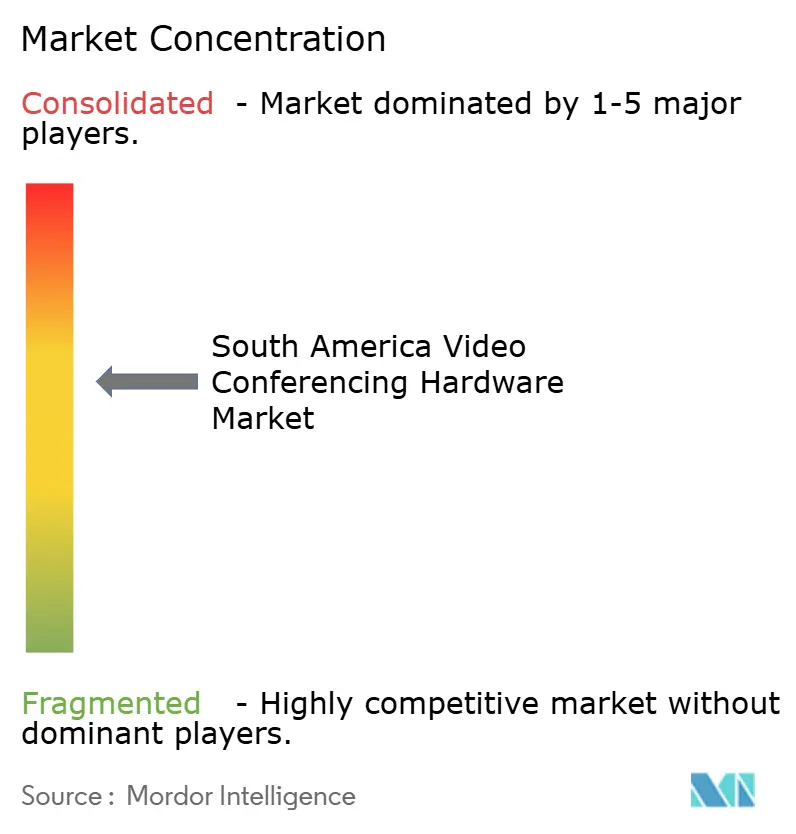
| Market Concentration | Medium |
Major Players *Disclaimer: Major Players sorted in no particular order Image © Mordor Intelligence. Reuse requires attribution under CC BY 4.0. | |
South America Video Conferencing Hardware Market Analysis by Mordor Intelligence
The South America video conferencing hardware market size is expected to increase from USD 353.62 million in 2025 to USD 406.68 million in 2026 and reach USD 826.67 million by 2031, expanding at a CAGR of 15.24% over 2026-2031. Hybrid work, wider fiber and 5G coverage, and institutional spending on health and education are expanding the use of certified room systems. Buyers increasingly prioritize devices that work with Microsoft Teams Rooms and Zoom Rooms because certification affects tender eligibility and deployment consistency. The South America video conferencing hardware market also reflects a divide between cloud-managed systems for distributed enterprises and on-premises systems for regulated users. Imported equipment faces higher landed costs in Brazil after the February 2026 tariff changes and the start of the CBS and IBS tax framework. This environment favors suppliers that combine certified products, local channel support, and flexible deployment options.
Key Report Takeaways
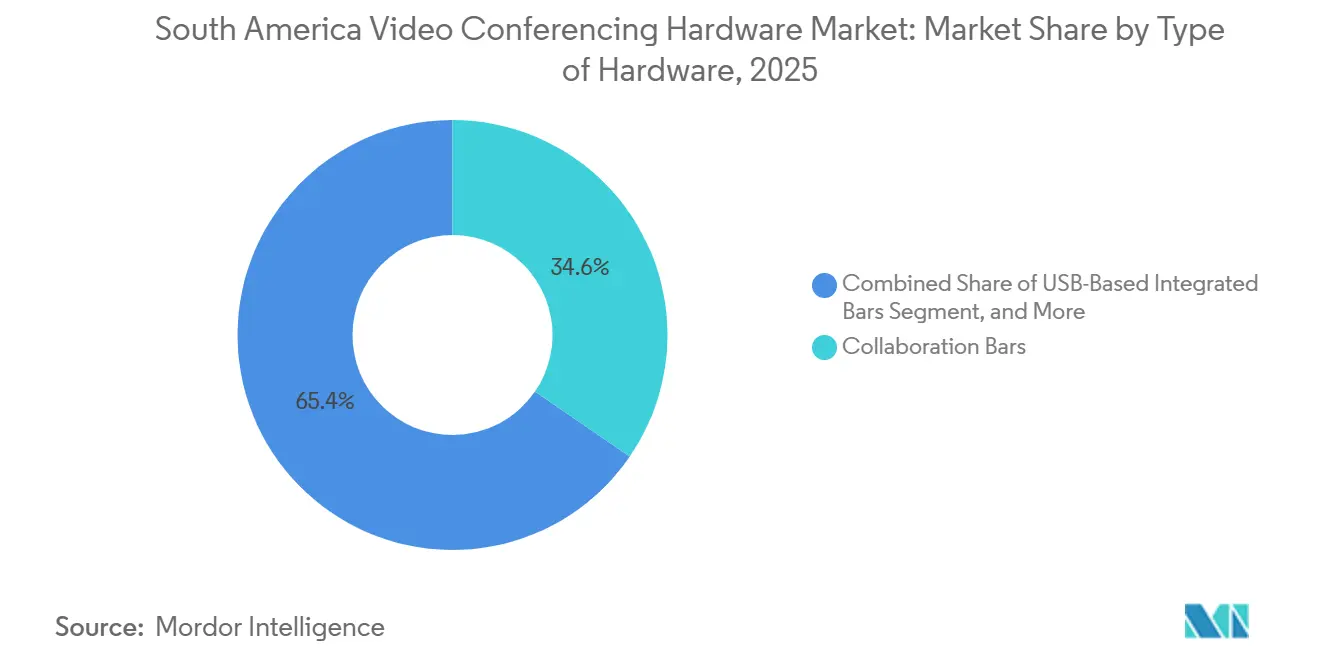
- By hardware type, Collaboration Bars held 34.56% of the South America video conferencing hardware market share in 2025, while USB-Based Integrated Bars are projected to expand at a 15.73% CAGR through 2031.
- By end user, Commercial Spaces held 62.27% of demand in 2025, while Healthcare Facilities are projected to expand at a 15.62% CAGR through 2031.
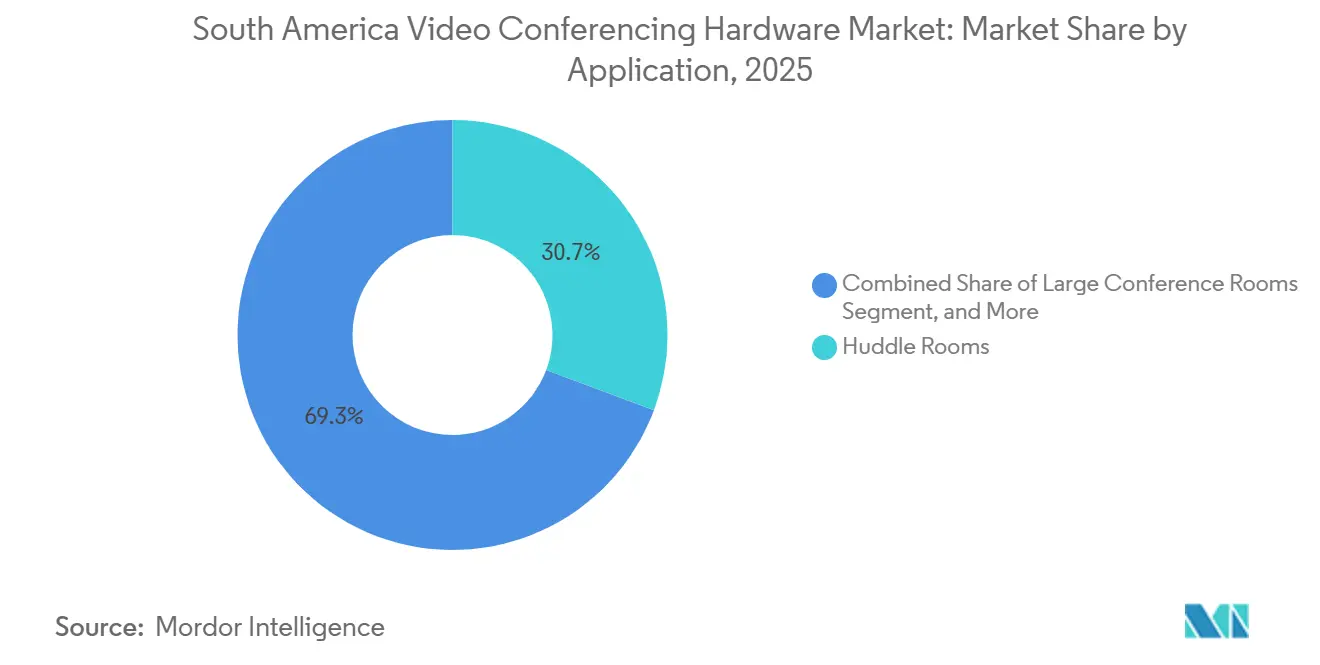
- By application, Huddle Rooms accounted for 30.69% of demand in 2025, while Large Conference Rooms are projected to expand at a 15.81% CAGR through 2031.
- By deployment mode, Cloud-Connected and Hybrid held 43.48% of demand in 2025 and are projected to expand at a 15.38% CAGR through 2031.
- By geography, Brazil held 22.39% of demand in 2025, while Colombia is projected to expand at a 15.72% CAGR through 2031.
Note: Market size and forecast figures in this report are generated using Mordor Intelligence’s proprietary estimation framework, updated with the latest available data and insights as of January 2026.
Market Trends and Insights
Drivers Impact Analysis of South America Video Conferencing Hardware Market*
| Driver | (~) % Impact on CAGR Forecast | Geographic Relevance | Impact Timeline |
|---|---|---|---|
| Hybrid Work and Distributed Team Expansion | +4.5% | South America, with greatest depth in Brazil and Colombia | Short term (≤ 2 years) |
| Digital Transformation in Healthcare and Education | +2.8% | Brazil, Colombia, and Chile, with early uptake in Peru and Argentina | Medium term (2-4 years) |
| Fiber, 4G, 5G, and Broadband Infrastructure Improvements | +2.2% | Brazil nationally, Colombia urban cores, and spillover to Chile and Peru | Medium term (2-4 years) |
| AI-Enabled Endpoint Upgrade Cycles | +1.8% | Brazil, Argentina, and Chile | Medium term (2-4 years) |
| Brazil-Led Scale and Geographic Dispersion | +1.2% | Brazil, Argentina, and Chile | Long term (≥ 4 years) |
| Interoperability and Platform Certification Requirements | +0.8% | South America, especially Brazil’s enterprise procurement channel | Short term (≤ 2 years) |
| Source: Mordor Intelligence | |||
Hybrid Work and Distributed Team Expansion
Hybrid work has changed room hardware requirements across South America. Firms are using a mix of office and remote work that concentrates demand into scheduled meeting periods. This pattern increases the need for rooms that can be used without specialist AV support. Enterprises are therefore standardizing cloud-managed endpoints with automatic framing and multiple microphones. The South America video conferencing hardware market benefits when firms replace ad hoc laptop setups with certified room deployments. New telework obligations in Peru also reinforce the importance of secure and dependable systems for distributed teams.
Digital Transformation in Healthcare and Education
Healthcare demand is increasingly tied to recurring telehealth procurement rather than emergency purchasing. Brazil’s SUS delivered millions of teleconsultations across thousands of municipalities over the recent period. The federal government allocated substantial funding for smart hospitals with interconnected ICUs over the coming years.[1] In education, the Ministry of Education connected 100,000 public schools through Política de Inovação Educação Conectada by May 2026.[2] Health and education buyers need equipment that works reliably across repeated sessions and varied room formats. These programs support institutional demand for reliable cameras, displays, and room audio systems in the South America video conferencing hardware market.
Fiber, 4G, 5G, and Broadband Infrastructure Improvements
Network investment is expanding the locations that can support cloud-managed, high-definition meeting systems. Brazil’s telecommunications sector has increased investment in network infrastructure. The country has also expanded 5G antenna deployment and coverage across more cities, with population coverage advancing ahead of the national licensing target. In Colombia, network modernization plans include fiber and 5G deployment in urban locations. This capacity supports systems with 4K video, AI processing, and centralized device management.
AI-Enabled Endpoint Upgrade Cycles
Embedded AI is making product refresh decisions more closely tied to platform certification and room experience requirements. HP introduced the Poly Studio Room Compute series with Intel Core Ultra processors and integrated NPUs for DirectorAI multi-camera speaker tracking. The products carry Microsoft Teams Rooms and Zoom Rooms certifications. Logitech introduced the Rally AI Camera series, adding RightSight framing and a dual-camera design for larger spaces. Companies operating hardware installed during the pandemic face certification end-of-life milestones for older devices. Microsoft maintains the approved device list that procurement teams use when selecting Teams Rooms systems.
Restraints Impact Analysis of South America Video Conferencing Hardware Market*
| Restraint | (~) % Impact on CAGR Forecast | Geographic Relevance | Impact Timeline |
|---|---|---|---|
| High Hardware, Installation, and Maintenance Costs | -2.8% | South America, especially SME and public-sector buyers | Short term (≤ 2 years) |
| Connectivity Limitations and Power Reliability Issues | -1.8% | Interior Brazil, rural Colombia, Peru, Bolivia, Paraguay, and Rest of South America | Long term (≥ 4 years) |
| Data Sovereignty and Regulatory Fragmentation | -0.8% | Brazil, Colombia, and Argentina | Medium term (2-4 years) |
| Import Duties, Currency Volatility, and Channel Inventory Risk | -0.7% | Brazil, with currency exposure across Argentina and Colombia | Short term (≤ 2 years) |
| Source: Mordor Intelligence | |||
High Hardware, Installation, and Maintenance Costs
Premium enterprise endpoints remain beyond the budget of many mid-market and public-sector buyers. Certified collaboration bars from leading suppliers carry high costs before installation, integration, and platform licensing. Brazilian import and industrial product taxes raise the landed cost of imported video communication equipment. The cost structure favors large enterprises that can standardize certified rooms across multiple sites. Smaller organizations often use software clients and consumer-grade peripherals instead. The South America video conferencing hardware market still has unmet demand for more affordable complete certified room systems.
Connectivity Limitations and Power Reliability Issues
Connectivity outside major urban corridors limits the use of advanced room systems. The OECD found that rural fixed broadband speeds in Colombia were significantly below the OECD rural average in 2024. Rural mobile download speeds were substantially lower than those of OECD rural peers.[3] Peru’s Internet Para Todos program extends 4G connectivity to thousands of villages through open-RAN and satellite backhaul. This level of access does not consistently support multi-camera, high-resolution rooms. Power reliability concerns in Peru, Bolivia, Ecuador, and northern Brazil also reduce confidence in always-on cloud systems.
*Our forecasts treat driver/restraint impacts as directional, not additive. The impact forecasts reflect baseline growth, mix effects, and variable interactions.
South America Video Conferencing Hardware Market Segment Analysis
By Hardware Type:
Collaboration Bars Lead, USB Bars Scale FastCollaboration Bars held 34.56% of the South America video conferencing hardware market size in 2025. They simplify deployment because the camera, microphone, speaker, and platform certification are integrated in one unit. This is valuable where in-house AV skills are limited outside major cities. Microsoft’s approved device ecosystem reinforces the use of certified all-in-one systems in enterprise tenders. USB-Based Integrated Bars are projected to expand at a 15.73% CAGR through 2031. Their appeal is strongest in Colombia, Chile, and Argentina, where diverse laptop fleets increase demand for straightforward BYOD rooms.
Logitech’s Rally AI Camera Pro illustrates the shift toward a higher-value collaboration bar category. The product combines dual-camera AI framing with an in-wall mounting option for boardrooms. PTZ cameras remain important where rooms exceed the field of view of an integrated bar. Codec systems remain relevant for government and regulated deployments that require security controls. Enterprise headsets, speakerphones, and microphone arrays address personal audio and larger-room acoustics. MCUs support multi-site conferencing, while bundled kits serve turnkey small and medium enterprise deployments. The South America video conferencing hardware industry relies on Microsoft and Zoom certification frameworks because these frameworks shape procurement shortlists and pricing.

By End User:
Commercial Sector Leads, Healthcare AcceleratesCommercial Spaces held 62.27% of end-user demand in 2025. Financial services, technology, and professional services firms in São Paulo, Buenos Aires, Bogotá, and Santiago have prioritized standardized workplace systems. Their programs commonly center on certified products that provide a consistent user experience across offices. Healthcare Facilities are projected to expand at a 15.62% CAGR through 2031. Health systems are moving toward repeatable telehealth workflows that require dependable room devices and support services. The resulting facility-level demand is more durable than emergency purchasing during the pandemic period.
Brazil’s smart hospital program supports the standardized procurement of clinical video endpoints. Universities, government agencies, and public bodies procure these solutions through formal tender processes. These buyers prioritize compliance records and regional distribution coverage. Data residency requirements also influence deployment decisions in regulated sectors. Cross-border collaboration increases the value of systems that support local controls while enabling broader interoperability. Therefore, the South America video conferencing hardware industry must support cloud-based, hybrid, and on-premises architectures to meet diverse customer requirements.
By Application:
Huddle Rooms Dominate, Large Conference Rooms Gain GroundHuddle Rooms accounted for 30.69% of the South America video conferencing hardware market share in 2025. They serve small-team meetings that commonly include 2 to 6 participants. A complete certified bar setup costs USD 900 to USD 2,500, placing it within a wider budget range than boardroom systems. Large Conference Rooms are projected to expand at a 15.81% CAGR through 2031. AI cameras are bringing multi-camera speaker tracking to systems that previously required high-end codec installations. Cisco introduced the Room Kit Pro G2 in February 2026 with AVoIP-first architecture and NVIDIA-accelerated AI framing for complex, larger rooms.
Small Meeting Rooms provide a transition from informal setups to standardized room systems. They usually accommodate 6 to 12 participants and receive significant enterprise consolidation spending. Boardrooms and auditoriums have the highest average selling price because they require codec-grade equipment and align with executive real estate and fit-out cycles. HP’s Poly Studio Room Compute 5 and Studio Room Compute 7 address this premium application space with NPU-enabled DirectorAI features. Larger applications place greater weight on camera coverage, room control, and audio quality. This leaves room for specialist AV suppliers alongside all-in-one device vendors.
By Deployment Mode:
Cloud Connectivity Reshapes Infrastructure StrategyCloud-Connected and Hybrid held 43.48% of demand in 2025. This deployment mode is projected to expand at a 15.38% CAGR through 2031. Centralized management allows IT teams to deploy, monitor, and troubleshoot room devices across dispersed office networks. That capability is useful where on-site AV support is limited outside major metropolitan areas. On-premises systems remain important in healthcare, legal services, and government. Data transfer requirements have reinforced the need for deployment choices that fit sector-specific controls.
The regulation has encouraged a split in purchasing between cloud-connected users and buyers who prefer local control. Cisco’s device roadmap supports Zoom Rooms through a public beta that began in June 2026 and targets general availability in September 2026. Cisco also supports Microsoft Teams Rooms through the Microsoft Device Ecosystem Platform. This approach lets enterprises use a single hardware base with several collaboration platforms. Flexible platforms reduce the risk of hardware replacement when a company changes its software environment. The South America video conferencing hardware market is therefore shaped by both remote management needs and compliance-led architecture choices.
Geography Analysis
Brazil Video Conferencing Hardware Market
Brazil held 22.39% of the South America video conferencing hardware market size in 2025. Its demand base draws on investments in 5G, digital health, and corporate workplace modernization. The telecommunications sector recorded substantial investment in 2025, while the number of 5G antennas increased significantly. The number of municipalities with 5G coverage also rose considerably. By May 2026, the Ministry of Education had connected a substantial number of public schools. These conditions support demand from corporate, public, health, and education users.
Colombia Video Conferencing Hardware Market
Colombia is projected to expand at a 15.72% CAGR through 2031. Corporate IT spending, 5G deployment, and hybrid work adoption support demand in Bogotá and Medellín. Network modernization plans include national investment, fiber installation, and additional base stations. The OECD also found that rural broadband penetration was close to half the OECD average. This creates an uneven demand pattern in which urban enterprises lead the adoption of advanced systems.
South America Video Conferencing Hardware Market
Argentina, Chile, Peru, and the Rest of South America form a developing tier with varied regulatory and infrastructure conditions. Argentina’s remote-work policy changes may prompt firms to review distributed-work arrangements. Chile’s multinational base supports consistent enterprise purchasing in Santiago. Peru’s Internet Para Todos program reaches 6,500 rural villages, although device demand often follows network rollout after 18-24 months. Bolivia, Ecuador, Paraguay, and Uruguay remain weighted toward institutional and government procurement, where duties, connectivity, and currency exposure limit private-sector adoption.
Competitive Landscape
The South America video conferencing hardware market has a certified enterprise layer led by Logitech International S.A. and Cisco Systems, Inc. HP Inc., through Poly, also competes for enterprise deployments, while Yealink and MAXHUB target the mid-market through price-performance positioning. Microsoft Teams Rooms and Zoom Rooms certification acts as a practical entry requirement in major corporate tenders. Suppliers without approved devices are often excluded before commercial evaluation begins. Vendors are widening their compatibility portfolios to reach organizations that use multiple collaboration platforms. The lower-priced complete Huddle Room category remains relatively underserved by certified suppliers.
Brazil’s tariff and tax changes are reshaping the economics of imported hardware. The revised cost base adds pressure to import-dependent distribution models. These changes can favor suppliers with local assembly or well-managed regional inventories. GN Audio’s Jabra recently introduced a video bar system with modular camera expansion from Huddly. The product reflects a strategy of flexible, integrator-friendly room architectures.
ClearOne, Shure, and Crestron hold specialist positions in professional audio, room control, and high-end AV installations. Crestron recently introduced an intelligent camera featuring visual AI speaker tracking, onboard microphones, and USB and HDMI connectivity. Cisco extended device support to Zoom Rooms, addressing mixed-platform environments without requiring a separate endpoint base. HP and Logitech have also introduced AI-enabled products that enhance camera framing and multi-camera capabilities. The South America video conferencing hardware market has no reported combined leading-player share, so the available data cannot substantiate a concentration assessment.
South America Video Conferencing Hardware Industry Leaders
-
Logitech International S.A.
-
Cisco Systems, Inc.
-
HP Inc.
-
GN Audio A/S
-
Huawei Technologies Co., Ltd.
- *Disclaimer: Major Players sorted in no particular order
South America Video Conferencing Hardware Market Companies Covered in this Report
- Logitech International S.A.
- Cisco Systems, Inc.
- HP Inc.
- GN Audio A/S
- Huawei Technologies Co., Ltd.
- EPOS Group A/S
- Barco NV
- AVer Information Inc.
- Panasonic Corporation
- Dahua Technology Co., Ltd.
- Yealink Network Technology Co., Ltd.
- ClearOne, Inc.
- Crestron Electronics, Inc.
- Shure Incorporated
- Huddly AS
- Neatframe Ltd.
- Lifesize, Inc.
- Owl Labs Inc.
- DTEN Inc.
- Konftel AB
- MAXHUB, a brand of Returnstar Interactive Technology Group Co., Ltd.
- Lumens Digital Optics Inc.
- ZTE Corporation
- AudioCodes Ltd.
Recent Industry Developments in South America Video Conferencing Hardware Market
- June 2026: Cisco Systems, Inc. launched the public beta of Cisco Devices for Zoom Rooms. General availability is expected in September 2026. The move extends Room Kit Pro G2 hardware to a third major meeting platform alongside Microsoft Teams Rooms and Webex, removing a specification-stage barrier for enterprises operating mixed-platform environments.
- June 2026: Yealink Network Technology Co., Ltd. showcased its fourth-generation MVC Series, MeetingBar Series, and MeetingBoard Pro at InfoComm 2026. The systems include AI-enhanced participant tracking, noise cancellation, and compatibility across Microsoft Teams, Zoom Rooms, and Cisco Webex. The portfolio addresses meeting rooms that need a consistent experience across more than 1 collaboration service.
- March 2026: Crestron Electronics, Inc. launched the 1 Beyond i12D intelligent camera with visual AI speaker tracking, onboard microphones, and USB and HDMI connectivity. The camera supports both BYOD and standardized environments. It also integrates with the Crestron XiO Cloud device management platform and Automate VX 6.5 firmware.
- February 2026: Cisco Systems, Inc. unveiled the Room Kit Pro G2 and Desk Pro G2 at ISE 2026 on February 2, 2026. The Room Kit Pro G2 introduced NVIDIA-accelerated AI framing, AVoIP-first architecture, and native support for the Microsoft Device Ecosystem Platform for Teams Rooms and Cisco Webex. The products became available to order from Q2 2026.
South America Video Conferencing Hardware Market Report Scope
South America Video Conferencing Hardware Market refers to the sale and deployment of physical devices that enable real-time audio and video collaboration across businesses, institutions, and other organizations. It includes conference cameras, webcams, video bars, microphones, speakers, speakerphones, codecs, multi-control units, collaboration boards, displays, headsets, and integrated room systems.
The South America Video Conferencing Hardware Market Report is Segmented by Hardware Type (Multi-Control Units (MCU), Collaboration Bars, Codec Systems, USB Cameras, USB-Based Integrated Bars, Enterprise Headsets, PTZ Cameras, and Speakerphones and Microphone Arrays), End User (Institutions, Commercial Spaces, and Healthcare), Application (Huddle Rooms, Small Meeting Rooms, Large Conference Rooms, and Boardrooms and Auditoriums), Deployment (On-Premises, and Cloud and Hybrid), Geography (Brazil, Argentina, Colombia, Chile, Peru, and Others). The Market Forecasts are Provided in Terms of Value (USD).
Segmentation Overview
| Multi-Control Units (MCU) |
| Collaboration Bars |
| Codec Systems |
| USB Cameras |
| USB-Based Integrated Bars |
| Other Bundled Kits |
| Enterprise Headsets |
| PTZ Cameras |
| Speakerphones and Microphone Arrays |
| Institutions |
| Commercial Spaces |
| Healthcare Facilities |
| Huddle Rooms |
| Small Meeting Rooms |
| Large Conference Rooms |
| Boardrooms and Auditoriums |
| On-Premises |
| Cloud-Connected and Hybrid |
| Brazil |
| Argentina |
| Colombia |
| Chile |
| Peru |
| Rest of South America |
| By Type of Hardware | Multi-Control Units (MCU) |
| Collaboration Bars | |
| Codec Systems | |
| USB Cameras | |
| USB-Based Integrated Bars | |
| Other Bundled Kits | |
| Enterprise Headsets | |
| PTZ Cameras | |
| Speakerphones and Microphone Arrays | |
| By End User | Institutions |
| Commercial Spaces | |
| Healthcare Facilities | |
| By Application | Huddle Rooms |
| Small Meeting Rooms | |
| Large Conference Rooms | |
| Boardrooms and Auditoriums | |
| By Deployment Mode | On-Premises |
| Cloud-Connected and Hybrid | |
| By Geography | Brazil |
| Argentina | |
| Colombia | |
| Chile | |
| Peru | |
| Rest of South America |
Key Questions Answered in the Report
What is the South America video conferencing hardware market size?
The South America video conferencing hardware market is expected to increase from USD 353.62 million in 2025 to USD 406.68 million in 2026 and reach USD 826.67 million by 2031. The projected CAGR is 15.24% for 2026-2031.
What is driving demand for video conferencing hardware in South America?
Hybrid work, better 5G and fiber coverage, and procurement by healthcare and education institutions are key factors. Certified equipment also helps organizations create consistent meeting rooms across dispersed locations.
Which hardware category leads demand in South America?
Collaboration Bars led with 34.56% of demand in 2025, while USB-Based Integrated Bars have the highest projected CAGR at 15.73% through 2031. Integrated systems can simplify installation by combining core room functions in 1 device.
Which end-user group is expanding fastest?
Healthcare Facilities are projected to expand at a 15.62% CAGR through 2031, supported by telehealth and smart hospital programs. Clinical settings require dependable systems that fit repeatable consultation workflows.
Which country is expanding fastest for conferencing equipment?
Colombia is projected to expand at a 15.72% CAGR through 2031, supported by network modernization and corporate IT investment. Adoption remains stronger in urban locations because rural broadband quality is uneven.
Why do certification programs matter for enterprise room devices?
Microsoft Teams Rooms and Zoom Rooms certification affects tender eligibility, compatibility, and standardization across offices. Certification can reduce uncertainty for buyers selecting hardware for a shared platform.