
Online Corporate Meeting Services Market Size and Share
Market Overview
| Study Period | 2021 - 2031 |
|---|---|
| Market Size (2026) | USD 12.11 Billion |
| Market Size (2031) | USD 20.01 Billion |
| Growth Rate (2026 - 2031) | 10.57 % |
| Fastest Growing Market | Asia-Pacific |
| Largest Market | North America |
| Market Concentration | Medium |
Major Players *Disclaimer: Major Players sorted in no particular order Image © Mordor Intelligence. Reuse requires attribution under CC BY 4.0. | |
Online Corporate Meeting Services Market Analysis by Mordor Intelligence
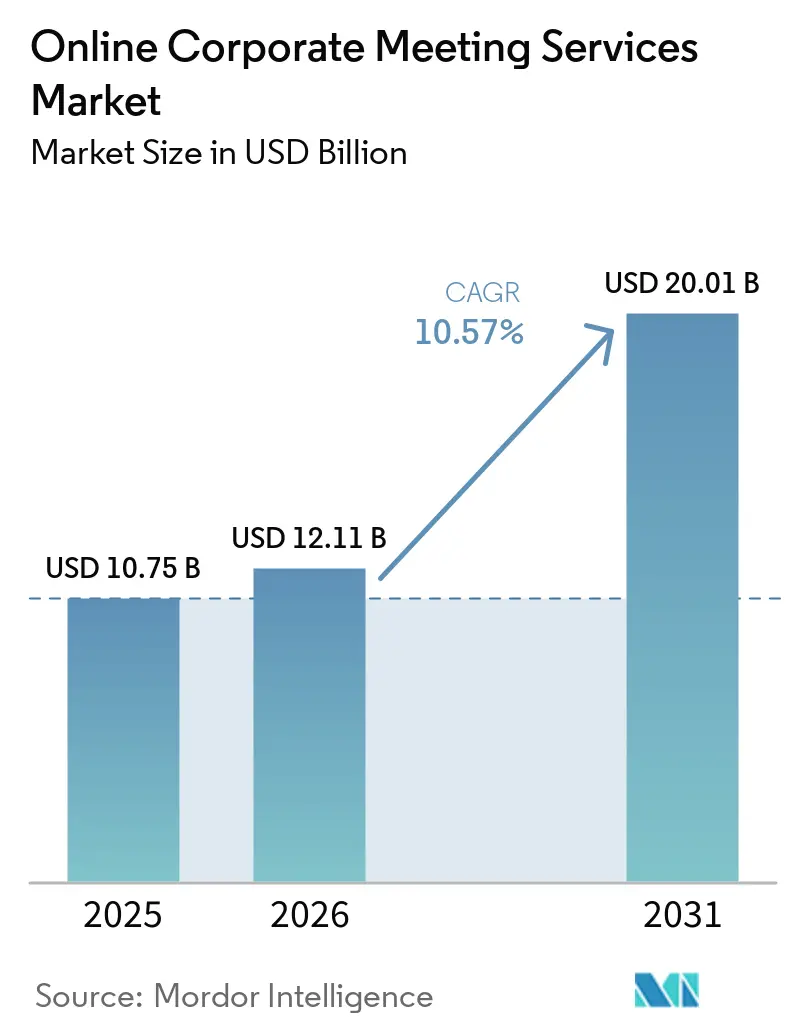
The Online Corporate Meeting Services Market was valued at USD 10.75 billion in 2025 and estimated to grow from USD 12.11 billion in 2026 to reach USD 20.01 billion by 2031, at a CAGR of 10.57% during the forecast period (2026-2031). This growth is driven by the normalization of hybrid work, which keeps enterprise collaboration investments focused on platforms that integrate meeting workflows, content, and decision-making for distributed teams[1]. AI-enabled features are enhancing these platforms by adding transcription, summarization, retrieval, and task follow-up capabilities, thereby increasing the value of each user seat. Procurement trends are shifting toward integrated communication bundles that combine meetings, unified communications, contact centers, and workflow integrations, raising switching costs and reducing the appeal of standalone tools. Compliance requirements in regulated sectors are also influencing platform selection, with encryption, governance, and audit controls becoming as critical as usability. The market's growth is driven by platform consolidation, feature integration, and enterprise adoption, rather than by user base expansion alone.
Key Report Takeaways
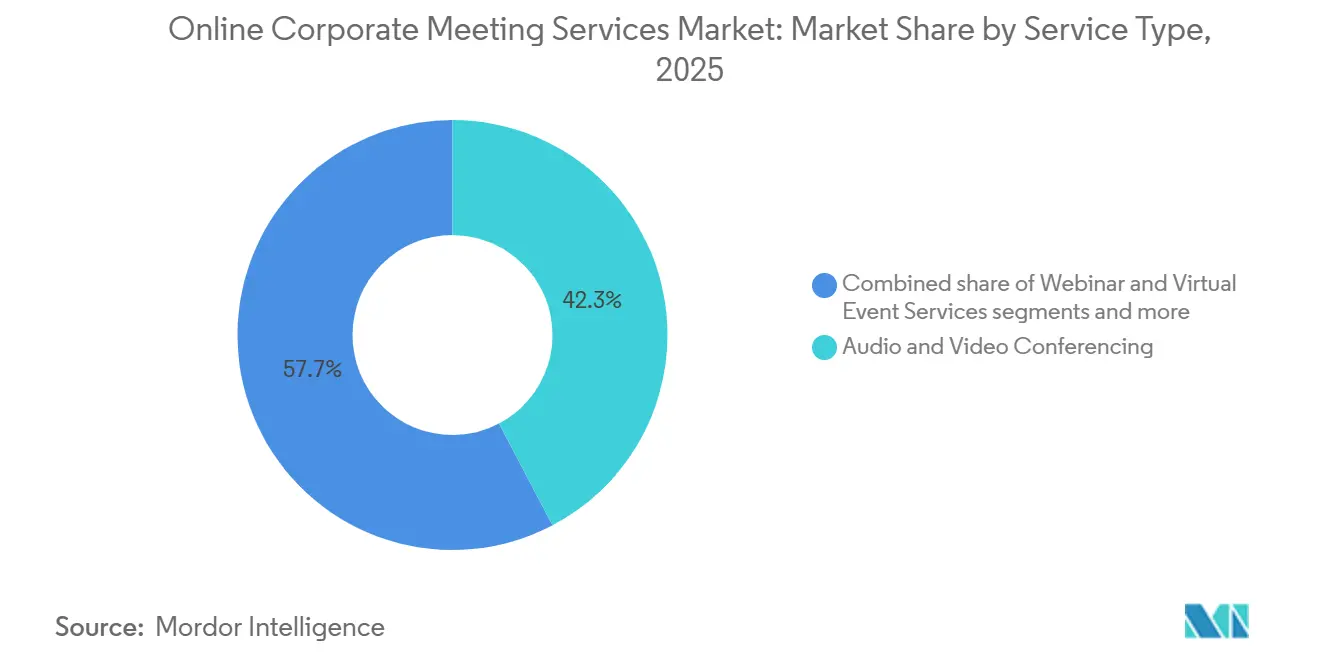
- By service type, Audio and Video Conferencing led with 42.3% revenue share in the Global Online Corporate Meeting Services Market in 2025, while Security and Compliance Services is forecast to expand at a 16.15% CAGR by 2031.
- By deployment mode, Cloud-based delivery accounted for 71.6% of the Global Online Corporate Meeting Services Market in 2025 and is also projected to record the highest CAGR of 13.50% by 2031.
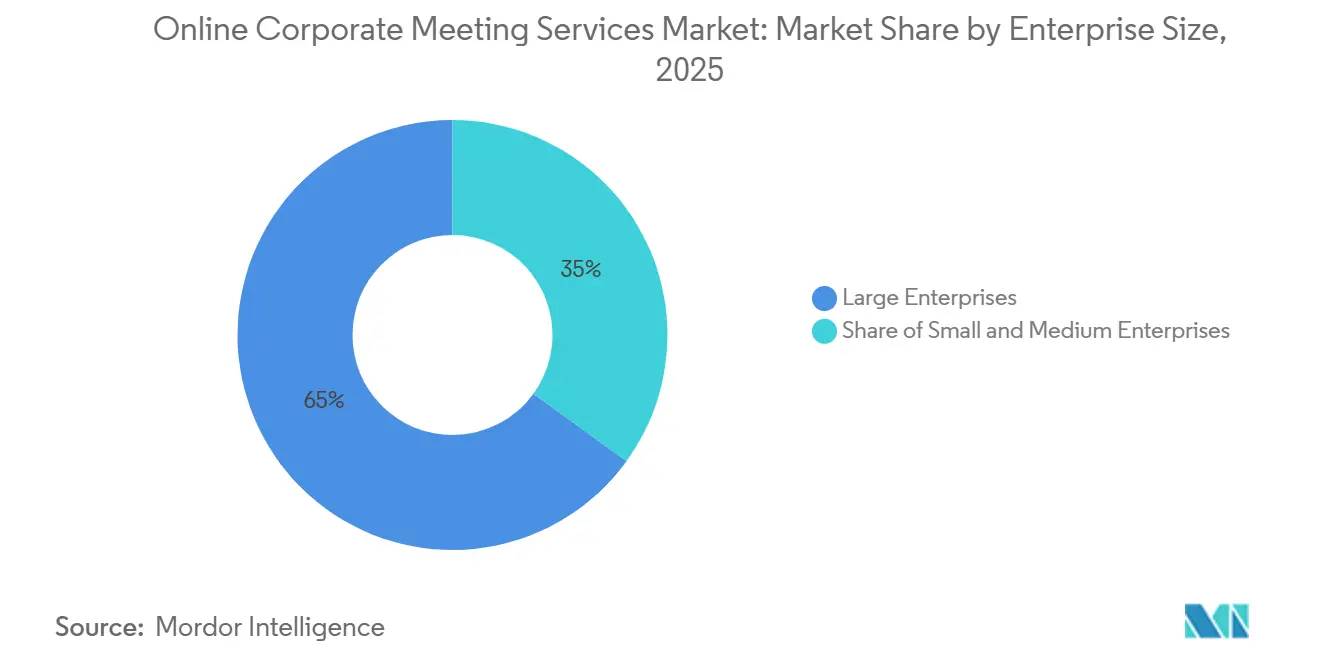
- By enterprise size, Large Enterprises accounted for 65.0% of revenue in the Global Online Corporate Meeting Services Market in 2025, while Small and Medium Enterprises (SMEs) are forecast to grow at a 14.50% CAGR by 2031.
- By end user, Information Technology and Telecom held the largest share at 24.2% in the Global Online Corporate Meeting Services Market in 2025, while Media and Entertainment is projected to expand at a 14.35% CAGR by 2031.
- By geography, North America commanded 39.0% share of the Global Online Corporate Meeting Services Market in 2025, while Asia-Pacific is expected to record the fastest CAGR at 15.70% by 2031.
Note: Market size and forecast figures in this report are generated using Mordor Intelligence’s proprietary estimation framework, updated with the latest available data and insights as of January 2026.
Global Online Corporate Meeting Services Market Trends and Insights
Drivers Impact Analysis*
| Driver | (~) % Impact on CAGR Forecast | Geographic Relevance | Impact Timeline |
|---|---|---|---|
| Rising Enterprise Demand for Hybrid Collaboration Environments | +1.8% | Global, with peak intensity in North America and Europe | Medium term (2-4 years) |
| Expansion of Geographically Distributed and Remote Workforce Models | +1.5% | Global, strongest in Asia-Pacific and South America | Medium term (2-4 years) |
| Integration of AI-Powered Meeting Productivity Tools | +2.1% | Global, strongest in North America and Western Europe | Short term (≤ 2 years) |
| Compliance-Driven Adoption of Secure Meeting Platforms | +1.2% | North America, Europe, and the regulated Asia-Pacific markets | Medium term (2-4 years) |
| Growth in Customer and Partner-Facing Virtual Engagements | +0.9% | Global, especially BFSI and retail in emerging markets | Short term (≤ 2 years) |
| Convergence of Meeting Services with Workflow and CRM Ecosystems | +0.8% | North America and Europe, expanding globally | Short term (≤ 2 years) |
| Source: Mordor Intelligence | |||
Rising Enterprise Demand for Hybrid Collaboration Environments
The online corporate meeting services market is driven by the growing adoption of hybrid work models, which are reshaping enterprise communication and coordination. Collaboration tools have proven effective in enhancing productivity and efficiency, prompting employers to invest in technologies that support hybrid work arrangements. This demand extends beyond remote workers, as office-based teams also rely on cloud meeting platforms to connect with field staff, suppliers, and distributed project groups. Increased spending on room systems, peripherals, and software subscriptions further supports market growth. Organizations with geographically dispersed teams increasingly depend on video conferencing, scheduling, and asynchronous follow-ups for daily operations. Hybrid work has transformed virtual meetings into an essential component of enterprise infrastructure, integrating them into standard business practices.
Integration of AI-Powered Meeting Productivity Tools
AI features are reshaping the online corporate meeting services market by transforming meetings into searchable, summarized, and action-oriented workflows rather than one-time live sessions. Zoom reported significant adoption of its AI Companion by late 2024, followed by notable growth in usage after the release of AI Companion 3.0. Google introduced Workspace Intelligence in 2026, integrating Meet into an autonomous workflow system that can retrieve files, schedule activities, and summarize context across workspace environments[2]. These advancements are influencing enterprise evaluation criteria, with buyers now focusing on note accuracy, workflow retrieval, action-item follow-through, and system relevance when assessing platforms. The market is shifting its emphasis from call quality to institutional memory, knowledge retention, and workflow continuity. Vendors capable of integrating meetings with broader enterprise data are gaining an advantage, as meetings are increasingly viewed as part of a continuous workflow rather than isolated communication events.
Compliance-Driven Adoption of Secure Meeting Platforms
The online corporate meeting services market is experiencing increased demand for compliance-driven solutions, particularly in regulated sectors such as financial services, healthcare, and government. Zoom's SOC 2 Type II coverage for its communications platform, including Zoom Meetings, reflects the growing emphasis on governance and audit requirements in enterprise procurement. Recent cybersecurity legislation enacted across many states in the United States has further amplified the need for platforms with robust controls, including multifactor authentication and security governance[3]. This trend extends beyond public-sector procurement, as private-sector buyers often adopt similar standards for vendor selection and contract evaluations. The market is undergoing a transformation where features such as security certification, encryption, data governance, and compliance reporting are becoming essential components. This shift is driving growth in security and compliance services, as enterprises increasingly seek platforms capable of meeting legal, operational, and audit requirements without relying on additional tools.
Convergence of Meeting Services with Workflow and CRM Ecosystems
Salesforce and Google expanded their partnership to integrate Agentforce 360 into Google Meet, enabling sales activities and opportunity logging directly within the meeting interface. This development highlights a shift in the online corporate meeting services market, where platforms are now evaluated not only for internal communication but also for their role in pipeline conversion, service coordination, and partner management. Zoom followed a similar approach by enhancing its Model Context Protocol to support searches across enterprise systems during live sessions. These advancements are driving new revenue opportunities by linking meetings with workflows, particularly in customer and partner-facing scenarios where meetings feed into records, tasks, and follow-ups. Vendors that integrate meetings with CRM and enterprise systems are positioning their platforms as essential tools for revenue-related activities rather than just communication spaces.
Restraints Impact Analysis*
| Restraint | (~) % Impact on CAGR Forecast | Geographic Relevance | Impact Timeline |
|---|---|---|---|
| Meeting Fatigue and Reduced User Engagement | -1.1% | Global, more pronounced in North America and Western Europe | Short term (≤ 2 years) |
| Data Privacy and Cybersecurity Concerns | -0.9% | Global, especially Europe and Asia-Pacific | Medium term (2-4 years) |
| Fragmented Tool Stacks and Subscription Cost Pressure | -0.7% | North America and Europe mid-market, SMEs globally | Short term (≤ 2 years) |
| Limited Bandwidth and Uneven Digital Infrastructure in Emerging Markets | -0.6% | Africa, South Asia, Southeast Asia, and parts of South America | Long term (≥ 4 years) |
| Source: Mordor Intelligence | |||
Meeting Fatigue and Reduced User Engagement
The online corporate meeting services market continues to face challenges from meeting fatigue, particularly in organizations where employees frequently participate in long virtual sessions. Research based on official data has shown a link between the frequency of virtual meetings and passive fatigue among knowledge workers, even when users do not report significant exhaustion. Similarly, a study based on official data links meeting duration and frequency to videoconference fatigue and highlights that longer breaks between sessions can help alleviate this issue. Sustained user engagement remains essential for deeper platform adoption in this market, beyond merely securing enterprise contracts. Buyers are increasingly focusing on features such as summaries, asynchronous updates, agenda controls, and workflow automation to reduce the strain of constant attendance. Vendors that fail to address meeting fatigue may experience lower user engagement, reduced feature adoption, and a higher likelihood of being replaced during enterprise software evaluations.
Data Privacy and Cybersecurity Concerns
The online corporate meeting services market faces challenges from data governance complexities, fragmented software ecosystems, and uneven digital infrastructure in emerging economies. Increasing data residency requirements across jurisdictions complicate deployments, favoring vendors that can support local processing, robust governance, and transparent trust practices[4]. Many SMEs struggle with overlapping subscriptions for messaging, conferencing, calling, and project tools, which create cost pressures and slow feature development despite strong demand for digital collaboration. Infrastructure gaps further hinder growth, as unreliable bandwidth in regions such as Africa, South Asia, Southeast Asia, and South America limits consistent video delivery and reduces the utility of advanced service tiers. Growth in the market remains uneven, with higher adoption in areas where network quality, compliance readiness, and software integration budgets align effectively. Smaller providers face significant challenges, as limited capital often prevents them from managing localization costs while competing on price and feature offerings.
*Our forecasts treat driver/restraint impacts as directional, not additive. The impact forecasts reflect baseline growth, mix effects, and variable interactions.
Segment Analysis
By Service Type: Security and Compliance Gaining Share Within an Audio/Video-Led Market
Audio and Video Conferencing accounted for 42.3% of the online corporate meeting services market size in 2025, highlighting its central role in enterprise meeting infrastructure. Enterprises prioritize reliability in audio, video, recording, and basic collaboration, making this segment essential for distributed communication. The shift toward video-centric work patterns supports this trend, with activities such as internal reviews, supplier coordination, executive meetings, and customer interactions taking place in unified digital environments. Vendors benefit from delivering consistent meeting quality to large user bases while integrating additional collaboration features. Audio and video services remain foundational, as workflows such as AI summarization and compliance monitoring rely on core meeting sessions.
Webinar and Virtual Event Services maintain steady demand, driven by their use in client outreach, training, education, and partner communication. Meeting Management and Scheduling Services are gaining relevance as enterprises seek streamlined coordination, calendar control, and automated follow-ups for distributed teams. Collaboration and Productivity Integration Services are also growing, as platforms connect live meetings to enterprise applications and enable contextual searches across business systems. Security and Compliance Services, growing at a 16.15% CAGR through 2031, reflect increased regulatory scrutiny and procurement oversight. Vendors embedding governance, audit readiness, and security controls into core platforms are better positioned to secure larger contracts compared to those offering compliance as a separate feature.

By Deployment Mode: Cloud Dominance Reinforced by AI Feature Parity Demands
Cloud-based delivery accounted for 71.6% of the online corporate meeting services market share in 2025 and is projected to grow at a 13.50% CAGR through 2031. This growth reflects ongoing migration trends and a preference for scalable delivery models with reduced infrastructure responsibilities. Cloud environments often receive AI feature rollouts first, creating a gap in automation, transcription, retrieval, and meeting intelligence features compared to on-premises options. This dynamic strengthens the functional advantage of cloud delivery, as non-cloud deployments struggle to maintain feature parity. Regular updates and simplified multi-site administration further enhance the appeal of cloud adoption for large organizations and SMEs.
On-premises deployment remains relevant in sectors like government, defense, and critical infrastructure, were sovereignty and security take precedence. Pexip’s private deployment model and trust documentation highlights why some buyers prioritize controlled hosting and transparent data handling. Hybrid deployment is emerging as a transition model for enterprises seeking centralized cloud management while retaining local control over specific workloads. GoTo’s certifications, including SOC 2 Type II, BSI C5, and APEC CBPR, demonstrate that trust expectations now span across deployment formats. Deployment decisions in the online corporate meeting services market increasingly focus on balancing AI access, governance requirements, and operational control rather than simple hosting preferences.
By Enterprise Size: Large Enterprises Anchor Revenue While SMEs Drive Volume Growth
Large enterprises contributed 65.0% of revenue in the online corporate meeting services market in 2025, significantly influencing purchasing trends. Their extensive collaboration needs, formal procurement processes, compliance requirements, and multi-country deployments drive higher contract values. These enterprises often adopt comprehensive platform suites, enabling vendors to cross-sell services like calling, contact centers, room systems, workflow tools, and security features alongside core meeting functionalities. Demand from large enterprises ensures revenue stability due to renewal cycles and bundled contracts, which provide better visibility than small-account expansions. This segment also shapes product development, with features like advanced governance, reporting, admin controls, and integration depth tailored for large procurement environments.
SMEs are the fastest-growing segment, with 14.50% CAGR projected through 2031. Subscription models that reduce upfront costs and accelerate deployment support this growth. Cloud-native platforms offering recording, collaboration, and AI capabilities without requiring dedicated infrastructure teams are particularly appealing to SMEs. Zoom’s acquisition of Bonsai in December 2025 highlights efforts to strengthen its position with smaller businesses and independent professionals. The market exhibits a dual dynamic: large enterprises anchor value, while SMEs expand the user base from a lower spending level. However, SMEs remain cautious about subscription overlaps, driving demand for unified platforms that integrate meetings, messaging, and lightweight workflow tools under a single contract.
By End User: IT & Telecom Leads, Media and Entertainment Redefines Collaboration Needs
The Information Technology and Telecom sector accounted for 24.2% of the end-user share in 2025, reflecting advanced digital maturity and reliance on distributed collaboration across product, support, and partner functions. This sector uses online meetings for internal coordination, remote demos, solution design, escalation management, and customer communication. Meeting reliability, workflow interoperability, and AI productivity tools are critical as they align with software-driven operating models. The IT and Telecom segment often adopts new features early, validating them before broader industry adoption. This drives demand for integrated administration and advanced analytics.
The BFSI sector is shifting toward platforms with strong security credentials to meet governance and audit requirements, away from lightly managed conferencing tools. Healthcare and Life Sciences are increasing platform adoption as vendors integrate HIPAA-compliant workflows and healthcare-specific collaboration features. Education and Government sectors maintain stable demand through institutional use cases and formal procurement programs. The Media and Entertainment sector is the fastest-growing end-user segment, with a 14.35% CAGR through 2031. Growth is driven by distributed creative production, remote editorial collaboration, and multi-location review cycles. This trend expands demand beyond generic business conferencing to secure, low-latency, and workflow-integrated collaboration environments.
Geography Analysis
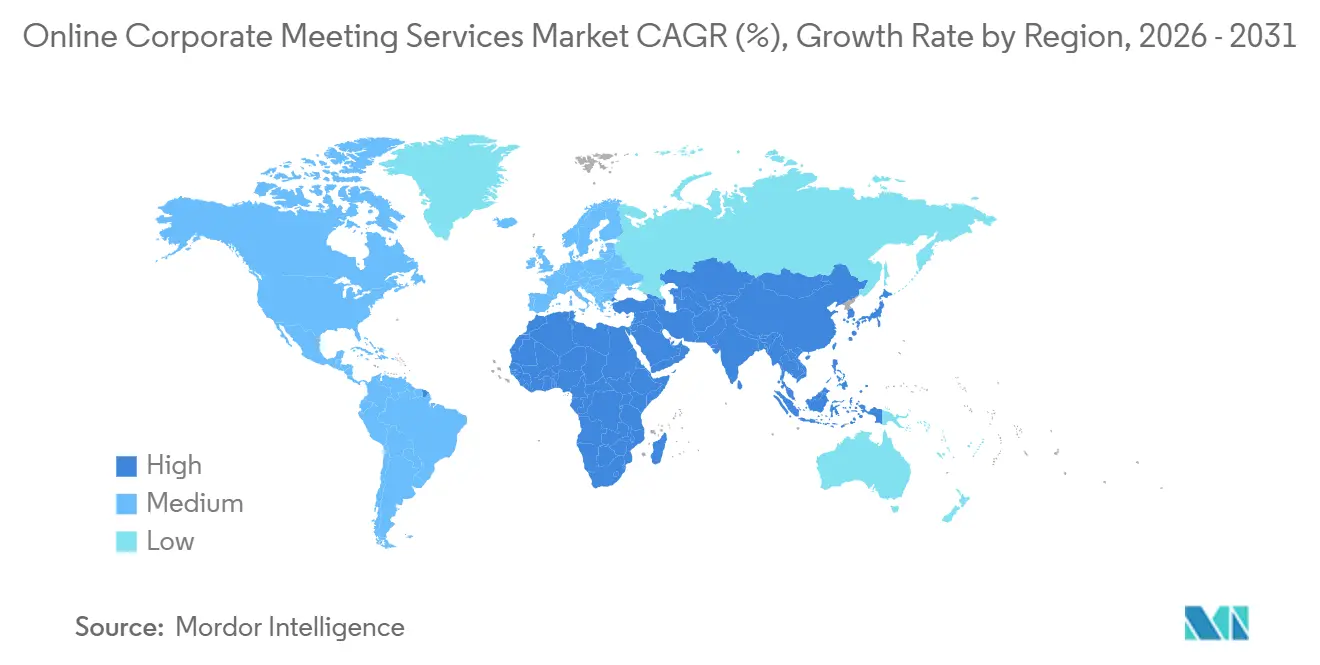
North America accounted for 39.0% of the online corporate meeting services market in 2025, driven by strong enterprise software adoption, mature cloud infrastructure, and vendor investments in communication platforms. Official data reported USD 2.52 billion in annual communication software spending in its FY2025 results, reflecting significant vendor activity. The United States leads due to large enterprise budgets, hybrid work adoption, and early adoption of AI-enabled collaboration. Canada and Mexico also contribute, with Mexico benefiting from enterprise digitization in manufacturing and cross-border business coordination.
Europe is projected to grow at a 7.40% CAGR through 2031, supported by hybrid work models and compliance-driven procurement in regulated sectors. The United Kingdom, Germany, and France dominate due to large enterprise user bases and digital workplace adoption. Cisco’s September 2025 integration of Microsoft Teams Rooms into select Cisco hardware highlights the region’s focus on interoperability. The NORDICS show advanced demand for secure, sovereign-data collaboration tools. Growth in Europe centers on platform upgrades aligned with governance and integration needs.
Asia-Pacific is the fastest-growing region, with a 15.70% CAGR through 2031, driven by cloud-first modernization, expanding digital workforces, and adoption of collaboration tools in India, Southeast Asia, and Australia. China’s market is led by domestic providers, with Tencent Meeting ranking as the leader in user time and revenue in 2026. South America is growing at an 8.00% CAGR, led by Brazil’s rising SaaS adoption. The Middle East and Africa expanded from a smaller base, driven by modernization in Western Asia and improved broadband access in parts of Africa.
Competitive Landscape
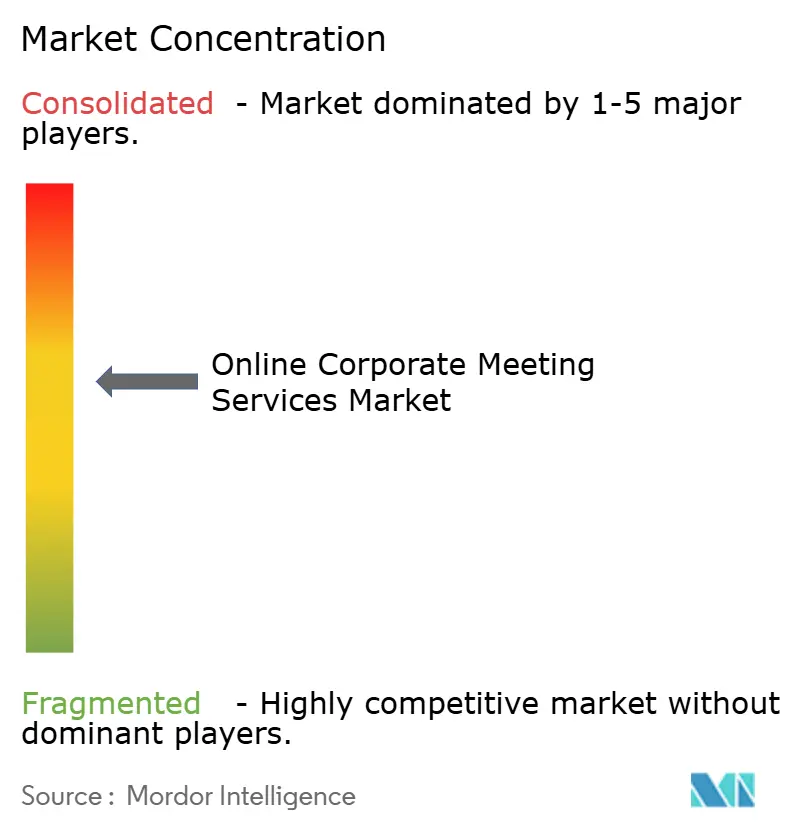
The online corporate meeting services market is moderately concentrated, with key players such as Microsoft, Zoom, Cisco, Google, and RingCentral holding a significant combined share. Leading vendors leverage their scale by bundling services like calling, contact centers, productivity tools, room hardware, AI assistants, and administrative tools under unified contracts. This approach increases switching costs and strengthens control over pricing, roadmaps, and partner channels. However, opportunities remain for challengers as buyers evaluate niche strengths in compliance, vertical support, localization, and customer experience integration. The balance between scale advantages and specialization drives active competition despite the dominance of larger vendors.
Microsoft benefits from its extensive enterprise reach and integration with its productivity suite. Zoom is expanding beyond meetings into workflows and business applications, supported by acquisitions of BrightHire and Bonsai, which enhance hiring intelligence and small-business engagement. Cisco is repositioning Webex with hardware-software integration, AI features, and interoperability, as demonstrated by its MDEP announcement enabling Microsoft Teams Rooms on select Cisco devices. These developments highlight that competition extends beyond meeting functionality to ecosystem integration. Vendors linking meetings to devices, workflows, administrative controls, and compliance frameworks hold a competitive edge over standalone conferencing solutions.
Second-tier providers focus on innovation, pricing flexibility, and regional or vertical relevance. RingCentral’s Customer Engagement Bundle for Microsoft Teams has attracted thousands of enterprise customers, with a significant portion adopting paid AI products, showcasing the potential of partner-led bundling. Dialpad targets enterprise buyers with its agentic AI platform, enhancing autonomy in customer and collaboration workflows. Avaya and RingCentral expanded their partnership to combine cloud communications with Avaya Aura telephony, demonstrating how alliances protect existing bases while integrating AI and cloud functionalities. The market remains competitive, with success favoring vendors combining platform breadth with strong execution in security, AI, and enterprise integration.
Online Corporate Meeting Services Industry Leaders
-
Microsoft
-
Zoom Video Communications
-
Cisco Systems
-
Google
-
RingCentral
- *Disclaimer: Major Players sorted in no particular order
Recent Industry Developments
- May 2026: Zoom upgraded its MCP Server, enabling integration of agentic search and conversation intelligence with third-party AI tools, including OpenAI Codex and Anthropic Claude, while connecting data from 10 third-party platforms to extend meeting context into enterprise AI workflows.
- April 2026: RingCentral introduced AI-powered tools, including the Customer Engagement Bundle (CEB) for Microsoft Teams, Enterprise Branded Calling, and AI Receptionist enhancements. CEB has attracted over 5,000 enterprise customers, with nearly 40% adopting at least one paid AI feature since its launch.
- April 2026: Google introduced Workspace Intelligence at Google Cloud Next 2026, transforming Workspace, including Google Meet, into an autonomous agent powered by Gemini. Users can now schedule meetings, retrieve documents, and summarize contexts using natural language commands, enhancing productivity and efficiency.
- April 2026: 8x8 introduced AI Studio, an AI development environment allowing enterprises to create, test, and deploy AI agents on the 8x8 Platform for CX using natural language instructions. Early availability includes no additional licensing fees.
Global Online Corporate Meeting Services Market Report Scope
| Audio and Video Conferencing |
| Webinar and Virtual Event Services |
| Meeting Management and Scheduling Services |
| Collaboration and Productivity Integration Services |
| Security and Compliance Services |
| Cloud Based |
| On Premises |
| Hybrid |
| Large Enterprises |
| Small and Medium Enterprises |
| Banking, Financial Services and Insurance |
| Information Technology and Telecom |
| Healthcare and Life Sciences |
| Education |
| Government and Public Sector |
| Retail and Consumer Goods |
| Manufacturing |
| Media and Entertainment |
| Other End Users |
| North America | United States |
| Canada | |
| Mexico | |
| South America | Brazil |
| Peru | |
| Chile | |
| Argentina | |
| Rest of South America | |
| Europe | United Kingdom |
| Germany | |
| France | |
| Spain | |
| Italy | |
| BENELUX (Belgium, Netherlands, and Luxembourg) | |
| NORDICS (Denmark, Finland, Iceland, Norway, and Sweden) | |
| Rest of Europe | |
| Asia-Pacific | India |
| China | |
| Japan | |
| Australia | |
| South Korea | |
| South East Asia (Singapore, Malaysia, Thailand, Indonesia, Vietnam, and Philippines) | |
| Rest of Asia-Pacific | |
| Middle East and Africa | United Arab Emirates |
| Saudi Arabia | |
| South Africa | |
| Nigeria | |
| Rest of Middle East and Africa |
| By Service Type | Audio and Video Conferencing | |
| Webinar and Virtual Event Services | ||
| Meeting Management and Scheduling Services | ||
| Collaboration and Productivity Integration Services | ||
| Security and Compliance Services | ||
| By Deployment Mode | Cloud Based | |
| On Premises | ||
| Hybrid | ||
| By Enterprise Size | Large Enterprises | |
| Small and Medium Enterprises | ||
| By End User | Banking, Financial Services and Insurance | |
| Information Technology and Telecom | ||
| Healthcare and Life Sciences | ||
| Education | ||
| Government and Public Sector | ||
| Retail and Consumer Goods | ||
| Manufacturing | ||
| Media and Entertainment | ||
| Other End Users | ||
| By Geography | North America | United States |
| Canada | ||
| Mexico | ||
| South America | Brazil | |
| Peru | ||
| Chile | ||
| Argentina | ||
| Rest of South America | ||
| Europe | United Kingdom | |
| Germany | ||
| France | ||
| Spain | ||
| Italy | ||
| BENELUX (Belgium, Netherlands, and Luxembourg) | ||
| NORDICS (Denmark, Finland, Iceland, Norway, and Sweden) | ||
| Rest of Europe | ||
| Asia-Pacific | India | |
| China | ||
| Japan | ||
| Australia | ||
| South Korea | ||
| South East Asia (Singapore, Malaysia, Thailand, Indonesia, Vietnam, and Philippines) | ||
| Rest of Asia-Pacific | ||
| Middle East and Africa | United Arab Emirates | |
| Saudi Arabia | ||
| South Africa | ||
| Nigeria | ||
| Rest of Middle East and Africa | ||
Key Questions Answered in the Report
What is the current value of the global online corporate meeting services space in 2026?
The online corporate meeting services market was valued at USD 10.75 billion in 2025 and is projected to reach USD 12.11 billion in 2026, before expanding to USD 20.01 billion by 2031.
What is driving growth in online corporate meeting services through 2031?
Growth is being supported by hybrid work, AI-enabled meeting productivity tools, stronger workflow integration, and rising compliance requirements in regulated industries.
Which service type is growing the fastest in online corporate meetings?
Security and Compliance Services is the fastest-growing service type, with a projected CAGR of 16.15% through 2031.
Which deployment model leads enterprise adoption?
Cloud-based delivery leads the market with a 71.6% share in 2025 and a projected CAGR of 13.50% through 2031.
Which region offers the strongest long-term growth opportunity?
Asia-Pacific is the fastest-growing geography, with a projected CAGR of 15.70% through 2031, supported by cloud-first modernization and expanding digital workforces.
How concentrated is competition among leading vendors?
The top 5 vendors, Microsoft, Zoom, Cisco, Google, and RingCentral, together held an estimated combined share of 57% to 74% in 2025, which points to a moderately concentrated competitive structure.