
Managed Unified Communications Services Market Size and Share
Market Overview
| Study Period | 2021 - 2032 |
|---|---|
| Market Size (2027) | USD 74.54 Billion |
| Market Size (2032) | USD 111.47 Billion |
| Growth Rate (2027 - 2032) | 10.10 % |
| Fastest Growing Market | Asia-Pacific |
| Largest Market | North America |
| Market Concentration | Medium |
Major Players *Disclaimer: Major Players sorted in no particular order Image © Mordor Intelligence. Reuse requires attribution under CC BY 4.0. | |
Managed Unified Communications Services Market Analysis by Mordor Intelligence
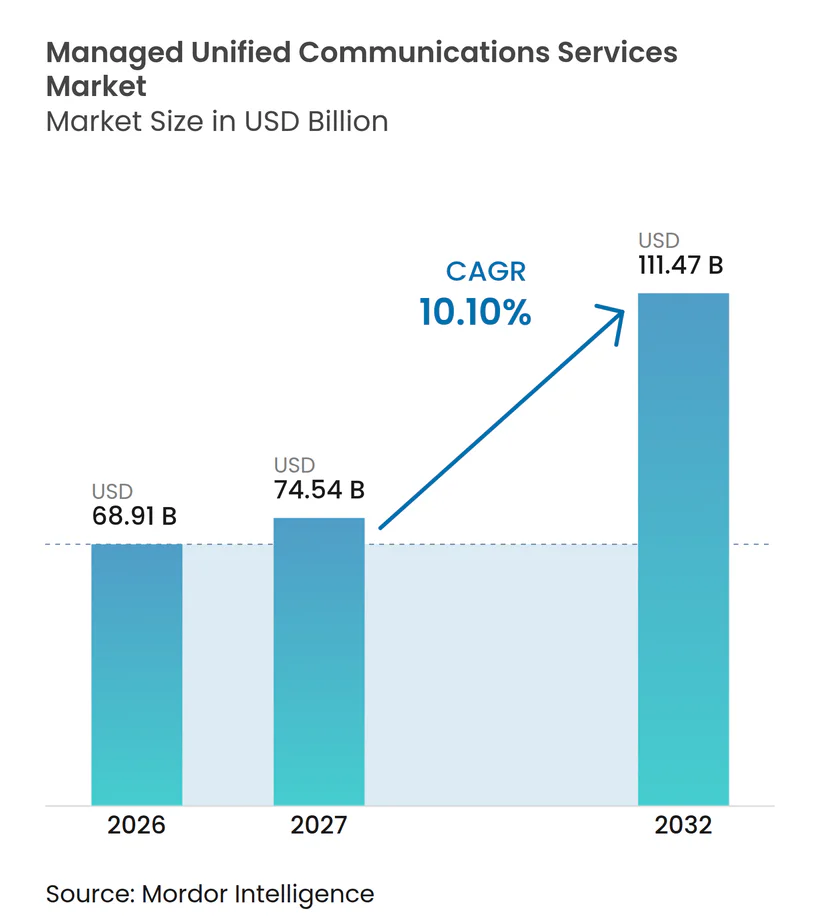
The Managed unified communications services market size is projected to expand from USD 68.91 billion in 2026 and USD 74.54 billion in 2027 to USD 111.47 billion by 2032, registering a CAGR of 10.10% between 2027 to 2032. The Managed unified communications services market is moving toward cloud-delivered operating models because enterprise teams must support voice, video, and messaging across distributed workforces and varied devices. Providers can extend their role beyond platform administration when they manage security controls, analytics, integration work, and compliance records. Artificial intelligence features are making this work more demanding because enterprises need governance, auditability, and reliable controls around automated communications. The Managed unified communications services market also benefits when legacy PBX replacement becomes a wider modernization program that includes endpoints, migration services, and managed operations. Data sovereignty, talent availability, and telecommunications fraud will remain important considerations in provider selection and contract design.
Key Report Takeaways
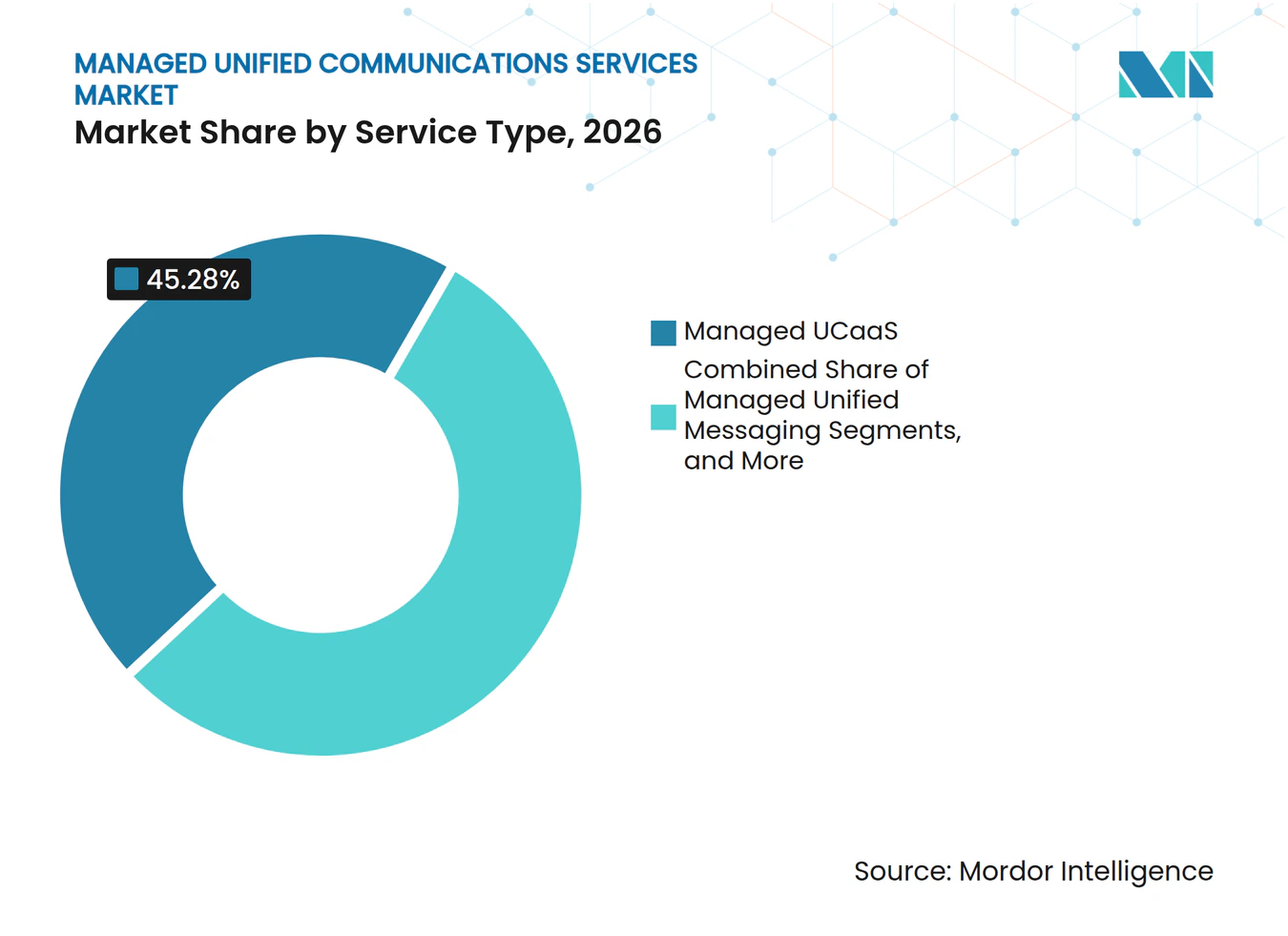
- By service type, Managed UCaaS held 45.28% of the Managed unified communications services market share in 2026, while it is projected to expand at an 11.15% CAGR through 2032.
- By component, Managed Services held 62.47% revenue share in 2026 and is projected to expand at an 11.45% CAGR through 2032.
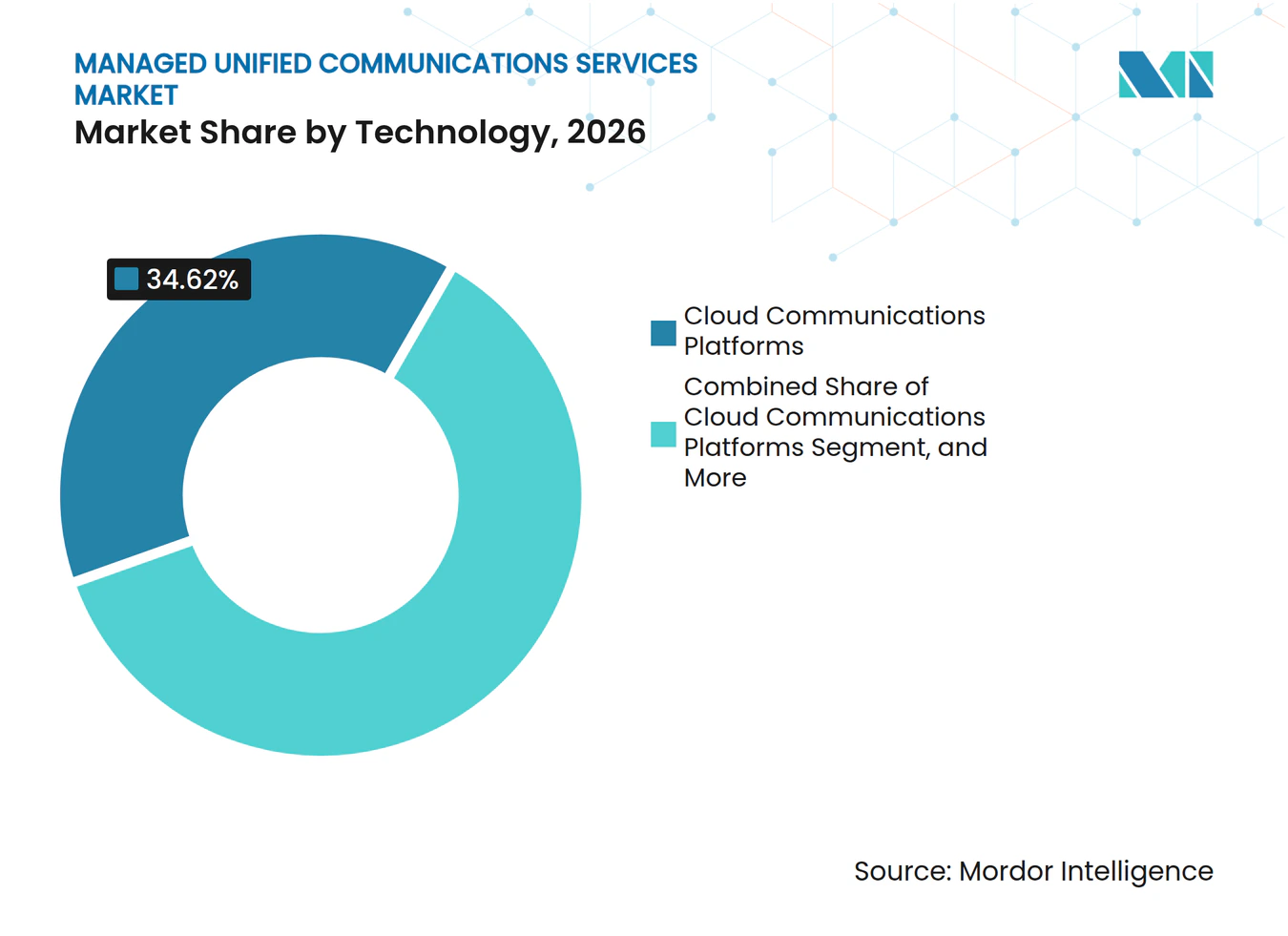
- By technology, Cloud Communications Platforms held 34.62% revenue share in 2026, while artificial intelligence and machine learning is projected to expand at an 11.82% CAGR through 2032.
- By end user, IT and Telecommunications held 19.56% revenue share in 2026, while Healthcare and Life Sciences is projected to expand at an 11.62% CAGR through 2032.
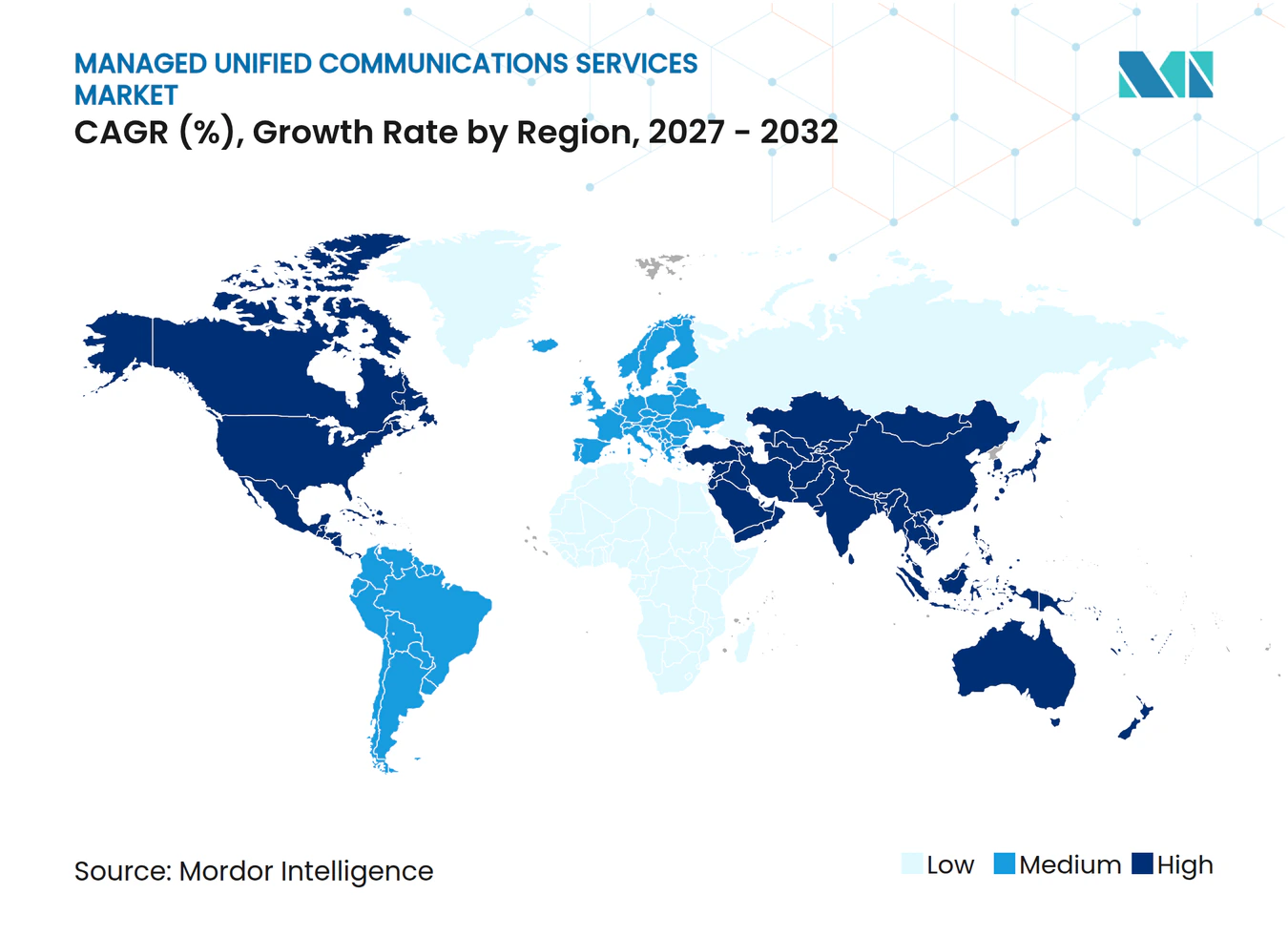
- By geography, North America held 43.25% revenue share in 2026, while Asia-Pacific is projected to expand at an 11.87% CAGR through 2032.
Note: Market numbers in this report are based on Mordor Intelligence's proprietary estimation framework, which combines nine months of actuals with Q4 projections for base year 2026.
Market Trends and Insights
Drivers Impact Analysis of Managed Unified Communications Services Market*
| Driver | (~) % Impact on CAGR Forecast | Geographic Relevance | Impact Timeline |
|---|---|---|---|
| Hybrid and Distributed Workforces | +2.5% | Global | Short term (≤ 2 years) |
| Cloud Migration and Legacy PBX Replacement | +2.0% | Global | Short term (≤ 2 years) |
| Integrated Voice, Video, and Messaging Demand | +1.5% | Global | Medium term (2-4 years) |
| AI-Enabled Operations and Collaboration Analytics | +1.5% | North America and Asia-Pacific, with spillover to Europe | Medium term (2-4 years) |
| SME Adoption of Subscription-Based Communications | +1.0% | Asia-Pacific and Western Europe | Medium term (2-4 years) |
| Regulated-Industry Demand for Managed Security and Compliance | +0.8% | North America and Europe | Long term (≥ 4 years) |
| Source: Mordor Intelligence | |||
Hybrid and Distributed Workforces Drive Sustained Managed UC Demand
Hybrid work has made internal communications operations harder to manage because employees connect through different networks, locations, and devices. The Managed unified communications services market addresses that operational burden by placing provisioning, monitoring, and security work with specialized providers. Organizations that initially managed rapid workforce changes on their own are now consolidating platforms and processes. That shift favors providers that can manage uncertainty across multi-year contracts and deliver a consistent experience for employees. Ofcom reported in July 2025 that 98% of surveyed United Kingdom SMEs used online communication services, which indicates that the next requirement is managed optimization rather than first-time adoption.[1] Basic connectivity alone is therefore less important than operational management, governance, and service quality.
Cloud Migration and Legacy PBX Replacement Unlock New Managed Service Categories
Legacy PBX retirement remains a major technology decision because aging systems create hardware lifecycle, integration, and support challenges. The Managed unified communications services market gains when an organization treats this transition as a managed migration rather than a simple platform purchase. Enterprises must often connect new cloud services with existing CRM, IT service management, and analytics systems. That requirement creates demand for sequencing, testing, endpoint support, and ongoing optimization after the cutover. In November 2025, 8x8 added native support for Mitel SIP desk phones, allowing Mitel users to access its cloud platform without replacing devices.[2] This approach links hardware continuity with cloud migration and can shorten the path from legacy infrastructure to a managed contract.
Demand for Integrated Voice, Video, and Messaging Shifts from Cost to Analytics
Enterprises increasingly want voice, video, and messaging to operate through a coordinated service rather than separate tools. Separate platforms can leave communications records fragmented and make policy enforcement inconsistent across channels. A unified environment gives providers a clearer role in managing records, access controls, workflow connections, and service performance. It also gives enterprises a single data model for communication activity, which supports internal oversight and customer service workflows. The Managed unified communications services market is therefore supported by demand for a platform that joins communication modes without transferring the integration burden to internal teams. Providers that cannot offer a consistent service layer across these modes risk losing renewals to firms with more complete operating and analytics capabilities.
AI-Enabled Operations and Collaboration Analytics Create New Managed Revenue Layers
Artificial intelligence features are becoming paid elements of communications contracts rather than background capabilities. RingCentral reported in October 2026 that annual recurring revenue from customers using a native paid AI product approached 15% of total annual recurring revenue and had doubled year over year.[3] The change moves providers beyond transcription and meeting summaries toward tools that can recognize intent, authenticate users, and support service workflows. These capabilities also require clear rules for data handling, access, monitoring, and record retention. Zoom announced centralized AI management, custom guardrails, and deepfake risk detection in October 2026, showing that governance features are becoming part of enterprise communications management. Managed providers can therefore create recurring work around deployment, controls, auditability, and compliance archiving.
Restraints Impact Analysis of Managed Unified Communications Services Market*
| Restraint | (~) % Impact on CAGR Forecast | Geographic Relevance | Impact Timeline |
|---|---|---|---|
| Data Sovereignty and Third-Party Control Concerns | -1.5% | Europe, Middle East, and Asia-Pacific | Medium term (2-4 years) |
| Shortage of UC, Cloud, and AI Operations Talent | -1.0% | Global | Long term (≥ 4 years) |
| Integration Complexity Across Multivendor Estates | -0.8% | Global | Medium term (2-4 years) |
| Toll Fraud, Identity Abuse, and Service Outage Exposure | -0.5% | Global, concentrated in North America and Europe | Short term (≤ 2 years) |
| Source: Mordor Intelligence | |||
Data Sovereignty and Third-Party Control Concerns Constrain Regulated Market Access
Data sovereignty is a major barrier in government and regulated customer groups because communications records can contain sensitive operational information. The proposed European Cloud and AI Development Act introduced in June 2026 addresses dependence on third-country cloud providers and considers data localization, auditability, and switching rights. The EU Data Act became effective in September 2025 and added requirements related to switching rights and data portability in cloud agreements. Customers in Europe, the Middle East, and parts of Asia-Pacific may require local data residency, tenant-level auditability, and contractual limits on sub-processor access. Providers that cannot meet these conditions can be excluded from government and regulated-industry procurement. Hybrid architectures that retain sensitive communications data on-site can have an advantage where customers want cloud capabilities but require stronger control over data location. The Managed unified communications services market must therefore accommodate different country and sector rules rather than rely on a single standardized delivery model. That requirement can increase contract complexity and lengthen procurement cycles for providers without clear sovereign deployment options.
Shortage of UC, Cloud, and AI Operations Talent Compresses Provider Margins and Service Quality
The shortage of skilled workers in unified communications, cloud operations, cybersecurity, and AI governance can limit provider capacity. Managed service providers need people who can operate communication systems while understanding the security and compliance demands of each customer environment. The constraint is particularly demanding in healthcare, financial services, and public sector deployments. These settings may require knowledge of HIPAA, FedRAMP, DORA, cybersecurity controls, and communications architecture at the same time. The Managed unified communications services market can face higher service costs when providers must compete for this combination of skills. Providers that invest in training, documented operating procedures, and automation can reduce some of the pressure, but specialized oversight remains necessary. Telecommunications fraud can add another operational concern, as the Communications Fraud Control Association reported global telecom fraud losses of USD 41.82 billion in 2025, compared with USD 38.95 billion in 2023. Subscription fraud, account takeover, and identity abuse can increase the value of continuous monitoring and incident response. These costs can pressure provider margins and raise the importance of security capability in customer procurement.
*Our forecasts treat driver/restraint impacts as directional, not additive. The impact forecasts reflect baseline growth, mix effects, and variable interactions.
Managed Unified Communications Services Market Segment Analysis
By Service Type:
Managed UCaaS Consolidates the Enterprise Voice TransitionManaged UCaaS accounted for 45.28% of the Managed unified communications services market size in 2026 and represented the leading service architecture. Its position reflects the move away from separate telephony services toward managed cloud environments that combine voice, video, messaging, and collaboration. Enterprises use this model to shift both capital spending and operating responsibility away from internal IT teams. The service supports organizations that need one provider to manage administration, service quality, security, and user support. Managed UCaaS is projected to expand at an 11.15% CAGR from 2027 to 2032. Its expected pace supports continuing investment in AI features, vertical capabilities, and compliance coverage. The Managed unified communications services market is also shaped by the convergence of contact center and employee communications services. Customers increasingly want these functions managed under a single contract so that service workflows and customer interactions can be handled more consistently.
Managed VoIP remains an entry point for organizations that are not ready to adopt a complete UCaaS deployment. It has relevance in cost-sensitive mid-market, manufacturing, and education accounts where a staged transition can be more practical. Managed Unified Messaging serves customers that need structured administration of message records and related workflows. Managed Conferencing and Collaboration addresses lifecycle management and interoperability needs in hybrid or multivendor settings. Managed UC Integration, Support, and Optimization is gaining importance as organizations connect communications tools with CRM, ERP, and IT service management platforms. The need becomes greater when AI communication agents must exchange information with those systems. This integration work was often handled internally in the past, but the growing number of connections makes managed support more attractive. Across these service types, competition is moving toward vertical expertise, reliable integration, and compliance readiness rather than basic connectivity.



By Component:
Managed Services Outpace Solutions as AI Operational Overhead RisesManaged Services held 62.47% revenue share in 2026, making it the leading component of the Managed unified communications services market. The share shows that many customers prefer fully outsourced platform operations over a model centered only on technology purchases. Managed Services is projected to expand at an 11.45% CAGR from 2027 to 2032. Each additional AI capability can increase the need for monitoring, audit trails, access controls, and policy enforcement. Agentic workflows, compliance archiving, conversation analytics, and deepfake detection can all add tasks for the provider and the customer. This makes the managed layer more valuable to organizations with limited internal operations capacity. It also means that providers must demonstrate that they can manage AI controls without compromising service reliability. The component’s expected expansion reflects the need to combine communications operations with governance and compliance support.
The solutions component remains important because it provides the hardware and software foundation for managed delivery. Revenue in this component benefits from the transition from PBX systems to UCaaS and the wider use of IP handsets, softphones, and video bars. Providers are increasingly combining endpoint support with service contracts to make customer relationships more durable. 8x8’s November 2025 addition of native Mitel phone support showed how a provider can preserve hardware continuity while moving customers toward cloud communications. This arrangement allows enterprise clients to retain installed devices while accessing a managed platform. It can also reduce disruption during hardware refresh decisions. As providers include lifecycle management within a managed contract, standalone solutions can become a smaller part of the commercial relationship. The component will still matter where customers need hybrid deployments, specialized endpoints, or a phased migration path.
By Technology:
Cloud Platforms Lead, but Artificial Intelligence Changes the Value HierarchyCloud Communications Platforms held 34.62% revenue share by technology in 2026, supported by enterprise platform consolidation and channel-led sales models. They provide the core environment through which voice, meetings, messaging, and related collaboration functions are delivered. Artificial intelligence and machine learning is projected to expand at an 11.82% CAGR from 2027 to 2032. This rate exceeds the overall forecast and indicates that AI is becoming a central operating layer rather than an optional feature. The Managed unified communications services market is affected by this shift because providers must build AI capabilities into both platform management and customer support. RingCentral launched AIR Pro and AIR Pro Studio in March 2026 as voice-first autonomous AI agent tools embedded in its business communications and contact center offerings. The platform can recognize intent, authenticate customers in real time, and execute multistep service workflows across voice, SMS, and digital channels.
SIP and IP Telephony continues to support voice infrastructure in hybrid environments and retains an important installed base. APIs and CPaaS provide a development layer that lets organizations embed communications functions in custom applications. Low-code tools can help mid-market users adopt these capabilities without extensive internal software development. Zero-Trust Security and Identity Management is becoming more important in deployments that must meet FedRAMP, HIPAA, and DORA requirements. Session Border Controllers and Network Quality Management also remain important where organizations connect cloud services with existing networks. Zoom’s October 2026 governance announcements included centralized AI management, custom guardrails, and deepfake risk detection. These functions show that AI governance is developing as a billable technology layer within managed communications. Providers that pair AI features with identity, security, and service quality controls can be better positioned for regulated and complex environments.

By End User:
IT and Telecommunications Leads, Healthcare and Life Sciences AcceleratesIT and Telecommunications accounted for 19.56% of end-user demand in 2026 and remained the leading customer group. This sector acts as both a sophisticated user of communications services and a channel that can support downstream client deployments. Its role creates relatively high spending per organization and makes it an early adopter of AI-enabled communications management. Healthcare and Life Sciences is projected to expand at an 11.62% CAGR from 2027 to 2032. Multi-site care delivery, secure access, and protected health information requirements shape demand in this group. Healthcare organizations require managed archiving, multifactor authentication for endpoints, and tamper-resistant retention of communication records. The Managed unified communications services market can benefit when healthcare customers treat modernization as a security and resilience requirement rather than only a communications upgrade. In January 2026, Health-ISAC warned healthcare organizations about SMS and voice one-time-password toll fraud campaigns that targeted patient portals and telehealth sign-up flows.
Banking, Financial Services, and Insurance requires record retention, trade surveillance, and controls over data access. Government and Public Sector customers also place high importance on sovereign data, certification, and procurement compliance. These priorities can support long-term managed service relationships because the provider must understand the customer’s operational and regulatory needs. Retail and Consumer Goods adopts managed communications for customer service and frontline coordination. Manufacturing uses similar tools for workforce coordination and operational communications. Education has a smaller revenue role, but hybrid learning continues to support demand for managed video conferencing and collaboration across distributed campuses. Across these verticals, AI governance can widen the range of customers that need specialist support. Providers that preconfigure compliance controls and sector-specific workflows can make procurement easier for customers with strict requirements.
Geography Analysis
North America Managed Unified Communications Services Market
North America held 43.25% of the Managed unified communications services market share in 2026 and remained the largest regional contributor. The region has mature enterprise technology procurement, extensive managed service ecosystems, and a large base of cloud communications providers. FedRAMP requirements also create a pathway for providers serving United States government and regulated-sector customers. RingCentral reported USD 2.515 billion in total revenue for fiscal year 2025, with subscription-based communications providing the foundation of its commercial scale. The United States leads regional demand, while Canada benefits from public sector cloud-first activity. Mexico adds demand through near-shoring-related enterprise communications deployments. RingCentral also reported that annual recurring revenue from customers using paid AI products approached 15% of total annual recurring revenue in the third quarter of 2026. This shows that many North American buyers are moving from AI evaluation to paid deployment.
Europe Managed Unified Communications Services Market
Europe has a varied demand profile because cloud maturity and regulatory requirements differ among national markets. The United Kingdom is a leading regional market for managed communications services. The EU Data Act has been effective since September 2025 and establishes data portability and switching-rights considerations in cloud agreements. The proposed Cloud and AI Development Act further focuses attention on localization, auditability, and cloud-provider dependence. These requirements can favor providers with regionally appropriate data controls and clear contractual terms. Customers may place more value on sovereign-capable architectures when selecting a managed service partner. Providers that cannot meet these expectations may face a narrower addressable customer base in public sector and regulated enterprise accounts.
APAC, South America and MEA Managed Unified Communications Services Market
Asia-Pacific is projected to expand at an 11.87% CAGR from 2027 to 2032, making it the fastest-growing geography. India, Japan, and Southeast Asia are supporting the shift away from legacy PBX infrastructure. Japan’s Digital Agency promotes a cloud-first principle that supports public sector modernization. India’s demand is tied to IT services, financial services, and healthcare deployments. South Korea adds demand through dense enterprise technology environments. Indonesia contributes through mobile-first enterprise architectures. South America is supported by banking, financial services, insurance, and retail use cases in Brazil. Saudi Arabia and the United Arab Emirates are advancing through government-supported digital transformation programs, while South Africa and Nigeria remain earlier-stage centers of adoption in Africa.
Competitive Landscape
Market Concentration
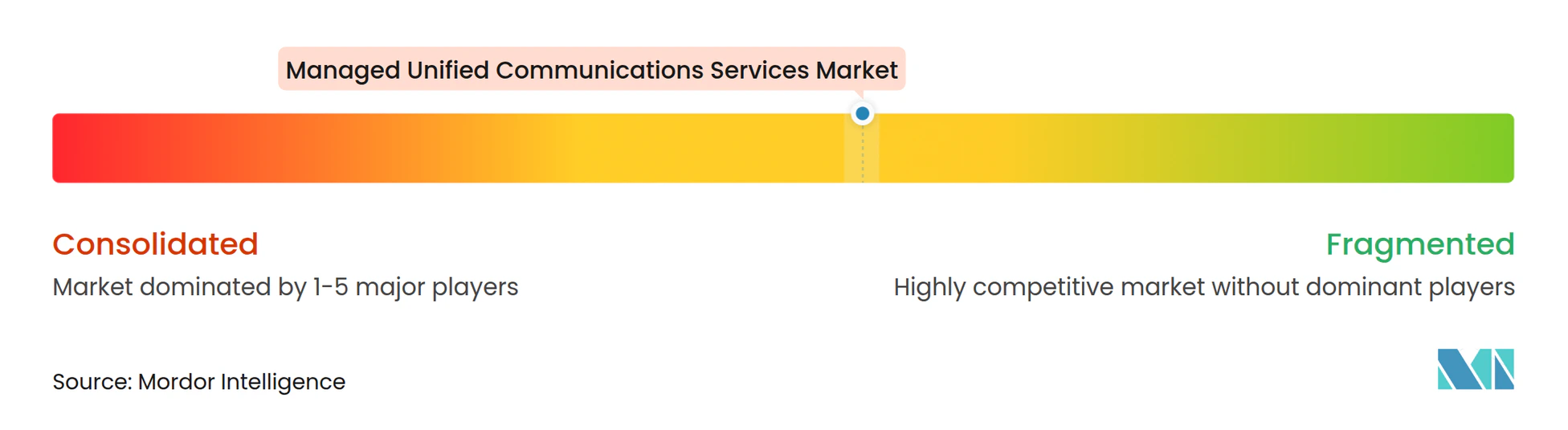
The Managed unified communications services market has moderate concentration at the enterprise tier, where RingCentral, Zoom Video Communications, Avaya, 8x8, and Dialpad have strong visibility and substantial AI development resources. Competition is more fragmented among mid-market providers, regional firms, and telecommunications-adjacent managed service companies. The current competitive focus is on converting AI capabilities into dependable paid services for enterprise customers. Providers must show that their AI agents can support voice engagement, customer experience, and compliance workflows with clear controls. RingCentral reported in October 2026 that paid AI products approached 15% of its total annual recurring revenue and had doubled year over year. This result indicates that AI monetization has a direct commercial role in the category. Zoom’s October 2026 releases emphasized centralized AI management, custom guardrails, and deepfake risk detection. The focus on governance means that compliance officers may have more influence in platform procurement.
Vertical specialization is an important opportunity because healthcare, financial services, and government customers need more than generic platform features. Providers can differentiate by supplying pre-integrated compliance controls, sector-specific AI agents, and certified workflows. RingCentral’s AIR Pro was initially directed toward healthcare-specific AI agents, with financial services and retail rollouts planned for the second half of 2026. These moves show that providers are using vertical workflows to make AI capabilities relevant to operational needs. Firms without a clear AI roadmap or a credible compliance approach for regulated sectors may lose customers to more specialized competitors.
Acquisitions and portfolio decisions also shape the competitive environment because providers need investment capacity and a focused service offering. Sangoma completed the sale of VoIP Supply LLC in August 2025 and directed proceeds toward cloud, hybrid, and on-premises unified communications solutions, contact center, and communications platforms. 8x8 used native Mitel phone support to reduce the disruption that can slow enterprise migration to managed cloud communications. Zoom is using governance functions to broaden the management requirements around AI-enabled communications. These strategies show that providers are competing through migration support, vertical capability, AI governance, and integrated operations. The market remains open to regional and specialist competitors because customer requirements vary by sector, data location, and existing infrastructure. A market concentration score cannot be assigned from the available material because it does not provide the combined market share of the leading companies.
Managed Unified Communications Services Industry Leaders
-
Microsoft Corporation
-
Cisco Systems, Inc.
-
Zoom Video Communications, Inc.
-
RingCentral, Inc.
-
8x8, Inc.
- *Disclaimer: Major Players sorted in no particular order
Managed Unified Communications Services Market Companies Covered in this Report
- RingCentral, Inc.
- Zoom Video Communications, Inc.
- 8x8, Inc.
- Dialpad, Inc.
- Nextiva, Inc.
- Sangoma Technologies Corporation
- Intermedia.net, Inc.
- Vonage Holdings Corp.
- Mitel Networks Corporation
- Avaya LLC
- ALE International
- Wildix S.p.A.
- Pexip Holding ASA
- Evolve IP, LLC
- Fusion Connect, Inc.
- GoTo Group, Inc.
- Telia Company AB
- Gamma Communications plc
- Masergy Communications, Inc.
- Cloudli Communications Corp.
Recent Industry Developments in Managed Unified Communications Services Market
- October 2026: Zoom introduced a comprehensive AI governance suite at Zoomtopia 2026, including centralized AI management, custom AI guardrails, Microsoft Purview Sensitivity Label integration for Zoom Meetings and Whiteboard, a compliance manager for AI-generated notes and canvases, and real-time deepfake risk detection for meetings and hiring workflows. Several capabilities are targeted for production in December 2026 and Q1 2027, establishing AI governance as a distinct commercial managed service layer.
- October 2026: RingCentral reported Q3 2026 total revenue of USD 676 million, up 5.9% year-over-year, with subscriptions revenue of USD 653 million growing 6.0% year-over-year. ARR from customers utilizing a native paid AI product approached 15% of total ARR, doubling year-over-year. The company raised its full-year 2026 guidance on total revenue, non-GAAP operating margins, and free cash flow.
- March 2026: RingCentral launched AIR Pro and AIR Pro Studio at Enterprise Connect 2026, a voice-first autonomous AI agent platform embedded in its business communications and contact center offerings. AIR Pro can recognize intent, authenticate customers in real time, and execute multi-step service workflows across voice, SMS, and digital channels. Initial deployment targeted healthcare-specific AI agents, with financial services and retail rollouts planned for H2 2026.
- March 2026: Zoom launched AI Companion 3.0 at Enterprise Connect 2026, adding agentic workflow orchestration across Zoom Workplace, Phone, and CX with no-code AI agents connected to Salesforce, ServiceNow, Slack, Box, Google Drive, and OneDrive. The release also introduced AI Docs, AI Sheets, and AI Slides, designed to convert meeting and call outputs into structured enterprise documents and analyses.
Global Managed Unified Communications Services Market Report Scope
The Managed Unified Communications Services Market refers to the industry focused on outsourced management, monitoring, optimization, deployment, and support of unified communications (UC) environments delivered by specialized service providers. These services integrate communication and collaboration technologies such as voice calling, video conferencing, instant messaging, team collaboration, presence management, contact center solutions, messaging, and mobility services into a centrally managed framework.
The Managed Unified Communications Services Market Report is Segmented by Service Type (Managed UCaaS, Managed VoIP, Managed Unified Messaging, Managed Conferencing and Collaboration, Managed UC Integration, Support and Optimization), Component (Solutions, Managed Services), Technology (Cloud Communications Platforms, SIP and IP Telephony, Artificial Intelligence and Machine Learning, APIs and CPaaS, Zero-Trust Security and Identity Management, Session Border Controllers and Network Quality Management), End User (IT and Telecommunications, Banking, Financial Services and Insurance, Healthcare and Life Sciences, Government and Public Sector, Retail and Consumer Goods, Manufacturing, Education, Other End-User Industries), and Geography (North America, South America, Europe, Asia-Pacific, Middle East, Africa). The Market Forecasts are Provided in Terms of Value (USD).
Segmentation Overview
| Managed UCaaS |
| Managed VoIP |
| Managed Unified Messaging |
| Managed Conferencing and Collaboration |
| Managed UC Integration, Support and Optimization |
| Solutions |
| Managed Services |
| Session Initiation Protocol and IP Telephony |
| Cloud Communications Platforms |
| Artificial Intelligence and Machine Learning |
| Application Programming Interfaces and Communications Platform as a Service |
| Session Border Controllers and Network Quality Management |
| Zero-Trust Security and Identity Management |
| Information Technology and Telecommunications |
| Banking, Financial Services and Insurance |
| Healthcare and Life Sciences |
| Government and Public Sector |
| Retail and Consumer Goods |
| Manufacturing |
| Education |
| Other End-User Industries |
| North America | United States |
| Canada | |
| Mexico | |
| South America | Brazil |
| Argentina | |
| Rest of South America | |
| Europe | United Kingdom |
| Germany | |
| France | |
| Italy | |
| Spain | |
| Russia | |
| Rest of Europe | |
| Asia-Pacific | China |
| Japan | |
| India | |
| South Korea | |
| Rest of Asia-Pacific | |
| Middle East | Saudi Arabia |
| United Arab Emirates | |
| Turkey | |
| Rest of Middle East | |
| Africa | South Africa |
| Egypt | |
| Rest of Africa |
| By Service Type | Managed UCaaS | |
| Managed VoIP | ||
| Managed Unified Messaging | ||
| Managed Conferencing and Collaboration | ||
| Managed UC Integration, Support and Optimization | ||
| By Component | Solutions | |
| Managed Services | ||
| By Technology | Session Initiation Protocol and IP Telephony | |
| Cloud Communications Platforms | ||
| Artificial Intelligence and Machine Learning | ||
| Application Programming Interfaces and Communications Platform as a Service | ||
| Session Border Controllers and Network Quality Management | ||
| Zero-Trust Security and Identity Management | ||
| By End User | Information Technology and Telecommunications | |
| Banking, Financial Services and Insurance | ||
| Healthcare and Life Sciences | ||
| Government and Public Sector | ||
| Retail and Consumer Goods | ||
| Manufacturing | ||
| Education | ||
| Other End-User Industries | ||
| By Geography | North America | United States |
| Canada | ||
| Mexico | ||
| South America | Brazil | |
| Argentina | ||
| Rest of South America | ||
| Europe | United Kingdom | |
| Germany | ||
| France | ||
| Italy | ||
| Spain | ||
| Russia | ||
| Rest of Europe | ||
| Asia-Pacific | China | |
| Japan | ||
| India | ||
| South Korea | ||
| Rest of Asia-Pacific | ||
| Middle East | Saudi Arabia | |
| United Arab Emirates | ||
| Turkey | ||
| Rest of Middle East | ||
| Africa | South Africa | |
| Egypt | ||
| Rest of Africa | ||
Key Questions Answered in the Report
What is the size of the Managed unified communications services market?
The Managed Unified Communications Services market size is projected at USD 68.91 billion in 2026 and USD 74.54 billion in 2027, before reaching USD 111.47 billion by 2032, growing at a 10.10% CAGR during the forecast period.
Which service type leads managed unified communications services?
Managed UCaaS leads service type demand with a 45.28% revenue share in 2026 and is projected to expand at an 11.15% CAGR through 2032.
Why are organizations adopting managed unified communications services?
Organizations adopt these services to reduce the operational burden of managing cloud communications across voice, video, and messaging, while improving integration, security, scalability, and compliance management.
Which technology is expanding fastest in managed unified communications services?
Artificial Intelligence and Machine Learning is projected to expand at an 11.82% CAGR through 2032, supported by increasing demand for automation, governance, predictive insights, and communications analytics.
Which end-user group is expanding fastest?
Healthcare and Life Sciences is projected to expand at an 11.62% CAGR through 2032, driven by requirements for secure communications, regulatory compliance, patient-data protection, and multi-site care coordination.
Which region is projected to expand fastest?
Asia-Pacific is projected to expand at an 11.87% CAGR through 2032 as enterprises across India, Japan, and Southeast Asia modernize legacy communications infrastructure and accelerate cloud adoption.