
Managed Collaboration Services Market Size and Share
Market Overview
| Study Period | 2021 - 2032 |
|---|---|
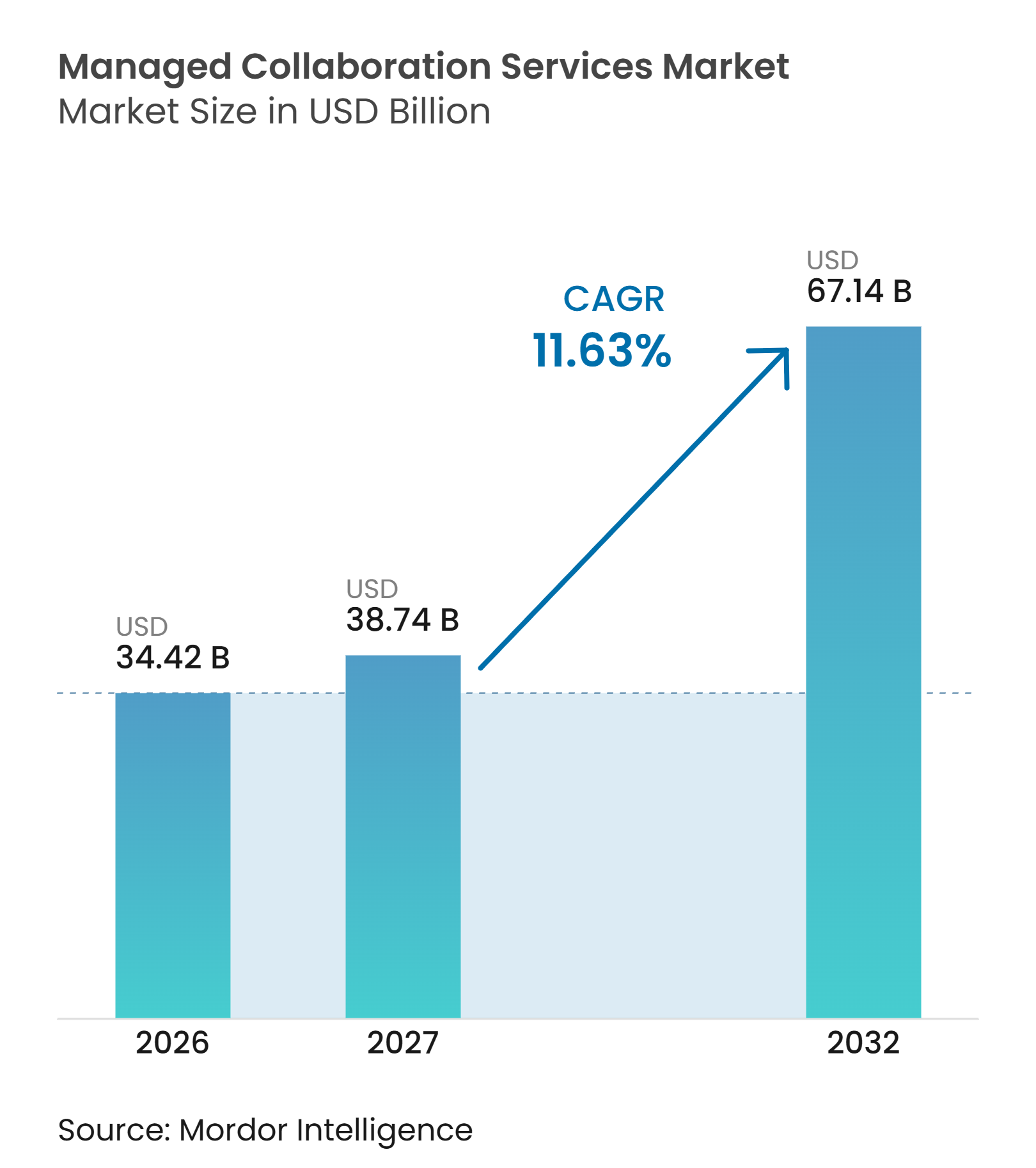
| Market Size (2027) | USD 38.74 Billion |
| Market Size (2032) | USD 67.14 Billion |
| Growth Rate (2027 - 2032) | 11.63 % |
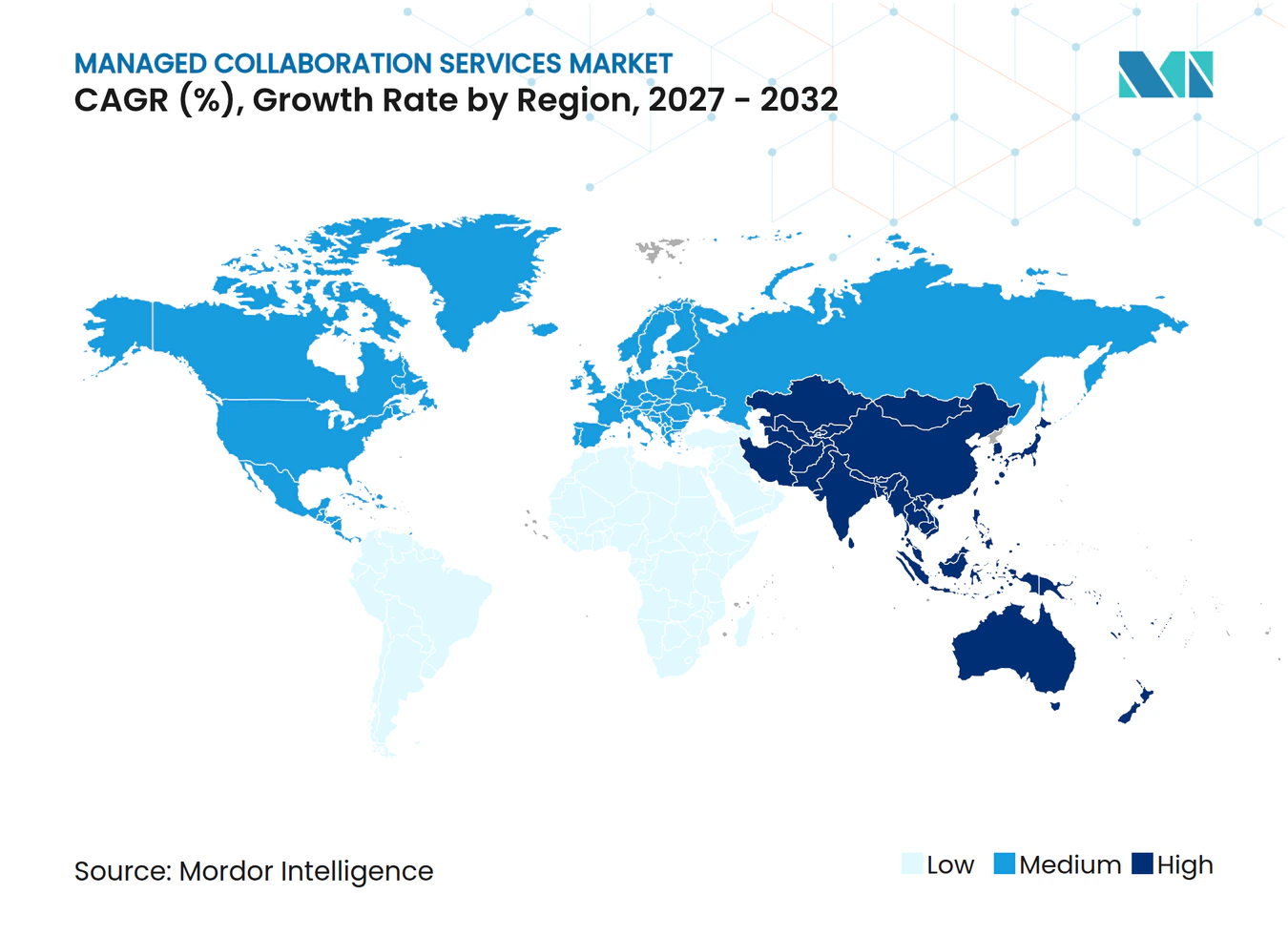
| Fastest Growing Market | Asia-Pacific |
| Largest Market | North America |
| Market Concentration | Medium |
Major Players *Disclaimer: Major Players sorted in no particular order Image © Mordor Intelligence. Reuse requires attribution under CC BY 4.0. | |
Managed Collaboration Services Market Analysis by Mordor Intelligence
The managed collaboration services market size is projected to expand from USD 34.42 billion in 2026 to USD 67.14 billion by 2032, registering a CAGR of 11.63% between 2027 to 2032. Enterprises are moving from owning communication infrastructure toward managed operating models that cover platform governance, integration, compliance, and ongoing service delivery. Hybrid work has made consistent service quality harder to maintain across locations, devices, and regulatory settings. This places more responsibility on providers to manage the operational environment rather than simply resell software licenses. Providers are also combining unified communications and contact center capabilities into broader agreements, which can increase contract scope. Data residency rules and AI governance needs are creating opportunities for providers that can support regulated deployments.
Key Report Takeaways
- By service type, Managed Unified Communications held 34.22% of the managed collaboration services market share in 2026, while Managed Voice is projected to expand at a 12.13% CAGR through 2032.
- By deployment mode, cloud-based solutions accounted for 58.36% of the managed collaboration services market size in 2026 and are expected to expand at an 11.94% CAGR through 2032.
- By organization size, large enterprises held 71.33% of the managed collaboration services market share in 2026, while small and medium enterprises are projected to expand at an 11.86% CAGR through 2032.
- By application, internal team collaboration accounted for 29.21% of the market in 2026, while customer communication and engagement is projected to expand at an 11.83% CAGR through 2032.
- By end-user industry, information technology and telecommunications held 17.83% of the market in 2026, while banking, financial services, and insurance is projected to expand at a 12.24% CAGR through 2032.
- By geography, North America held 40.66% of the market in 2026, while Asia-Pacific is projected to expand at a 12.36% CAGR through 2032.
Note: Market numbers in this report are based on Mordor Intelligence's proprietary estimation framework, which combines nine months of actuals with Q4 projections for base year 2026.
Market Trends and Insights
Drivers Impact Analysis of Managed Collaboration Services Market*
| Driver | (~) % Impact on CAGR Forecast | Geographic Relevance | Impact Timeline |
|---|---|---|---|
| Hybrid Work and Distributed Workforce Enablement | +3.0% | Global, strongest in North America, Europe, and Asia-Pacific core markets | Short term (≤ 2 years) |
| Cloud Migration and Operating-Expense Preference | +2.5% | Global, high adoption in North America and Europe, with growing adoption in Asia-Pacific and South America | Medium term (2-4 years) |
| AI-Enabled Collaboration Operations and Employee Productivity | +2.2% | North America and Europe, expanding to Asia-Pacific core markets | Medium term (2-4 years) |
| Unified Communications and Contact Center Convergence | +1.6% | North America and Europe core markets, with spillover to Asia-Pacific and Middle East and Africa | Medium term (2-4 years) |
| Sovereign Collaboration and Compliance-by-Design Demand | 0.9% | Europe core markets, expanding to Asia-Pacific and Middle East and Africa | Long term (≥ 4 years) |
| Managed Serviceability of Complex Multi-Platform Estates | 0.5% | Global | Short term (≤ 2 years) |
| Source: Mordor Intelligence | |||
Hybrid Work and Distributed Workforce Enablement
Hybrid work has moved from a short-term response into an established operating model for many employers. In May 2026, 52% of remote-capable U.S. employees worked in hybrid arrangements, a share that had remained broadly stable since mid-2022. Collaboration teams must now support users across dispersed locations, mixed devices, different connection conditions, and work patterns that shift between home, office, and customer sites. Gallup reported that only 21% of employees strongly agreed that they received meaningful weekly feedback from their managers, while formal hybrid collaboration plans were associated with 66% higher engagement and 29% lower burnout.[1] Cisco’s 2025 study found that 73% of surveyed employees reported higher productivity in hybrid arrangements, with a self-reported 19% gain that equated to 7.6 hours per week.[2] The managed collaboration services market benefits when organizations seek providers that can monitor platforms, respond to incidents, support adoption, and establish operating practices across these distributed work patterns.
Cloud Migration and Operating-Expense Preference
Enterprises are shifting their communication infrastructure toward cloud platforms and subscription-based spending models. This reduces the need to retain internal teams for routine hardware maintenance, software updates, capacity management, and the continuing upkeep of systems that were once maintained on premises. The change also creates a continuing need for providers that can operate cloud calling, conferencing, identity, policy controls, carrier connections, and the integration points between those services. Small and medium enterprises often lack specialized teams to manage multiple carriers, codecs, application links, and compliance requirements across a cloud communications estate. Outcome-based agreements can address this need by linking provider responsibility to availability and user experience instead of seat volume, which gives buyers a clearer basis for reviewing delivery. The managed collaboration services market, therefore, gains support from buyers that want more predictable costs while retaining accountability for service delivery.
AI-Enabled Collaboration Operations and Employee Productivity
AI features are extending managed collaboration contracts beyond infrastructure maintenance and into workflow support. Cisco announced task management, real-time notes, polling, and AI receptionist capabilities for Webex collaboration environments in September 2025. These tools require providers to manage access controls, output retention, platform settings, user adoption policies, model configuration, and the rules that apply to AI-generated content. Contact center tools also use AI for agent assistance, routing, transcription, quality support, and the handling of communication records. This broadens the skills required from providers beyond conventional network operations and adds governance responsibilities to routine service management. The managed collaboration services market rewards providers that can govern AI-enabled features within defined service levels, user policies, and compliance practices.
Unified Communications and Contact Center Convergence
Enterprises increasingly want one managed environment for employee and customer communications. This combines unified communications, cloud calling, contact center operations, compliance recording, quality management, and service management under more consistent provider responsibility. Oracle introduced its Intelligent Communications Orchestration Network Cloud Service in October 2025 to connect voice, UCaaS, CCaaS, AI services, and on-premises telephony across hybrid environments. A wider managed contract can increase account value because an existing unified communications customer can add contact center management, compliance recording, AI-supported quality controls, and common reporting. It can also make replacement decisions less frequent when several workloads are managed under the same agreement and service experience is reviewed together. The managed collaboration services market has opportunities where providers can manage this broader scope with consistent accountability.
Restraints Impact Analysis of Managed Collaboration Services Market*
| Restraint | (~) % Impact on CAGR Forecast | Geographic Relevance | Impact Timeline |
|---|---|---|---|
| Data Privacy, Residency, and Cross-Border Transfer Constraints | -1.6% | Europe, Asia-Pacific, and Middle East and Africa, with growing global relevance | Short term (≤ 2 years) |
| Integration Complexity Across Legacy and Cloud Estates | -1.2% | Global | Medium term (2-4 years) |
| Collaboration Platform Commoditization and Price Pressure | -0.9% | North America and Europe primarily | Medium term (2-4 years) |
| Limited Observability of Meeting Quality and Business Outcomes | -0.5% | Global | Long term (≥ 4 years) |
| Source: Mordor Intelligence | |||
Data Privacy, Residency, and Cross-Border Transfer Constraints
Data storage and transfer requirements have increased the complexity of delivering collaboration services across borders. China’s certification measures for cross-border personal information transfers became effective on January 1, 2026, establishing compliance pathways for transfers to overseas parties. These rules affect cloud collaboration platforms used by organizations with operations in China and require service design decisions before data can move outside a jurisdiction. Providers may need to design jurisdiction-specific data routing, local service instances, customer-controlled encryption arrangements, operational access rules, and supporting documentation. Those requirements raise delivery costs, limit standardization, and can slow deployment across multiple countries. The managed collaboration services market also needs providers to address European data protection requirements alongside the controls developing across the Asia-Pacific markets.
Integration Complexity Across Legacy and Cloud Estates
Many large organizations operate a mix of legacy PBX systems, on-premises telephony, cloud collaboration platforms, contact center tools, recording systems, and separate carrier arrangements. This mix makes implementation more difficult than a standard cloud software deployment because the managed provider must coordinate different technology generations and operating models. Integration work can consume a large share of contract value and lengthen the time required to begin service, which can affect margins and customer experience. Providers must also take responsibility for service-level performance even when older trunks, SD-WAN settings, carrier arrangements, or third-party network conditions affect quality. Pre-certified designs and established integration methods can reduce this burden in common hybrid environments. The managed collaboration services market faces margin pressure where providers rely on one-off integration work for every customer.
*Our forecasts treat driver/restraint impacts as directional, not additive. The impact forecasts reflect baseline growth, mix effects, and variable interactions.
Managed Collaboration Services Market Segment Analysis
By Service Type:
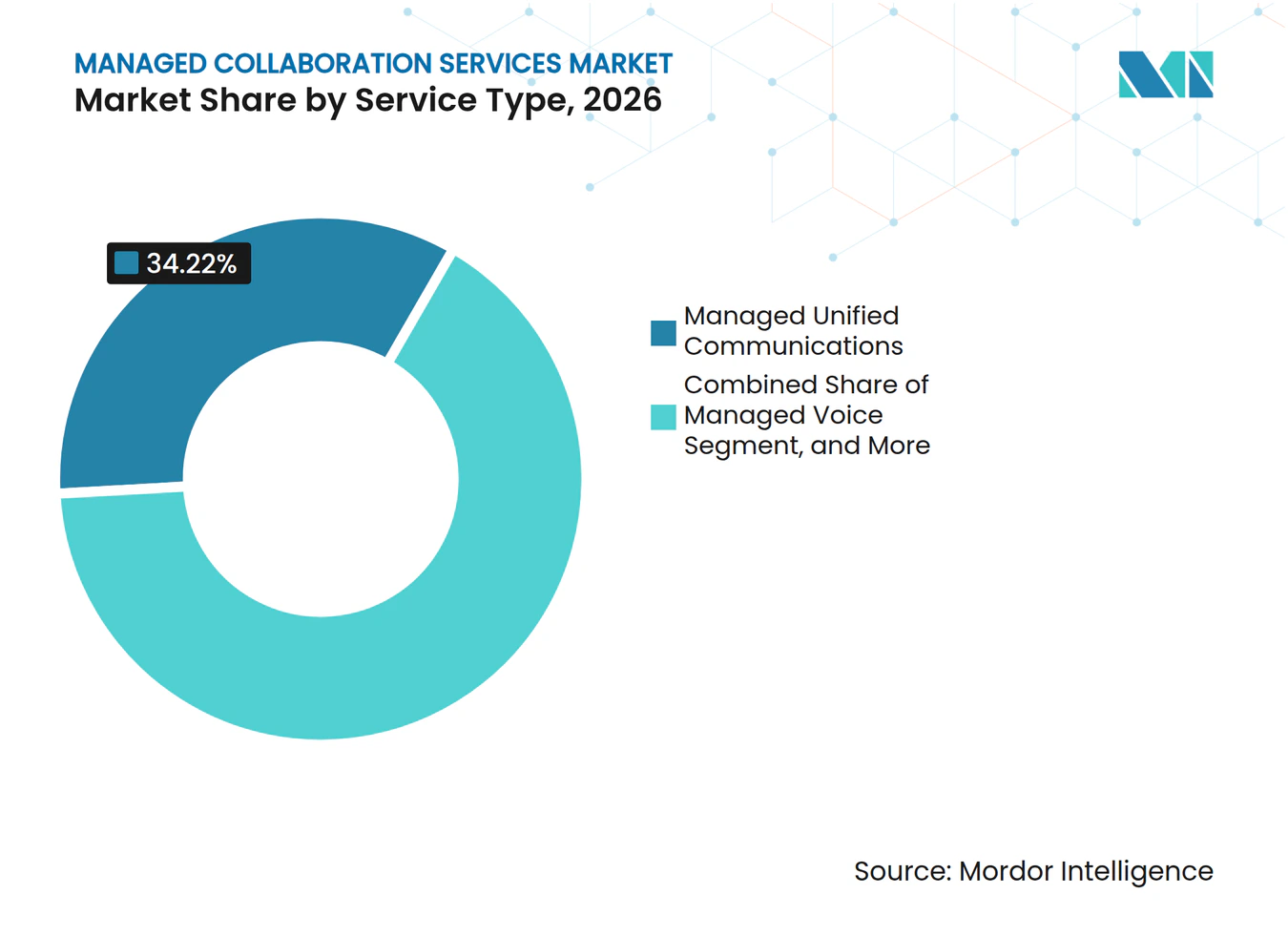
Managed Voice Expands While Unified Communications LeadsManaged Unified Communications held 34.22% of the managed collaboration services market share in 2026, supported by long-term enterprise agreements and the central role of unified communications in employee workflows. The service type provides the operating layer for messaging, calling, meetings, content sharing, and related collaboration tools. Organizations use managed providers to oversee platform performance, user administration, identity management, integration, policy controls, and incident response across these services. This work becomes more important when employees use several devices, work from several locations, and depend on the same platform for routine internal decisions. Managed Conferencing and Collaboration and Managed Contact Center remain complementary service lines that are increasingly sold with unified communications management. As platforms converge, customers can place meeting operations, communications support, recording, and customer interactions under a common operating approach.
Managed Voice is projected to expand at a 12.13% CAGR from 2027 to 2032 in the managed collaboration services market. Enterprises are replacing PSTN-connected PBX systems with cloud-native calling environments that require continuing operational oversight. The transition involves PSTN interconnection, dial plan configuration, emergency calling procedures, number management, device support, and user provisioning. These requirements are often difficult for internal IT teams to own consistently after the initial deployment has ended. In November 2025, 8x8 added native support for Mitel SIP desk phones, allowing users to access cloud communications while retaining existing hardware. Retaining installed devices can reduce migration friction for enterprises that had deferred a wider voice transition because replacement costs and disruption were concerns.



By Deployment Mode:
Cloud Leads While Hybrid Requirements ContinueCloud-based solutions accounted for 58.36% of the managed collaboration services market size in 2026. Enterprises use cloud delivery to transfer routine infrastructure maintenance, software update cycles, capacity scaling, and platform availability tasks to service providers. This lets internal teams focus more closely on configuration, governance, user adoption, and alignment with business processes. The shift also supports subscription pricing and service models that can adjust as organizations change their user base, locations, or operating footprint. Providers must manage the reliability, integration, security, and support expectations that accompany this transition. Customers still expect clear accountability when cloud platform issues affect calling, meetings, messaging, or access to shared information.
Cloud-based solutions are projected to expand at an 11.94% CAGR from 2027 to 2032. On-premises and hybrid models remain important for regulated organizations and settings that require local systems alongside cloud connectivity. Avaya and Mitel continued to focus on hybrid on-premises models in 2025, reflecting customer needs for local control and performance safeguards. Hybrid estates require providers to govern cloud and on-premises layers under a consistent service level, even where legacy equipment remains in use. Cloud-connected deployments also provide access to AI-enabled features that may not be available in isolated local environments. This widens the functional case for migration while keeping hybrid management relevant during the transition.
By Organization Size:
Large Enterprises Lead While SMEs Gain AccessLarge enterprises held 71.33% of the managed collaboration services market share in 2026. These organizations often operate multi-site communication environments that are costly and difficult to manage with internal teams alone. They require providers to coordinate platforms, carrier relationships, security settings, service performance, integration rules, and support processes across a broad user base. Large customers may also need a common operating framework for business units that have inherited different communication systems through earlier investment or acquisition. Their contracts increasingly focus on measurable availability, user experience, and adoption of relevant features. This shifts provider accountability from license administration toward ongoing operational outcomes that can be reviewed throughout the agreement.
Small and medium enterprises are projected to expand at an 11.86% CAGR from 2027 to 2032. Channel aggregation platforms and per-user service bundles are lowering the implementation costs and minimum scale required for smaller deployments. These organizations often benefit from predictable subscriptions because they avoid large upfront infrastructure spending and do not need to maintain dedicated specialist teams. They also need external support for issues involving cloud calling, access controls, routine changes, and user service requests. Standardized service packages make it easier for providers to serve this group without the customized implementation work required by larger estates. The managed collaboration services market can reach this customer group through bundles that combine cloud platforms with continuing administration and support.
By Application:
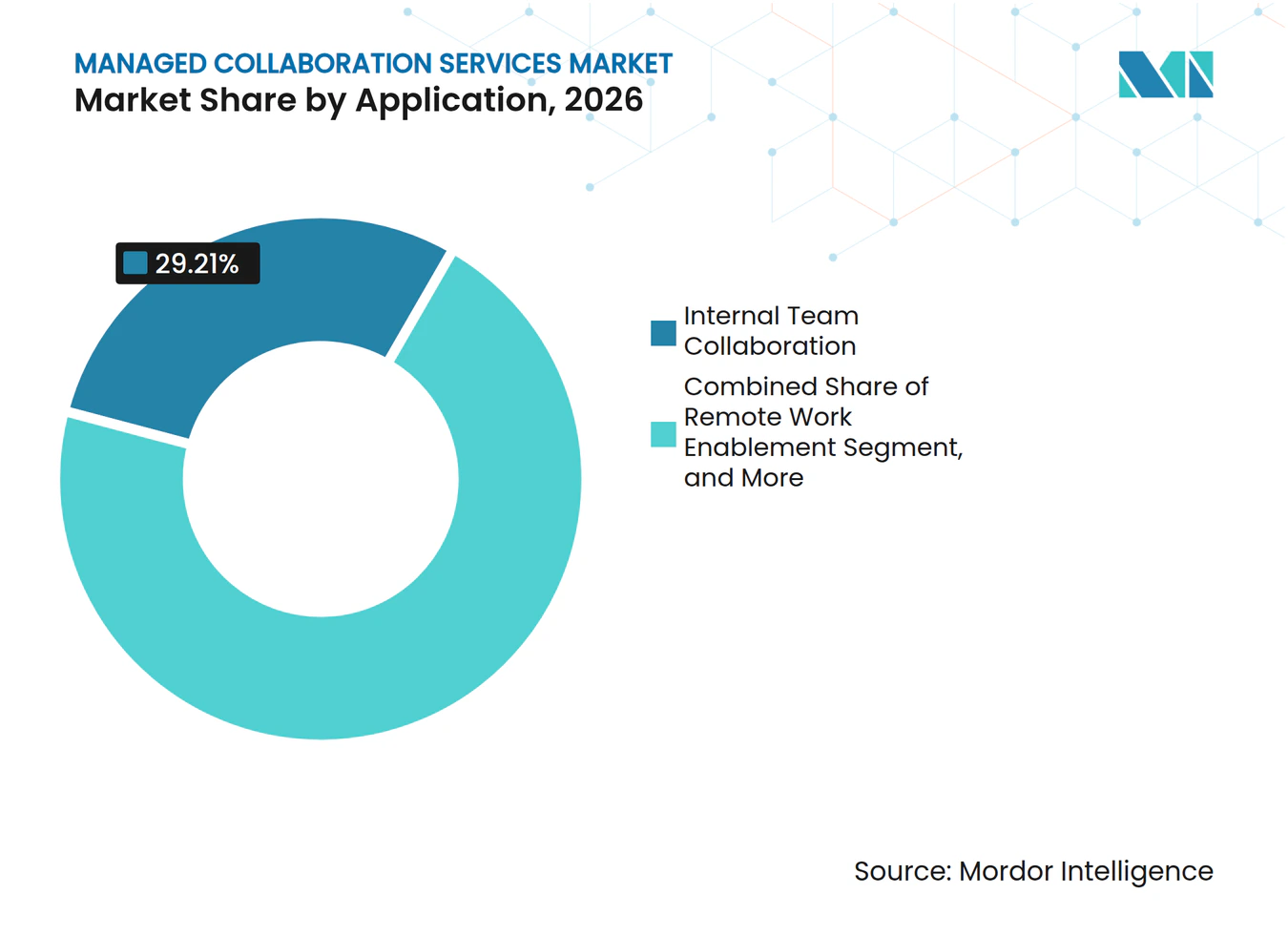
Internal Collaboration Leads While Customer Engagement AcceleratesInternal team collaboration accounted for 29.21% of the market in 2026. It is the primary entry point for enterprises that seek managed collaboration support for messaging, video meetings, calling, file sharing, and routine workflow coordination. Organizations are applying more formal controls to these workflows because they are embedded in daily employee activity and often contain operational information. Providers are now expected to address availability, access controls, retention settings, service quality, and the management of AI-generated content. The scope can include practical support for users as well as technical oversight of the underlying platform. This expands responsibility beyond the network-quality commitments that shaped earlier managed communications contracts.
Customer communication and engagement is projected to expand at an 11.83% CAGR from 2027 to 2032. Demand is supported by the connection of unified communications and contact center systems within a single service agreement. Remote Work Enablement, Project Management and Workflow Coordination, Training and Virtual Events, and Sales and Marketing Communication remain separate use cases within the broader environment. Remote work services are extending beyond video meetings into digital workspace support that can connect collaboration platforms with HR systems, workplace management, and security monitoring. Providers can use these connections to support communication workflows that span employees, managers, customers, and other stakeholders. These use cases can widen the service scope per enterprise user and support longer customer relationships.

By End-User Industry:
IT and Telecommunications Lead While BFSI AcceleratesInformation technology and telecommunications held 17.83% of the market in 2026. The sector has mature cloud adoption and plays two roles as a buyer of managed collaboration services and as a channel for delivery to other organizations. Buyers in this sector use managed services to coordinate multi-tenant delivery, platform operations, AI-related governance, and service consistency across distributed customer environments. Their experience operating cloud services does not remove the need for specialized support when communication environments include several platforms, carriers, and regulatory controls. This keeps the sector important to the managed collaboration services market despite its internal technical capability. It also makes the sector a practical setting for providers to develop and demonstrate more advanced managed operating models.
Banking, financial services, and insurance is projected to expand at a 12.24% CAGR from 2027 to 2032. The segment faces stringent requirements for compliance, recordkeeping, access control, reliable communications, and defined service responsibilities. Managed agreements can allow these institutions to outsource non-differentiating operational work while retaining defined service and governance standards. Providers must support controlled environments where platform settings, user access, records, and service quality can be reviewed against institutional requirements. Healthcare and life sciences, government and public sector, retail and e-commerce, manufacturing, and other industries also represent material opportunities. Their adoption patterns differ because procurement processes, operating practices, and compliance obligations vary by sector. Providers that can align platform management with these industry requirements are positioned to compete for these accounts.
Geography Analysis
North America Managed Collaboration Services Market
North America held 40.66% of the managed collaboration services market share in 2026. The region benefits from early cloud adoption, established channel partner networks, and a dense base of large organizations with multi-site communication estates that require consistent service across offices and remote locations. The United States remains the central market because enterprises have widely deployed Microsoft Teams and Cisco Webex and require continuing operational support for those environments. These deployments create demand for integration management, policy administration, service monitoring, user support, lifecycle planning, and change management over the life of the platform. Canada contributes demand from public sector and financial services organizations, while Mexico offers opportunities as multinational organizations extend managed collaboration agreements across North American operations and seek a more consistent operating model across the region.
APAC Managed Collaboration Services Market
Asia-Pacific is projected to expand at a 12.36% CAGR from 2027 to 2032. The region is supported by enterprise digitalization, wider hybrid work adoption, tighter data residency requirements, and the replacement of local communication systems with cloud-connected services that can be managed centrally while meeting country-level operating needs. China’s cross-border personal information transfer certification framework affects cloud collaboration deployments by organizations with local operations. Japan, South Korea, India, and Australia are established growth markets for cloud calling and the consolidation of legacy PBX estates, while managed providers can support these transitions by addressing platform operations, user migration, service continuity, and local data architecture requirements. Southeast Asia is a further demand area as digital economies, smartphone use, and small and medium enterprise cloud adoption expand, placing local operating knowledge alongside technical platform skills at the center of provider selection.
EMEA Managed Collaboration Services Market
Europe has substantial value from large enterprises in the United Kingdom, Germany, France, and Italy that use established managed service procurement models and increasingly consider collaborative AI tools. Microsoft announced sovereign cloud capabilities for European datacenter regions in June 2025, covering Microsoft 365 and related services with European operational controls and customer data protections.[3] These capabilities can support providers building collaboration environments for regulated customers that need clear controls over data handling, operational access, encryption practices, and platform administration. The Middle East and Africa is led by Saudi Arabia and the United Arab Emirates, where digital investment and enterprise cloud adoption are increasing demand, while South Africa and Egypt support early adoption across the wider African region and require providers to adapt service delivery to local carrier and customer conditions.
Competitive Landscape
Market Concentration
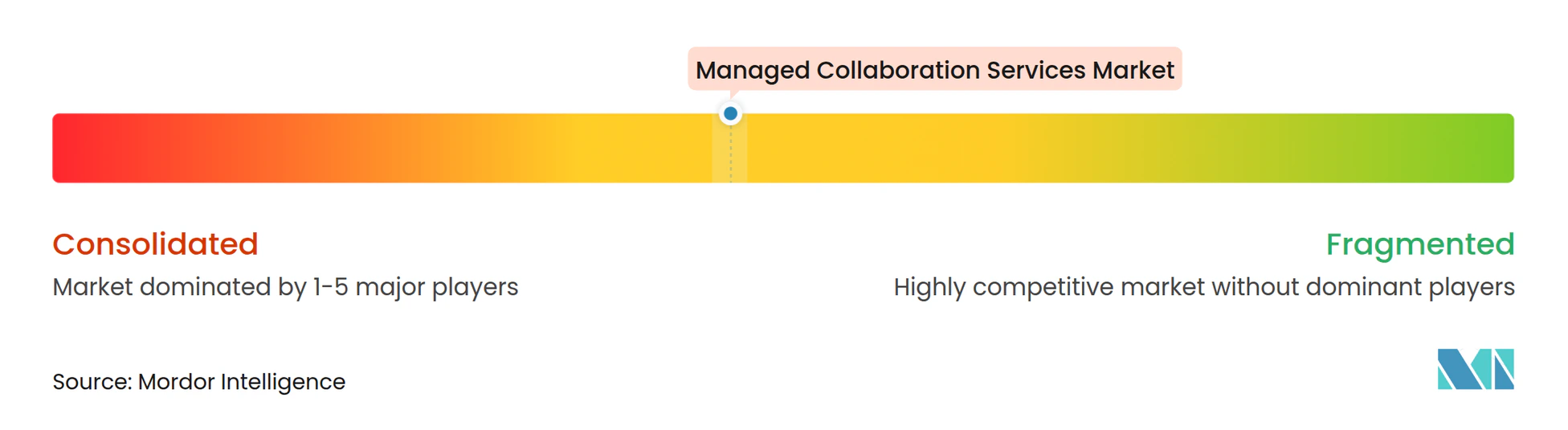
The managed collaboration services market has a layered competitive structure with moderate-to-high concentration among large carriers, IT services providers, and platform vendors. NTT DATA, BT Group, Orange, Deutsche Telekom, and Tata Communications compete for global managed communications mandates that often require regional delivery capacity, long-standing enterprise relationships, and the ability to coordinate local operations under global commercial and service standards. Cognizant, Capgemini, HCL Technologies, and DXC Technology also compete for enterprise contracts that require managed delivery, integration skills, workplace technology support, and services designed for complex customer operating environments. Microsoft, Cisco, and Zoom provide collaboration platforms while also setting partner program terms that influence channel revenue, service configuration options, technical enablement, and the range of services partners can package for customers. Carriers and IT services firms can therefore compete for managed service contracts on platforms that platform vendors also support directly.
Competition is centered on AI-enabled operations, sovereign service architectures, and combined unified communications and contact center management. Court Square Capital Partners acquired CallTower in April 2026, backing a provider that served more than 3,000 enterprise customers as a certified Microsoft, Cisco, and Zoom partner. Cisco acquired EzDubs in November 2025 to add real-time speech-to-speech translation across 31 languages to its collaboration portfolio. RingCentral acquired CommunityWFM in 2025 to integrate AI-first workforce management into RingCX. These moves show how providers and platform companies are seeking capabilities that can extend managed service scope, reduce technology fragmentation, and help customers run complex communication environments with clearer operational responsibility.
Compliance architectures can create barriers to entry because providers must meet data residency, sector rules, and public sector requirements. This favors firms that have already built regional operating models, compliance controls, certified partner relationships, tested service processes, and established links with large regulated buyers, rather than firms entering a region with limited local operating experience. Specialist providers can compete in the mid-market where the largest carriers have historically had less focus and where customers may require more tailored support, faster implementation decisions, and closer attention to individual platform choices. Platform feature breadth alone is becoming less important than the ability to monitor, govern, integrate, support, and demonstrate accountability for the environment over time, especially where customers operate several platforms together. Competitive pricing pressure remains a risk where providers offer similar core platform management services, particularly when buyers can compare basic offerings primarily on per-user cost.
Managed Collaboration Services Industry Leaders
-
Microsoft Corporation
-
Cisco Systems, Inc.
-
Zoom Video Communications, Inc.
-
RingCentral, Inc.
-
Google LLC
- *Disclaimer: Major Players sorted in no particular order
Managed Collaboration Services Market Companies Covered in this Report
- Microsoft Corporation
- Cisco Systems, Inc.
- Zoom Video Communications, Inc.
- RingCentral, Inc.
- Google LLC
- International Business Machines Corporation
- AT&T Inc.
- Verizon Communications Inc.
- 8x8, Inc.
- Avaya Inc.
- NTT DATA Corporation
- BT Group plc
- Orange S.A.
- Deutsche Telekom AG
- Vodafone Group plc
- Tata Communications Limited
- Fujitsu Limited
- HCL Technologies Limited
- DXC Technology Company
- Cognizant Technology Solutions Corporation
- Capgemini SE
- Huawei Technologies Co., Ltd.
- NEC Corporation
- Mitel Networks Corporation
- Unisys Corporation
Recent Industry Developments in Managed Collaboration Services Market
- September 2026: 8x8 reported that AI Studio customer interactions had grown nearly 450% while in open beta, with GDPR compliance support added for European enterprise deployments, signaling expanding managed AI engagement tooling demand within the cloud contact center segment.
- July 2026: Avaya and RingCentral amended their strategic partnership, transitioning Avaya Cloud Office customers and partners from the co-branded platform to the direct RingCentral EX platform. RingCentral reported a USD 15 million gain from the amendment while Avaya reoriented its managed collaboration strategy around its enterprise Aura, Infinity, and Nexus portfolio.
- June 2026: Cleura launched an EU Sovereign Collaboration Suite in strategic partnership with Nextcloud, delivering productivity, communication, and file-sharing capabilities hosted entirely on European cloud infrastructure, targeting regulated enterprises seeking compliance-aligned alternatives to non-European cloud ecosystems.
- April 2026: Court Square Capital Partners acquired CallTower, a managed unified communications provider serving more than 3,000 enterprise customers across 40-plus countries as a certified partner of Microsoft, Cisco, and Zoom, as a direct play on enterprise managed communication consolidation.
Global Managed Collaboration Services Market Report Scope
The Managed Collaboration Services Market comprises outsourced services in which a third-party provider designs, deploys, operates, secures, and supports an organization’s collaboration and communication stack, including unified communications (UC), video conferencing, team messaging, file sharing, digital workspaces, and cloud contact center tools on a subscription or managed-service basis.
The Managed Collaboration Services Market Report is Segmented by Service Type (Managed Unified Communications, Managed Conferencing and Collaboration, Managed Contact Center, and Managed Voice), Deployment Mode (Cloud-Based, On-Premises, and Hybrid), Organization Size (Large Enterprises and Small and Medium Enterprises), Application (Internal Team Collaboration, Customer Communication and Engagement, Remote Work Enablement, Project Management and Workflow Coordination, Training and Virtual Events, and Sales and Marketing Communication), End-User Industry (Information Technology and Telecommunications, Banking, Financial Services and Insurance, Healthcare and Life Sciences, Government and Public Sector, Retail and E-Commerce, Manufacturing, and Other End-User Industries), and Geography (North America, South America, Europe, Asia-Pacific, and Middle East and Africa). The Market Forecasts Are Provided in Terms of Value (USD).
Segmentation Overview
| Managed Unified Communications |
| Managed Conferencing and Collaboration |
| Managed Contact Center |
| Managed Voice |
| Cloud-Based |
| On-Premises |
| Hybrid |
| Large Enterprises |
| Small and Medium Enterprises |
| Internal Team Collaboration |
| Customer Communication and Engagement |
| Remote Work Enablement |
| Project Management and Workflow Coordination |
| Training and Virtual Events |
| Sales and Marketing Communication |
| Information Technology and Telecommunications |
| Banking, Financial Services and Insurance |
| Healthcare and Life Sciences |
| Government and Public Sector |
| Retail and E-Commerce |
| Manufacturing |
| Other End-User Industries |
| North America | United States |
| Canada | |
| Mexico | |
| South America | Brazil |
| Argentina | |
| Rest of South America | |
| Europe | United Kingdom |
| Germany | |
| France | |
| Italy | |
| Rest of Europe | |
| Asia-Pacific | China |
| India | |
| Japan | |
| South Korea | |
| Rest of Asia-Pacific | |
| Middle East and Africa | Saudi Arabia |
| United Arab Emirates | |
| South Africa | |
| Egypt | |
| Rest of Middle East and Africa |
| By Service Type | Managed Unified Communications | |
| Managed Conferencing and Collaboration | ||
| Managed Contact Center | ||
| Managed Voice | ||
| By Deployment Mode | Cloud-Based | |
| On-Premises | ||
| Hybrid | ||
| By Organization Size | Large Enterprises | |
| Small and Medium Enterprises | ||
| By Application | Internal Team Collaboration | |
| Customer Communication and Engagement | ||
| Remote Work Enablement | ||
| Project Management and Workflow Coordination | ||
| Training and Virtual Events | ||
| Sales and Marketing Communication | ||
| By End-User Industry | Information Technology and Telecommunications | |
| Banking, Financial Services and Insurance | ||
| Healthcare and Life Sciences | ||
| Government and Public Sector | ||
| Retail and E-Commerce | ||
| Manufacturing | ||
| Other End-User Industries | ||
| By Geography | North America | United States |
| Canada | ||
| Mexico | ||
| South America | Brazil | |
| Argentina | ||
| Rest of South America | ||
| Europe | United Kingdom | |
| Germany | ||
| France | ||
| Italy | ||
| Rest of Europe | ||
| Asia-Pacific | China | |
| India | ||
| Japan | ||
| South Korea | ||
| Rest of Asia-Pacific | ||
| Middle East and Africa | Saudi Arabia | |
| United Arab Emirates | ||
| South Africa | ||
| Egypt | ||
| Rest of Middle East and Africa | ||
Key Questions Answered in the Report
What is the managed collaboration services market size?
The managed collaboration services market size is USD 34.42 billion in 2026 and is projected to reach USD 67.14 billion by 2032, at an 11.63% CAGR from 2027 to 2032.
Which service type has the largest share of managed collaboration services?
Managed Unified Communications leads service types with a 34.22% share in 2026.
Which service type has the largest share of managed collaboration services?
In the managed collaboration services market, Managed Unified Communications leads service types with a 34.22% share in 2026.
Which deployment model leads managed collaboration services?
In the managed collaboration services market, cloud-based solutions lead deployment modes with a 58.36% share in 2026 and are projected to expand at an 11.94% CAGR through 2032.
Which organization type drives spending on managed collaboration services?
In the managed collaboration services market, large enterprises account for 71.33% of the 2026 total, while small and medium enterprises are projected to expand at an 11.86% CAGR through 2032.
Which region is expanding fastest for managed collaboration services?
Asia-Pacific is projected to expand at a 12.36% CAGR from 2027 to 2032.