
Managed Supply Chain Application Services Market Size and Share
Market Overview
| Study Period | 2021 - 2032 |
|---|---|
| Market Size (2027) | USD 7.24 Billion |
| Market Size (2032) | USD 13.34 Billion |
| Growth Rate (2027 - 2032) | 13.01 % |
| Fastest Growing Market | Asia-Pacific |
| Largest Market | North America |
| Market Concentration | Medium |
Major Players *Disclaimer: Major Players sorted in no particular order Image © Mordor Intelligence. Reuse requires attribution under CC BY 4.0. | |
Managed Supply Chain Application Services Market Analysis by Mordor Intelligence
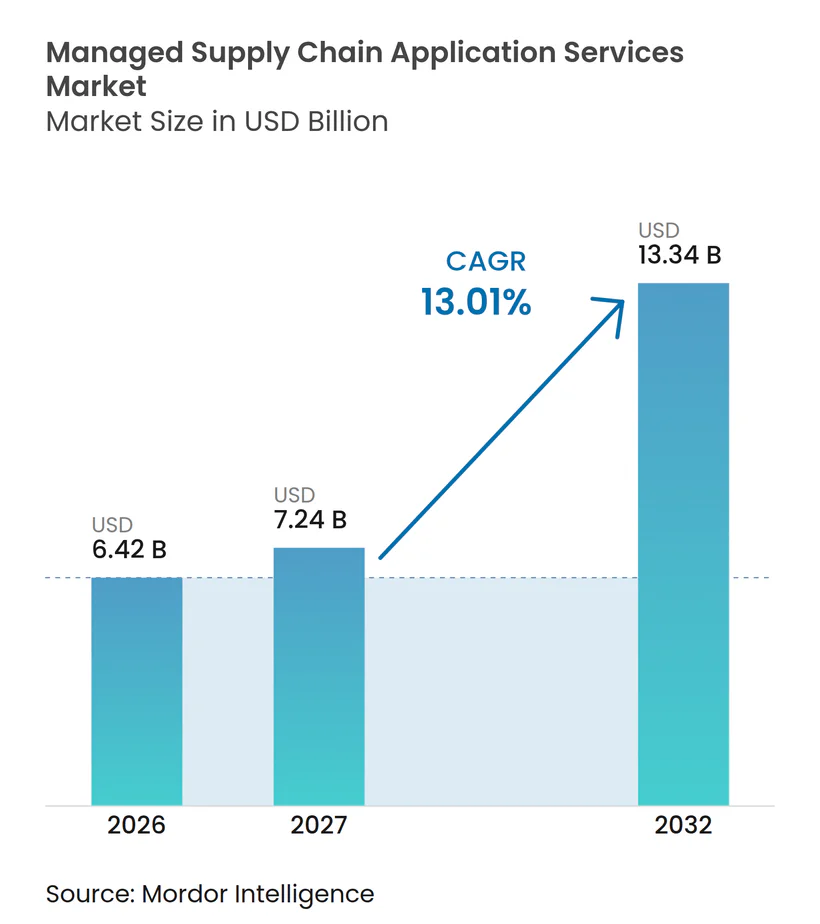
The managed supply chain application services market size is projected to expand from USD 6.42 billion in 2026 to USD 7.24 billion in 2027, and to USD 13.34 billion by 2032, registering a CAGR of 13.01% between 2027 and 2032. Demand is shifting from staff augmentation toward contracts tied to application availability, integration quality, operational results, and, increasingly, the dependable use of AI-enabled planning functions, making service performance more visible to procurement and operations leaders. Cloud migration gives providers a larger role after implementation because customers need monitoring, upgrades, integration support, performance tuning, and governed data connections throughout the contract term, not only during the initial deployment phase. AI tools are changing how planning and exception management are delivered, making model governance and performance validation more important in service agreements. Talent shortages also support outsourcing, while resilience, traceability, and third-party risk requirements favor providers that can document controls, recovery procedures, and oversight across complex supplier networks.
Key Report Takeaways
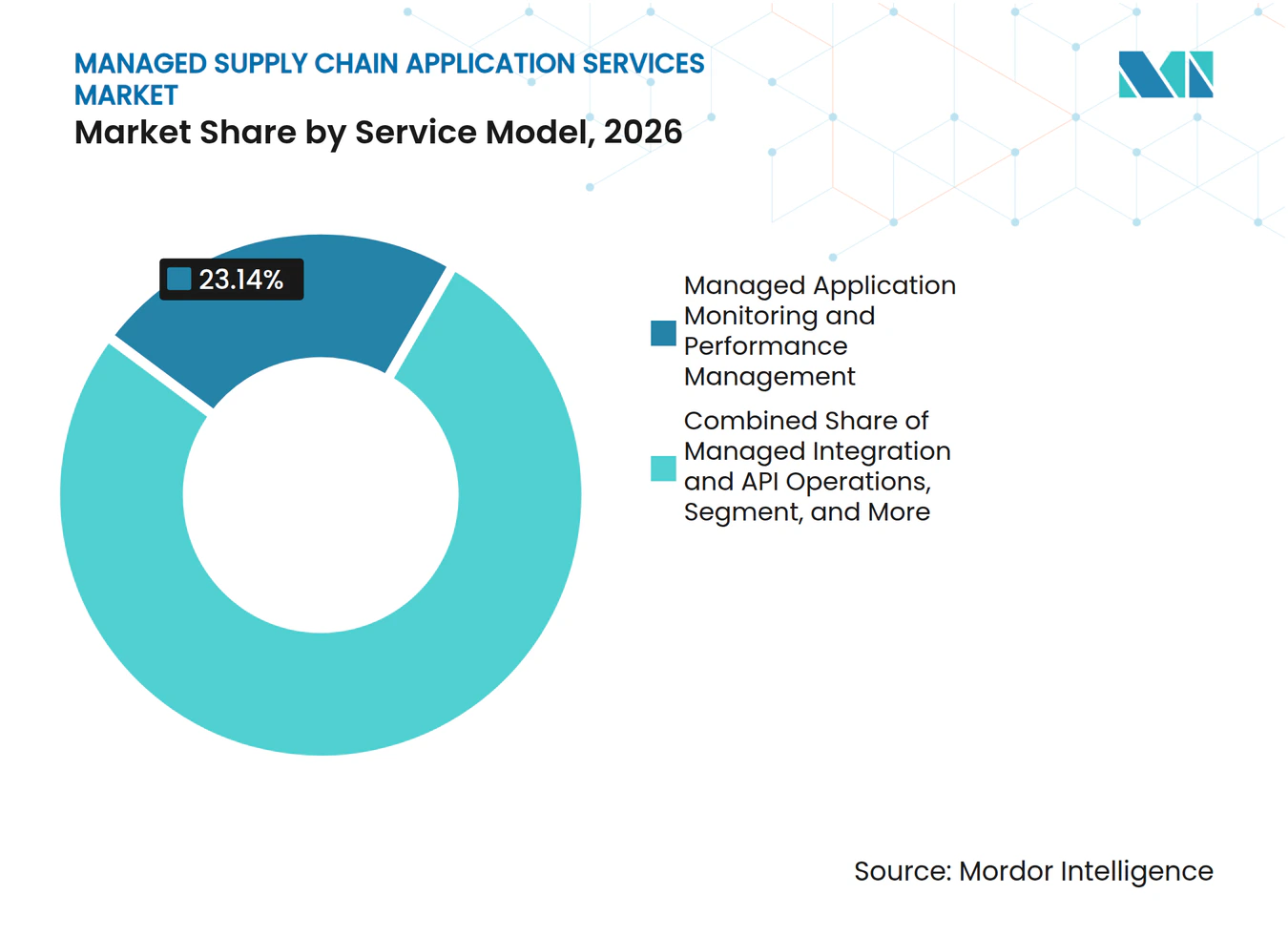
- By service model, managed application monitoring and performance management accounted for 23.14% of the managed supply chain application services market share in 2026 and is projected to expand at a 14.21% CAGR through 2032.
- By deployment model, cloud-based deployment accounted for 71.39% of revenue in 2026 and is expected to grow at a 13.62% CAGR through 2032.
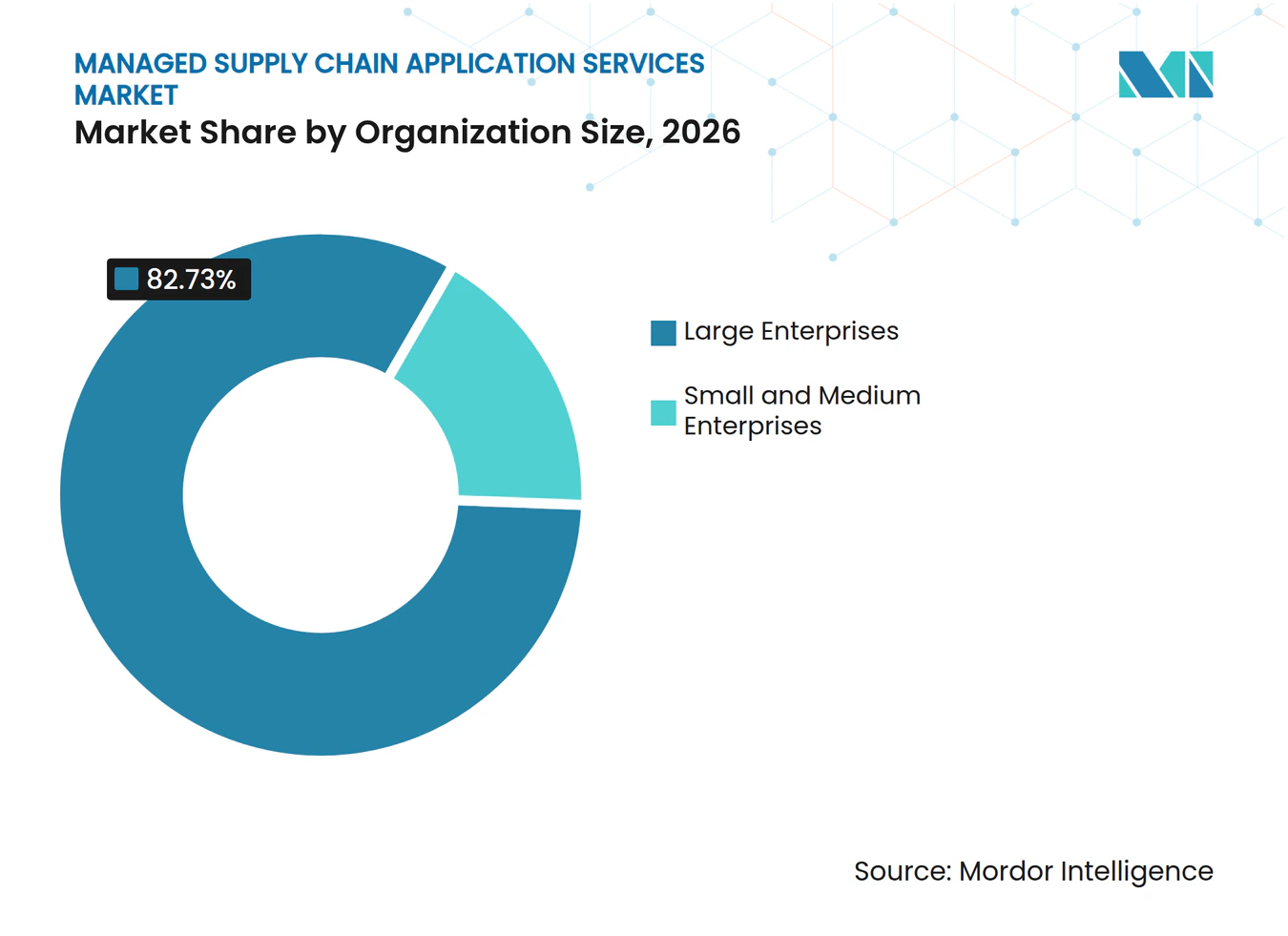
- By organization size, large enterprises held 82.73% of revenue in 2026, while small and medium enterprises are projected to record the highest CAGR at 13.38% through 2032.
- By industry vertical, manufacturing accounted for 24.77% of revenue in 2026, while logistics and transportation are expected to grow at a 14.37% CAGR through 2032.
- By geography, North America held 39.41% of revenue in 2026, while Asia-Pacific is projected to record the highest CAGR at 13.98% through 2032.
Note: Market numbers in this report are based on Mordor Intelligence's proprietary estimation framework, which combines nine months of actuals with Q4 projections for base year 2026.
Global Managed Supply Chain Application Services Market Trends and Insights
Drivers Impact Analysis*
| Driver | (~) % Impact on CAGR Forecast | Geographic Relevance | Impact Timeline |
|---|---|---|---|
| Cloud-First Adoption by Supply Chain Teams | +2.5% | Global, with North America and Asia-Pacific leading implementation velocity | Short term (≤ 2 years) |
| Rising Demand for Real-Time Supply Chain Visibility | +2.1% | Global, concentrated in North America, Europe, and the Asia-Pacific | Short term (≤ 2 years) |
| AI-Enabled Predictive Planning and Exception Management | +1.8% | Global, with North America and Europe as primary investment hubs, and Asia-Pacific accelerating | Medium term (2-4 years) |
| Increasing Supply Chain Resilience and Traceability Requirements | +1.5% | Global, strongest in North America and Europe, with spillover to Asia-Pacific manufacturing hubs | Medium term (2-4 years) |
| Shortage of Specialized Supply Chain Application Talent | +1.3% | Primarily North America and Europe, with an early-stage effect in the Asia-Pacific | Short term (≤ 2 years) |
| Embedded Automation for Multi-Tier Supply Chain Operations | +1.0% | Asia-Pacific manufacturing corridors, with spillover to North America and Europe | Long term (≥ 4 years) |
| Source: Mordor Intelligence | |||
Cloud-First Adoption by Supply Chain Teams
Cloud-native applications create both migration work and recurring operational work for providers in the managed supply chain application services market, especially when customers combine planning, execution, supplier connectivity, and reporting functions on shared platforms. In the managed supply chain application services market, the move to subscriptions shifts spending away from large, one-time infrastructure purchases and toward services that remain active after deployment, including configuration support, release testing, and regular administration. This arrangement increases the need for release management, platform administration, interface monitoring, user support, data validation, and technical support across connected planning and execution systems. In 2025, Kinaxis and Infor introduced a joint planning offering for discrete manufacturers, supported by a joint go-to-market approach for North America and EMEA. The offering illustrates how suppliers are packaging planning software and operational support for buyers that cannot build extensive internal implementation teams or maintain separate specialists for planning, data integration, and application administration. Providers that enter during migration can therefore remain involved as customers add users, applications, partner connections, operating sites, and new reporting requirements.
Rising Demand for Real-Time Supply Chain Visibility
The managed supply chain application services market is supported by the fact that real-time visibility has become a core operational need for enterprises managing transportation, inventory, supplier commitments, and production schedules across dispersed networks, where delayed or inconsistent information can affect service levels, working capital, and production decisions. Many buyers need persistent support because visibility platforms depend on data feeds, carrier updates, supplier connections, and business rules that must be checked, maintained, and changed as operating processes change, suppliers are added, and business priorities are revised. Early control-tower programs often addressed a narrow transport or warehouse problem, whereas current programs connect planning, procurement, manufacturing, distribution, inventory, and supplier-response activities. Blue Yonder's September 2025 transportation release added cognitive capabilities for carrier performance monitoring, route optimization, and earlier identification of at-risk shipments. These functions show why managed teams must interpret alerts, validate data, coordinate corrective action, and document responses for business users rather than only keep applications available. The resulting service relationship is more continuous than a traditional implementation project because business rules, exception logic, data connections, and user requirements require regular review.
AI-Enabled Predictive Planning and Exception Management
The managed supply chain application services market is changing as AI-enabled planning shifts the work customers expect managed-service providers to perform, shifting attention from routine system administration toward supervised decision-making, data quality, and business process reliability. The provider role increasingly includes monitoring model inputs, reviewing outcomes, maintaining audit trails, testing exception thresholds, and adjusting models when supplier networks, demand patterns, or supply conditions change. Kinaxis reported in 2025 that its Maestro Agents reduced the number of clicks to identify inventory risk from 40 to 4 and improved planner productivity by 10× in a disclosed use case. Such productivity changes can make headcount-based pricing less aligned with the business value created through managed planning services, particularly when a smaller operating team can handle more exceptions and planning cycles. AI also underscores the importance of clear exception handling, as planners need to understand which recommendation requires action, what data supports it, and why it has priority. Providers that support outcome validation, explainable workflows, and documented handoff procedures can address that need while operating applications across multiple business units and supplier networks, where planners need confidence in both the recommendation and the underlying data.
Increasing Supply Chain Resilience and Traceability Requirements
The managed supply chain application services market is also being shaped by expanding resilience and traceability needs, which are expanding the scope of managed support beyond application maintenance into supplier data stewardship, compliance documentation, and ongoing network oversight. Manufacturers are diversifying their sites and suppliers and using digital systems to trace materials, shipment status, origin records, and compliance obligations across jurisdictions. JETRO described this combination of supply-chain diversification and investment in digital traceability among Japanese and multinational manufacturers operating across ASEAN markets in 2025. These operating models require sustained management of partner data, system access, event records, application interfaces, master data updates, and reporting procedures, rather than a limited period of technical support following a software launch. WiseTech Global completed its acquisition of E2open in August 2025, combining CargoWise logistics execution with E2open's multi-enterprise network, trade compliance tools, and demand planning capabilities across a broader set of international logistics and supply-chain processes.[1] The transaction reflects the commercial value of connecting compliance and network services with daily logistics and planning operations.
Restraints Impact Analysis*
| Restraint | (~) % Impact on CAGR Forecast | Geographic Relevance | Impact Timeline |
|---|---|---|---|
| Cybersecurity and Data-Privacy Exposure Across Connected Supply Chains | -2.3% | Global, with the strongest regulatory influence in Europe and North America | Short term (≤ 2 years) |
| Legacy ERP and Supply Chain Execution Integration Costs | -1.7% | North America and Europe, where SAP and Oracle installed bases are deepest, with an early-stage effect in the Asia-Pacific region | Medium term (2-4 years) |
| Data-Ownership and Accountability Friction in Multi-Enterprise Networks | -1.2% | Global, with the strongest compliance factors in Europe | Medium term (2-4 years) |
| Difficulties Quantifying Return on Managed-Service Contracts | -0.9% | Global, particularly where benchmarking infrastructure is limited | Long term (≥ 4 years) |
| Source: Mordor Intelligence | |||
Cybersecurity and Data-Privacy Exposure Across Connected Supply Chains
In the managed supply chain application services market, connected supply chain systems improve coordination, but they also create greater security and privacy exposure for buyers and providers because data and access rights must move across many organizations and systems. A managed provider may operate applications, interfaces, or data environments that connect to many customers, suppliers, carriers, cloud platforms, and internal user groups with different operating responsibilities. Verizon's 2025 data breach reporting identified third-party involvement as a significant part of reported breaches, reinforcing the need to review external technology relationships. Security requirements can slow procurement when customers need clearer obligations for incident response, access control, recovery, liability, monitoring, and coordination with subcontractors, often involving security, legal, procurement, and operations stakeholders in the decision. European data residency and operational resilience rules further increase the documentation, testing, governance, and reporting requirements for providers serving regulated supply chains. The same risk can support specialized providers with stronger controls, but it remains a restraint when buyers view outsourcing as an additional layer of exposure, accountability, and contractual complexity that must be assessed before critical systems are transferred.
Legacy ERP and Supply Chain Execution Integration Costs
Integration remains a practical barrier for the managed supply chain application services market where organizations connect new planning, transportation, warehouse, or supplier-network applications to long-established ERP environments that often support finance, manufacturing, procurement, and regulatory reporting simultaneously. Many large deployments include customized SAP, Oracle, or Infor instances, regional data models, legacy middleware, and interfaces that were added over many years. Replacing these systems is often unrealistic, so the managed provider must maintain reliable connections while minimizing disruption to daily operations, reporting cycles, and production or fulfillment workflows. This work requires preconfigured connectors, API libraries, migration templates, testing procedures, and people who understand the customer's historic system design and local operating processes. Smaller specialists may find the required investment difficult to manage, while larger providers can spread the cost of reusable tools across more accounts. Broader interoperability standards may reduce friction over time, but current integration costs can delay modernization and extend sales cycles, particularly where business processes cannot tolerate service interruption during system change.
*Our forecasts treat driver/restraint impacts as directional, not additive. The impact forecasts reflect baseline growth, mix effects, and variable interactions.
Segment Analysis
By Service Model: Monitoring Services Define the Performance Baseline
Managed application monitoring and performance management held 23.14% of the managed supply chain application services market share in 2026. Within the managed supply chain application services market, organizations often outsource the first service layer because it establishes uptime targets, alert rules, performance baselines, escalation paths, and regular service-level reporting. Providers use that operational visibility to identify recurring issues across planning, transportation, warehouse, supplier network, and order management applications before they affect day-to-day execution, allowing teams to set priorities before disruption reaches customers or production sites. The segment also helps customers create a consistent response process when an interface, data feed, service level, or application component falls outside agreed parameters, preventing local teams from handling similar issues in different ways. This makes monitoring a practical base for later additions such as maintenance, integration operations, analytics, security support, and disaster-recovery coordination, since providers already understand the customer's application behavior and operating priorities.
The managed supply chain application services market size for monitoring and performance management is projected to expand at a 14.21% CAGR from 2027 to 2032. The rate reflects the broader shift of control towers from narrow visibility tools toward more connected operational platforms that integrate alerts, data, planning decisions, and corrective actions across functional teams that previously used separate systems. Blue Yonder's 2025 transportation enhancements illustrate the direction of travel through earlier shipment-risk identification and real-time carrier performance monitoring. Managed maintenance and upgrade services remain important because cloud platforms release new capabilities continuously rather than through isolated annual cycles, which requires testing and controlled adoption. Data and analytics operations are also gaining relevance as AI tools produce predictions, exception queues, confidence measures, and model outputs that need governed oversight and clear accountability for operational decisions, compliance records, and management reporting.



By Deployment Model: Cloud Pricing Rewrites Managed-Service Economics
Cloud-based deployment accounted for 71.39% of revenue in 2026, indicating that providers must increasingly support subscription-based environments rather than only managing customer-owned infrastructure. For the managed supply chain application services market, subscription pricing, elastic capacity, vendor-managed updates, and faster access to new features have made cloud environments the standard choice for many new supply chain application deployments. The model can reduce the initial infrastructure burden while increasing the importance of recurring administration, access control, release support, data integration, and performance management. It also gives providers a clearer role in upgrade planning, user management, performance monitoring, integration oversight, configuration control, and service-level reporting, which are difficult to separate once cloud applications are closely connected. Cloud delivery supports shared data environments where customers, suppliers, logistics partners, and internal teams can use connected applications with a common operating view and more current operational data, even when they work across different locations and time zones.
The managed supply chain application services market size for cloud-based deployment is expected to expand at a 13.62% CAGR from 2027 to 2032. AI-native functions often require cloud infrastructure, which supports further migration from locally managed systems and makes access to advanced planning features more practical. The cloud segment also drives demand for hybrid operations when customers keep sensitive, regulated, historical, or highly customized workloads in on-premises environments while moving planning, collaboration, and newer analytical functions to cloud services. Providers that manage synchronization, application state, data quality, security controls, and failover across both environments can offer a more specialized service, helping customers retain control over sensitive workloads without isolating operational teams. On-premises deployments still create work through patching, capacity planning, performance tuning, recovery planning, and support for established installed bases with local requirements.
By Organization Size: Enterprise Scale Anchors While SMEs Accelerate
Large enterprises commanded 82.73% of revenue in 2026, reflecting their larger installed application bases and the operational demands of global, multi-site supply networks. Across the managed supply chain application services market, operations commonly span multiple plants, suppliers, regions, product lines, and application instances, creating a significant need for integration and continuous operational support across teams that may use different data standards and local processes. These buyers increasingly keep small internal architecture teams while relying on providers for routine monitoring, upgrades, interface management, data operations, and incident response. The model gives enterprises one accountable service partner across a larger portion of the application life cycle, from deployment and stabilization through ongoing operational management, rather than assigning responsibility for each issue to disconnected technology teams. It also aligns with the need to coordinate complex systems that support procurement, production, inventory, transportation, order fulfillment, supplier collaboration, and customer commitments.
Small and medium enterprises are projected to record a 13.38% CAGR from 2027 to 2032. Subscription offers reduce the upfront licensing and infrastructure burden that previously limited access to advanced planning and execution tools, especially for firms with smaller internal technology teams and limited capacity for multi-year transformation programs. Kinaxis and Infor introduced their joint planning solution for discrete manufacturing mid-market customers in 2025, pairing supply chain planning capabilities with a coordinated go-to-market model.[2]Smaller buyers can use managed services to obtain planning, integration, monitoring, and security skills that would be difficult to hire and retain internally, while allowing management teams to focus on production, customer service, and commercial priorities. This creates room for providers to build relationships with first-time users and extend services such as customers' operations, partner networks, data needs, and compliance expectations become more complex, creating a different commercial pattern from that of contract renewal among established enterprise buyers.

By Industry Vertical: Manufacturing Leads as Logistics Surges
Manufacturing captured 24.77% of revenue in 2026, supported by systems that must coordinate materials, production capacity, quality requirements, and outbound distribution in near real time. In the managed supply chain application services market, the manufacturing sector depends on multi-tier supplier networks, production schedules, procurement processes, inventory positions, and distribution systems that must work across locations and product lines, making application failure or unreliable data a direct operational concern. Manufacturers also face different compliance requirements across industries and jurisdictions, which adds to their application management burden and increases the need for traceable operating records. JETRO reported in 2025 that manufacturers operating in ASEAN markets were pursuing digital supply chain initiatives alongside diversified production strategies. Those requirements support recurring demand for application operations, monitoring, integration, data governance, traceability support, and coordinated exception management.
Logistics and transportation are projected to post a 14.37% CAGR from 2027 to 2032, reflecting the sector's need to respond quickly to shipment changes, capacity constraints, and delivery performance commitments. The vertical needs current operational data to manage carriers, shipments, routes, exceptions, delivery commitments, capacity changes, and changing customer requirements. E2open was recognized as a Leader in Gartner's 2026 Magic Quadrant for Transportation Management Systems for the 4th consecutive year, according to the company. Retail and e-commerce also require managed support for omnichannel order flow, inventory availability, warehouse activity, transportation execution, and customer status updates. Healthcare and life sciences need serialization, cold-chain, regulatory documentation, and traceability support, while food and beverage operations require lot tracking, shelf-life control, and temperature monitoring across distributed suppliers, storage sites, and transport providers. Chemicals and other regulated sectors represent smaller current opportunities but require more support as compliance scrutiny increases.
Geography Analysis
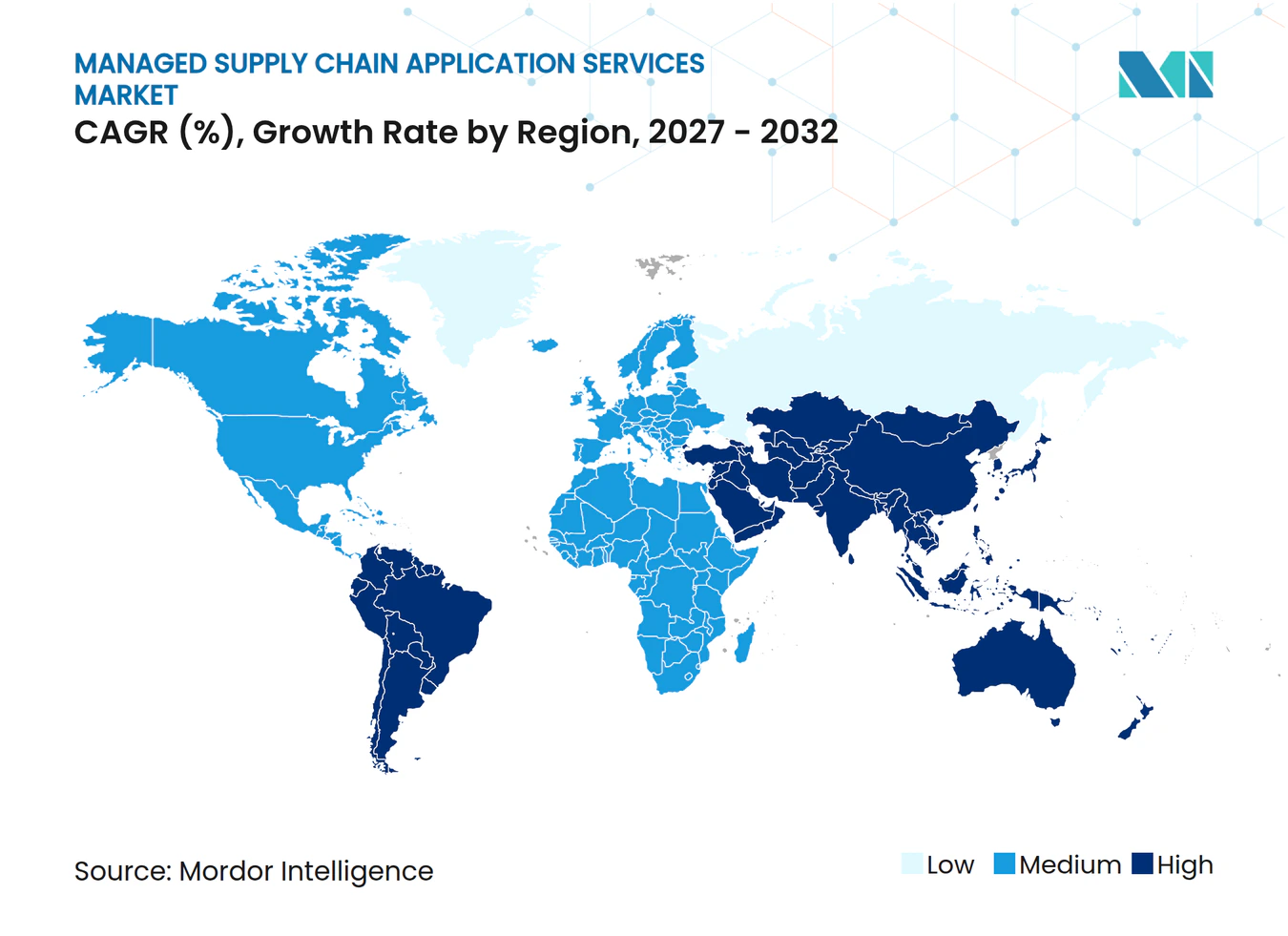
North America accounted for 39.41% of revenue in 2026, supported by the mature adoption of supply chain software and a large concentration of global technology buyers and service providers. The managed supply chain application services market in North America combines a large base of supply chain software providers with customers moving from project-focused arrangements to recurring operational service models spanning planning, execution, and integration. The United States, Canada, and Mexico support demand through near-shoring, domestic manufacturing investment, and cross-border industrial operations that add complexity across closely linked production corridors. Manhattan Associates made its Manhattan Active solutions available through Google Cloud Marketplace in May 2025, showing the growing importance of marketplace-based procurement and deployment for regional buyers.
The managed supply chain application services market in Asia-Pacific is projected to expand at a 13.98% CAGR from 2027 to 2032, as manufacturers and logistics operators build new digital capabilities across established and emerging production locations. China, India, and Southeast Asia each provide different sources of demand through export manufacturing, logistics modernization, new production capacity, and more connected regional supplier networks. Japanese providers are supporting manufacturers operating across ASEAN markets with supply chain systems that integrate ERP, AI, and IoT capabilities. SCSK presents global digital supply chain services that support this type of cross-border operating model, while Spectee announced a JPY 1.25 billion (USD 8.3 million) funding round in January 2026 to expand its manufacturing-focused supply chain risk-management cloud.[3]
Europe has a more compliance-led demand profile because data residency, operational resilience, and sustainability reporting requirements impose additional responsibilities on application contracts, particularly for providers supporting regulated industries and cross-border operating models. Germany, the United Kingdom, France, and Italy remain important centers because of their manufacturing and logistics activity, complex enterprise systems, and high compliance expectations, which favor providers with regional delivery resources and documented governance processes. South America, led by Brazil, has emerging demand tied to manufacturing, e-commerce, and agricultural export chains, although infrastructure gaps, economic volatility, and uneven digital readiness constrain adoption. Middle East markets, especially Saudi Arabia and the UAE, are modernizing supply chain applications through industrialization programs, while Africa remains the least-penetrated region with smaller but developing demand centers that may adopt more services as logistics platforms mature. South Africa, Nigeria, and Egypt offer early demand centers where mobile-first logistics adoption may support future managed-service use.
Competitive Landscape
Market Concentration
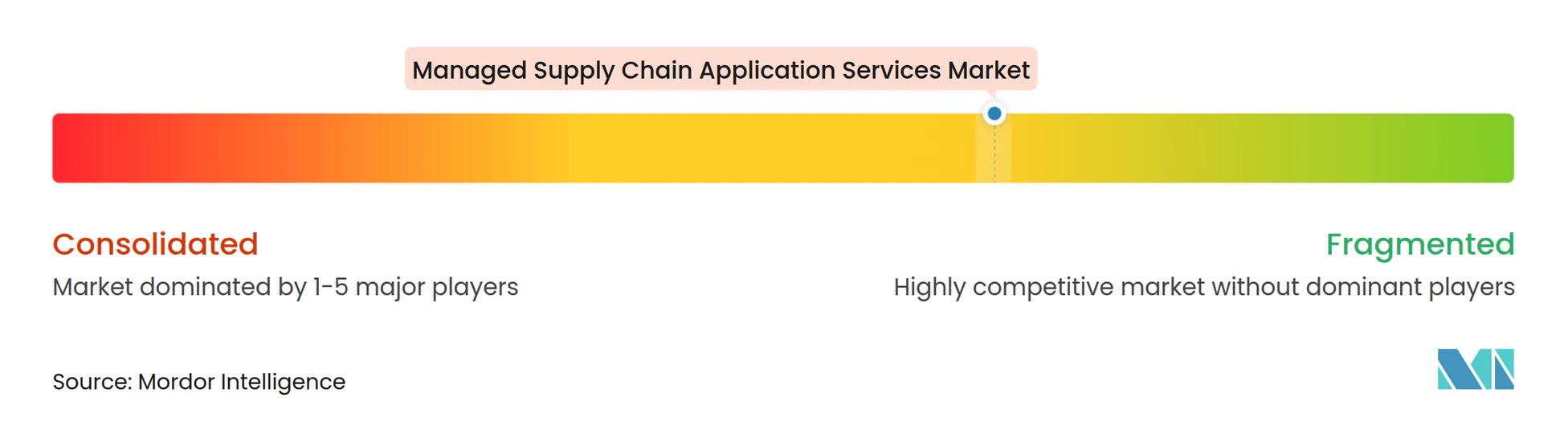
The managed supply chain application services market remains moderately fragmented because providers compete across service models, industry verticals, deployment environments, and geographic needs, and few can meet all requirements with a single standardized service. Large IT service firms compete with supply chain software vendors and specialized providers of visibility, cargo risk, transportation, and network management. Customers increasingly seek partners that can advise on transformation, implement applications, connect data, manage upgrades, and operate them post-deployment, reducing the coordination burden of working with separate vendors and internal teams. WiseTech Global completed its acquisition of E2open in August 2025, combining CargoWise logistics execution with E2open's network, trade compliance, and demand planning capabilities. The combined offer can reduce the number of providers a customer needs for closely connected logistics, trade compliance, demand planning, and multi-enterprise network services, although customers will still assess how well the combined technology fits existing enterprise applications.
Software suppliers are adding AI capabilities that change the work available to traditional systems integrators, particularly where standardized configuration and initial implementation tasks can be supported directly within the platform. Kinaxis launched Maestro Agents in 2025, positioning the tools around faster planning actions and automated assistance for supply chain teams.[4] Blue Yonder expanded its transportation management functions in September 2025 to include cognitive intelligence for routing, carrier monitoring, and shipment risk management. These changes can reduce implementation effort for standard tasks, while increasing demand for governance, data preparation, integration, process support, and operating controls around AI-enabled systems. Smaller specialists such as FourKites, project44, and Overhaul focus on data-intensive visibility, cargo risk, and execution needs, where domain depth, up-to-date data, and operational responsiveness can matter more than broad platform coverage.
Providers that build reusable ERP, SCM, and transportation-system connectors can turn a persistent integration issue into a competitive advantage, particularly when they can adapt templates to customer-specific data models and operating processes without losing control of testing, security, and change management. They can also differentiate through data governance, model validation, compliance support, recovery capabilities, and documented service performance for mission-critical applications that support daily purchasing, production, shipping, and customer fulfillment decisions. Larger firms have an advantage because developing reusable tools, maintaining global delivery capacity, and supporting complex customer environments requires sustained investment and specialist talent. However, the variety of customer environments leaves room for specialized firms with strong vertical expertise or regional delivery capabilities.
Managed Supply Chain Application Services Industry Leaders
-
Blue Yonder Group, Inc.
-
Kinaxis Inc.
-
Manhattan Associates, Inc.
-
The Descartes Systems Group Inc.
-
E2open Parent Holdings, Inc.
- *Disclaimer: Major Players sorted in no particular order
Recent Industry Developments
- May 2026: Coupa and Miebach announced a strategic collaboration to connect supply chain design, planning, and execution through a unified Design-to-Plan approach, incorporating scenario analysis and optimization into Integrated Business Planning and Sales and Operations Planning.
- May 2026: Manhattan Associates unveiled Manhattan Marketplace, an AI agent marketplace enabling customers and partners to deploy pre-built AI agents across warehouse, transportation, and order management applications. Its first agent, Wave Coordinator, was deployed at Giant Eagle to sequence distribution-center workloads in real time.
- May 2026: Manhattan Associates introduced Sightline, an AI-powered decision intelligence capability embedded in ActivePlanning that provides real-time analysis of forecasts, inventory recommendations, and supply chain decisions in plain business language.
- April 2026: Kinaxis and TraceLink expanded their strategic partnership, launching Kinaxis Network Collaboration by TraceLink, which integrates Kinaxis Maestro concurrent planning with live multi-enterprise trading-partner data to improve supply chain planning and collaboration.
Global Managed Supply Chain Application Services Market Report Scope
The Managed Supply Chain Application Services Market refers to the market for outsourced services that support the ongoing operation, monitoring, maintenance, integration, security, and optimization of supply chain applications. These services help enterprises maintain application performance, ensure system availability, integrate supply chain platforms with enterprise systems, manage data and analytics, and support continuous upgrades and operational resilience across complex supply chain networks.
The Managed Supply Chain Application Services Market is Segmented by Service Model (Managed Application Monitoring and Performance Management, Managed Application Maintenance and Upgrades, Managed Integration and API Operations, Managed Data and Analytics Operations, Managed Application Security and Disaster Recovery, and Managed Platform and Hosting Operations), by Application Function (Supply Chain Planning, Procurement and Supplier Management, Warehouse and Fulfillment Management, Transportation and Logistics Management, Order Management and Omnichannel Fulfillment, Supply Chain Visibility and Control Tower Management, and Trade and Compliance Management), by Deployment Model (Cloud-Based, On-Premises, and Hybrid), by Organization Size (Large Enterprises, and Small and Medium Enterprises), by Industry Vertical (Manufacturing, Retail and E-Commerce, Food and Beverage, Healthcare and Life Sciences, Automotive, Logistics and Transportation, Energy and Utilities, and Government and Public Sector), and by Geography (North America, South America, Europe, Asia-Pacific, Middle East, and Africa). The Market Forecasts are Provided in Terms of Value (USD).
| Managed Application Monitoring and Performance Management |
| Managed Application Maintenance and Upgrades |
| Managed Integration and API Operations |
| Managed Data and Analytics Operations |
| Managed Application Security and Disaster Recovery |
| Managed Platform and Hosting Operations |
| Cloud-Based |
| On-Premises |
| Hybrid |
| Large Enterprises |
| Small and Medium Enterprises |
| Manufacturing |
| Retail and E-Commerce |
| Food and Beverage |
| Healthcare and Life Sciences |
| Automotive |
| Logistics and Transportation |
| Energy and Utilities |
| Government and Public Sector |
| North America | United States |
| Canada | |
| Mexico | |
| South America | Brazil |
| Argentina | |
| Rest of South America | |
| Europe | Germany |
| United Kingdom | |
| France | |
| Italy | |
| Spain | |
| Russia | |
| Rest of Europe | |
| Asia-Pacific | China |
| Japan | |
| India | |
| South Korea | |
| Australia and New Zealand | |
| Rest of Asia-Pacific | |
| Middle East | Saudi Arabia |
| United Arab Emirates | |
| Turkey | |
| Rest of Middle East | |
| Africa | South Africa |
| Nigeria | |
| Egypt | |
| Rest of Africa |
| By Service Model | Managed Application Monitoring and Performance Management | |
| Managed Application Maintenance and Upgrades | ||
| Managed Integration and API Operations | ||
| Managed Data and Analytics Operations | ||
| Managed Application Security and Disaster Recovery | ||
| Managed Platform and Hosting Operations | ||
| By Deployment Model | Cloud-Based | |
| On-Premises | ||
| Hybrid | ||
| By Organization Size | Large Enterprises | |
| Small and Medium Enterprises | ||
| By Industry Vertical | Manufacturing | |
| Retail and E-Commerce | ||
| Food and Beverage | ||
| Healthcare and Life Sciences | ||
| Automotive | ||
| Logistics and Transportation | ||
| Energy and Utilities | ||
| Government and Public Sector | ||
| By Geography | North America | United States |
| Canada | ||
| Mexico | ||
| South America | Brazil | |
| Argentina | ||
| Rest of South America | ||
| Europe | Germany | |
| United Kingdom | ||
| France | ||
| Italy | ||
| Spain | ||
| Russia | ||
| Rest of Europe | ||
| Asia-Pacific | China | |
| Japan | ||
| India | ||
| South Korea | ||
| Australia and New Zealand | ||
| Rest of Asia-Pacific | ||
| Middle East | Saudi Arabia | |
| United Arab Emirates | ||
| Turkey | ||
| Rest of Middle East | ||
| Africa | South Africa | |
| Nigeria | ||
| Egypt | ||
| Rest of Africa | ||
Key Questions Answered in the Report
What is the managed supply chain application services market size?
The managed supply chain application services market is projected to expand from USD 6.42 billion in 2026 to USD 7.24 billion in 2027, and to USD 13.34 billion by 2032, at a 13.01% CAGR. Demand comes from recurring support for cloud applications, integrations, and operational controls that remain necessary after the initial software deployment is complete and new business requirements are introduced.
Which service model leads managed supply chain application services?
Managed application monitoring and performance management leads with a 23.14% revenue share in 2026 and is projected to expand at a 14.21% CAGR through 2032. It creates performance baselines and response processes for connected supply chain systems, enabling customers to address technical issues before they disrupt daily operations across planning, fulfillment, production, and transportation.
Why is cloud deployment important for managed supply chain applications?
Cloud-based deployment accounted for 71.39% of revenue in 2026 and is expected to grow at a 13.62% CAGR, supported by subscription pricing and recurring operational support needs. It also requires ongoing upgrade, integration, and user-management support as customers connect additional partners, data feeds, and operational applications across planning, execution, and multi-enterprise collaboration environments.
Which customer group is expanding fastest?
Small and medium enterprises are projected to record a 13.38% CAGR through 2032 as subscription models lower access barriers to managed planning and execution tools. Managed providers give these firms access to specialized skills without building a large internal team for planning, integration, monitoring, and security, allowing them to focus their limited resources on core business operations.
Which vertical has the strongest growth outlook?
Logistics and transportation are projected to grow at a 14.37% CAGR through 2032 because they require current operational data and support tied to delivery performance. Providers help manage carrier data, shipment exceptions, and route-related application workflows that must change as transport capacity and service conditions shift across carriers, routes, facilities, and customer delivery commitments.
Which region has the highest projected growth?
Asia-Pacific is projected to expand at a 13.98% CAGR through 2032, supported by manufacturing digitalization, logistics modernization, and new production capacity. Demand reflects activity across China, India, Japan, and Southeast Asian manufacturing locations, each with its own supply-chain application and integration requirements as manufacturing networks and logistics infrastructure continue to develop