
Managed Application Maintenance and Support Services Market Size and Share
Market Overview
| Study Period | 2021 - 2032 |
|---|---|
| Market Size (2027) | USD 73.55 Billion |
| Market Size (2032) | USD 128.12 Billion |
| Growth Rate (2027 - 2032) | 11.74 % |
| Fastest Growing Market | Asia-Pacific |
| Largest Market | North America |
| Market Concentration | Medium |
Major Players *Disclaimer: Major Players sorted in no particular order Image © Mordor Intelligence. Reuse requires attribution under CC BY 4.0. | |
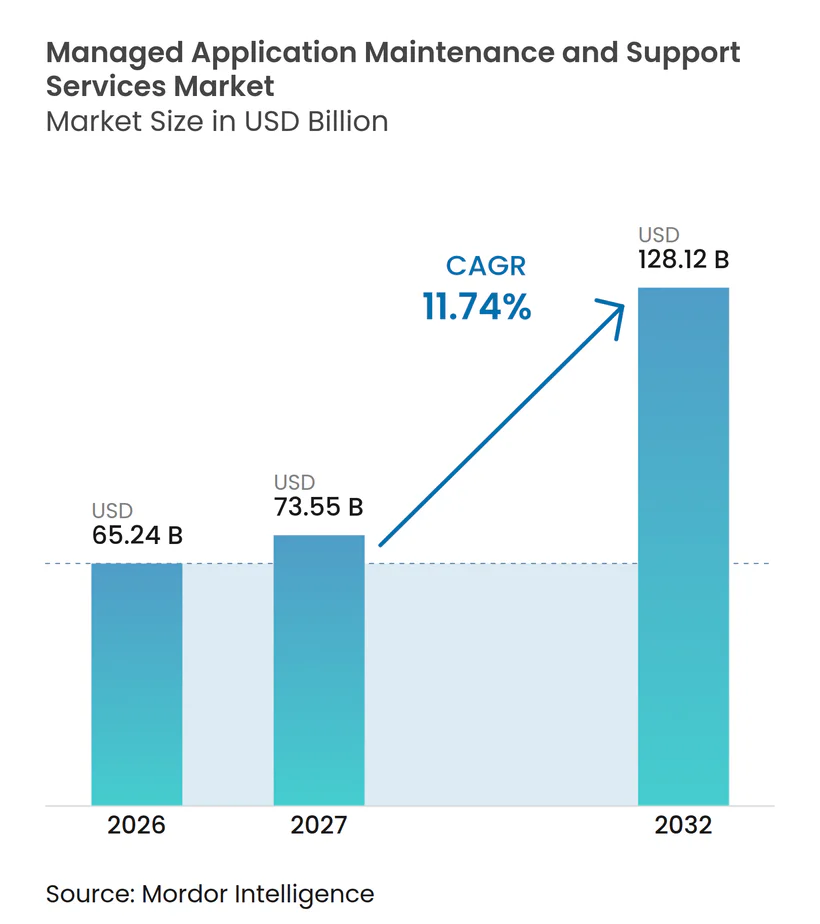
Managed Application Maintenance and Support Services Market Analysis by Mordor Intelligence
The managed application maintenance and support services market size is projected to expand from USD 65.24 billion in 2026 and USD 72.90 billion in 2027 to USD 128.12 billion by 2032, registering a CAGR of 11.74% between 2027 to 2032. Growth reflects the need to support legacy systems, cloud-native applications, and software-as-a-service platforms at the same time. Hybrid operating models extend the number of applications that require testing, monitoring, integration checks, and updated operating procedures. Buyers are placing greater value on predictable availability, faster incident resolution, and evidence that a provider can improve resilience. Providers are responding through automation, specialized operational talent, and sector-specific service models. The managed application maintenance and support services market therefore favors firms that can manage complex estates while showing measurable service outcomes.
Key Report Takeaways
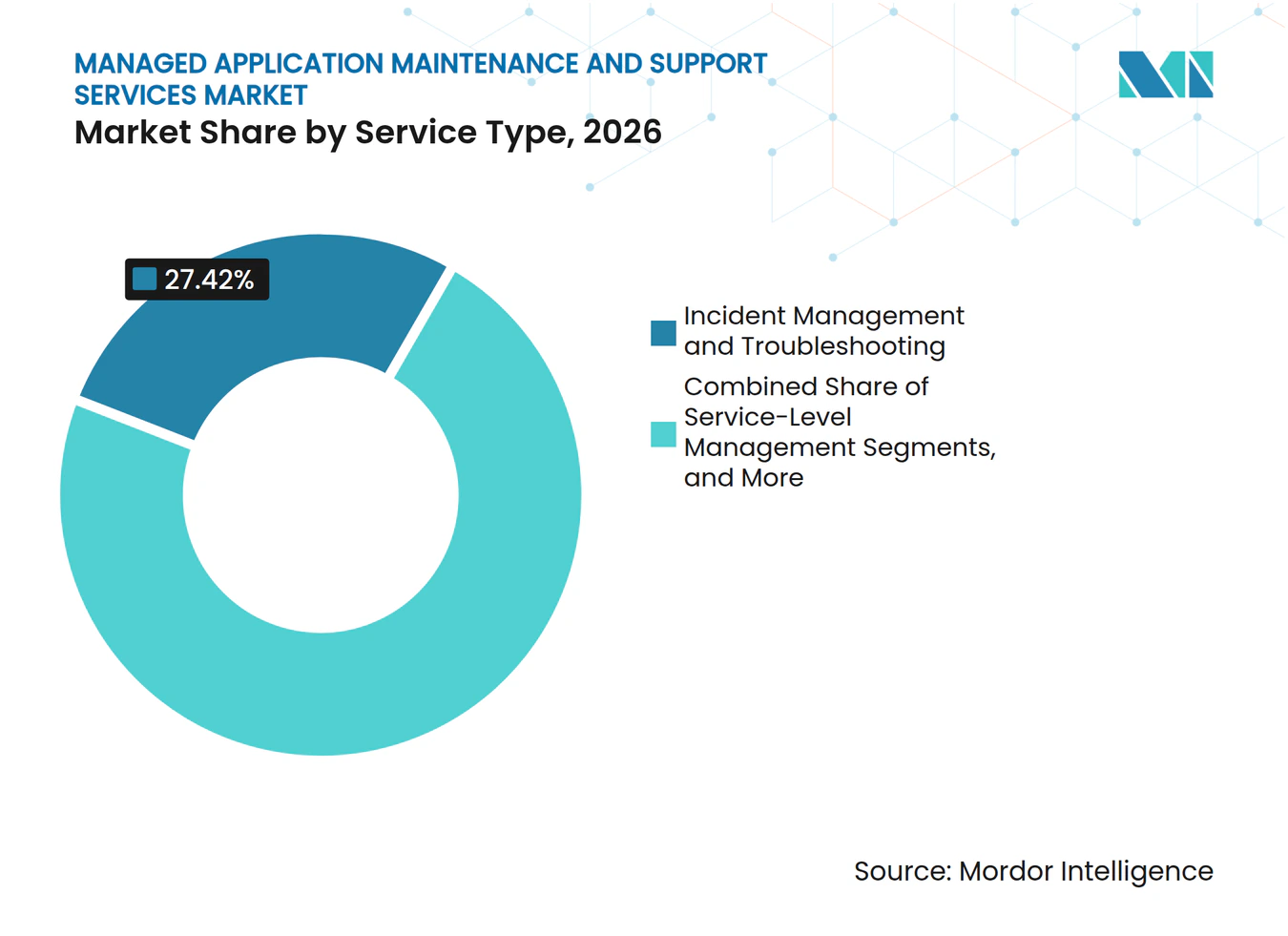
- By service type, Incident Management and Troubleshooting held 27.42% of the managed application maintenance and support services market share in 2026, while Application Monitoring and Performance Management is projected to expand at a 12.63% CAGR through 2032.
- By deployment model, On-Premises held 48.63% of the managed application maintenance and support services market share in 2026, while Cloud-Based deployment is projected to expand at a 12.27% CAGR through 2032.
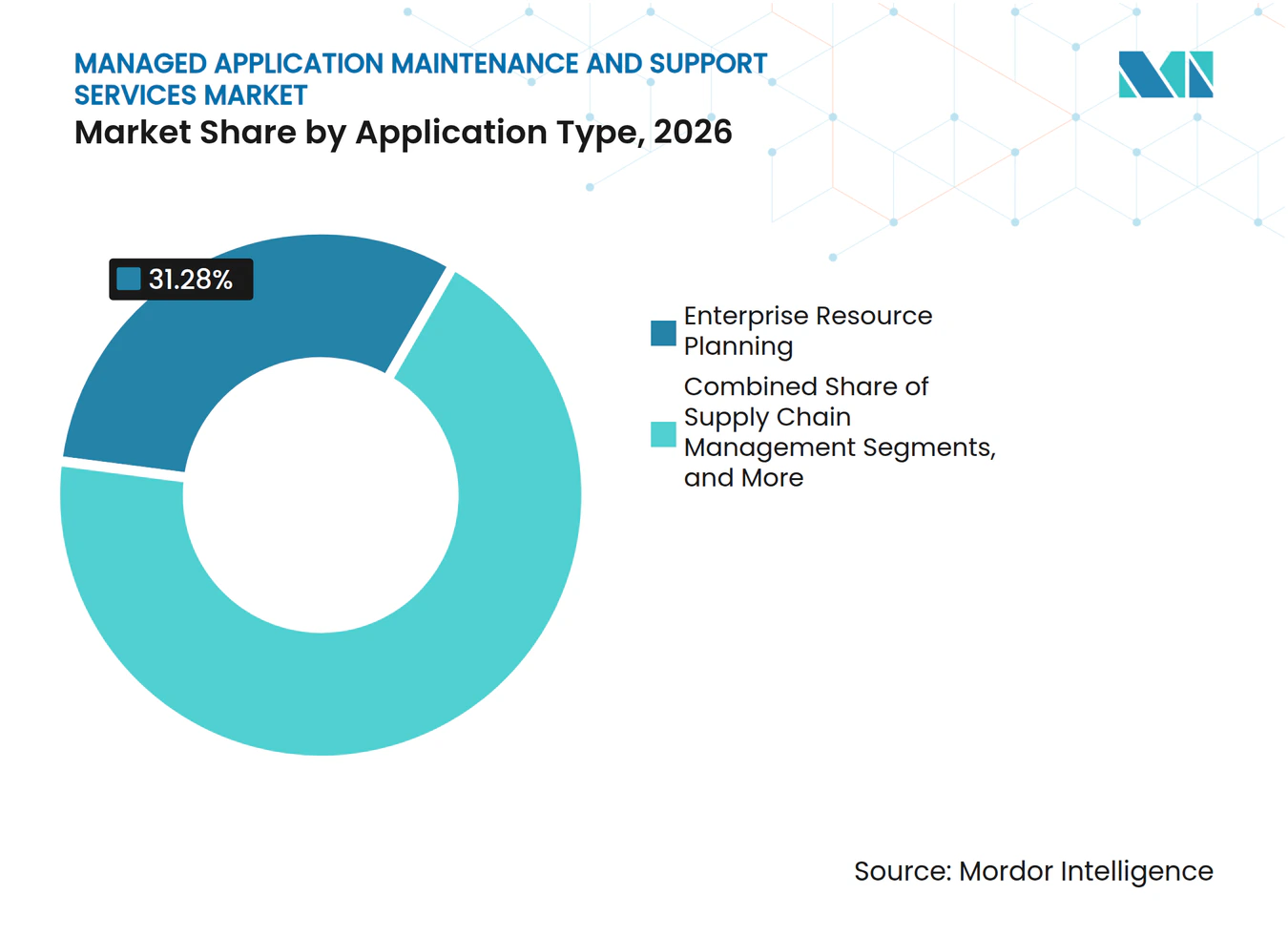
- By application type, Enterprise Resource Planning held 31.28% revenue share in 2026, while Business Intelligence and Analytics is projected to expand at a 12.54% CAGR through 2032.
- By organization size, Large Enterprises held 72.37% revenue share in 2026, while Small and Medium Enterprises are projected to expand at a 12.38% CAGR through 2032.
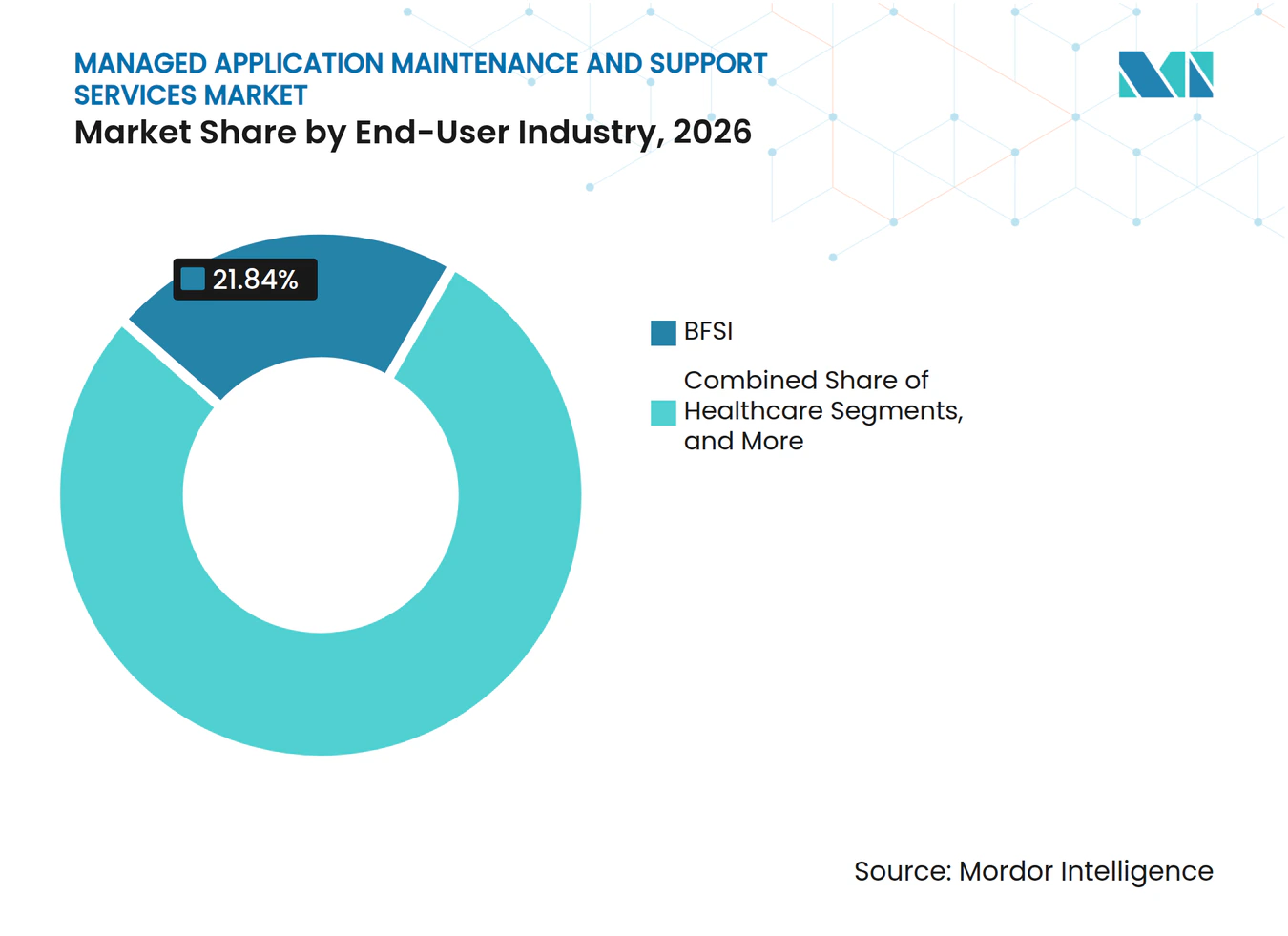
- By end-user industry, BFSI held 21.84% revenue share in 2026, while Healthcare is projected to expand at a 12.72% CAGR through 2032.
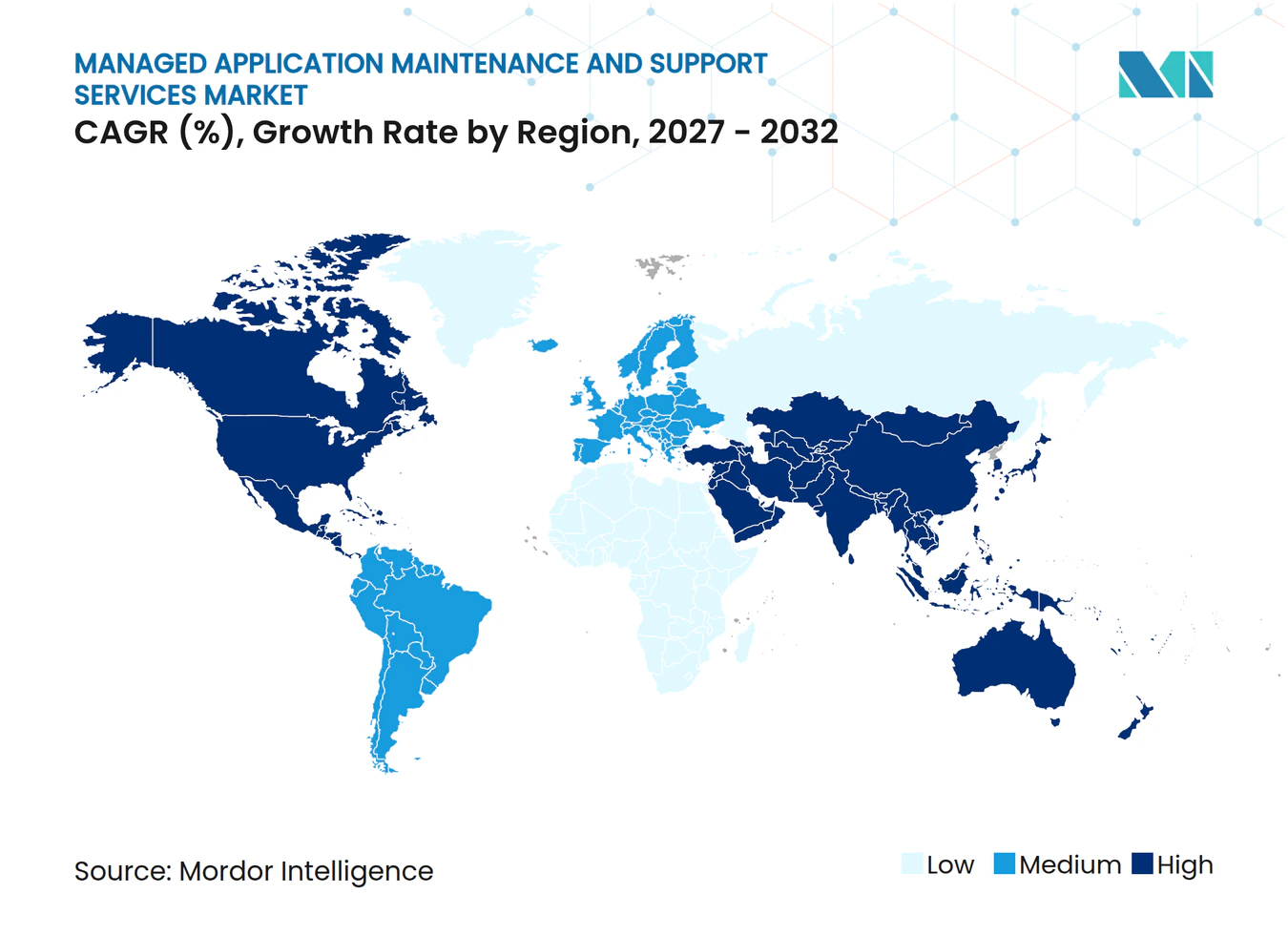
- By geography, North America held 36.47% revenue share in 2026, while Asia-Pacific is projected to expand at a 12.46% CAGR through 2032.
Note: Market numbers in this report are based on Mordor Intelligence's proprietary estimation framework, which combines nine months of actuals with Q4 projections for base year 2026.
Global Managed Application Maintenance and Support Services Market Trends and Insights
Drivers Impact Analysis*
| Driver | (~) % Impact on CAGR Forecast | Geographic Relevance | Impact Timeline |
|---|---|---|---|
| Cloud Migration and Hybrid Application Estate Expansion | +2.8% | Global, with concentration in North America, Europe, and Asia-Pacific | Short term (≤ 2 years) |
| Rising Technical Debt and Legacy Application Modernization Requirements | +2.5% | Global, most acute in North America and Europe | Medium term (2-4 years) |
| Shortage of Specialized Application Operations and Engineering Talent | +2.0% | Global, most severe in North America, Asia-Pacific GCC hubs, and Western Europe | Medium term (2-4 years) |
| Escalating Downtime, Resilience, and Customer Experience Costs | +1.5% | Global | Short term (≤ 2 years) |
| Application-Specific Operational Data Readiness for AI Automation | +1.2% | North America and Europe lead, Asia-Pacific is catching up | Medium term (2-4 years) |
| Continuous Business Restructuring and Application Portfolio Reconfiguration | +0.8% | Global | Long term (≥ 4 years) |
| Source: Mordor Intelligence | |||
Cloud Migration and Hybrid Application Estate Expansion
The managed application maintenance and support services market grows as cloud programs become continuing changes rather than one-time projects. Kyndryl reported that 84% of technology leaders intentionally use multiple cloud environments, while 41% are also moving workloads back on-premises for control, performance, or compliance reasons. Each migration or repatriation requires application testing, integration validation, security review, and refreshed runbooks. F5 reported that 93% of organizations use hybrid multicloud environments and move 10% to 20% of workloads each year.[1] This continuing movement keeps the managed application maintenance and support services market tied to a changing application estate. It also makes providers with consistent cross-environment monitoring more useful to buyers. The managed application maintenance and support services market benefits when those providers can preserve accountability across changing deployment locations.
Rising Technical Debt and Legacy Application Modernization Requirements
Technical debt keeps many enterprises dependent on sustained maintenance even while they modernize their systems. Pegasystems reported that the average global enterprise loses more than USD 370 million each year because it cannot modernize legacy applications, including nearly USD 134 million linked to delayed transformation projects.[2] Cognizant found that 85% of Global 2000 executives worry that their technology estate will limit AI integration.[3] The same research found that 79% expect to retire less than half of their technology debt by 2030. Aging applications need support while modernization schedules, budgets, and skills remain constrained. This need gives the managed application maintenance and support services market a role alongside, rather than after, transformation programs.
Shortage of Specialized Application Operations and Engineering Talent
A persistent skills gap is increasing the case for external application operations support. Robert Half found that 79% of large-enterprise technology leaders reported skills gaps, and 65% found it harder to fill skilled IT roles in 2025 than in 2024. Enterprises need people who understand both longstanding production systems and cloud-native operating layers. This combination is difficult to develop internally because the required skills span legacy platforms, containers, data tools, security processes, and business workflows. The managed application maintenance and support services market benefits when providers can organize those skills across clients and service centers. Buyers also gain access to vendor-certified capabilities without carrying the full cost of recruiting and retaining each specialist.
Escalating Downtime, Resilience, and Customer Experience Costs
Downtime has made application availability a direct financial issue for many organizations. New Relic reported a median annual cost of USD 74 million from high-impact outages and a per-hour cost of USD 1.85 million in its 2026 survey. Its 2025 survey had placed the respective figures at USD 76 million and USD 2 million. SIOS Technology found that 76% of organizations had at least 1 outage lasting more than 10 minutes during the prior year despite using high-availability and disaster-recovery protections.These costs shift procurement attention from ticket volumes toward uptime, recovery, and business-process continuity. The managed application maintenance and support services market gains where providers can link service commitments to those operational outcomes. This approach is particularly relevant for customer-facing and regulated applications.
Restraints Impact Analysis*
| Restraint | (~) % Impact on CAGR Forecast | Geographic Relevance | Impact Timeline |
|---|---|---|---|
| Integration Complexity Across Legacy, Cloud-Native, and SaaS Environments | -1.2% | Global | Medium term (2-4 years) |
| Cybersecurity, Data Sovereignty, and Regulatory Exposure | -0.9% | Europe and Asia-Pacific most affected, growing in Middle East | Medium term (2-4 years) |
| High Transition Costs and Uncertain Total Cost of Ownership | -0.7% | Global, most acute in large enterprises | Short term (≤ 2 years) |
| Inconsistent Operational Data and Limited Client Readiness for Autonomous AMS | -0.5% | Global | Long term (≥ 4 years) |
| Source: Mordor Intelligence | |||
Integration Complexity Across Legacy, Cloud-Native, and SaaS Environments
Mixed application environments slow transitions and reduce the efficiency of managed support programs. Kyndryl found that 35% of IT leaders see integration challenges as a leading barrier to realizing returns from cloud investments. A single service engagement can cover ERP software, container-based services, and third-party software, each with different monitoring, ownership, and escalation requirements. Providers must maintain separate runbooks and response paths while still meeting a unified service commitment. This work increases transition effort and can compress delivery margins. Traditional service-level agreements also struggle when one business process crosses several application tiers. The managed application maintenance and support services market therefore requires stronger integration discipline before automation can create full value.
Cybersecurity, Data Sovereignty, and Regulatory Exposure
Data sovereignty limits how service providers design and staff cross-border delivery. ISACA stated that AI-enabled managed services tools can create cross-border data flows outside established third-party risk frameworks. Kyndryl reported that 75% of technology leaders are concerned about geopolitical risks in global cloud environments, and 65% have changed strategies for data-residency compliance. Requirements under the EU General Data Protection Regulation, HIPAA, and European Banking Authority guidance can require local personnel and localized audit processes. These requirements raise costs for providers that do not have regional scale. They also make security controls and data-handling evidence central to buyer selection. The managed application maintenance and support services market faces slower delivery standardization where jurisdictional restrictions are strict.
*Our forecasts treat driver/restraint impacts as directional, not additive. The impact forecasts reflect baseline growth, mix effects, and variable interactions.
Segment Analysis
By Service Type: Automation Changes the Mix of Support Work
Incident Management and Troubleshooting accounted for 27.42% of the managed application maintenance and support services market size in 2026. That position reflects the reactive operating model that remains common across enterprise application estates. Application Monitoring and Performance Management is projected to record a 12.63% CAGR through 2032 as organizations seek continuous visibility across hybrid environments. Buyers increasingly want to identify problems before they disrupt a business process. Application Maintenance and Upgrades remains necessary where vendors release functional changes and enterprises maintain customized configurations. Version and Patch Management has greater importance as clients require shorter vulnerability-remediation windows. Service-Level Management continues to connect operational work with agreed business priorities.
Operational analytics and service catalog management remain smaller service areas, but they support clearer service performance reporting. These tools help clients understand application ownership, service demand, and recurring failure patterns. Providers are moving from input measures such as ticket counts and staffing levels toward availability and mean-time-between-failures measures. IBM stated that real integration of AI into operating workflows has become a more meaningful differentiator than simply presenting AI as a capability. This changes the value of triage, monitoring, and self-healing functions within the managed application maintenance and support services industry. Providers that document service improvement can use that evidence in renewals and scope discussions. The shift does not eliminate reactive support, because complex applications still need informed human response. It changes the balance between incident response and preventive operations.



By Deployment Model: Hybrid Delivery Remains Essential
On-Premises deployment accounted for 48.63% of the managed application maintenance and support services market size in 2026. Regulated sectors and organizations with strict data-residency requirements still operate important systems in their own environments. Cloud-Based deployment is projected to grow at a 12.27% CAGR through 2032 as enterprises use cloud-delivered services to support ERP modernization. It can also reduce dependence on scarce on-site engineering talent. Hybrid deployment sits between those models because many clients retain core finance and operations systems on-premises. They then extend support to cloud-native applications and third-party software.
Flexera identified application dependency understanding as the largest barrier to cloud migration in its 2026 research. This finding indicates that changes in deployment models will remain gradual through 2032. Providers need common service-management methods across local, cloud, and software-as-a-service environments. Unified monitoring can reduce governance gaps when a client would otherwise use separate providers. The managed application maintenance and support services market rewards providers that can combine these environments in one accountable operating model. This capability can also simplify reporting for security and compliance teams. The model must still respect the separate ownership and data requirements of each application layer.
By Application Type: ERP Remains Core While Analytics Demand Expands
Enterprise Resource Planning applications held 31.28% of revenue in 2026, making them the largest application category. These systems remain essential because they connect finance, procurement, supply chains, human resources, and operations. The SAP S/4HANA migration cycle also sustains demand for specialized support across complex, multi-module deployments. Business Intelligence and Analytics is projected to grow at a 12.54% CAGR through 2032. Organizations are treating data and analytics platforms as critical systems because they support AI readiness and real-time decisions. This increases the need for high availability, data-quality monitoring, and faster incident response.
Customer Relationship Management, Supply Chain Management, Human Capital Management, and Financial Management and Accounting represent significant support budgets. Each category faces recurring functional updates, integration requirements, and compliance needs. Support complexity does not always match application size. A documented cloud-native analytics platform can require less effort than a heavily customized legacy ERP environment. Providers can retain clients more effectively when they design coverage around business impact rather than a uniform service tier. The managed application maintenance and support services market is therefore shaped by the business criticality and customization level of each application. Service teams also need platform-specific certifications and familiarity with the client’s operating processes.

By Organization Size: Large Accounts Lead While Smaller Buyers Gain Access
Large Enterprises accounted for 72.37% of revenue in 2026. Their application estates commonly include multi-geography ERP deployments, numerous integrations, and systems that internal teams cannot maintain without specialized talent. Established outsourcing practices also make external support familiar to many large buyers. Small and Medium Enterprises are projected to grow at a 12.38% CAGR through 2032. Cloud-delivered services let smaller organizations use professional application management without committing to high minimum volumes. Standardized ERP-as-a-service offerings from SAP, Oracle, and Microsoft provide more consistent support surfaces for providers.
The smaller-business opportunity depends on productized services and subscription-based delivery. Clients can seek defined coverage without a major transition project. Robert Half found that 64% of SMB technology leaders reported skills gaps in 2026. That shortage makes outsourced support a practical talent option for organizations with limited internal capacity. The managed application maintenance and support services market can grow in this group when offerings are clear, modular, and affordable. Providers must balance standardization with the specific configurations each customer has retained. Large enterprises will remain important because their estates are broader and their contracts are larger.
By End-User Industry: Financial Services Leads While Healthcare Advances
BFSI accounted for 21.84% of revenue in 2026, supported by dense application portfolios and strict availability requirements. Banking, insurance, and capital-markets organizations need reliable application performance, audit trails, and regulatory controls. Healthcare is projected to grow at a 12.72% CAGR through 2032. Electronic health record complexity, interoperability obligations, and reliance on applications for care delivery support this expansion. Healthcare systems also depend on application integration for revenue-cycle management. Information Technology and Telecommunications, Retail and E-Commerce, and Manufacturing remain substantial demand areas with different modernization and compliance requirements.
Government and Defense, Energy and Utilities, Transportation and Logistics, Education, and Hospitality and Travel hold smaller but growing positions. Government work can be difficult to enter because providers need security certifications and cleared personnel. The managed application maintenance and support services market also needs tailored delivery for applications that support critical infrastructure and citizen services. Healthcare buyers increasingly view managed services as part of their core IT approach rather than only a way to fill staffing gaps. Sector-specific workflow knowledge can support premium pricing when it improves response quality. Providers that understand the client’s regulatory environment can reduce switching risk. This makes vertical specialization an important competitive approach.
Geography Analysis
North America held 36.47% of global revenue in 2026, giving it the largest regional position in the managed application maintenance and support services market. The United States has a high concentration of financial services, healthcare, and technology organizations with layered application estates. Those estates include long-running ERP, customer relationship management, and supply-chain systems that require continuous support. Canada and Mexico add demand through manufacturing and financial services tied to North American supply chains. Regional demand also benefits from buyers that use framework-based sourcing. The Bank of England awarded a GBP 180 million technology transformation and delivery framework in December 2025 to a consortium including Accenture, Capgemini, and Cognizant, showing the use of larger coordinated procurement models.
Europe remains a mature demand center, with Germany, the United Kingdom, and France holding important positions. Data protection and operational-resilience requirements create demand for monitored application services and evidence of incident response. Germany’s SAP S/4HANA migration cycle supports specialized maintenance work across industrial companies with complex SAP environments. The managed application maintenance and support services market must accommodate localized data and audit requirements in the region. Asia-Pacific is projected to grow at a 12.46% CAGR through 2032, the highest regional rate. China’s financial-services digitization, India’s expanding global capability-center base, and telecommunications modernization in Southeast Asia support demand. These markets need operational structures that can maintain availability as digital platforms expand.
South America, the Middle East, and Africa have earlier-stage but distinct demand patterns. Brazil supports South American demand through banking and retail applications. Saudi Arabia and the United Arab Emirates are increasing digital infrastructure investment in line with national Vision programs. Saudi Arabia’s National Data Management Office and the United Arab Emirates Data Protection Law support demand for structured, compliance-focused service engagements. South Africa, Egypt, and Nigeria lead African adoption in BFSI and telecommunications. Kyndryl found that 82% of surveyed organizations experienced a cyber-related outage in 2025. Resilience concerns can increase demand for managed support across emerging regions. The managed application maintenance and support services market can expand where local delivery and compliance capabilities meet these operational needs.
Competitive Landscape
Market Concentration
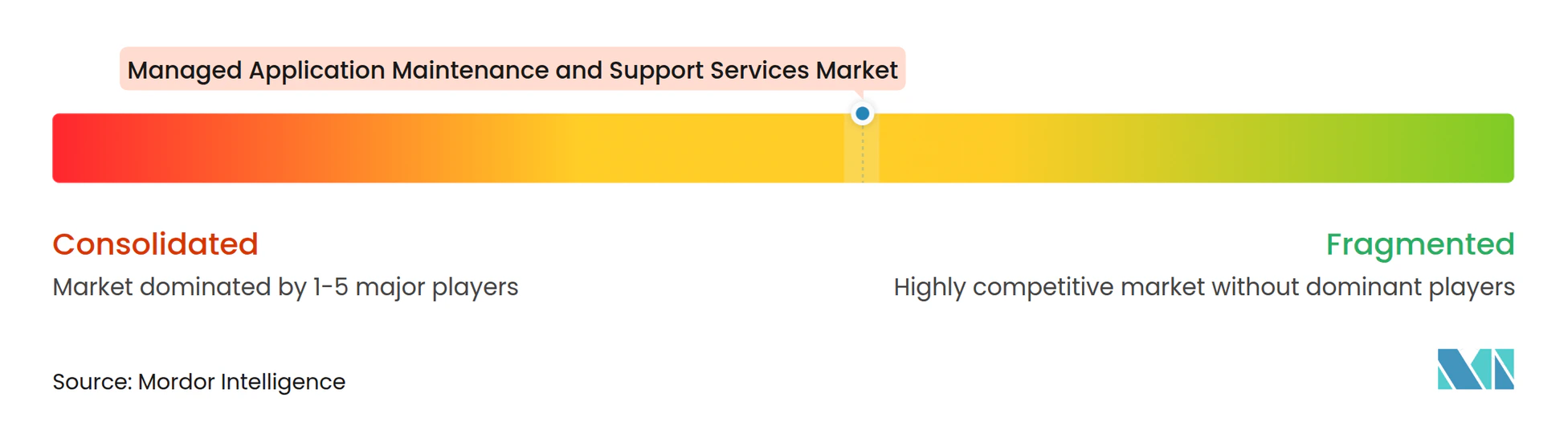
The managed application maintenance and support services market is moderately concentrated among Accenture, TCS, IBM, Infosys, Capgemini, HCLTech, and Wipro. These companies support large global contracts through broad delivery capacity, established customer relationships, and platform partnerships. Competition increasingly depends on the ability to embed AI in incident triage, predictive alerting, and remediation processes. IBM noted that buyers are focusing on operational AI use rather than broad capability claims. This favors providers that can show improvements in service outcomes. Capgemini stated that ISG recognized it as a leader in AI-driven application development and maintenance services for the eighth consecutive year in 2026. Its Agentic ADM framework highlights predictive operations and intelligent ticket handling.
Large contract movements show that incumbency does not guarantee renewal. Infosys won a GBP 1.2 billion contract, equivalent to USD 1.6 billion, from NHS Business Services Authority in October 2025 for a 15-year workforce solution that covers payroll and workforce applications for 1.9 million NHS employees in England and Wales. LTIMindtree secured a USD 450 million, 7-year agreement with a global agribusiness company in May 2025 for application management, infrastructure support, and cybersecurity services across SAP S/4HANA, ServiceNow, and Microsoft Azure. These deals show client interest in consolidated services and AI-enabled operating models. Providers must combine transition discipline with clear performance commitments. Large buyers can use competitive sourcing to seek better efficiency or specialized capabilities.
Mid-tier firms such as LTIMindtree, Mphasis, Hexaware, Persistent Systems, and Kyndryl compete through domain expertise, flexible pricing, and focused delivery. LTIMindtree reported a multi-million-dollar managed-services transformation deal in October 2026 that consolidates infrastructure, cybersecurity, and application administration services under a 3-year AI-led model. TCS expanded its partnership with Google Cloud in April 2026 and introduced 4 commercial offerings that use Google Cloud infrastructure, including an AI security operations center. Vertical knowledge, industry-specific service levels, and regulatory workflows can help providers limit client attrition. Cloud partnerships and proprietary automation tools may create stronger differentiation over time. A market concentration score cannot be assigned from the supplied material because it does not provide the combined share of the leading companies.
Managed Application Maintenance and Support Services Industry Leaders
-
Accenture plc
-
Tata Consultancy Services Limited
-
International Business Machines Corporation
-
Infosys Limited
-
Capgemini SE
- *Disclaimer: Major Players sorted in no particular order
Recent Industry Developments
- October 2026: LTIMindtree secured a multi-million-dollar managed services transformation deal with a leading North American specialty engineering and construction company. The engagement consolidates infrastructure, cybersecurity, and application administration managed services from multiple providers under a unified AI-led operating model with an initial 3-year term, reflecting the ongoing trend of enterprise vendor consolidation in application support.
- September 2026: Capgemini was recognized as a market leader in AI-Driven ADM services by Information Services Group for the 8th consecutive year. Information Services Group cited Capgemini's Agentic ADM framework and its AI-driven predictive operations and intelligent ticket handling as differentiating strengths across Application Managed Services, Application Development Outsourcing, and Application Quality Assurance across Asia-Pacific, Europe, and the United States.
- April 2026: TCS expanded its strategic partnership with Google Cloud to enable agentic and autonomous AI systems for enterprise IT operations. TCS launched 4 commercial offerings on Google Cloud infrastructure, including an AI Security Operations Center powered by Google SecOps, and embedded Gemini Enterprise across its portfolio with more than 3,000 industry-specific AI agents deployed for enterprise clients.
- February 2026: TCS and ServiceNow signed a multi-year partnership to accelerate enterprise AI adoption across back-office functions including HR, finance, supply chain, and procurement. The partnership will develop industry-specific AI solutions on the ServiceNow platform using agentic AI and unified governance models to transform manual, fragmented back-office workflows.
Global Managed Application Maintenance and Support Services Market Report Scope
The Managed Application Maintenance and Support Services Market encompasses outsourced monitoring, troubleshooting, maintenance, upgrades, patching, and performance optimization of enterprise applications across on-premises, cloud-based, and hybrid environments globally.
The market is Segmented by Service Type (Application Monitoring and Performance Management, Incident Management and Troubleshooting, Application Maintenance and Upgrades, Version and Patch Management, Service-Level Management, and Other Service Types), Deployment Model (On-Premises, Cloud-Based, and Hybrid), Application Type (Enterprise Resource Planning, Customer Relationship Management, Supply Chain Management, Business Intelligence and Analytics, Human Capital Management, Financial Management and Accounting, and Other Application Types), Organization Size (Small and Medium Enterprises, and Large Enterprises), End-User Industry (Information Technology and Telecommunications, BFSI, Healthcare, Retail and E-Commerce, Manufacturing, Government and Defense, and Other End-User Industries), and Geography (North America, Europe, Asia-Pacific, Middle East, and Africa. The Market Forecasts are Provided in Terms of Value (USD).
| Application Monitoring and Performance Management |
| Incident Management and Troubleshooting |
| Application Maintenance and Upgrades |
| Version and Patch Management |
| Service-Level Management |
| Other Service Types |
| On-Premises |
| Cloud-Based |
| Hybrid |
| Enterprise Resource Planning |
| Customer Relationship Management |
| Supply Chain Management |
| Business Intelligence and Analytics |
| Human Capital Management |
| Financial Management and Accounting |
| Other Applications Types |
| Small and Medium Enterprises |
| Large Enterprises |
| Information Technology and Telecommunications |
| BFSI |
| Healthcare |
| Retail and E-Commerce |
| Manufacturing |
| Government and Defense |
| Other End-User Industries |
| North America | United States |
| Canada | |
| Mexico | |
| South America | Brazil |
| Argentina | |
| Rest of South America | |
| Europe | Germany |
| United Kingdom | |
| France | |
| Italy | |
| Spain | |
| Russia | |
| Rest of Europe | |
| Asia-Pacific | China |
| India | |
| Japan | |
| South Korea | |
| Australia | |
| Rest of Asia-Pacific | |
| Middle East | Saudi Arabia |
| United Arab Emirates | |
| Turkey | |
| Rest of Middle East | |
| Africa | South Africa |
| Egypt | |
| Nigeria | |
| Rest of Africa |
| By Service Type | Application Monitoring and Performance Management | |
| Incident Management and Troubleshooting | ||
| Application Maintenance and Upgrades | ||
| Version and Patch Management | ||
| Service-Level Management | ||
| Other Service Types | ||
| By Deployment Model | On-Premises | |
| Cloud-Based | ||
| Hybrid | ||
| By Application Type | Enterprise Resource Planning | |
| Customer Relationship Management | ||
| Supply Chain Management | ||
| Business Intelligence and Analytics | ||
| Human Capital Management | ||
| Financial Management and Accounting | ||
| Other Applications Types | ||
| By Organization Size | Small and Medium Enterprises | |
| Large Enterprises | ||
| By End-User Industry | Information Technology and Telecommunications | |
| BFSI | ||
| Healthcare | ||
| Retail and E-Commerce | ||
| Manufacturing | ||
| Government and Defense | ||
| Other End-User Industries | ||
| By Geography | North America | United States |
| Canada | ||
| Mexico | ||
| South America | Brazil | |
| Argentina | ||
| Rest of South America | ||
| Europe | Germany | |
| United Kingdom | ||
| France | ||
| Italy | ||
| Spain | ||
| Russia | ||
| Rest of Europe | ||
| Asia-Pacific | China | |
| India | ||
| Japan | ||
| South Korea | ||
| Australia | ||
| Rest of Asia-Pacific | ||
| Middle East | Saudi Arabia | |
| United Arab Emirates | ||
| Turkey | ||
| Rest of Middle East | ||
| Africa | South Africa | |
| Egypt | ||
| Nigeria | ||
| Rest of Africa | ||
Key Questions Answered in the Report
What is the managed application maintenance and support services market size?
The sector is projected to grow from USD 65.24 billion in 2026 and USD 72.90 billion in 2027 to USD 128.12 billion by 2032, at an 11.74% CAGR.
What is driving demand for managed application maintenance and support services?
Hybrid cloud operations, legacy modernization needs, skills shortages, and the cost of outages are increasing demand for specialized support.
Which service type is largest in managed application support?
Incident Management and Troubleshooting is the largest service type, with a 27.42% share in 2026.
Which deployment model is growing fastest?
Cloud-Based deployment is projected to grow at a 12.27% CAGR through 2032, while On-Premises deployment retains the largest share.
Which end-user sector is growing fastest?
Healthcare is projected to expand at a 12.72% CAGR through 2032 because of electronic health record complexity and integrated care applications.
Which region is growing fastest for application support services?
Asia-Pacific is projected to expand at a 12.46% CAGR through 2032, supported by digital platform investment across China, India, and Southeast Asia.