
Supply Chain Execution (SCE) Market Size and Share
Market Overview
| Study Period | 2020 - 2031 |
|---|---|
| Market Size (2026) | USD 13.60 Billion |
| Market Size (2031) | USD 24.30 Billion |
| Growth Rate (2026 - 2031) | 12.31 % |
| Fastest Growing Market | Asia-Pacific |
| Largest Market | North America |
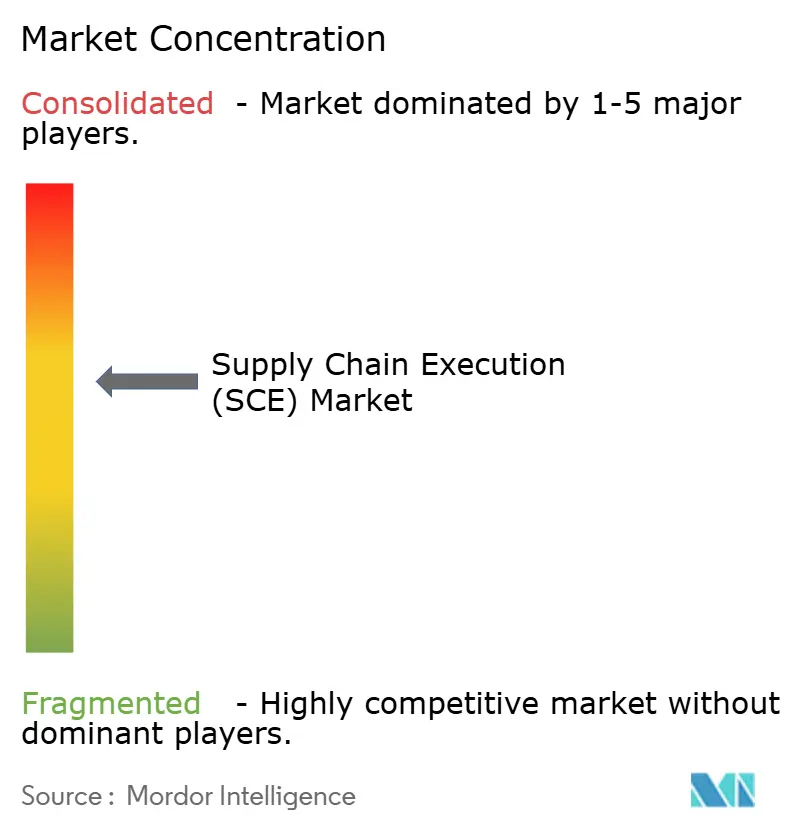
| Market Concentration | Medium |
Major Players *Disclaimer: Major Players sorted in no particular order Image © Mordor Intelligence. Reuse requires attribution under CC BY 4.0. | |
Supply Chain Execution (SCE) Market Analysis by Mordor Intelligence
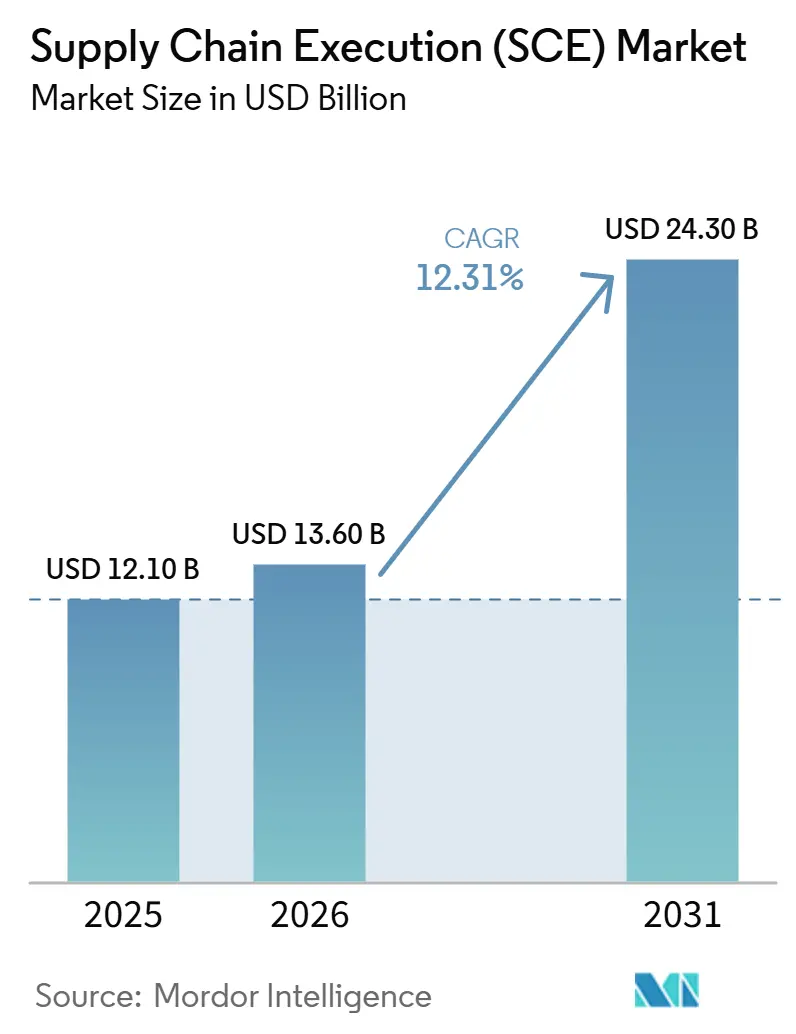
The supply chain execution (SCE) market size is projected to expand from USD 12.10 billion in 2025 and USD 13.60 billion in 2026 to USD 24.30 billion by 2031, registering a CAGR of 12.31% between 2026 to 2031. Growth is supported by the rising complexity of omnichannel fulfillment, wider use of artificial intelligence in operational workflows, and greater emphasis on resilience after recent supply disruptions. Execution software now supports warehouse activity, transportation, order fulfillment, and network visibility in a connected operating environment. Buyers are also giving greater weight to platforms that can work across suppliers, carriers, and internal teams without relying on separate point systems. Regulatory requirements for traceability are adding another reason to invest, especially in Europe, where physical supply chain events must be linked to product data. These conditions are raising the importance of cloud deployment, real-time information, and reliable integration across the supply chain execution market, while favoring providers that connect warehouse, transportation, order, and visibility functions without complex implementation work for users with older systems or dispersed operating networks that still rely on many manual handoffs.
Key Report Takeaways
- By component, software held 73.34% revenue share in 2025, further under the software subsegment Warehouse Management Systems held 20.24% revenue share in 2025, while Supply Chain Visibility and Control Tower solutions are projected to expand at a 13.77% CAGR through 2031, also services segment is expected to grow at 13.58% CAGR through 2031 in the supply chain execution (SCE) market.
- By deployment mode, on-premises systems held 42.48% revenue share in 2025, while cloud-based deployment is projected to expand at a 13.52% CAGR through 2031.
- By enterprise size, large enterprises held 60.67% revenue share in 2025, while small and medium-sized enterprises are projected to expand at a 13.40% CAGR through 2031 in supply chain execution (SCE) market .
- By end-user industry, retail and e-commerce held 20.24% revenue share in 2025, while healthcare and life sciences are projected to expand at a 13.45% CAGR through 2031.
- By geography, North America held 33.39% revenue share in 2025, while Asia-Pacific is projected to expand at a 13.41% CAGR through 2031 in supply chain execution (SCE) market.
Note: Market size and forecast figures in this report are generated using Mordor Intelligence’s proprietary estimation framework, updated with the latest available data and insights as of January 2026.
Market Trends and Insights
Drivers Impact Analysis of Supply Chain Execution (SCE) Market*
| Driver | (~) % Impact on CAGR Forecast | Geographic Relevance | Impact Timeline |
|---|---|---|---|
| E-Commerce Fulfillment Complexity and Real-Time Visibility | +2.8% | Global, strongest in North America, Europe, and Asia-Pacific | Short term (≤ 2 years) |
| AI-Enabled Predictive Execution and Autonomous Workflows | +2.5% | Global, with early concentration in North America and Europe and rapid scaling in Asia-Pacific | Medium term (2-4 years) |
| Cloud-First SME Modernization | +1.8% | Global, strongest in Asia-Pacific and emerging markets, with spillover to South America and the Middle East | Medium term (2-4 years) |
| Supply Chain Resilience and Multi-Tier Risk Monitoring | +1.5% | Global, with highest intensity in North America and Europe and growing use in Asia-Pacific | Medium term (2-4 years) |
| Mandatory Traceability and Sustainability Data Digitalization | +1.0% | Europe primarily, followed by North America and Asia-Pacific | Long term (≥ 4 years) |
| Freight Volatility and Dynamic Optimization API Adoption | +0.8% | Global, concentrated in major freight corridors in North America, Europe, and East Asia | Short term (≤ 2 years) |
| Source: Mordor Intelligence | |||
E-Commerce Fulfillment Complexity and Real-Time Visibility Demand
E-commerce has become a core part of supply chain design, rather than an added sales channel. Nearly 80% of 647 supply chain leaders reported continued e-commerce growth, and a similar share were implementing or planning omnichannel distribution strategies in 2026.[1]MIT Center for Transportation and Logistics, “State of Supply Chain Omnichannel Report,” MIT Center for Transportation and Logistics, mit.edu The reported level of omnichannel planning was 10 percentage points higher than in the prior year. Distribution and logistics, inventory management, and order fulfillment were the 3 leading operating priorities in the same research. This places greater demand on warehouse, order, and visibility applications that can coordinate fulfillment across several channels in near real time. The supply chain execution (SCE) market benefits because delivery reliability and inventory accuracy increasingly affect customer retention as well as logistics performance.
AI-Enabled Predictive Execution and Autonomous Workflow Adoption
Artificial intelligence is moving from planning tools into daily execution work across the supply chain execution market. In 2026, 71% of supply chain organizations planned to invest in generative AI during the following 3 to 5 years, and 60% planned to invest in predictive AI. These figures were 12 percentage points and 17 percentage points higher than the respective 2025 results. This supply chain execution (SCE) market adoption pattern supports demand for systems that can identify exceptions, recommend actions, and coordinate decisions across warehouses and transportation networks. Platforms with embedded agents can reduce the work needed to connect new AI tools with operational data. The remaining gap between experimentation and broad deployment keeps integration, governance, and implementation services important for vendors and users.
Cloud-First Modernization Among Small and Medium-Sized Enterprises
Cloud delivery is lowering the capital and technical barriers that once limited advanced supply chain systems to large organizations. A 2025 peer-reviewed study found that 85% of surveyed SMEs had adopted a cloud-based supply chain solution. Adopters in that study reported an 18% improvement in inventory turnover, a 16% reduction in order fulfillment time, and a 17% reduction in operating costs. Subscription pricing can reduce up-front costs and provide access to analytics that smaller firms may not be able to develop internally. The OECD also identified cost and skills gaps as longstanding limits on SME digitalization.[2]Organisation for Economic Co-operation and Development, “OECD Supply Chain Resilience Review,” OECD, oecd.org As more smaller suppliers use connected platforms, the supply chain execution (SCE) market gains from more structured data, stronger visibility across wider supplier networks, and more consistent information exchange between trading partners.
Supply Chain Resilience and Multi-Tier Risk Monitoring Requirements
The tariff changes of 2025 increased the need to understand supplier relationships beyond the first tier. The share of organizations with visibility into tier-2 suppliers rose by 22 percentage points in 2025, as companies sought clearer evidence of component origin under changing tariff conditions. Although 58% of respondents had mapped tier-2 suppliers, fewer than half had established regular direct contact with them. This gap makes continuous data collection and exception monitoring more useful than periodic reviews. Control towers and multi-tier visibility tools can therefore serve compliance and resilience needs, not only planning needs. That role can make supply chain execution (SCE) market investments easier to link with risk governance priorities and ongoing supplier oversight requirements.
Restraints Impact Analysis of Supply Chain Execution (SCE) Market*
| Restraint | (~) % Impact on CAGR Forecast | Geographic Relevance | Impact Timeline |
|---|---|---|---|
| Legacy ERP and Warehouse Automation Integration Complexity | -2.2% | Global, most acute in Europe and established industrial markets in North America and Asia-Pacific | Medium term (2-4 years) |
| Cybersecurity and Cyber-Physical Risk Exposure | -1.8% | Global, highest in North America and Europe and expanding in Asia-Pacific industrial hubs | Short term (≤ 2 years) |
| Shortage of Execution-Focused Digital Operations Talent | -1.2% | Global, most acute in North America and Europe and emerging in Southeast Asia | Medium term (2-4 years) |
| AI Governance, Data Readiness, and Human-in-the-Loop Constraints | -0.9% | Global | Long term (≥ 4 years) |
| Source: Mordor Intelligence | |||
Legacy ERP and Warehouse Automation Integration Complexity
The connection between modern cloud platforms and older enterprise resource planning systems remains a major deployment issue. Many legacy systems were designed for batch processing and do not exchange inventory, shipment, or exception data at the speed required by current warehouse and transportation platforms. A 2025 industry report identified access to accurate, real-time data as a continuing barrier to supply chain digitalization. OPEX also noted that integration can involve incompatible data formats between modern JSON or XML interfaces and proprietary legacy file structures.[3]OPEX Corporation, “Legacy System Integration with Automation,” OPEX Corporation, opex.com Delays in reconciling warehouse and ERP records can lead to allocation and invoicing errors. These issues extend project timelines, weaken visible returns, and slow further investment in the supply chain execution (SCE) market, particularly among mid-sized manufacturers and retailers.
Cybersecurity and Cyber-Physical Risk Exposure
The connection of information technology and operational technology has increased the risk exposure of warehouses and logistics sites. Cybersecurity incidents can affect warehouse robotics, yard systems, and conveyor equipment, rather than data systems alone. More than 70% of organizations reported at least 1 material third-party cybersecurity incident in the prior year, while fewer than half monitored cybersecurity across even 50% of their extended supply chain networks. Security practices must now bring operational teams, technology teams, and security specialists into the same response process. Fortinet reported that this collaboration is necessary for faster incident response in converged environments. The required security work can delay platform selection and implementation in the supply chain execution (SCE) market.
*Our forecasts treat driver/restraint impacts as directional, not additive. The impact forecasts reflect baseline growth, mix effects, and variable interactions.
Supply Chain Execution (SCE) Market Segment Analysis
By Component:
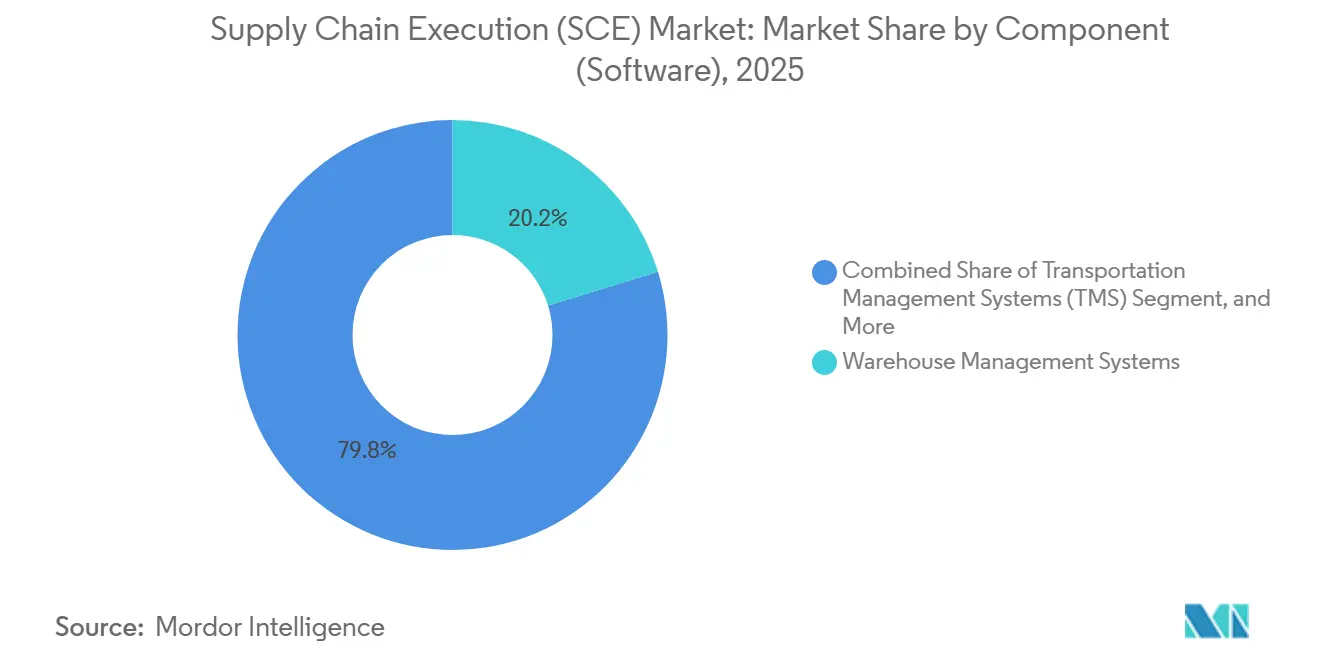
WMS Leads While Visibility Platforms Grow FastestBy component, software held 73.34% revenue share in 2025, services segment is expected to grow at 13.58% CAGR through 2031 in the supply chain execution (SCE) market. Within Software segment, Warehouse Management Systems accounted for 20.24% of supply chain execution software market share in 2025. Warehousing is a concentrated execution point where labor scheduling, inventory records, robotics coordination, and order sequencing meet. Retail and industrial users often place high value on functions such as pick-path optimization and slotting because these functions affect fulfillment cost and speed. Supply Chain Visibility and Control Tower solutions are projected to grow at a 13.77% CAGR from 2026 to 2031 in the supply chain execution software market. Their growth reflects the move from separate systems toward connected information across warehouse, carrier, and supplier handoffs.
Transportation Management Systems, Order Management Systems, Labor Management Systems, Yard Management Systems, freight audit and payment, and reverse logistics tools each address a specific operating need. Supply chain execution (SCE) market buyers increasingly assess these applications as part of a broader platform rather than as isolated products. Services remain important because modernization projects require implementation support, managed services, and process change. High-quality data infrastructure is also needed before organizations can realize the full benefits of advanced automation. This encourages vendors to bundle WMS licenses with visibility and services, which can increase contract value while reducing reliance on standalone licenses.



By Deployment Mode:
On-Premises Retains Scale While Cloud Gains GroundOn-premises deployment held 42.48% of revenue in 2025, reflecting the installed base at large organizations. These users have often invested heavily in customized warehouse and transportation systems that connect with proprietary automation equipment. Migration can involve material cost, operational continuity risks, and long implementation cycles. Cloud-based deployment is projected to advance at a 13.52% CAGR from 2026 to 2031. The supply chain execution market size for cloud-based deployment is supported by SaaS pricing, greenfield adoption by SMEs, and vendor investment in cloud-native product plans.
Blue Yonder stated in May 2026 that it would sell only its cloud-native cognitive portfolio. The decision shows how cloud architecture is becoming a key consideration during SCE market platform selection. Hybrid systems remain relevant for companies with facilities that cannot move to cloud services at the same time. They can also help organizations manage varied legal and data requirements across countries. Data sovereignty rules in Europe and financial services requirements in Asia-Pacific continue to support both on-premises and hybrid deployment, while many hybrid installations retain an on-premises element until a phased migration is complete.
By Enterprise Size:
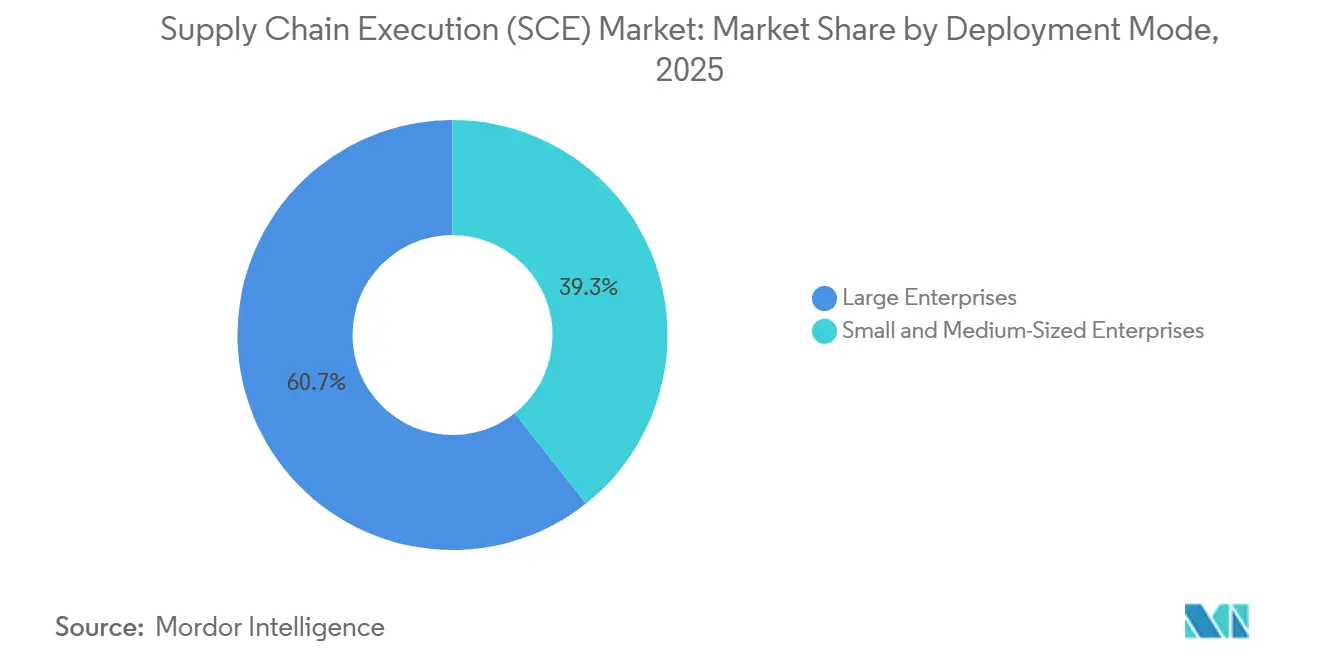
Large Enterprises Lead and SMEs Close the Adoption GapLarge enterprises held 60.67% of revenue in 2025, supported by their broad operating networks and complex integration needs. Their systems often coordinate multiple distribution centers, global transportation activity, and order flows across many fulfillment channels. Existing investments in enterprise resource planning and warehouse automation also create demand for extensive integration work. Small and medium-sized enterprises are projected to grow at a 13.40% CAGR from 2026 to 2031. The supply chain execution (SCE) industry is becoming more accessible to these users through cloud subscriptions and simpler implementation paths.
The 2025 SME study found that cloud supply chain users reported 17% lower operating costs. This return profile helps position supply chain execution market software as an operating tool rather than an application reserved for large companies. SME onboarding can also help larger buyers because connected suppliers generate structured information for visibility networks. That information can improve demand sensing, lead-time tracking, and disruption alerts across wider value chains. Vendors that make it easy for smaller suppliers to join a platform can strengthen the data and network value available to enterprise customers.
By End-User Industry:
Retail Leads and Healthcare Expands QuicklyRetail and e-commerce held 20.24% of revenue in 2025, making it the leading end-user group. This sector needs accurate inventory allocation, order routing, returns processing, and last-mile coordination across several sales channels. Same-day and next-day service expectations reduce the room for delayed information or manual intervention. Distribution, logistics, inventory management, and order fulfillment were all leading priorities among the supply chain leaders surveyed by MIT in 2026. These requirements sustain demand for warehouse and order management tools in the SCE market across retail and e-commerce operations.
Healthcare and life sciences are projected to grow at a 13.45% CAGR through 2031. Serialization and traceability obligations make reliable execution systems necessary for many healthcare supply chains. Tecsys reported 23% year-over-year SaaS revenue growth in the 12 months ended January 31, 2026, while SaaS annual recurring revenue represented 57% of revenue. McKesson reported USD 6.2 billion in operating cash flow for fiscal 2026 after deploying an AI-driven planning and execution system across demand, supply, inventory, and operations. Industrial manufacturing, transportation and logistics, automotive, food and beverage, chemicals, consumer packaged goods, energy and utilities, and government users continue to require specialized execution capabilities based on their product, compliance, and logistics needs.
Geography Analysis
North America Supply Chain Execution (SCE) Market
North America held 33.39% of supply chain execution (SCE) market share in 2025. The SCE market in the region benefits from established third-party logistics activity, high cloud infrastructure use, and a broad base of established providers and specialist vendors. Demand is concentrated in the United States, while Canada and Mexico benefit from nearshoring activity. In 2025, 33% of surveyed enterprises were developing nearshoring or onshoring plans and 43% planned to shift more of their supply chain footprint to the United States during the next 3 years.
Europe Supply Chain Execution (SCE) Market
Europe is the second-largest regional market, with Germany, the United Kingdom, and France acting as important centers for industrial and retail demand. The region also has a regulatory basis for new traceability requirements. The European Commission launched the Digital Product Passport Registry on July 20, 2026, under the Ecodesign for Sustainable Products Regulation. The registry requires product traceability information to be captured and transmitted within physical execution processes. The Corporate Sustainability Due Diligence Directive has also extended supplier-data obligations into corporate supply chain workflows. These rules make traceability readiness a relevant supply chain execution (SCE) market platform qualification factor for European buyers.
APAC, South America and MEA Supply Chain Execution (SCE) Market
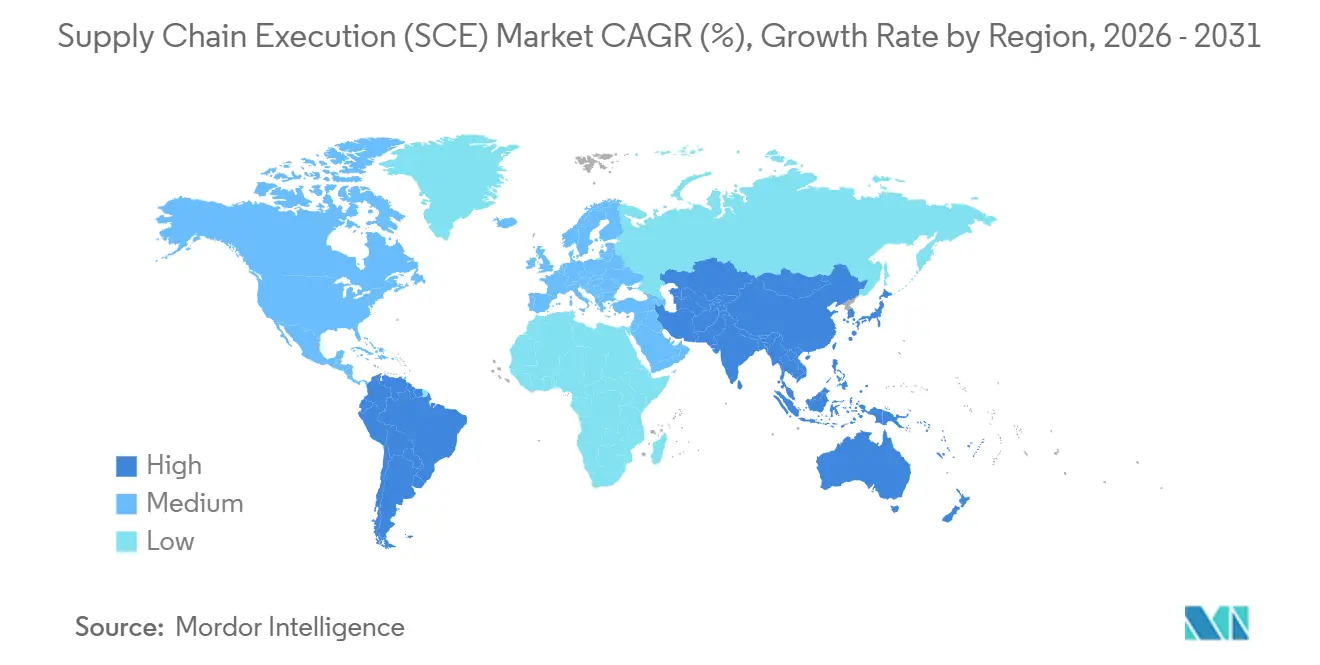
Asia-Pacific is projected to grow at a 13.41% CAGR from 2026 to 2031. China and India support SCE market growth through expanding e-commerce volumes and manufacturing activity, while Southeast Asian supplier networks are becoming more complex. Japan and South Korea provide demand through automotive and electronics operations that require precise warehouse and yard execution. Australia, New Zealand, and Southeast Asia add demand from retail, consumer packaged goods, and food and beverage users. South America offers opportunities in food, beverage, and agricultural supply chains, while the Middle East and African markets are adopting cloud transportation and visibility tools as infrastructure investment and cross-border e-commerce expand.

Competitive Landscape
The supply chain execution (SCE) market has a moderately consolidated group of broad platform providers and a fragmented group of specialists. Manhattan Associates, Blue Yonder, SAP, Oracle, and Infor have strong enterprise reach and broad platform coverage. Supply chain execution (SCE) market competition increasingly centers on AI capability and the quality of connected operating data. Manhattan Associates introduced Manhattan Marketplace in June 2026, allowing customers and partners to discover and deploy intelligent agents, extensions, and accelerators on ActivePlatform. The marketplace builds on the company’s Agent Foundry and offers governance and application programming interfaces for interoperability.
Blue Yonder introduced Cognitive Solutions for space planning and production planning and scheduling in May 2026. It also announced a strategic partnership with NVIDIA and reaffirmed its focus on cloud-native cognitive offerings. Oracle added 4 Fusion Agentic Applications to Fusion Cloud Supply Chain and Manufacturing in June 2026 to improve inventory visibility, supplier disruption management, and manufacturing execution. These actions raise supply chain execution (SCE) market expectations for automation and cloud readiness during enterprise procurement.
Specialist supply chain execution market firms are also extending from visibility into execution. project44 reorganized its business in July 2026, separating its enterprise shipper business from LSP44, which serves logistics service providers with AI agents and application programming interface infrastructure. Descartes launched MacroPoint OpsForce in March 2026 to automate freight visibility workflows across interconnected supply chains. Healthcare remains an area where vendors with expertise in serialization, lot traceability, and good manufacturing practice documentation can compete effectively with broader suites. Smaller firms such as Shipsy, FarEye Technologies, and FreightPOP also target SMEs and mid-market customers with subscription-based transportation and last-mile tools.
Supply Chain Execution (SCE) Industry Leaders
Manhattan Associates, Inc.
Blue Yonder Group, Inc.
Kinaxis Inc.
The Descartes Systems Group Inc.
E2open Parent Holdings, Inc.
- *Disclaimer: Major Players sorted in no particular order
Supply Chain Execution (SCE) Market Companies Covered in this Report
- EPG (Ehrhardt Partner Group)
- Infios (formerly Körber SC Software)
- Softeon
- Made4net
- Tecsys
- Manhattan Associates
- Blue Yonder
- Infor
- Generix Group
- Aptean
- Oracle
- SAP
- WiseTech Global
- The Descartes Systems Group
- QAD
- Transporeon
- project44
- Shipsy
- FarEye Technologies
- FreightPOP
- Overhaul

Recent Industry Developments in Supply Chain Execution (SCE) Market
- July 2026: project44 restructured into two separate businesses, the original project44 serving enterprise shippers as a decision intelligence platform encompassing TMS, visibility, yard management, and last-mile solutions, and LSP44, a newly launched AI-native infrastructure entity serving 3PLs, freight forwarders, and brokers through AI agents and API infrastructure. The company connects over 1.5 billion shipments annually across 280,000 carriers and is reported to be eyeing an IPO as early as 2026.
- June 2026: Oracle announced 4 new Fusion Agentic Applications embedded in Oracle Fusion Cloud Supply Chain and Manufacturing, powered by coordinated teams of specialized AI agents designed to increase inventory visibility, reduce supplier and operational disruption impact, and improve manufacturing execution efficiency. The release also introduced new inventory optimization capabilities for supply chain planning.
- June 2026: Manhattan Associates unveiled Manhattan Marketplace on ActivePlatform at its Momentum 2026 conference, creating a shared ecosystem where customers and partners can discover and deploy intelligent agents, extensions, and accelerators for supply chain and commerce operations. The marketplace provides a unified governance and API foundation for agent interoperability, building on the AgentFoundry launched in 2025.
- May 2026: Blue Yonder launched new Cognitive Solutions for Space Planning and Production Planning and Scheduling, introduced new AI agents, and announced a strategic partnership with NVIDIA at ICON 2026. The company simultaneously reaffirmed its commitment to selling exclusively cloud-native cognitive solutions across its entire product portfolio going forward.


Global Supply Chain Execution (SCE) Market Report Scope
The Global Supply Chain Execution (SCE) Market refers to the market for software solutions and platforms that facilitate, automate, monitor, and optimize the execution of supply chain operations across logistics, warehousing, transportation, order fulfillment, inventory management, and distribution networks. SCE solutions provide real-time visibility, coordination, and control over the movement of goods, information, and resources from suppliers to end customers, enabling organizations to improve operational efficiency, reduce costs, enhance service levels, and respond quickly to disruptions. The market encompasses transportation management systems (TMS), warehouse management systems (WMS), labor management systems (LMS), yard management systems (YMS), order management solutions, and related execution technologies delivered through on-premises and cloud-based deployment models. It serves a wide range of industries, including manufacturing, retail, e-commerce, healthcare, automotive, food and beverage, and third-party logistics (3PL), with adoption driven by increasing supply chain complexity, digital transformation initiatives, omnichannel commerce growth, and the need for end-to-end supply chain visibility and resilience.
The Supply Chain Execution Market Report is Segmented by Component (Software [Warehouse Management Systems (WMS), Transportation Management Systems (TMS), Order Management Systems (OMS), Labor Management Systems (LMS), Yard Management Systems (YMS), Freight Audit and Payment, Supply Chain Visibility and Control Tower, Reverse Logistics Execution], and Services), Deployment Mode (Cloud-Based, On-Premises, and Hybrid), Enterprise Size (Large Enterprises, and Small and Medium-Sized Enterprises), End-User Industry (Industrial Manufacturing, Retail and E-Commerce, Transportation and Logistics, Healthcare and Life Sciences, Automotive, Food and Beverage, Chemicals and Process Industries, Consumer Packaged Goods, Energy and Utilities, Government and Defense, and Other End-User Industries), and Geography (North America, Europe, Asia-Pacific, South America, Middle East, and Africa). The Market Forecasts are Provided in Terms of Value (USD).
| Software | Warehouse Management Systems (WMS) |
| Transportation Management Systems (TMS) | |
| Order Management Systems (OMS) | |
| Labor Management Systems (LMS) | |
| Yard Management Systems (YMS) | |
| Freight Audit and Payment | |
| Supply Chain Visibility and Control Tower | |
| Reverse Logistics Execution | |
| Services |
| Cloud-Based |
| On-Premises |
| Hybrid |
| Large Enterprises |
| Small and Medium-Sized Enterprises |
| Industrial Manufacturing |
| Retail and E-Commerce |
| Transportation and Logistics |
| Healthcare and Life Sciences |
| Automotive |
| Food and Beverage |
| Chemicals and Process Industries |
| Consumer Packaged Goods |
| Energy and Utilities |
| Government and Defense |
| Other End-User Industries |
| North America | United States |
| Canada | |
| Mexico | |
| South America | Brazil |
| Argentina | |
| Chile | |
| Rest of South America | |
| Europe | Germany |
| United Kingdom | |
| France | |
| Italy | |
| Spain | |
| Russia | |
| Rest of Europe | |
| Asia-Pacific | China |
| Japan | |
| India | |
| South Korea | |
| Australia and New Zealand | |
| Southeast Asia | |
| Rest of Asia-Pacific | |
| Middle East | Türkiye |
| United Arab Emirates | |
| Saudi Arabia | |
| Israel | |
| Rest of Middle East | |
| Africa | South Africa |
| Egypt | |
| Nigeria | |
| Rest of Africa |
| By Component | Software | Warehouse Management Systems (WMS) |
| Transportation Management Systems (TMS) | ||
| Order Management Systems (OMS) | ||
| Labor Management Systems (LMS) | ||
| Yard Management Systems (YMS) | ||
| Freight Audit and Payment | ||
| Supply Chain Visibility and Control Tower | ||
| Reverse Logistics Execution | ||
| Services | ||
| By Deployment Mode | Cloud-Based | |
| On-Premises | ||
| Hybrid | ||
| By End Use Enterprise Size | Large Enterprises | |
| Small and Medium-Sized Enterprises | ||
| By End-User Industry | Industrial Manufacturing | |
| Retail and E-Commerce | ||
| Transportation and Logistics | ||
| Healthcare and Life Sciences | ||
| Automotive | ||
| Food and Beverage | ||
| Chemicals and Process Industries | ||
| Consumer Packaged Goods | ||
| Energy and Utilities | ||
| Government and Defense | ||
| Other End-User Industries | ||
| By Geography | North America | United States |
| Canada | ||
| Mexico | ||
| South America | Brazil | |
| Argentina | ||
| Chile | ||
| Rest of South America | ||
| Europe | Germany | |
| United Kingdom | ||
| France | ||
| Italy | ||
| Spain | ||
| Russia | ||
| Rest of Europe | ||
| Asia-Pacific | China | |
| Japan | ||
| India | ||
| South Korea | ||
| Australia and New Zealand | ||
| Southeast Asia | ||
| Rest of Asia-Pacific | ||
| Middle East | Türkiye | |
| United Arab Emirates | ||
| Saudi Arabia | ||
| Israel | ||
| Rest of Middle East | ||
| Africa | South Africa | |
| Egypt | ||
| Nigeria | ||
| Rest of Africa | ||


Key Questions Answered in the Report
What is the supply chain execution market size?
The supply chain execution market size is USD 13.60 billion in 2026 and is projected to reach USD 24.30 billion by 2031 at a 12.31% CAGR.
What is driving demand for supply chain execution software?
Omnichannel fulfillment, cloud adoption, AI-enabled workflows, and multi-tier risk monitoring are key factors supporting demand.
Which component leads supply chain execution software revenue?
Warehouse Management Systems led with a 20.24% share in 2025, while visibility and control tower solutions are projected to grow fastest at 13.77% CAGR in the supply chain execution software market.
Why are cloud platforms gaining adoption in supply chain operations?
Cloud platforms offer subscription pricing and simpler access for SMEs, while vendors are increasingly placing new capabilities on cloud-native systems.
Which end-user sector is growing fastest for supply chain execution platforms?
Healthcare and life sciences are projected to expand at a 13.45% CAGR through 2031 due to serialization and traceability needs.
Which region is projected to grow fastest through 2031?
Asia-Pacific is projected to grow at a 13.41% CAGR, supported by e-commerce activity, manufacturing networks, and SME cloud adoption.
Page last updated on:





