
Managed Site Reliability Engineering (SRE) Services Market Size and Share
Market Overview
| Study Period | 2021 - 2032 |
|---|---|
| Market Size (2027) | USD 6.31 Billion |
| Market Size (2032) | USD 12.44 Billion |
| Growth Rate (2027 - 2032) | 14.58 % |
| Fastest Growing Market | Asia-Pacific |
| Largest Market | North America |
| Market Concentration | Medium |
Major Players *Disclaimer: Major Players sorted in no particular order Image © Mordor Intelligence. Reuse requires attribution under CC BY 4.0. | |
Managed Site Reliability Engineering (SRE) Services Market Analysis by Mordor Intelligence
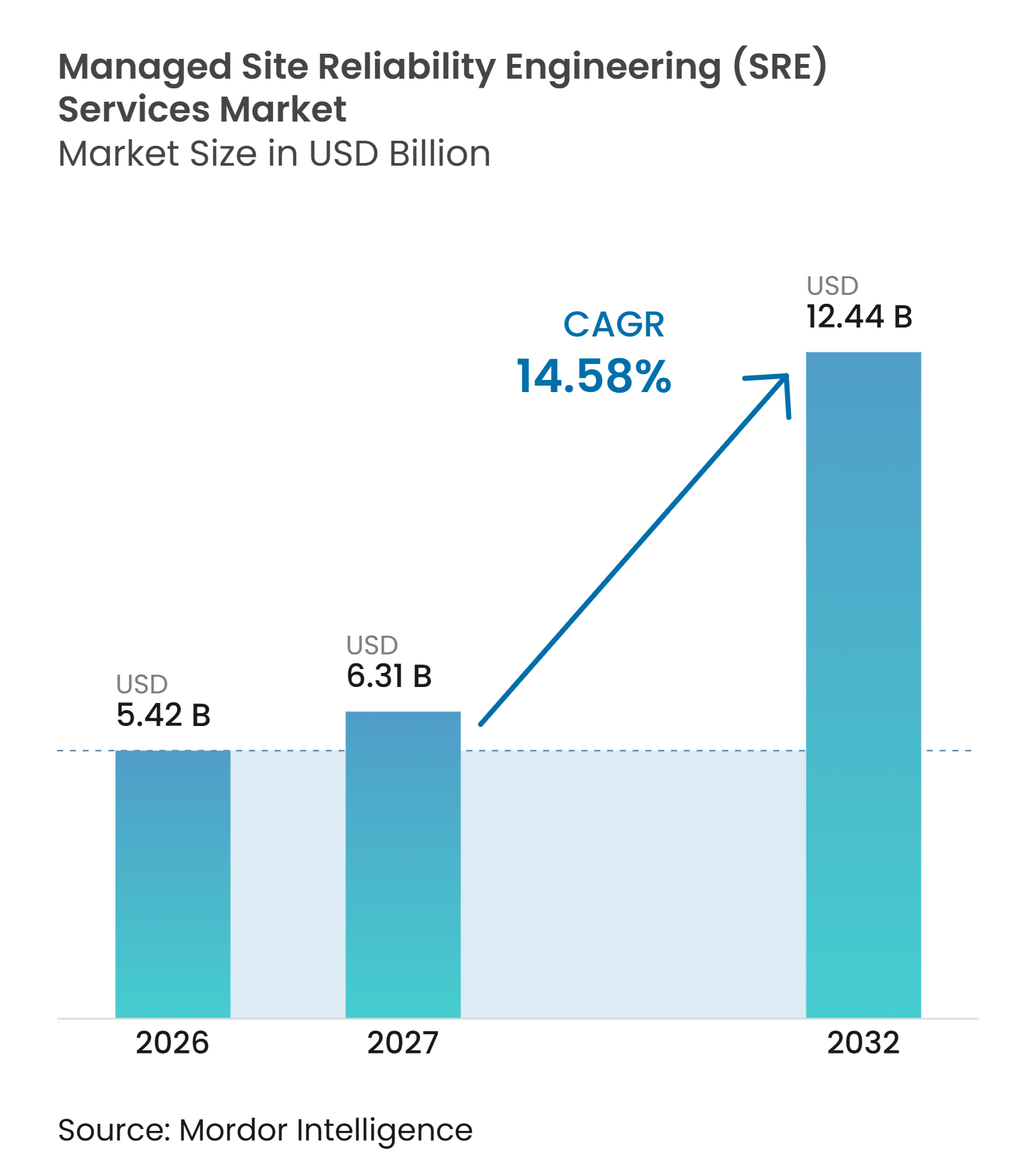
The managed SRE services market size is projected to expand from USD 5.42 billion in 2026 to USD 6.31 billion in 2027, and to USD 12.44 billion by 2032, registering a CAGR of 14.58% between 2027 and 2032. Enterprise teams are transferring more production responsibility to specialist providers as cloud estates become harder to operate with internal teams alone. The managed SRE services market benefits from rising expectations for continuous digital availability, especially where outages disrupt revenue, customer service, or regulated operations. Providers are responding with cloud observability, service-level objectives, incident response, and automation that address operating needs rather than isolated monitoring tasks. Data residency requirements limit centralized delivery models, but they also create an opening for providers that can operate locally and demonstrate clear controls. The managed SRE services market is also moving toward supervised AI-assisted remediation, although enterprises still require explicit authorization and auditability for production changes.
Key Report Takeaways
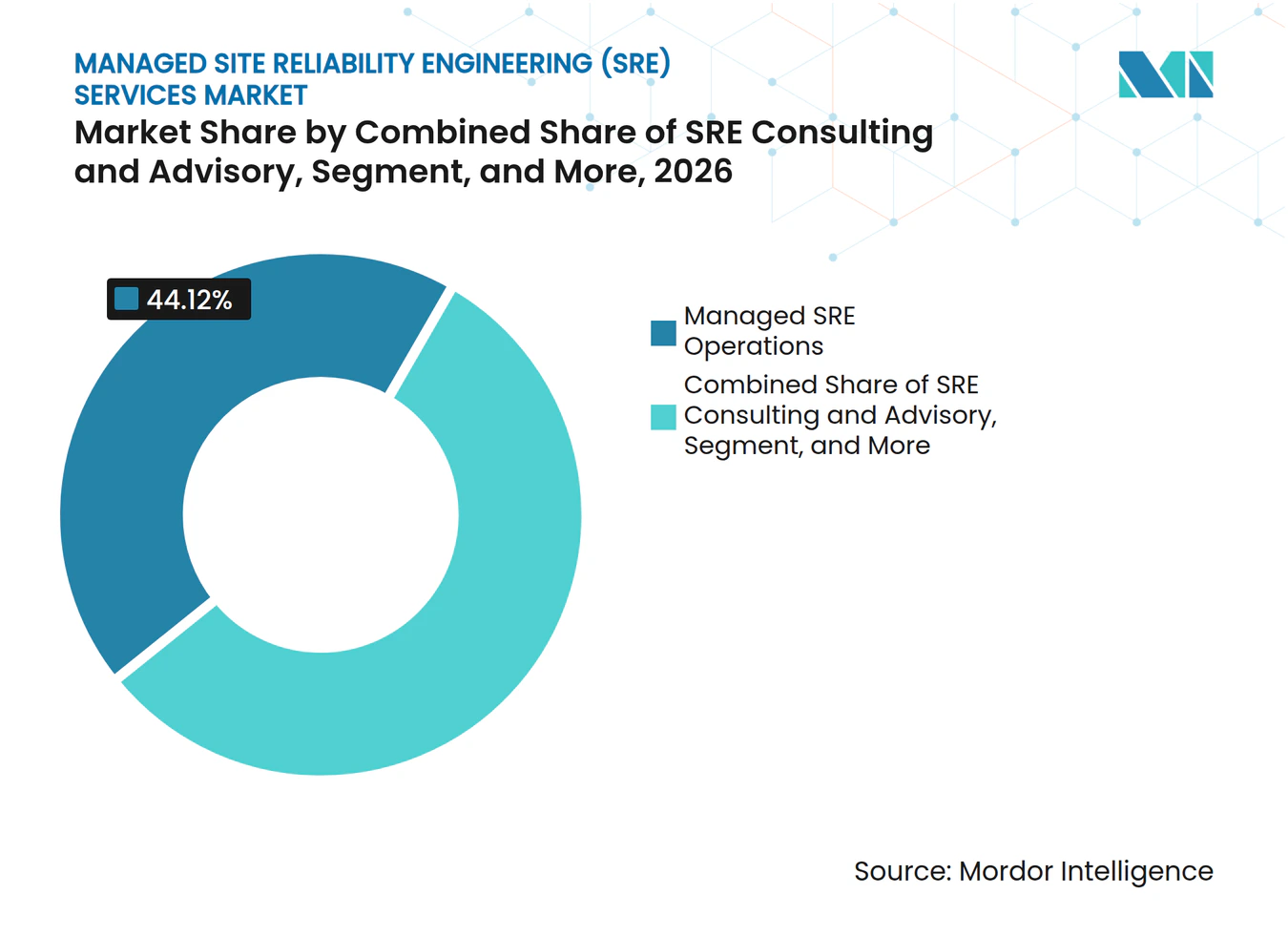
- By service type, Managed SRE Operations accounted for 44.12% of the managed SRE services market share in 2026 and is projected to grow at a 15.78% CAGR through 2032.
- By engagement model, Fully Managed SRE accounted for 52.29% of the managed SRE services market share in 2026 and is projected to expand at a 15.17% CAGR through 2032.
- By deployment model, Cloud-Based delivery accounted for 76.34% of the managed SRE services market in 2026, while Hybrid deployment is expected to expand at a 15.21% CAGR through 2032.
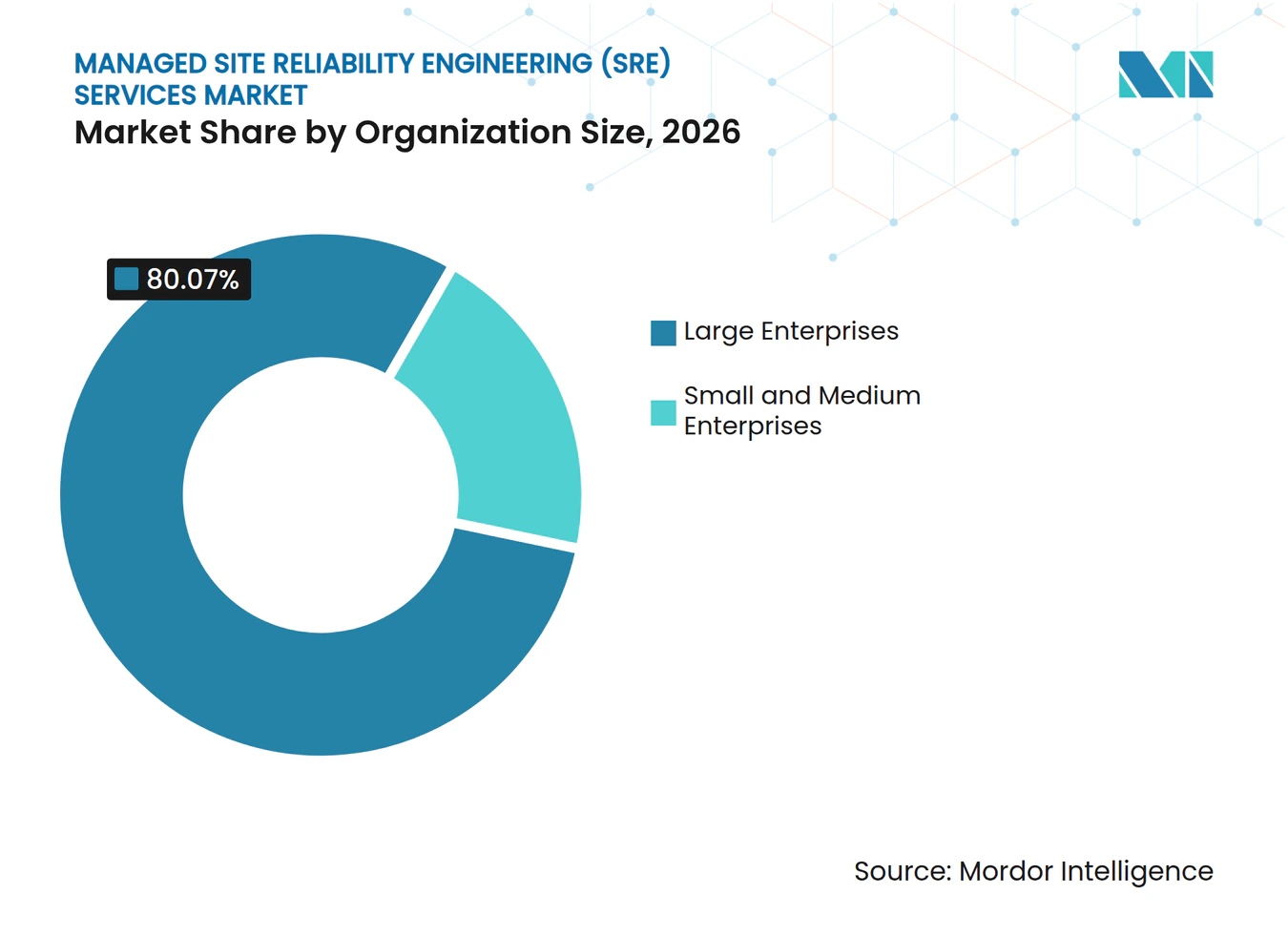
- By organization size, Large Enterprises accounted for 80.07% of the managed SRE services market in 2026, while SMEs are projected to expand at a 14.87% CAGR through 2032.
- By end-user industry, BFSI held 23.87% of the managed SRE services market share in 2026, while IT and Telecom are projected to expand at a 15.96% CAGR through 2032.
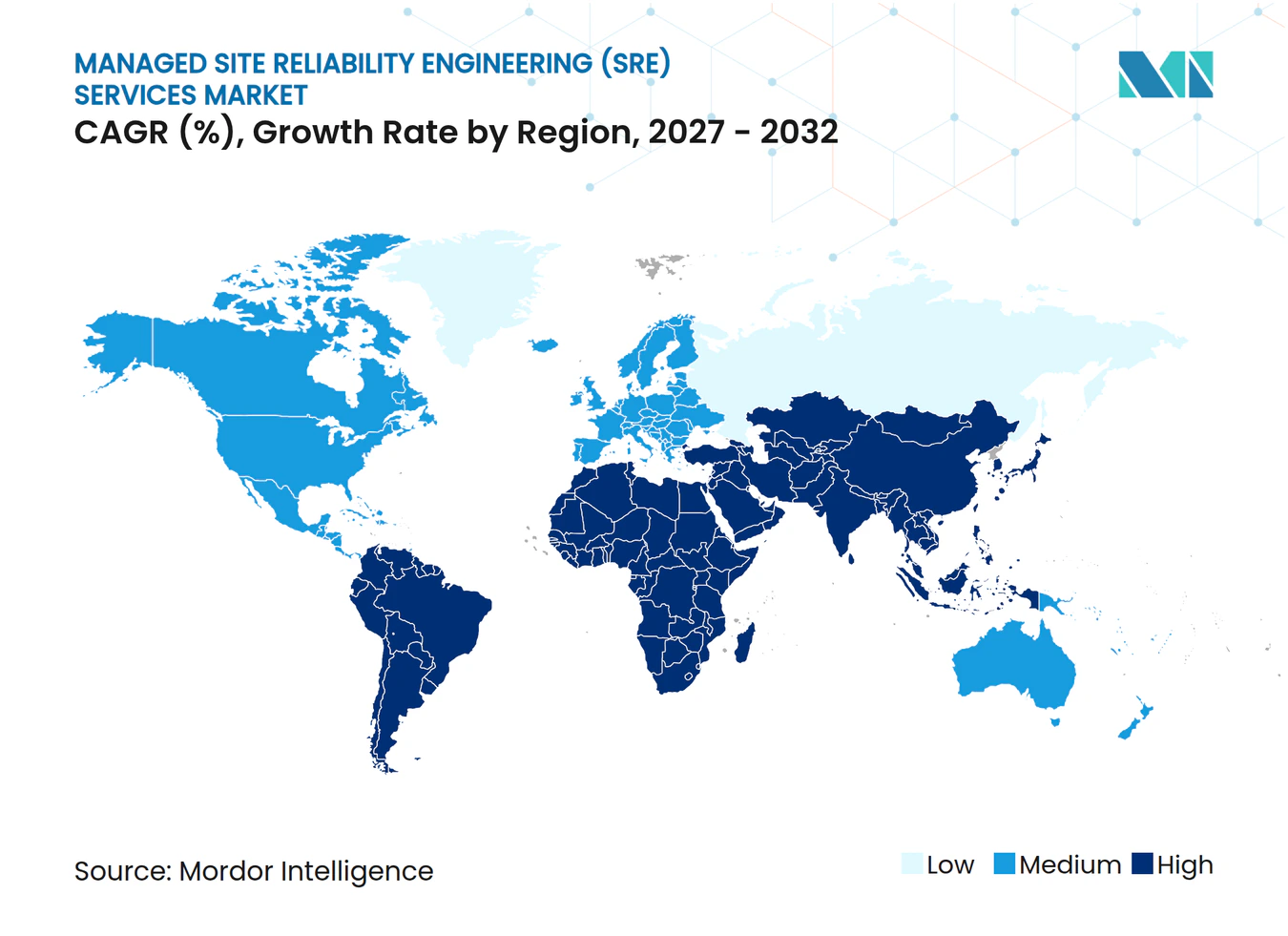
- By geography, North America accounted for 46.13% of the managed SRE services market in 2026, while Asia-Pacific is projected to expand at a 15.61% CAGR through 2032.
Note: Market numbers in this report are based on Mordor Intelligence's proprietary estimation framework, which combines nine months of actuals with Q4 projections for base year 2026.
Market Trends and Insights
Drivers Impact Analysis of Managed Site Reliability Engineering (SRE) Services Market*
| Driver | (~) % Impact on CAGR Forecast | Geographic Relevance | Impact Timeline |
|---|---|---|---|
| Enterprise Cloud and Distributed-Systems Complexity | +3.5% | Global | Long term (≥ 4 years) |
| Shortage of Experienced SRE Talent | +3.2% | Global, acutely concentrated in North America and Europe | Medium term (2-4 years) |
| Demand for 24/7 Digital-Service Availability | +2.8% | Global | Long term (≥ 4 years) |
| Generative AI and Autonomous Incident Response | +2.5% | North America and Europe, with Asia-Pacific accelerating | Medium term (2-4 years) |
| SME Adoption of Outsourced Reliability Operations | +1.9% | Global, led by North America and Asia-Pacific | Medium term (2-4 years) |
| Multi-Cloud Reliability Governance Requirements | +1.6% | North America and the EU, extending to Asia-Pacific | Long term (≥ 4 years) |
| Source: Mordor Intelligence | |||
Enterprise Cloud and Distributed-Systems Complexity Drives Foundational Demand
Microservices, Kubernetes-native architectures, and layered cloud dependencies place operational demands beyond many traditional IT teams. The operational gap often emerges after migration, when teams must govern reliability across interdependent applications, services, and cloud resources rather than simply completing the initial infrastructure migration. Managed SRE providers build service-level objectives, error budgets, and observability into operating processes from deployment onward. Enterprises may otherwise need 5 to 7 years to develop comparable capabilities internally. AI inference workloads further increase latency and availability requirements across cloud-native systems. This complexity keeps the managed SRE services market focused on operational outcomes instead of basic infrastructure administration.
Shortage of Experienced SRE Talent Accelerates Outsourcing Decisions
SRE work requires a blend of infrastructure engineering, software development, and cloud operations skills. An experienced practitioner typically has 5 to 10 years of experience across these disciplines, which makes recruitment difficult for enterprises competing with large technology companies. The supplied workforce evidence reported 79,000 open IT roles across the DACH region in 2026. An internal team of 4 to 5 specialists who cover operations around the clock can cost more than USD 1 million per year. Managed alternatives can provide similar coverage without requiring every enterprise to assemble that team. This cost-and-talent gap supports outsourcing decisions in the managed SRE services market.
Demand for 24/7 Digital-Service Availability Narrows the Build-versus-Buy Calculation
Financial services firms reported an average cost of USD 1.8 million per hour for a high-business-impact outage. The same financial services evidence reported that 29% of respondents experienced those outages at least weekly. Poor performance can be as damaging as a full outage for customer-facing digital services. Managed providers can take first-response duties and apply established observability processes, allowing internal engineers to spend less time responding to disruption. Financial services respondents also reported strong returns from observability investment, with 42% stating that it generated 2x or greater ROI. These conditions strengthen the commercial case for the managed SRE services market.
Generative AI and Autonomous Incident Response Redefine the Managed-SRE Value Proposition
AI agents are extending reliability work from assisted triage toward supervised remediation. Google described how its SRE teams used Gemini CLI to inspect configuration changes and production logs, prepare code changes, and support authorized rollout decisions during live incidents. PagerDuty reported that early adopters of its AI agent suite achieved incident resolution rates up to 50% faster. Microsoft expanded Azure SRE Agent connections with Dynatrace, New Relic, and Datadog through Model Context Protocol servers in November 2025.[1] These tools can improve analysis speed, but production authorization and human oversight remain central to adoption. The managed SRE services market can therefore offer AI-supported operations without removing enterprise control.
Restraints Impact Analysis of Managed Site Reliability Engineering (SRE) Services Market*
| Restraint | (~) % Impact on CAGR Forecast | Geographic Relevance | Impact Timeline |
|---|---|---|---|
| Data Residency and Cross-Border Operational-Control Requirements | -1.8% | EU, Asia-Pacific, Middle East, and global multinationals | Long term (≥ 4 years) |
| Reluctance to Outsource Mission-Critical Production Operations | -1.4% | Global, particularly BFSI, healthcare, and government | Medium term (2-4 years) |
| Fragmented Telemetry and Customer Toolchain Integration | -1.0% | Global | Short term (≤ 2 years) |
| Reliability Accountability Gaps in Shared-Responsibility Environments | -0.7% | Global | Medium term (2-4 years) |
| Source: Mordor Intelligence | |||
Data Residency and Cross-Border Operational-Control Requirements Constrain Global Delivery Models
Data localization rules increase the operating complexity of cross-border managed SRE delivery. The EU Data Act has been in force since September 2025 and includes safeguards regarding third-country government access to non-personal data held in the EU. DORA requires financial entities to maintain provisions on audit access, data recoverability, and exit strategies in ICT contracts. Saudi Arabia also applies cross-border transfer rules under its Personal Data Protection Law. Providers must therefore build regional operating capacity and carefully document access controls. These requirements can raise delivery costs within the managed SRE services market.
Reluctance to Outsource Mission-Critical Production Operations Slows Penetration in Core Enterprise Accounts
Many regulated organizations hesitate to grant external teams production write access, escalation authority, or ownership of service-level objectives. This concern is especially visible in BFSI, healthcare, and government settings where audit trails and internal controls are central. Shared responsibility can also complicate incident resolution when internal and provider teams disagree over system-layer ownership. Co-managed services allow enterprises to retain key decisions while using external tooling and specialist support. Project-based work can provide a lower-risk entry point before a company adopts a fully managed arrangement. This trust threshold slows adoption even as the managed SRE services market addresses a real operating need.
*Our forecasts treat driver/restraint impacts as directional, not additive. The impact forecasts reflect baseline growth, mix effects, and variable interactions.
Managed Site Reliability Engineering (SRE) Services Market Segment Analysis
By Service Type:
Managed Operations Leads Ongoing Reliability DeliveryManaged SRE Operations held 44.12% market share in the managed SRE services market in 2026. This position reflects buyer demand for continuous production support rather than one-time advice. Organizations increasingly assess providers through service-level objective attainment and mean time to resolution. Those measures support recurring contracts built around defined reliability outcomes. Managed operations also place responsibility for first response, observability, and improvement cycles within a single delivery model.
SRE Consulting and Advisory remains relevant for enterprises that are earlier in their reliability programs. These buyers may need architecture guidance, governance design, or operating models before shifting production responsibility. SRE Implementation and Transformation work is often connected to cloud migration programs. Organizations can use implementation engagements to set service-level objectives and establish observability before entering run-state operations. Staffing and staff augmentation address immediate skill gaps, while assessments, audits, training, and enablement serve organizations at different maturity levels. Rising operational toil reinforces the role of managed operations, as Catchpoint reported that toil accounted for 30% of engineering work in 2025.



By Engagement Model:
Fully Managed SRE Combines Scale and ResponsibilityFully managed SRE accounted for 52.29% of the managed SRE services market share in 2026. The model is projected to expand at a 15.17% CAGR through 2032. It appeals to enterprises that have established confidence in external operating controls. These organizations can redirect internal engineers toward product work rather than routine on-call rotations. The model also enables providers to run more consistent processes across incident detection, triage, recovery, and review.
Co-Managed SRE provides a middle path for enterprises that need specialist capability but want to retain internal authority. It is especially relevant where leaders must approve production decisions or maintain direct operational ownership. Project-Based SRE supports defined transformation programs and can help a buyer evaluate a provider. Many organizations begin with a bounded engagement before considering a larger transfer of responsibility. PagerDuty introduced early access to its SRE Agent in the Spring 2026 release with bounded autonomy, explicit authorization, and audit trails. Such controls can make fully managed engagement more acceptable in regulated accounts.
By Deployment Model:
Cloud-Based Delivery Is the Core ModelCloud-based delivery accounted for 76.34% of the managed SRE services market in 2026. Public cloud workloads and cloud-native observability tools provide a strong technical fit for this delivery model. Providers can collect telemetry, define service-level objectives, and coordinate response processes across distributed environments. The model also supports centralized visibility for applications that run across multiple cloud services. It remains the default choice for organizations that have already deployed major workloads on public cloud platforms.
Hybrid deployment is projected to expand at a 15.21% CAGR through 2032. It combines cloud-delivered observability with on-premises control for selected workload tiers. This approach matters in regulated sectors that need unified dashboards across cloud and local environments. On-premises delivery retains a role in air-gapped settings and highly restricted environments. Sovereign cloud options are reducing some jurisdictional barriers that previously favored fully local operations. The AWS European Sovereign Cloud opened to customers in 2025, illustrating a direction that can broaden cloud-based reliability options.
By Organization Size:
Large Enterprises Anchor Revenue While SMEs Expand AdoptionLarge Enterprises represented 80.07% of the managed SRE services market size in 2026. Their larger application estates and higher contract values make them important revenue sources for established providers. They often need formal service-level agreements, reporting, and governance across many teams. Longer procurement processes can slow initial contract awards, but they also support longer commitments after a provider is selected. Large enterprises commonly use managed SRE alongside internal platform and cloud teams.
SMEs are projected to expand at a 14.87% CAGR through 2032. Many smaller cloud-native companies cannot justify an internal team to provide continuous coverage. Their needs favor modular services with pre-built incident playbooks and integration-ready observability configurations. JumpCloud reported that SME trust in managed service providers for full IT management rose from 26.6% in 2023 to 42% in early 2025.[2] Providers serving this group need simpler onboarding and a product-led delivery approach. This contrast makes the managed SRE services industry serve both enterprise consulting and standardized service models.

By End-User Industry:
BFSI Holds Revenue Leadership While IT and Telecom Advances FastestBFSI held 23.87% of the managed SRE services market share in 2026. High outage costs and operational resilience requirements make continuous reliability work important in this sector. Evidence from the financial services outage placed the average high-business-impact cost at USD 1.8 million per hour. DORA introduces requirements for oversight of third-party ICT arrangements within the EU. Financial institutions also need clear audit trails for incident response and production changes.
IT and Telecom is projected to expand at a 15.96% CAGR through 2032. Telecom operators are moving toward cloud-native OSS and BSS, network function virtualization, and software-defined 5G cores. These changes increase the need for consistent performance management across distributed network and software layers. Network operators are also placing greater weight on automated observability and reliable response processes as their service stacks become more software-defined. Retail and e-commerce, healthcare and life sciences, manufacturing, government and public sector, and other industries have distinct service-level requirements. Their adoption pace depends on outage exposure, regulatory demands, and willingness to use external operators.
Geography Analysis
North America Managed Site Reliability Engineering (SRE) Services Market
North America accounted for 46.13% of the managed SRE services market in 2026. The region combines substantial enterprise technology budgets with a mature managed-service ecosystem. The United States leads regional demand through financial services, technology, and retail organizations with large cloud estates. The supplied cloud management evidence reported that 62% of U.S. enterprises used managed service providers for at least some public cloud management.[3] Canada is expanding with its technology employment base, while Mexico is developing as a nearshore delivery location for U.S. customers.
Europe and South America Managed Site Reliability Engineering (SRE) Services Market
Europe is shaped by regulations that create demand for operational resilience and limit simple cross-border delivery. The United Kingdom is the largest single European market, followed by Germany and the Netherlands. Financial services, manufacturing, and digital infrastructure support regional demand. DORA establishes requirements that affect ICT third-party contracts for EU financial entities. The reported 79,000 open IT positions in DACH add to pressure on mid-market companies to use external reliability capability. South America, led by Brazil and Argentina, is developing as cloud use rises across financial services and e-commerce.
APAC and MEA Managed Site Reliability Engineering (SRE) Services Market
Asia-Pacific is projected to expand at a 15.61% CAGR through 2032. India is both a major user of managed services and a leading delivery hub for global engagements. Japan combines a mature enterprise base, an SRE talent gap, and a focus on digital financial infrastructure. Hitachi’s Application Reliability Center service supported Japan Card Network’s modernization in August 2026, covering a credit payment platform that processes 40.9 billion transactions annually through 858,000 terminals. China is supported by the reliability of digital payments and e-commerce, while Singapore is a hub for Southeast Asian deployments. Australia and South Korea contribute to regional demand, while the Middle East and Africa remain earlier-stage opportunities shaped by digital transformation and data sovereignty requirements.
Competitive Landscape
Market Concentration
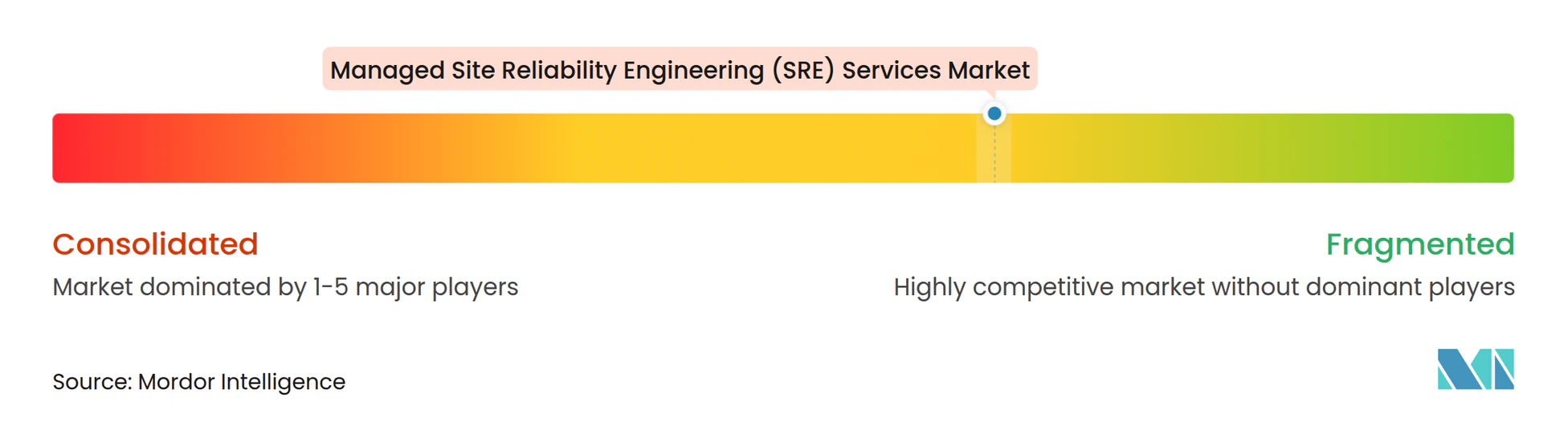
The managed SRE services market is moderately fragmented. Observability and incident-management vendors hold visible positions because their software underpins many managed service offerings. PagerDuty, Datadog, Dynatrace, and New Relic compete alongside global system integrators, regional specialists, and newer AI-native providers. Hyperscaler-native monitoring capabilities place pressure on independent platform vendors. As a result, providers are strengthening interoperability, AI functions, and integration ecosystems. Security certifications and evidence of third-party risk controls also influence buying decisions in regulated sectors.
Technology partnerships are central to competitive strategy in the managed SRE services market. Dynatrace and ServiceNow announced a multiyear collaboration in October 2025 to combine AI-powered observability with AI-driven IT service management.[4] Datadog signed an expanded collaboration agreement with AWS in December 2025 covering joint solution development, Marketplace availability, and go-to-market programs. Dynatrace also announced acquisitions of Arize AI and Bindplane during 2026, seeking broader AI observability and telemetry pipeline capability. These actions show that providers are seeking control across monitoring, data movement, incident response, and AI workloads.
SMEs and sovereign cloud settings offer distinct competitive opportunities. Large vendor platforms can be costly for smaller organizations unless offerings are simplified and packaged for faster adoption. Local providers can also have an advantage where in-region infrastructure and local operational controls are necessary. Nobl9, Chronosphere, and incident.io focus on service-level objective management, cloud-native observability, and structured incident workflows. Their focused products can fit into broader enterprise SRE programs without replacing every incumbent platform. Providers that offer transparent service-level reporting, joint incident procedures, and bounded AI autonomy can reduce the trust barrier that limits the adoption of fully managed services.
Managed Site Reliability Engineering (SRE) Services Industry Leaders
-
PagerDuty, Inc.
-
Datadog, Inc.
-
Dynatrace, Inc.
-
New Relic, Inc.
-
Nobl9, Inc.
- *Disclaimer: Major Players sorted in no particular order
Managed Site Reliability Engineering (SRE) Services Market Companies Covered in this Report
- PagerDuty, Inc.
- Datadog, Inc.
- Dynatrace, Inc.
- New Relic, Inc.
- Nobl9, Inc.
- Circonus, Inc.
- BigPanda, Inc.
- OpsLevel, Inc.
- Shoreline Software, Inc.
- Rootly, Inc.
- FireHydrant, Inc.
- Squadcast, Inc.
- Gremlin, Inc.
- Catchpoint Systems, Inc.
- LogicMonitor, Inc.
- Grafana Labs, LLC
- Chronosphere, Inc.
- LightStep, Inc.
- incident.io, Inc.
- Blameless, Inc.
Recent Industry Developments in Managed Site Reliability Engineering (SRE) Services Market
- August 2026: Hitachi's Application Reliability Center (HARC) managed-SRE service was engaged to support Japan Card Network's credit-payment platform modernization, a mission-critical system that processes approximately 40.9 billion transactions annually across approximately 858,000 terminals. HARC's SRE and Platform Engineering specialists defined SLOs, operating models, and DevSecOps guardrails for a phased hybrid-cloud migration.
- April 2026: Dynatrace announced the acquisition of Bindplane, a telemetry pipeline provider, to establish a unified data-ingestion layer for AI and cloud-native observability across multi-cloud and hybrid environments, strengthening the technical foundation of managed-SRE service delivery.
- March 2026: PagerDuty unveiled the Spring 2026 release of its Operations Cloud platform, introducing early access to its SRE Agent as a virtual responder that integrates into team escalation policies, performs AI-driven diagnostics before alerting human responders, and draws on 16 years of historical incident data. The platform serves more than 35,000 organizations across over 700 integrations.
- January 2026: Dynatrace introduced domain-specific agents that extend the capabilities of SRE, development, and security teams with trusted, autonomous action and expanded cloud operations integrations across AWS, Azure, and Google Cloud environments, advancing its AI-native observability positioning for enterprise-managed SRE customers.
Global Managed Site Reliability Engineering (SRE) Services Market Report Scope
The Managed SRE Services Market refers to the provision of outsourced site reliability engineering services that help organizations maintain the availability, performance, scalability, and reliability of production applications and IT systems. The market includes managed SRE operations, consulting and advisory, implementation and transformation, staffing, reliability assessments, and training, delivered through fully managed, co-managed, or project-based engagement models across cloud, hybrid, and on-premises environments.
The Managed Site Reliability Engineering (SRE) Services Market Report is Segmented by Service Type (Managed SRE Operations, SRE Consulting and Advisory, SRE Implementation and Transformation, Staffing and Staff Augmentation, SRE Training and Enablement, Reliability Assessment and Audit Services), Engagement Model (Fully Managed SRE, Co-Managed SRE, and Project-Based SRE), Deployment Model (Cloud-Based, Hybrid, and On-Premises), Organization Size (Large Enterprises and Small and Medium Enterprises), End-User Industry (Banking, Financial Services and Insurance [BFSI], IT and Telecom, Retail and E-Commerce, Healthcare and Life Sciences, Manufacturing, Government and Public Sector, and Other End-User Industries), and Geography (North America, South America, Europe, Asia-Pacific, Middle East, and Africa). The Market Forecasts are Provided in Terms of Value (USD).
Segmentation Overview
| Managed SRE Operations |
| SRE Consulting and Advisory |
| SRE Implementation and Transformation |
| SRE Staffing and Staff Augmentation |
| SRE Training and Enablement |
| Reliability Assessment and Audit Services |
| Fully Managed SRE |
| Co-Managed SRE |
| Project-Based SRE |
| Cloud-Based |
| On-Premises |
| Hybrid |
| Large Enterprises |
| Small and Medium Enterprises |
| BFSI |
| IT and Telecom |
| Retail and E-Commerce |
| Healthcare and Life Sciences |
| Manufacturing |
| Government and Public Sector |
| Other End-User Industries |
| North America | United States |
| Canada | |
| Mexico | |
| South America | Brazil |
| Argentina | |
| Chile | |
| Rest of South America | |
| Europe | United Kingdom |
| Germany | |
| France | |
| Netherlands | |
| Spain | |
| Rest of Europe | |
| Asia-Pacific | China |
| Japan | |
| India | |
| Australia | |
| Singapore | |
| South Korea | |
| Rest of Asia-Pacific | |
| Middle East | United Arab Emirates |
| Saudi Arabia | |
| Turkey | |
| Rest of Middle East | |
| Africa | South Africa |
| Nigeria | |
| Egypt | |
| Rest of Africa |
| By Service Type | Managed SRE Operations | |
| SRE Consulting and Advisory | ||
| SRE Implementation and Transformation | ||
| SRE Staffing and Staff Augmentation | ||
| SRE Training and Enablement | ||
| Reliability Assessment and Audit Services | ||
| By Engagement Model | Fully Managed SRE | |
| Co-Managed SRE | ||
| Project-Based SRE | ||
| By Deployment Model | Cloud-Based | |
| On-Premises | ||
| Hybrid | ||
| By Organization Size | Large Enterprises | |
| Small and Medium Enterprises | ||
| By End-User Industry | BFSI | |
| IT and Telecom | ||
| Retail and E-Commerce | ||
| Healthcare and Life Sciences | ||
| Manufacturing | ||
| Government and Public Sector | ||
| Other End-User Industries | ||
| By Geography | North America | United States |
| Canada | ||
| Mexico | ||
| South America | Brazil | |
| Argentina | ||
| Chile | ||
| Rest of South America | ||
| Europe | United Kingdom | |
| Germany | ||
| France | ||
| Netherlands | ||
| Spain | ||
| Rest of Europe | ||
| Asia-Pacific | China | |
| Japan | ||
| India | ||
| Australia | ||
| Singapore | ||
| South Korea | ||
| Rest of Asia-Pacific | ||
| Middle East | United Arab Emirates | |
| Saudi Arabia | ||
| Turkey | ||
| Rest of Middle East | ||
| Africa | South Africa | |
| Nigeria | ||
| Egypt | ||
| Rest of Africa | ||
Key Questions Answered in the Report
What is the managed SRE services market size?
The managed SRE services market is projected to expand from USD 5.42 billion in 2026 and USD 6.31 billion in 2027 to USD 12.44 billion by 2032, at a 14.58% CAGR.
What services are included in managed SRE?
The service mix includes managed operations, consulting and advisory, implementation and transformation, staffing, assessments, audits, and training.
Why do enterprises use managed SRE services?
Enterprises use external specialists to support 24/7 operations, reduce internal toil, improve incident response, and operate complex cloud environments.
Which deployment model leads managed SRE adoption?
Cloud-Based delivery led with 76.34% share in 2026, while Hybrid deployment is projected to expand at a 15.21% CAGR through 2032.
Which organizations are adopting managed SRE services most quickly?
SMEs are projected to expand at a 14.87% CAGR through 2032 because many cannot justify a full internal on-call SRE team.
Which end-user sector has the fastest projected adoption?
IT and Telecom is projected to expand at a 15.96% CAGR through 2032, supported by cloud-native operations and 5G core reliability requirements.