
Managed Application Hosting Services Market Size and Share
Market Overview
| Study Period | 2021 - 2032 |
|---|---|
| Market Size (2027) | USD 32.21 Billion |
| Market Size (2032) | USD 55.09 Billion |
| Growth Rate (2027 - 2032) | 11.32 % |
| Fastest Growing Market | Asia-Pacific |
| Largest Market | North America |
| Market Concentration | Medium |
Major Players *Disclaimer: Major Players sorted in no particular order Image © Mordor Intelligence. Reuse requires attribution under CC BY 4.0. | |
Managed Application Hosting Services Market Analysis by Mordor Intelligence
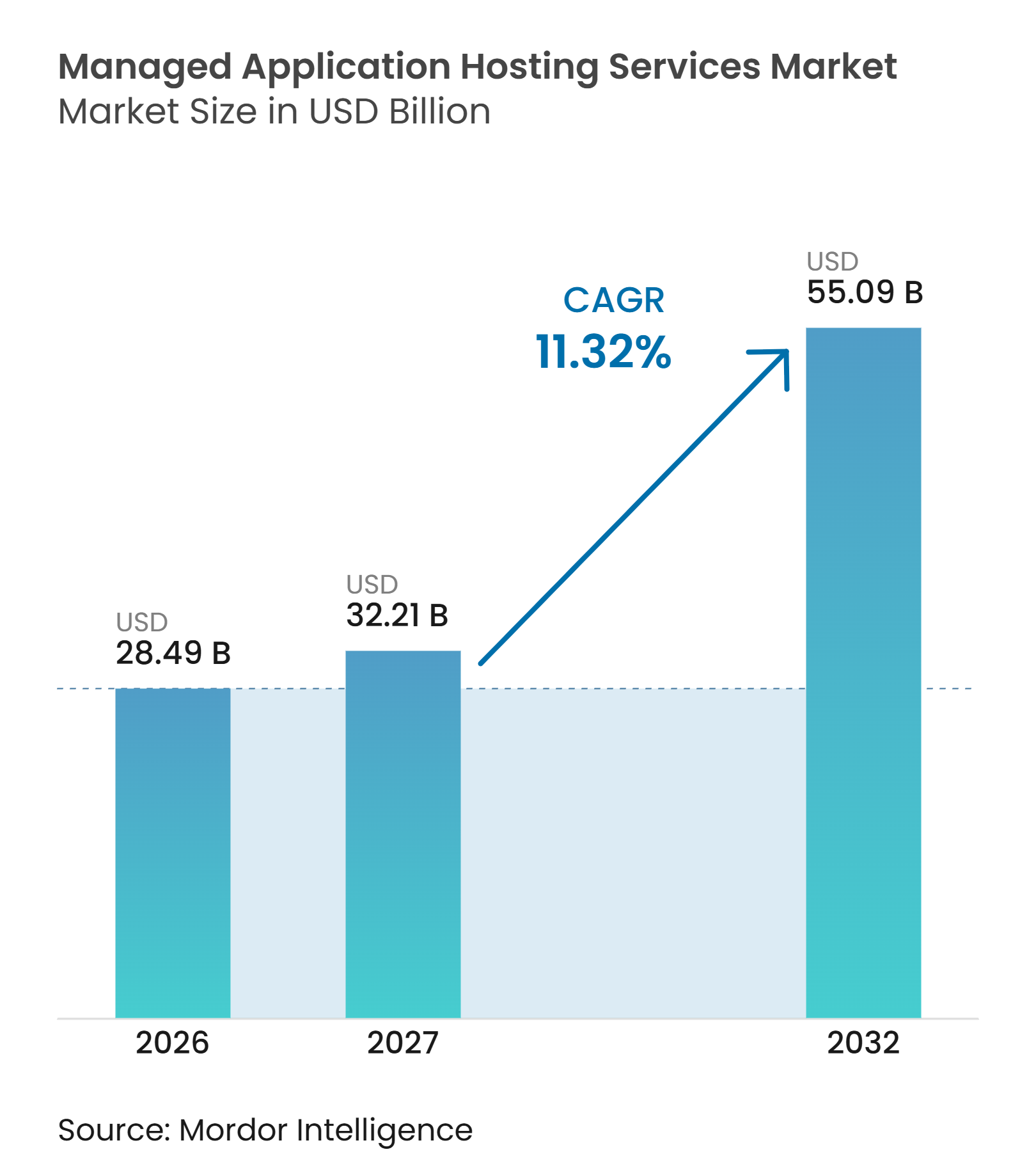
The managed application hosting services market size is projected to expand from USD 28.49 billion in 2026 and USD 32.21 billion in 2027 to USD 55.09 billion by 2032, registering a CAGR of 11.32% between 2027 to 2032. The managed application hosting services market is being shaped by enterprise use of hybrid and multi-cloud infrastructure, which is increasing the work required to operate applications across on-premises systems, cloud platforms, and edge locations. Many organizations face a gap between the complexity of these environments and the skills available within their internal teams, especially when multiple vendors and application types must be supported at the same time. Downtime exposure, cloud-spend controls, security obligations, and compliance requirements are also moving managed operations from a cost decision toward a core operating requirement. Providers are responding by combining hosting with observability, security operations, governance, and support for AI workloads. Opportunities in the managed application hosting services market are strongest where providers can offer compliance capability, reliable application operations, and workload placement support without creating excessive migration barriers.
Key Report Takeaways
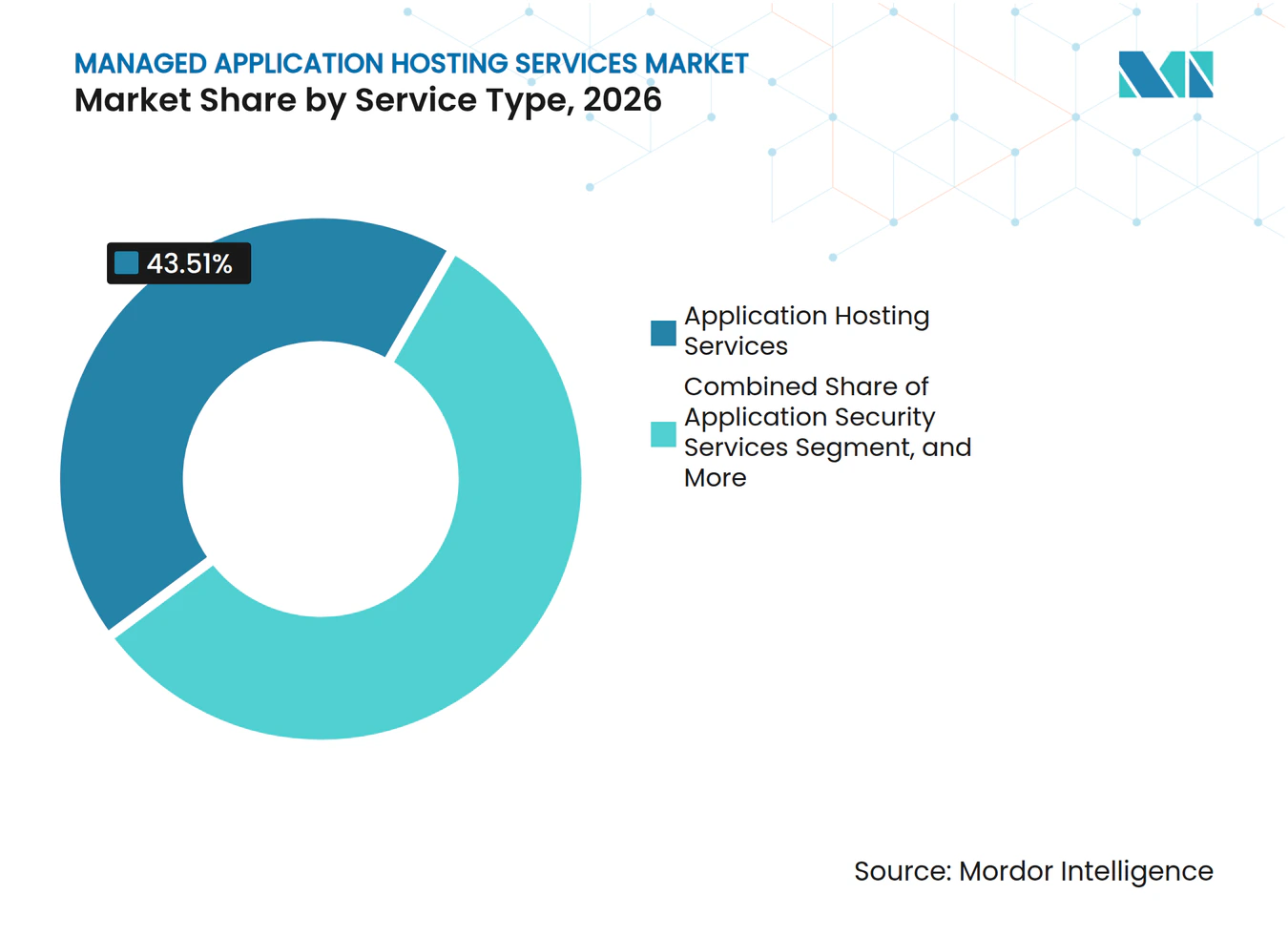
- By service type, Application Hosting Services held 43.51% of the managed application hosting services market share in 2026, while Application Security Services is projected to expand at a 12.31% CAGR through 2032.
- By deployment model, cloud-based hosting accounted for 66.32% of revenue in 2026 and is projected to expand at an 11.89% CAGR through 2032.
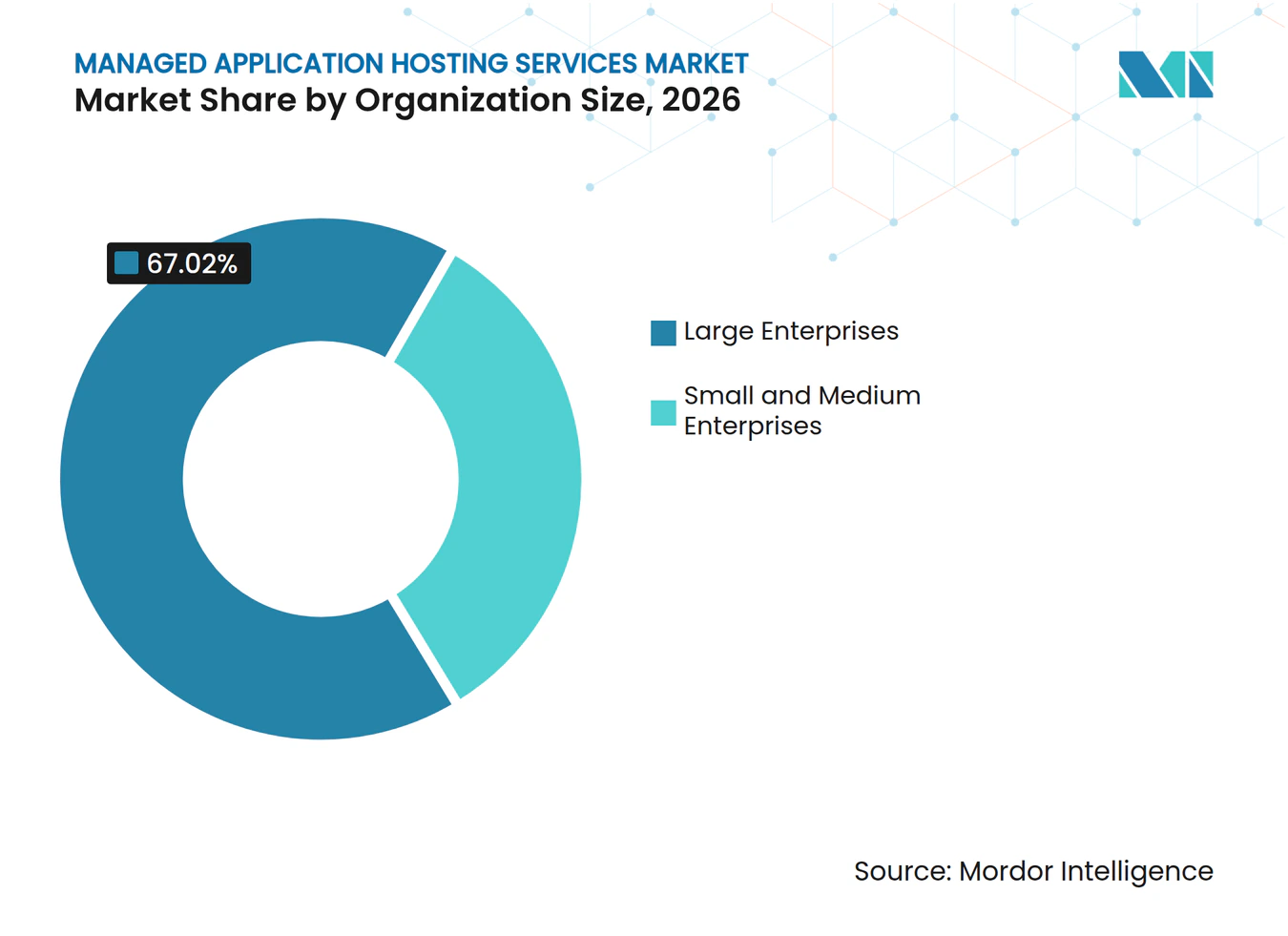
- By organization size, large enterprises held 67.02% of revenue in 2026, while SMEs are projected to expand at an 11.74% CAGR through 2032.
- By industry vertical, BFSI accounted for 20.71% of revenue in 2026, while Healthcare and Life Sciences are projected to expand at a 12.53% CAGR through 2032.
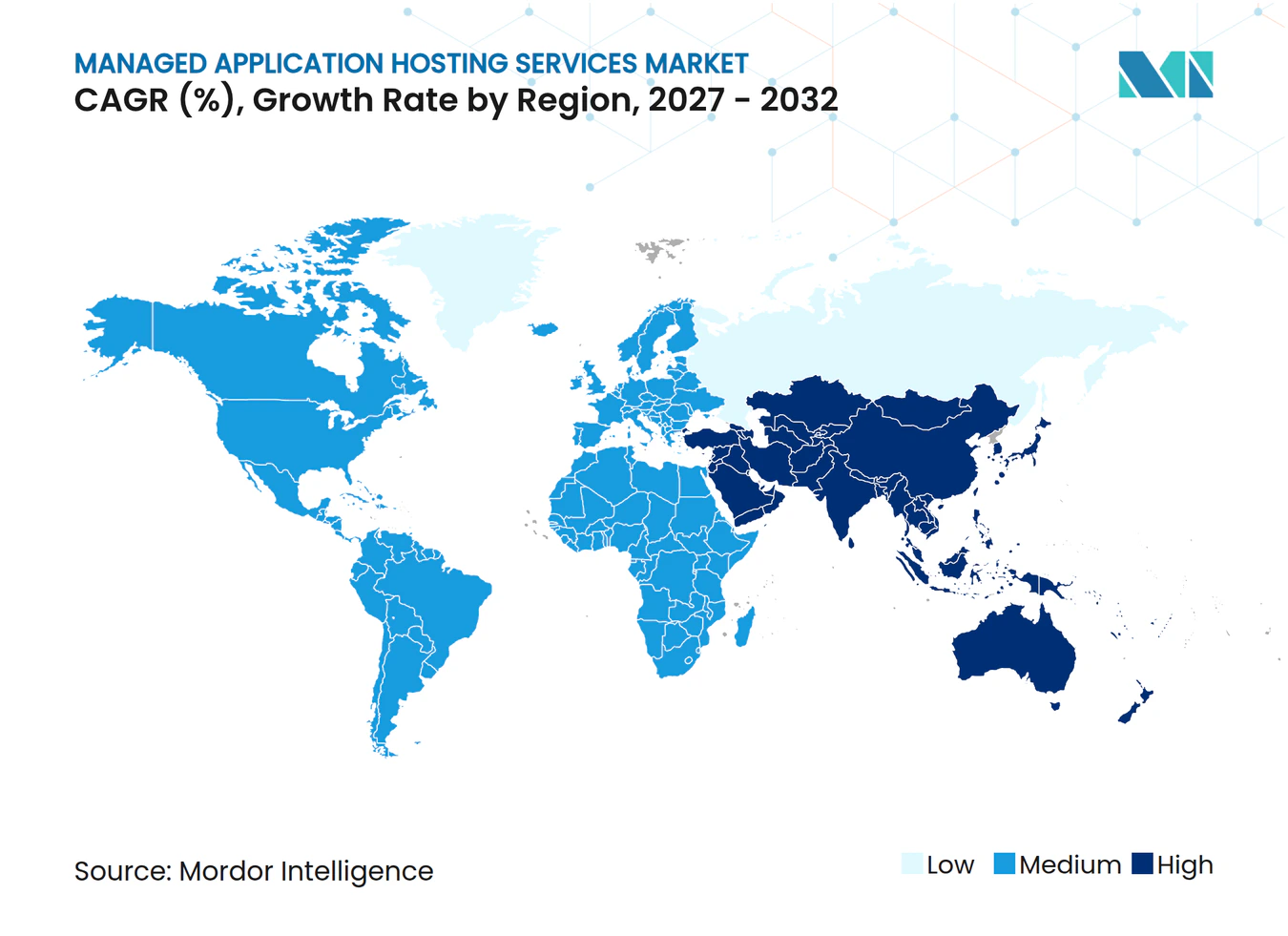
- By geography, North America held 41.05% of the managed application hosting services market share in 2026, while Asia-Pacific is projected to expand at a 12.28% CAGR through 2032.
Note: Market numbers in this report are based on Mordor Intelligence's proprietary estimation framework, which combines nine months of actuals with Q4 projections for base year 2026.
Market Trends and Insights
Drivers Impact Analysis of Managed Application Hosting Services Market*
| Driver | (~) % Impact on CAGR Forecast | Geographic Relevance | Impact Timeline |
|---|---|---|---|
| Cloud Migration and Hybrid Environment Complexity | +2.8% | Global, with concentration in North America and Europe | Medium term (2-4 years) |
| Security, Compliance, and Business Continuity Requirements | +2.4% | Global, with highest intensity in BFSI and Healthcare across North America, Europe, and Asia-Pacific | Long term (≥ 4 years) |
| Rising Application Downtime and Performance Cost Exposure | +2.1% | Global, pronounced in financial services and digital commerce | Short term (≤ 2 years) |
| AI Workload Placement and Inference Latency Optimization | +1.9% | North America, Europe, and Asia-Pacific core | Medium term (2-4 years) |
| Shortage of Specialized Application Operations Talent | +1.8% | Global, acute in North America, Germany, and Japan | Medium term (2-4 years) |
| Consumption-Based FinOps and Infrastructure Utilization Optimization | +1.3% | North America and Europe, with spillover to Asia-Pacific | Short term (≤ 2 years) |
| Source: Mordor Intelligence | |||
Cloud Migration and Hybrid Environment Complexity Drive Structural Demand
Enterprise cloud programs have moved beyond early lift-and-shift projects into more complex migrations of connected legacy systems. This change raises the need for operating expertise that many internal IT teams cannot maintain across several clouds and on-premises platforms. F5 reported that 97% of surveyed organizations agreed that no single application deployment model fits every requirement, which reflects the ongoing need to optimize hybrid and multi-cloud environments.[1] The managed application hosting services market benefits when providers can monitor, secure, and support these varied environments under a single service model. Enterprises also need help deciding where workloads should run when security, performance, and cost requirements change. This need remains after migration because workload placement must be reviewed as application demand and infrastructure conditions evolve.
Security, Compliance, and Business Continuity Requirements Sustain Enterprise Reliance
Security and compliance obligations are central to the selection of managed hosting for organizations with regulated applications. ISO 27001, SOC 2 Type II, FedRAMP, HIPAA, and the General Data Protection Regulation can determine whether a provider is eligible for contracts in BFSI, healthcare, and public-sector settings. ISC2 identified third-party access to the management layer as a major risk in shared service environments, increasing the value placed on audited controls and documented provider governance. Splunk reported that 54% of respondents had experienced a security incident that originated with a SaaS provider or third-party application. These conditions strengthen the managed application hosting services market for providers that can demonstrate established control processes, incident management, and continuity planning. They also favor operators with dedicated compliance teams over providers that rely only on general hosting capabilities.
Rising Application Downtime and Performance Cost Exposure Create Urgency
Unplanned application downtime creates a direct financial reason to use managed operations services. New Relic found that high-impact IT outages had a median cost of USD 2 million per hour and an annual median cost of USD 76 million among surveyed organizations. The same research found that teams with full-stack observability experienced high-impact outages less frequently and detected incidents an average of 7 minutes faster. Catchpoint reported that 51% of organizations incurred monthly losses exceeding USD 1 million due to internet outages or service degradation. The managed application hosting services market, therefore, rewards providers that can identify failures before customers report them. Reliable monitoring, incident response, and performance management can reduce pressure on internal teams lacking continuous operational coverage.
AI Workload Placement and Inference Latency Optimization Reshape Hosting Architectures
AI inference workloads place different demands on hosting environments than conventional applications. They require access to GPU resources, routing that accounts for cache usage, and service levels that meet latency requirements. DigitalOcean reported that an implementation with Workato's AI Research Lab team achieved 67% lower model cost and 79% lower end-to-end latency through NVIDIA H200 GPUs, NVIDIA Dynamo, vLLM, and DigitalOcean Kubernetes Service. The Cloud Native Computing Foundation introduced Kthena in January 2026 and reported 2.73 times higher throughput and a 73.5% reduction in time to first token compared with random baseline routing. The managed application hosting services market can capture these workloads when providers turn such infrastructure practices into managed services. Providers that support intelligent scheduling and inference optimization can address workloads that are otherwise maintained by customers themselves.
Restraints Impact Analysis of Managed Application Hosting Services Market*
| Restraint | (~) % Impact on CAGR Forecast | Geographic Relevance | Impact Timeline |
|---|---|---|---|
| Application Data Security and Third-Party Access Risk | -1.4% | Global, most acute in BFSI and Healthcare across North America and Europe | Medium term (2-4 years) |
| Vendor Lock-In and Limited Application Portability | -1.2% | Global, with regulatory amplification in Europe through the General Data Protection Regulation and EU Data Act | Long term (≥ 4 years) |
| Data Center Power, Cooling, and Capacity Constraints | -0.8% | North America and Asia-Pacific core, with spillover to Middle East and Africa | Medium term (2-4 years) |
| Fragmented Observability and Difficult Service Exit Processes | -0.6% | Global | Long term (≥ 4 years) |
| Source: Mordor Intelligence | |||
Application Data Security and Third-Party Access Risk Limit Enterprise Confidence
Delegating application operations to a third party creates a continuing security concern for enterprise buyers. Splunk reported that financial services organizations averaged 6.5 cyber incidents and 7.3 infrastructure and application incidents a year that were linked to human error. The same research reported that 54% of respondents had encountered security incidents involving a SaaS provider or third-party application. Enterprises must assess provider controls, supply chain risks, and incident-response responsibilities before moving critical applications. Limited access to infrastructure telemetry can also make independent forensic work more difficult after an incident. These concerns constrain the managed application hosting services market most clearly in BFSI and healthcare, where regulators may directly examine third-party service providers.
Vendor Lock-In and Limited Application Portability Raise Strategic Costs
Managed hosting environments can create switching friction when applications become closely linked to a provider's tools and operating processes. The Cloud Security Alliance found that 71% of companies standardize on a single cloud service provider, despite chief information officers' preference for multi-cloud sourcing. The finding shows how operational requirements can outweigh stated preferences for portability. The EU Data Act promotes switching procedures and interoperability, but implementation will take time, and customers will remain constrained during much of the forecast period.[2] Migration labor, disruption risk, and application reconfiguration can make the cost of leaving a provider comparable to the initial migration investment. Buyers will continue to favor providers that offer clear exit processes, portable architectures, and transparent access to operational data.
*Our forecasts treat driver/restraint impacts as directional, not additive. The impact forecasts reflect baseline growth, mix effects, and variable interactions.
Managed Application Hosting Services Market Segment Analysis
By Service Type:
Core Hosting Services Anchor RevenueApplication Hosting Services held 43.51% of the managed application hosting services market share in 2026, making it the leading service category. Hosting is the foundational layer on which customers add management, integration, security, and development support. Enterprises commonly secure infrastructure and hosting capacity before extending contracts to cover a wider set of operational needs. This purchase pattern supports recurring demand for managed application hosting services across large, distributed application estates.
Application Security Services is projected to expand at a 12.31% CAGR through 2032, the fastest rate among the service types. The segment is supported by the need for continuous monitoring, vulnerability management, and incident response. Application Management and Support Services remain important for release management, patching, and L2 and L3 support across multi-vendor portfolios. Integration and development services have a smaller revenue role, but they help customers reduce the coordination burden of working with several providers. The managed application hosting services industry is therefore moving toward service bundles that combine stable hosting with application operations and security support.



By Deployment Model:
Cloud-Based Hosting Commands Most SpendingCloud-based hosting accounted for 66.32% of the managed application hosting services market size in 2026 and is projected to expand at an 11.89% CAGR through 2032. The segment reflects enterprise confidence in moving infrastructure operations to specialized providers. GenAI adoption and cloud-centered application architectures are also increasing the need for managed cloud operations. Organizations use these services when they need flexible infrastructure capacity without expanding internal operational teams.
Sovereign cloud programs in Germany, France, and Japan are creating distinct demand for cloud-based managed hosting. Data residency, regulatory certification, and geopolitical independence are becoming procurement requirements in these environments. On-premises managed hosting remains relevant for regulated organizations and legacy application estates that cannot move without major business disruption. Hybrid deployment continues to serve workloads that require local processing, tighter control, or specific data-sovereignty arrangements. The managed application hosting services market must therefore support customers who use multiple deployment model simultaneously.
By Organization Size:
Large Enterprises Lead Revenue While SMEs Expand FasterLarge enterprises commanded 67.02% of the managed application hosting services market share in 2026. Their revenue position reflects a broad portfolio of applications, including ERP, CRM, analytics, and custom-built systems. These organizations also manage distributed deployments and strict service-level requirements. Their scale makes it difficult to sustain dependable operations and compliance management entirely with internal resources.
SMEs are projected to expand at an 11.74% CAGR through 2032 as managed plans and consumption-based pricing lower adoption costs. Providers are packaging capabilities that were once used mainly by larger organizations into services that smaller buyers can procure. Cloudways reported that its Copilot tool reduced average server issue resolution time from 30-40 minutes to 5-6 minutes. This type of automation can make stronger operations support accessible to organizations with smaller IT teams. The managed application hosting services industry can address both buyer groups by balancing enterprise governance needs with simpler service delivery for SMEs.

By Industry Vertical:
BFSI Anchors Revenue While Healthcare and Life Sciences Leads GrowthBFSI held 20.71% of revenue in 2026, the highest share among industry verticals. Banks, insurers, and financial services firms operate applications where uptime, security, and compliance have direct business consequences. New Relic reported that high-impact IT outages cost financial services companies USD 1.8 million per hour on average. This cost structure supports managed operations for critical application environments within the managed application hosting services market.
Healthcare and Life Sciences are projected to expand at a 12.53% CAGR through 2032. Electronic health record migration, telemedicine deployment, and AI-assisted diagnostics all require secure, highly available application infrastructure. HIPAA, HITRUST, and ISO 27001 remain relevant procurement requirements for providers serving this field. Retail and E-Commerce, IT and Telecom, Manufacturing, and Government and Public Sector also contribute to demand. Government bodies are using managed models to update aging application estates without building equivalent in-house data center capacity. The managed application hosting services market has particular room for providers with sector-specific security, continuity, and compliance capabilities.
Geography Analysis
North America Managed Application Hosting Services Market
North America held 41.05% of the managed application hosting services market share in 2026. The region benefits from mature cloud infrastructure, a high concentration of technology-intensive enterprises, and established managed-services procurement across financial services, healthcare, defense, and technology. The United States remains the leading national market because many enterprises operate complex application estates across several locations. Canada adds demand where data residency and privacy requirements create value for providers with certified local infrastructure.
Europe and South America Managed Application Hosting Services Market
South America is smaller but is developing steadily, with Brazil and Argentina leading adoption. Brazilian enterprises are moving more financial services and manufacturing applications to cloud environments, while local data requirements increase the need for in-country infrastructure capacity. Europe is shaped by data sovereignty rules and an expanding regulatory environment that redirects hosting budgets toward locally certified providers. IONOS opened a cloud data center in eastern Frankfurt in August 2025 with ISO 27001, BSI C5, and SOC 1-3 certifications, and the company stated that the facility uses renewable energy.[3] The United Kingdom, France, Italy, Spain, the Benelux countries, and the Nordics continue to exhibit active demand, with data protection and public-sector requirements influencing provider selection.
APAC and MEA Managed Application Hosting Services Market
Asia-Pacific is projected to expand at a 12.28% CAGR through 2032, the fastest regional rate in the managed application hosting services market. China, India, Japan, South Korea, and Southeast Asia are advancing cloud migration programs that require ongoing managed operations support. Sakura Internet introduced its AppRun application execution platform in December 2025 for enterprises and public-sector organizations seeking sovereign hosting options. Data localization requirements in China, India, Indonesia, and Vietnam favor providers that maintain infrastructure within each country. The Middle East and Africa offer long-term potential as Saudi Arabia and the UAE continue to invest in digital infrastructure for government, BFSI, and telecommunications use cases, while South Africa, Nigeria, Egypt, and Kenya lead adoption in Africa through expanding fiber networks and mobile-first digital commerce.
Competitive Landscape
Market Concentration
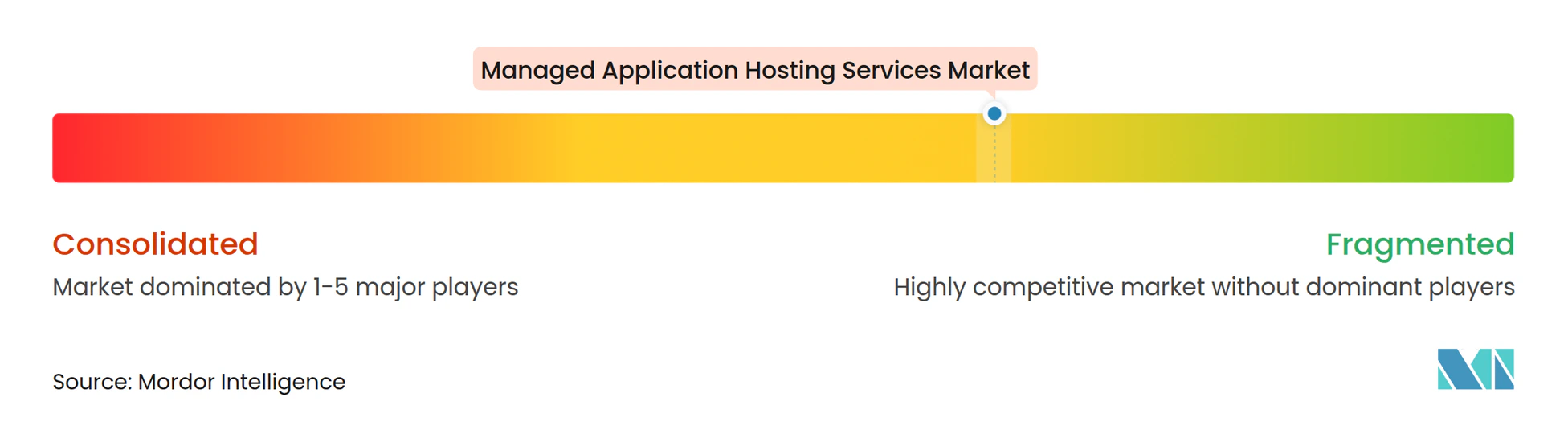
The managed application hosting services market is moderately fragmented. Competition is based on geographic coverage, sovereign compliance capability, AI-optimized infrastructure, and vertical-specific expertise. Rackspace Technology and OVH Groupe compete through broader portfolios and enterprise relationships. Logicworks, Atlantic.Net, and phoenixNAP compete through compliance-focused offerings for regulated customers. HIPAA, PCI DSS, and SOC 2 certifications can raise entry barriers in BFSI and healthcare because they are important in provider qualification.
AI inference hosting is changing competitive positioning because customers need managed infrastructure that can support demanding AI workloads. DigitalOcean's investment in Agentic Inference Cloud indicates how infrastructure providers are entering services that overlap with managed hosting. IONOS expanded its Frankfurt infrastructure with a data center designed around certified controls, digital sovereignty, and renewable-energy-powered operations. This approach supports European providers seeking to serve public-sector and compliance-sensitive workloads. Rackspace Technology also joined the NVIDIA Cloud Partner Program in September 2026, combining NVIDIA Blackwell accelerated computing with Palantir software in a governed private cloud for regulated enterprises and governments.
Provider strategies increasingly focus on services that extend beyond basic hosting. Rackspace launched Rackspace Cloud in August 2026 as a fully managed multitenant cloud platform based on VMware Cloud Foundation 9.1 for virtual machines, Kubernetes, and production AI workloads. OVHcloud launched Managed Hosting for WordPress in May 2026 with automated lifecycle management, security functions, and backup features for web agencies, freelancers, and SMEs. The managed application hosting services market also has opportunities in AI-enabled hosting for SMEs, FinOps-integrated managed services, and vertical offerings for manufacturing and government.
Managed Application Hosting Services Industry Leaders
-
Rackspace Technology, Inc.
-
Liquid Web, LLC
-
WP Engine, Inc.
-
OVH Groupe S.A.
-
IONOS SE
- *Disclaimer: Major Players sorted in no particular order
Managed Application Hosting Services Market Companies Covered in this Report
- Rackspace Technology, Inc.
- NaviSite, Inc.
- Virtustream, LLC
- Liquid Web, LLC
- WP Engine, Inc.
- Kinsta, Inc.
- DigitalOcean, LLC
- Cloudways Limited
- Leaseweb Global B.V.
- OVH Groupe S.A.
- IONOS SE
- DreamHost, LLC
- GoDaddy.com, LLC
- InMotion Hosting, Inc.
- Hostinger International, UAB
- Kamatera, Inc.
- phoenixNAP, LLC
- Logicworks Corporation
- Atlantic.Net, Inc.
- ServerCentral Turing Group, LLC
- Web Werks Data Centers Private Limited
- Hostek.com, Inc.
- GreenGeeks, LLC
- MaximumASP, LLC
Recent Industry Developments in Managed Application Hosting Services Market
- October 2026: GoDaddy released a significant expansion to its Developer Platform, launching APIs for hosting, professional email, and commerce, enabling AI agents and developers to programmatically manage the full application lifecycle from domain registration through deployment and commerce operations. The move accelerates GoDaddy's strategic repositioning toward AI-native developer tooling as a platform differentiation strategy and expands its addressable managed hosting market among AI-assisted development workflows.
- September 2026: GoDaddy released a significant expansion to its Developer Platform, launching APIs for hosting, professional email, and commerce, enabling AI agents and developers to programmatically manage the full application lifecycle from domain registration through deployment and commerce operations. The move accelerates GoDaddy's strategic repositioning toward AI-native developer tooling as a platform differentiation strategy and expands its addressable managed hosting market among AI-assisted development workflows.
- September 2026: GoDaddy launched Node.js Hosting with an API-first model enabling developers and AI coding tools to deploy, manage, and publish web applications programmatically, bundled with automatic HTTPS, CDN, web application firewall, and managed MySQL at a flat subscription rate. The offering removes usage-based billing complexity for SMB customers and signals a broader industry shift toward AI-native deployment automation within managed hosting platforms.
- July 2026: Palantir designated Rackspace Technology as a Preferred Partner in regulated and sovereign markets, formalizing a go-to-market collaboration designed to accelerate AI adoption in government and compliance-intensive enterprise sectors. The designation strengthens Rackspace's positioning in a segment where technical credentials and security clearances function as structural entry barriers.
Global Managed Application Hosting Services Market Report Scope
The managed application hosting services market refers to the industry providing outsourced infrastructure, technical expertise, and managed solutions for hosting, operating, maintaining, securing, and optimizing enterprise applications. These services enable organizations to run business-critical applications while reducing infrastructure management complexity, improving application availability and performance, strengthening security, and ensuring scalability and operational continuity.
The Managed Application Hosting Services Report is Segmented by Service Type (Application Hosting Services, Application Management and Support Services, Application Integration Services, Application Security Services, and Application Development Services), Deployment Model (On-Premises, Cloud-Based, and Hybrid), Organization Size (Small and Medium Enterprises and Large Enterprises), Industry Vertical (BFSI, Healthcare and Life Sciences, Retail and E-Commerce, IT and Telecom, Manufacturing, Government and Public Sector, and Other Industry Verticals), and Geography (North America, South America, Europe, Asia-Pacific, Middle East, and Africa). The Market Forecasts are Provided in Terms of Value (USD).
Segmentation Overview
| Application Hosting Services |
| Application Management and Support Services |
| Application Integration Services |
| Application Security Services |
| Application Development Services |
| On-Premises |
| Cloud-Based |
| Hybrid |
| Small and Medium Enterprises |
| Large Enterprises |
| BFSI |
| Healthcare and Life Sciences |
| Retail and E-Commerce |
| IT and Telecom |
| Manufacturing |
| Government and Public Sector |
| Other Industry Verticals |
| North America | United States |
| Canada | |
| Mexico | |
| South America | Brazil |
| Argentina | |
| Rest of South America | |
| Europe | United Kingdom |
| Germany | |
| France | |
| Italy | |
| Spain | |
| Benelux | |
| Nordics | |
| Rest of Europe | |
| Asia-Pacific | China |
| India | |
| Japan | |
| South Korea | |
| Southeast Asia | |
| Rest of Asia-Pacific | |
| Middle East | Saudi Arabia |
| United Arab Emirates | |
| Turkey | |
| Rest of Middle East | |
| Africa | South Africa |
| Egypt | |
| Nigeria | |
| Kenya | |
| Rest of Africa |
| By Service Type | Application Hosting Services | |
| Application Management and Support Services | ||
| Application Integration Services | ||
| Application Security Services | ||
| Application Development Services | ||
| By Deployment Model | On-Premises | |
| Cloud-Based | ||
| Hybrid | ||
| By Organization Size | Small and Medium Enterprises | |
| Large Enterprises | ||
| By Industry Vertical | BFSI | |
| Healthcare and Life Sciences | ||
| Retail and E-Commerce | ||
| IT and Telecom | ||
| Manufacturing | ||
| Government and Public Sector | ||
| Other Industry Verticals | ||
| By Geography | North America | United States |
| Canada | ||
| Mexico | ||
| South America | Brazil | |
| Argentina | ||
| Rest of South America | ||
| Europe | United Kingdom | |
| Germany | ||
| France | ||
| Italy | ||
| Spain | ||
| Benelux | ||
| Nordics | ||
| Rest of Europe | ||
| Asia-Pacific | China | |
| India | ||
| Japan | ||
| South Korea | ||
| Southeast Asia | ||
| Rest of Asia-Pacific | ||
| Middle East | Saudi Arabia | |
| United Arab Emirates | ||
| Turkey | ||
| Rest of Middle East | ||
| Africa | South Africa | |
| Egypt | ||
| Nigeria | ||
| Kenya | ||
| Rest of Africa | ||
Key Questions Answered in the Report
What is the managed application hosting services market size?
The market is projected at USD 32.21 billion in 2027 and is expected to reach USD 55.09 billion by 2032, at an 11.32% CAGR over 2027-2032.
Which service category leads managed application hosting services?
Application Hosting Services leads with 43.51% of revenue in 2026. Application Security Services has the fastest projected expansion rate at a 12.31% CAGR through 2032.
Why are enterprises using managed application hosting services?
Enterprises use these services to manage hybrid environments, improve uptime, address security and compliance requirements, and reduce internal operational workload.
Which deployment model has the largest revenue position?
Cloud-based hosting holds 66.32% of revenue in 2026 and is projected to expand at an 11.89% CAGR through 2032.
Which end-user sectors create the strongest demand?
BFSI holds the largest vertical share at 20.71% in 2026, while Healthcare and Life Sciences has the highest projected CAGR at 12.53% through 2032.
Which region is expanding fastest for managed hosting services?
Asia-Pacific has the highest projected regional CAGR at 12.28% through 2032, supported by cloud migration and local data infrastructure requirements.