
Managed DevOps and Application Operations Services Market Size and Share
Market Overview
| Study Period | 2021 - 2032 |
|---|---|
| Market Size (2027) | USD 28.29 Billion |
| Market Size (2032) | USD 52.46 Billion |
| Growth Rate (2027 - 2032) | 13.15 % |
| Fastest Growing Market | Asia-Pacific |
| Largest Market | North America |
| Market Concentration | Low |
Major Players *Disclaimer: Major Players sorted in no particular order Image © Mordor Intelligence. Reuse requires attribution under CC BY 4.0. | |
Managed DevOps and Application Operations Services Market Analysis by Mordor Intelligence
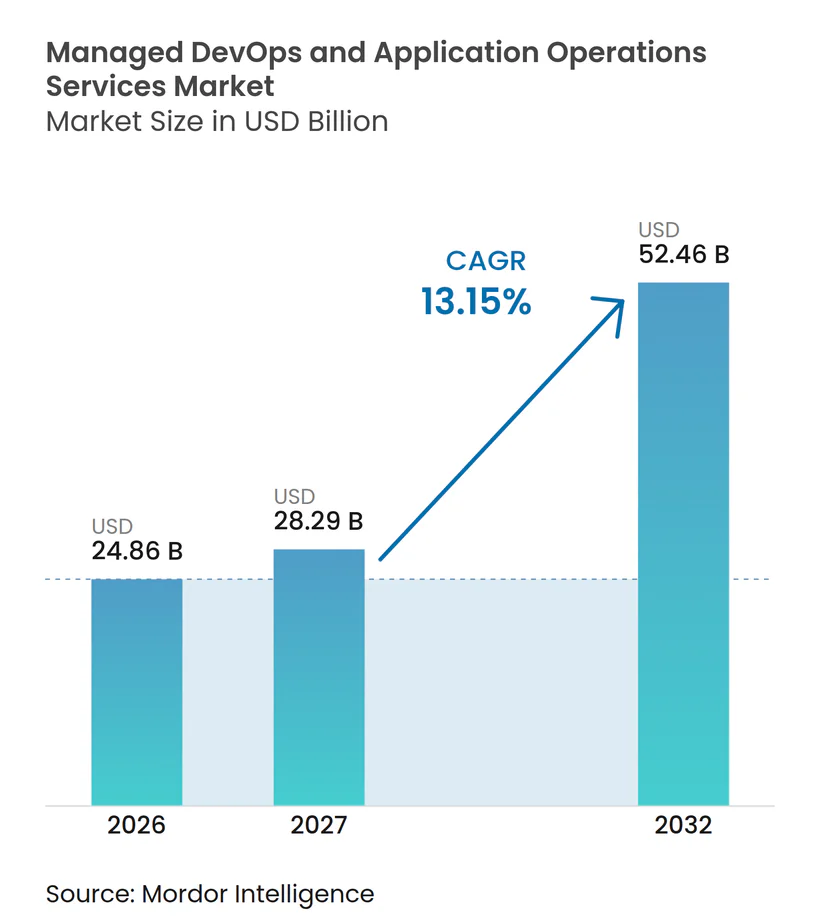
The Managed DevOps and Application Operations Services market size is projected to expand from USD 24.86 billion in 2026 to USD 28.29 billion in 2027, and to USD 52.46 billion by 2032, registering a CAGR of 13.15% between 2027 and 2032. The Managed DevOps and Application Operations Services market is supported by cloud-native estates that many enterprises cannot operate and govern on their own. Clients are moving from reactive alerts toward AI-supported remediation, which is changing the value expected from managed delivery. Regulated sectors increasingly treat controlled service delivery as a procurement need because security, resilience, and audit evidence must be maintained through software releases. The Managed DevOps and Application Operations Services market also benefits when cloud transformations leave clients with new operational complexity across containers, pipelines, observability tools, and multiple cloud environments. Providers with SRE, platform engineering, and DevSecOps capabilities are therefore competing on operational outcomes rather than staffing capacity alone.
Key Report Takeaways
- By service type, Managed DevOps Engineering Services held 34.92% of the Managed DevOps and Application Operations Services market share in 2026, while Site Reliability Engineering and Incident Management are projected to expand at a 14.16% CAGR through 2032.
- By deployment model, cloud-based deployment accounted for 62.12% of revenue in 2026, and the segment is expected to grow at a 14.75% CAGR through 2032.
- By organization size, Large Enterprises held 77.23% revenue share of Managed DevOps and Application Operations Services in 2026, while SMEs are projected to expand at a 14.56% CAGR through 2032.
- By application and workload, Web Applications held 29.86% revenue share in 2026, while Artificial Intelligence and Machine Learning Applications are projected to expand at a 14.33% CAGR through 2032.
- By industry vertical, BFSI held 24.59% revenue share in 2026, while Healthcare and Life Sciences are projected to expand at a 14.51% CAGR through 2032.
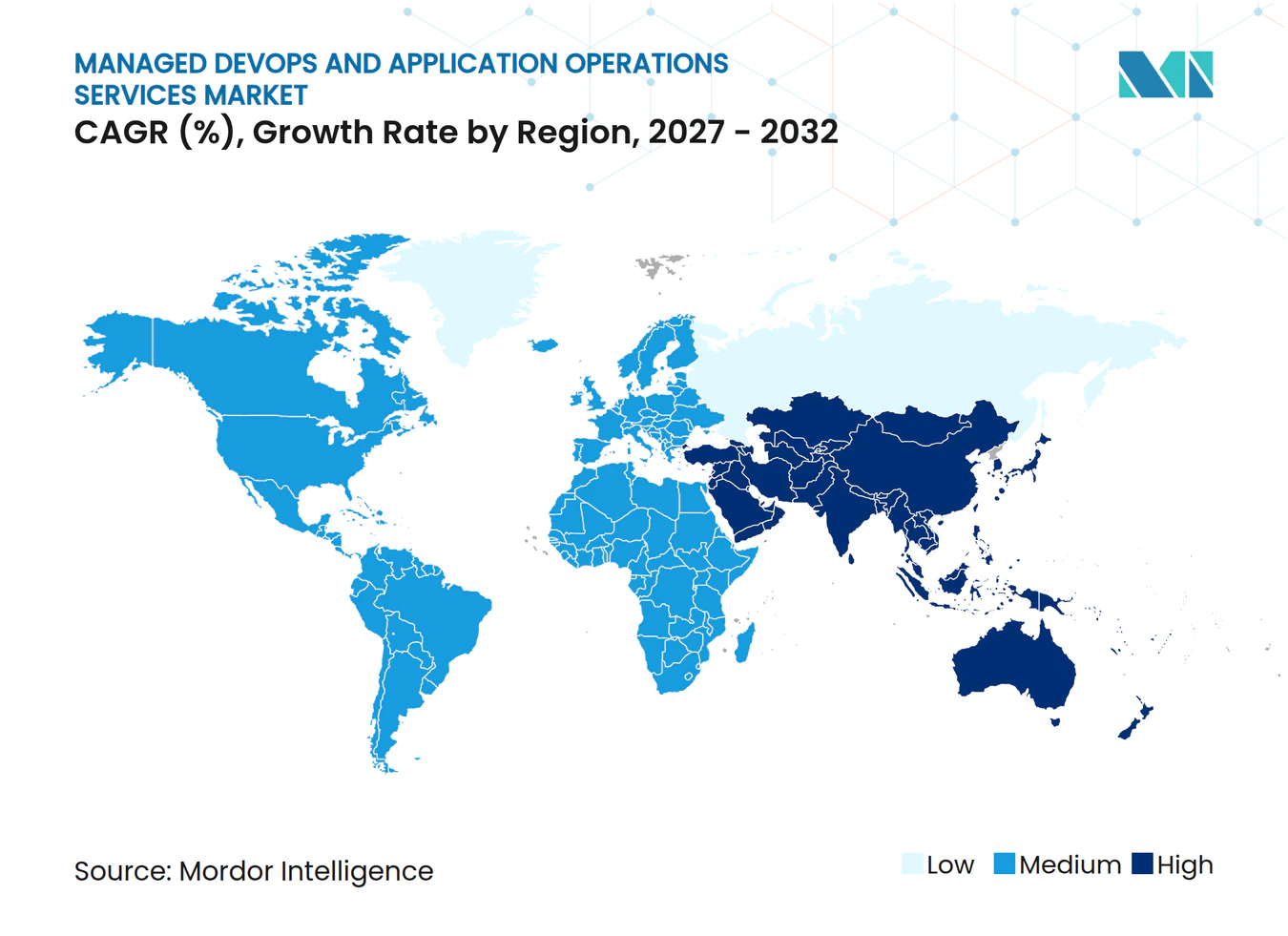
- By geography, North America held 42.81% revenue share in 2026, while Asia-Pacific is projected to expand at a 14.18% CAGR through 2032.
Note: Market numbers in this report are based on Mordor Intelligence's proprietary estimation framework, which combines nine months of actuals with Q4 projections for base year 2026.
Market Trends and Insights
Drivers Impact Analysis of Managed DevOps and Application Operations Services Market*
| Driver | (~) % Impact on CAGR Forecast | Geographic Relevance | Impact Timeline |
|---|---|---|---|
| AI-Augmented Operations and Autonomous Remediation | +3.2% | Global, concentrated near-term gains in North America and Asia-Pacific core | Short term (≤ 2 years) |
| Enterprise Cloud-Native Modernization | +2.6% | Global, strongest in North America, Europe, and Asia-Pacific | Medium term (2-4 years) |
| DevSecOps, Compliance, and Resilience Requirements | +1.7% | North America and Europe, with spillover to Asia-Pacific and Gulf states | Short term (≤ 2 years) |
| Platform Engineering as a Managed Operating Model | +1.3% | Global, led by North America and Western Europe | Medium term (2-4 years) |
| Shorter Software Release Cycles and Continuous Delivery | +1.1% | Global | Medium term (2-4 years) |
| Cloud-Native and Microservices Proliferation | +0.9% | Global, strongest in hyperscaler-heavy North America and Asia-Pacific | Long term (≥ 4 years) |
| Source: Mordor Intelligence | |||
AI-Augmented Operations and Autonomous Remediation Redefining Service Economics
AI-supported operations are reshaping client expectations for the Managed DevOps and Application Operations Services market. Cisco expanded AgenticOps across networking, security, and observability in February 2026, presenting agents that can triage faults, assess root-cause hypotheses, and execute defined remediation steps.[1] This reduces the importance of activity-based service contracts, in which providers are compensated primarily for manual effort. Clients can instead evaluate providers against resolution quality, service-level objectives, and the ability to automate repeatable incidents. Dynatrace reported that 50% of surveyed organizations were deploying AI-powered automated incident response, indicating broader demand for managed teams to operate these systems. Providers that invest in governed runbooks and reliable remediation controls can differentiate their delivery without relying only on larger engineering teams.
Enterprise Cloud-Native Modernization Creating Structural Demand
Cloud-native modernization continues to create work after the initial migration project is finished. Organizations moving from monolithic applications to microservices must manage container orchestration, GitOps controls, multi-cluster reliability, and shared observability practices. These requirements give the Managed DevOps and Application Operations Services market a longer contract cycle than a one-time migration engagement. Royal Bank of Canada described centralized infrastructure-as-code workflows with execution agents across zones to improve deployment consistency and reduce configuration drift in a complex hybrid cloud environment. Such operating environments need continuous engineering support, not only cloud hosting. The requirement is strongest where many application teams use common platforms but retain separate release responsibilities.
DevSecOps, Compliance, and Resilience Requirements Locking In Managed Delivery
Compliance is making secure software delivery a continuing operating requirement for many clients. The Digital Operational Resilience Act has applied to EU financial entities since January 17, 2025, increasing the need to demonstrate operational resilience through information and communications technology processes. The EU Cyber Resilience Act introduces reporting duties as of September 11, 2026, while its main product obligations take effect on December 11, 2027. NIST released the preliminary draft of SP 1800-44 in July 2025 to set out DevSecOps practices consistent with its Secure Software Development Framework. The Managed DevOps and Application Operations Services market gains relevance when providers can automate software bills of materials, security-gate evidence, vulnerability handling, and audit trails. This service model allows buyers to link technical delivery with risk management and regulatory readiness.
Platform Engineering as a Managed Operating Model Elevating Provider Value
Platform engineering is shifting from a purely internal technical discipline to a service that providers can operate for clients. Puppet found that 31% of surveyed organizations reported fully autonomous operations, rising to 44% among environments with standardized internal developer platforms. Standardized platforms bring together developer tools, approved templates, access controls, and delivery rules. Providers can support these environments through internal developer platform provisioning, golden-path maintenance, and governance-as-code controls. This raises the value of managed delivery beyond basic pipeline administration. It also affects buying decisions because platform product managers, application leaders, and infrastructure owners may all influence the scope of the managed service.
Restraints Impact Analysis of Managed DevOps and Application Operations Services Market*
| Restraint | (~) % Impact on CAGR Forecast | Geographic Relevance | Impact Timeline |
|---|---|---|---|
| Shortage of DevOps, SRE, and Platform Engineering Talent | -2.1% | Global, most acute in North America, Western Europe, and Australia | Short term (≤ 2 years) |
| Legacy Application and Toolchain Integration Complexity | -1.6% | Global, concentrated in enterprises with decade-old on-premises estates | Medium term (2-4 years) |
| Fragmented Observability Data and Inconsistent Telemetry Ownership | -1.0% | Global | Medium term (2-4 years) |
| Outcome Measurement and Shared Responsibility Ambiguity | -0.8% | Global | Long term (≥ 4 years) |
| Source: Mordor Intelligence | |||
Shortage of DevOps, SRE, and Platform Engineering Talent Constraining Capacity Growth
The limited supply of experienced SRE, platform engineering, and DevSecOps professionals restricts provider capacity in the Managed DevOps and Application Operations Services market. Delivery teams need personnel who can understand automation, cloud controls, incident management, and regulated operating procedures simultaneously. This scarcity raises delivery costs and makes it harder for smaller providers to scale quickly. Providers cannot offset wage pressure indefinitely through rate-card changes because clients compare services against internal hiring and automation investments. Agentic automation and standardized runbooks can reduce reliance on linear increases in headcount. However, those systems require upfront funding, mature operational data, and engineering capacity to design and maintain them.
Legacy Application and Toolchain Integration Complexity Extending Onboarding Cycles
Client toolchains often combine older Jenkins deployments, various CI tools, inconsistent infrastructure-as-code frameworks, and monitoring platforms selected separately over time. This complicates service transitions in the Managed DevOps and Application Operations Services market because providers must establish common controls before they can standardize operations. Dynatrace reported that 37% of platform engineers named integration with existing tools as their leading operational challenge. The same study found that only 40% had embedded observability across every deployment stage.[2] Longer onboarding periods can delay service activation and make shared responsibilities harder to define. They can also increase the chance that a client renegotiates the scope before a provider has demonstrated measurable results.
*Our forecasts treat driver/restraint impacts as directional, not additive. The impact forecasts reflect baseline growth, mix effects, and variable interactions.
Managed DevOps and Application Operations Services Market Segment Analysis
By Service Type:
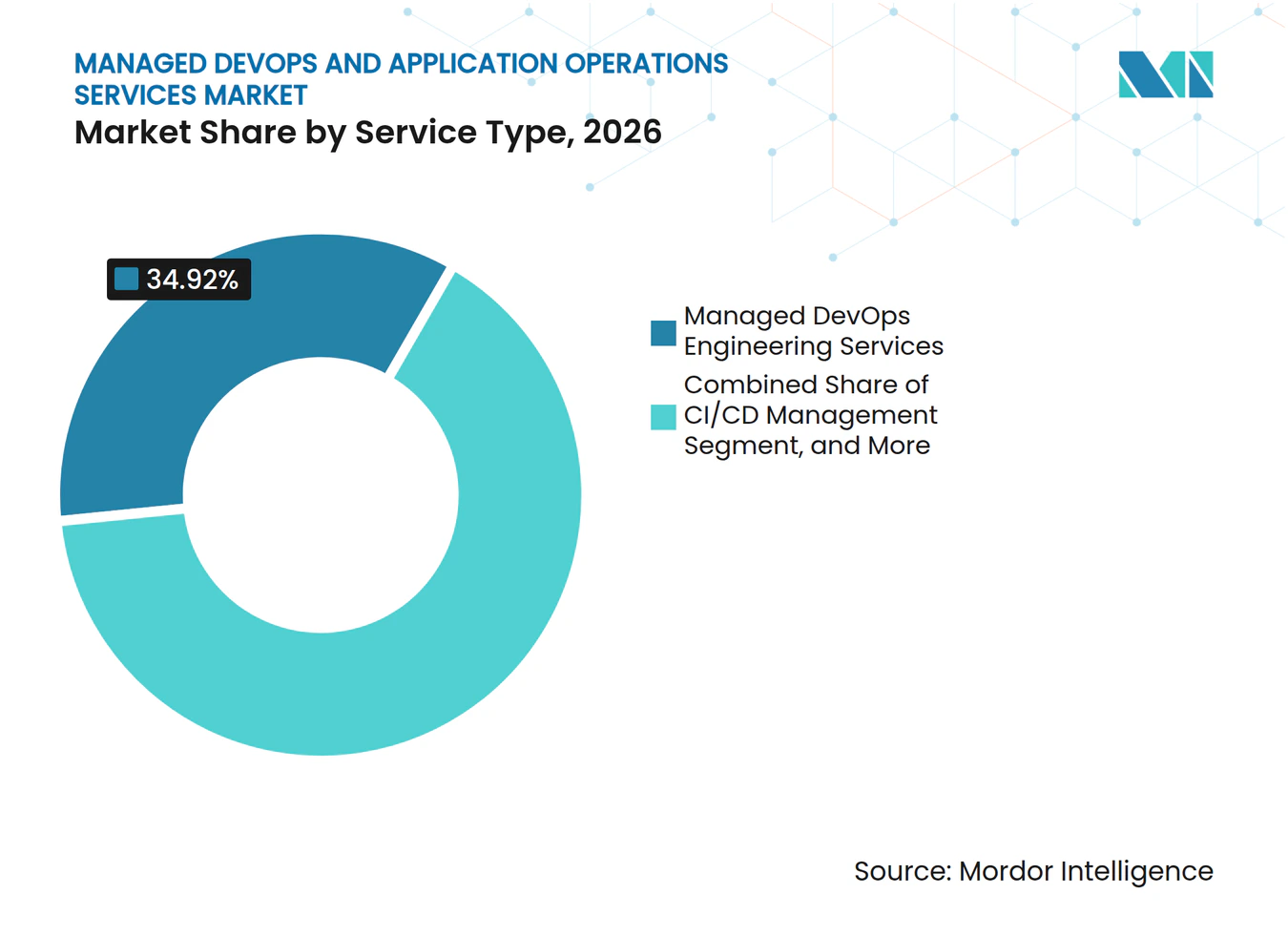
SRE and Incident Management Pull the Fastest Growth From a Broad PortfolioManaged DevOps Engineering Services accounted for 34.92% of the Managed DevOps and Application Operations Services market revenue in 2026. The segment acts as the core delivery layer for greenfield cloud programs and the modernization of established applications. It covers engineering support that clients need across release management, infrastructure automation, and cloud operations. CI/CD Management remains relevant because software teams need repeatable release controls across varied applications. Infrastructure as Code and Cloud Operations are also supported by multi-cloud operating models that require consistent configuration management. Royal Bank of Canada’s hybrid cloud approach illustrates the demand for centralized infrastructure-as-code workflows and local execution controls across complex environments. CNCF.IO These needs support a broad service portfolio rather than a single tool-specific offering.
Site Reliability Engineering and Incident Management is projected to expand at a 14.16% CAGR through 2032. The Managed DevOps and Application Operations Services market size for this service type is driven by clients who want measurable service-level objectives rather than ticket-based operations. Dynatrace found that 89% of organizations use service-level objectives in at least some teams. It also found that 67% of SRE respondents identified AI model monitoring as their leading emerging use case. Managed SRE teams can operate incident processes where internal teams lack sufficient specialist coverage. The service is becoming more valuable as organizations require reliable remediation and better evidence that operational targets are being met.



By Deployment Model:
Cloud Leads the Estate as Hybrid Serves Regulated SectorsCloud-based deployment commanded 62.12% of the Managed DevOps and Application Operations Services market share in 2026. Public cloud environments provide native CI/CD services, managed Kubernetes offerings, and developer tooling that support managed delivery. AWS, Azure, and Google Cloud offer the operating foundations used by many client programs. The cloud model gives providers access to automated controls, scalable capacity, and shared service integrations. This makes it suitable for clients who want standardized pipeline operations across multiple application teams. Cloud environments also support the growing use of AI-assisted monitoring and remediation tools. The deployment preference reflects the role of hyperscaler platforms as the principal operating base for managed DevOps workloads.
Hybrid cloud remains necessary for BFSI, healthcare, government, and other clients with data residency, latency, or application constraints. These contracts require continuous coordination between private and public environments. As a result, hybrid service scopes can require higher-priced delivery because providers must support separate operational controls simultaneously. The 2022 edition of ISO/IEC 27001 completed its transition from the 2013 version in October 2025. This update reinforces the importance of secure coding, configuration management, and continuous monitoring in governed environments. The Managed DevOps and Application Operations Services market has an opportunity where a client has placed workloads in public cloud but continues to operate fragmented toolchain governance. On-premises deployment is the smallest model and is largely associated with air-gapped government and defense settings
By Organization Size:
Large Enterprises Set the Revenue Base as SMEs Expand QuicklyLarge Enterprises accounted for 77.23% of revenue in 2026. These buyers operate multiple cloud accounts, many application teams, and demanding compliance processes that require dedicated managed engineering support. Enterprise contracts often combine SRE, infrastructure-as-code, and CI/CD services across multi-year terms. Their large and complex estates sustain revenue concentration despite faster SME expansion. Dedicated internal developer platforms add another operating layer that enterprises may ask a provider to run and improve. Platform teams can establish shared controls, while application teams adapt approved deployment paths for specific business needs. This federated structure creates a practical role for providers that can enforce common governance without slowing delivery.
SMEs are projected to expand at a 14.56% CAGR through 2032. Smaller organizations increasingly use cloud consumption models that make managed engineering capabilities more accessible. The Managed DevOps and Application Operations Services market size for SMEs depends on offerings that are clearly scoped and proportionate to a smaller engineering team. Providers need to avoid simply scaling down a complex enterprise engagement. Fixed-scope services can make pricing more understandable while retaining essential support for pipelines, cloud operations, and incidents. The most effective offerings can address skills gaps without requiring an SME to build a full in-house platform team. This creates demand for standardized service packages with clear response and governance commitments.
By Application and Workload:
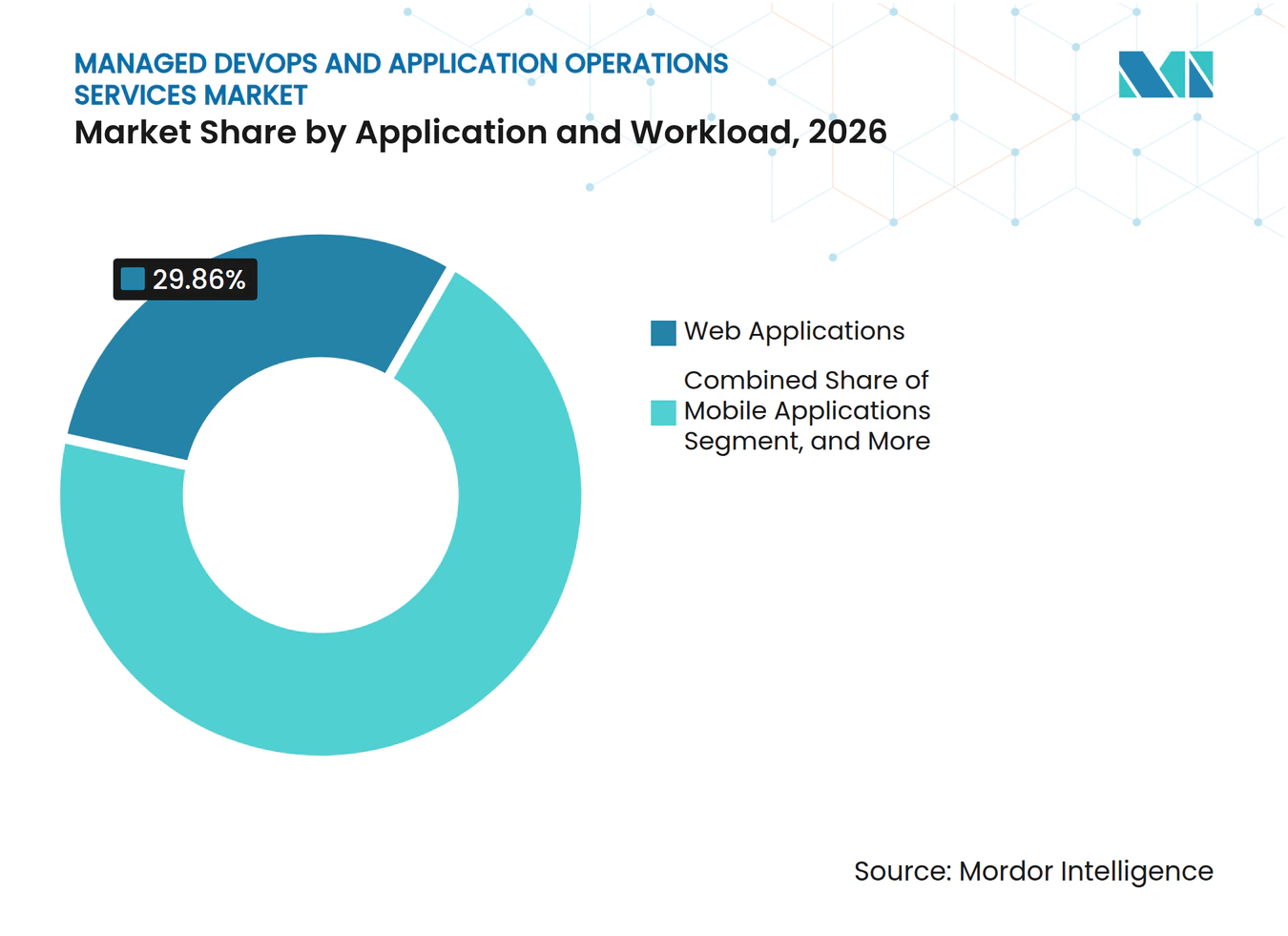
AI and ML Pipelines Create New Managed Operations NeedsWeb Applications accounted for 29.86% of revenue in 2026. They support recurring demand for frequent releases, blue-green deployment controls, and 24/7 incident response across industries. Mobile applications require parallel pipeline management, app store approval controls, and multi-device testing automation. Data and Analytics Applications require reliable pipelines as enterprises consolidate data systems on cloud-native stacks. These use cases extend the need for DataOps and pipeline reliability services. IoT and Edge Applications add distributed deployment, intermittent connectivity, and hardware-specific limitations. Those requirements differentiate managed application operations from conventional cloud infrastructure support.
Artificial Intelligence and Machine Learning Applications are projected to expand at a 14.33% CAGR through 2032. The Managed DevOps and Application Operations Services market size for these workloads is driven by model drift monitoring, feature-store management, inference cost controls, and evaluation-based deployment gates. Traditional DevOps controls were not designed for all of these requirements. Dynatrace completed its acquisition of Arize in October 2026 for USD 915 million to extend AI observability across development and production processes. The transaction shows that production AI operations require more specialized tooling and controls. Providers that build MLOps and LLMOps capabilities can support clients as AI workloads move from experimentation into critical operating environments.

By Industry Vertical:
BFSI Generates Volume as Healthcare Commands the Growth PremiumBFSI held 24.59% revenue share in 2026. Financial institutions combine a high rate of software releases with strict audit requirements and very limited tolerance for downtime. DORA requires EU financial entities to demonstrate ICT operational resilience, including the controls that support software delivery processes. This increases demand for managed DevSecOps and SRE services. Banco do Brasil operated a platform that supported more than 2,000 developers and 3,900 monthly deployments across Kubernetes and infrastructure-as-code governance. This scale shows why BFSI clients need a disciplined platform and release operations. IT and Telecom, Retail and E-Commerce, Manufacturing, Government and Public Sector, and Energy and Utilities also generate demand through network delivery, customer experience, factory digitization, public service modernization, and grid applications.
Healthcare and Life Sciences are projected to expand at a 14.51% CAGR through 2032. This vertical combines the cloud-native adoption of health record platforms and AI-assisted diagnostic tools with stringent validation and audit requirements. Patient-critical services require resilient operations and evidence of controlled release. Wipro described a managed service model that helped a global healthcare provider migrate to AWS while maintaining regulatory compliance and operational resilience. Managed DevSecOps can help buyers maintain software validation records and controlled security practices. The Managed DevOps and Application Operations Services market gains from healthcare clients that need external support to maintain confidence in delivery controls. This need is strongest where internal teams cannot consistently provide round-the-clock operational coverage and audit documentation.
Geography Analysis
North America Managed DevOps and Application Operations Services Market
North America accounted for 42.81% of revenue in 2026. The region combines early hyperscaler adoption, a dense platform vendor base, and significant BFSI and healthcare spending. United States enterprises often manage complex multi-account environments on AWS and Azure. This creates demand for managed SRE and platform engineering teams that can maintain operating controls at high delivery speed. Canada adds demand from financial services and government organizations. Mexico is emerging as a nearshore delivery location for United States enterprises. These conditions support the region’s established position in the Managed DevOps and Application Operations Services market.
APAC Managed DevOps and Application Operations Services Market
Asia-Pacific is projected to expand at a 14.18% CAGR through 2032. India combines rising domestic demand with a major offshore delivery role for North American and European customers. South Korea’s industrial and financial enterprises, Japan’s automotive and manufacturing groups, and Australia’s regulated financial sector are increasing their investment in cloud-native platforms. The region’s service requirements differ by country because cloud ecosystems and data rules vary. China uses a distinct hyperscaler environment that includes Alibaba Cloud, Huawei Cloud, and Tencent Cloud. These differences give regional providers opportunities to serve local platform and operational requirements.
EMEA and South America Managed DevOps and Application Operations Services Market
Europe combines enterprise cloud adoption with demanding regulatory conditions that affect software delivery. CRA reporting duties and NIS2 transposition requirements are prompting enterprises to build compliance checks into DevOps pipelines. Germany, the United Kingdom, and France are key centers of demand because of their BFSI and industrial manufacturing clients. Devoteam obtained managed service provider certification across AWS, Microsoft Azure, and Google Cloud in January 2025, demonstrating the certification depth sought by large European buyers. South America is anchored by Brazil’s financial services sector. Saudi Arabia and the United Arab Emirates are expanding adoption through national digital transformation programs, while South Africa is an early demand center in Africa for banking and telecommunications clients.
Competitive Landscape
Market Concentration
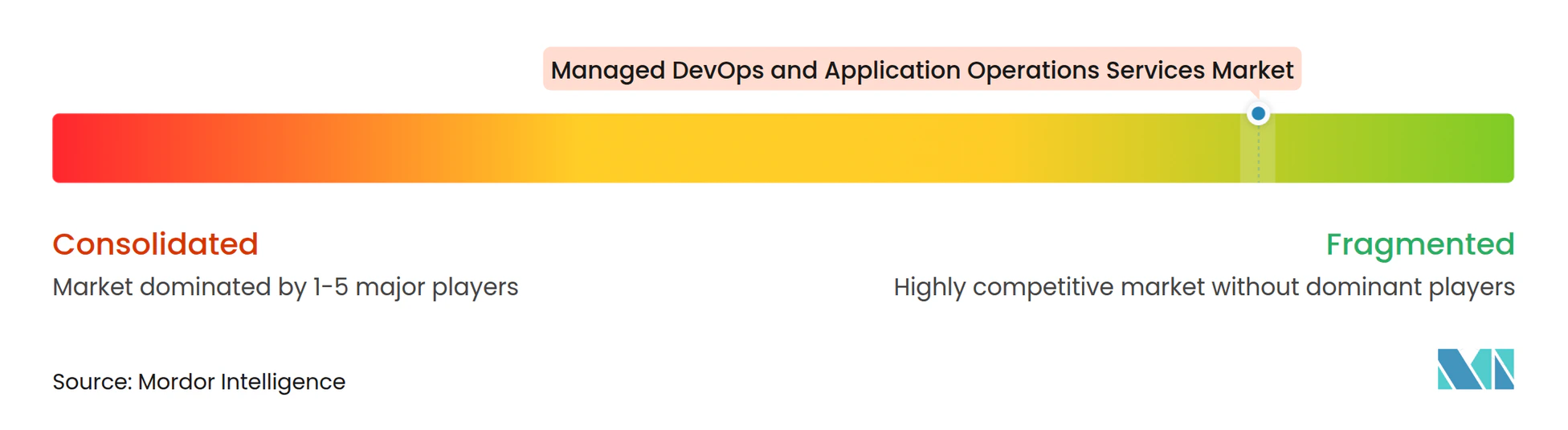
The Managed DevOps and Application Operations Services market is fragmented below the USD 100 million revenue tier. No single provider has a dominant global share. Rackspace Technology and Ensono compete with multi-cloud specialists such as Nordcloud Oy and Devoteam. Mission Cloud Services, CloudHesive, Palark GmbH, and Xpirit International serve narrower hyperscaler and technology-stack requirements. Rackspace reported USD 67.6 million in FY2025 Public Cloud segment operating profit, up 52.9% year over year, and guided FY2026 total revenue to USD 2,600-2,700 million.[3] Its focus on platform engineering and AI-enabled managed operations illustrates a shift toward higher-value services. Certification requirements also make it harder for undifferentiated entrants to compete for large enterprise contracts.
Ensono received its eighth consecutive AWS Managed Service Provider designation in December 2025 and its sixth consecutive Microsoft Azure Expert MSP designation in August 2026. These qualifications can matter in enterprise selection processes because clients seek evidence of cloud architecture, automation, and migration capability. CloudBees introduced CloudBees Unify in May 2025 as an AI-enhanced DevOps control plane that links Jenkins, GitHub Actions, and GitLab under a single governance layer. Its approach addresses toolchain fragmentation that can raise transition costs for managed providers. Dynatrace completed its acquisition of Arize in October 2026 to strengthen AI model evaluation and observability. These actions show that AI workload operations are becoming a strategic capability for managed services portfolios.
Productized managed platform engineering for SMEs remains an opportunity because many smaller buyers need standard delivery rather than a scaled-down enterprise project. AI, ML, and LLMOps are another service area, as clients need model monitoring and controlled deployment in production. Outcome-based contracts that link fees to the achievement of service-level objectives and to autonomous resolution can also differentiate providers. The Managed DevOps and Application Operations Services market favors firms that turn runbooks, change controls, and operational knowledge into reusable delivery assets. In the Managed DevOps and Application Operations Services market, these reusable assets can help ensure more consistent delivery across similar client environments. The Managed DevOps and Application Operations Services market also rewards providers that can align automation with documented governance controls. For the Managed DevOps and Application Operations Services market, an operating model needs to support both rapid releases and controlled escalation paths. The Managed DevOps and Application Operations Services market requires providers to explain how automated action remains within agreed operational controls. Providers must still maintain transparent responsibility models because clients retain accountability for many application and risk decisions. Broad tool coverage alone is not sufficient when buyers require consistent governance across public cloud, hybrid systems, and application teams. Competition therefore centers on credible operating capability, certification depth, automation, and a service scope that matches the client’s risk profile.
Managed DevOps and Application Operations Services Industry Leaders
-
Rackspace Technology, Inc.
-
Ensono, LLC
-
Virtusa Corporation
-
CloudHesive LLC
-
Mission Cloud Services, Inc.
- *Disclaimer: Major Players sorted in no particular order
Managed DevOps and Application Operations Services Market Companies Covered in this Report
- Virtusa Corporation
- ScienceSoft Inc.
- CloudBees, Inc.
- Ziffity Solutions LLC
- Synetec Limited
- TechMagic LLC
- Kopius, Inc.
- Autimo Systems Inc.
- CMS IT Services Private Limited
- Future Processing Sp. z o.o.
- CloudHesive LLC
- Theodo SAS
- 2nd Watch, Inc.
- Mission Cloud Services, Inc.
- Rackspace Technology, Inc.
- Ensono, LLC
- Nordcloud Oy
- tecRacer Consulting GmbH
- Xpirit International B.V.
- Palark GmbH
- Ciklum Group Limited
- Devoteam S.A.
- CloudBolt Software, Inc.
- DoiT International, Ltd.
Recent Industry Developments in Managed DevOps and Application Operations Services Market
- October 2026: Dynatrace completed its acquisition of Arize, an AI observability and evaluation platform, in a cash-and-stock transaction valued at USD 915 million. The deal combines Arize's AI-native tracing, evaluation, and experimentation capabilities with Dynatrace's full-stack observability platform, establishing a full-lifecycle AI observability offering from development through production, directly extending managed monitoring capabilities for AI and ML workload operations.
- August 2026: Ensono secured its sixth consecutive Microsoft Azure Expert MSP designation, reinforcing its multi-cloud managed services credentials for enterprise clients requiring governed operations across both AWS and Azure estates.
- August 2026: Dynatrace announced a definitive agreement to acquire Arize for USD 915 million, signaling the observability industry's pivot toward AI model governance as a core managed operations capability, subject to regulatory approval and customary closing conditions.
- February 2026: Cisco expanded its AgenticOps innovations across its networking, security, and observability portfolio, extending agentic AI operations to cloud, on-premises, air-gapped industrial, and data-center environments. The platform applies autonomous troubleshooting that can reduce mean time to recovery to minutes, with CCIE-grade remediation precision.
Global Managed DevOps and Application Operations Services Market Report Scope
The Managed DevOps and Application Operations Services Market refers to the global market for outsourced services that help organizations plan, develop, deploy, monitor, maintain, and optimize software applications and IT infrastructure throughout the application lifecycle. These services combine DevOps engineering practices, continuous integration and continuous delivery (CI/CD) pipeline management, infrastructure as code (IaC), cloud operations, site reliability engineering (SRE), and incident management to improve software delivery speed, operational efficiency, system reliability, scalability, and security. Managed service providers support the automation of software development and deployment workflows, infrastructure provisioning, cloud resource management, application performance monitoring, troubleshooting, and operational maintenance across cloud, hybrid cloud, and on-premises environments.
The Managed DevOps and Application Operations Services Market Report is Segmented by Service Type (Managed DevOps Engineering Services, CI/CD Pipeline Management, Infrastructure as Code and Cloud Operations Management, Site Reliability Engineering and Incident Management, and Other Service Types), Deployment Model (Cloud, Hybrid Cloud, and On-Premises), Organization Size (Large Enterprises and Small and Medium-sized Enterprises), Application and Workload (Web Applications, Mobile Applications, Data Analytics Applications, Artificial Intelligence and Machine Learning Applications, IoT and Edge Applications, and Other Applications), Industry Vertical (BFSI, IT and Telecom, Healthcare and Life Sciences, Retail and E-Commerce, Manufacturing, Government and Public Sector, Energy and Utilities, and Other Industry Verticals), and Geography (North America, South America, Europe, Asia-Pacific, and Middle East and Africa). The Market Forecasts are Provided in Terms of Value (USD).
Segmentation Overview
| Managed DevOps Engineering Services |
| CI/CD Pipline Management |
| Infrastructure as Code and Cloud Operations |
| Site Reliability Engineering and Incident Management |
| Other Service Types |
| Cloud |
| Hybrid Cloud |
| On-Premises |
| Large Enterprises |
| Small and Medium-sized Enterprises |
| Web Applications |
| Mobile Applications |
| Data and Analytics Applications |
| Artificial Intelligence and Machine Learning Applications |
| IoT and Edge Applications |
| Other Applications |
| BFSI |
| IT and Telecom |
| Retail and E-Commerce |
| Healthcare and Life Sciences |
| Manufacturing |
| Government and Public Sector |
| Energy and Utilities |
| Other Industry Verticals |
| North America | United States |
| Canada | |
| Mexico | |
| Rest of North America | |
| South America | Brazil |
| Argentina | |
| Rest of South America | |
| Europe | Germany |
| United Kingdom | |
| France | |
| Italy | |
| Spain | |
| Rest of Europe | |
| Asia-Pacific | China |
| India | |
| Japan | |
| South Korea | |
| Australia and New Zealand | |
| Rest of Asia-Pacific | |
| Middle East | United Arab Emirates |
| Saudi Arabia | |
| Turkey | |
| Rest of Middle East | |
| Africa | South Africa |
| Egypt | |
| Nigeria | |
| Rest of Africa |
| By Service Type | Managed DevOps Engineering Services | |
| CI/CD Pipline Management | ||
| Infrastructure as Code and Cloud Operations | ||
| Site Reliability Engineering and Incident Management | ||
| Other Service Types | ||
| By Deployment Model | Cloud | |
| Hybrid Cloud | ||
| On-Premises | ||
| By Organization Size | Large Enterprises | |
| Small and Medium-sized Enterprises | ||
| By Application and Workload | Web Applications | |
| Mobile Applications | ||
| Data and Analytics Applications | ||
| Artificial Intelligence and Machine Learning Applications | ||
| IoT and Edge Applications | ||
| Other Applications | ||
| By Industry Vertical | BFSI | |
| IT and Telecom | ||
| Retail and E-Commerce | ||
| Healthcare and Life Sciences | ||
| Manufacturing | ||
| Government and Public Sector | ||
| Energy and Utilities | ||
| Other Industry Verticals | ||
| By Geography | North America | United States |
| Canada | ||
| Mexico | ||
| Rest of North America | ||
| South America | Brazil | |
| Argentina | ||
| Rest of South America | ||
| Europe | Germany | |
| United Kingdom | ||
| France | ||
| Italy | ||
| Spain | ||
| Rest of Europe | ||
| Asia-Pacific | China | |
| India | ||
| Japan | ||
| South Korea | ||
| Australia and New Zealand | ||
| Rest of Asia-Pacific | ||
| Middle East | United Arab Emirates | |
| Saudi Arabia | ||
| Turkey | ||
| Rest of Middle East | ||
| Africa | South Africa | |
| Egypt | ||
| Nigeria | ||
| Rest of Africa | ||
Key Questions Answered in the Report
What is the Managed DevOps and Application Operations Services market valuation?
The market is projected at USD 28.29 billion in 2027 and is forecast to reach USD 52.46 billion by 2032 at a 13.15% CAGR.
Which service type leads managed DevOps spending?
Managed DevOps Engineering Services held 34.92% revenue share in 2026, making it the leading service type.
Which managed DevOps service is projected to expand fastest?
Site Reliability Engineering and Incident Management is projected to expand at a 14.16% CAGR through 2032.
Why are enterprises using managed DevOps providers?
Organizations need support for cloud-native operations, resilient releases, security controls, compliance evidence, and incident management.
Which customer group is expanding fastest?
SMEs are projected to expand at a 14.56% CAGR through 2032 as productized managed services become more accessible.
Which region is projected to expand fastest?
Asia-Pacific is projected to expand at a 14.18% CAGR through 2032, supported by cloud-native platform investment and offshore delivery capacity.